
Political Parties Definition Purpose What Is a Political






- Slides: 38
Political Parties: Definition & Purpose • What Is a Political Party? • A political party is a coalition of people formed around political cleavages seeking to control government by contesting elections & winning office. • What Is the role & core purpose of a Political Party? • The core of a political party's purpose, and the basis on which most scholars define parties, is their role as electoral organizations=> • Get their party’s candidates elected to office.
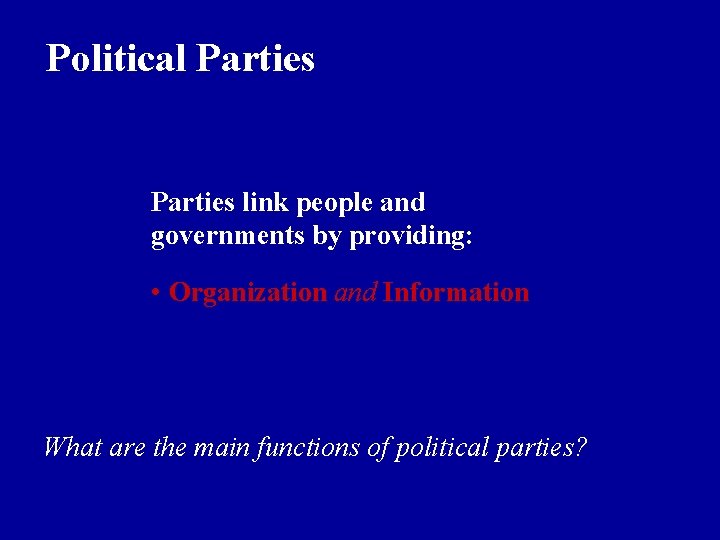
Political Parties link people and governments by providing: • Organization and Information What are the main functions of political parties?
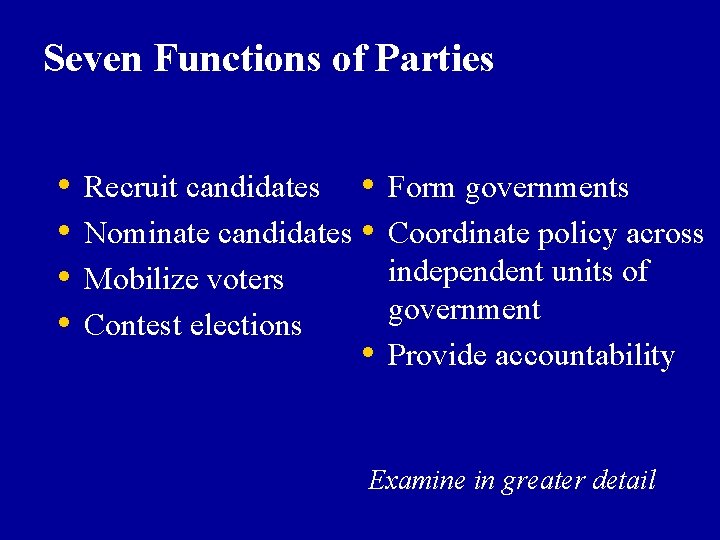
Seven Functions of Parties • • Recruit candidates • Nominate candidates • Mobilize voters Contest elections • Form governments Coordinate policy across independent units of government Provide accountability Examine in greater detail
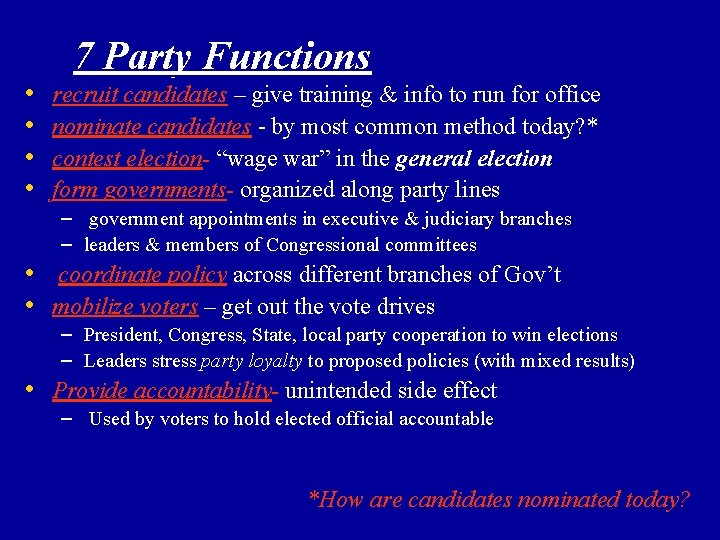
• • 7 Party Functions recruit candidates – give training & info to run for office nominate candidates - by most common method today? * contest election- “wage war” in the general election form governments- organized along party lines – government appointments in executive & judiciary branches – leaders & members of Congressional committees • coordinate policy across different branches of Gov’t • mobilize voters – get out the vote drives – President, Congress, State, local party cooperation to win elections – Leaders stress party loyalty to proposed policies (with mixed results) • Provide accountability- unintended side effect – Used by voters to hold elected official accountable *How are candidates nominated today?
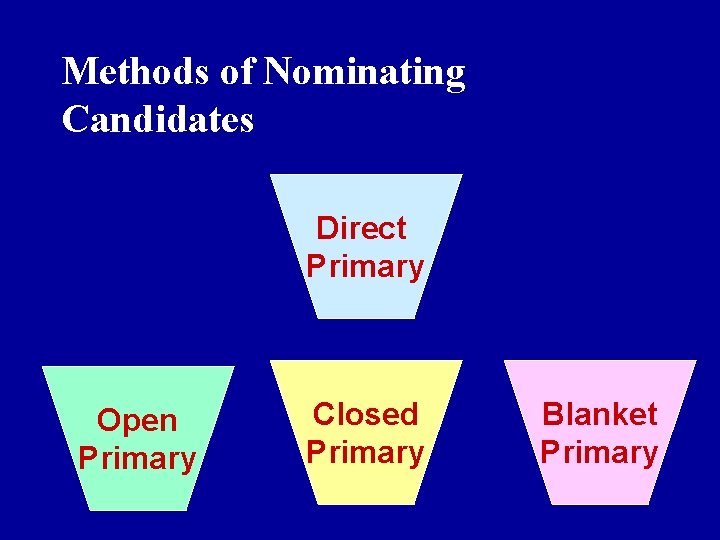
Methods of Nominating Candidates Direct Primary Open Primary Closed Primary Blanket Primary
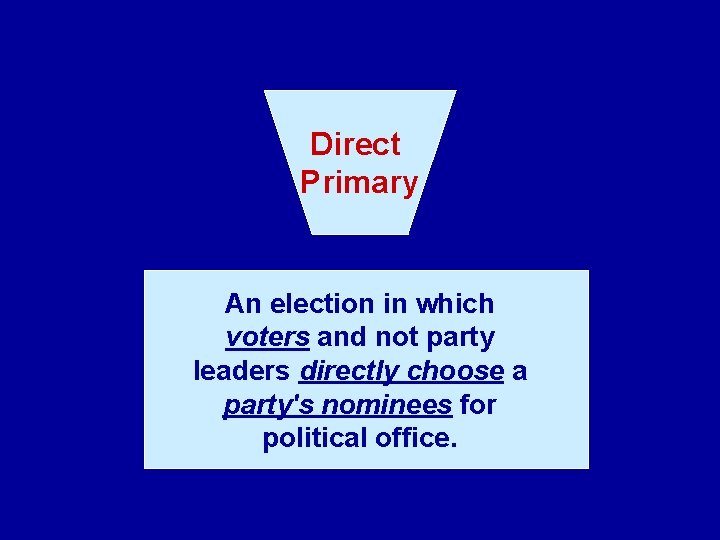
Direct Primary An election in which voters and not party leaders directly choose a party's nominees for political office.
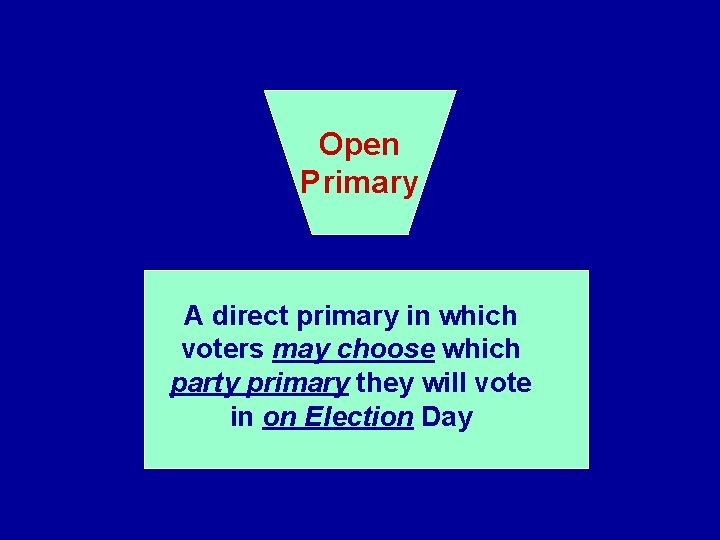
Open Primary A direct primary in which voters may choose which party primary they will vote in on Election Day
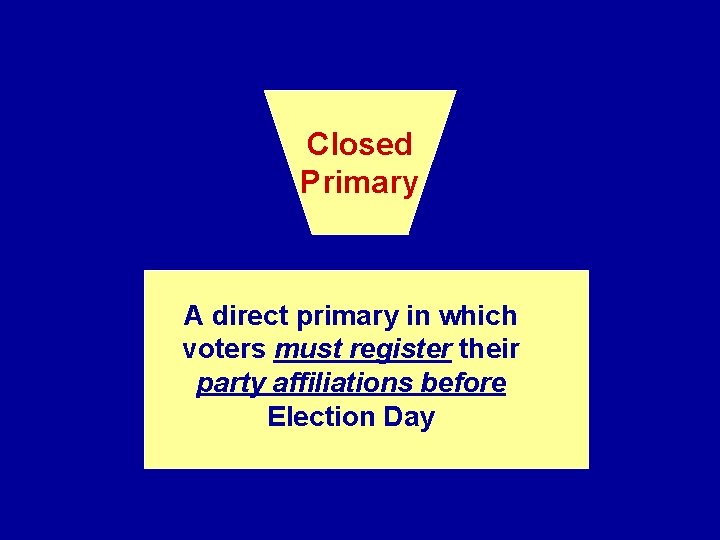
Closed Primary A direct primary in which voters must register their party affiliations before Election Day
Blanket Primary A direct primary in which voters may cast ballots for candidates of any party, but may only vote once for each office.
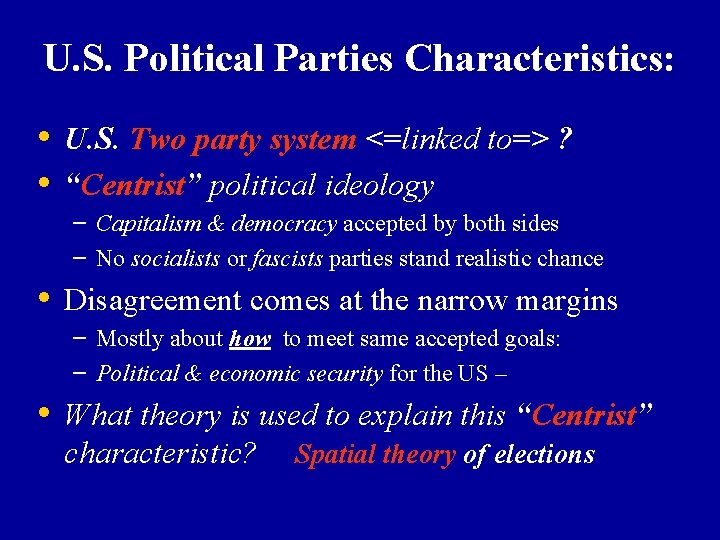
U. S. Political Parties Characteristics: • U. S. Two party system <=linked to=> ? • “Centrist” political ideology – Capitalism & democracy accepted by both sides – No socialists or fascists parties stand realistic chance • Disagreement comes at the narrow margins – Mostly about how to meet same accepted goals: – Political & economic security for the US – • What theory is used to explain this “Centrist” characteristic? Spatial theory of elections
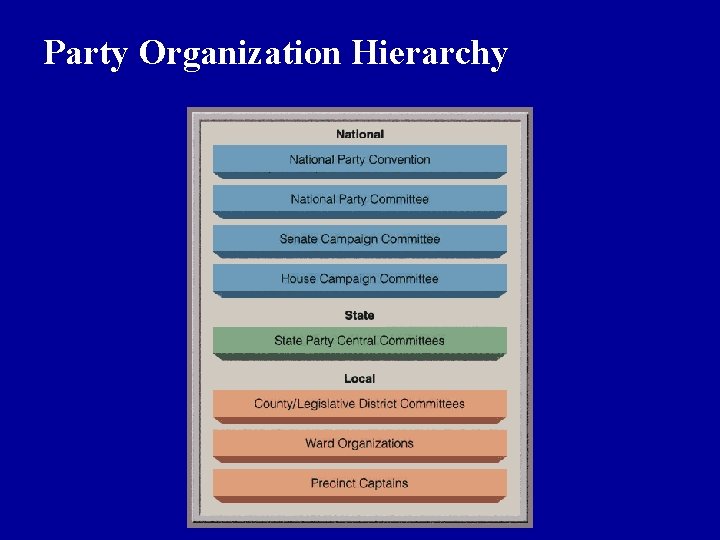
Party Organization Hierarchy
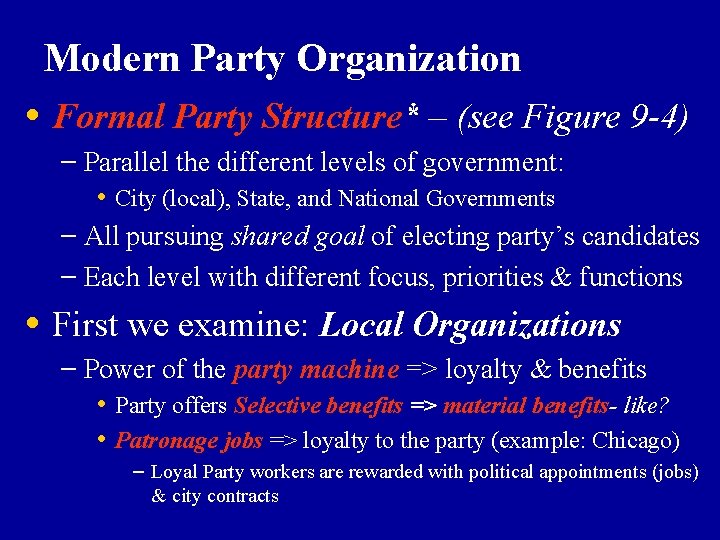
Modern Party Organization • Formal Party Structure* – (see Figure 9 -4) – Parallel the different levels of government: • City (local), State, and National Governments – All pursuing shared goal of electing party’s candidates – Each level with different focus, priorities & functions • First we examine: Local Organizations – Power of the party machine => loyalty & benefits • Party offers Selective benefits => material benefits- like? • Patronage jobs => loyalty to the party (example: Chicago) – Loyal Party workers are rewarded with political appointments (jobs) & city contracts
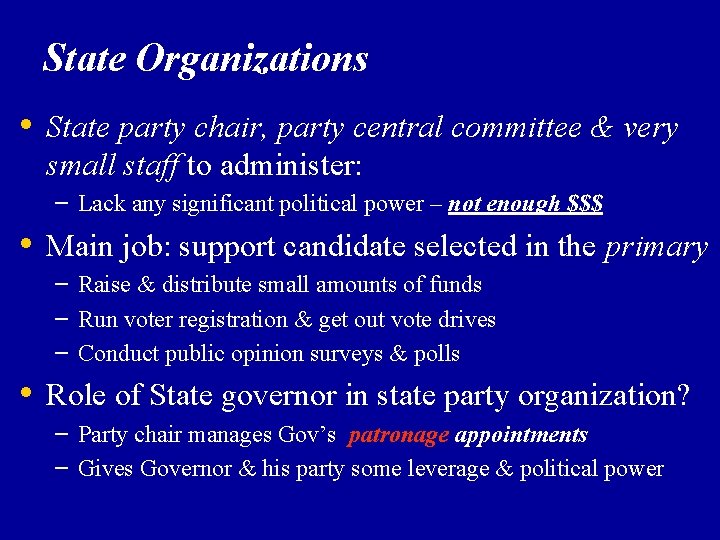
State Organizations • State party chair, party central committee & very small staff to administer: – Lack any significant political power – not enough $$$ • Main job: support candidate selected in the primary – – – Raise & distribute small amounts of funds Run voter registration & get out vote drives Conduct public opinion surveys & polls • Role of State governor in state party organization? – Party chair manages Gov’s patronage appointments – Gives Governor & his party some leverage & political power
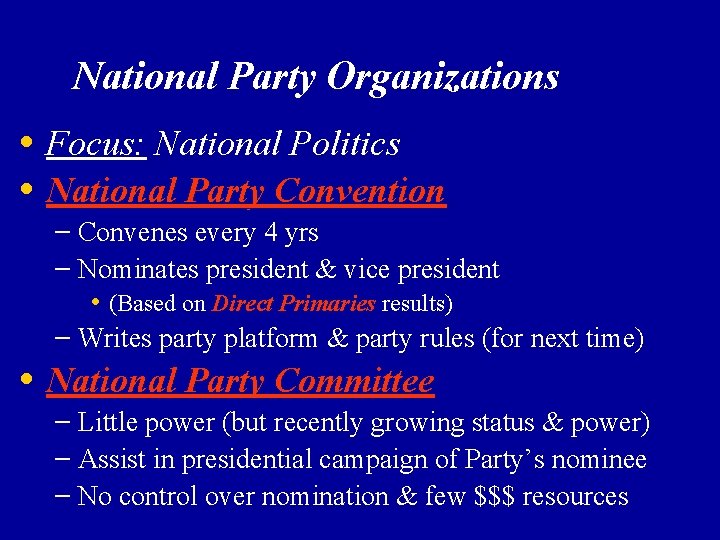
National Party Organizations • Focus: National Politics • National Party Convention – Convenes every 4 yrs – Nominates president & vice president • (Based on Direct Primaries results) – Writes party platform & party rules (for next time) • National Party Committee – Little power (but recently growing status & power) – Assist in presidential campaign of Party’s nominee – No control over nomination & few $$$ resources
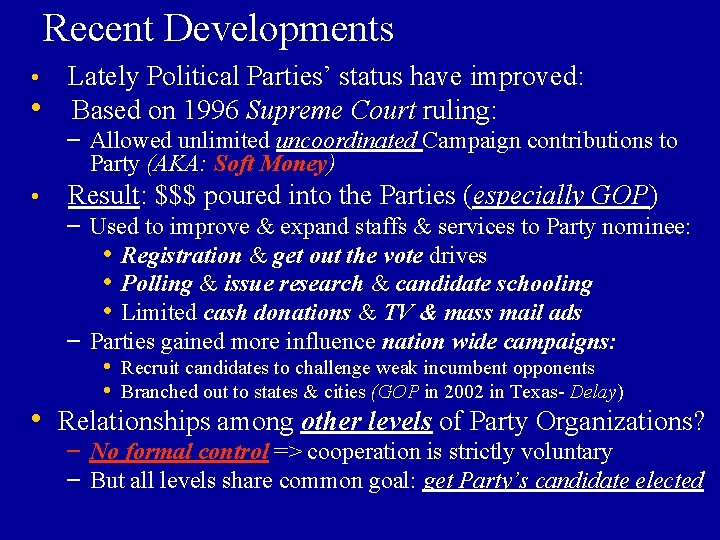
Recent Developments • • • Lately Political Parties’ status have improved: Based on 1996 Supreme Court ruling: – Allowed unlimited uncoordinated Campaign contributions to Party (AKA: Soft Money) Result: $$$ poured into the Parties (especially GOP) – Used to improve & expand staffs & services to Party nominee: • Registration & get out the vote drives • Polling & issue research & candidate schooling • Limited cash donations & TV & mass mail ads – Parties gained more influence nation wide campaigns: • Recruit candidates to challenge weak incumbent opponents • Branched out to states & cities (GOP in 2002 in Texas- Delay) • Relationships among other levels of Party Organizations? – No formal control => cooperation is strictly voluntary – But all levels share common goal: get Party’s candidate elected
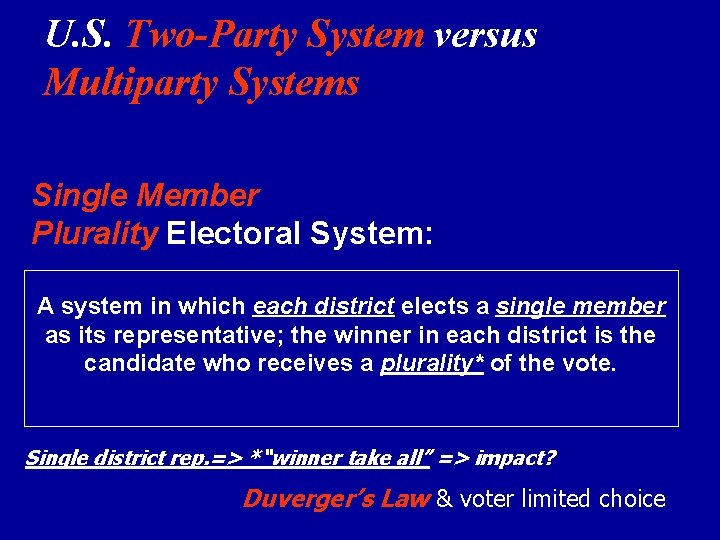
U. S. Two-Party System versus Multiparty Systems Single Member Plurality Electoral System: A system in which each district elects a single member as its representative; the winner in each district is the candidate who receives a plurality* of the vote. Single district rep. => *“winner take all” => impact? Duverger’s Law & voter limited choice
Proportional Representation System A system in which legislators are elected at large and each party wins legislative seats in proportion to the number of votes it receives. National parliament => proportional seats -> impact? More minor party challenges & greater voter choice- why?
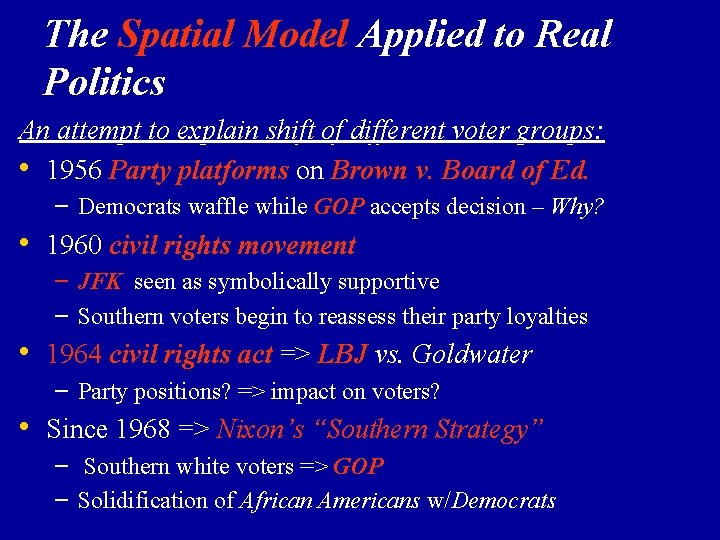
The Spatial Model Applied to Real Politics An attempt to explain shift of different voter groups: • 1956 Party platforms on Brown v. Board of Ed. – Democrats waffle while GOP accepts decision – Why? • 1960 civil rights movement – JFK seen as symbolically supportive – Southern voters begin to reassess their party loyalties • 1964 civil rights act => LBJ vs. Goldwater – Party positions? => impact on voters? • Since 1968 => Nixon’s “Southern Strategy” – Southern white voters => GOP – Solidification of African Americans w/Democrats
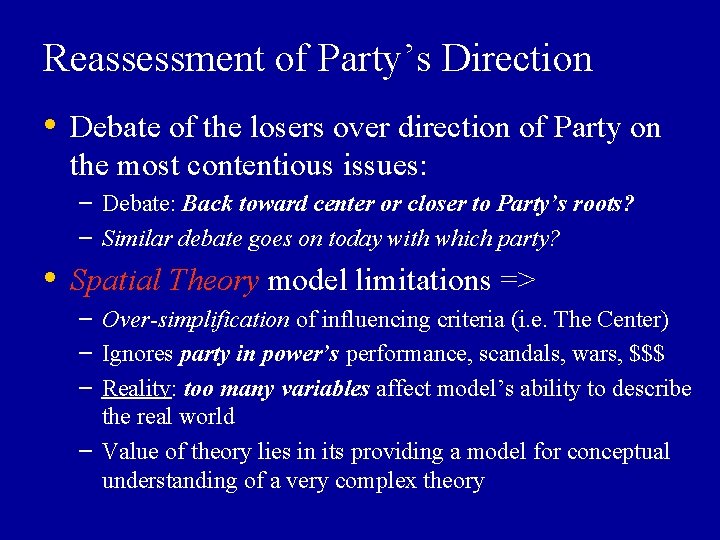
Reassessment of Party’s Direction • Debate of the losers over direction of Party on the most contentious issues: – Debate: Back toward center or closer to Party’s roots? – Similar debate goes on today with which party? • Spatial Theory model limitations => – – – Over-simplification of influencing criteria (i. e. The Center) Ignores party in power’s performance, scandals, wars, $$$ Reality: too many variables affect model’s ability to describe the real world – Value of theory lies in its providing a model for conceptual understanding of a very complex theory
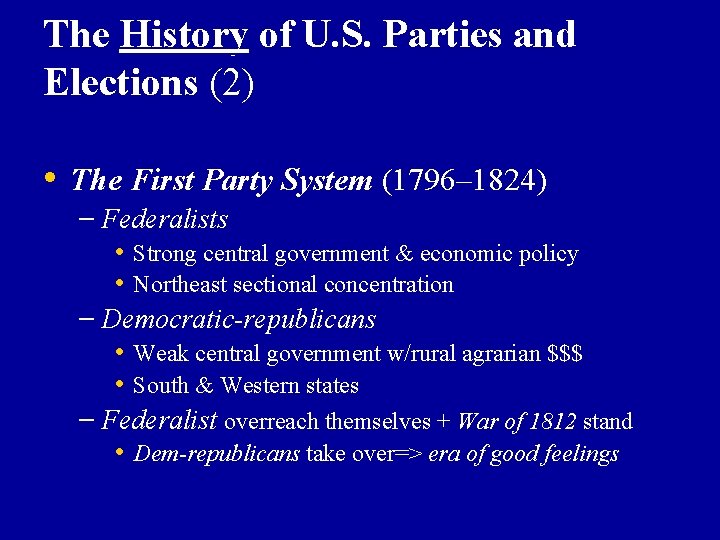
The History of U. S. Parties and Elections (2) • The First Party System (1796– 1824) – Federalists • Strong central government & economic policy • Northeast sectional concentration – Democratic-republicans • Weak central government w/rural agrarian $$$ • South & Western states – Federalist overreach themselves + War of 1812 stand • Dem-republicans take over=> era of good feelings
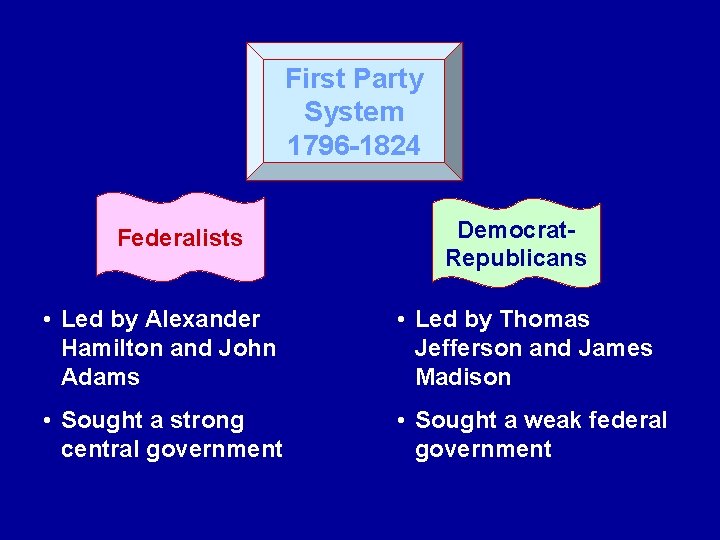
First Party System 1796 -1824 Federalists Democrat. Republicans • Led by Alexander Hamilton and John Adams • Led by Thomas Jefferson and James Madison • Sought a strong central government • Sought a weak federal government
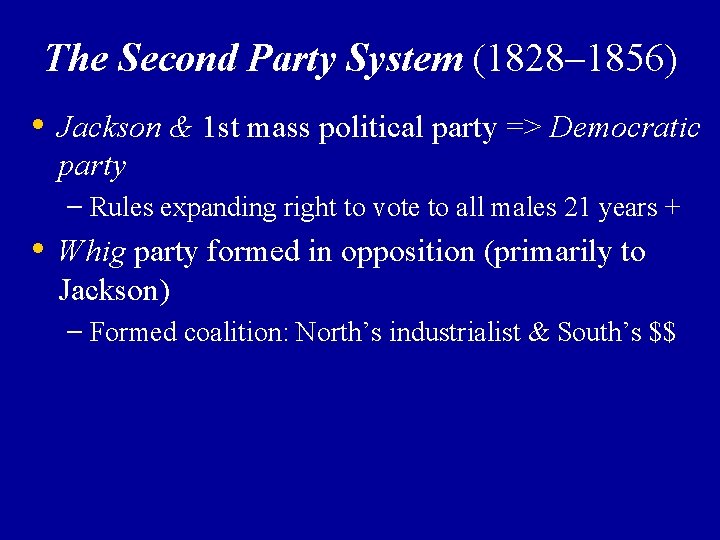
The Second Party System (1828– 1856) • Jackson & 1 st mass political party => Democratic party – Rules expanding right to vote to all males 21 years + • Whig party formed in opposition (primarily to Jackson) – Formed coalition: North’s industrialist & South’s $$
Second Party System 1828 -1856 Democrats • Led by Andrew Jackson Whigs • Used party organization to mobilize voters • Built a coalition of Northern Industrialists and rich Southerners • Used new convention system to select party nominee • Led by Daniel Webster and Henry Clay at times
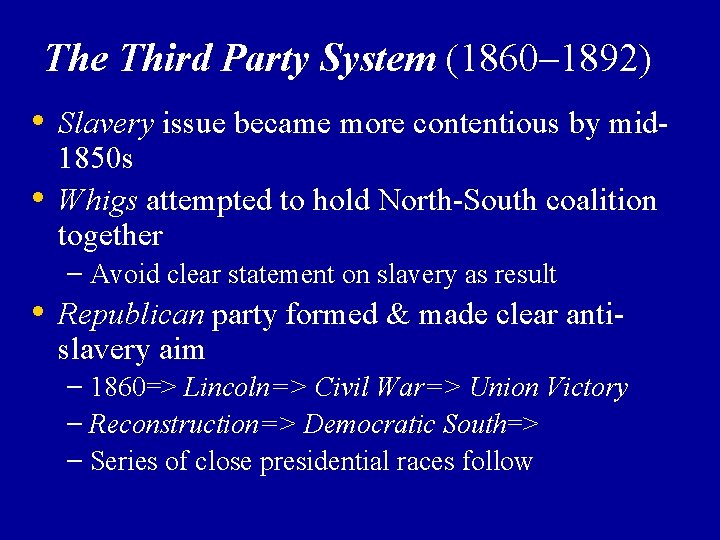
The Third Party System (1860– 1892) • Slavery issue became more contentious by mid • 1850 s Whigs attempted to hold North-South coalition together – Avoid clear statement on slavery as result • Republican party formed & made clear antislavery aim – 1860=> Lincoln=> Civil War=> Union Victory – Reconstruction=> Democratic South=> – Series of close presidential races follow
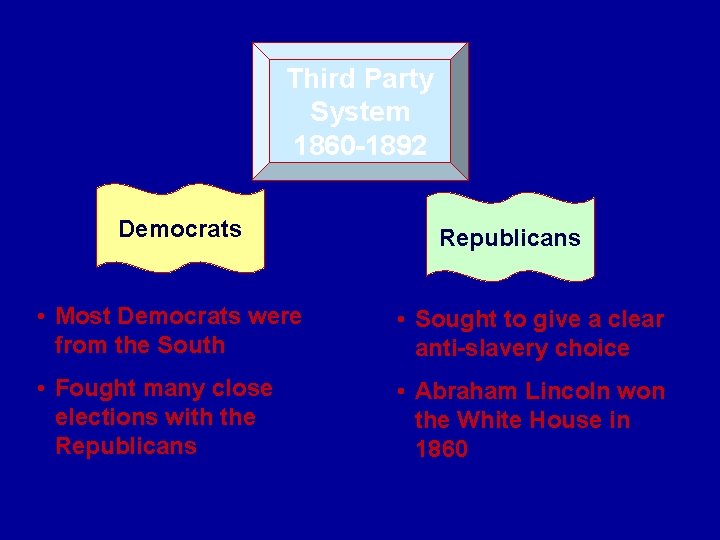
Third Party System 1860 -1892 Democrats Republicans • Most Democrats were from the South • Sought to give a clear anti-slavery choice • Fought many close elections with the Republicans • Abraham Lincoln won the White House in 1860
The Fourth Party System (1896– 1928) • Democrat Cleveland => $$$ depression of 1893 – William Jennings Bryan nominated by Democrats: – “Cross of Gold” speech=> cheap $$$ for debts • GOP blames poor economy on Cleveland – GOP’s nominee Mc. Kinley wins landslide victory – Begins 32 year GOP control of presidency – (Woodrow Wilson only exception in 1912)
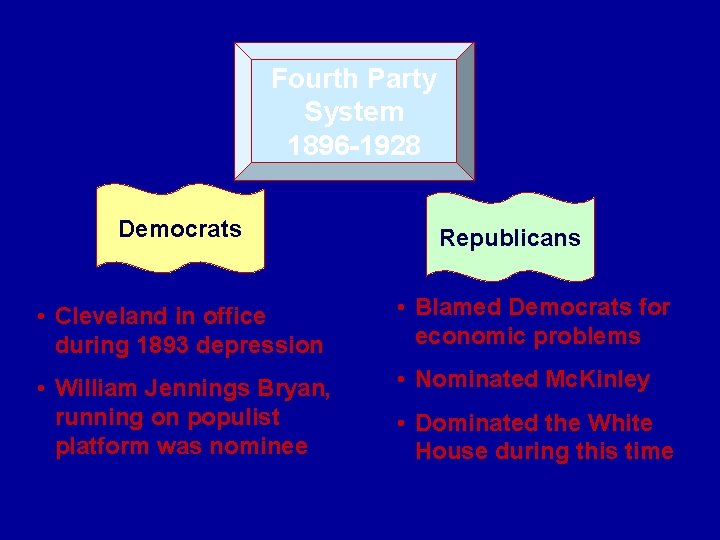
Fourth Party System 1896 -1928 Democrats Republicans • Cleveland in office during 1893 depression • Blamed Democrats for economic problems • William Jennings Bryan, running on populist platform was nominee • Nominated Mc. Kinley • Dominated the White House during this time
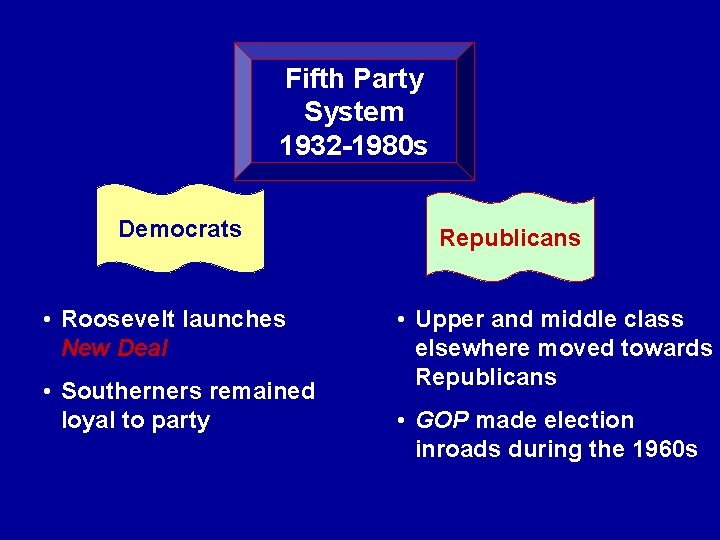
The Fifth Party System (1932– 1980 s) • 1929 Stock Market Crash=> Great Depression – GOP Hoover offers balanced budget as solution – Nation’s unemployment rises to 25% – Nation (voters) demands jobs & bold Federal action – GOP fails to produce $$$ recovery • FDR’s landslide & New Deal coalition begins major party shift of voters from one party to the other: – Poor, working class & unions align w/Democrats – Upper middle class & wealth align w/GOP – Above alignments cut across sectional lines • (In contrast to previous sectional alignment of past party systems) • Only exception? => The Solid South (why? ) • Democrats would dominate Congress as majority until 1960 s – New Deal coalition would start to weaken from then on – Ended sometime in the 1980 s
Fifth Party System 1932 -1980 s Democrats • Roosevelt launches New Deal • Southerners remained loyal to party Republicans • Upper and middle class elsewhere moved towards Republicans • GOP made election inroads during the 1960 s
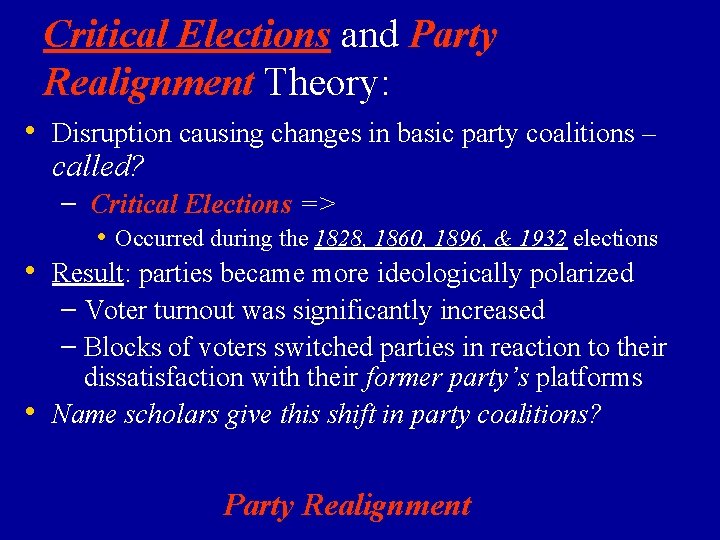
Critical Elections and Party Realignment Theory: • Disruption causing changes in basic party coalitions – called? – Critical Elections => • Occurred during the 1828, 1860, 1896, & 1932 elections • Result: parties became more ideologically polarized – Voter turnout was significantly increased – Blocks of voters switched parties in reaction to their dissatisfaction with their former party’s platforms • Name scholars give this shift in party coalitions? Party Realignment
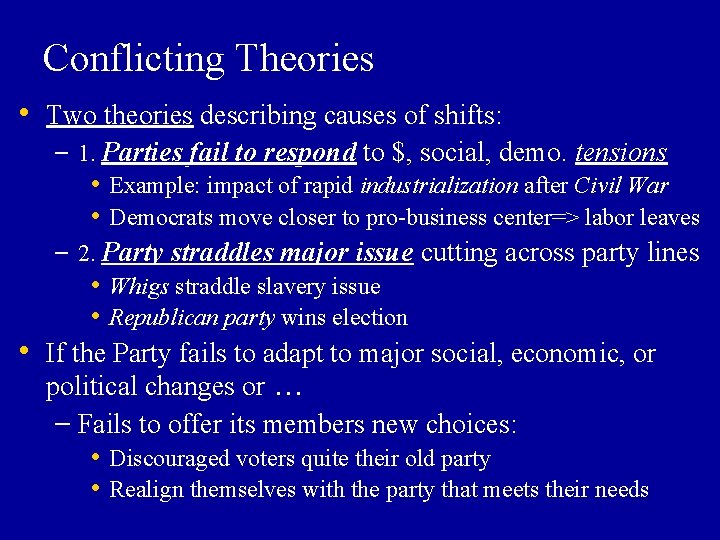
Conflicting Theories • Two theories describing causes of shifts: – 1. Parties fail to respond to $, social, demo. tensions • Example: impact of rapid industrialization after Civil War • Democrats move closer to pro-business center=> labor leaves – 2. Party straddles major issue cutting across party lines • Whigs straddle slavery issue • Republican party wins election • If the Party fails to adapt to major social, economic, or political changes or … – Fails to offer its members new choices: • Discouraged voters quite their old party • Realign themselves with the party that meets their needs
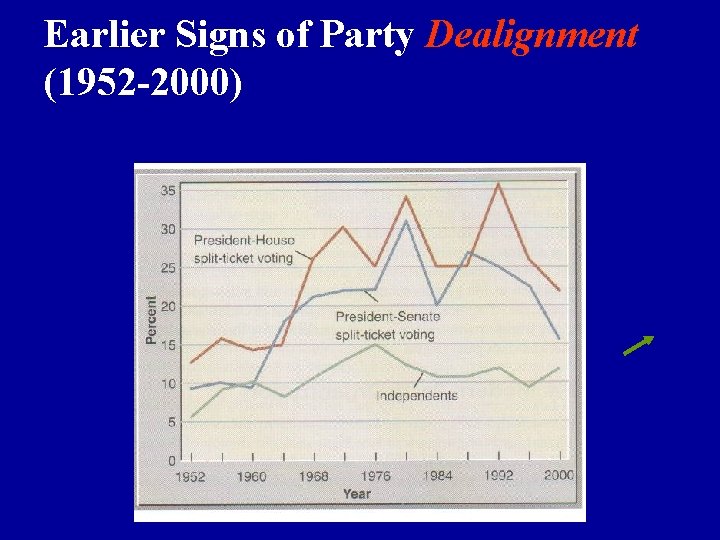
From Realignment to Dealignment? • Historically, realignments occur every 35 -40 years – (It’s been over 70 years since the last one) – what’s the problem? Are we already in realignment? • The growth in ticket spitting? *(Figure 9 -3) – Signs of party dealignment? • Growth in no party identification => Independent • Signs of 6 th party realignment forming? – Shift of South & Rocky Mountain West to GOP – NE & Midwest Voters => Democratic Party
Earlier Signs of Party Dealignment (1952 -2000)
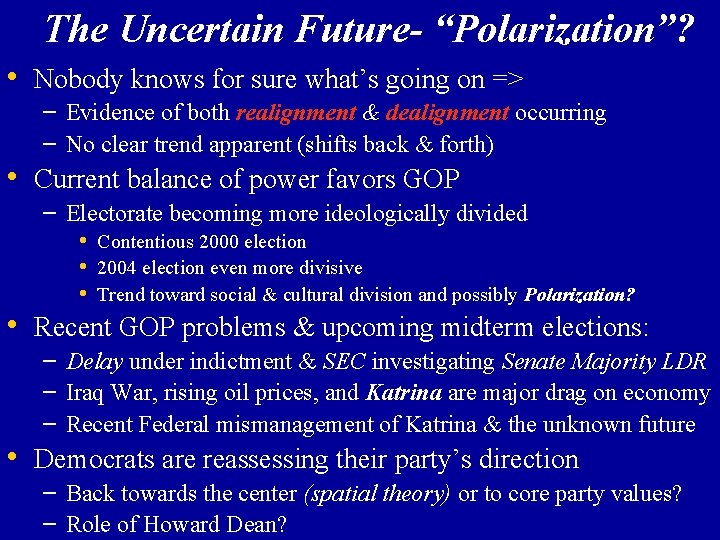
The Uncertain Future- “Polarization”? • Nobody knows for sure what’s going on => – Evidence of both realignment & dealignment occurring – No clear trend apparent (shifts back & forth) • Current balance of power favors GOP – Electorate becoming more ideologically divided • Contentious 2000 election • 2004 election even more divisive • Trend toward social & cultural division and possibly Polarization? • Recent GOP problems & upcoming midterm elections: – – – Delay under indictment & SEC investigating Senate Majority LDR Iraq War, rising oil prices, and Katrina are major drag on economy Recent Federal mismanagement of Katrina & the unknown future • Democrats are reassessing their party’s direction – Back towards the center (spatial theory) or to core party values? – Role of Howard Dean?
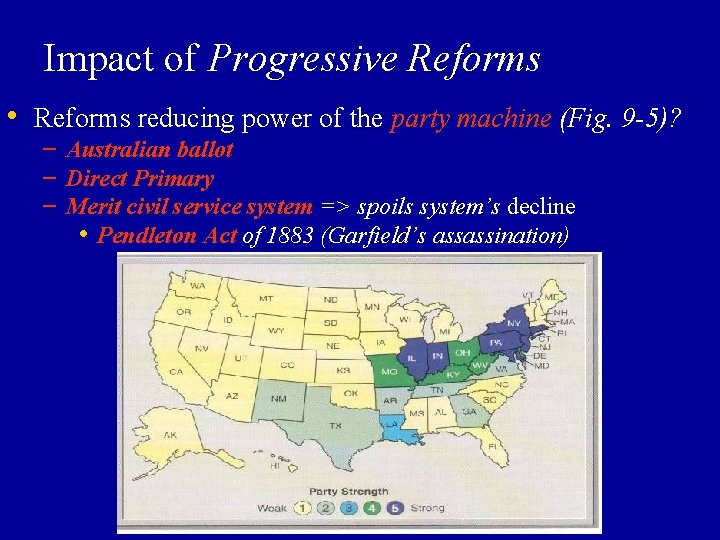
Impact of Progressive Reforms • Reforms reducing power of the party machine (Fig. 9 -5)? – Australian ballot – Direct Primary – Merit civil service system => spoils system’s decline • Pendleton Act of 1883 (Garfield’s assassination)
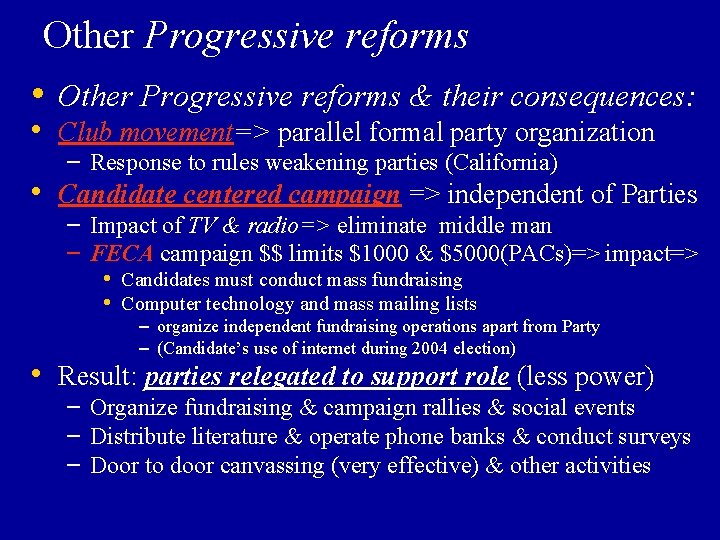
Other Progressive reforms • Other Progressive reforms & their consequences: • Club movement=> parallel formal party organization – Response to rules weakening parties (California) • Candidate centered campaign => independent of Parties – Impact of TV & radio=> eliminate middle man – FECA campaign $$ limits $1000 & $5000(PACs)=> impact=> • Candidates must conduct mass fundraising • Computer technology and mass mailing lists – organize independent fundraising operations apart from Party – (Candidate’s use of internet during 2004 election) • Result: parties relegated to support role (less power) – – – Organize fundraising & campaign rallies & social events Distribute literature & operate phone banks & conduct surveys Door to door canvassing (very effective) & other activities
KEY TERMS – Political Parties • Australian ballot: A government-printed, secret ballot. • Blanket primary: A direct primary in which voters may cast ballots for candidates of • • • any party, but may only vote once for each office. Candidate-centered campaigns: Campaigns in which candidates set up campaign organizations, raise money, and campaign independently of other candidates in their party. Caucus/convention system: A nomination method in which registered party members attend a party caucus, or meeting, to choose a nominee. In large districts, local caucuses send delegates to represent them at convention. Centrist parties: Parties close to the political center. Closed primary: A direct primary in which voters must register their party affiliations before Election Day. Critical elections: Elections that disrupt party coalitions and create new ones in a party realignment. Direct primary: An election in which voters and not party leaders directly choose a party’s nominee for political office. Duverger's Law: The generalization that if a nation has a single-member, plurality electoral system, it will develop a two-party system. Median voter hypothesis: The theory that the best possible position for a politician who cares only about winning elections in the center—that is, in the position of the median voter.
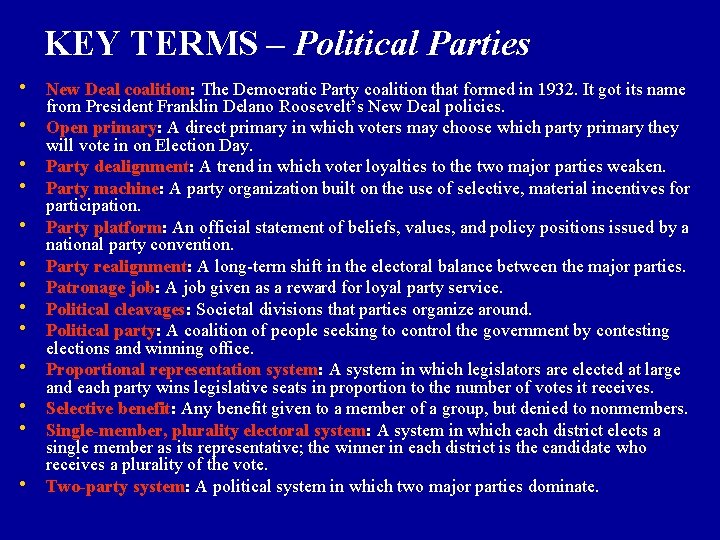
KEY TERMS – Political Parties • New Deal coalition: The Democratic Party coalition that formed in 1932. It got its name • • • from President Franklin Delano Roosevelt’s New Deal policies. Open primary: A direct primary in which voters may choose which party primary they will vote in on Election Day. Party dealignment: A trend in which voter loyalties to the two major parties weaken. Party machine: A party organization built on the use of selective, material incentives for participation. Party platform: An official statement of beliefs, values, and policy positions issued by a national party convention. Party realignment: A long-term shift in the electoral balance between the major parties. Patronage job: A job given as a reward for loyal party service. Political cleavages: Societal divisions that parties organize around. Political party: A coalition of people seeking to control the government by contesting elections and winning office. Proportional representation system: A system in which legislators are elected at large and each party wins legislative seats in proportion to the number of votes it receives. Selective benefit: Any benefit given to a member of a group, but denied to nonmembers. Single-member, plurality electoral system: A system in which each district elects a single member as its representative; the winner in each district is the candidate who receives a plurality of the vote. Two-party system: A political system in which two major parties dominate.