
Political Parties and Ideology What is a Party
- Slides: 44
Political Parties and Ideology
What is a Party? n Political Party – a group of people who seek to control government through the winning of elections and the holding of public office – Major Party – a party that has a chance to win representation in government – Minor Party – any political party that doesn’t
Major Parties n There are two major parties in the U. S. Can you name them?
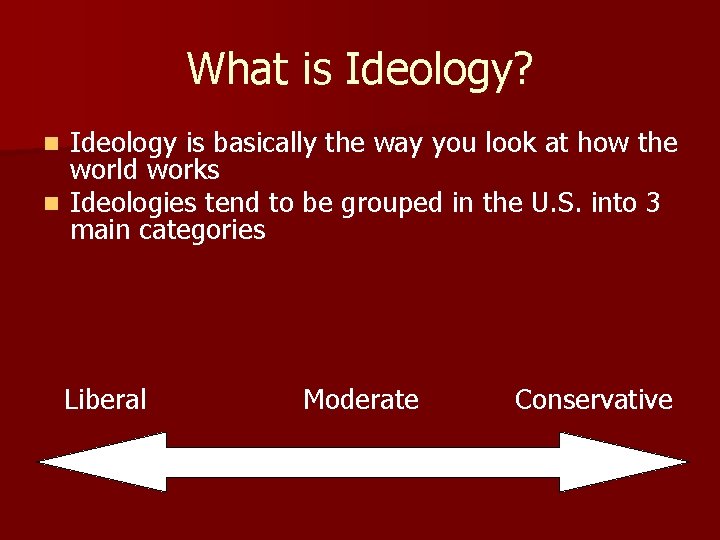
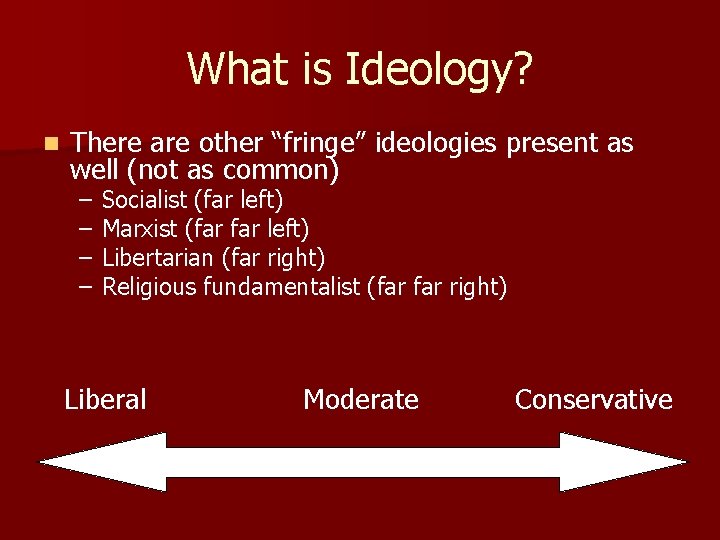
What is Ideology? Ideology is basically the way you look at how the world works n Ideologies tend to be grouped in the U. S. into 3 main categories n Liberal Moderate Conservative
What is Ideology? n There are other “fringe” ideologies present as well (not as common) – – Socialist (far left) Marxist (far left) Libertarian (far right) Religious fundamentalist (far right) Liberal Moderate Conservative
Liberal and Conservative n People do not have to be strictly liberal on all issues, or conservative on all issues n You can mix the two to form your own individual ideology n We group them because certain viewpoints tend to naturally go together
Liberal and Conservative n Common Liberal Characteristics – Desire progressive change in society – Main values: Idealism, Equality, Fairness, Personal Freedom – Examples: ACLU, Sierra Club, NAACP, NOW, labor unions, Dems.
Liberal and Conservative n Common Liberal Issue Stances – Pro-choice – Affirmative Action – Gun control – Progressive taxes (higher on rich) – Aid to the poor – Equal access to health care – Protecting the environment – Equal gay rights
Liberal and Conservative n Common Conservative Characteristics – Desire to keep things as they are, maintain the status-quo, change should be cautious and slow – Main values: Realism, Law and Order, Justice, Morality, Economic Freedom – Examples: Christian Coalition, NRA, Americans for Tax Reform, Republicans
Liberal and Conservative n Common Conservative Issue Stances – Anti-abortion – Belief in private sector efficiency over the government – Free gun ownership rights – Cutting taxes, less progressive taxation – Cutting regulations on businesses – Immigration control – Increased military spending – Support traditional marriage
What Do Parties Do? n Nominate Candidates n Inform and Activate Supporters n The “Bonding Agent” Function – making sure that officeholders do a good job once they are elected n Govern n Act as a Watchdog – criticizes the opposing party
The Two-Party System n Why do we have a two party system? – 1. Historical Basis – division between Federalists and Anti. Federalists – 2. Tradition – it has always been that way, so it naturally selfperpetuates
The Two-Party System n 3. The American Ideological Consensus – for the most part, we pretty much agree on all of the major stuff –People should own property –We should have equality –People have the right to vote
The Two-Party System n 4. The Electoral System – the U. S. uses single-member districts… that means only one person wins representation from each district
Multiparty Systems n Several major parties, many lesser parties all compete for and win public office n Mostly in Europe and Latin American Democracies n Many parties must form a coalition, or a group of parties that form a majority
One-Party Systems • Found in dictatorships where only one party is allowed • Also found in places where one of the major parties has no chance of winning
Party Membership Patterns n Party membership is voluntary n Each party must try to attract as much support as possible
Party Membership Patterns n Some demographic groups are more reliable to each party, though n Tend to be Democrat – Female, African American, Hispanic, Catholic, Jewish, Union Member, Lower Income, Lower Education, Under 30, Over 60
Party Membership Patterns n Some demographic groups are more reliable to each party, though n Tend to be Republican – Male, White, Protestant, Work in the Business Community, Higher Income, Higher Education, Middle. Aged
History of the Two-Party System n The First Two Parties – Federalists §Founded by Alexander Hamilton §Believed in forming a strong national government, supported policies that favored business
History of the Two-Party System n The First Two Parties – Democratic-Republicans §Founded by Thomas Jefferson §Believed in limiting the federal government’s power, and supported policies that benefited the “common man”
History of the Two-Party System n Era of the Democrats (1800 -1860) – Democratic-Republicans had come to dominate politics, but then broke into two factions, the Democrats and Whigs – Democrats, led by Andrew Jackson, won most of the time over the Whigs
History of the Two-Party System n Era of the Republicans (1860 -1932) – Began with election of Abraham Lincoln and the Civil War – Republicans dominated elections due to support from businesses and African Americans – Democrats only won in the South
History of the Two-Party System n The Return of the Democrats (1932 -1968) – The Great Depression turned people against the Republican Party, especially as FDR led the U. S. out of the Depression – Dwight Eisenhower was the only Republican from this period
History of the Two-Party System n Divided Government (1968 -Present) – Nixon’s Watergate scandal has led people to distrust government – Characterized by different parties controlling Congress and the Presidency – Country is evenly divided (remember the 2000 election? )
Minor Parties n Why run for election when you know you will lose? – Act as the “spoiler” (Perot in 1992, Nader in 2000)
Minor Parties n Why run for election when you know you will lose? – Make your issues public, get the major parties to adopt them
Minor Parties n Why run for election when you know you will lose? – Criticize the major parties (That’s basically all Nader does)
Types of Minor Parties n Ideological Parties – based on a set of beliefs – Tend to be long lasting – Have very little electoral success – Examples: Communist, Socialist, Libertarian
Types of Minor Parties n Single-Issue Parties – concentrate on one public policy matter – Name usually reflects their issue – Party dies after the issue fades or one of the major parties adopts their issue – Examples: Marijuana, Right to Life, Prohibition
Types of Minor Parties n Economic Protest Parties – arise during periods of poor economy, and express disgust – Usually sectional, drawing support from one region of the country – They invent an “enemy” of the economy and blame them – Examples: America First, Populist
Types of Minor Parties n Splinter Parties – break away from one of the major parties – Usually form around a strong personality – Typically have short-term electoral success – Fade away when the leader steps aside – Examples: Bull Moose, American Independent, Reform
Chapter 7: Elections
Nominations – the First Step n Before the election can take place, candidates must be nominated – This applies in ALL elections, not just presidential! n Nomination – the naming of candidates who will seek office n After candidates are nominated, the general election is held
How Does a Candidate get Nominated? n 4 Ways: – Self Announcement – Convention – Caucus – Primary **To become a major party nominee for president, all 4 will be used**
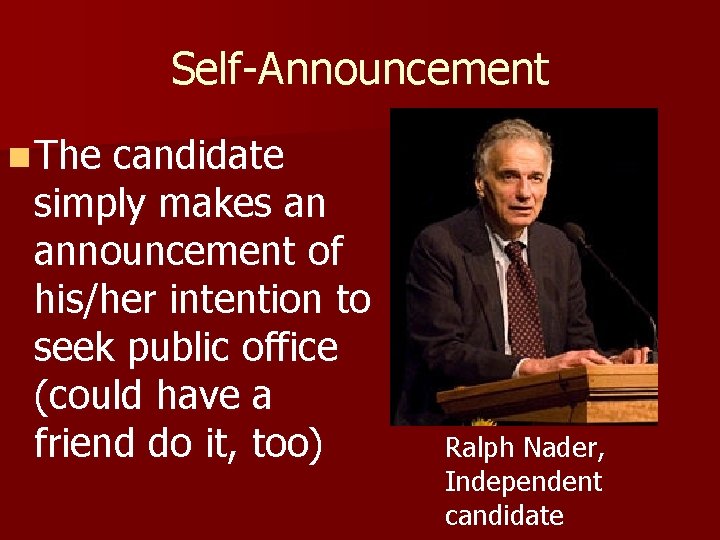
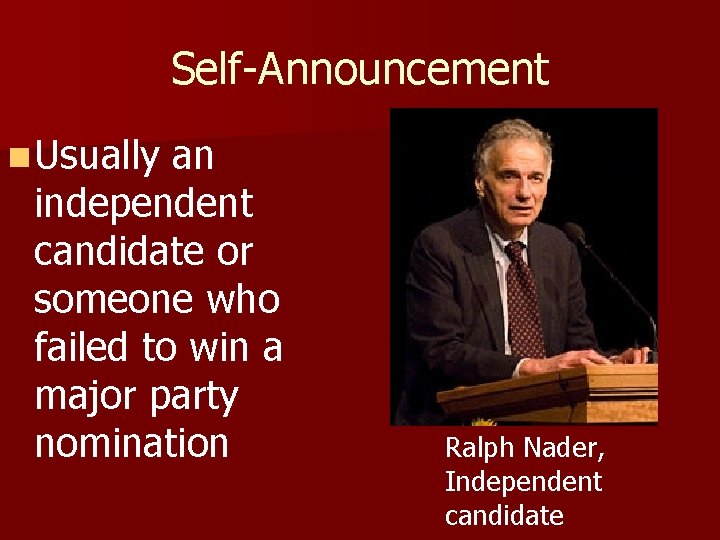
Self-Announcement n The candidate simply makes an announcement of his/her intention to seek public office (could have a friend do it, too) Ralph Nader, Independent candidate
Self-Announcement n Usually an independent candidate or someone who failed to win a major party nomination Ralph Nader, Independent candidate
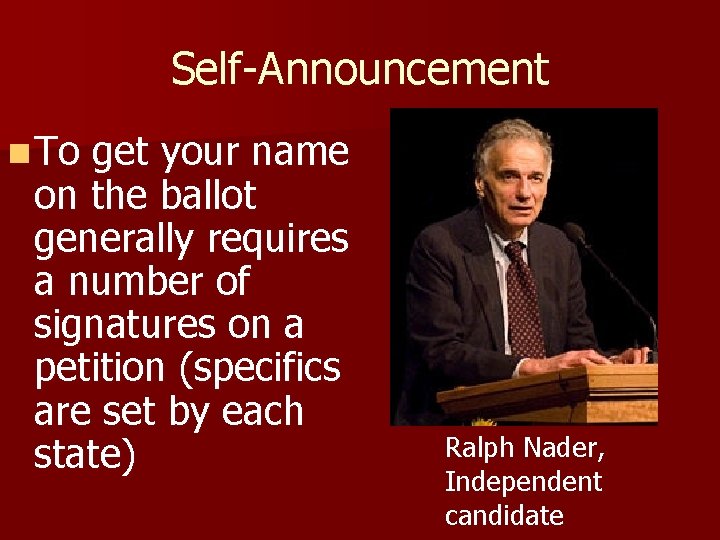
Self-Announcement n To get your name on the ballot generally requires a number of signatures on a petition (specifics are set by each state) Ralph Nader, Independent candidate
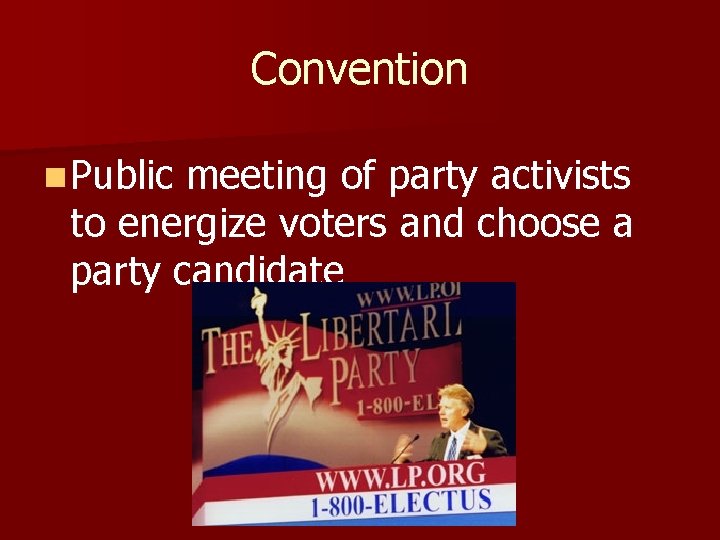
Convention n Public meeting of party activists to energize voters and choose a party candidate
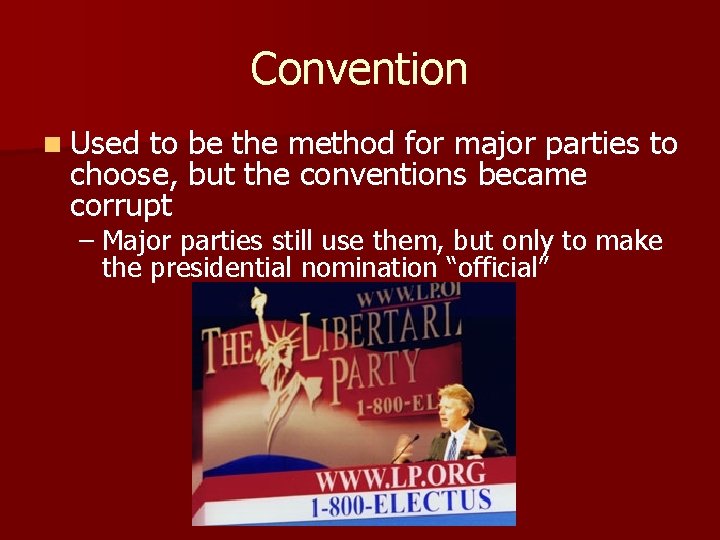
Convention n Used to be the method for major parties to choose, but the conventions became corrupt – Major parties still use them, but only to make the presidential nomination “official”
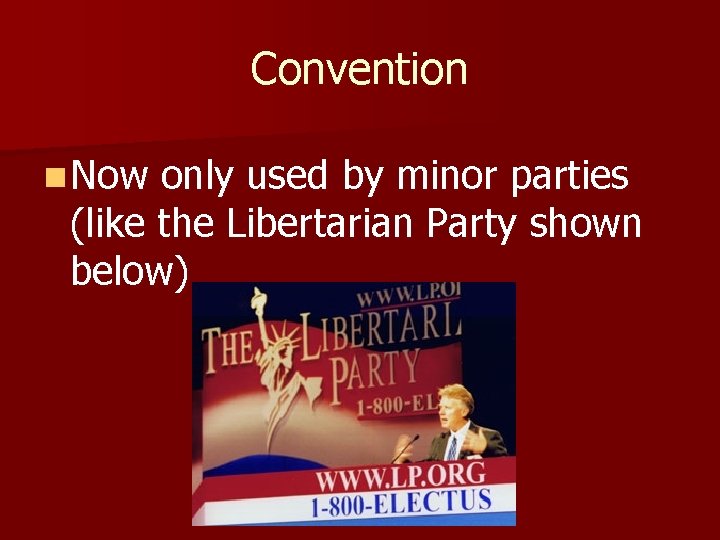
Convention n Now only used by minor parties (like the Libertarian Party shown below)
Caucus n 1800 s - originally a private meeting of party leaders – no records kept or journalists allowed n The appearance of corruption led to reforms
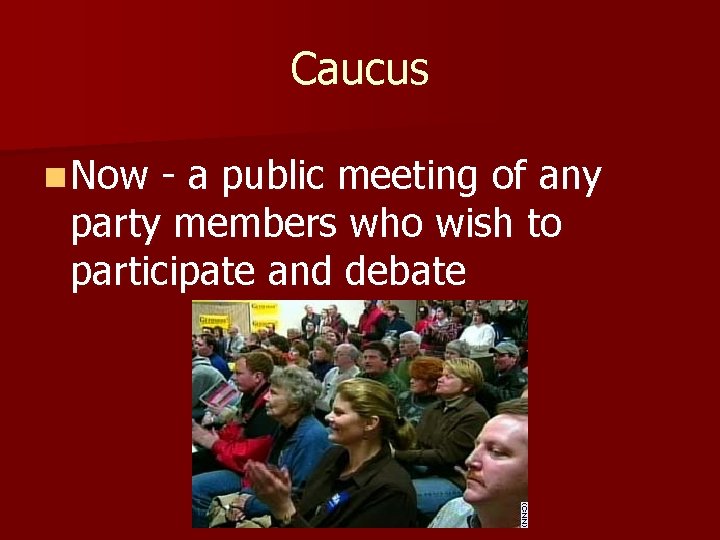
Caucus n Now - a public meeting of any party members who wish to participate and debate
Primary n. A public election held within a political party to choose the party’s nominee for office – Open Primary – any eligible voters may vote – Closed Primary – only registered party members may vote in their party’s primary n Most common method in states today