
Political Organization of Space Colonialism and Imperialism Definition


- Slides: 18
Political Organization of Space
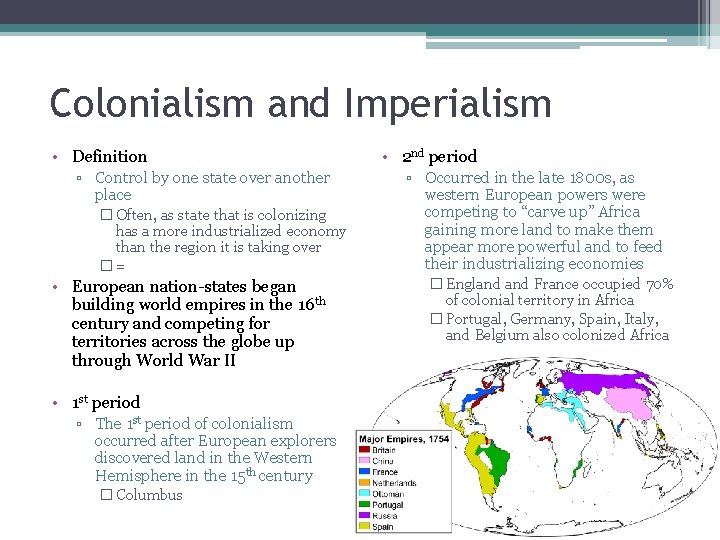
Colonialism and Imperialism • Definition ▫ Control by one state over another place � Often, as state that is colonizing has a more industrialized economy than the region it is taking over �= • European nation-states began building world empires in the 16 th century and competing for territories across the globe up through World War II • 1 st period ▫ The 1 st period of colonialism occurred after European explorers discovered land in the Western Hemisphere in the 15 th century � Columbus • 2 nd period ▫ Occurred in the late 1800 s, as western European powers were competing to “carve up” Africa gaining more land to make them appear more powerful and to feed their industrializing economies � England France occupied 70% of colonial territory in Africa � Portugal, Germany, Spain, Italy, and Belgium also colonized Africa
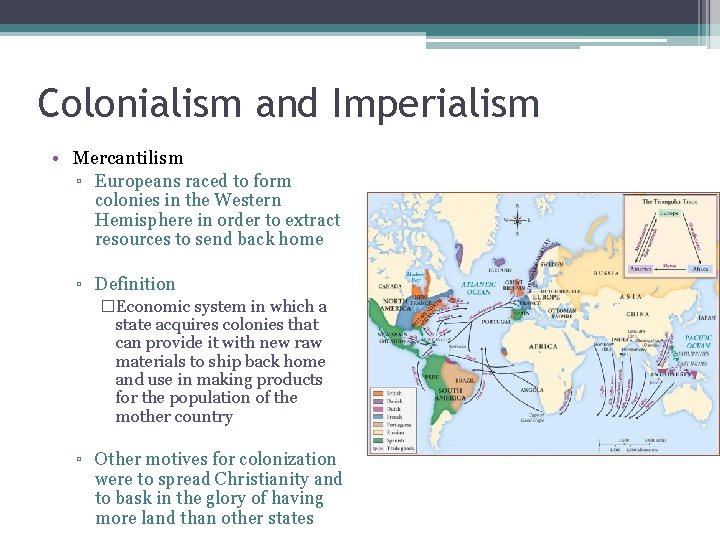
Colonialism and Imperialism • Mercantilism ▫ Europeans raced to form colonies in the Western Hemisphere in order to extract resources to send back home ▫ Definition �Economic system in which a state acquires colonies that can provide it with new raw materials to ship back home and use in making products for the population of the mother country ▫ Other motives for colonization were to spread Christianity and to bask in the glory of having more land than other states
Colonialism and Imperialism • Imperialism ▫ Colonization fueled imperialism �The process of establishing political, social, and economic dominance over a colonized area ▫ Europeans acculturated indigenous peoples to European Christianity and culture �Also destroyed indigenous landscapes and imposing European architecture to signify dominance
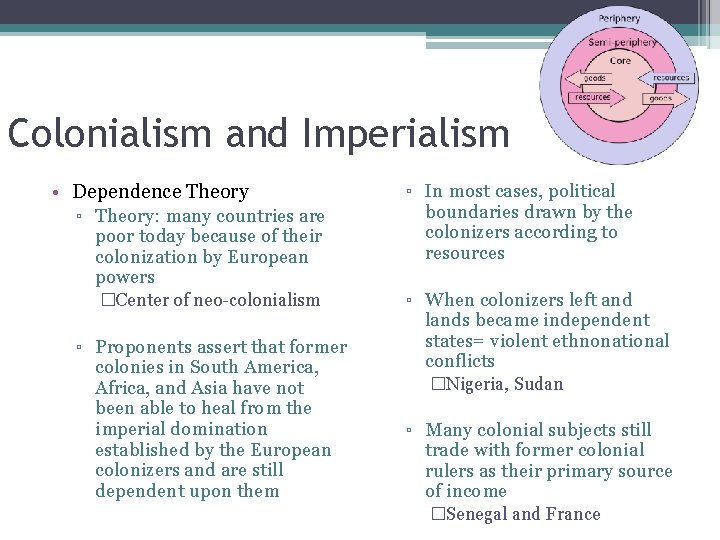
Colonialism and Imperialism • Dependence Theory ▫ Theory: many countries are poor today because of their colonization by European powers �Center of neo-colonialism ▫ Proponents assert that former colonies in South America, Africa, and Asia have not been able to heal from the imperial domination established by the European colonizers and are still dependent upon them ▫ In most cases, political boundaries drawn by the colonizers according to resources ▫ When colonizers left and lands became independent states= violent ethnonational conflicts �Nigeria, Sudan ▫ Many colonial subjects still trade with former colonial rulers as their primary source of income �Senegal and France
Colonialism and Imperialism • Neocolonialism ▫ Definition � Continued economic dependence of new states on their former colonial masters � Also called “post-colonial dependency” � the term neo-colonialism describes the domination-praxis (social, economic, cultural) of countries from the developed world in the respective internal affairs of the countries of the developing world; that, despite the decolonisation occurred in the aftermath of the Second World War (1939– 45), the (former) colonial powers continue to apply existing and past international economic arrangements with their former colony countries, and so maintain colonial control. ▫ Because the political and economic structures established by the Europeans benefited the colonizers, not the local people, essential elements of infrastructure were not built in most colonized lands ▫ When European colonizers left, education systems, health care networks, roads, communication lines, and other basic elements were not in place for the regions to thrive on their own � Many colonies left with finances or ability to develop basic infrastructure � Left little choice to turn back on colonizers and ask for loans to build up economies ▫ Today � To alleviate some of the effects of neocolonialism, the American economist Jeffrey Sachs recommended that the entire African debt (ca. 200 billion U. S. dollars) be dismissed, and recommended that African nations not repay the World Bank and the International Monetary Fund (IMF)
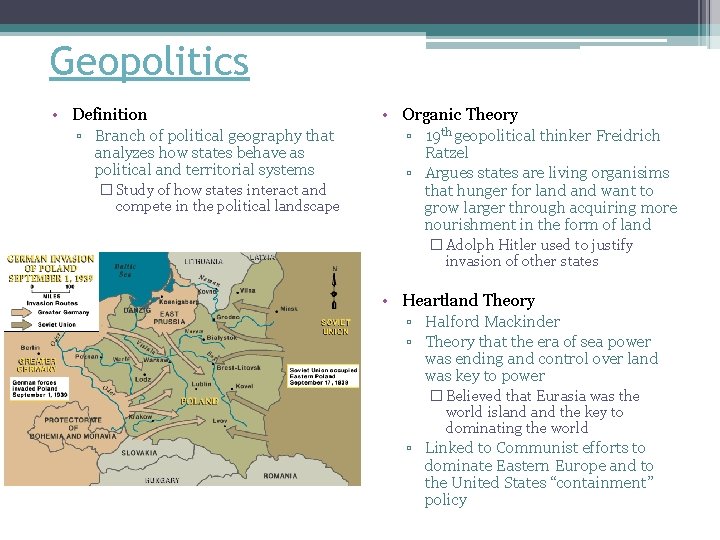
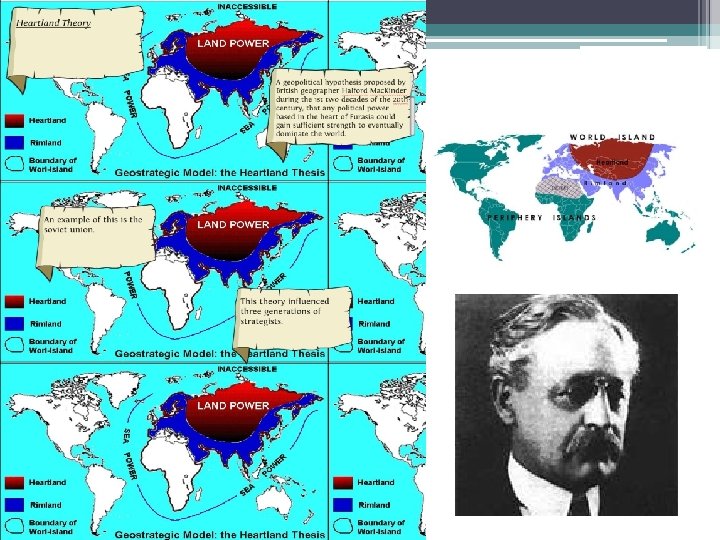
Geopolitics • Definition ▫ Branch of political geography that analyzes how states behave as political and territorial systems � Study of how states interact and compete in the political landscape • Organic Theory ▫ 19 th geopolitical thinker Freidrich Ratzel ▫ Argues states are living organisims that hunger for land want to grow larger through acquiring more nourishment in the form of land � Adolph Hitler used to justify invasion of other states • Heartland Theory ▫ Halford Mackinder ▫ Theory that the era of sea power was ending and control over land was key to power � Believed that Eurasia was the world island the key to dominating the world ▫ Linked to Communist efforts to dominate Eastern Europe and to the United States “containment” policy
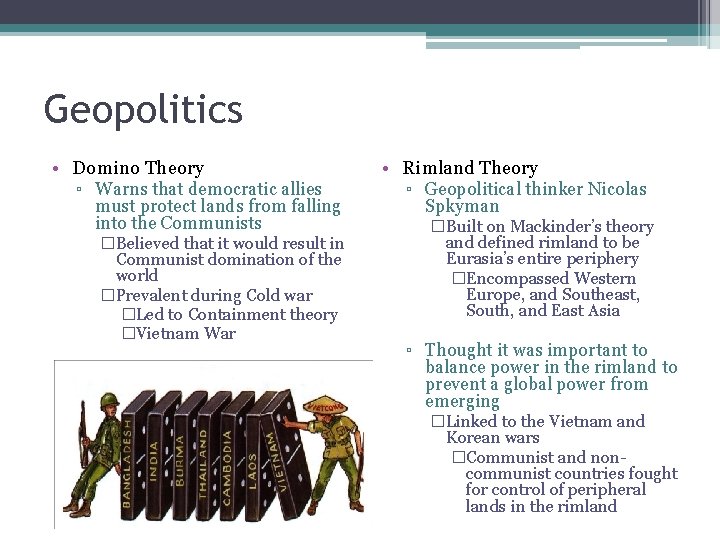
Geopolitics • Domino Theory ▫ Warns that democratic allies must protect lands from falling into the Communists �Believed that it would result in Communist domination of the world �Prevalent during Cold war �Led to Containment theory �Vietnam War • Rimland Theory ▫ Geopolitical thinker Nicolas Spkyman �Built on Mackinder’s theory and defined rimland to be Eurasia’s entire periphery �Encompassed Western Europe, and Southeast, South, and East Asia ▫ Thought it was important to balance power in the rimland to prevent a global power from emerging �Linked to the Vietnam and Korean wars �Communist and noncommunist countries fought for control of peripheral lands in the rimland
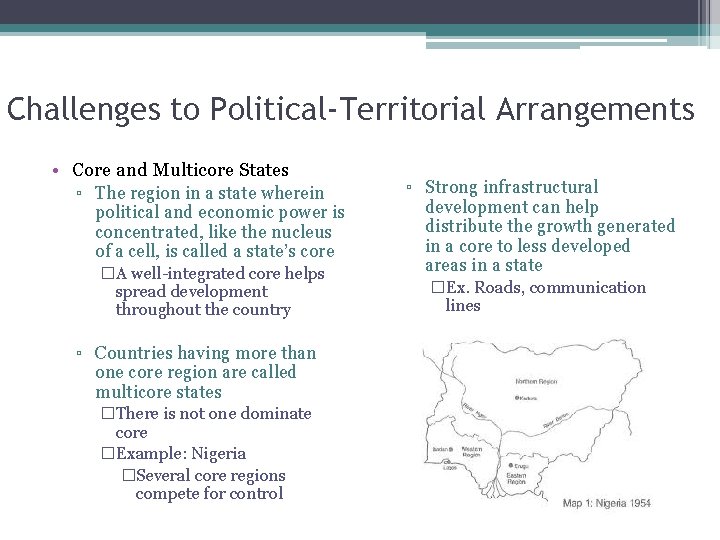
Challenges to Political-Territorial Arrangements • Core and Multicore States ▫ The region in a state wherein political and economic power is concentrated, like the nucleus of a cell, is called a state’s core �A well-integrated core helps spread development throughout the country ▫ Countries having more than one core region are called multicore states �There is not one dominate core �Example: Nigeria �Several core regions compete for control ▫ Strong infrastructural development can help distribute the growth generated in a core to less developed areas in a state �Ex. Roads, communication lines
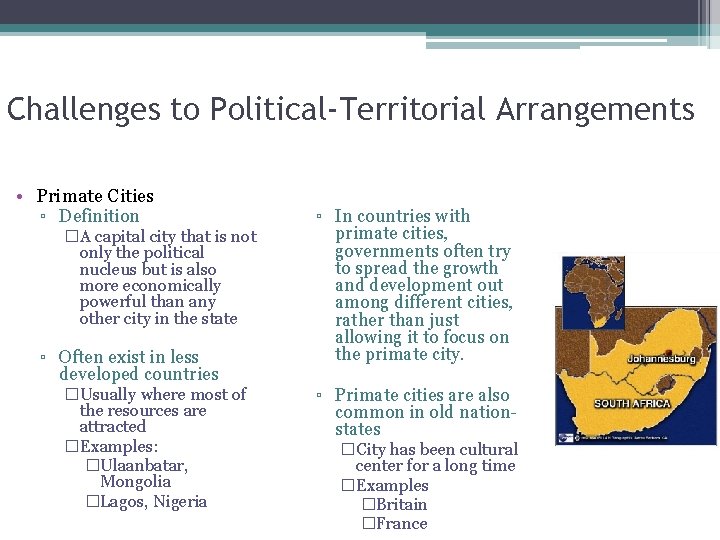
Challenges to Political-Territorial Arrangements • Primate Cities ▫ Definition �A capital city that is not only the political nucleus but is also more economically powerful than any other city in the state ▫ Often exist in less developed countries �Usually where most of the resources are attracted �Examples: �Ulaanbatar, Mongolia �Lagos, Nigeria ▫ In countries with primate cities, governments often try to spread the growth and development out among different cities, rather than just allowing it to focus on the primate city. ▫ Primate cities are also common in old nationstates �City has been cultural center for a long time �Examples �Britain �France
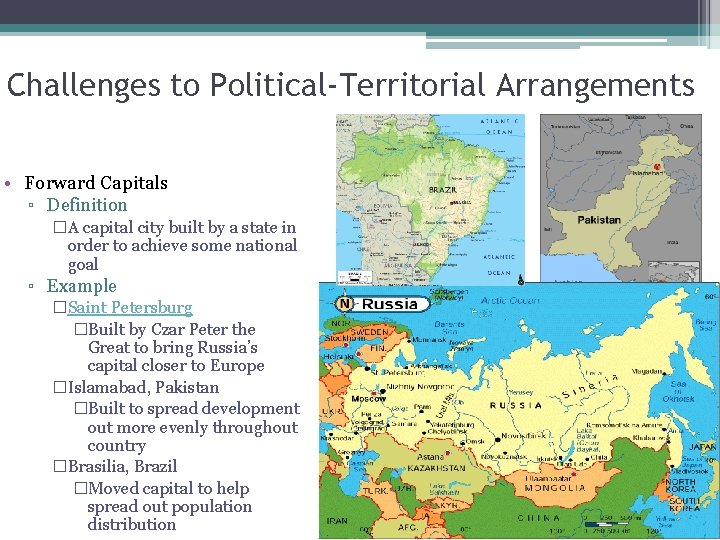
Challenges to Political-Territorial Arrangements • Forward Capitals ▫ Definition �A capital city built by a state in order to achieve some national goal ▫ Example �Saint Petersburg �Built by Czar Peter the Great to bring Russia’s capital closer to Europe �Islamabad, Pakistan �Built to spread development out more evenly throughout country �Brasilia, Brazil �Moved capital to help spread out population distribution
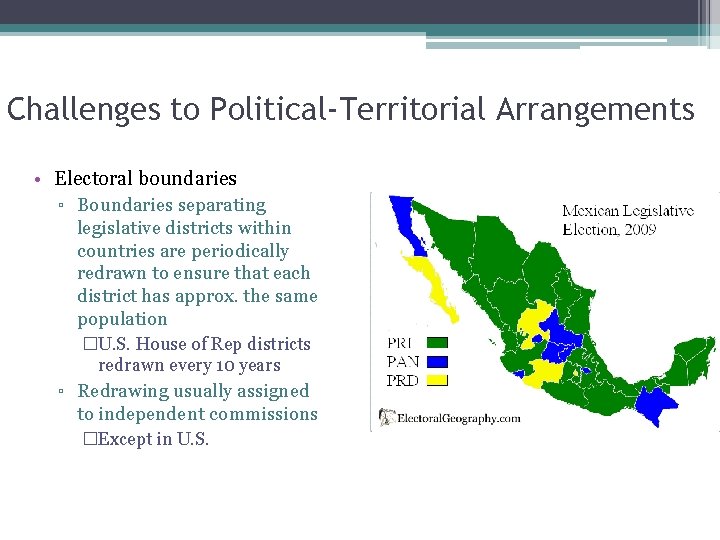
Challenges to Political-Territorial Arrangements • Electoral boundaries ▫ Boundaries separating legislative districts within countries are periodically redrawn to ensure that each district has approx. the same population �U. S. House of Rep districts redrawn every 10 years ▫ Redrawing usually assigned to independent commissions �Except in U. S.
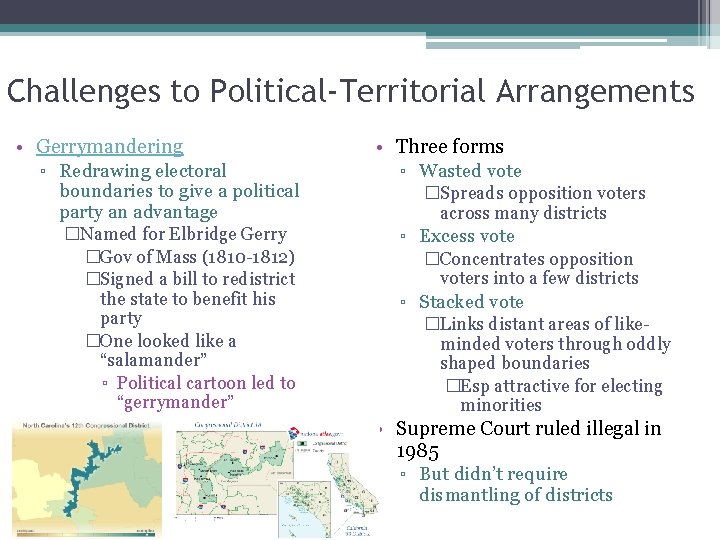
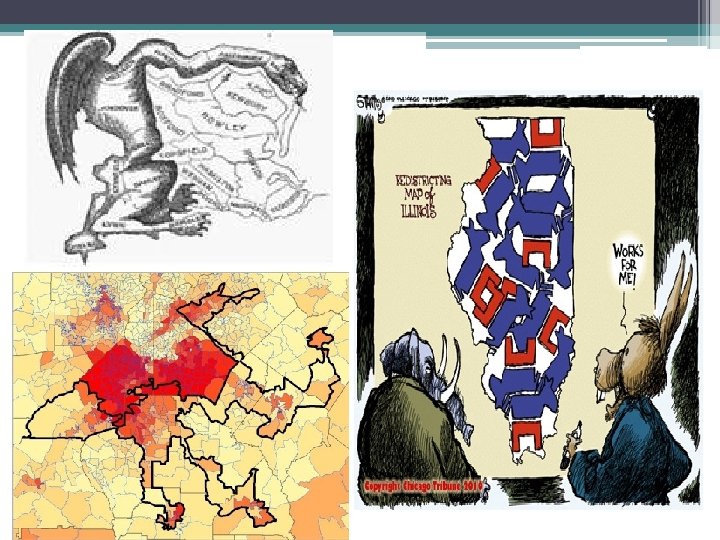
Challenges to Political-Territorial Arrangements • Gerrymandering ▫ Redrawing electoral boundaries to give a political party an advantage �Named for Elbridge Gerry �Gov of Mass (1810 -1812) �Signed a bill to redistrict the state to benefit his party �One looked like a “salamander” ▫ Political cartoon led to “gerrymander” • Three forms ▫ Wasted vote �Spreads opposition voters across many districts ▫ Excess vote �Concentrates opposition voters into a few districts ▫ Stacked vote �Links distant areas of likeminded voters through oddly shaped boundaries �Esp attractive for electing minorities • Supreme Court ruled illegal in 1985 ▫ But didn’t require dismantling of districts
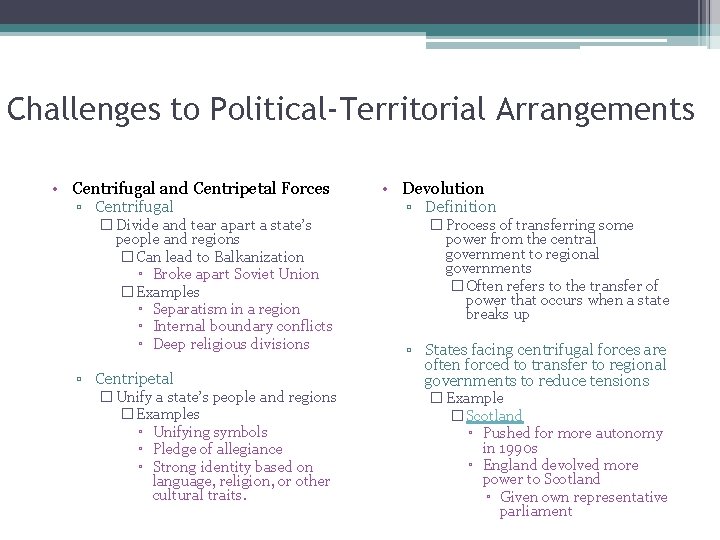
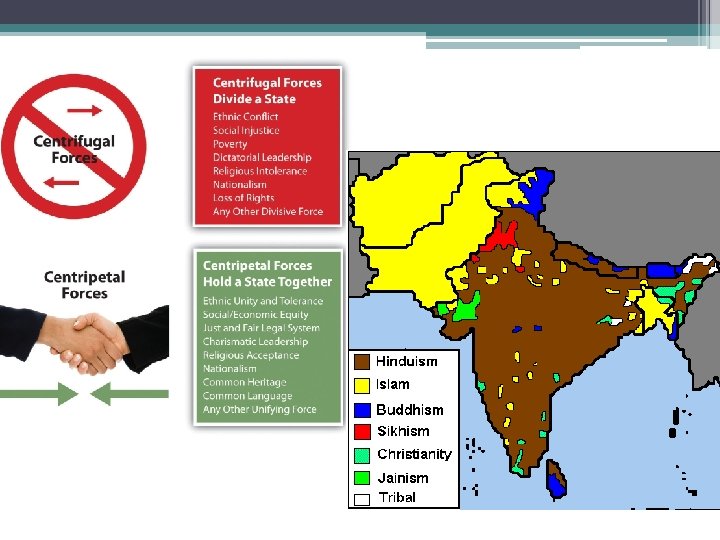
Challenges to Political-Territorial Arrangements • Centrifugal and Centripetal Forces ▫ Centrifugal � Divide and tear apart a state’s people and regions �Can lead to Balkanization ▫ Broke apart Soviet Union �Examples ▫ Separatism in a region ▫ Internal boundary conflicts ▫ Deep religious divisions ▫ Centripetal � Unify a state’s people and regions �Examples ▫ Unifying symbols ▫ Pledge of allegiance ▫ Strong identity based on language, religion, or other cultural traits. • Devolution ▫ Definition � Process of transferring some power from the central government to regional governments �Often refers to the transfer of power that occurs when a state breaks up ▫ States facing centrifugal forces are often forced to transfer to regional governments to reduce tensions � Example �Scotland ▫ Pushed for more autonomy in 1990 s ▫ England devolved more power to Scotland ▫ Given own representative parliament