
Political Mobilization and Government Targeting When Do Dissidents
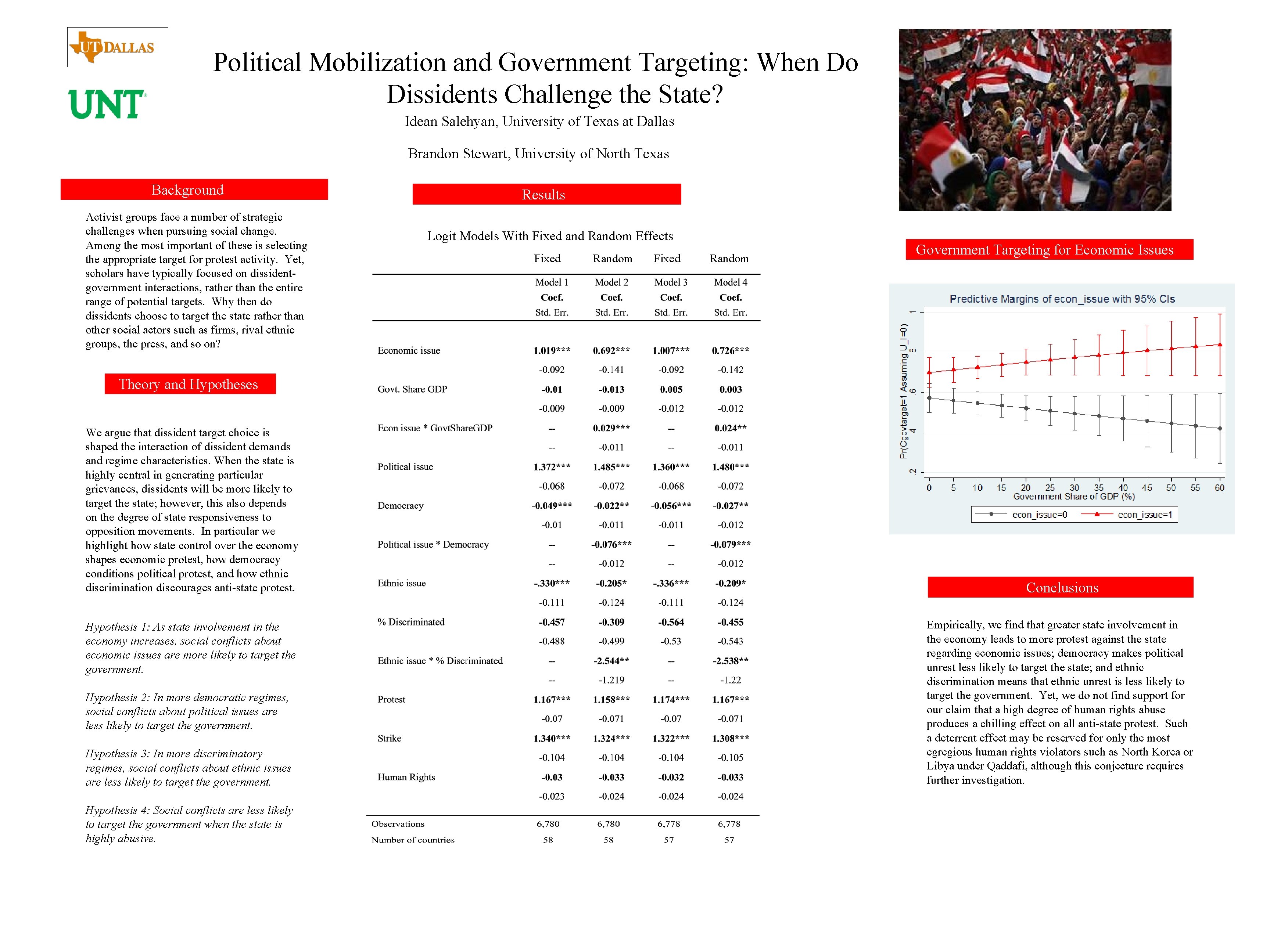
Political Mobilization and Government Targeting: When Do Dissidents Challenge the State? Idean Salehyan, University of Texas at Dallas Brandon Stewart, University of North Texas Background Activist groups face a number of strategic challenges when pursuing social change. Among the most important of these is selecting the appropriate target for protest activity. Yet, scholars have typically focused on dissidentgovernment interactions, rather than the entire range of potential targets. Why then do dissidents choose to target the state rather than other social actors such as firms, rival ethnic groups, the press, and so on? Results Logit Models With Fixed and Random Effects Fixed Random Government Targeting for Economic Issues Theory and Hypotheses We argue that dissident target choice is shaped the interaction of dissident demands and regime characteristics. When the state is highly central in generating particular grievances, dissidents will be more likely to target the state; however, this also depends on the degree of state responsiveness to opposition movements. In particular we highlight how state control over the economy shapes economic protest, how democracy conditions political protest, and how ethnic discrimination discourages anti-state protest. Hypothesis 1: As state involvement in the economy increases, social conflicts about economic issues are more likely to target the government. Hypothesis 2: In more democratic regimes, social conflicts about political issues are less likely to target the government. Hypothesis 3: In more discriminatory regimes, social conflicts about ethnic issues are less likely to target the government. Hypothesis 4: Social conflicts are less likely to target the government when the state is highly abusive. Conclusions Empirically, we find that greater state involvement in the economy leads to more protest against the state regarding economic issues; democracy makes political unrest less likely to target the state; and ethnic discrimination means that ethnic unrest is less likely to target the government. Yet, we do not find support for our claim that a high degree of human rights abuse produces a chilling effect on all anti-state protest. Such a deterrent effect may be reserved for only the most egregious human rights violators such as North Korea or Libya under Qaddafi, although this conjecture requires further investigation.
- Slides: 1