
POLITICAL GEOGRAPHY OF EUROPE SSWG 3 BASIC DEFINITIONS
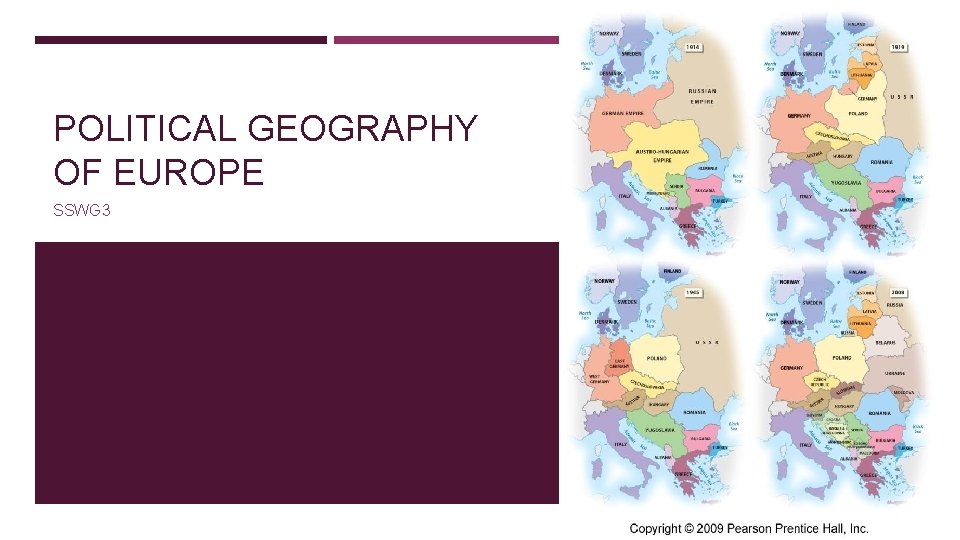
POLITICAL GEOGRAPHY OF EUROPE SSWG 3
BASIC DEFINITIONS Nation – a group with a shared culture inside a land area (ex: Cherokee Nation) State – sovereign territory with distinct borders (ex: Canada) Nation-state – area where a nation & state are within the same sovereign territory (ex: Japan) Political Sovereignty – absolute control of a state by a government Ethnic Sovereignty – control for an ethnic group inside of a functioning politically sovereign state
BORDERS & BOUNDARIES Peace of Westphalia (1648) – modern beginnings of political borders Single government, common language, common religion, ethnicity & culture Physical features = logical barriers 1. Civil Conflict (ex: Yugoslavia) 2. War – gain, lose, or destroy territory Why do borde r s chan ge?

COOPERATION & CONFLICT Scotland – separatist movements b/c feel not represented in Great Britain’s government Basques in Spain – conflict over rare language & culture = 3 million want independence
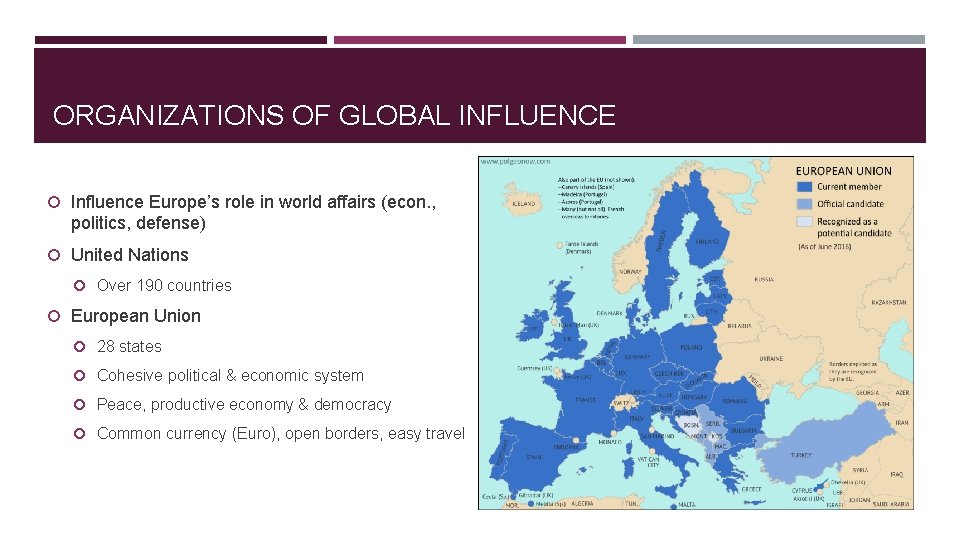
ORGANIZATIONS OF GLOBAL INFLUENCE Influence Europe’s role in world affairs (econ. , politics, defense) United Nations Over 190 countries European Union 28 states Cohesive political & economic system Peace, productive economy & democracy Common currency (Euro), open borders, easy travel
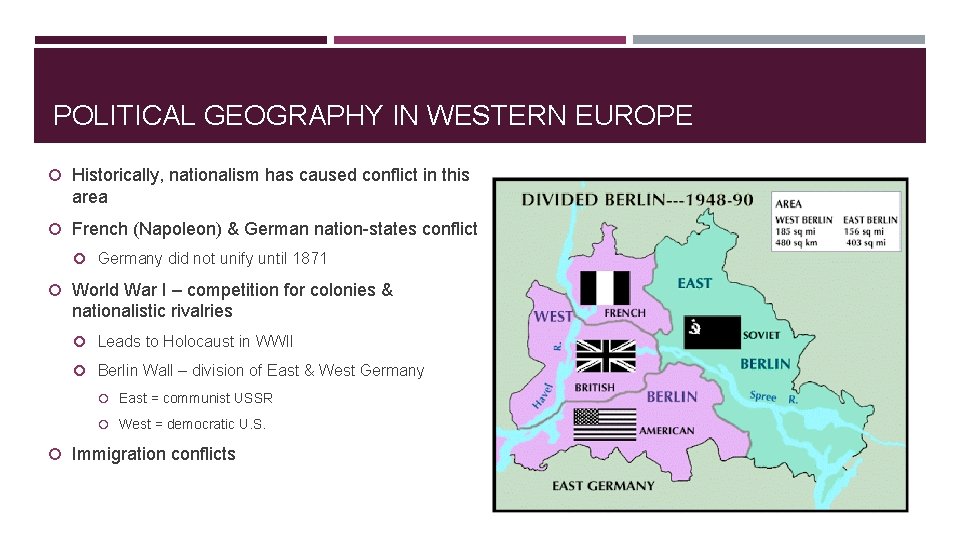
POLITICAL GEOGRAPHY IN WESTERN EUROPE Historically, nationalism has caused conflict in this area French (Napoleon) & German nation-states conflict Germany did not unify until 1871 World War I – competition for colonies & nationalistic rivalries Leads to Holocaust in WWII Berlin Wall – division of East & West Germany East = communist USSR West = democratic U. S. Immigration conflicts
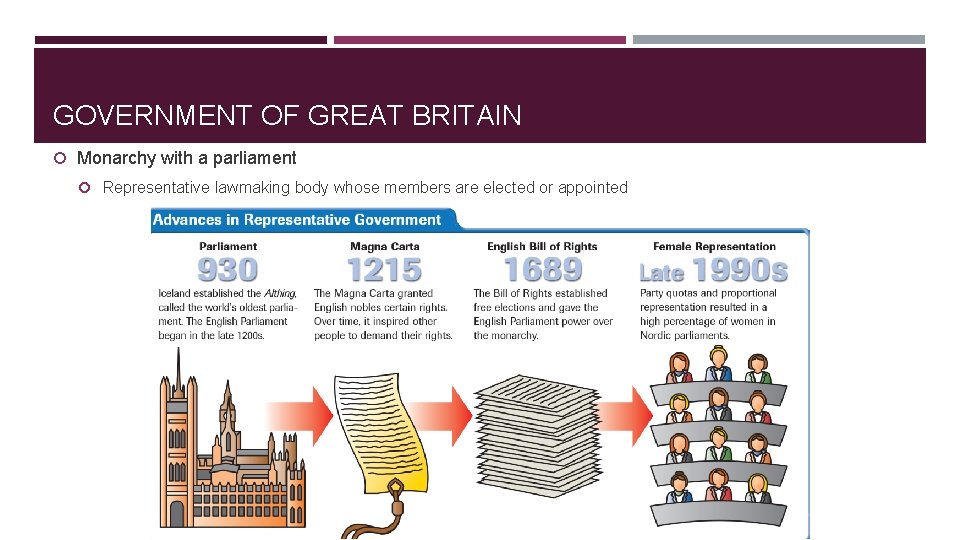
GOVERNMENT OF GREAT BRITAIN Monarchy with a parliament Representative lawmaking body whose members are elected or appointed
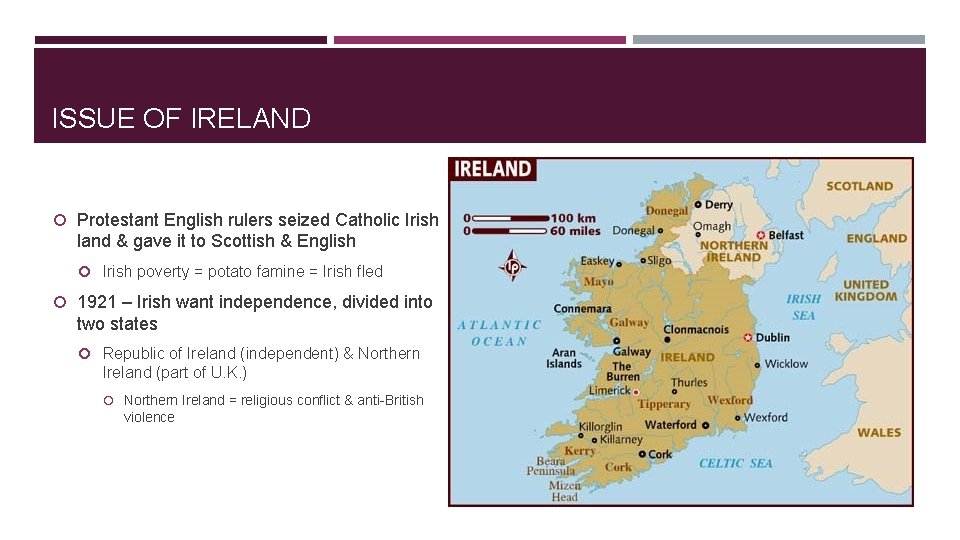
ISSUE OF IRELAND Protestant English rulers seized Catholic Irish land & gave it to Scottish & English Irish poverty = potato famine = Irish fled 1921 – Irish want independence, divided into two states Republic of Ireland (independent) & Northern Ireland (part of U. K. ) Northern Ireland = religious conflict & anti-British violence
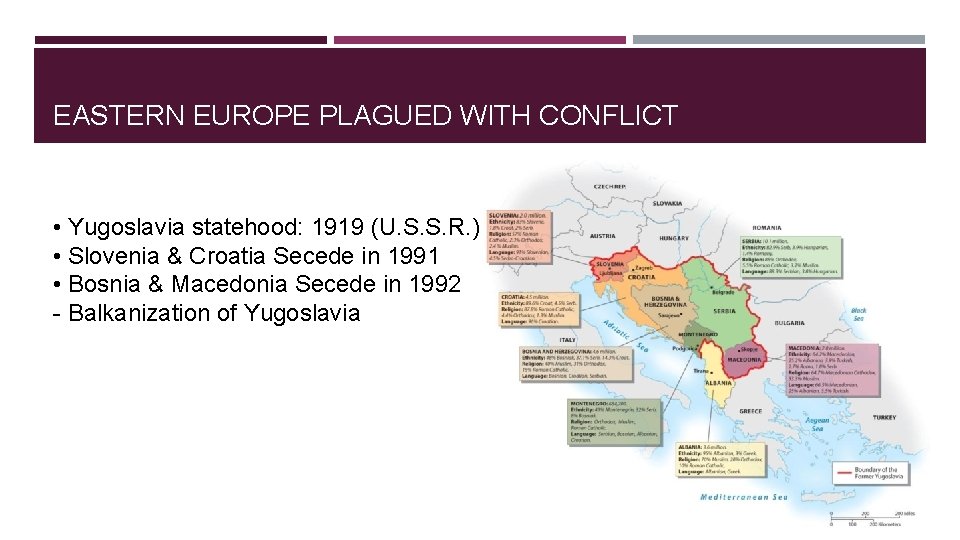
EASTERN EUROPE PLAGUED WITH CONFLICT • Yugoslavia statehood: 1919 (U. S. S. R. ) • Slovenia & Croatia Secede in 1991 • Bosnia & Macedonia Secede in 1992 - Balkanization of Yugoslavia
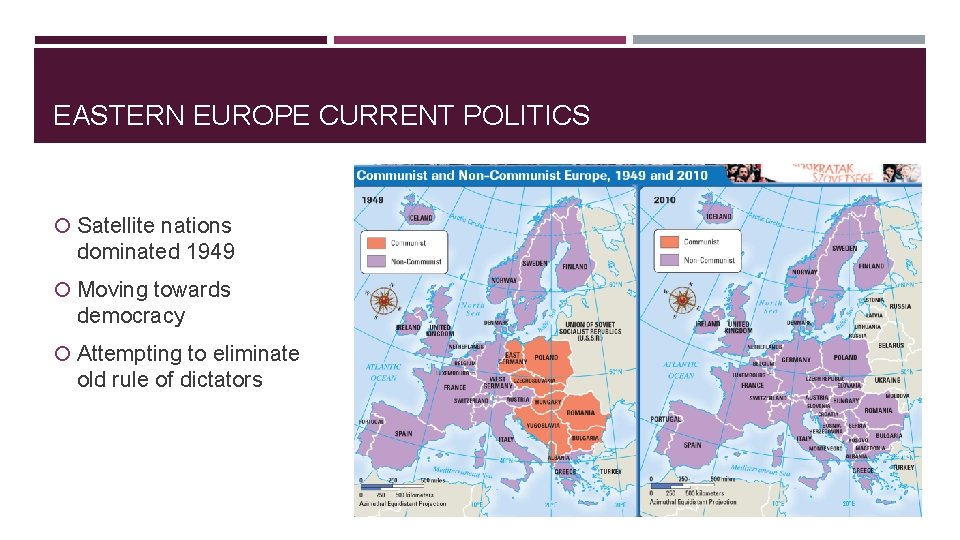
EASTERN EUROPE CURRENT POLITICS Satellite nations dominated 1949 Moving towards democracy Attempting to eliminate old rule of dictators
RUSSIA & THE WESTERN REPUBLICS
RISE & FALL OF THE SOVIET UNION Russian Revolution (1917) Formation of communist government (1922) Capital in Moscow 1939 – WWII under Stalin Beginning of Cold War (1940 s) Fall of USSR (1991)

GOVERNMENT CONTROL Government controlled all things Soviet gov’t killed ~14 million people Any form of protest punished Society slowly becoming more relaxed
TRANSCAUCASIA
HISTORICALLY INVADED REGION 1500 s - Russia expands southward 1700 s – Russia expands south of Caucus Mountains 1723 – Peter the great conquers Azerbaijan 1801 – Russia annexes Georgia 1828 – Russia annexes Armenia 1870 s – Transcaucasia part of Russian empire
POST-RUSSIAN REVOLUTION Transcaucasia briefly independent Red army takes over in 1920 s Developed politically just as ussr Deadly, killed because of political beliefs 1991 – regains independence, struggling to rebuild
CONFLICT OVER THE CASPIAN After ussr breakup, conflict over Caspian began Inland sea or lake? Decides how resources will be divided between 5 border countries Sea = each country has rights to resources depending on how much of country borders sea Lake = share equally among each country
CENTRAL ASIA
THE GREAT GAME Interest in controlling Central Asia Russia moving south, British concerned Both sides recruit soldiers in disguise Guide leaders through land via maps 19 th century – Russia controls Central Asia Independent after collapse or USSR
DIVIDE & CONQUER USSR gained control by taking advantage of fighting between ethnic groups If ethnic groups are fighting, no time to oppose USSR gov’t 5 new regions correlate to 5 largest ethnic groups Ethnic minorities inside larger countries
TODAY’S ISSUES USSR collapse = central authority weakened Increased crime, conflict & instability conflict in the caucus = Chechnya, Dagestan, Ingushetia, North Ossetia = many cultures
CHECHNYA Extremely violent region Chechnya wants independence = Russia invades Invaded twice, killed over 100, 000 1 st war = Chechen rebels fighting, peace agreement in 1996 2 nd war = bombing in Russia, blamed on Chechen terrorists 3 rd war = bombing in Moscow subway, Chechen responsibility
RUSSIAN CRIME Organized crime = major problem Russian mafia – criminal organization in the republic, grew rapidly in 1990 s Mafia controls sectors of economy and government via corruption Putin aggressive approach to Crimea & Ukraine & tightening freedoms of Russians
- Slides: 24