
Political Deadlock in the Canadas And the creation
- Slides: 8
Political Deadlock in the Canadas And the creation of the Great Coalition
� In the united Canada of the 1860’s, the government and opposition parties were almost equal in numbers - also…”loose fish” – independent members of the Elected Assembly � Result of this? - It was almost impossible to get “bills” passed or make new laws - No party could form a majority and no one could agree on a “coalition” - The government of Canada was in chaos
� “responsible government” requires “confidence” in the govt. and its policies - Voting against the govt. shows a feeling of “non-confidence” …and this meant calling a new election again & again… � Between � How 1849 -1864, there were 12 govts. did this happen? - both Canada West and Canada East received an equal # of seats in the Elected Assembly…even though the East had more people
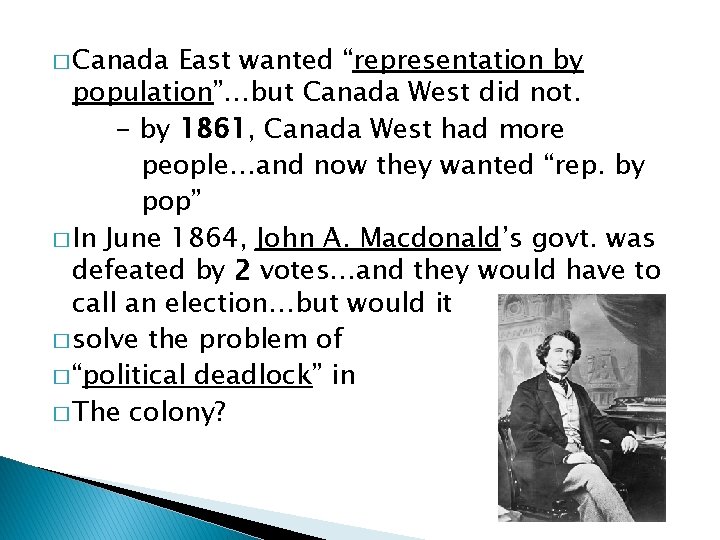
� Canada East wanted “representation by population”…but Canada West did not. - by 1861, Canada West had more people…and now they wanted “rep. by pop” � In June 1864, John A. Macdonald’s govt. was defeated by 2 votes…and they would have to call an election…but would it � solve the problem of � “political deadlock” in � The colony?
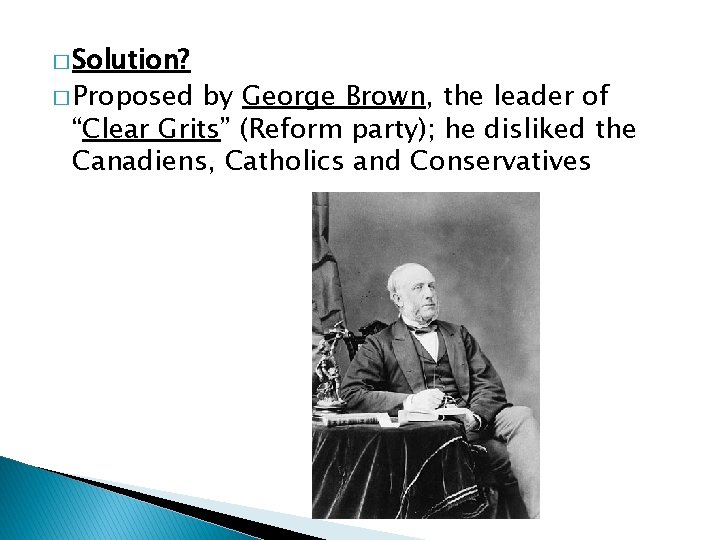
� Solution? � Proposed by George Brown, the leader of “Clear Grits” (Reform party); he disliked the Canadiens, Catholics and Conservatives
� An “all-party” committee, led by Brown, presented a report to the Assembly in June 1864 which said that deadlock could only be broken by: - A federal union or “confederation” of the 6 BNA colonies; prov. and 1 central govt. - splitting the united Canada into Ontario and Quebec; allow them to govern selves
� With a confederation, there would be 2 levels of govt. , each with an Elected Assembly - Federal – responsible for things that affect everyone in the union, e. g: taxes, currency, defence, trade… - Provincial – laws to deal with local matters
� Brown announced that he would join with Macdonald and the Conservatives (his rivals) to form a “coalition govt. ” and end deadlock � So… the leaders of the: - Clear Grits (Brown) - Conservatives (Macdonald) - Bleus (G. E. Cartier) + a leading Independent (Galt) shared leadership in the “Great Coalition” - committed to seeking a federal union of the Canadas and the Maritime colonies - “Confederation” was gaining momentum…