
Political Data Why important Political Understanding of Districts



- Slides: 14
Political Data Why important? • Political Understanding of Districts Political Fairness • Use with Racial Bloc Voting Analysis
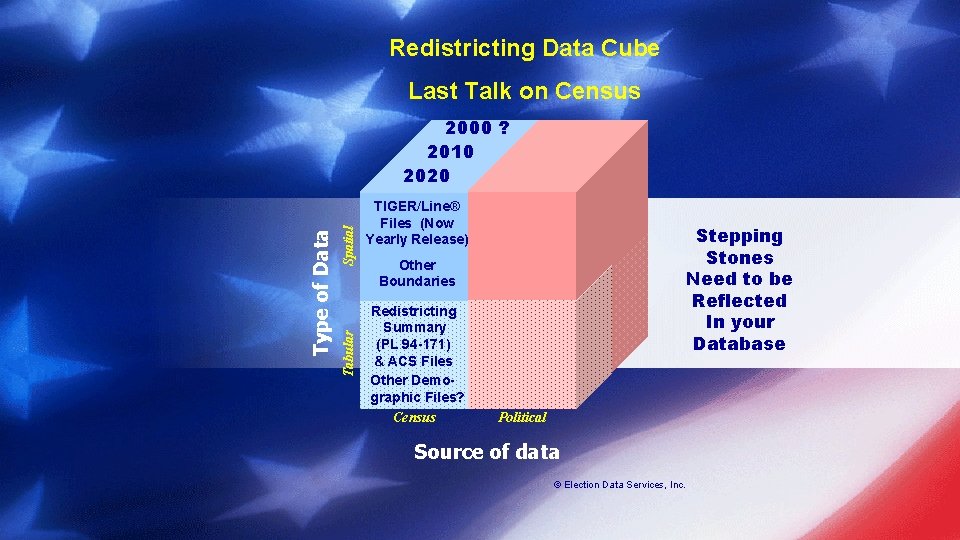
Redistricting Data Cube Last Talk on Census Spatial Tabular Type of Data 2000 ? 2010 2020 TIGER/Line® Files (Now Yearly Release) Stepping Stones Need to be Reflected In your Database Other Boundaries Redistricting Summary (PL 94 -171) & ACS Files Other Demographic Files? Census Political Source of data © Election Data Services, Inc.
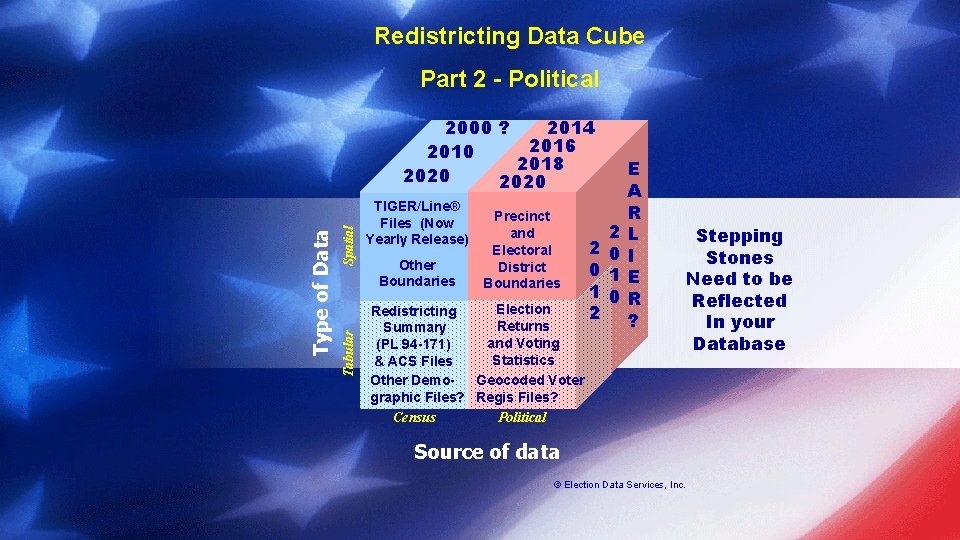
Redistricting Data Cube Part 2 - Political Spatial Tabular Type of Data 2000 ? 2014 2016 2010 2018 2020 TIGER/Line® Files (Now Yearly Release) Other Boundaries Precinct and Electoral District Boundaries Election Redistricting Returns Summary and Voting (PL 94 -171) Statistics & ACS Files Geocoded Voter Other Demographic Files? Regis Files? Census Political 2 2 0 0 1 1 0 2 E A R L I E R ? Source of data © Election Data Services, Inc. Stepping Stones Need to be Reflected In your Database
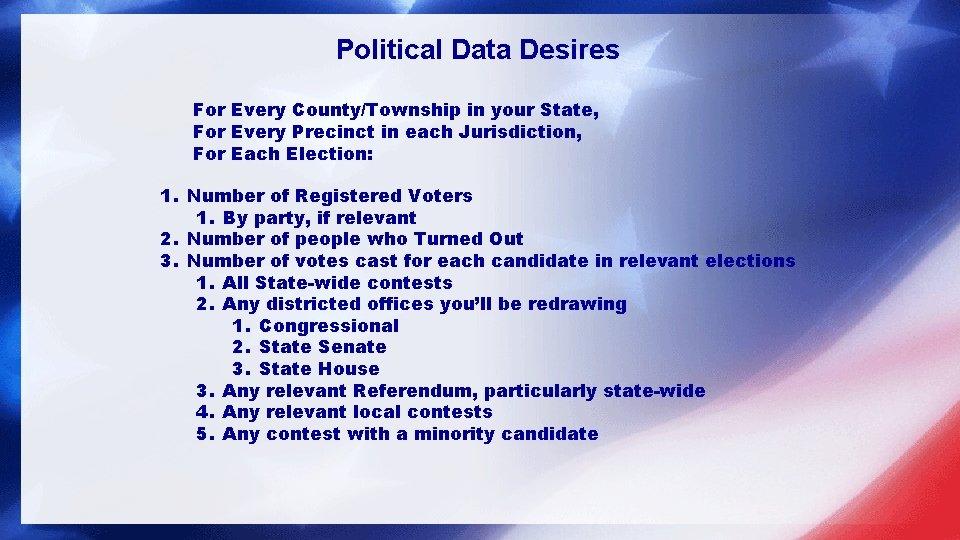
Political Data Desires For Every County/Township in your State, For Every Precinct in each Jurisdiction, For Each Election: 1. Number of Registered Voters 1. By party, if relevant 2. Number of people who Turned Out 3. Number of votes cast for each candidate in relevant elections 1. All State-wide contests 2. Any districted offices you’ll be redrawing 1. Congressional 2. State Senate 3. State House 3. Any relevant Referendum, particularly state-wide 4. Any relevant local contests 5. Any contest with a minority candidate
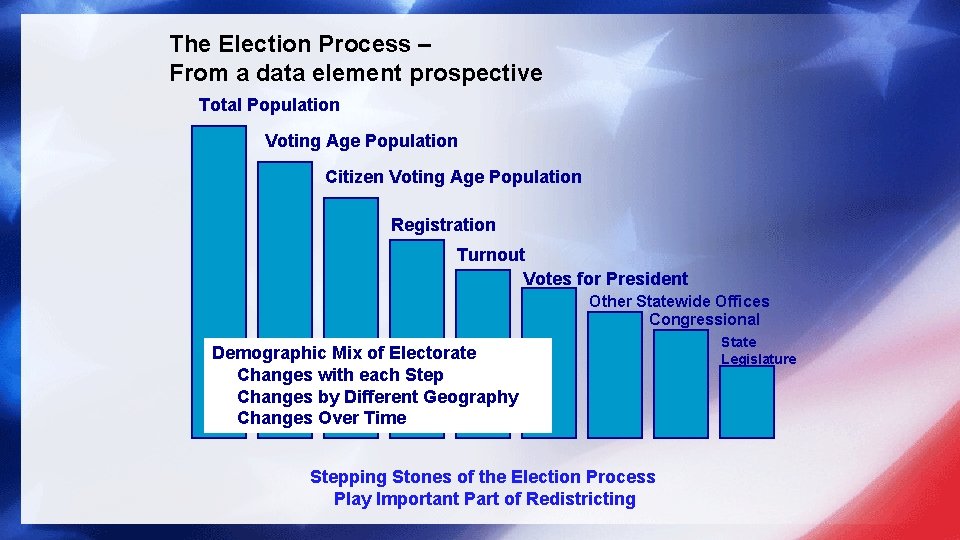
The Election Process – From a data element prospective Total Population Voting Age Population Citizen Voting Age Population Registration Turnout Votes for President Other Statewide Offices Congressional Demographic Mix of Electorate Changes with each Step Changes by Different Geography Changes Over Time Stepping Stones of the Election Process Play Important Part of Redistricting State Legislature
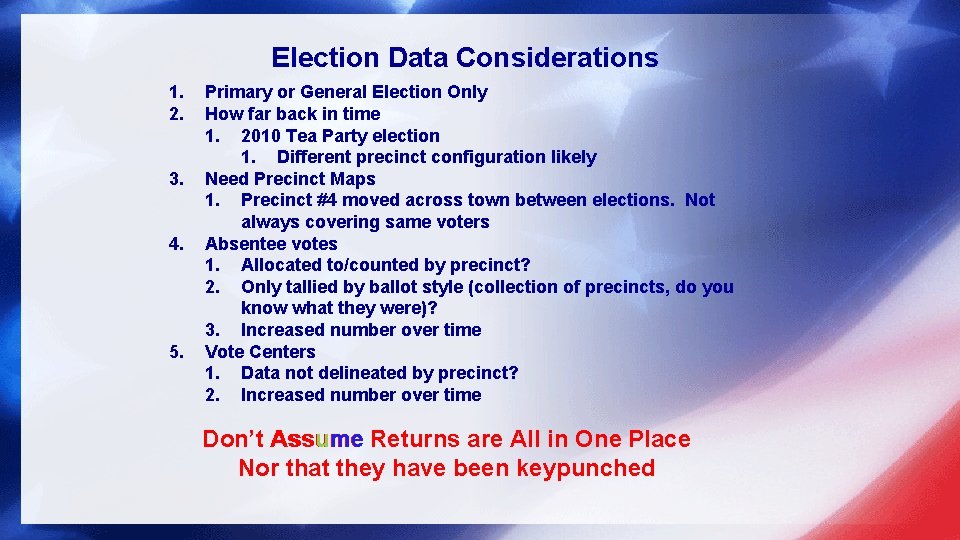
Election Data Considerations 1. 2. 3. 4. 5. Primary or General Election Only How far back in time 1. 2010 Tea Party election 1. Different precinct configuration likely Need Precinct Maps 1. Precinct #4 moved across town between elections. Not always covering same voters Absentee votes 1. Allocated to/counted by precinct? 2. Only tallied by ballot style (collection of precincts, do you know what they were)? 3. Increased number over time Vote Centers 1. Data not delineated by precinct? 2. Increased number over time Don’t Assume Returns are All in One Place Nor that they have been keypunched
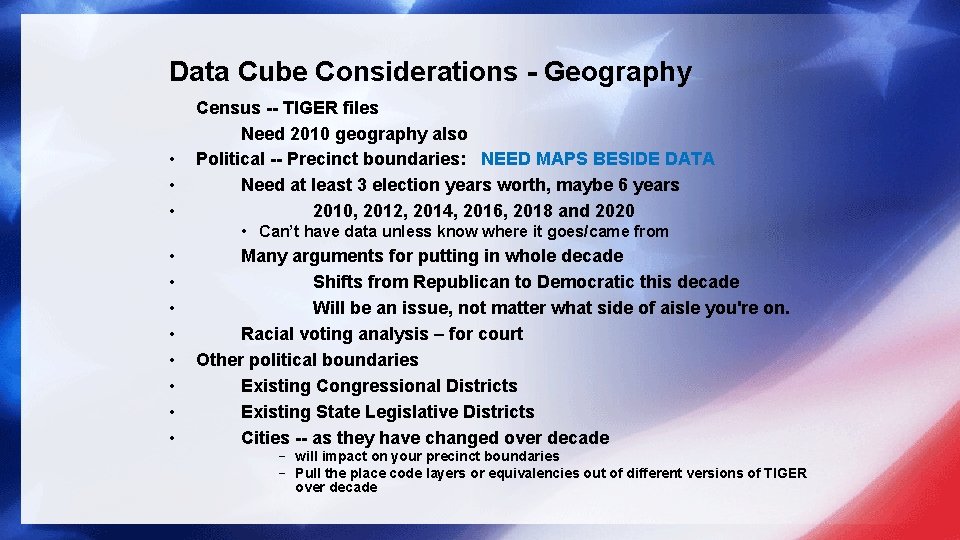
Data Cube Considerations - Geography • • • Census -- TIGER files Need 2010 geography also Political -- Precinct boundaries: NEED MAPS BESIDE DATA Need at least 3 election years worth, maybe 6 years 2010, 2012, 2014, 2016, 2018 and 2020 • Can’t have data unless know where it goes/came from • • Many arguments for putting in whole decade Shifts from Republican to Democratic this decade Will be an issue, not matter what side of aisle you're on. Racial voting analysis – for court Other political boundaries Existing Congressional Districts Existing State Legislative Districts Cities -- as they have changed over decade − will impact on your precinct boundaries − Pull the place code layers or equivalencies out of different versions of TIGER over decade
What Do We Do With All the Election Returns?
Disaggregation Process In order to bring precinct level election returns down to the block level, you’ll need to encounter the disaggregation process In other words, what percent of a precinct’s vote should come from each census block There a few different disaggregation methods that are available:
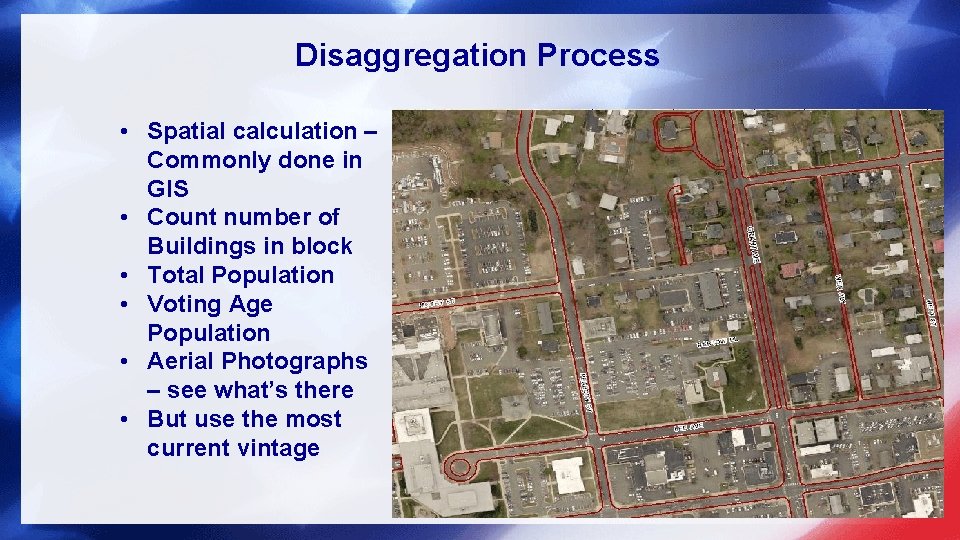
Disaggregation Process • Spatial calculation – Commonly done in GIS • Count number of Buildings in block • Total Population • Voting Age Population • Aerial Photographs – see what’s there • But use the most current vintage
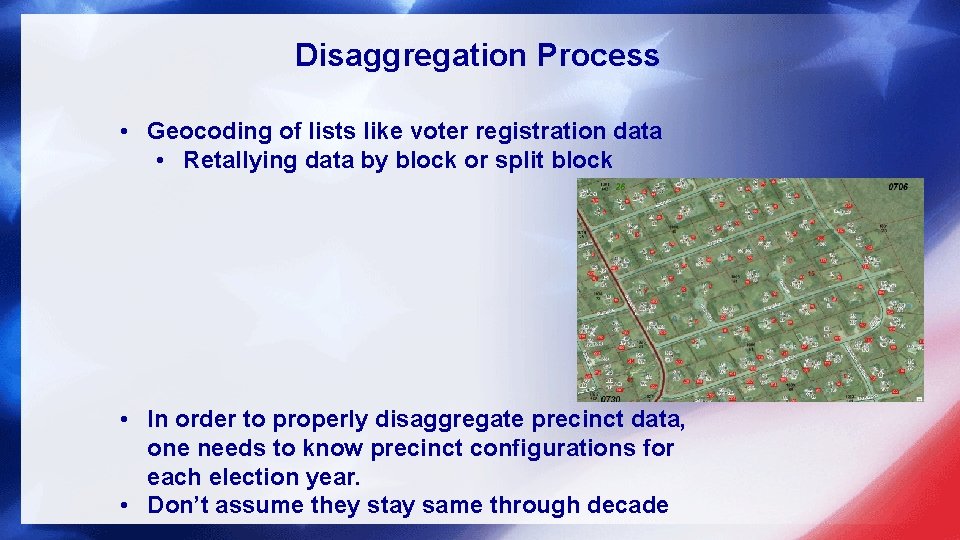
Disaggregation Process • Geocoding of lists like voter registration data • Retallying data by block or split block • In order to properly disaggregate precinct data, one needs to know precinct configurations for each election year. • Don’t assume they stay same through decade
Final Goal Election data gets assigned to Census Blocks, So Election Information gets tallied with the Census data when you build the districts you’re drawing. The Computer and GIS are just a big (and Fast) Adding Machine
Questions?
Thank you Kimball Brace President Election Data Services, Inc. 6171 Emerywood Court Manassas, VA 20112 (703 -580 -7267 or 202 -789 -2004) KBrace@electiondataservices. com or KBrace@aol. com www. electiondataservices. com