
Political and Economic Change I Political Change Methods






- Slides: 84
Political and Economic Change
I. Political Change Methods
Revolutions • A fundamental change in the political and social institutions of a society • Often accompanied by violence and civil war • Usually has grass roots popular support • More than just a leadership change • Examples – – – Industrial Revolution Bolshevik Revolution Chinese Revolution Iranian Revolution Mexican Revolution US in 1776?
Reforms • A significant change to the political or economic system to improve conditions • Not radical, absent of revolutionary change
Coup d'état • French translation means blow (stroke) to the state • Act of overthrowing the existing government, usually done by the military • May or may not lead to a revolution • Africa; between 1952 and 2000, 33 countries experienced 85 coups • Unsuccessful attempt in Russia against Boris Yeltsin
War • Clausewitz- “Politics by other means. ” • Types – Interstate conflicts – Civil War – Guerrilla Warfare • Examples – Nigerian Biafran Civil War – Iran-Iraq War
Political Change: Trends and Types
Political Liberalization • Occurs when a nondemocratic system becomes more politically open and less repressive • Government expands individual rights and freedoms • Usually takes place with a regime change • Enhances legitimacy • China’s change enhances their legitimacy • Soviet’s Gorbachev led to more destabilization
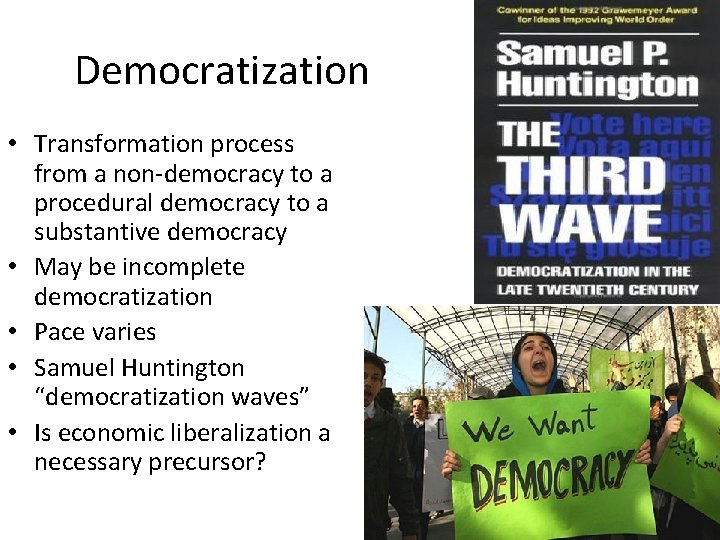
Democratization • Transformation process from a non-democracy to a procedural democracy to a substantive democracy • May be incomplete democratization • Pace varies • Samuel Huntington “democratization waves” • Is economic liberalization a necessary precursor?
Stages of democratization
1. Breakdown of nondemocracy (authoritarianism) • Democratization from above – CCP in China allowed privatization • Democratization from below – PRI movement in Mexico to open up politics
2. Establishment of democracy • • Decision stage Elites develop new institutional framework Country adopts new constitution National referendum to adopt new framework? – Russia
3. Consolidation of democracy • Democracy very unlikely to fall apart • Would require cataclysmic events to destroy • US during the Great Depression and WWII democracy stayed strong
When is democracy consolidated? • Free and fair elections are routine • Peaceful transition of power through elections is routine – 2 turnover rule • Can survive tests of democracy – US 2000 presidential election • Adherence to rule of law, peaceful • Legitimacy • Lengthy period of time – UK
Democratic breakdown • Democracy breaks down, creeping authoritarianism • Juan Linz 3 stages: – Crisis Stage • A huge event emerges, Russia & Chechnya – Breakdown stage • Rules change in the system and freedoms erode, since 1992, 50 journalists have been murdered for their professional activity in Russia – Re-equilibration • Acceptance of new less democratic rules, par for the course
II. Economic Change • Nationalization – Government takes over existing private companies, state monopolies – Oil in Mexico and Iran
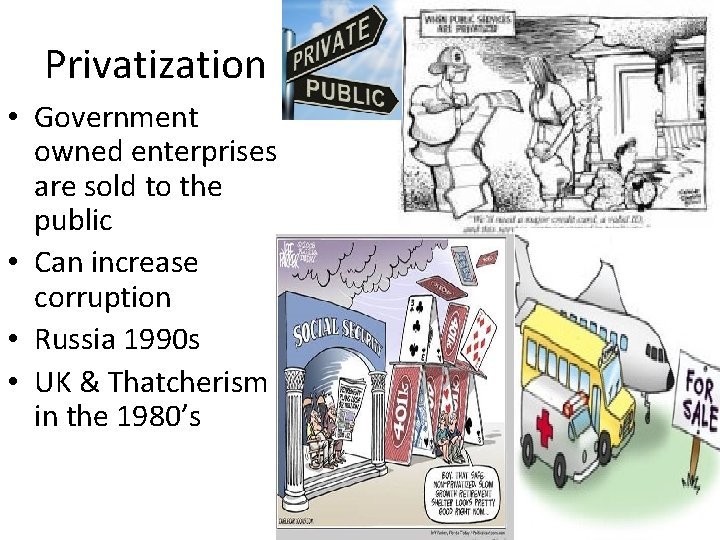
Privatization • Government owned enterprises are sold to the public • Can increase corruption • Russia 1990 s • UK & Thatcherism in the 1980’s
Economic Liberalization • Policies to move the country towards free market capitalism • Removal of price restrictions • Privatization of most industries • Encouragement of foreign direct investment • Reduce regulatory measures, trade barriers, and government spending • Mexico and NAFTA
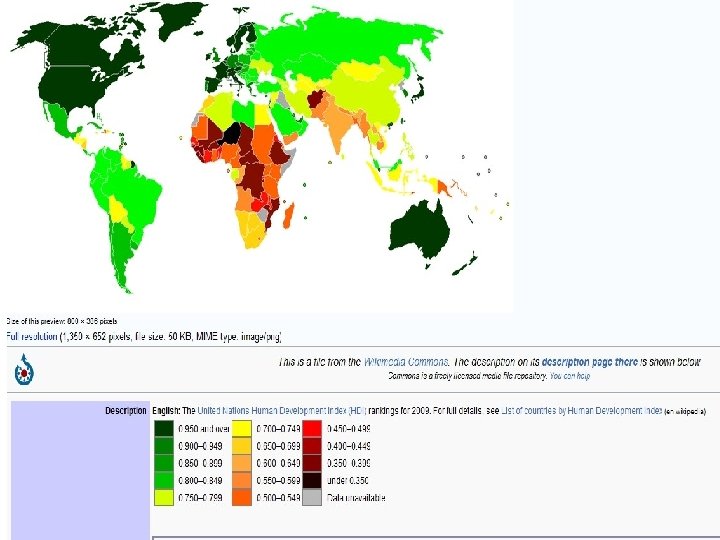
Economic Development Statistics • GDP – Gross domestic product – GNP just includes citizens • GDP per capita – GDP divided by population • HDI – Human development index – Infant mortality, literacy rates and other quality of life issues • PPP – Purchasing Power Parity – Takes into account the real cost of living
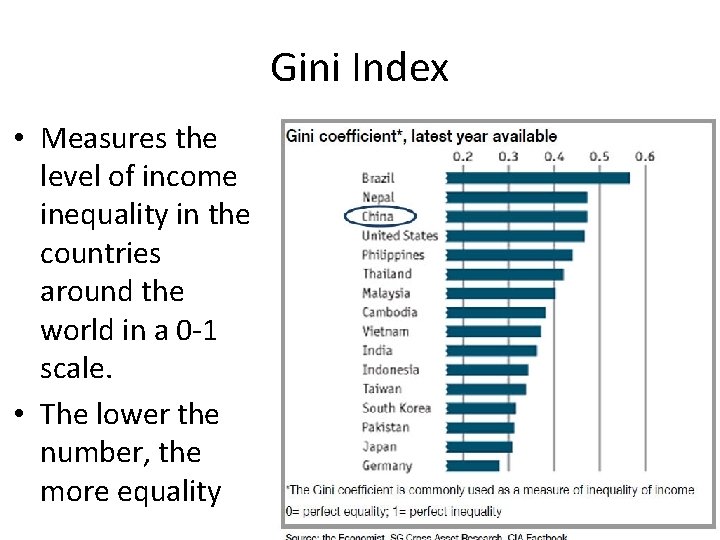
Gini Index • Measures the level of income inequality in the countries around the world in a 0 -1 scale. • The lower the number, the more equality
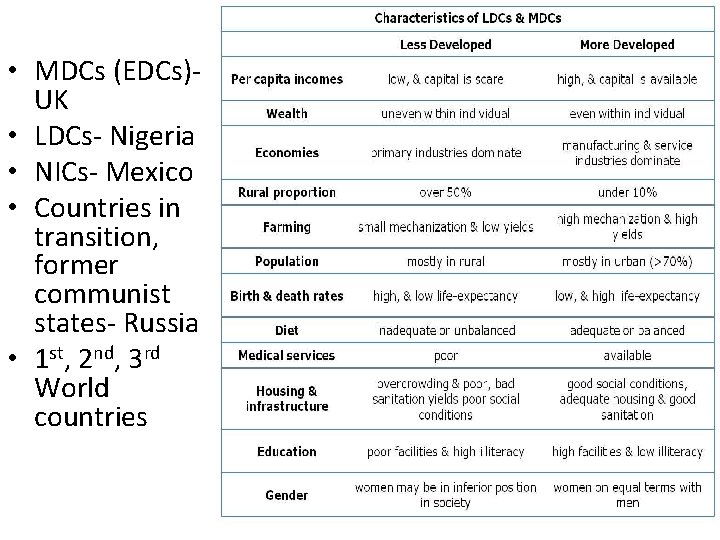
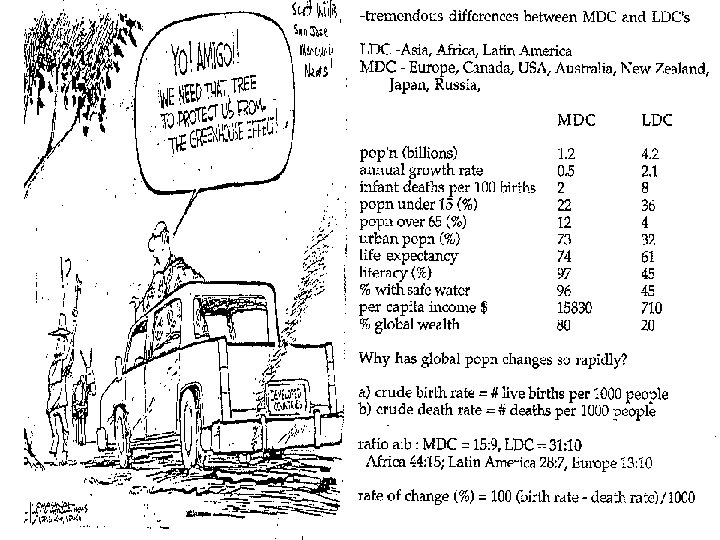
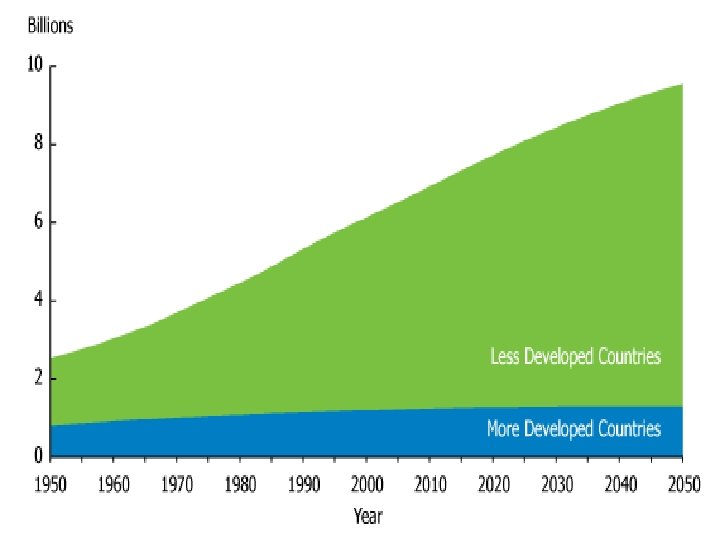
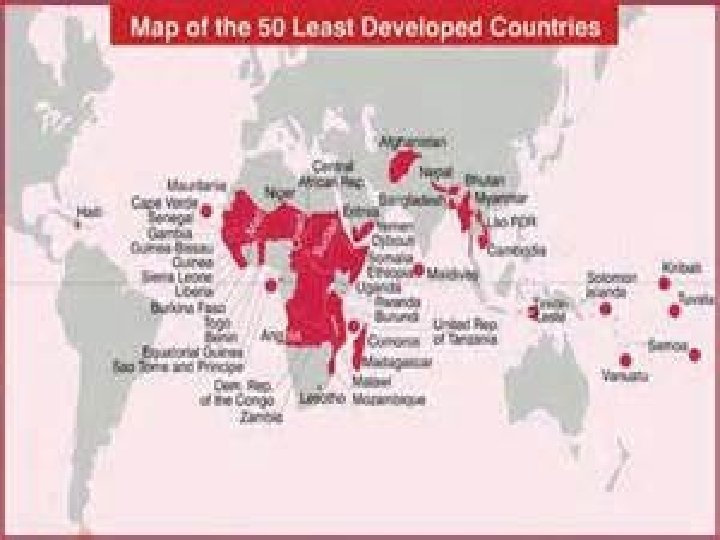
• MDCs (EDCs)UK • LDCs- Nigeria • NICs- Mexico • Countries in transition, former communist states- Russia • 1 st, 2 nd, 3 rd World countries
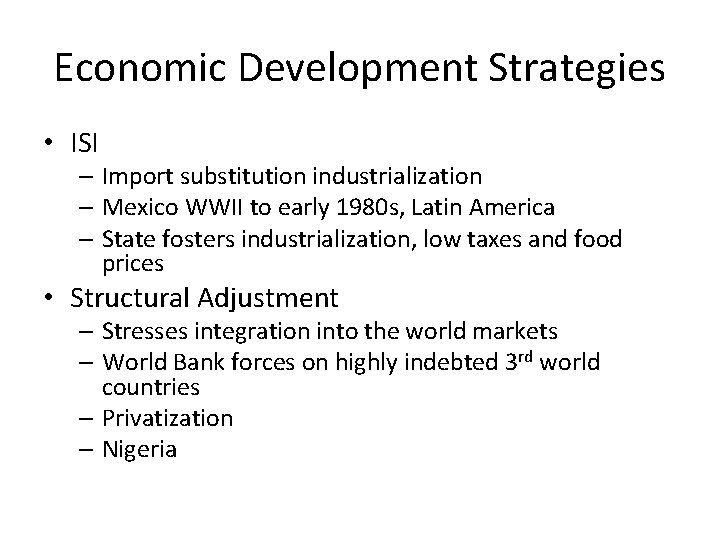
Economic Development Strategies • ISI – Import substitution industrialization – Mexico WWII to early 1980 s, Latin America – State fosters industrialization, low taxes and food prices • Structural Adjustment – Stresses integration into the world markets – World Bank forces on highly indebted 3 rd world countries – Privatization – Nigeria
Modernization Theory • Western model is ideal • Requires education, urbanization, middle class, human capital investments by government • Economic development is related cultural changes • Fosters democratization • China?
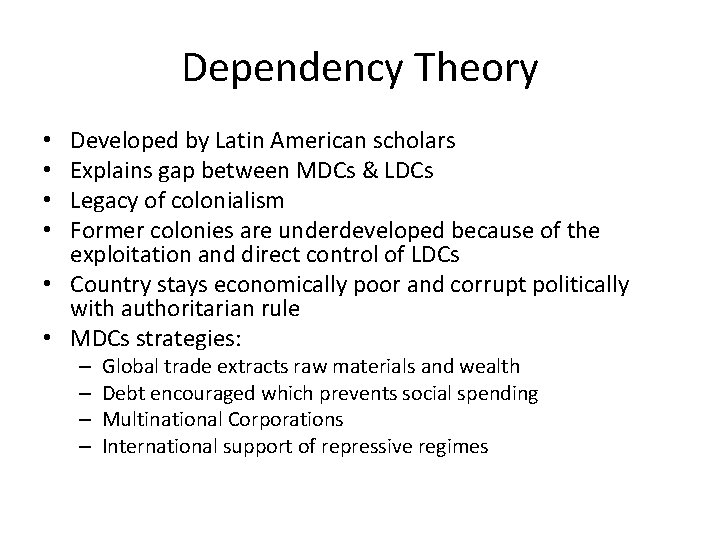
Dependency Theory Developed by Latin American scholars Explains gap between MDCs & LDCs Legacy of colonialism Former colonies are underdeveloped because of the exploitation and direct control of LDCs • Country stays economically poor and corrupt politically with authoritarian rule • MDCs strategies: • • – – Global trade extracts raw materials and wealth Debt encouraged which prevents social spending Multinational Corporations International support of repressive regimes
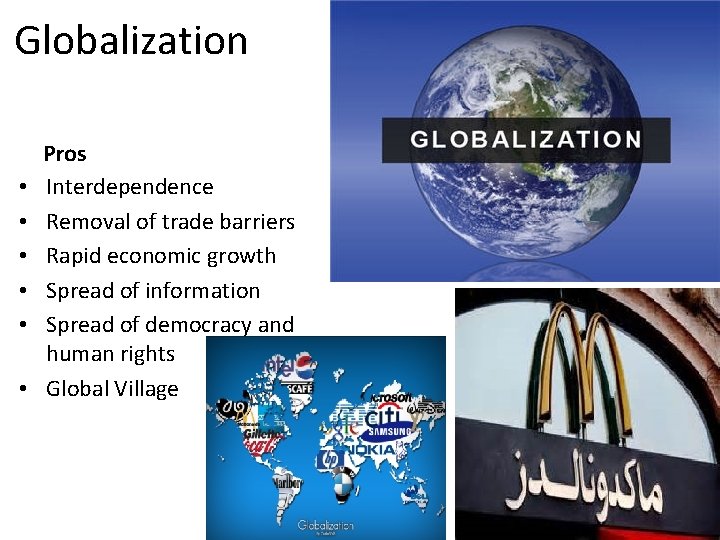
Globalization • • • Pros Interdependence Removal of trade barriers Rapid economic growth Spread of information Spread of democracy and human rights Global Village
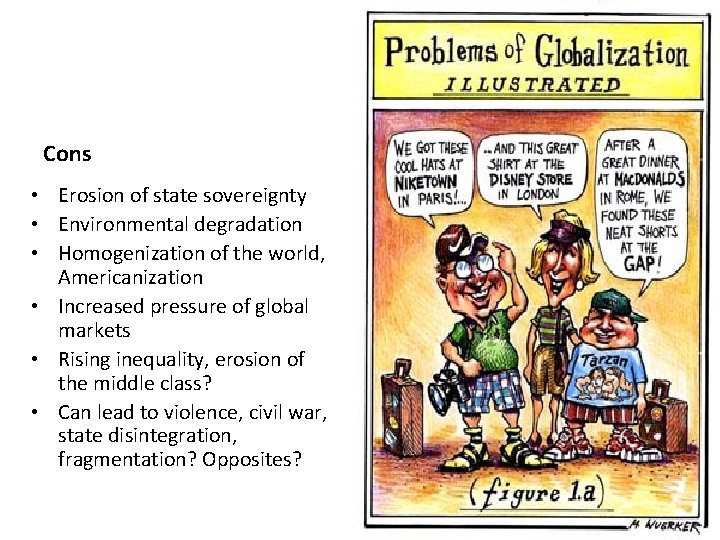
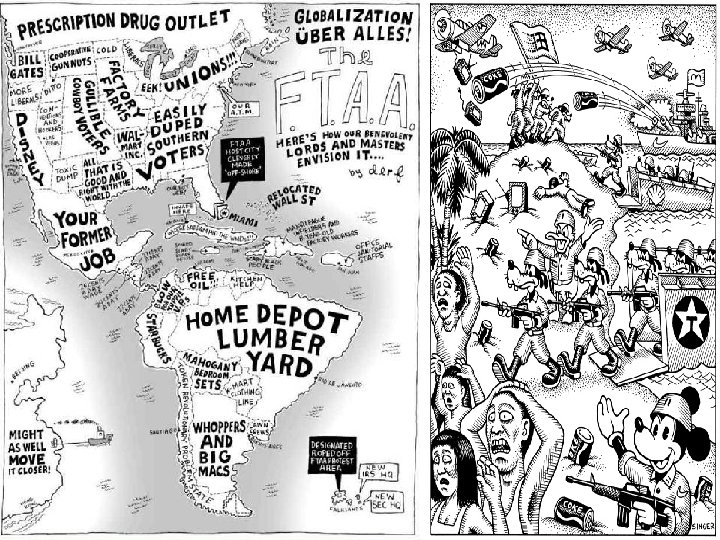
Cons • Erosion of state sovereignty • Environmental degradation • Homogenization of the world, Americanization • Increased pressure of global markets • Rising inequality, erosion of the middle class? • Can lead to violence, civil war, state disintegration, fragmentation? Opposites?
Whip Around
“A confidence problem exists on the part of the people of the region who desire democratic rule in principle, but remain suspicious of both the fashion with which democratization is presented and the purposes of the democratic world. ” -- Recep Tayyip Erdogan (Prime Minister of Turkey) PART FIVE: POLITICAL & ECONOMIC CHANGE
Political and Economic Change • Occur together and often influence one another • Types of Change – Reform • Does not advocate overthrowing basic institutions – Revolution • Either a major revision or overthrowing basic institutions • Usually has major impact in more than one area – Coup d'état • Replace leadership with new leaders
Attitudes Toward Change • Radicalism – – “When you are right you cannot Rapid, dramatic changes be too radical; you are Replace current system with somethingwhen better wrong, you cannot be too conservative. “ Gradual change instead of revolution Martin Luther King, Jr. • Liberalism – • Conservatism – Less supportive of change • Reactionaries – Protect against change
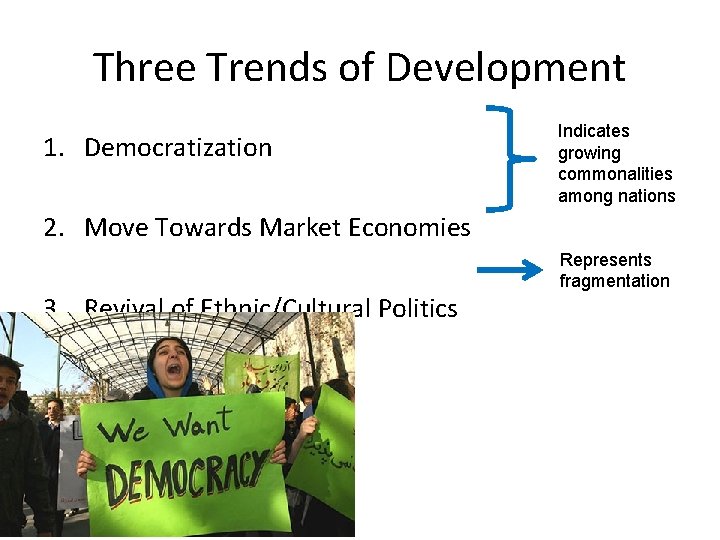
Three Trends of Development 1. Democratization Indicates growing commonalities among nations 2. Move Towards Market Economies 3. Revival of Ethnic/Cultural Politics Represents fragmentation
Review of Democratization • Democratization: – The spread of representative governments to more countries and the process of making governments more representative… – The transformation process from a nondemocratic regime to a illiberal/procedural democracy to a liberal/substantive democracy • What must be present to qualify as a procedural democracy? • What must be present to qualify as a substantive democracy?
Review of Democratization • Discussion Question: – TRUE or FALSE (be prepared to defend your answer): – The presence of an illiberal/procedural is a necessary condition for development of a liberal/substantive democracy
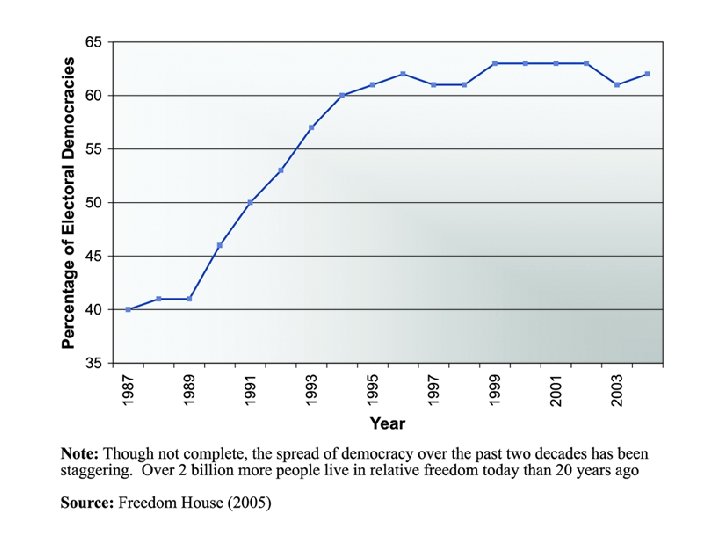
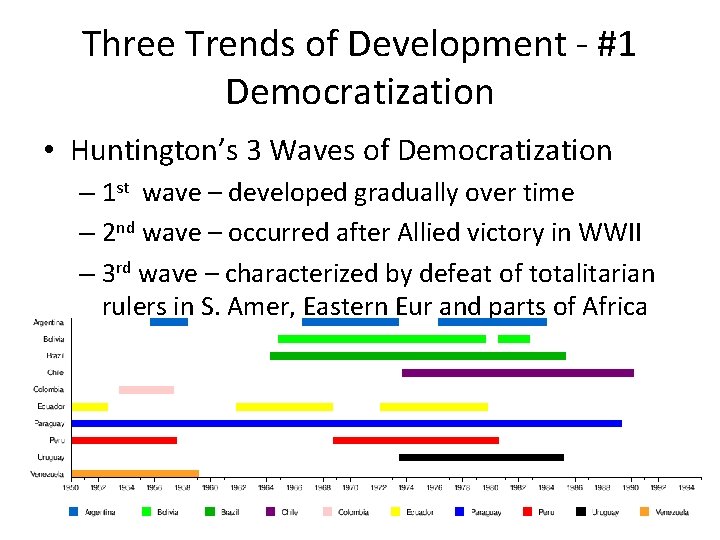
Three Trends of Development - #1 Democratization • Huntington’s 3 Waves of Democratization – 1 st wave – developed gradually over time – 2 nd wave – occurred after Allied victory in WWII – 3 rd wave – characterized by defeat of totalitarian rulers in S. Amer, Eastern Eur and parts of Africa
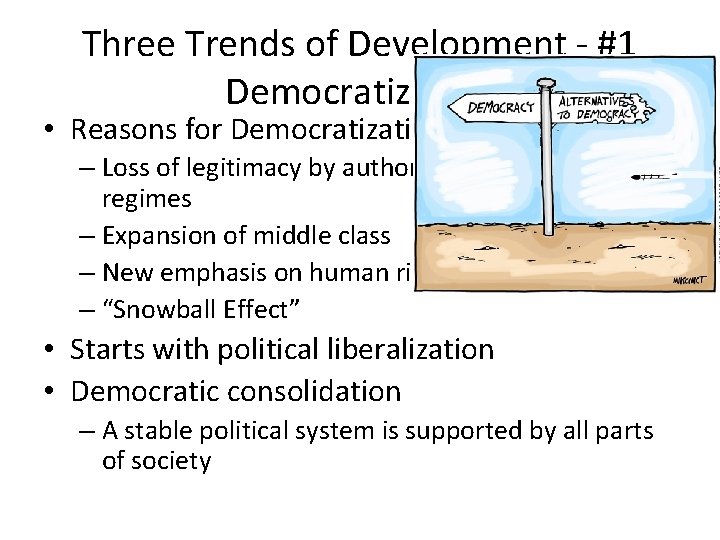
Three Trends of Development - #1 Democratization • Reasons for Democratization – Loss of legitimacy by authoritarian regimes – Expansion of middle class – New emphasis on human rights – “Snowball Effect” • Starts with political liberalization • Democratic consolidation – A stable political system is supported by all parts of society
Three Trends of Development - #2 Economic Liberalism and Market Economies • Ideology of liberalism from 19 th century Europe – Bourgeoisie – middle class professionals/businessmen • More political & economic freedoms – Right to own property, freedom of speech, representation, free trade – Radicals (such as Karl Marx) advocated more equality • Command Economy – Government owned industrial enterprises & sales
Three Trends of Development - #2 Economic Liberalism and Market Economies • Discussion Question: • What was a major problem for 20 th century communist countries with command economies?
Three Trends of Development - #2 Economic Liberalism and Market Economies • Discussion Question: What was a major problem for 20 th century communist countries with command economies? • A major problem was that economic growth of major industries had not translated into higher living standards for citizens
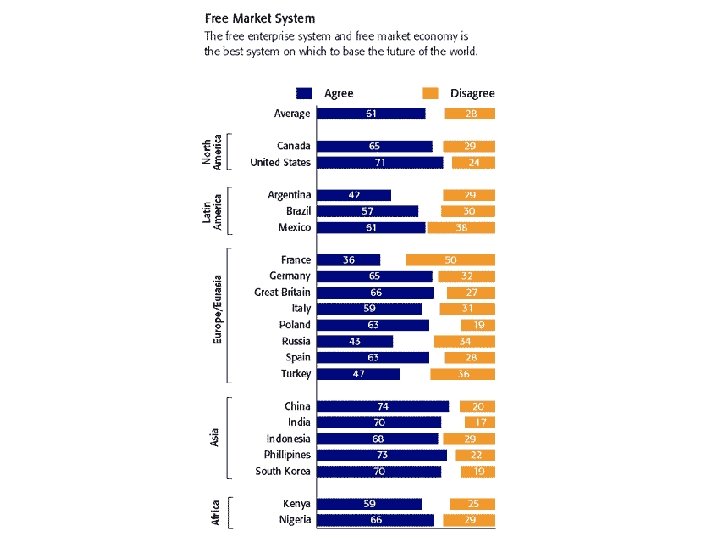
Three Trends of Development - #2 Economic Liberalism and Market Economies • Trend toward market economies based on private ownership of property and little interference from govt regulation – Mixed economy – some government involvement – Pure Market economy – no government involvement • Economic Liberalization: – Process of limiting the power of the state over private property and market forces • Privatization:
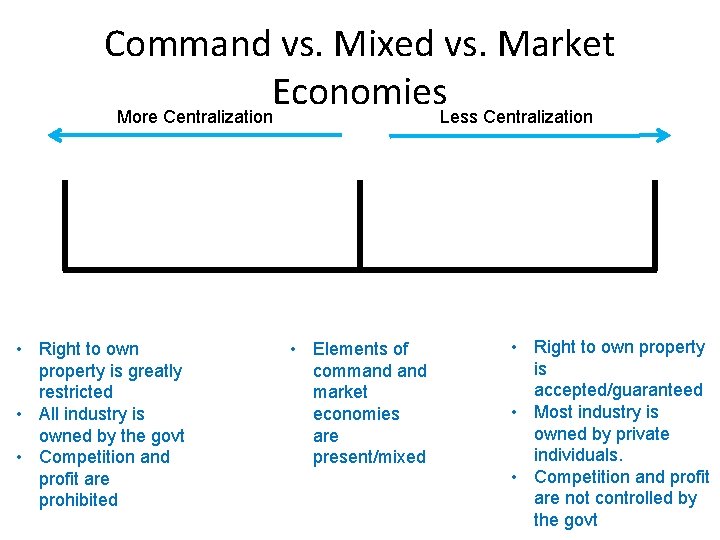
Command vs. Mixed vs. Market Economies More Centralization Less Centralization • Right to own property is greatly restricted • All industry is owned by the govt • Competition and profit are prohibited • Elements of command market economies are present/mixed • Right to own property is accepted/guaranteed • Most industry is owned by private individuals. • Competition and profit are not controlled by the govt
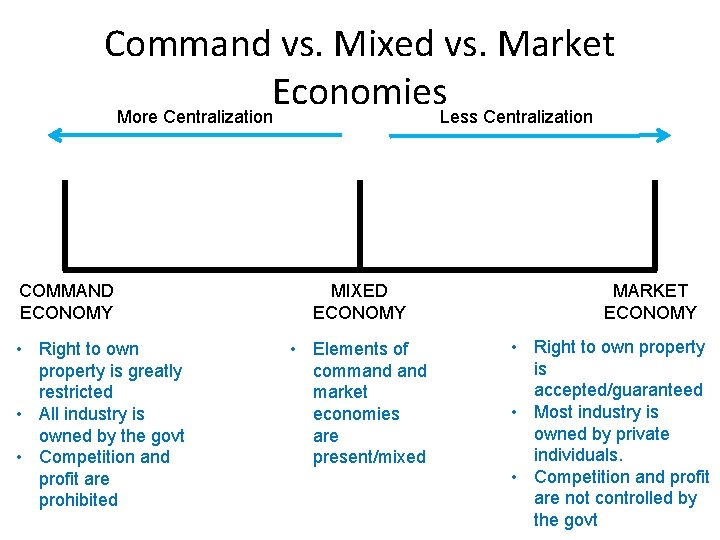
Command vs. Mixed vs. Market Economies More Centralization Less Centralization COMMAND ECONOMY • Right to own property is greatly restricted • All industry is owned by the govt • Competition and profit are prohibited MIXED ECONOMY • Elements of command market economies are present/mixed MARKET ECONOMY • Right to own property is accepted/guaranteed • Most industry is owned by private individuals. • Competition and profit are not controlled by the govt
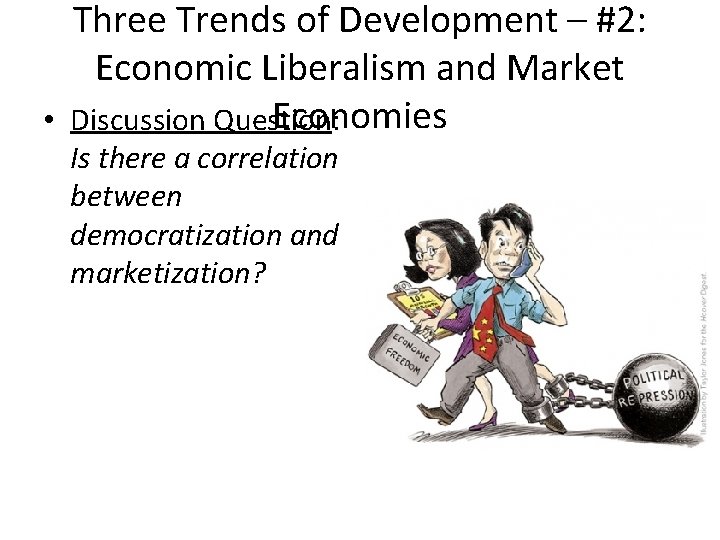
Three Trends of Development – #2: Economic Liberalism and Market Economies • Discussion Question: Is there a correlation between democratization and marketization?
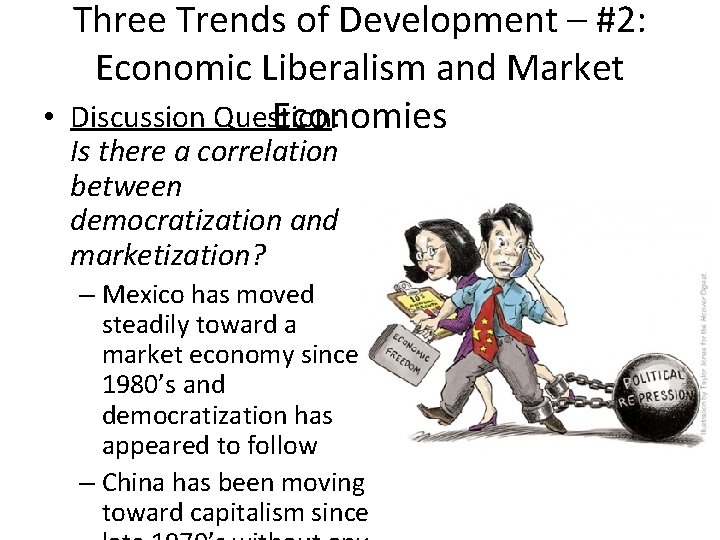
Three Trends of Development – #2: Economic Liberalism and Market • Discussion Question: Economies Is there a correlation between democratization and marketization? – Mexico has moved steadily toward a market economy since 1980’s and democratization has appeared to follow – China has been moving toward capitalism since
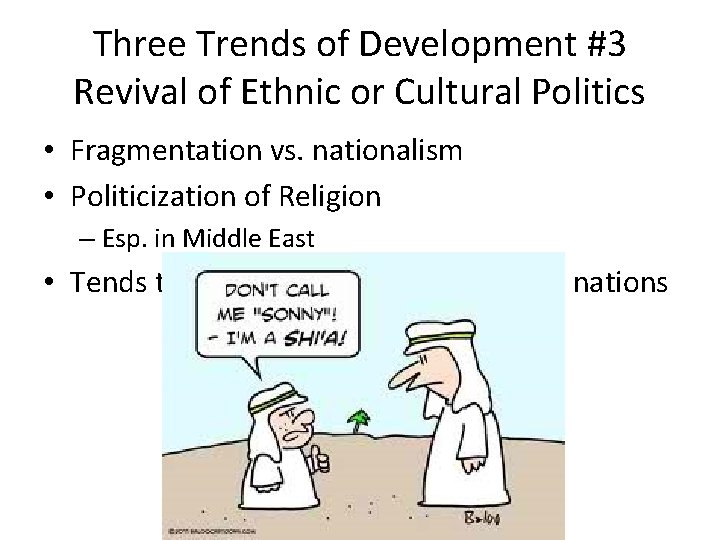
Three Trends of Development #3 Revival of Ethnic or Cultural Politics • Fragmentation vs. nationalism • Politicization of Religion – Esp. in Middle East • Tends to emphasize difference among nations
PART TWO: SOVEREIGNTY, AUTHORITY & “Sovereignty is not given, it is taken. ” -- Kemal Ataturk (Turkish soldier) POWER (CONTINUED) “I have as much authority as the Pope, I just don't have as many people DEMOCRATIZATION who believe it. ” -- George Carlin (comedian)
Fostering Democracy, Human Rights, and Civil Liberties • Democratization is the second major force transforming contemporary political systems. – Includes the enhancement of human rights and the expansion of freedom.
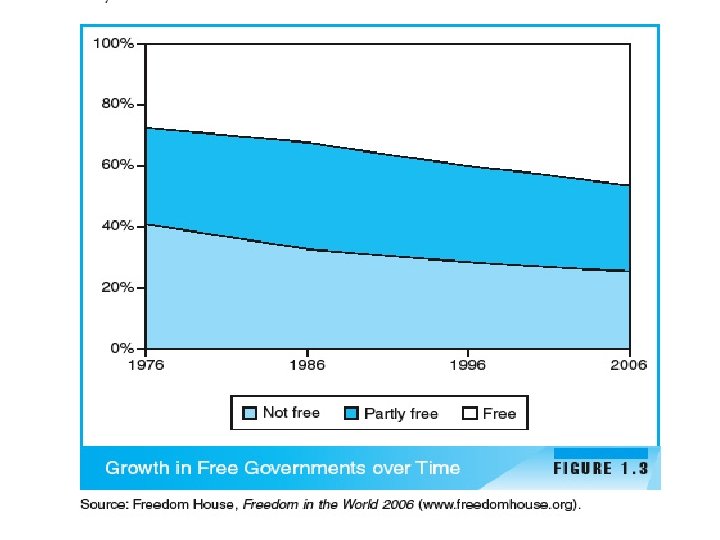
Fostering Democracy, Human Rights, and Civil Liberties • The most important general distinction in classifying political systems: – Democratic systems versus authoritarian systems – Authoritarian: lack one or several of the defining features of democracy • Oligarchy • Totalitarian – Waves of Democratization • First: during the first half of the 20 th century: Western states • Second: 1943 to 1960 s: newly independent states and defeated authoritarian powers • Third: 1974 involving Southern Europe, East Asia, Latin America, and a number of African states. • Result: democracy more of a common goal of the global
Types of Regimes - Democracy • • What is Democracy? The word democracy means many different things to many different people. For many, “democratic” means good things and “nondemocratic” means bad. • Basic Definition: political power exercised either directly or indirectly through participation, competition, and liberty.
Types of Regimes - Democracy • • Various Textbook Definitions: (Almond) - a political system in which citizens enjoy a number of basic civil and political rights, and in which their most important political leaders are elected in free and fair elections and accountable under a rule of law. • (Barrington) A regime type that involves the selection of government officials through free and fair elections, a balance between the principle of majority rule and the protection of minority interests, and constitutional limitations on government actions.
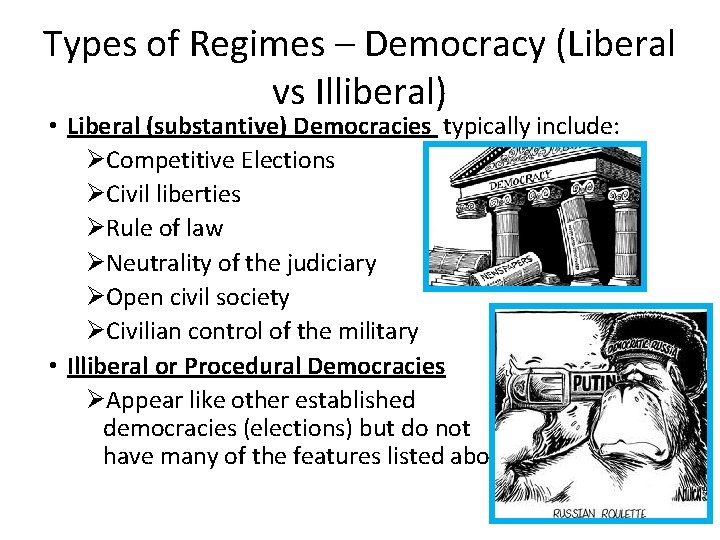
Types of Regimes – Democracy (Liberal vs Illiberal) • Liberal (substantive) Democracies typically include: ØCompetitive Elections ØCivil liberties ØRule of law ØNeutrality of the judiciary ØOpen civil society ØCivilian control of the military • Illiberal or Procedural Democracies ØAppear like other established democracies (elections) but do not have many of the features listed above
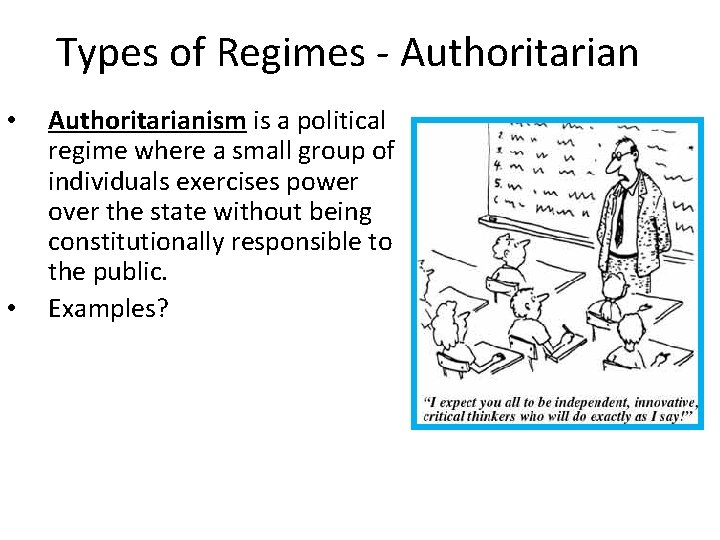
Types of Regimes - Authoritarian • • Authoritarianism is a political regime where a small group of individuals exercises power over the state without being constitutionally responsible to the public. Examples?
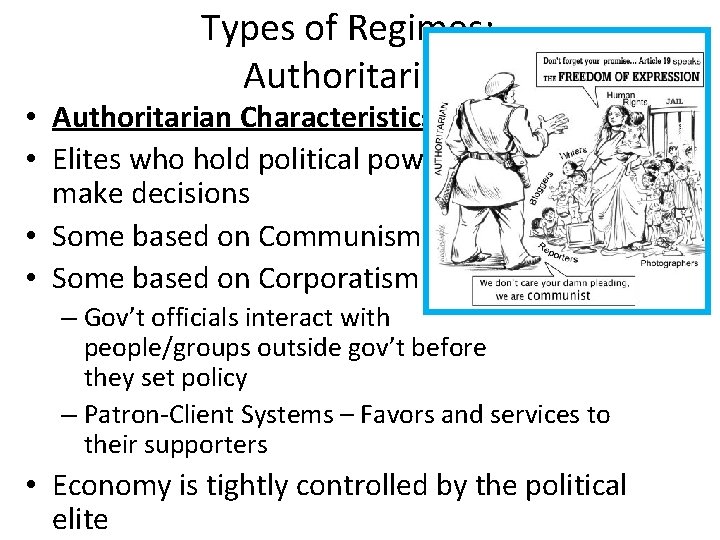
Types of Regimes: Authoritarian • Authoritarian Characteristics: • Elites who hold political power make decisions • Some based on Communism • Some based on Corporatism – Gov’t officials interact with people/groups outside gov’t before they set policy – Patron-Client Systems – Favors and services to their supporters • Economy is tightly controlled by the political elite
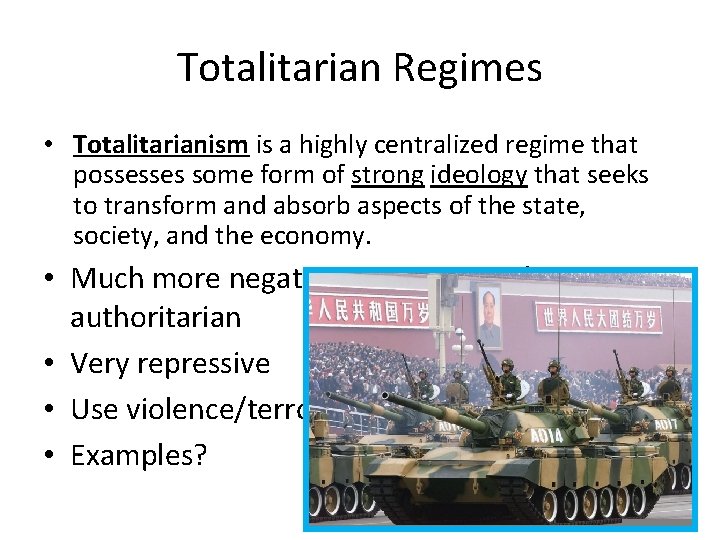
Totalitarian Regimes • Totalitarianism is a highly centralized regime that possesses some form of strong ideology that seeks to transform and absorb aspects of the state, society, and the economy. • Much more negative connotation than authoritarian • Very repressive • Use violence/terror • Examples?
Military Regimes • Military rule – Nondemocratic – Formerly prevalent in Latin America, Africa and parts of Asia – Usually begins with a coup d’etat – Examples?
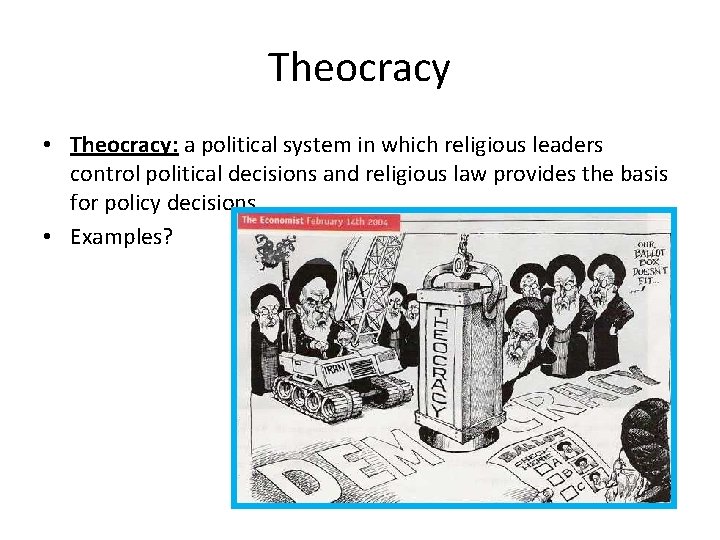
Theocracy • Theocracy: a political system in which religious leaders control political decisions and religious law provides the basis for policy decisions. • Examples?
“Our political institutions work remarkably well. They are designed to clang against each other. The noise is democracy at work. ” -- Michael Novak (American philosopher) PART THREE: POLITICAL STRUCTURES/INSTITUTIONS
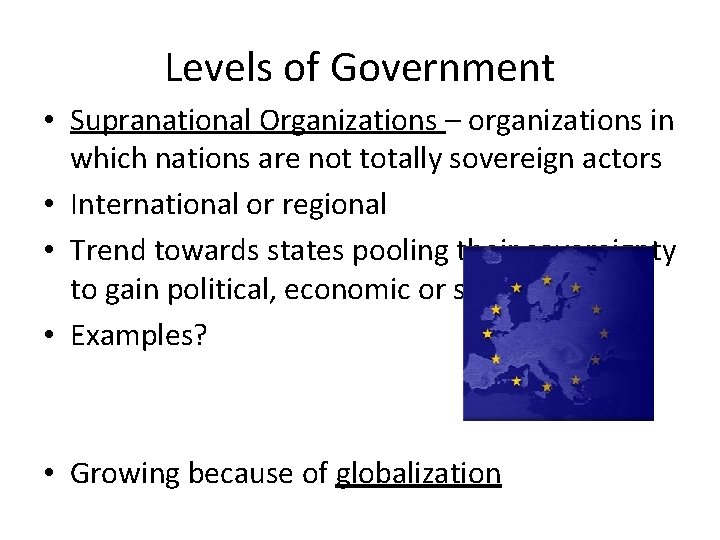
Levels of Government • Supranational Organizations – organizations in which nations are not totally sovereign actors • International or regional • Trend towards states pooling their sovereignty to gain political, economic or social clout • Examples? • Growing because of globalization
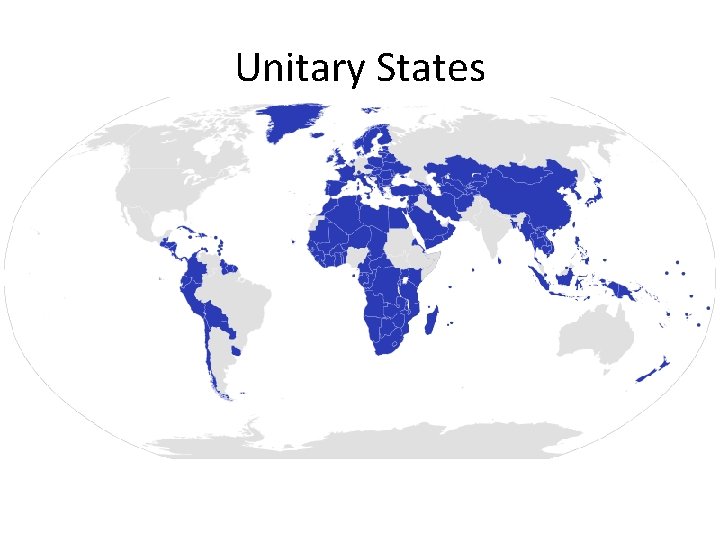
Levels of Government • Unitary System • Concentrates all policymaking powers in one geographic place • Central government is responsible for most policies • Most countries have unitary • Federal System • Power divided between the central government & subunits • Regional bodies have significant powers (taxation, lawmaking, keeping order) • Confederal
Unitary States
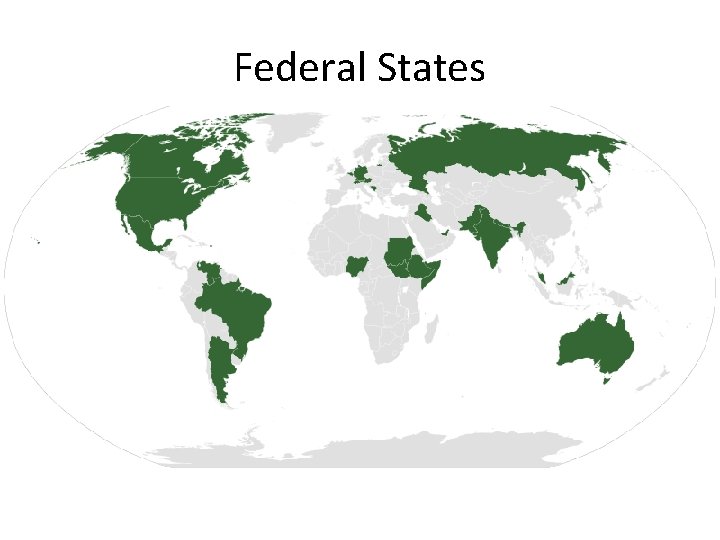
Federal States
Confederate States • Historical examples: – US before Constitution was ratified (originally governed by the Articles of Confederation) – Confederate States of America (American South during Civil War) – Serbia & Montenegro (2003 – 2006) • Modern examples (arguable): – Iroquois Confederacy (consists of six Native American groups) – Canada
Levels of Government • Advantages of Federal System: ü Makes it easier to govern a very large country (physically largest countries tend to have fed arrangements – not China though) ü Better accommodates regional differences ü Helps guard against concentration of political power • Disadvantages: ü Lack of uniformity in policy (ex: voting
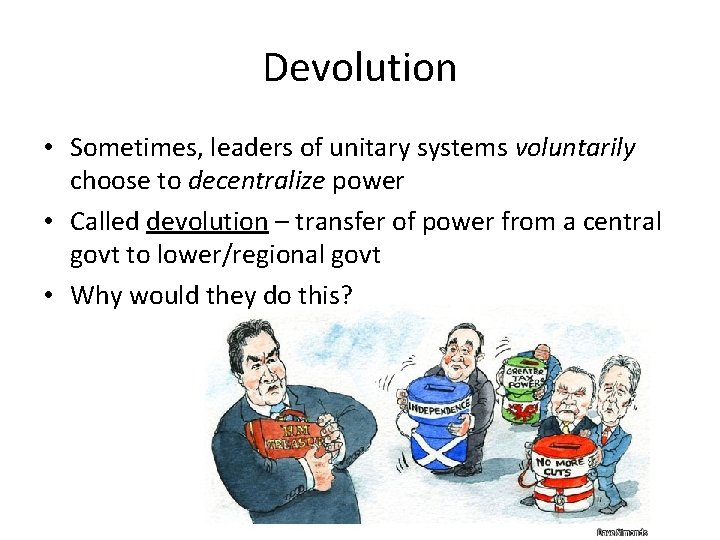
Devolution • Sometimes, leaders of unitary systems voluntarily choose to decentralize power • Called devolution – transfer of power from a central govt to lower/regional govt • Why would they do this?
Three Causes of Devolution • Ethnic Forces – Identity based on language, religion, customs – Ethnonationalism • See themselves as a distinct nation with a right to autonomy – Example? • Economic Forces – Regional inequalities in income or standard of living • Spatial Forces
Political Institutions • Structures of the political system – Carry out the work of governing – Vary by country – Common structures that exist in most countries are legislatures, executives, judicial systems, bureaucracies, and armies
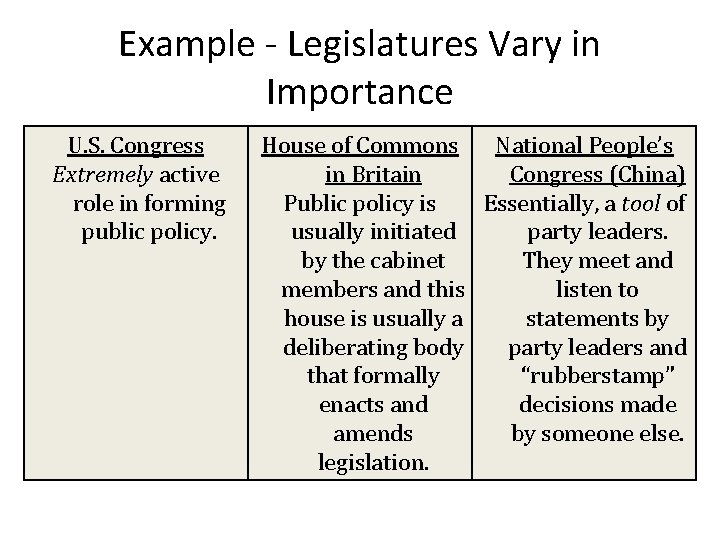
Example - Legislatures Vary in Importance U. S. Congress Extremely active role in forming public policy. House of Commons National People’s in Britain Congress (China) Public policy is Essentially, a tool of usually initiated party leaders. by the cabinet They meet and members and this listen to house is usually a statements by deliberating body party leaders and that formally “rubberstamp” enacts and decisions made amends by someone else. legislation.
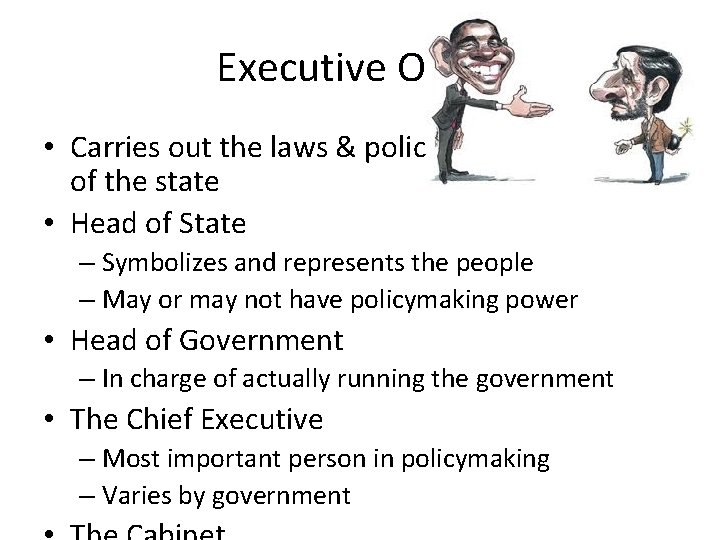
Executive Office • Carries out the laws & policies of the state • Head of State – Symbolizes and represents the people – May or may not have policymaking power • Head of Government – In charge of actually running the government • The Chief Executive – Most important person in policymaking – Varies by government
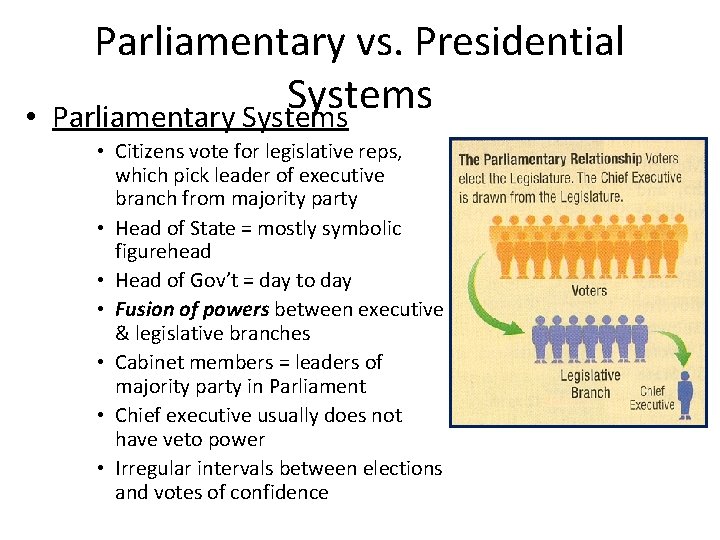
• Parliamentary vs. Presidential Systems Parliamentary Systems • Citizens vote for legislative reps, which pick leader of executive branch from majority party • Head of State = mostly symbolic figurehead • Head of Gov’t = day to day • Fusion of powers between executive & legislative branches • Cabinet members = leaders of majority party in Parliament • Chief executive usually does not have veto power • Irregular intervals between elections and votes of confidence
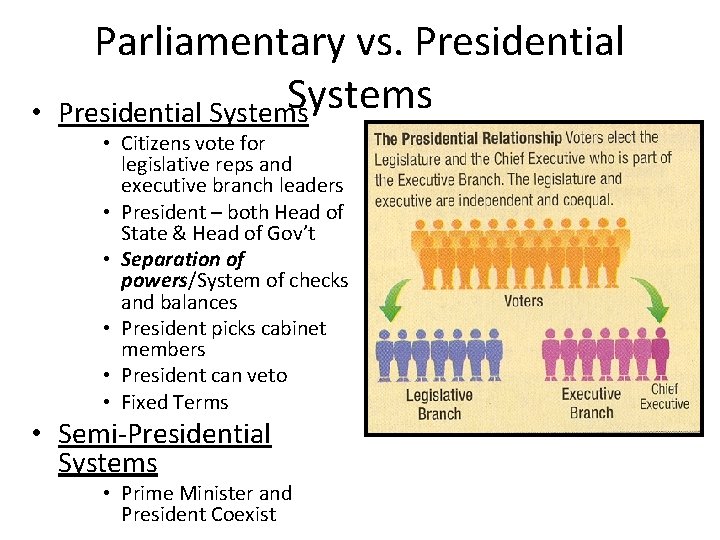
• Parliamentary vs. Presidential Systems • Citizens vote for legislative reps and executive branch leaders • President – both Head of State & Head of Gov’t • Separation of powers/System of checks and balances • President picks cabinet members • President can veto • Fixed Terms • Semi-Presidential Systems • Prime Minister and President Coexist
• Parliamentary vs. Presidential Systems Parliamentary: – Advantages: efficiency in passing legislation, clearer accountability to voters – Disadvantages: instability, hasty decision-making • Presidential: – Adv: checks power of legislature; since directly elected, more of a national mandate – Disadv: difficulty removing unpopular president until next election, gridlock!, creeping authoritarianism • Semi Pres: – Adv: shields pres from criticism (can blame on PM), can remove unpopular PM and maintain stability from pres. fixed term, additional checks and balances
Legislatures • Branch that makes laws • Bicameral – Two houses – Advantages/Disadvantages? • Unicameral – One house – Advantages/Disadvantages?
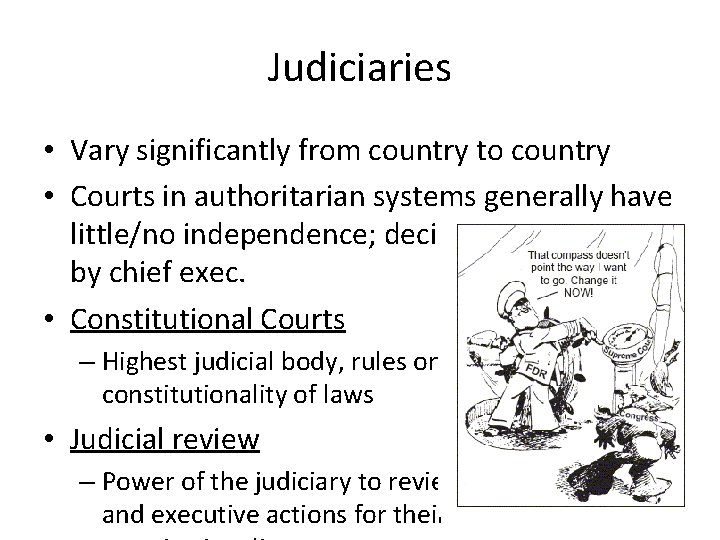
Judiciaries • Vary significantly from country to country • Courts in authoritarian systems generally have little/no independence; decisions controlled by chief exec. • Constitutional Courts – Highest judicial body, rules on constitutionality of laws • Judicial review – Power of the judiciary to review laws and executive actions for their
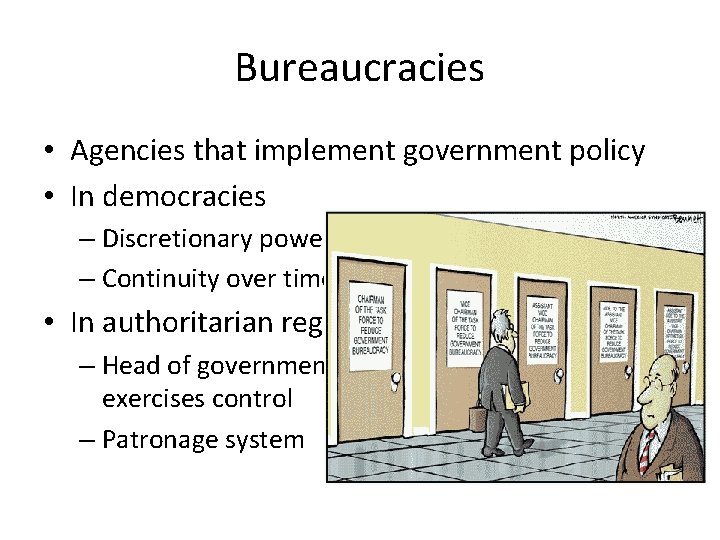
Bureaucracies • Agencies that implement government policy • In democracies – Discretionary power – Continuity over time • In authoritarian regimes – Head of government exercises control – Patronage system
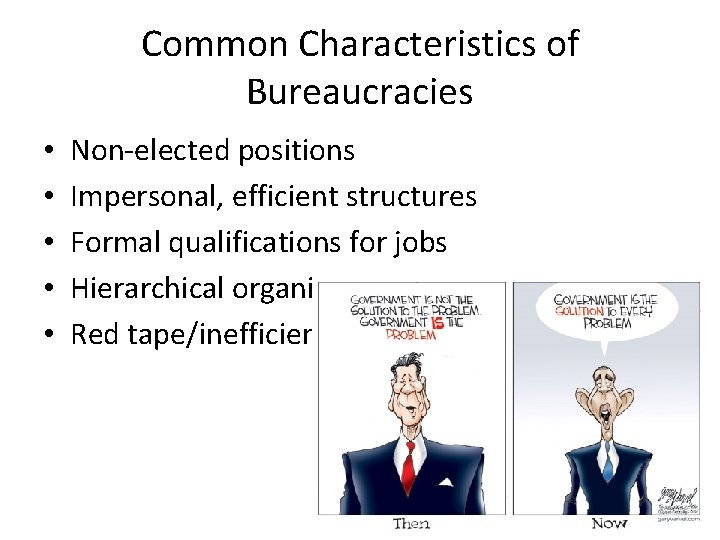
Common Characteristics of Bureaucracies • • • Non-elected positions Impersonal, efficient structures Formal qualifications for jobs Hierarchical organization Red tape/inefficiency