
Political and Economic Analysis What Creates an Economy
- Slides: 21
Political and Economic Analysis
What Creates an Economy q. What is an Economy? q. Organized way a nation provides for the needs and wants of its people q. Factors of Production (Resources) q. Tangible q. Land Capital q. Intangible q. Labor and Entrepreneurship
What Creates an Economy q. Land q. Everything on the Earth q. Natural Resources: Land, Animals, Plants, Minerals q. Labor q. All Employees q. Education and Training = Advantages!
What Creates an Economy q. Capital q. Money used by the business and goods used in production q. Factories, Buildings, Computers, Tools, Etc. q. Includes Infrastructure q. Roads, Ports, Utilities (Water/Electric), Sanitation
What Creates an Economy q. Entrepreneurship q. Skills of people who invest time and money into a business q. Organize the factors of production to create goods or services q. Technology q. Advancements in technology can provide new opportunities for business or cause products/services to become obsolete
What Creates an Economy q. Scarcity q. The difference between wants/needs and available resources q. Shortages – Can be replenished q. Scarcity – Resources are limited
Types of Economic Systems q 3 questions nations must answer about limited economic resources 1. What? 2. How? 3. For whom? q. How countries answer these questions determine their type of economic system
Types of Economic Systems q. Traditional q. Habits/traditions/rituals q. Culture/religious practices/passed down ideals 1. What – Little choice – What’s needed to survive 2. How – Underdeveloped – Techniques learned from ancestors 3. For whom – Community – Excess is traded among residents
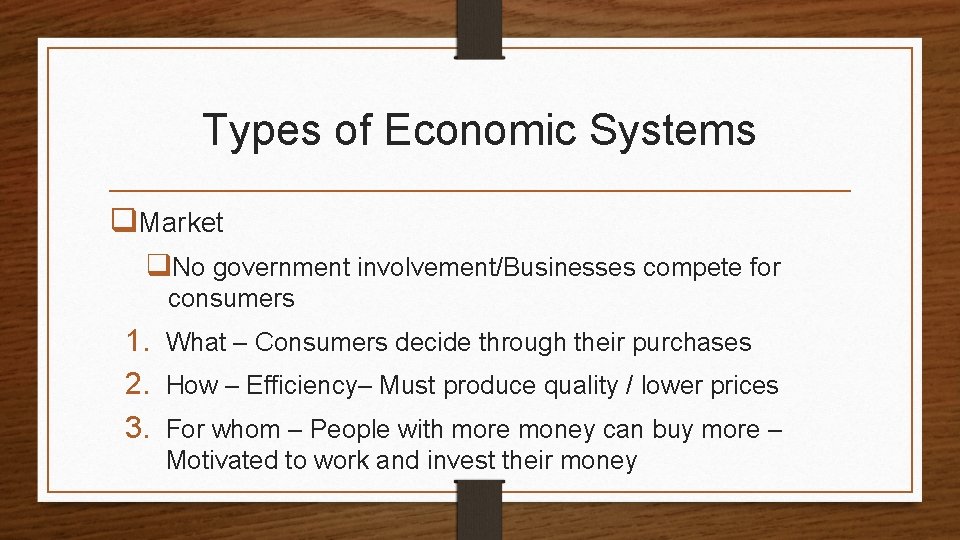
Types of Economic Systems q. Market q. No government involvement/Businesses compete for consumers 1. What – Consumers decide through their purchases 2. How – Efficiency– Must produce quality / lower prices 3. For whom – People with more money can buy more – Motivated to work and invest their money
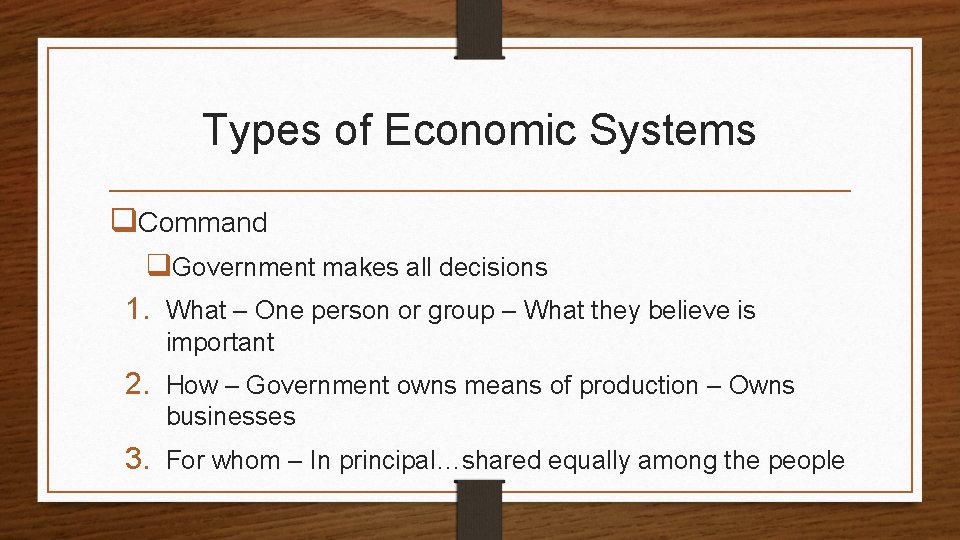
Types of Economic Systems q. Command q. Government makes all decisions 1. What – One person or group – What they believe is important 2. How – Government owns means of production – Owns businesses 3. For whom – In principal…shared equally among the people
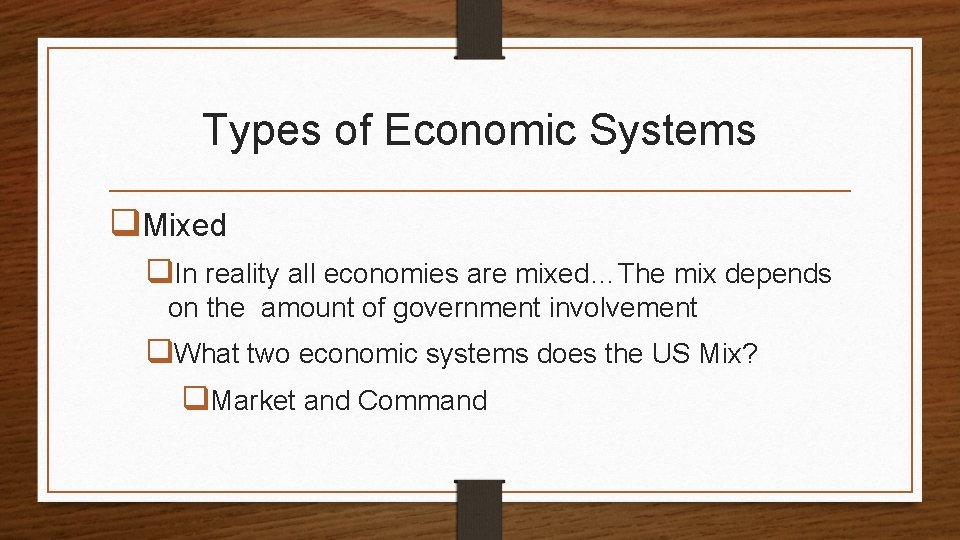
Types of Economic Systems q. Mixed q. In reality all economies are mixed…The mix depends on the amount of government involvement q. What two economic systems does the US Mix? q. Market and Command
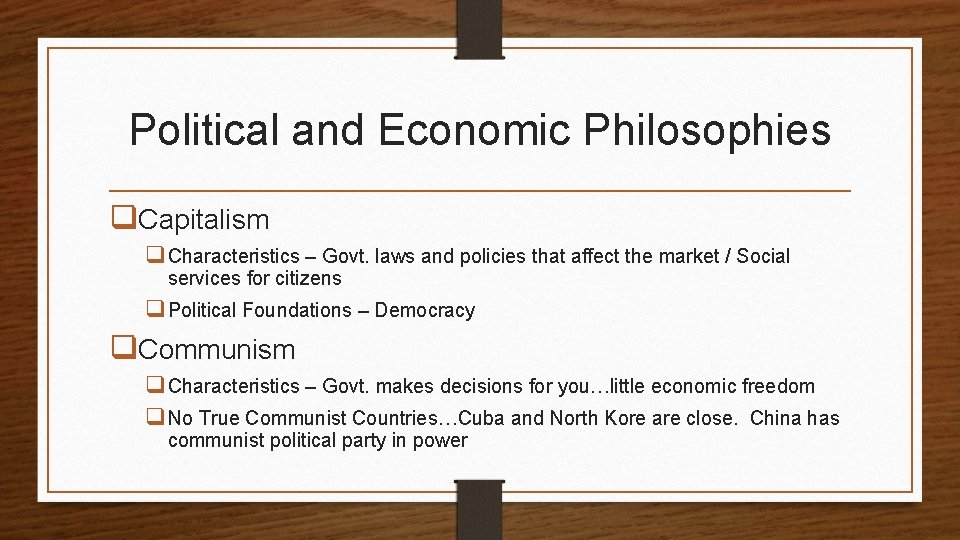
Political and Economic Philosophies q. Capitalism q Characteristics – Govt. laws and policies that affect the market / Social services for citizens q Political Foundations – Democracy q. Communism q Characteristics – Govt. makes decisions for you…little economic freedom q No True Communist Countries…Cuba and North Kore are close. China has communist political party in power
Political and Economic Philosophies q. Socialism q. Characteristics – Increased levels of social services / Businesses and citizens pay higher taxes than Capitalist countries / Govt. owned and run industries (Telecommunications, transportation, natural resources, and banking) q. Examples – Canada, Germany, and Sweden q Government official are still elected
The Economy and Marketing q. Goals of a Healthy Economy 1. Increase Productivity • Efficiency / Training and Education /Increased Duties 2. Decrease Unemployment • More people working = more production…. and taxes! 3. Maintain Stable Prices • Keep Inflation in check
The Economy and Marketing q. Economic Measurements q. Gross Domestic Product (GDP) q. Output of goods and services produced by labor and property located within a country q. Gross National Product (GNP) q. Total goods and services produced by a nation q. Includes goods and services produced abroad by citizens and companies
The Economy and Marketing q. Economic Measurements q. Standard of Living q Amount of GDP or GNP person (Divide GDP or GNP by the population) q High levels or production typically equal higher standards of living q. Inflation Rate q Rising Prices q Consumer Price Index (CPI) – Measures the change in price of 400 specific retail and service goods q Producer Price Index (PPI) – Measures Wholesale price levels in the economy q. Unemployment Rate
The Business Cycle q. Expansion vs Recession q. Expansion = Growth and low unemployment…good time for business to start or expand q. Recession = Slowdown for at least 2 quarters of a year…companies reduce workforce and plans for new products or expansions are put on hold
The Business Cycle q. Depression vs Recovery q. Depression = prolonged recession…high unemployment and businesses shut down. q. Recovery = Renewed growth following a depression…Production increases and more jobs are created
Political and Economic Analysis Project and Power. Point Presentation Working with a Partner: 1. Identify the following for the US and another country of your choosing – No teams can have the same 2 nd country!! a. Unemployment Rate, Inflation Rate, Consumer Price Index, and GDP/GNP. b. Government actions that may affect the economy in the near future c. What does the information tell you about the economy? d. How will this information dictate your marketing decisions?
Political and Economic Analysis Project and Power. Point Presentation Working with a Partner: 2. Chose how you will invest in your country (Not US) a. Select two companies to invest in based upon your previous research? – Provide rationale behind all decisions b. Conduct a SWOT analysis for each company you select for investment c. Explain your Target Market for each company invested in
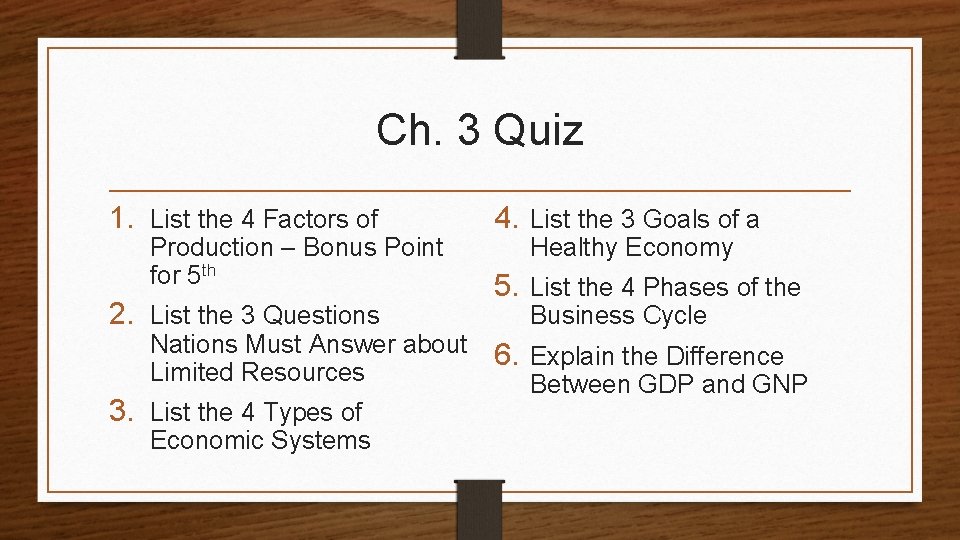
Ch. 3 Quiz 1. List the 4 Factors of Production – Bonus Point for 5 th 2. List the 3 Questions Nations Must Answer about Limited Resources 3. List the 4 Types of Economic Systems 4. List the 3 Goals of a Healthy Economy 5. List the 4 Phases of the Business Cycle 6. Explain the Difference Between GDP and GNP