
POLITICAL ACTIVITIES THE HATCH ACT Applicability of the
POLITICAL ACTIVITIES THE HATCH ACT
Applicability of the Hatch Act to DOJ Students and Interns • The Hatch Act governs permissible and restricted political activities of the Federal workforce, both in the office and when employees (and some interns) are not on duty. • The purpose is to protect an employee’s right to engage in political activities (with some restrictions) and maintain a Federal workplace that is free of political activity and pressure.
Applicability of the Hatch Act, cont’d… • The extent to which you, as a student, intern or volunteer, are subject to the Hatch Act rules depends on whether you are paid or unpaid. • Let’s examine the applicable rules:
The Hatch Act • Under the Act, absolutely NO partisan political activity may take place while on duty, on government property, in a government vehicle, or while using government equipment such as email, the Internet, the telephone and the fax machine. • Activity is partisan if it encourages or discourages the success of a candidate for partisan office, a political party, or partisan political group. This is broadly defined and includes simple acts like inviting a fellow intern to a campaign event.
No Political Activity in the Workplace Means: v You may not wear a campaign button or display political paraphernalia in the workplace; v You may not use any DOJ equipment, including the phone, fax, copy machines, or computer (email and internet access), which includes: v You may not give your DOJ phone number or email address as a means of contact to a campaign or friend who wants to send you partisan information; v You may not use the DOJ telephone to coordinate with a friend to meet at a campaign function; v You may not use DOJ email (internal or internet) to forward an invitation to a campaign event;
No Political Activity in the Workplace, cont’d… : v You may not deliver by hand or post on a bulletin board campaign literature or other political material that is partisan in nature in the workplace; v You may not use your personal cell phone while in your office to call a friend to arrange your meeting at a campaign function; v You may not solicit or discourage the partisan activity of an employee or a person who has business before the Department.
How Do I Arrange Political Activity? • You will need to coordinate your activities and arrangements when you are not on duty and not in the office. • If you need to check an appointment during the day, you will need to use your personal cell phone or PDA outside the office on non-gov’t property to contact others about political activities that will occur during non-business hours.
Why are the rules so strict? • An important objective of the Hatch Act is to preserve an apolitical work environment so that no employee or volunteer feels explicit or implicit pressure that she needs to conform her political views in order to keep her federal position. • Congress and the Executive Branch determined that the best means of preserving the apolitical environment is to prohibit any partisan activity in the workplace.
Unpaid Volunteers • Even if you are unpaid, the prohibition on all partisan political activity is in force while you are on duty, in a government building, and while using government equipment. • Reminder: This prohibition applies even to use of or access to personal equipment in the office, including using cell phones in DOJ offices and access to personal Internet accounts by DOJ computer.
Compensated Students and Interns • The restrictions that apply to what a paid student or intern may do outside the office (when not on duty, and in one’s personal capacity), depend on what office you are assigned to work.
“Further Restricted” Interns Paid students and interns of the following offices are “further restricted” and are prohibited from all active participation in political campaigns, even in their personal capacity, away from work: • Criminal Division • National Security Division • FBI
“Further Restricted” Interns Paid students and interns who are “further restricted” may only: • vote • make campaign contributions • sign nominating petitions And, very importantly…… (next slide)
“Further Restricted” Interns … May attend a political event such as a speech or rally; however, they may NOT actively participate in the event, and may NOT act in concert with the campaign or party. For example, if you attend a rally, you may not wave a sign provided by the campaign. We strongly recommend that you seek advice from an ethics official before attending a campaign event (and remember you may not solicit an invitation).
Prohibited Political Activity: A Practical Example • You are an intern in the Civil Division (not “further restricted”), and volunteering for the Republocratic National Committee (RPNC). The coordinator wants to call you at work about an upcoming fundraising event and send you by email an invitation to the event. – You cannot talk with the RPNC on a government phone or in a government building or on government time. – You cannot receive, send or forward political emails using government time and equipment. If you get one, take no action except to delete it. Ask the sender not to send any more emails to your DOJ address.
Compensated Students and Interns If you are a compensated student or intern in an office that is not “further restricted, ” you may, outside of work and in your personal capacity, be actively engaged in partisan activities, both publicly and behind-the-scenes. For example, you may: v Join, be an active member of, and hold most offices (except for the position of Treasurer) in a political party, campaign, or club; v Assist in organizing, attend, and assist in functions at a rally, meeting, or other campaign event (but not a fundraiser); v Distribute campaign literature and make telephone calls (but neither may solicit political contributions), and stuff envelopes.
Compensated Students and Interns, cont’d… When you engage in political activity outside the office, you may NOT: v Solicit, accept, or receive political contributions v Use or permit others to use or refer to your student/intern position at DOJ v (and remember, do not make arrangements with DOJ equipment or in the office!)
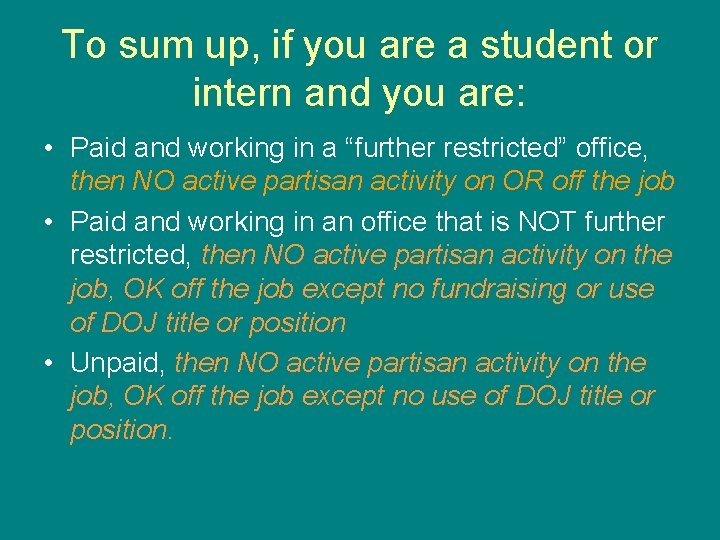
To sum up, if you are a student or intern and you are: • Paid and working in a “further restricted” office, then NO active partisan activity on OR off the job • Paid and working in an office that is NOT further restricted, then NO active partisan activity on the job, OK off the job except no fundraising or use of DOJ title or position • Unpaid, then NO active partisan activity on the job, OK off the job except no use of DOJ title or position.
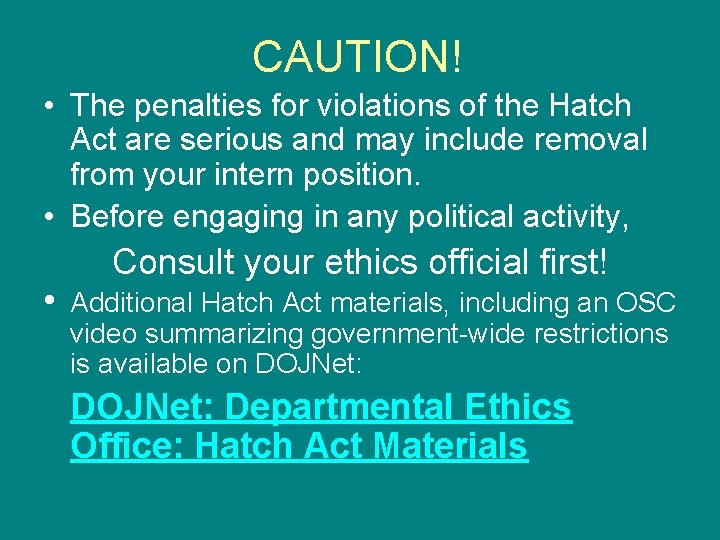
CAUTION! • The penalties for violations of the Hatch Act are serious and may include removal from your intern position. • Before engaging in any political activity, • Consult your ethics official first! Additional Hatch Act materials, including an OSC video summarizing government-wide restrictions is available on DOJNet: Departmental Ethics Office: Hatch Act Materials
- Slides: 18