
Polite Computing Software that respects the user Presented
- Slides: 20
Polite Computing Software that respects the user Presented at “Etiquette for Human-Computer Work”, AAAI Fall Symposium, November 15 -17, 2002, North Falmouth, Ma. Brian Whitworth © 2002, bwhitworth@acm. org 1
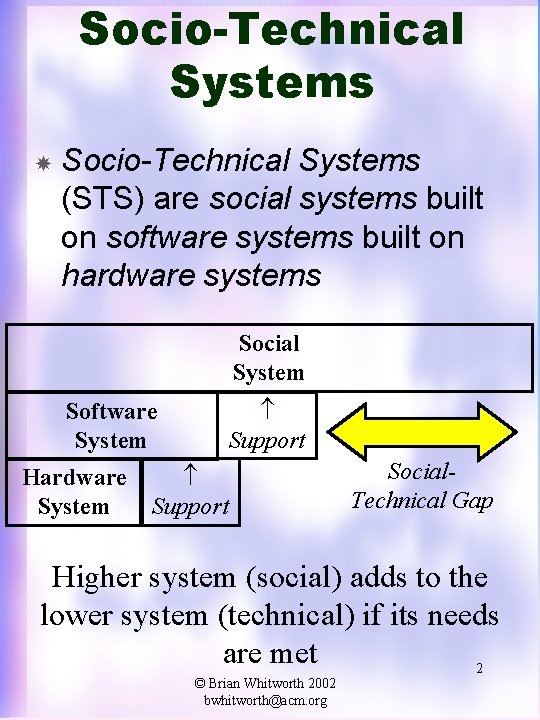
Socio-Technical Systems (STS) are social systems built on software systems built on hardware systems Social System Support Software System Hardware System Support Social. Technical Gap Higher system (social) adds to the lower system (technical) if its needs are met 2 © Brian Whitworth 2002 bwhitworth@acm. org
Social Value Social systems must: – Increase benefits, and – Reduce costs (of social interaction) to survive (as social systems) They create social value: – Information exchange – Interpersonal friendships – Collective action (belonging) And reduce risk (increase trust) If a society creates social value and trust, which creates economic value, it is adaptive © Brian Whitworth 2002 bwhitworth@acm. org 3
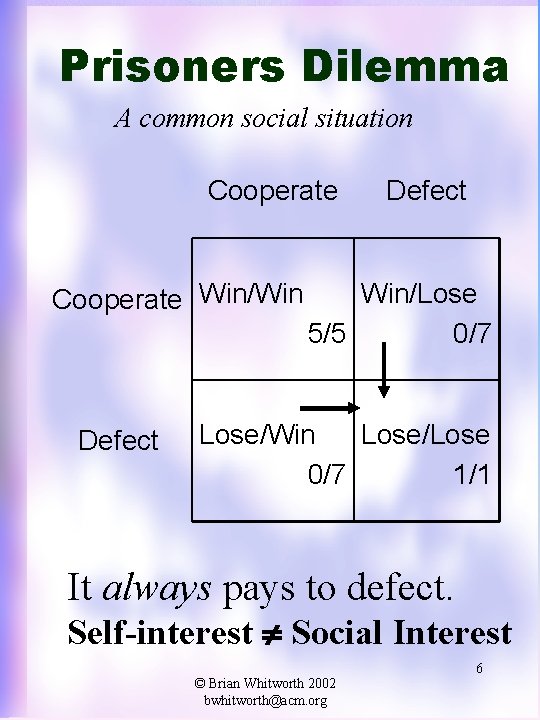
Social Risk Two people, seeking incompatible actions in a common environment may conflict E. g. two cars at an intersection – Both proceed, crash (both lose) – One waits - one wins, one loses – Classic prisoner’s dilemma For social groups internal conflict is always a loss – A group divided cannot stand © Brian Whitworth 2002 bwhitworth@acm. org 4
Social Value Research teams share their findings Friends help each other when one is sick or needy Groups can undertake tasks beyond individuals Social cooperation leads from hunter-gatherers to modern society Are we just hunter-gatherer’s in an information age? (Meyrowitz) © Brian Whitworth 2002 bwhitworth@acm. org 5
Prisoners Dilemma A common social situation Cooperate Win/Win Defect Win/Lose 5/5 0/7 Lose/Win Lose/Lose 0/7 1/1 It always pays to defect. Self-interest Social Interest © Brian Whitworth 2002 bwhitworth@acm. org 6
Legitimacy Defection is unstable - leads to lose-lose situations A social perception of what actions are “right” or “fair” social interaction – privacy, copyright, censorship, trespass, intellectual property, etc Illegitimate acts benefit one at other’s expense e. g. stealing (defection) Legitimate acts benefit equally © Brian Whitworth 2002 bwhitworth@acm. org 7
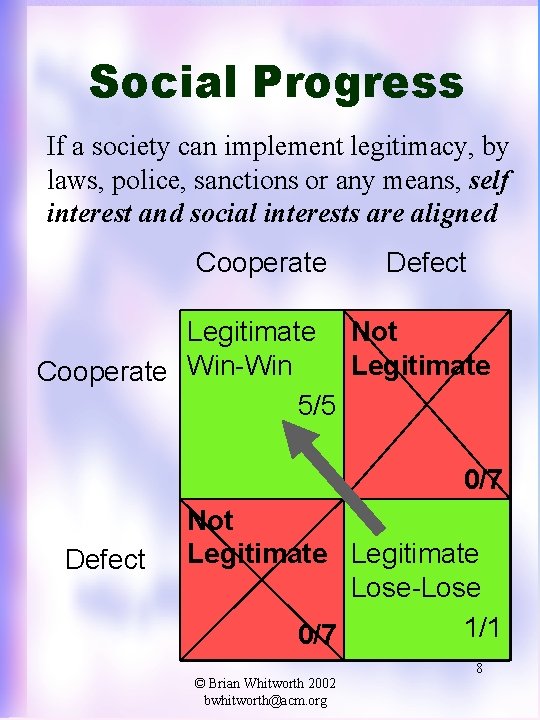
Social Progress If a society can implement legitimacy, by laws, police, sanctions or any means, self interest and social interests are aligned Cooperate Defect Legitimate Not Legitimate Cooperate Win-Win 5/5 0/7 Defect Not Legitimate Lose-Lose 1/1 0/7 © Brian Whitworth 2002 bwhitworth@acm. org 8
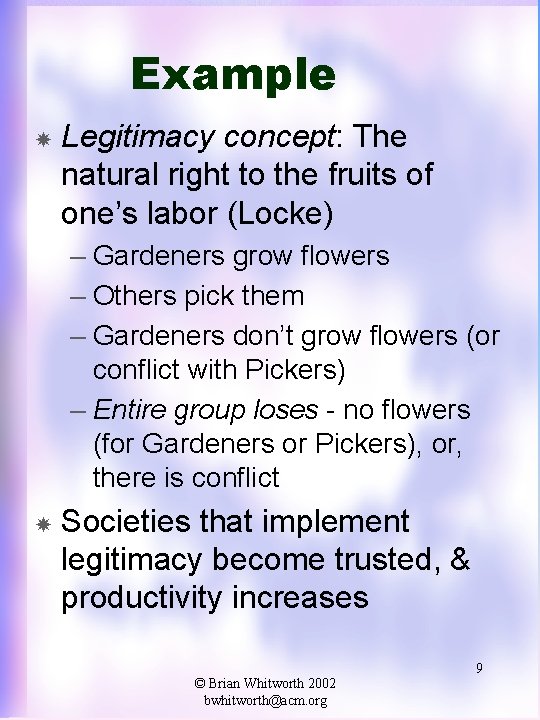
Example Legitimacy concept: The natural right to the fruits of one’s labor (Locke) – Gardeners grow flowers – Others pick them – Gardeners don’t grow flowers (or conflict with Pickers) – Entire group loses - no flowers (for Gardeners or Pickers), or, there is conflict Societies that implement legitimacy become trusted, & productivity increases © Brian Whitworth 2002 bwhitworth@acm. org 9
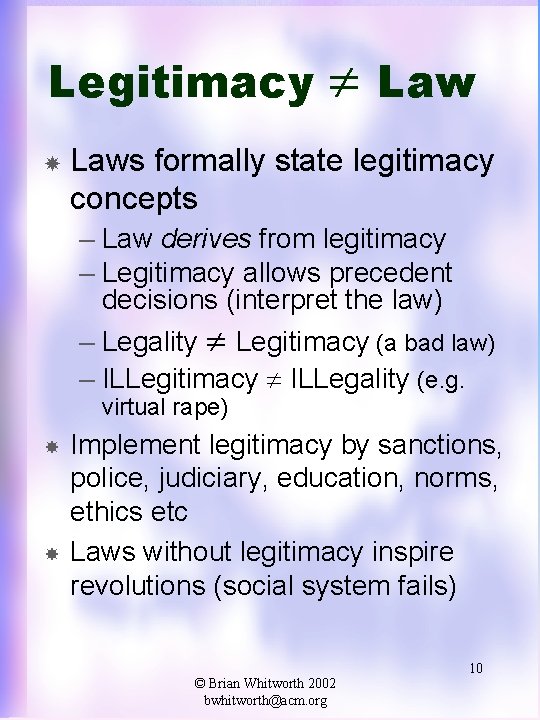
Legitimacy Laws formally state legitimacy concepts – Law derives from legitimacy – Legitimacy allows precedent decisions (interpret the law) – Legality Legitimacy (a bad law) – ILLegitimacy ILLegality (e. g. virtual rape) Implement legitimacy by sanctions, police, judiciary, education, norms, ethics etc Laws without legitimacy inspire revolutions (social system fails) © Brian Whitworth 2002 bwhitworth@acm. org 10
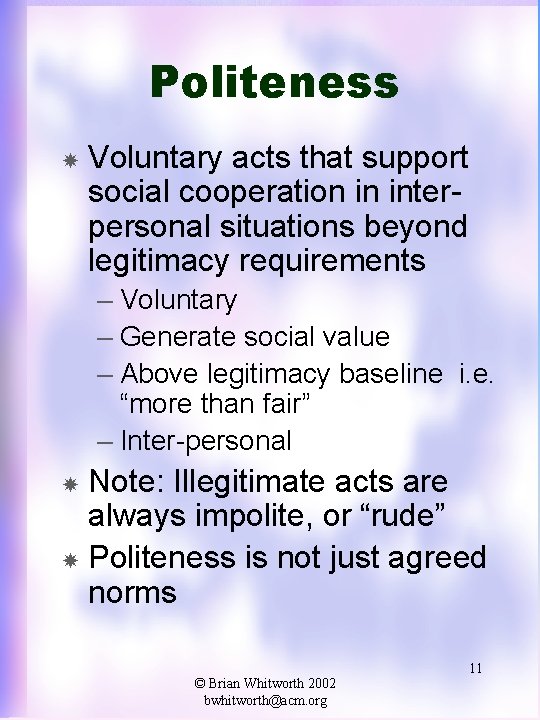
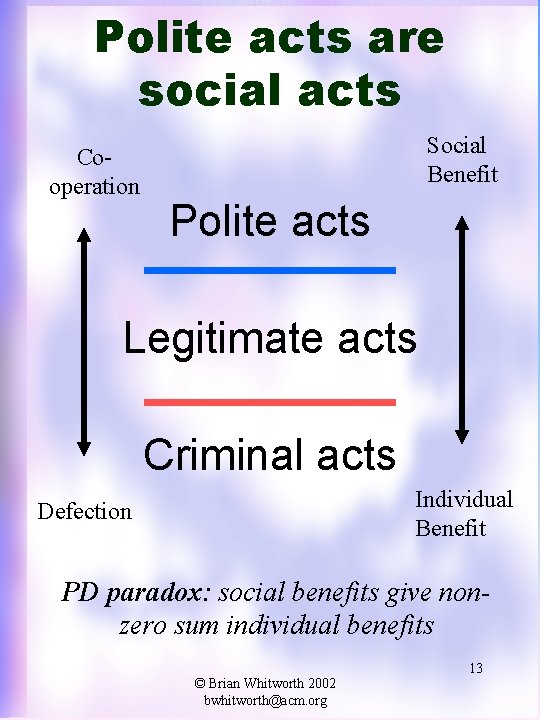
Politeness Voluntary acts that support social cooperation in interpersonal situations beyond legitimacy requirements – Voluntary – Generate social value – Above legitimacy baseline i. e. “more than fair” – Inter-personal Note: Illegitimate acts are always impolite, or “rude” Politeness is not just agreed norms © Brian Whitworth 2002 bwhitworth@acm. org 11
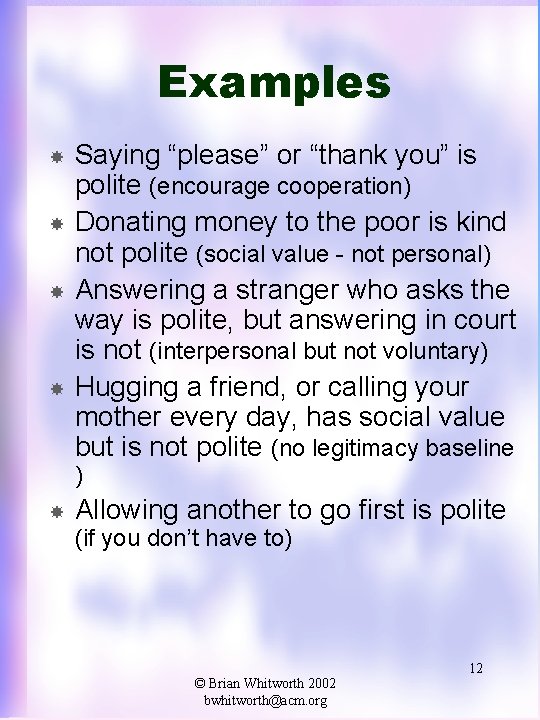
Examples Saying “please” or “thank you” is polite (encourage cooperation) Donating money to the poor is kind not polite (social value - not personal) Answering a stranger who asks the way is polite, but answering in court is not (interpersonal but not voluntary) Hugging a friend, or calling your mother every day, has social value but is not polite (no legitimacy baseline ) Allowing another to go first is polite (if you don’t have to) © Brian Whitworth 2002 bwhitworth@acm. org 12
Polite acts are social acts Cooperation Social Benefit Polite acts Legitimate acts Criminal acts Individual Benefit Defection PD paradox: social benefits give nonzero sum individual benefits © Brian Whitworth 2002 bwhitworth@acm. org 13
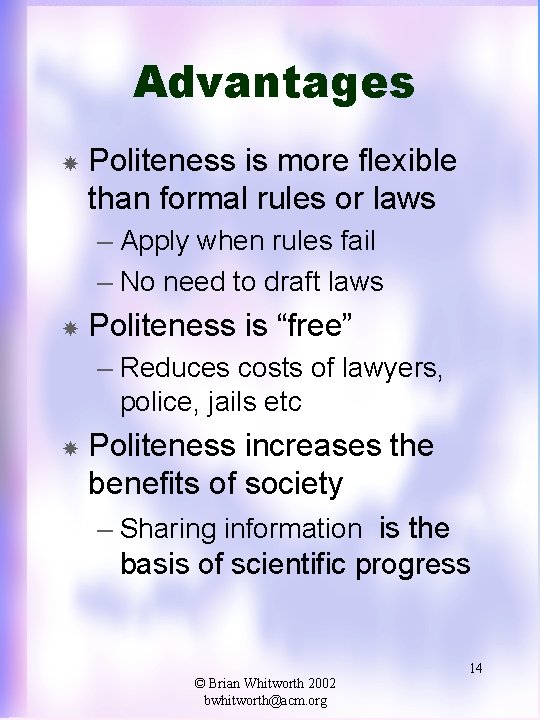
Advantages Politeness is more flexible than formal rules or laws – Apply when rules fail – No need to draft laws Politeness is “free” – Reduces costs of lawyers, police, jails etc Politeness increases the benefits of society – Sharing information is the basis of scientific progress © Brian Whitworth 2002 bwhitworth@acm. org 14
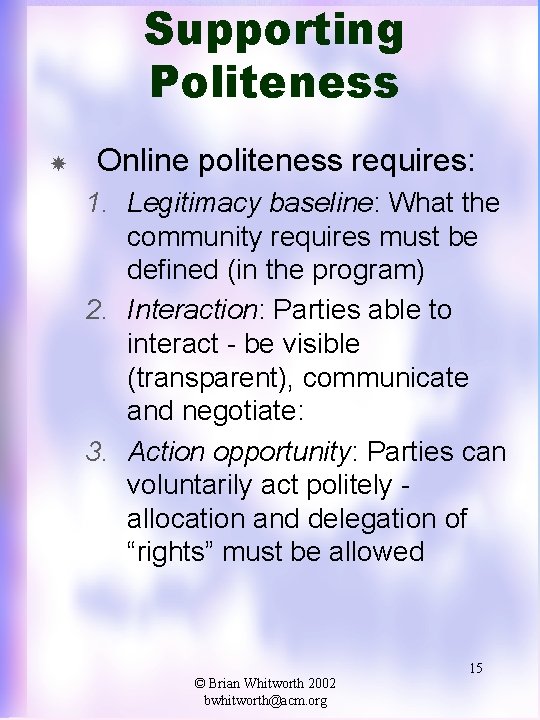
Supporting Politeness Online politeness requires: 1. Legitimacy baseline: What the community requires must be defined (in the program) 2. Interaction: Parties able to interact - be visible (transparent), communicate and negotiate: 3. Action opportunity: Parties can voluntarily act politely allocation and delegation of “rights” must be allowed © Brian Whitworth 2002 bwhitworth@acm. org 15
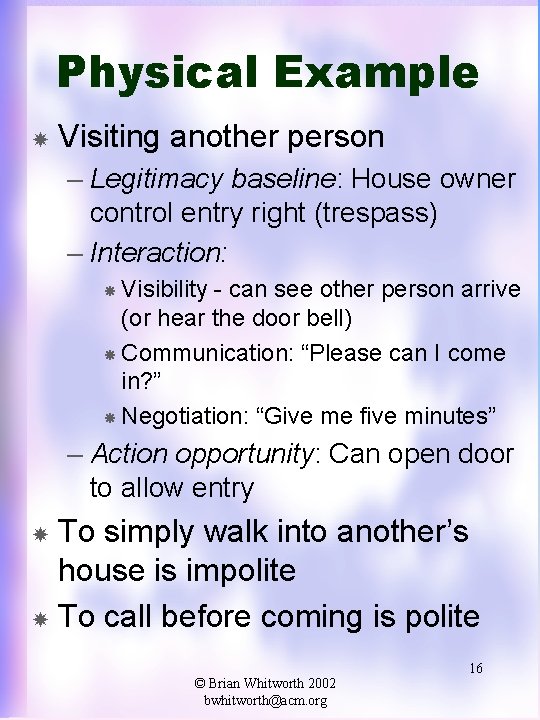
Physical Example Visiting another person – Legitimacy baseline: House owner control entry right (trespass) – Interaction: Visibility - can see other person arrive (or hear the door bell) Communication: “Please can I come in? ” Negotiation: “Give me five minutes” – Action opportunity: Can open door to allow entry To simply walk into another’s house is impolite To call before coming is polite © Brian Whitworth 2002 bwhitworth@acm. org 16
Online Example 1 Using another’s online work – Legitimacy baseline: Creator ownership (copyright) supported by law but not by software (no public/private data field) – Interaction: Visibility - Don’t know others want it (email who? ) Communication: No easy way to request use (cf a data form) Negotiation: “You can use it if I know who you are” – Action opportunity: No electronic way to give rights to use Web does not support polite sharing of information © Brian Whitworth 2002 bwhitworth@acm. org 17
Online Example 2 Spam: Undesired communication – Legitimacy baseline: Spam benefits individuals but costs the community - reduces value of online society – Interaction: Visibility - The spammer is invisible Communication: Cannot reply to them Negotiation: “You can use my details but not forward them to others” - N/A – Action opportunity: No easy way to be removed from electronic lists Web does support impolite communication Polite marketing would be much more profitable - spam reduces value for the entire market © Brian Whitworth 2002 bwhitworth@acm. org 18
Polite computing Gives legitimate control to the user voluntarily Software should ask not take (support user’s rights, not apply electronic might) E. g. Paper clip takes control of the cursor, screen and CPU away from the user like a “friendly” person who keeps interrupting While “infant” users may not mind, experienced users do © Brian Whitworth 2002 bwhitworth@acm. org 19
Conclusions Supporting polite interaction and polite computing would increase the value online communities generate Business should support politeness - “defecting” gives lose-lose social interaction Impolite acts reduce online society’s value - people avoid it Without trust profits decline Politeness supports the social system that generates value © Brian Whitworth 2002 bwhitworth@acm. org 20