
Polish workers in the UK Their involvement with

- Slides: 20
Polish workers in the UK Their involvement with unions and their employment rights Labour Research Department 26 November 2016
Issued to be covered • Polish workers in the labour market • Polish workers and unions • Polish workers and their employment rights
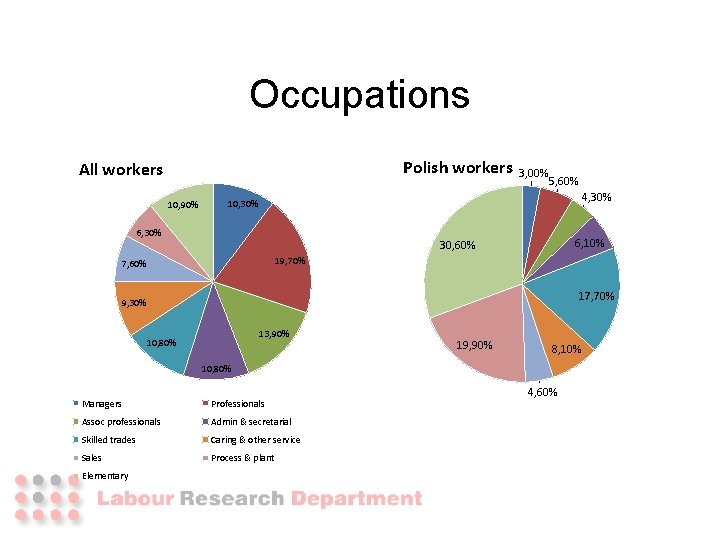
Occupations Polish workers All workers 10, 90% 3, 00% 5, 60% 4, 30% 10, 30% 6, 10% 30, 60% 19, 70% 7, 60% 17, 70% 9, 30% 13, 90% 10, 80% 19, 90% 8, 10% 10, 80% Managers Professionals Assoc professionals Admin & secretarial Skilled trades Caring & other service Sales Process & plant Elementary 4, 60%
How employed • More likely to be employed through agencies – “There are significantly more agency workers who are from a minority group (including Eastern Europeans) compared with all employees. ” BIS 2008 – 70% of workers supplied to meat and poultry indutry were migrant workers, with Polish being the largest nationality. EHRC 2010 • More likely to be employed through gangmasters – “ 64% came from A 8 countries: with the
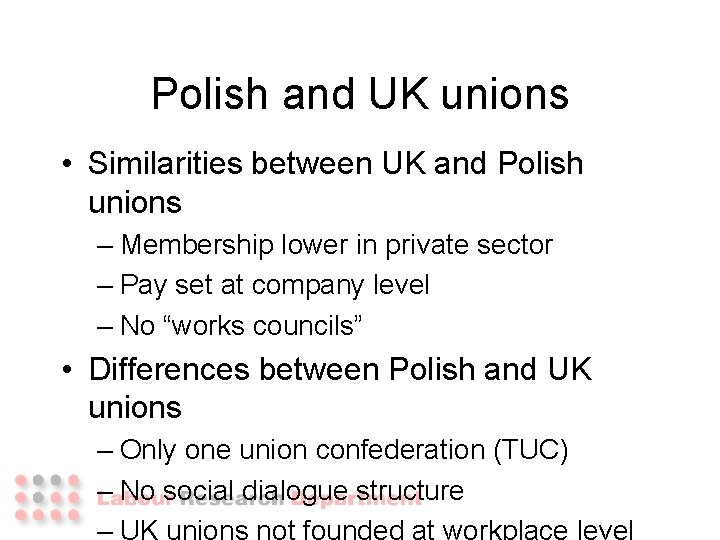
Polish and UK unions • Similarities between UK and Polish unions – Membership lower in private sector – Pay set at company level – No “works councils” • Differences between Polish and UK unions – Only one union confederation (TUC) – No social dialogue structure
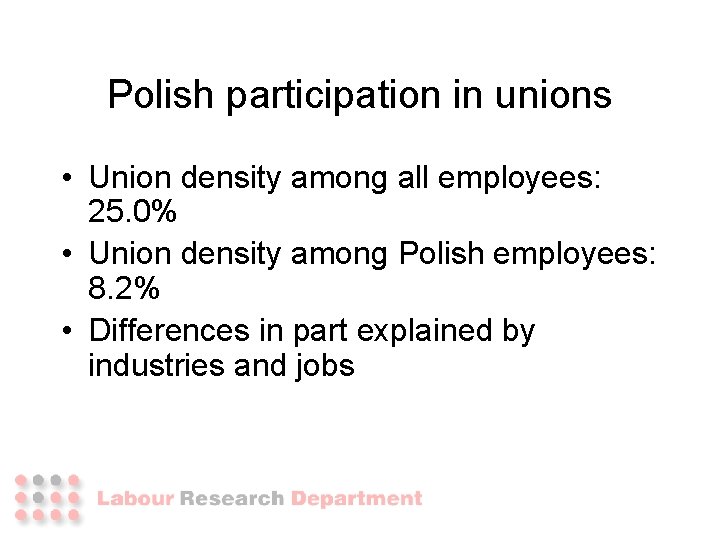
Polish participation in unions • Union density among all employees: 25. 0% • Union density among Polish employees: 8. 2% • Differences in part explained by industries and jobs
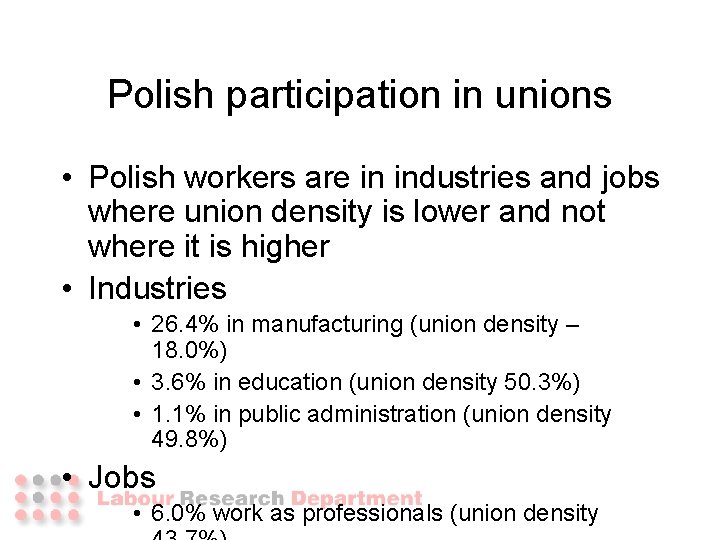
Polish participation in unions • Polish workers are in industries and jobs where union density is lower and not where it is higher • Industries • 26. 4% in manufacturing (union density – 18. 0%) • 3. 6% in education (union density 50. 3%) • 1. 1% in public administration (union density 49. 8%) • Jobs • 6. 0% work as professionals (union density
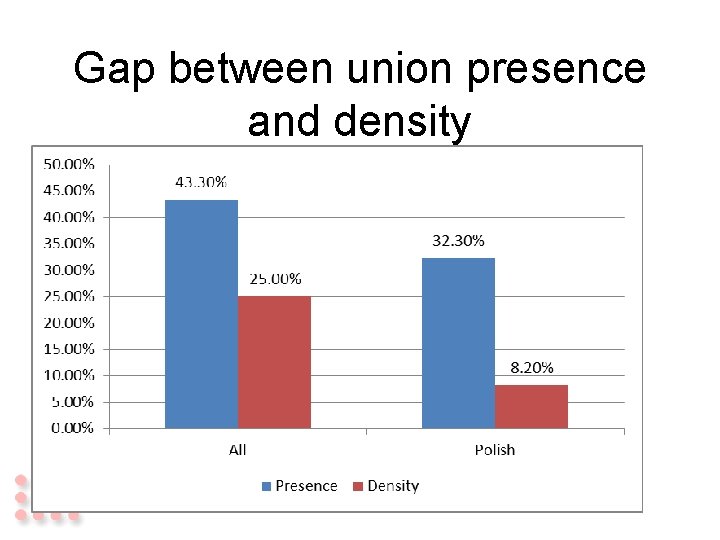
Gap between union presence and density
Other factors explain lower density • Employed as temporary workers – Overall: 25. 7% density for permanent but 14. 5% for temporary – Process workers: 23. 8% density for permanent but 10. 2% for temporary • Other factors – Language – Unfamiliarity – Fear of victimisation – Discrimination
Unions want to organise Polish workers • New unionism in 1998 - aim – “to develop a culture of organising that could help to transform unions by bringing in new and diverse members. ” • New developments provided resources for this – Union Modernisation Fund – funds from government to help unions (ended 2010) – unionlearn – funds for government for training
Example of a union campaign • UNISON – migrant workers’ participation project – Aims: • to increase migrant workers’ participation in the union; • to ensure that there were participating at all levels; • to bring migrant workers’ concerns into the mainstream of bargaining at the workplace; • to reduce the exclusion of migrants in the workplace; and • to make the services UNISON offers more
But remains limited and precarious • Most specific campaigns ended when Union Modernisation Fund ended – “the UMF project gave UNISON the opportunity to do an important piece of work that otherwise would not have happened” UNISON organiser 2010 • Since then – Continues where part of ongoing campaign – Relies on new Polish officials and activists
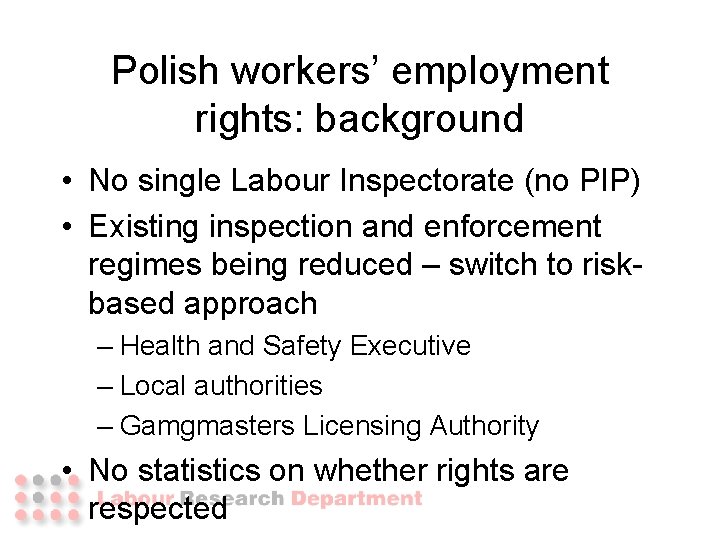
Polish workers’ employment rights: background • No single Labour Inspectorate (no PIP) • Existing inspection and enforcement regimes being reduced – switch to riskbased approach – Health and Safety Executive – Local authorities – Gamgmasters Licensing Authority • No statistics on whether rights are respected
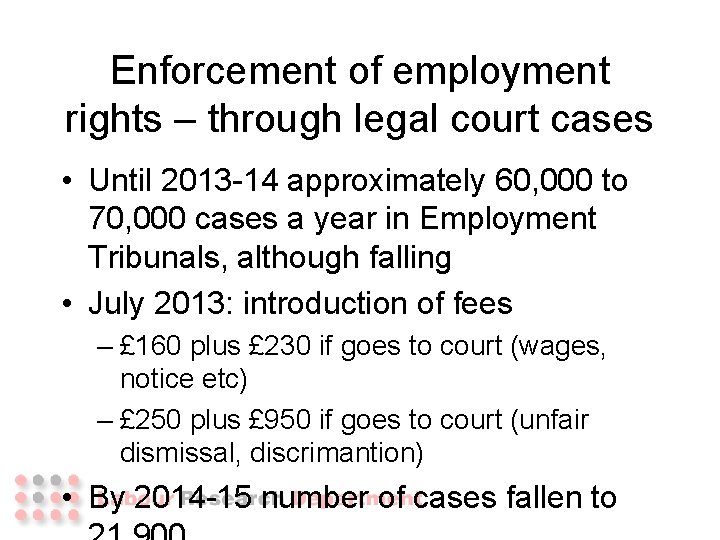
Enforcement of employment rights – through legal court cases • Until 2013 -14 approximately 60, 000 to 70, 000 cases a year in Employment Tribunals, although falling • July 2013: introduction of fees – £ 160 plus £ 230 if goes to court (wages, notice etc) – £ 250 plus £ 950 if goes to court (unfair dismissal, discrimantion) • By 2014 -15 number of cases fallen to
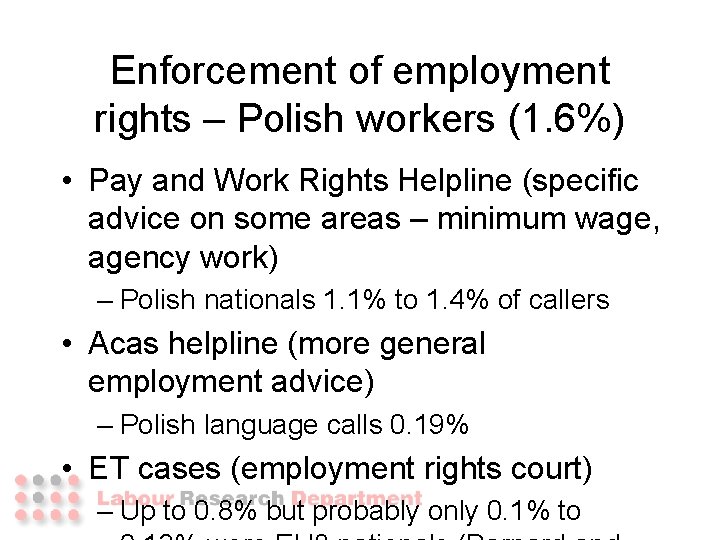
Enforcement of employment rights – Polish workers (1. 6%) • Pay and Work Rights Helpline (specific advice on some areas – minimum wage, agency work) – Polish nationals 1. 1% to 1. 4% of callers • Acas helpline (more general employment advice) – Polish language calls 0. 19% • ET cases (employment rights court) – Up to 0. 8% but probably only 0. 1% to
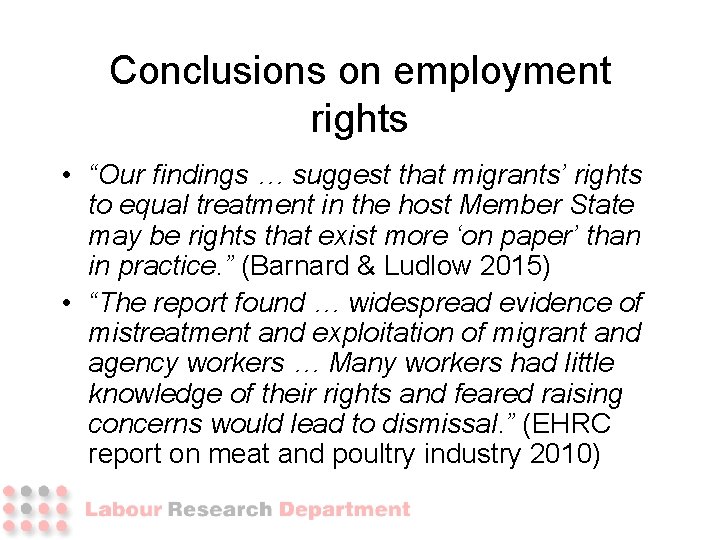
Conclusions on employment rights • “Our findings … suggest that migrants’ rights to equal treatment in the host Member State may be rights that exist more ‘on paper’ than in practice. ” (Barnard & Ludlow 2015) • “The report found … widespread evidence of mistreatment and exploitation of migrant and agency workers … Many workers had little knowledge of their rights and feared raising concerns would lead to dismissal. ” (EHRC report on meat and poultry industry 2010)
The future • Unions help to secure employment rights – “In workplaces where unions are recognised, or have a strong presence we found that they provide a significant degree of protection for workers”. EHRC • But unions are likely to be weakened through Trade Union Bill • Overall attitude to Polish migrants may change as a result of plans to remove in -work benefits
• Thank you for your attention Lionel Fulton lfulton@lrd. org. uk
The project “Solidarity in action. Employment rights, participation in social dialogue and membership in trade unions among Polish employees in the UK” is co-financed by the Polish Ministry of Foreign Affairs within the „ Cooperation with Polish Diaspora and Poles abroad in 2015. ”