
POLISH SYLLABLE IDALIA SMOCZYK Outline n n n
POLISH SYLLABLE IDALIA SMOCZYK
Outline n n n n VARIOUS DEFINITIONS OF A SYLLABLES CAN BE DIVIDED INTO : AMBIGUITY OF DIVISIONS PHONOLOGICAL MODEL OF POLISH SYLLABLE THE INTERNAL STRUCTURE OF THE ONSETS OF POLISH SYLLABLES ANALYSIS OF THE POLISH SYLLABLE PROBLEMS REPRESENTATIONS OF SYLLABLES
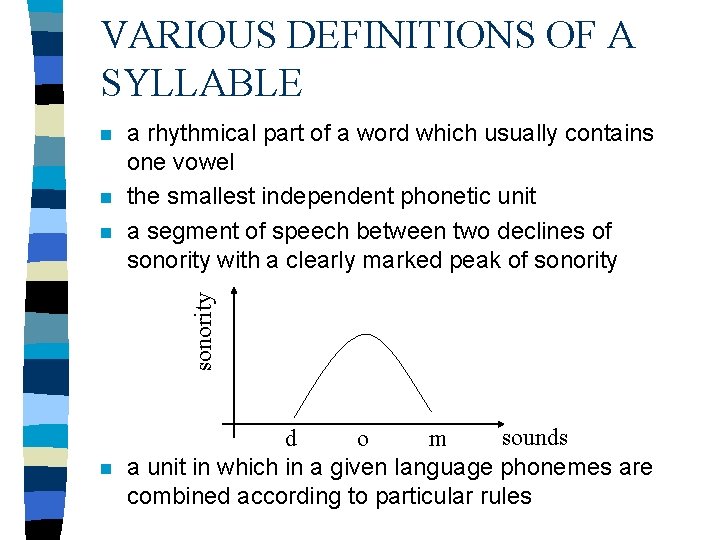
VARIOUS DEFINITIONS OF A SYLLABLE n n sonority n a rhythmical part of a word which usually contains one vowel the smallest independent phonetic unit a segment of speech between two declines of sonority with a clearly marked peak of sonority n sounds d o m a unit in which in a given language phonemes are combined according to particular rules
TYPES OF SYLLABLES n OPEN SYLLABLES ending with a vowel, eg. za-ba-wa, o-głosze-nie n CLOSED SYLLABLES ending with a consonant or a cluster of consonants, eg. staw, pod-ręcz-nik
AMBIGUITY OF SYLLABLE DIVISIONS The division of a word into syllables may be ambiguous. Consonantal clusters inside a word can be split in different ways. Two or more different divisions are usually possible! e. g. :
PHONOLOGICAL MODEL OF POLISH SYLLABLE In Polish only the opposition between a consonant and a vowel is relevant! ( C )* V ( C )* * - the element of the type C can occur many times ( ) - C is optional V - an obligatory element
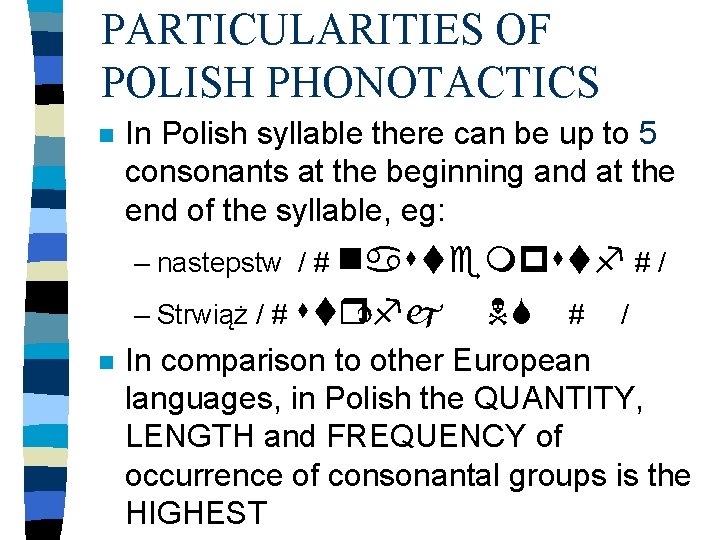
PARTICULARITIES OF POLISH PHONOTACTICS n In Polish syllable there can be up to 5 consonants at the beginning and at the end of the syllable, eg: – nastepstw / # nastempstf # / – Strwiąż / # strfj c n NS # / In comparison to other European languages, in Polish the QUANTITY, LENGTH and FREQUENCY of occurrence of consonantal groups is the HIGHEST
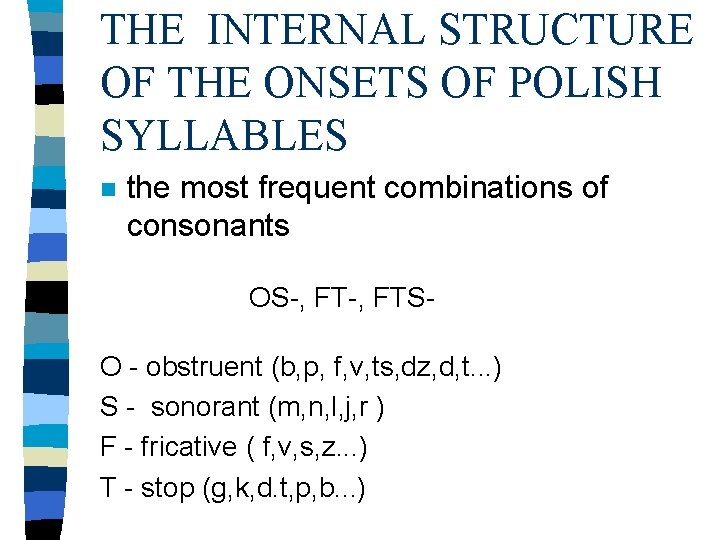
THE INTERNAL STRUCTURE OF THE ONSETS OF POLISH SYLLABLES n the most frequent combinations of consonants OS-, FTS- O - obstruent (b, p, f, v, ts, dz, d, t. . . ) S - sonorant (m, n, l, j, r ) F - fricative ( f, v, s, z. . . ) T - stop (g, k, d. t, p, b. . . )
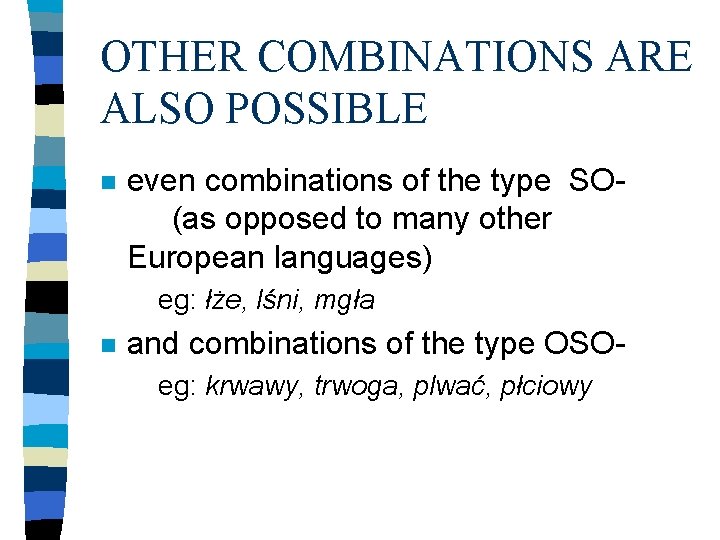
OTHER COMBINATIONS ARE ALSO POSSIBLE n even combinations of the type SO(as opposed to many other European languages) eg: łże, lśni, mgła n and combinations of the type OSOeg: krwawy, trwoga, plwać, płciowy
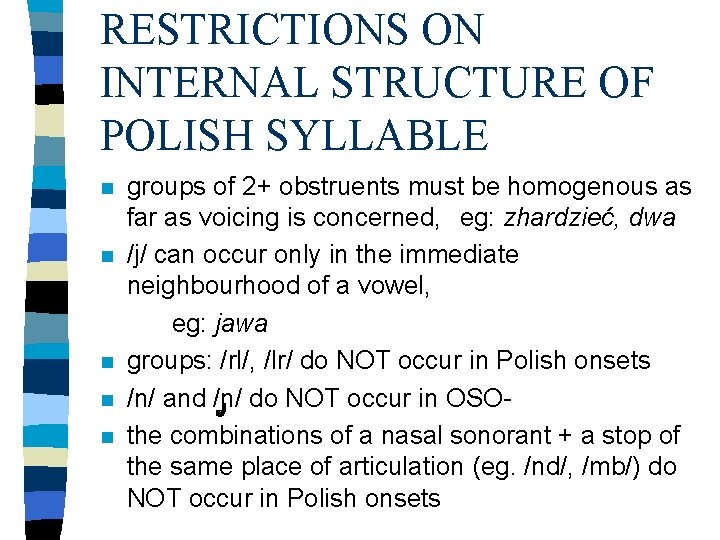
RESTRICTIONS ON INTERNAL STRUCTURE OF POLISH SYLLABLE n n n groups of 2+ obstruents must be homogenous as far as voicing is concerned, eg: zhardzieć, dwa /j/ can occur only in the immediate neighbourhood of a vowel, eg: jawa groups: /rl/, /lr/ do NOT occur in Polish onsets /n/ and /n/ do NOT occur in OSOthe combinations of a nasal sonorant + a stop of the same place of articulation (eg. /nd/, /mb/) do NOT occur in Polish onsets
METHODOLOGICAL ASPECTS OF THE STUDY n no research concerning all possible combinations of consonants and vowels in the Polish syllable is known the analysis made on the basis of 240 words (out of 20. 000) occurring most frequently on WWW pages on the Internet. Therefore, the study does not fully reflect reality only onsets of Polish syllables analysed
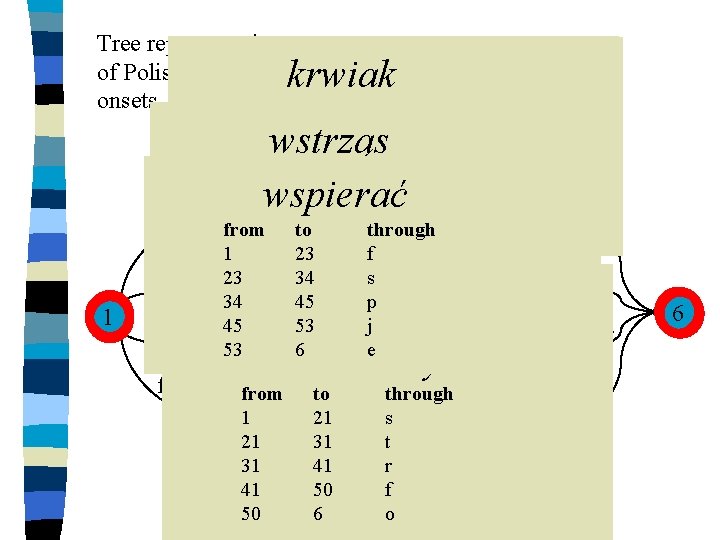
Tree representation of Polish CCCCV onsets from krwiak skrwawiony z' s 1 k to to 11 22 21 22 33 21 32 dz' from 33 30 32 to 43 42 1 43 42 2351 51 2351 3466 20 from 51 to t 23 44 31 134 44 21 23 34 2134 52 6 k 45 45 53 32 2253 fromr 6 to through ks 40 brk through fr f jf 41 s raa through ft s. S 42 r o~ p j f e through 43 wstrząs wspierać źdźbło strwożony 20 z’ f 23 1 from 20 s 1 30 21 40 31 50 41 50 to 33 30 21 40 31 5034 41 6 50 6 through t 44 dz’ s b t wp r o 45 f o w f 50 f o 51 a j 52 S j o~ e 53 6
- Slides: 12