
Policy Influence Capacity Advancement PICA Process Virtual Version
- Slides: 17
Policy Influence Capacity Advancement (PICA) Process Virtual Version
Process Description The Policy Influence Capacity Advancement Process is a six-week virtual learning platform that is intended to help policy-oriented institutions identify the capacities needed in order to increase their influence in the policy environment in which they find themselves. The PICA process was developed under the Innovation Lab for Food Security Policy Research, Capacity, and Influence (PRCI) at Michigan State University and is based on the Kaleidoscope Model (Resnick et al. , 2018). The process helps local policy research centers achieve five things. • • • Better understand their policy environment and their position within it; More clearly identify their preferred position within that environment; Identify capacity needs to achieve that position within the policy environment; Develop a concrete capacity development plan for acquiring those capacities, and Develop and implement a monitoring, evaluation, and learning process to make capacity development an on-going part of their organizational structure and culture. In the following slides, we review the component parts of the learning platform that makes up the PICA process and present two case studies of the application of PICA under PRCI. Resnick, D. , Haggblade, S. , Babu, S. , Hendriks, S. L. , & Mather, D. (2018). The Kaleidoscope Model of policy change: Applications to food security policy in Zambia. World Development, 109, 101 -120.
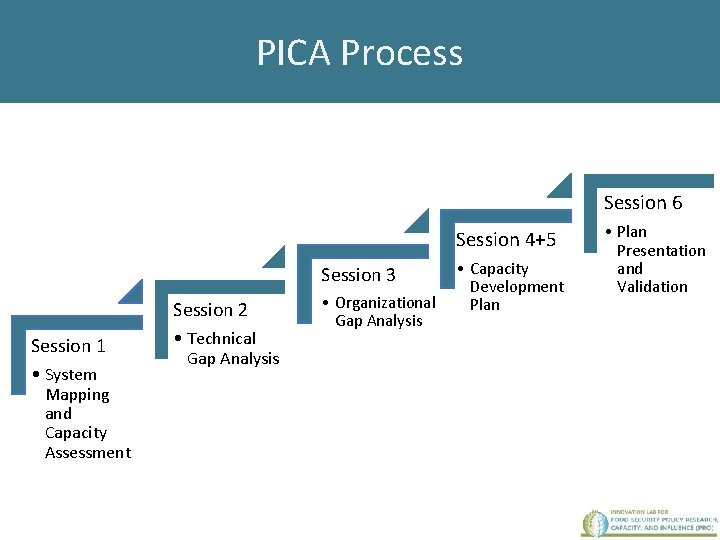
PICA Process Session 6 Session 4+5 Session 3 Session 2 Session 1 • System Mapping and Capacity Assessment • Technical Gap Analysis • Organizational Gap Analysis • Capacity Development Plan • Plan Presentation and Validation
System Mapping + Capacity Assessment Prep: Surveys sent out to all Centre technical and administrative staff that ask them to identify key stakeholders and processes that exist within the national agriculture policy system. A systems map is created based on the responses of participants and an analysis of each segment of the policy-making process (agenda setting, design, adoption, implementation, evaluation and reform) is created. Process: The systems map is shared with participants highlighting key insights and challenges before moving to breakout rooms to draw out further details on the policy making process and opportunities/barriers effecting impact. Objectives: PRCI Team members and Centre participants have a shared sense of the national policy environment and the Centre’s position within it. Outputs: A systems map of the national agriculture policy system, specific organizational aspirations for a three-year time horizon identifying where the Centre would like to see itself in the agriculture policy system. Session 1: 3 Hours
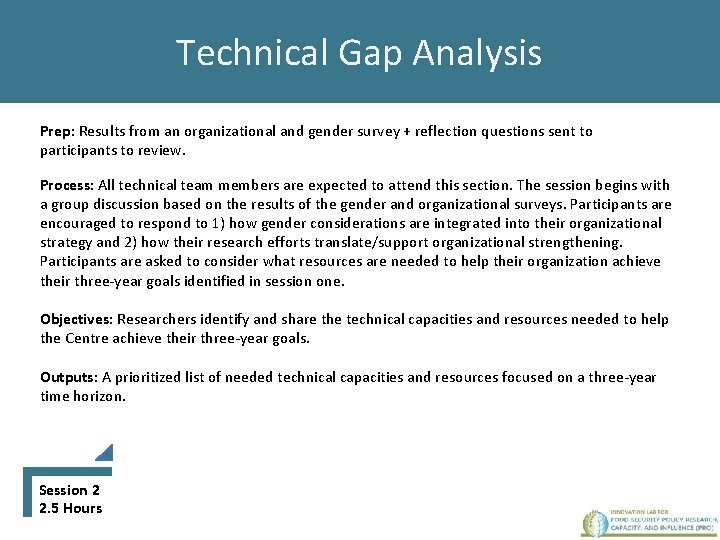
Technical Gap Analysis Prep: Results from an organizational and gender survey + reflection questions sent to participants to review. Process: All technical team members are expected to attend this section. The session begins with a group discussion based on the results of the gender and organizational surveys. Participants are encouraged to respond to 1) how gender considerations are integrated into their organizational strategy and 2) how their research efforts translate/support organizational strengthening. Participants are asked to consider what resources are needed to help their organization achieve their three-year goals identified in session one. Objectives: Researchers identify and share the technical capacities and resources needed to help the Centre achieve their three-year goals. Outputs: A prioritized list of needed technical capacities and resources focused on a three-year time horizon. Session 2 2. 5 Hours
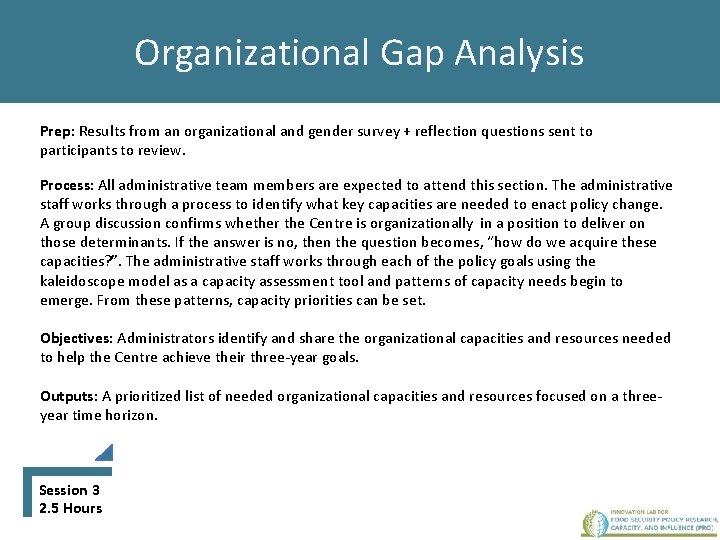
Organizational Gap Analysis Prep: Results from an organizational and gender survey + reflection questions sent to participants to review. Process: All administrative team members are expected to attend this section. The administrative staff works through a process to identify what key capacities are needed to enact policy change. A group discussion confirms whether the Centre is organizationally in a position to deliver on those determinants. If the answer is no, then the question becomes, “how do we acquire these capacities? ”. The administrative staff works through each of the policy goals using the kaleidoscope model as a capacity assessment tool and patterns of capacity needs begin to emerge. From these patterns, capacity priorities can be set. Objectives: Administrators identify and share the organizational capacities and resources needed to help the Centre achieve their three-year goals. Outputs: A prioritized list of needed organizational capacities and resources focused on a threeyear time horizon. Session 3 2. 5 Hours
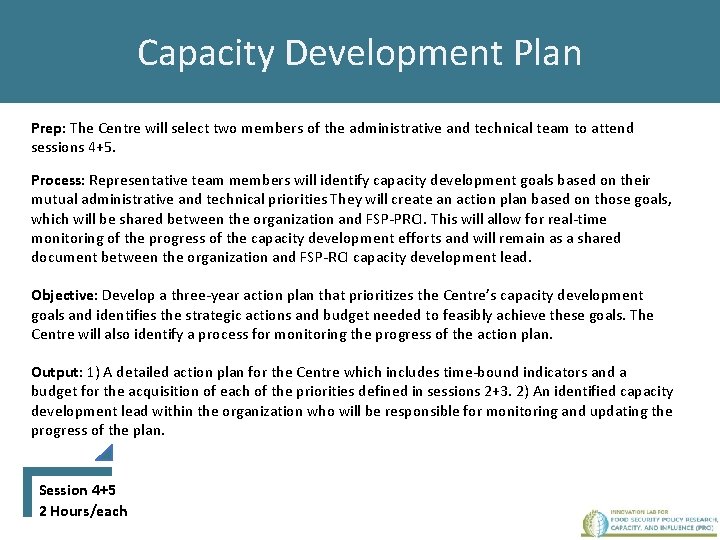
Capacity Development Plan Prep: The Centre will select two members of the administrative and technical team to attend sessions 4+5. Process: Representative team members will identify capacity development goals based on their mutual administrative and technical priorities They will create an action plan based on those goals, which will be shared between the organization and FSP-PRCI. This will allow for real-time monitoring of the progress of the capacity development efforts and will remain as a shared document between the organization and FSP-RCI capacity development lead. Objective: Develop a three-year action plan that prioritizes the Centre’s capacity development goals and identifies the strategic actions and budget needed to feasibly achieve these goals. The Centre will also identify a process for monitoring the progress of the action plan. Output: 1) A detailed action plan for the Centre which includes time-bound indicators and a budget for the acquisition of each of the priorities defined in sessions 2+3. 2) An identified capacity development lead within the organization who will be responsible for monitoring and updating the progress of the plan. Session 4+5 2 Hours/each
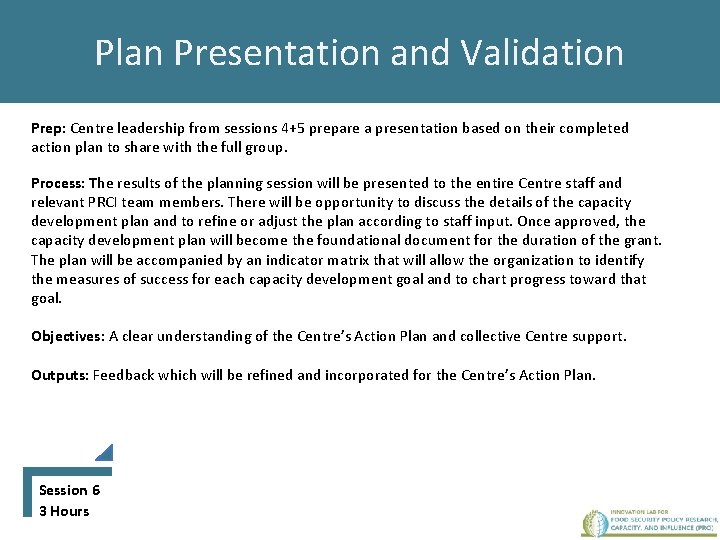
Plan Presentation and Validation Prep: Centre leadership from sessions 4+5 prepare a presentation based on their completed action plan to share with the full group. Process: The results of the planning session will be presented to the entire Centre staff and relevant PRCI team members. There will be opportunity to discuss the details of the capacity development plan and to refine or adjust the plan according to staff input. Once approved, the capacity development plan will become the foundational document for the duration of the grant. The plan will be accompanied by an indicator matrix that will allow the organization to identify the measures of success for each capacity development goal and to chart progress toward that goal. Objectives: A clear understanding of the Centre’s Action Plan and collective Centre support. Outputs: Feedback which will be refined and incorporated for the Centre’s Action Plan. Session 6 3 Hours
Monitoring, Evaluation, and Learning Prep: Centre Leadership appoints a capacity development lead and possibly a capacity development team to give oversight to the monitoring, evaluation, and learning (MEL) process. Process: The MEL lead or team meets regularly (ideally once a week) to review the implementation of the action plan and make any adjustments needed in goals, activities, or implementation details, such as cost, time, and resources devoted. During these sessions, plans are adjusted to meet the realities of the circumstances in which they find themselves. The MEL system should have policies, structures, and the funding necessary in order to become part of the organizational architecture. It is possible that the MEL lead or team would meet periodically with the PICA process organizers for continued advice and recommendations. Objectives: An on-going, sustainable capacity development effort focused on achieving the organizations mission and goals. Outputs: An up-to-date tolling three-year capacity development plan. Post-PICA MEL
Network Case Study: Re. NAPRI Overview: The Regional Network of Agricultural Policy Research Institutes (Re. NAPRI) is a regionally coordinated group of national agricultural policy research institutes operating in East, West, and Southern Africa. While Re. NAPRI did not go through the formal PICA Process designed for policy centres, many elements of the PICA Process were incorporated into the eight sessions held with Re. NAPRI members both from the Executive Committee and policy centres in the network. Process: Re. NAPRI participants kicked-off the engagements in session one with interactive activities to answer, 1) what does the ideal African Agricultural Policy System look like in 5 years? And 2) What is Re. NAPRI’s role in this ideal system? Next, participants were led through additional sessions that helped Re. NAPRI to identify strategic priorities by region, understand Re. NAPRI’s own strengths and weaknesses, and elaborate on internal processes for responding to regional and continental issues and priorities. Finally, participants identified research priorities for Pan-African and regional African engagement before using the information throughout the sessions to inform a five-year strategic plan. Outputs: A five-year, detailed strategic plan that breaks down each objective into action steps. The five-year detailed strategic plan is a living document that is continually being updated. The planning document is reviewed weekly to monitor progress toward goals, review relevance of goals, actions, and objectives, and update the plan based on changes in the environment or circumstances.
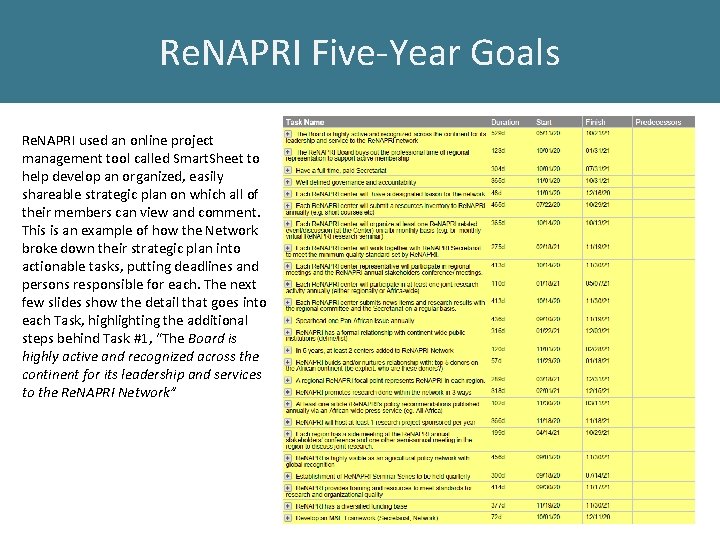
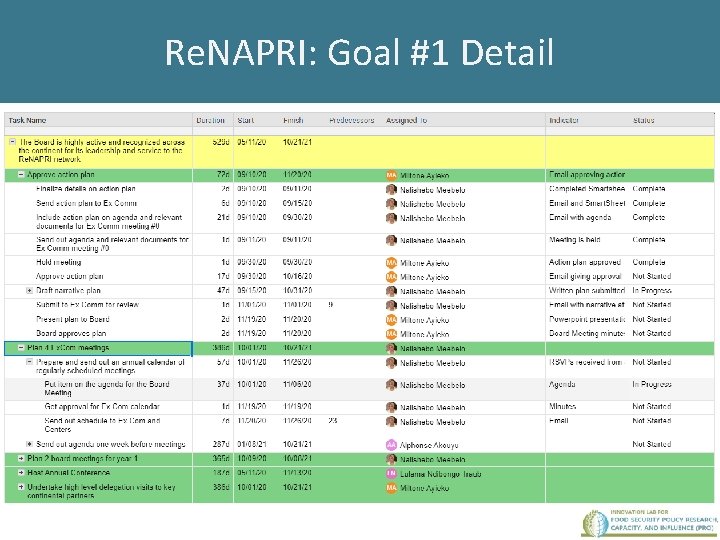
Re. NAPRI Five-Year Goals Re. NAPRI used an online project management tool called Smart. Sheet to help develop an organized, easily shareable strategic plan on which all of their members can view and comment. This is an example of how the Network broke down their strategic plan into actionable tasks, putting deadlines and persons responsible for each. The next few slides show the detail that goes into each Task, highlighting the additional steps behind Task #1, “The Board is highly active and recognized across the continent for its leadership and services to the Re. NAPRI Network”
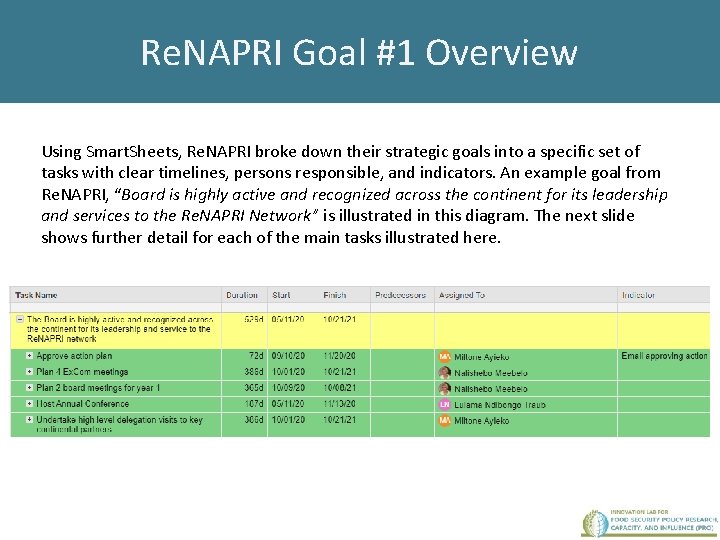
Re. NAPRI Goal #1 Overview Using Smart. Sheets, Re. NAPRI broke down their strategic goals into a specific set of tasks with clear timelines, persons responsible, and indicators. An example goal from Re. NAPRI, “Board is highly active and recognized across the continent for its leadership and services to the Re. NAPRI Network” is illustrated in this diagram. The next slide shows further detail for each of the main tasks illustrated here.
Re. NAPRI: Goal #1 Detail
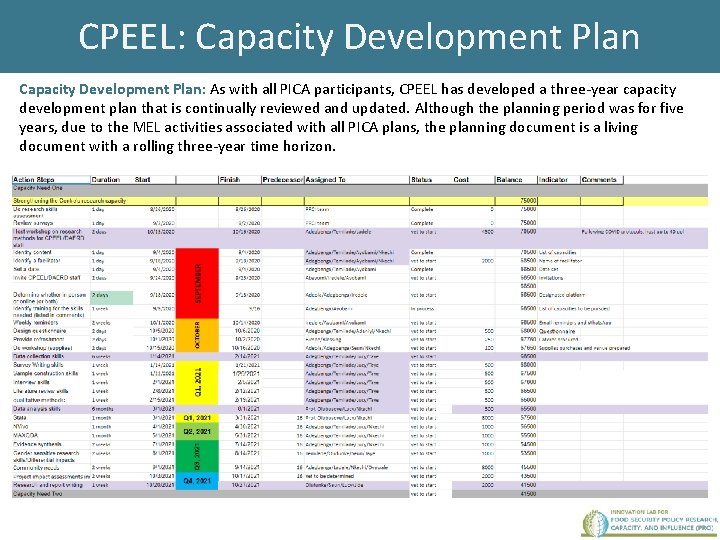
Institutional Case Study: CPEEL Overview: The Centre for Petroleum, Energy, Economics, and Law (CPEEL) based at the University of Ibadan, Nigeria is well known for its work in the energy sector. Through the PICA Process, the Centre wishes to strengthen its capacity to further its work in the agriculture sector and work crosssectorally for greater impact. Process: The PICA process was a six-week process that began with all members of CPEEL participating in a systems mapping process to illustrate their current role in the agriculture policy system and compare it to where they hope to be in three-years time. During follow-up sessions with select administrative and technical staff, participants were asked to 1) determine the specific technical capacities that needed strengthening and aligned with the Centre’s three-year vision and 2) prioritize the capacities based on timeliness and funds available. The sessions highlighted that CPEEL needed to invest in network building and better understanding the stakeholders within the system along with strengthening the Centre’s research capacity and project management skills. A detailed action plan was created focused on how to achieve these specific capacities and in the final session, the plan was presented to the full CPEEL team. Outputs: CPEEL cocreated a systems map of the Nigerian Agriculture Policy System (See example of the map on the following slide) and a detailed CPEEL Technical and Organizational Capacities Action Plan
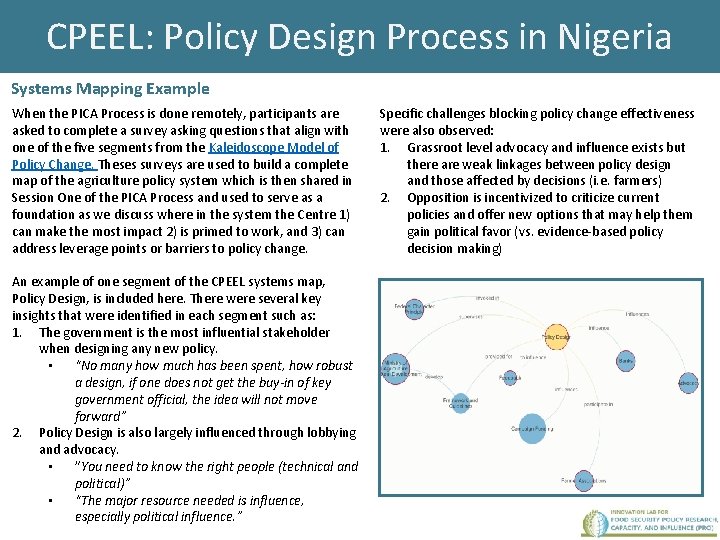
CPEEL: Policy Design Process in Nigeria Systems Mapping Example When the PICA Process is done remotely, participants are asked to complete a survey asking questions that align with one of the five segments from the Kaleidoscope Model of Policy Change. Theses surveys are used to build a complete map of the agriculture policy system which is then shared in Session One of the PICA Process and used to serve as a foundation as we discuss where in the system the Centre 1) can make the most impact 2) is primed to work, and 3) can address leverage points or barriers to policy change. An example of one segment of the CPEEL systems map, Policy Design, is included here. There were several key insights that were identified in each segment such as: 1. The government is the most influential stakeholder when designing any new policy. • “No many how much has been spent, how robust a design, if one does not get the buy-in of key government official, the idea will not move forward” 2. Policy Design is also largely influenced through lobbying and advocacy. • ”You need to know the right people (technical and political)” • “The major resource needed is influence, especially political influence. ” Specific challenges blocking policy change effectiveness were also observed: 1. Grassroot level advocacy and influence exists but there are weak linkages between policy design and those affected by decisions (i. e. farmers) 2. Opposition is incentivized to criticize current policies and offer new options that may help them gain political favor (vs. evidence-based policy decision making)
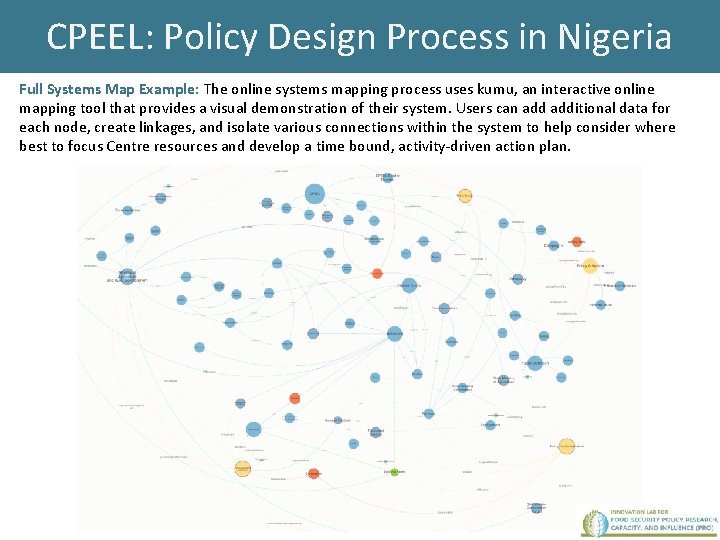
CPEEL: Policy Design Process in Nigeria Full Systems Map Example: The online systems mapping process uses kumu, an interactive online mapping tool that provides a visual demonstration of their system. Users can additional data for each node, create linkages, and isolate various connections within the system to help consider where best to focus Centre resources and develop a time bound, activity-driven action plan.
CPEEL: Capacity Development Plan: As with all PICA participants, CPEEL has developed a three-year capacity development plan that is continually reviewed and updated. Although the planning period was for five years, due to the MEL activities associated with all PICA plans, the planning document is a living document with a rolling three-year time horizon.