
Policy Dialogue on Environment and Climat Change Module

- Slides: 31
Policy Dialogue on Environment and Climat Change Module 2: Preparing for a strategic approach to policy dialogue Brussels, 23 May 2019 Thomas Theisohn (thomas. theisohn@gmail. com) 1
What would make an approach to policy dialogue on environment & climate change more “structured” or “strategic”? 2
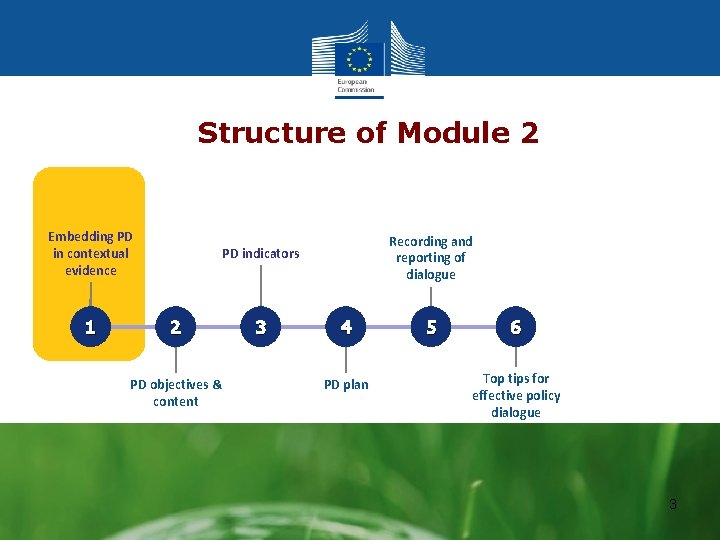
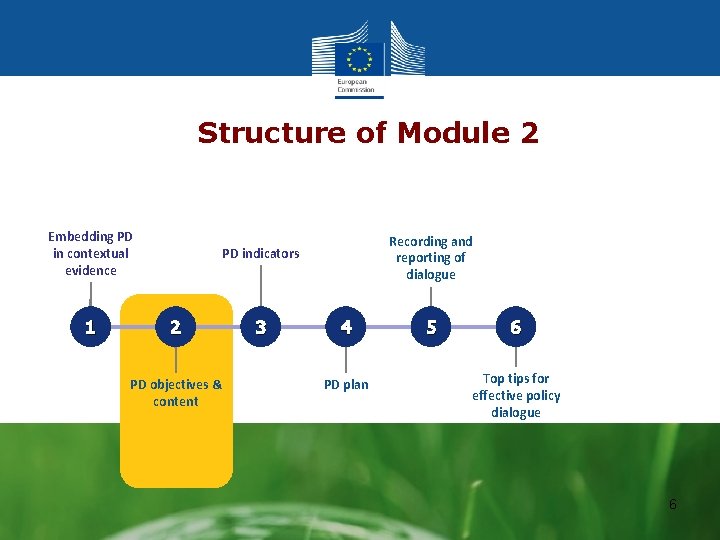
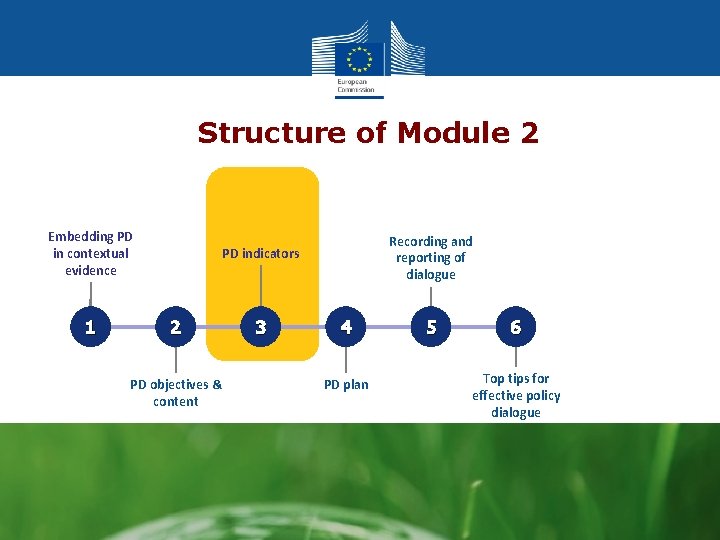
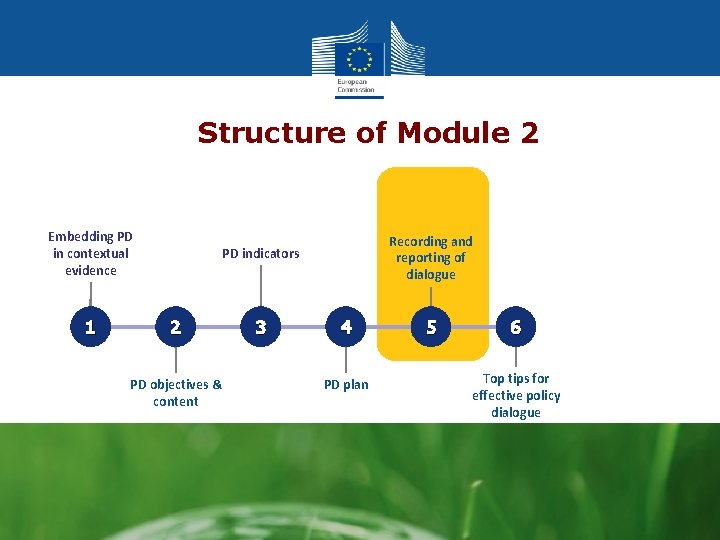
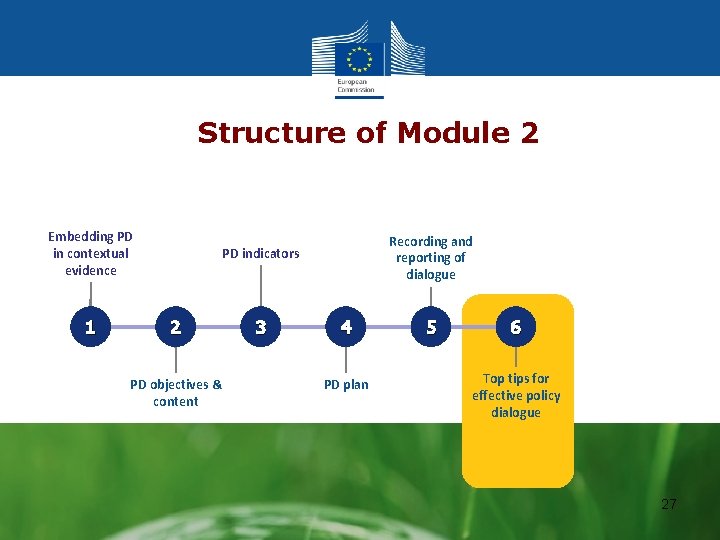
Structure of Module 2 Embedding PD in contextual evidence 1 Recording and reporting of dialogue PD indicators 2 PD objectives & content 3 4 PD plan 5 6 Top tips for effective policy dialogue 3
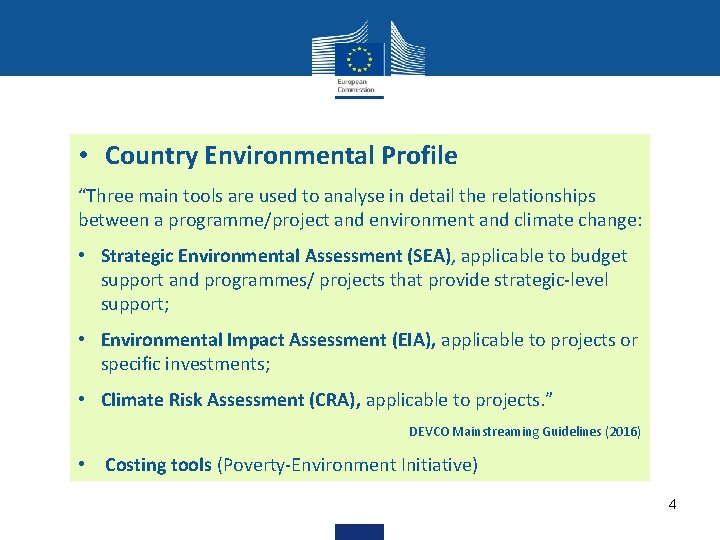
• Country Environmental Profile “Three main tools are used to analyse in detail the relationships between a programme/project and environment and climate change: • Strategic Environmental Assessment (SEA), applicable to budget support and programmes/ projects that provide strategic-level support; • Environmental Impact Assessment (EIA), applicable to projects or specific investments; • Climate Risk Assessment (CRA), applicable to projects. ” DEVCO Mainstreaming Guidelines (2016) • Costing tools (Poverty-Environment Initiative) 4
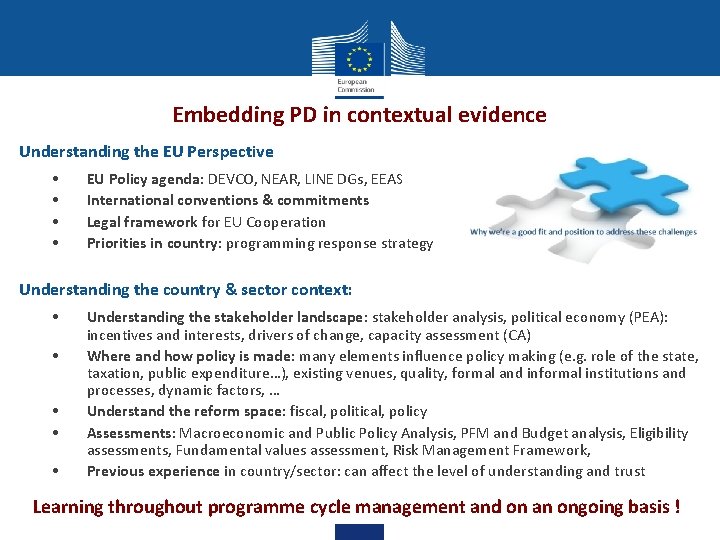
Embedding PD in contextual evidence Understanding the EU Perspective • • EU Policy agenda: DEVCO, NEAR, LINE DGs, EEAS International conventions & commitments Legal framework for EU Cooperation Priorities in country: programming response strategy Understanding the country & sector context: • • • Understanding the stakeholder landscape: stakeholder analysis, political economy (PEA): incentives and interests, drivers of change, capacity assessment (CA) Where and how policy is made: many elements influence policy making (e. g. role of the state, taxation, public expenditure…), existing venues, quality, formal and informal institutions and processes, dynamic factors, … Understand the reform space: fiscal, political, policy Assessments: Macroeconomic and Public Policy Analysis, PFM and Budget analysis, Eligibility assessments, Fundamental values assessment, Risk Management Framework, Previous experience in country/sector: can affect the level of understanding and trust Learning throughout programme cycle management and on an ongoing basis ! 5
Structure of Module 2 Embedding PD in contextual evidence 1 Recording and reporting of dialogue PD indicators 2 PD objectives & content 3 4 PD plan 5 6 Top tips for effective policy dialogue 6
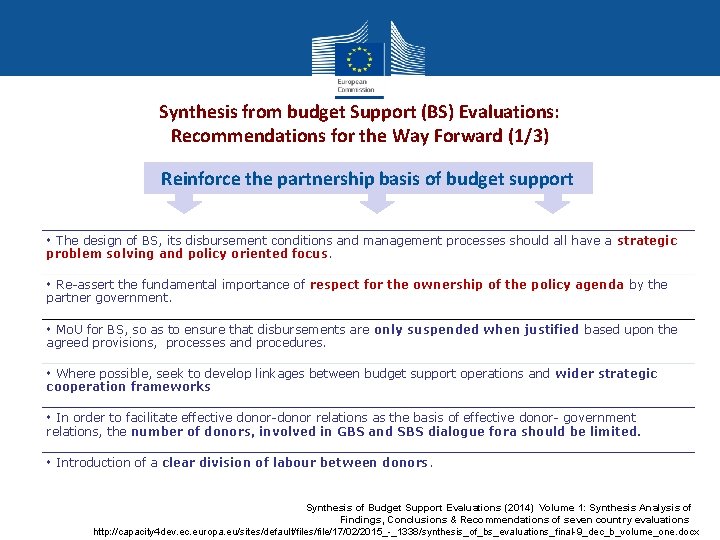
Synthesis from budget Support (BS) Evaluations: Recommendations for the Way Forward (1/3) Reinforce the partnership basis of budget support The design of BS, its disbursement conditions and management processes should all have a strategic problem solving and policy oriented focus. Re-assert the fundamental importance of respect for the ownership of the policy agenda by the partner government. Mo. U for BS, so as to ensure that disbursements are only suspended when justified based upon the agreed provisions, processes and procedures. Where possible, seek to develop linkages between budget support operations and wider strategic cooperation frameworks In order to facilitate effective donor-donor relations as the basis of effective donor- government relations, the number of donors, involved in GBS and SBS dialogue fora should be limited. Introduction of a clear division of labour between donors. 7 Synthesis of Budget Support Evaluations (2014) Volume 1: Synthesis Analysis of Findings, Conclusions & Recommendations of seven country evaluations http: //capacity 4 dev. ec. europa. eu/sites/default/files/file/17/02/2015_-_1338/synthesis_of_bs_evaluations_final-9_dec_b_volume_one. docx
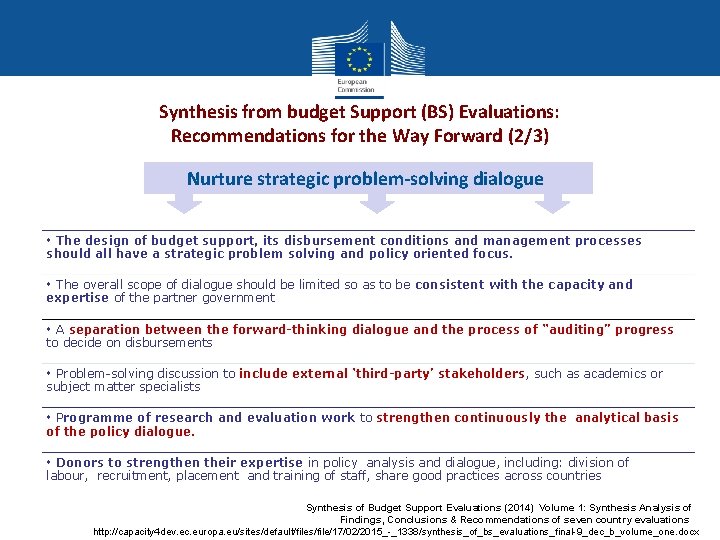
Synthesis from budget Support (BS) Evaluations: Recommendations for the Way Forward (2/3) Nurture strategic problem-solving dialogue The design of budget support, its disbursement conditions and management processes should all have a strategic problem solving and policy oriented focus. The overall scope of dialogue should be limited so as to be consistent with the capacity and expertise of the partner government A separation between the forward-thinking dialogue and the process of “auditing” progress to decide on disbursements Problem-solving discussion to include external ‘third-party’ stakeholders, such as academics or subject matter specialists Programme of research and evaluation work to strengthen continuously the analytical basis of the policy dialogue. Donors to strengthen their expertise in policy analysis and dialogue, including: division of labour, recruitment, placement and training of staff, share good practices across countries 8 Synthesis of Budget Support Evaluations (2014) Volume 1: Synthesis Analysis of Findings, Conclusions & Recommendations of seven country evaluations http: //capacity 4 dev. ec. europa. eu/sites/default/files/file/17/02/2015_-_1338/synthesis_of_bs_evaluations_final-9_dec_b_volume_one. docx
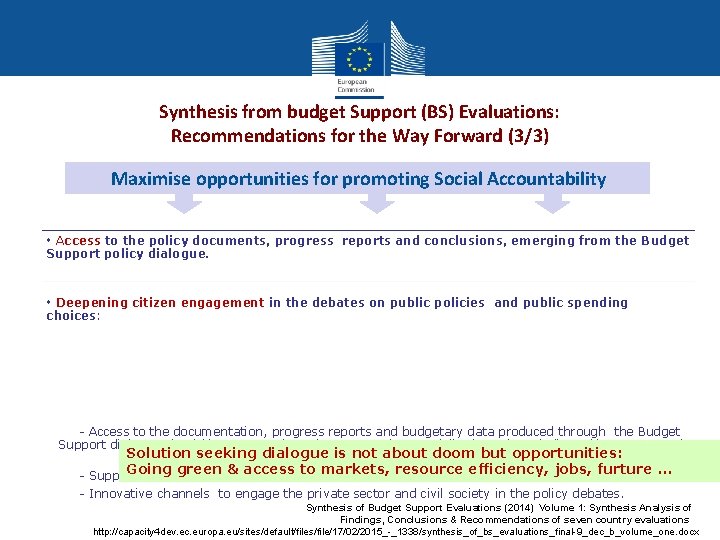
Synthesis from budget Support (BS) Evaluations: Recommendations for the Way Forward (3/3) Maximise opportunities for promoting Social Accountability Access to the policy documents, progress reports and conclusions, emerging from the Budget Support policy dialogue. Deepening citizen engagement in the debates on public policies and public spending choices: - Access to the documentation, progress reports and budgetary data produced through the Budget Support dialogue should be systematic and guaranteed, potentially through a dedicated internet portal; Solution seeking dialogue is not about doom but opportunities: Going green & access to markets, resource efficiency, jobs, furture. . . - Support to CSOs in improving understanding of public budgets and public policy issues; - Innovative channels to engage the private sector and civil society in the policy debates. 9 Synthesis of Budget Support Evaluations (2014) Volume 1: Synthesis Analysis of Findings, Conclusions & Recommendations of seven country evaluations http: //capacity 4 dev. ec. europa. eu/sites/default/files/file/17/02/2015_-_1338/synthesis_of_bs_evaluations_final-9_dec_b_volume_one. docx
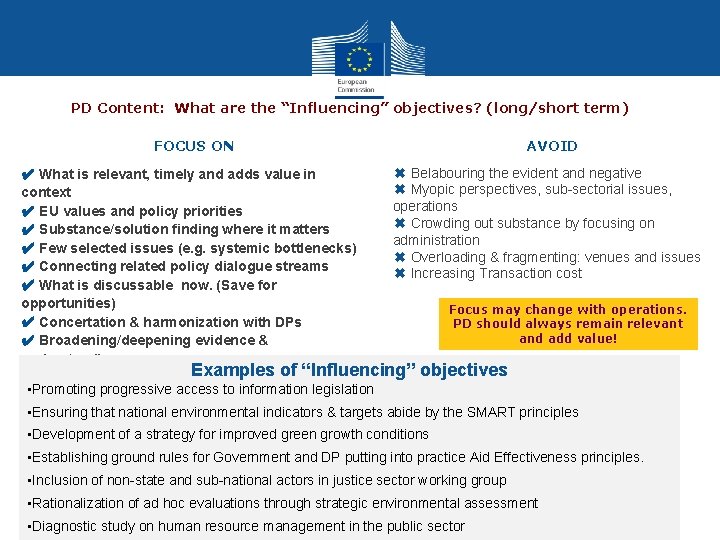
PD Content: What are the “Influencing” objectives? (long/short term) FOCUS ON AVOID ✖ Belabouring the evident and negative ✔ What is relevant, timely and adds value in ✖ Myopic perspectives, sub-sectorial issues, context operations ✔ EU values and policy priorities ✖ Crowding out substance by focusing on ✔ Substance/solution finding where it matters administration ✔ Few selected issues (e. g. systemic bottlenecks) ✖ Overloading & fragmenting: venues and issues ✔ Connecting related policy dialogue streams ✖ Increasing Transaction cost ✔ What is discussable now. (Save for opportunities) Focus may change with operations. ✔ Concertation & harmonization with DPs PD should always remain relevant and add value! ✔ Broadening/deepening evidence & understanding Examples of “Influencing” objectives ✔ Coherence, Risks, Sustainability etc. • Promoting progressive access to information legislation • Ensuring that national environmental indicators & targets abide by the SMART principles • Development of a strategy for improved green growth conditions • Establishing ground rules for Government and DP putting into practice Aid Effectiveness principles. • Inclusion of non-state and sub-national actors in justice sector working group • Rationalization of ad hoc evaluations through strategic environmental assessment • Diagnostic study on human resource management in the public sector 10
Structure of Module 2 Embedding PD in contextual evidence 1 Recording and reporting of dialogue PD indicators 2 PD objectives & content 3 4 PD plan 5 6 Top tips for effective policy dialogue 11
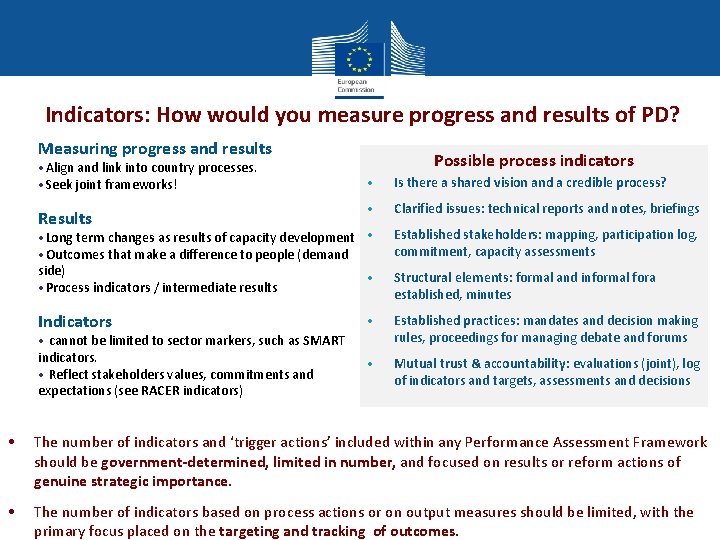
Indicators: How would you measure progress and results of PD? Measuring progress and results • Align and link into country processes. • Seek joint frameworks! Possible process indicators • Is there a shared vision and a credible process? • Clarified issues: technical reports and notes, briefings • Long term changes as results of capacity development • • Outcomes that make a difference to people (demand side) • • Process indicators / intermediate results Established stakeholders: mapping, participation log, Possible process indicators commitment, capacity assessments Indicators • Established practices: mandates and decision making rules, proceedings for managing debate and forums • Mutual trust & accountability: evaluations (joint), log of indicators and targets, assessments and decisions Results • cannot be limited to sector markers, such as SMART indicators. • Reflect stakeholders values, commitments and expectations (see RACER indicators) for policy dialogue ? Structural elements: formal and informal fora established, minutes • The number of indicators and ‘trigger actions’ included within any Performance Assessment Framework should be government-determined, limited in number, and focused on results or reform actions of genuine strategic importance. • 12 The number of indicators based on process actions or on output measures should be limited, with the primary focus placed on the targeting and tracking of outcomes.
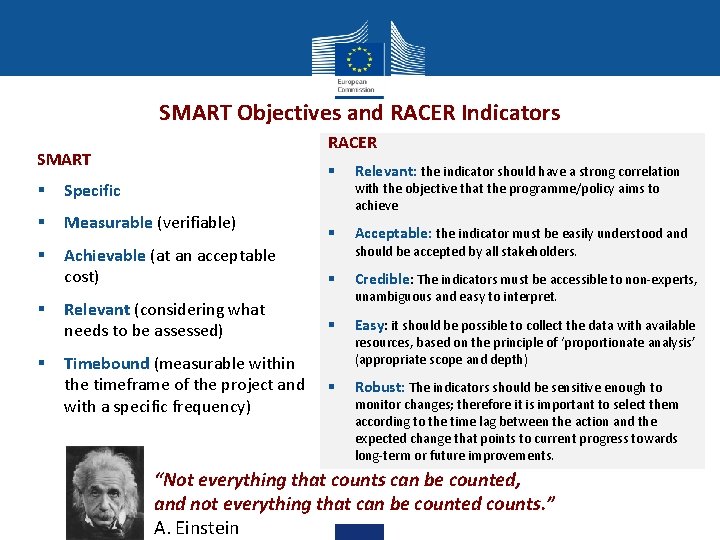
SMART Objectives and RACER Indicators RACER SMART § § Specific § Measurable (verifiable) § Achievable (at an acceptable cost) § § Relevant: the indicator should have a strong correlation with the objective that the programme/policy aims to achieve § Acceptable: the indicator must be easily understood and should be accepted by all stakeholders. § Credible: The indicators must be accessible to non-experts, unambiguous and easy to interpret. Relevant (considering what needs to be assessed) § Timebound (measurable within the timeframe of the project and with a specific frequency) § Easy: it should be possible to collect the data with available resources, based on the principle of ‘proportionate analysis’ (appropriate scope and depth) Robust: The indicators should be sensitive enough to monitor changes; therefore it is important to select them according to the time lag between the action and the expected change that points to current progress towards long-term or future improvements. “Not everything that counts can be counted, and not everything that can be counted counts. ” A. Einstein
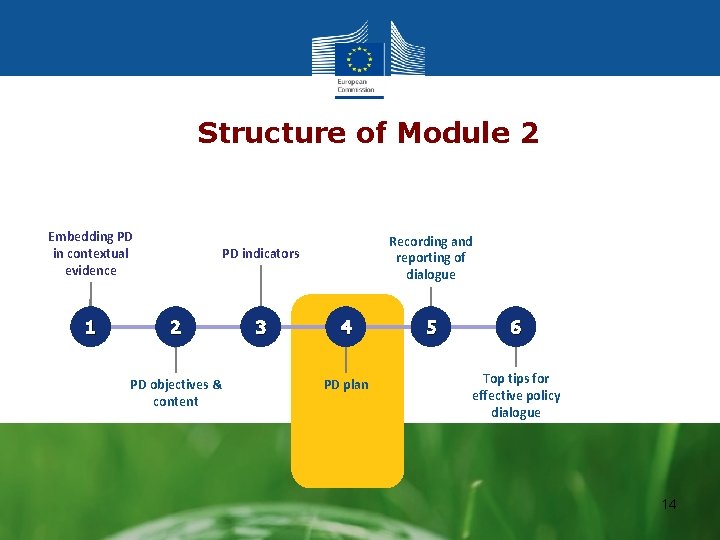
Structure of Module 2 Embedding PD in contextual evidence 1 Recording and reporting of dialogue PD indicators 2 PD objectives & content 3 4 PD plan 5 6 Top tips for effective policy dialogue 14
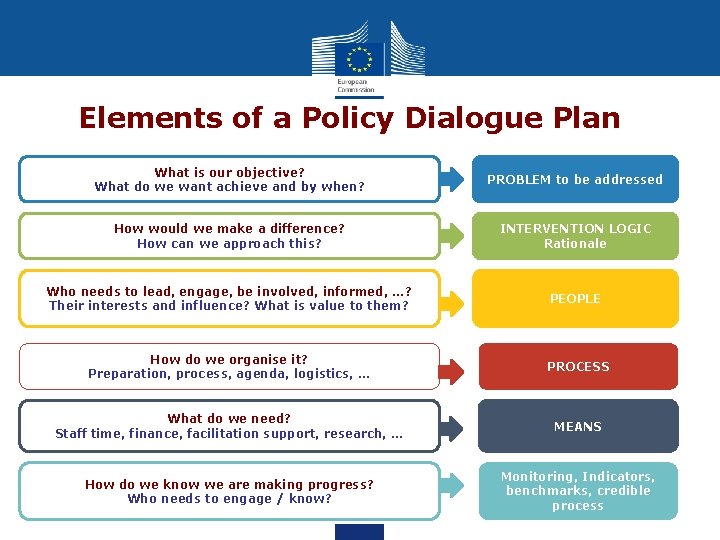
Elements of a Policy Dialogue Plan What is our objective? What do we want achieve and by when? PROBLEM to be addressed How would we make a difference? How can we approach this? INTERVENTION LOGIC Rationale Who needs to lead, engage, be involved, informed, …? Their interests and influence? What is value to them? PEOPLE How do we organise it? Preparation, process, agenda, logistics, … PROCESS What do we need? Staff time, finance, facilitation support, research, … MEANS How do we know we are making progress? Who needs to engage / know? Monitoring, Indicators, benchmarks, credible 15 process
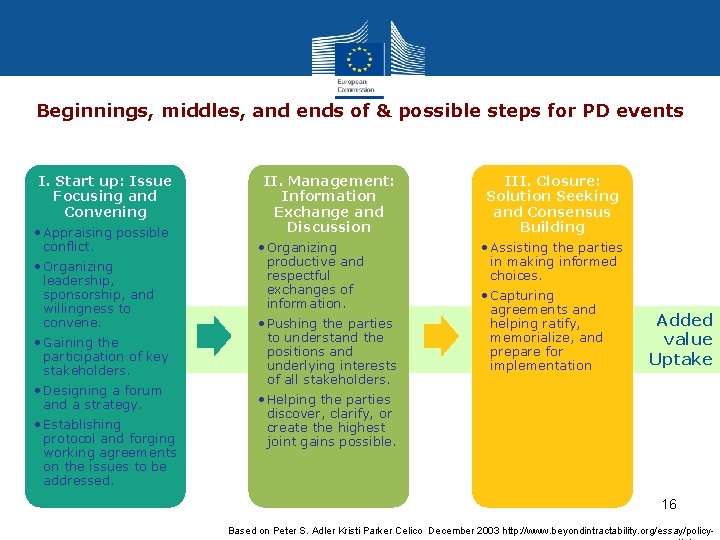
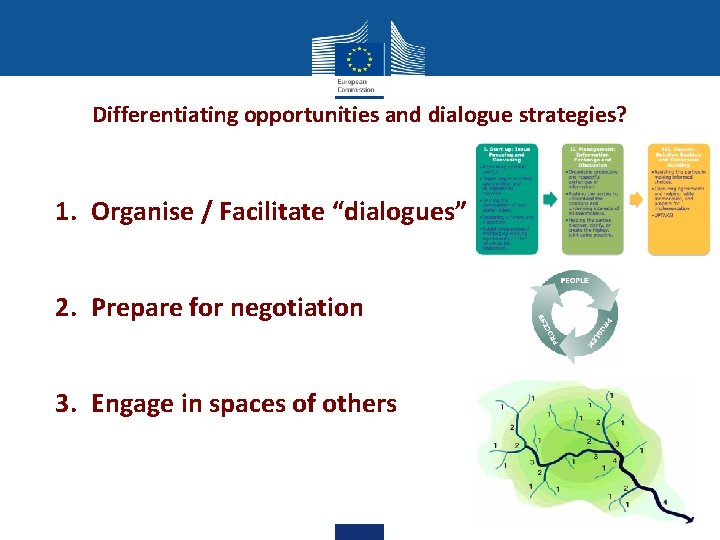
Beginnings, middles, and ends of & possible steps for PD events I. Start up: Issue Focusing and Convening • Appraising possible conflict. • Organizing leadership, sponsorship, and willingness to convene. • Gaining the participation of key stakeholders. • Designing a forum and a strategy. • Establishing protocol and forging working agreements on the issues to be addressed. II. Management: Information Exchange and Discussion • Organizing productive and respectful exchanges of information. • Pushing the parties to understand the positions and underlying interests of all stakeholders. • Helping the parties discover, clarify, or create the highest joint gains possible. III. Closure: Solution Seeking and Consensus Building • Assisting the parties in making informed choices. • Capturing agreements and helping ratify, memorialize, and prepare for implementation Added value Uptake 16 Based on Peter S. Adler Kristi Parker Celico December 2003 http: //www. beyondintractability. org/essay/policy-
Differentiating opportunities and dialogue strategies? 1. Organise / Facilitate “dialogues” 2. Prepare for negotiation 3. Engage in spaces of others 17
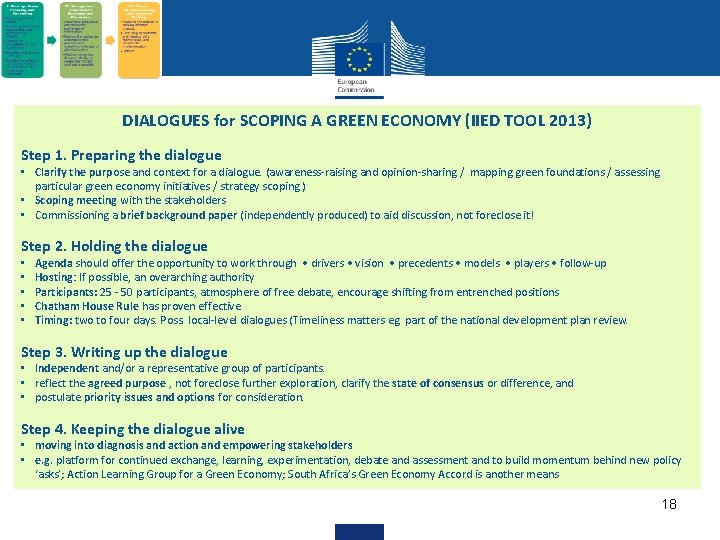
DIALOGUES for SCOPING A GREEN ECONOMY (IIED TOOL 2013) Step 1. Preparing the dialogue • Clarify the purpose and context for a dialogue. (awareness-raising and opinion-sharing / mapping green foundations / assessing particular green economy initiatives / strategy scoping ) • Scoping meeting with the stakeholders • Commissioning a brief background paper (independently produced) to aid discussion, not foreclose it! Step 2. Holding the dialogue • • • Agenda should offer the opportunity to work through • drivers • vision • precedents • models • players • follow-up Hosting: If possible, an overarching authority Participants: 25 - 50 participants, atmosphere of free debate, encourage shifting from entrenched positions Chatham House Rule has proven effective Timing: two to four days. Poss. local-level dialogues (Timeliness matters eg. part of the national development plan review. Step 3. Writing up the dialogue • Independent and/or a representative group of participants. • reflect the agreed purpose , not foreclose further exploration, clarify the state of consensus or difference, and • postulate priority issues and options for consideration. Step 4. Keeping the dialogue alive • moving into diagnosis and action and empowering stakeholders • e. g. platform for continued exchange, learning, experimentation, debate and assessment and to build momentum behind new policy ‘asks’; Action Learning Group for a Green Economy; South Africa’s Green Economy Accord is another means 18
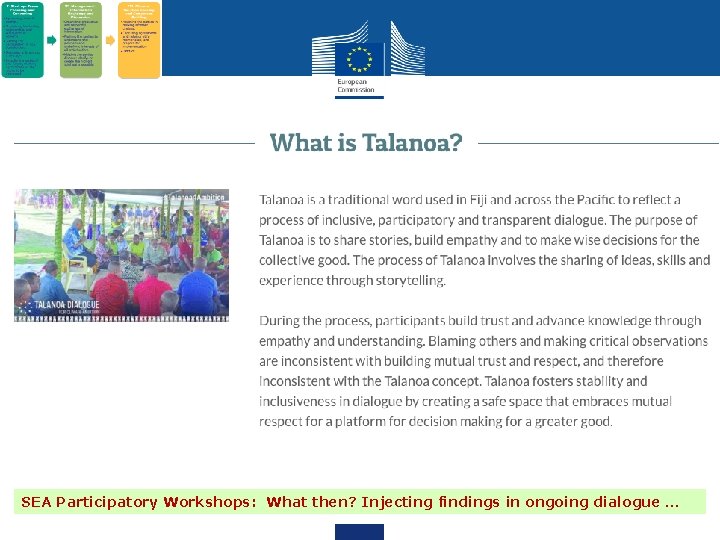
SEA Participatory Workshops: What then? Injecting findings in ongoing dialogue … 19
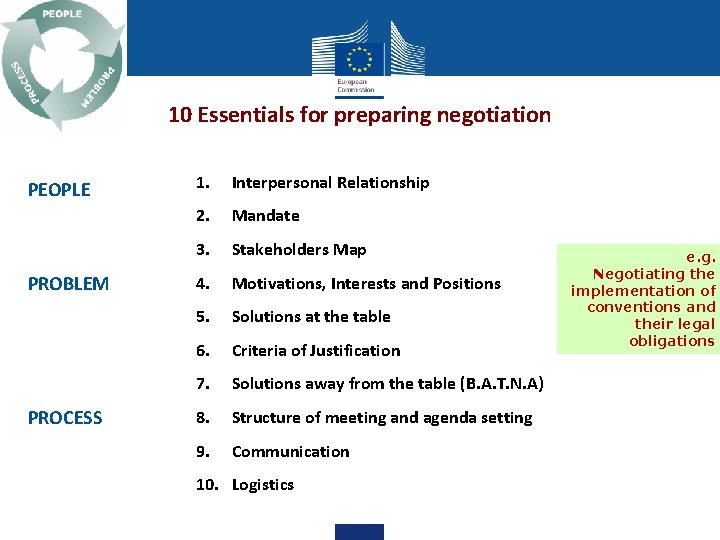
10 Essentials for preparing negotiation PEOPLE PROBLEM PROCESS 1. Interpersonal Relationship 2. Mandate 3. Stakeholders Map 4. Motivations, Interests and Positions 5. Solutions at the table 6. Criteria of Justification 7. Solutions away from the table (B. A. T. N. A) 8. Structure of meeting and agenda setting 9. Communication 10. Logistics e. g. Negotiating the implementation of conventions and their legal obligations
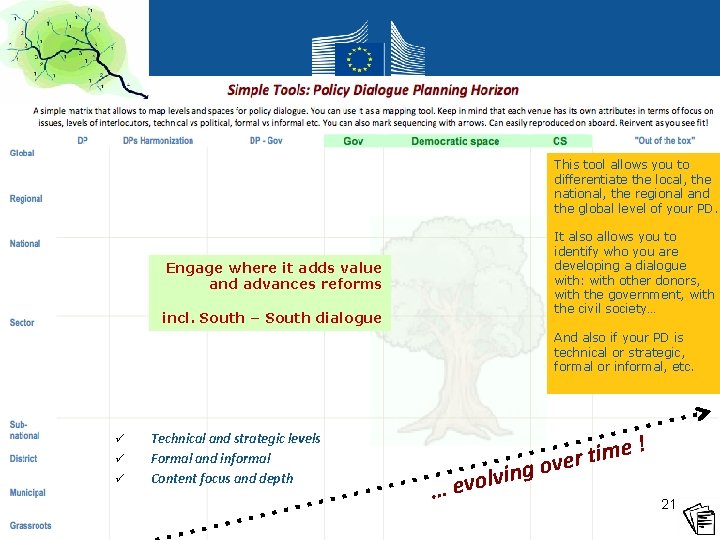
This tool allows you to differentiate the local, the national, the regional and the global level of your PD. It also allows you to identify who you are developing a dialogue with: with other donors, with the government, with the civil society… Engage where it adds value and advances reforms incl. South – South dialogue And also if your PD is technical or strategic, formal or informal, etc. ü ü ü Technical and strategic levels Formal and informal Content focus and depth ng i v l o v …e ! e m i t over 21
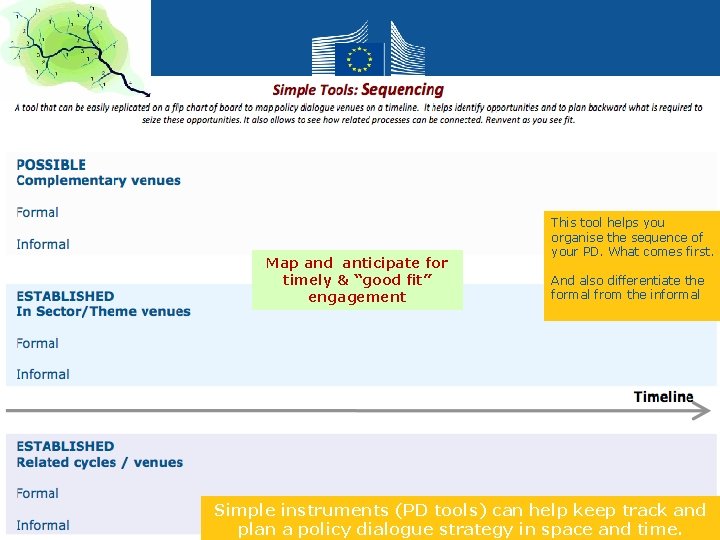
Map and anticipate for timely & “good fit” engagement This tool helps you organise the sequence of your PD. What comes first. And also differentiate the formal from the informal Simple instruments (PD tools) can help keep track and plan a policy dialogue strategy in space and time.
Structure of Module 2 Embedding PD in contextual evidence 1 Recording and reporting of dialogue PD indicators 2 PD objectives & content 3 4 PD plan 5 6 Top tips for effective policy dialogue 23
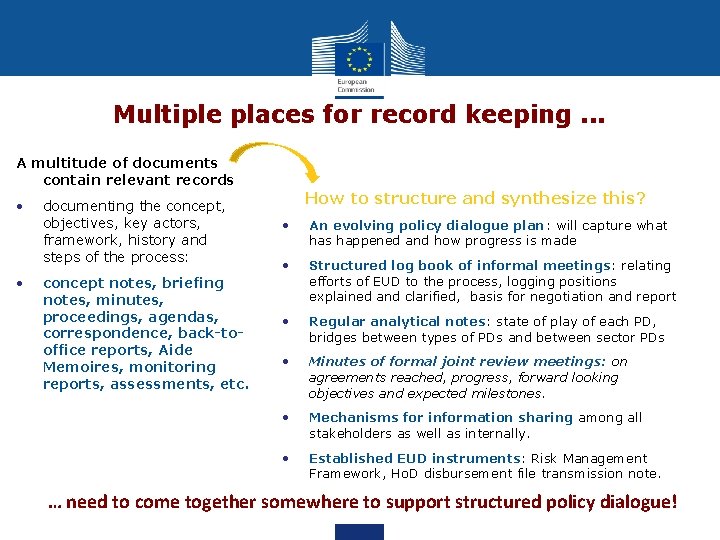
Multiple places for record keeping. . . A multitude of documents contain relevant records • • documenting the concept, objectives, key actors, framework, history and steps of the process: concept notes, briefing notes, minutes, proceedings, agendas, correspondence, back-tooffice reports, Aide Memoires, monitoring reports, assessments, etc. How to structure and synthesize this? • An evolving policy dialogue plan: will capture what has happened and how progress is made • Structured log book of informal meetings: relating efforts of EUD to the process, logging positions explained and clarified, basis for negotiation and report • Regular analytical notes: state of play of each PD, bridges between types of PDs and between sector PDs • Minutes of formal joint review meetings: on agreements reached, progress, forward looking objectives and expected milestones. • Mechanisms for information sharing among all stakeholders as well as internally. • Established EUD instruments: Risk Management Framework, Ho. D disbursement file transmission note. … need to come together somewhere to support structured policy dialogue! 24
Useful Rules in Record Keeping (1/2) • Be imaginative about how you (and others) record events, meetings and project activities. Use flip charts, ad hoc notes, logbooks, audiotapes, videotapes, photographs, cartoons or drawings – anything that will capture and communicate information more vividly • Be selective – only record information that is useful and relevant. Nobody ever wants to read pages and pages of what everyone said, rather it is more useful to provide information that prompts and reminds readers of key issues discussed and activities agreed or undertaken • Choose good record keepers– since record keeping is a highly skilled role, always allocate it to an experienced and confident colleague (not the most inexperienced, junior member of the team) Source: Brokering Guidebook 25
Useful Rules in Record Keeping (2/2) • Disseminate information appropriately to meet the needs of different audiences including: partners; partner organisations; external donors; public officials; project staff and beneficiaries; media; reviewers and project evaluators; and other partnership practitioners • Remember to double-check that all partners (and other key stakeholders) are comfortable with the communications and record-keeping approaches • Take time to educate all those involved in the value of good record keeping to enhance the efficiency, effectiveness and impact of the partnership • Build storytelling skills with all those involved to help materials come alive since every bit of partnering activity – if one thinks of a partnership as a journey where those travelling together may have had to overcome insurmountable odds – is, after all, a story worth telling Source: Brokering Guidebook 26
Structure of Module 2 Embedding PD in contextual evidence 1 Recording and reporting of dialogue PD indicators 2 PD objectives & content 3 4 PD plan 5 6 Top tips for effective policy dialogue 27
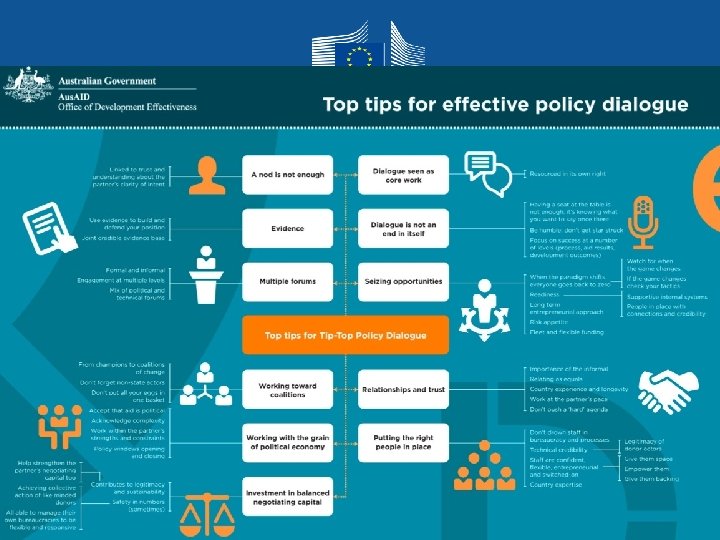
28
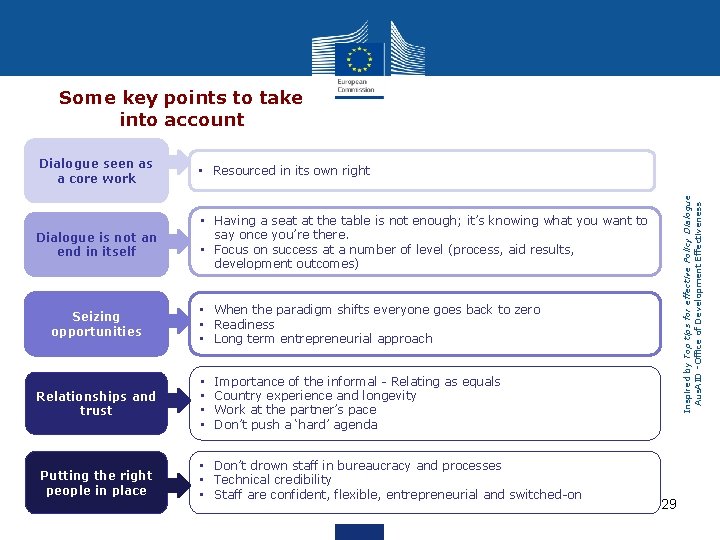
Some key points to take into account Dialogue is not an end in itself Seizing opportunities Relationships and trust Putting the right people in place • Resourced in its own right Inspired by Top tips for effective Policy Dialogue Aus. AID -Office of Development Effectiveness Dialogue seen as a core work • Having a seat at the table is not enough; it’s knowing what you want to say once you’re there. • Focus on success at a number of level (process, aid results, development outcomes) • When the paradigm shifts everyone goes back to zero • Readiness • Long term entrepreneurial approach • • Importance of the informal - Relating as equals Country experience and longevity Work at the partner’s pace Don’t push a ‘hard’ agenda • Don’t drown staff in bureaucracy and processes • Technical credibility • Staff are confident, flexible, entrepreneurial and switched-on 29
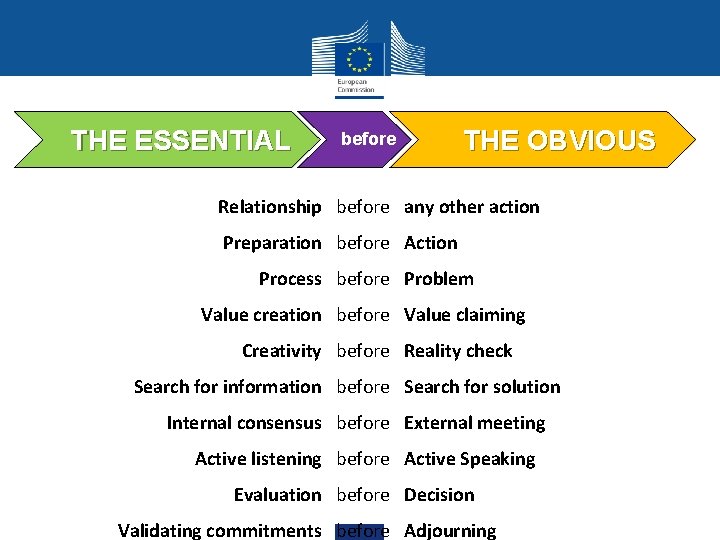
THE ESSENTIAL before THE OBVIOUS Relationship before any other action Preparation before Action Process before Problem Value creation before Value claiming Creativity before Reality check Search for information before Search for solution Internal consensus before External meeting Active listening before Active Speaking Evaluation before Decision Validating commitments before Adjourning
Policy Dialogue in practice Module 1: Rationale, challenges and potential of a structured approach to Policy Dialogue THANK YOU! DEVCO Environment Week 2018, Brussels, 17 October 2018 Thomas Theisohn (thomas. theisohn@gmail. com) 31