
Policy Coherence for Sustainable Development and the SDGs
Policy Coherence for Sustainable Development and the SDGs Towards implementing Agenda 2030 Anna Knoll Policy Officer, ECDPM The Hague, 21 January 2016
Agenda I. Transition from MDGs to SDGs and PCD to PCSD A) A new global development framework B) From PCD to PCSD in the post-2015 context (45 min) II. Implementation of PC(S)D – Lessons learned and challenges III. What way forward with Agenda 2030? IV. Open Questions and Discussion (30 min) ECDPM Page 2
I. Transition from MDGs to SDGs, from PCD to PCSD ECDPM Page 3
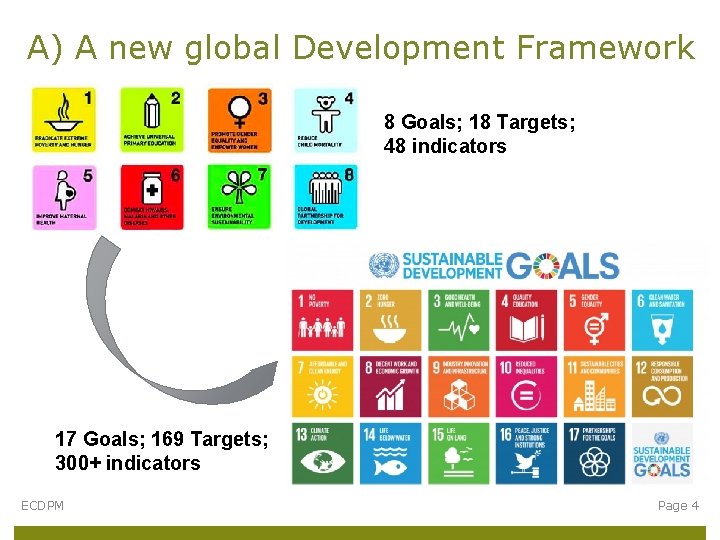
A) A new global Development Framework 8 Goals; 18 Targets; 48 indicators 17 Goals; 169 Targets; 300+ indicators ECDPM Page 4
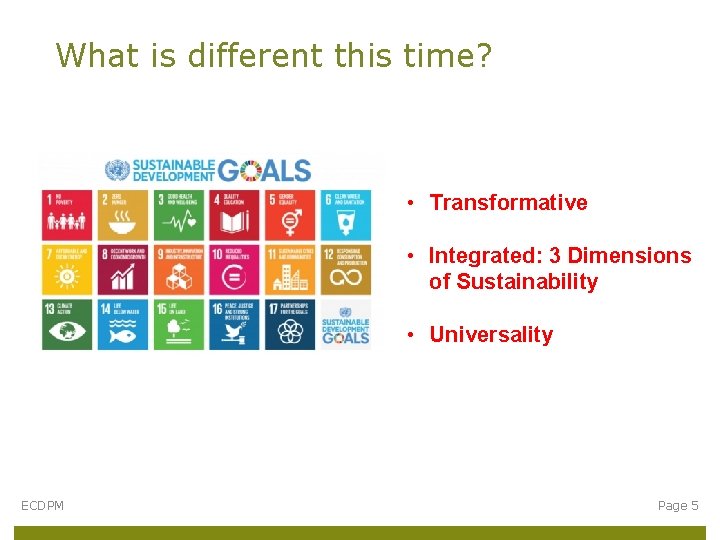
What is different this time? • Transformative • Integrated: 3 Dimensions of Sustainability • Universality ECDPM Page 5
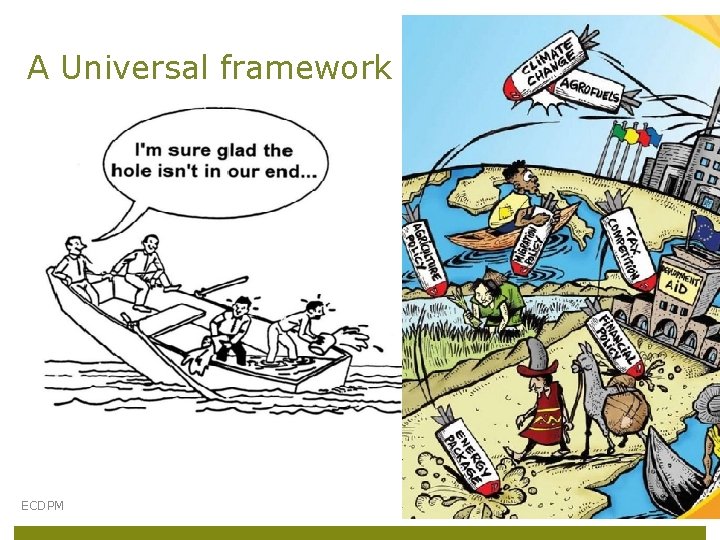
A Universal framework ECDPM Page 6

Integrated Nature of the SDGs Source: David Le Blanc, 2015; UNDESA Working Paper 141 ECDPM Page 7

What is different this time? • Transformative • Universal • Integrated: 3 Dimensions of Sustainability Explicit PCSD target: SDG Target 17. 14 Enhance Policy Coherence for Sustainable Development ECDPM Page 8
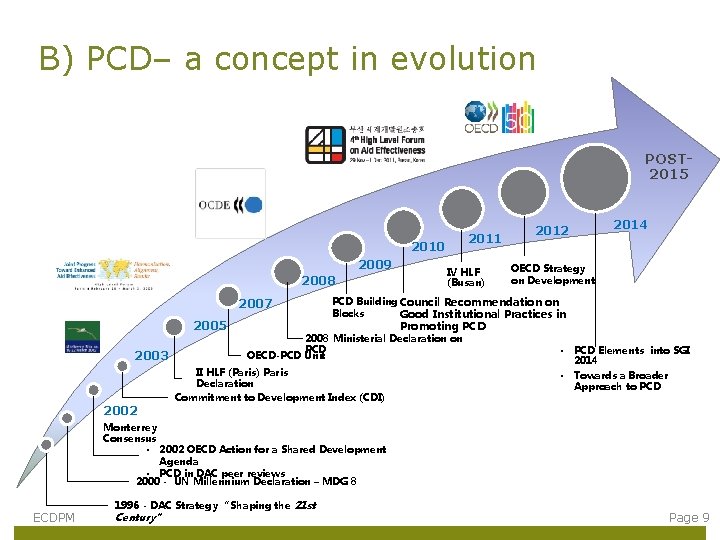
B) PCD– a concept in evolution POST 2015 2011 2010 2009 2008 2007 2005 2003 2002 IV HLF (Busan) 2012 2014 OECD Strategy on Development PCD Building Council Recommendation on Blocks Good Institutional Practices in Promoting PCD 2008 Ministerial Declaration on PCD OECD-PCD Unit II HLF (Paris) Paris Declaration Commitment to Development Index (CDI) • PCD Elements into SGI 2014 • Towards a Broader Approach to PCD Monterrey Consensus • 2002 OECD Action for a Shared Development Agenda • PCD in DAC peer reviews 2000 - UN Millennium Declaration – MDG 8 ECDPM 1996 - DAC Strategy “Shaping the 21 st Century” Page 9

What is PCD? EU OECD “The EU seeks to minimise contradictions and to build synergies between policies other than development cooperation that have an impact on developing countries, for the benefit of overseas development” “The pursuit of development objectives through the systematic promotion of mutually reinforcing policy actions on the part of both OECD and developing countries”. Two-fold implication: “do no harm” and beyond: 1. Make sure all policies are development-friendly (do no harm) 2. Ensure the proactive promotion of development objectives in other policies: exploit synergies > win-win ECDPM Page 10
Prevalent definitions: PCD ≠ … Diverging interpretations and use of the concept of PCD IS NOT (only): • Coordination with other policies • Harmonization with other donors • Adjustment of development policy to other policies (it is PC for Development) • Consistency among development policies, strategies and instruments ECDPM Page 11
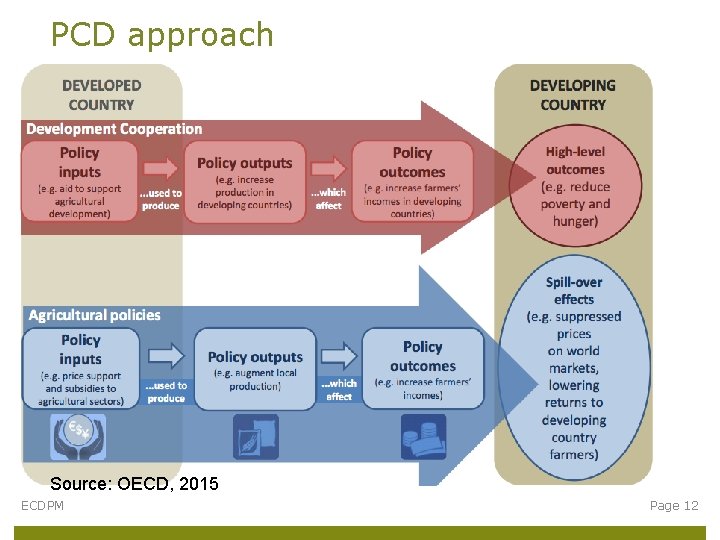
PCD approach Source: OECD, 2015 ECDPM Page 12

Towards a universal notion: PCSD ECDPM Foster synergies across economic, social and environmental policy areas 1 2 3 = an approach and policy tool to integrate the economic, social, environmental, and governance dimensions of sustainable development at all stages of domestic and international policy making. = a problem of all governments worldwide (not any longer a challenge for donors only). It aims to increase governments capacities to: Identify trade-offs & reconcile domestic policy objectives with internationally agreed objectives Address the spillovers of domestic policies SUSTAINABLE DEVELOPMENT Main Objectives PCSD Source: OECD (2014), Better Policies for Development 2014: Policy Coherence and Illicit Financial Flows Page 13
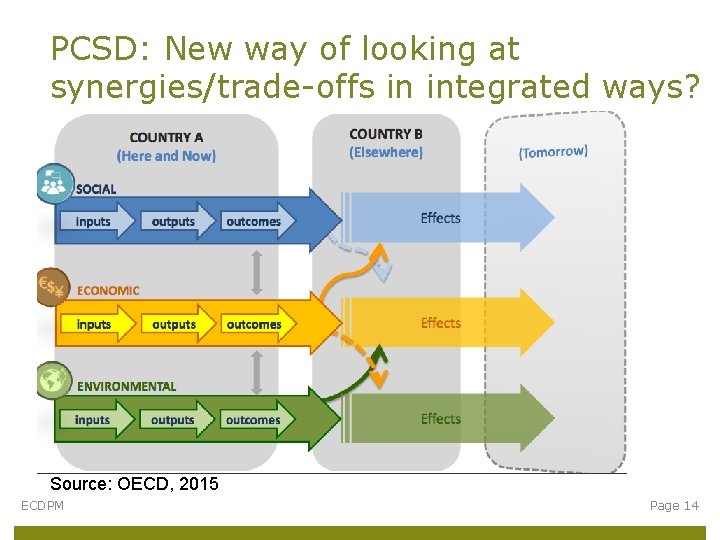
PCSD: New way of looking at synergies/trade-offs in integrated ways? Source: OECD, 2015 ECDPM Page 14
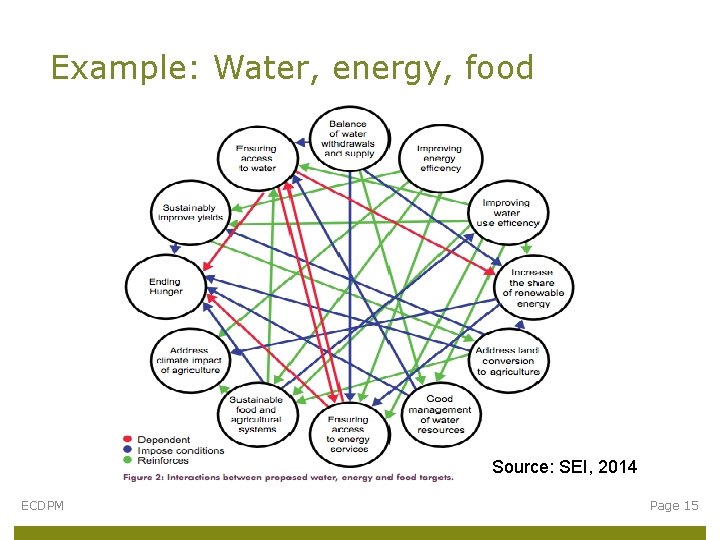
Example: Water, energy, food Source: SEI, 2014 ECDPM Page 15

Agenda 2030: Opportunities for PC(S)D • SDGs • Intrinsically integrated approach • Finally brings 3 pillars of sustainable development together • Responsibility of All (Universality) • Some similar ideas in other areas than development cooperation • Whole-of-government approaches • Joined-up government • One United Nations • PCSD formally recognised and agreed as Means of Implementation ECDPM Page 16
Challenges of moving from PCD to PCSD • Loss of focus? • PCSD makes targets more diffuse – A theory of everything? • Do we lose the unitary focus on PCD • Universality – Who is to benefit from PCD action? • Greater complexity • Progress on PCD already tough • Taking so much into account may make progress even more difficult • Brings different worlds together • Development – external relations • Economic & social & sustainability – internal affairs ECDPM Page 17
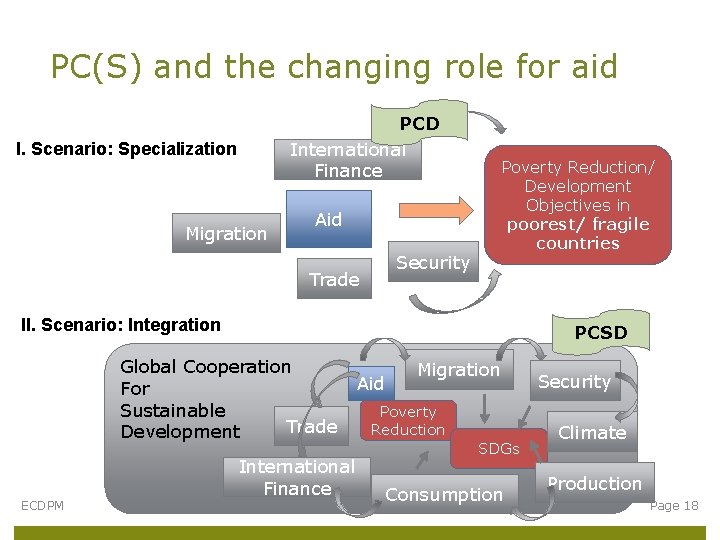
PC(S) and the changing role for aid PCD International Finance I. Scenario: Specialization Migration Poverty Reduction/ Development Objectives in poorest/ fragile countries Aid Security Trade II. Scenario: Integration PCSD Global Cooperation For Sustainable Trade Development ECDPM International Finance Aid Migration Poverty Reduction SDGs Consumption Security Climate Production Page 18
II. PC(S)D Implementation to support SDG achievement ECDPM Page 19
How to strengthen PCSD? ECDPM Page 20
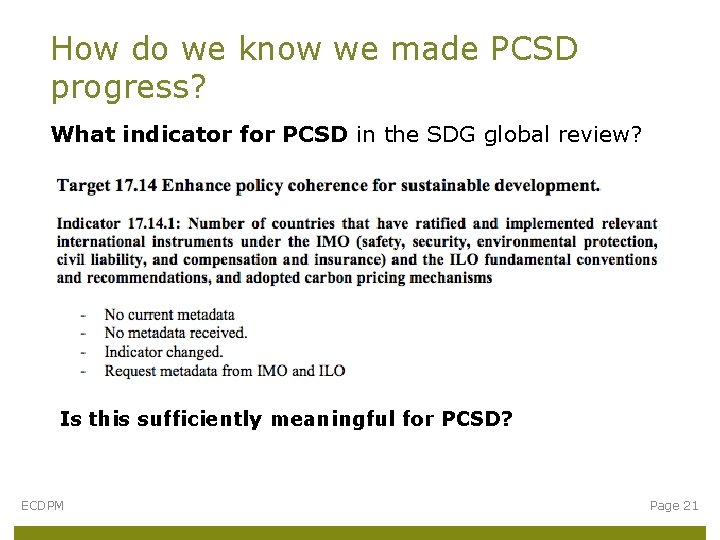
How do we know we made PCSD progress? What indicator for PCSD in the SDG global review? Is this sufficiently meaningful for PCSD? ECDPM Page 21

PCSD as red-thread for SDG implementation Monitoring, analysis and reporting Identifying policy interactions, synergies, potential policy effects ‘elsewhere’ and for long-term ECDPM Setting countryspecific objectives for PCSD based on SDGs and targets Setting and prioritizing objectives Coordinating policy and its implementation Strengthening existing PC(S)D institutional mechanisms Page 22
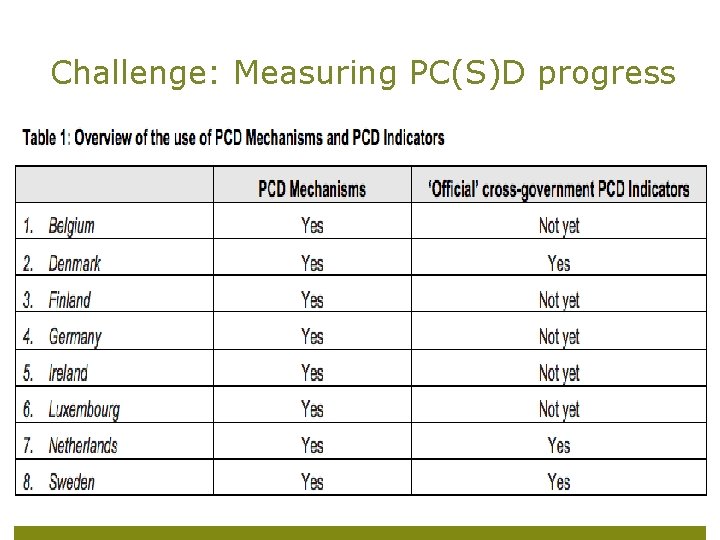
Challenge: Measuring PC(S)D progress ECDPM Page 23
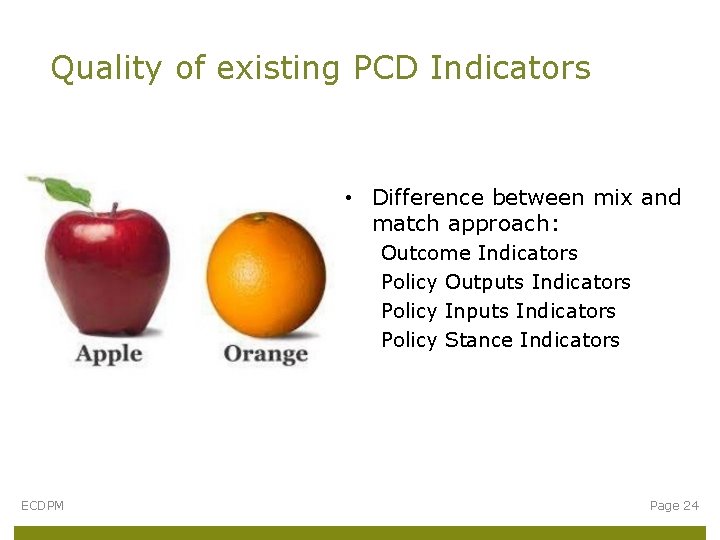
Quality of existing PCD Indicators • Difference between mix and match approach: Outcome Indicators Policy Outputs Indicators Policy Inputs Indicators Policy Stance Indicators ECDPM Page 24
Country Studies on policy impact – Food Security • Some European countries felt that more evidence on impact of policies needed – suggestion for impact analysis to examine effects on development outcomes in individual developing countries • ECDPM with OECD-DAC developed draft methodology for identifying/assessing impacts of OECD policies on food security in individual developing countries • Methodology currently tested in Tanzania and Burkina Faso with support from Finland/Switzerland

Challenge: Progress on PCD building blocks – yes? But fairer policies…. . ? ECDPM Page 26
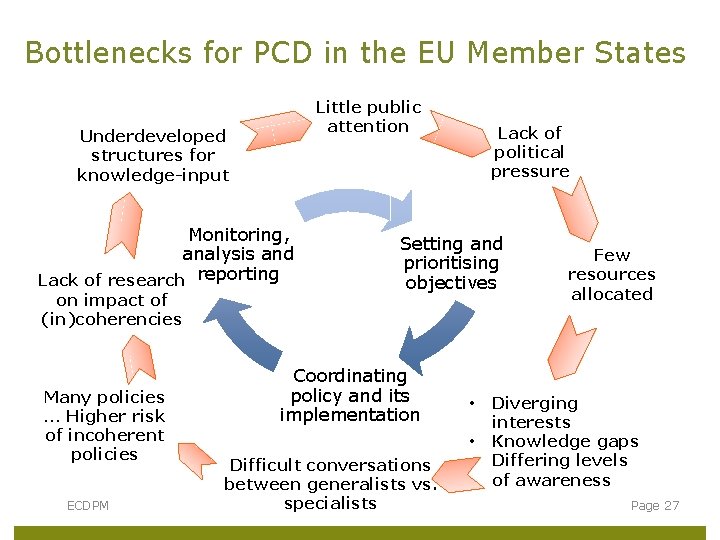
Bottlenecks for PCD in the EU Member States Little public attention Underdeveloped structures for knowledge-input Monitoring, analysis and Lack of research reporting on impact of (in)coherencies Many policies … Higher risk of incoherent policies ECDPM Lack of political pressure Setting and prioritising objectives Coordinating policy and its implementation Difficult conversations between generalists vs. specialists • • • Few resources allocated Diverging interests Knowledge gaps Differing levels of awareness Page 27
PCSD is a Political Economy Challenge PCD Lessons learned – Not a technical exercise PCD highly political= policies driven by national interests that are at times hard to reconcile with development • Who has power? • Is there adequate, accountability, information and evidence? Identify political momentum on the basis of solid political economy analysis in limited number of areas where concrete progress is feasible (taxation, illicit capital flows, food security…? ) ECDPM Page 28
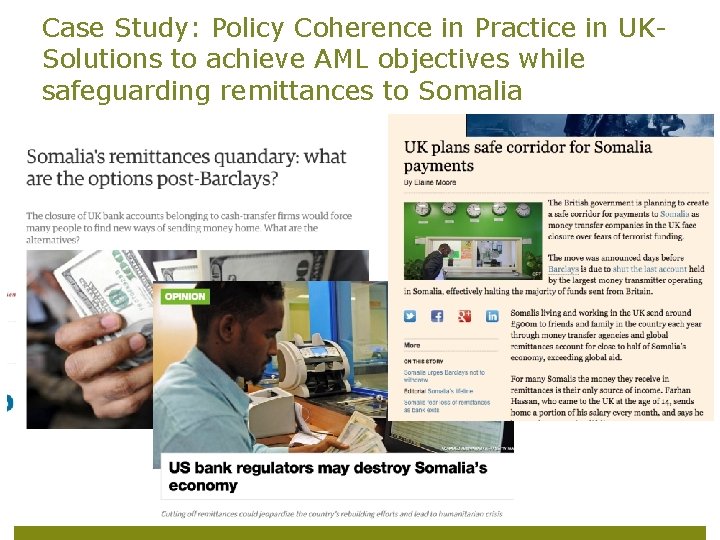
Case Study: Policy Coherence in Practice in UKSolutions to achieve AML objectives while safeguarding remittances to Somalia
III. Implementation of Agenda 2030 – The Way forward ECDPM Page 30

Follow up and Review of SDGs – Institutional framework Principles: • Country-led (ownership) • Inclusive (multistakeholder) • Transparent • Building on existing mechanisms ECDPM Page 31
Development of SDG Indicators – Process • Global Indicator framework currently being developed by IAEG-SDG (Inter-agency expert group) • UN Statistical Commission will consider the group’s proposal in March 2016 • National Implementation: Additional and complementary indicators will be developed at country/regional level adapted to context ECDPM Page 32
National Implementation • Identification of priority areas without ‘cherry picking’? • Not all SDG targets are clear • How to set baseline and benchmarks? • How to define appropriate actions and policies to support progress towards targets and assess progress? PCSD an important tool here ECDPM Page 33

Example Goal 16: Country-level Perspective PCSD ECDPM Implementation: 1) Domestic Development Outcomes 2) Responsibilities for assisting other countries 3) Responsibilities for supporting progress towards global common goods Page 34
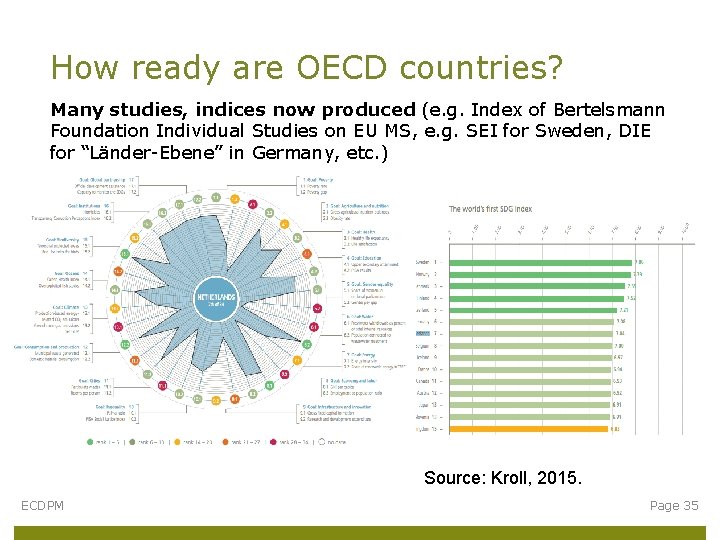
How ready are OECD countries? Many studies, indices now produced (e. g. Index of Bertelsmann Foundation Individual Studies on EU MS, e. g. SEI for Sweden, DIE for “Länder-Ebene” in Germany, etc. ) Source: Kroll, 2015. ECDPM Page 35

Coherence in implementation of Agenda 2030 EU Country EU European Institutions Government Ministries Federal States Ministries at federal level Local authorities ECDPM Partner countries Regional Level National Level Sub-national level Local Level Page 36
Role of CSOs in post-2015 implementation / strengthening PCSD • CSOs/Knowledge community can play critical role in providing analysis but approach could be more political • • • Level of awareness on PCD/PCSD has grown quite spectacularly Increased peer pressure (OECD, EU, NGOs, policy research institutes, . . ) exchange of experiences, best practices, institutional arrangements beyond aid agencies, … More PCD measurement and assessment systems (CDI), institutional arrangements and actors involved but risk of overly technocratic approaches • Clear role in SDG implementation Agenda Priorities - Setting benchmarks (avoiding “cherry-picking”) Identifying indicators that fit the context Reporting on progress Contribute to building multi-stakeholder partnerships ECDPM Page 37
IV. Questions and Discussion ECDPM Page 38
Thank you Anna Knoll – ak@ecdpm. org www. slideshare. net/ecdpm Page 39
- Slides: 39