
Policy Backdrop to The International Trade Administration ITA
Policy Backdrop to The International Trade Administration (ITA) Bill 12 June 2002
CONTENTS • Historical/Policy Background • ITA’s Guiding Trade Policy Objectives • ITA’s Key Provisions • ITA’s Relationship with SACU Agreement • Transitional Arrangements • Conclusion
Historical/Policy Context ITA Bill motivated by SA’s post-1994 political and economic policy imperatives and choices Ø economic reform needed to underpin democracy with economic growth driven by manufacturing and exports ü trade/tariff policy and its reform seen as key in promoting efficiency/competitiveness, and welfare via lower cost/price levels Ø ITA also responds to regional political imperative to democratize relations with the BLNS states with whom SA shares a common customs tariff wall in SACU – hence in 1994 re-negotiation of SACU agreement (of 1969)
Trade Policy Objectives guiding ITA • Ratification of WTO agreements in 1995 a signal of continuation of trade/tariff reform process started pre-1994 • Trade/tariff reform further deepened with agreements with EU and SADC to boost exports, inward investment and regional integration • Policy approach to trade/tariff reform: provide less protection to inputs (capital goods & raw materials) than outputs (finished goods) to enable firms to source world prices and thus to compete in domestic and world markets
Trade Policy Objectives guiding ITA • To facilitate administration of custom tariff to these ends, a further objective is simplification of the tariff Ø In 1995 SA undertook in WTO to reduce to 6 the no. of tariff rates to 0%, 5%, 10%, 15%, 20%, and 30% • Pursuit of these trade/tariff and regional policy imperatives called for a new institutional dispensation
Principles of ITA’s new Institutional Dispensation ü Separation of investigative and adjudicative functions regarding customs tariffs and other (contingent protection) duties, to enable transparent and objective decision-making ü Provision for shared decision-making with BLNS in SACU regarding customs tariffs and other (contingent protection) duties, whilst ensuring efficiency of decision-making
The New SACU Agreement Rationale Ø SACU has economic & geo-strategic value for SA: • BLNS add a market of 6 m people & GDP of over R 60 bn • SA’s exports to BLNS over R 29 bn; imports of R 7, 2 bn (1998) • SACU fosters regional economic and political stability • SACU is a regional platform for global integration Ø Therefore: – Re-negotiation of SACU into democratic & institutionally sound body is a strategic imperative
The new SACU Agreement key provisions • maintains intra-SACU Free Trade, Common External & Excise Tariffs • amends the Revenue Sharing Formula • introduces New Institutions • gives SACU nature of International Body with Headquarters • provides for Common Policies on trade, customs, agriculture, industry, competition, & a dispute settlement system
New SACU Institutions • Council of Ministers (supreme trade policy & tariffs decision-making body) • Tariff Board (recommends tariff decisions to Council) • Tribunal (to resolve disputes) • Commission of Senior Officials – at DG-level, reports to & advises Council, & supervises Secretariat
New SACU Institutions, cont. • National Bodies – to receive requests for tariff changes & investigate & recommend to Tariff Board • Secretariat – administrative function & depository of records – headed by Executive Secretary, have own staff – HQ decision on basis of joint evaluation of capacity, by scoring agreed criteria – HQ candidates are Windhoek, Maseru or Mbabane • Rules of procedure & Protocols for above still to be negotiated & annexed to agreement
The ITA Bill - Key Provisions Ø Authorizes Minister of Trade and Industry to determine trade policy; regulate imports & exports (as per Import & Export Act, 1963) Ø The Act has as its purpose: “to foster economic growth & development of industry in the Republic and within SACU, by establishing an efficient & effective system for the administration of international trade within the framework of prevailing economic policy, and as provided for in this Act and the SACU agreement”
The ITA Bill - Key Provisions Ø Implements the new SACU agreement’s provisions in SA, i. e. : ü recognizes SACU as a juristic person in SA ü authorizes action on behalf of SA regarding the SACU agreement Ø Creates a national body (Commission of International Trade Administration (CITA)) to interface with new SACU institutions
The ITA Bill - Key Provisions Ø Repeals the BTT Act; provides for CITA to continue BTT functions, re: custom duties, rebates, import/export controls, and anti-dumping, countervailing and safeguard Ø sets outs CITA’s reporting responsibilities to the Minister and Parliament Ø establishes the right to appeal, or take matters on review to the high court, with usual limits Ø authorizes the Minister to make regulations to give effect to the purpose of the Act, such as regarding to annexes elaborating further procedural provisions
The ITA Bill - Key Provisions • CITA will be constituted of: – Full-time Chief and Deputy Chief Commissioner – Maximum of ten additional Commissioners – Commissioners to be appointed by the President, for terms of up to 5 years
Relationship between CITA and SACU institutions • Tariff Investigations vs. Decisions: • Investigations (national bodies, i. e. CITA in SA) • Adjudication & Recommendations (supranational body, i. e. Tariff Board) • Anti-dumping investigations and preliminary findings (national bodies, i. e. CITA) • Final determinations (supranational body, recommendation by Tariff Board and decision by Council of Ministers • Trade Policy: – Coordination and consensus at SACU level
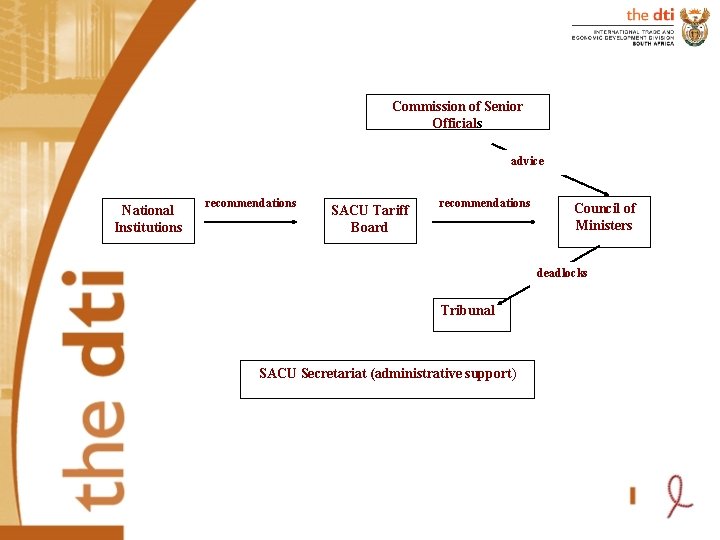
Commission of Senior Officials advice National Institutions recommendations SACU Tariff Board recommendations Council of Ministers deadlocks Tribunal SACU Secretariat (administrative support)
Transitional Arrangements • until Rules & Protocols governing new SACU bodies are in place, ITA provisions on the interface with SACU tariff-setting procedure will not come into force • this means there will be no loss of national tariffsetting capacity in the transition to new SACU • it will be SA’s negotiating objective to have the efficiency of current national (BTT) procedures incorporated into the envisaged SACU rules & protocols

END
- Slides: 18