
Policy approach for basic skills in adult learning
Policy approach for basic skills in adult learning: success criteria Graciela Sbertoli Secretary General EBSN April 2019
The European Basic Skills Network 4 Policy level network: better policies for basic skills in European Adult Learning 4 Policy makers and policy providers: Exchange of experiences, mutual learning 4 Cooperating with the European Commission: Upskilling Pathways and EPALE
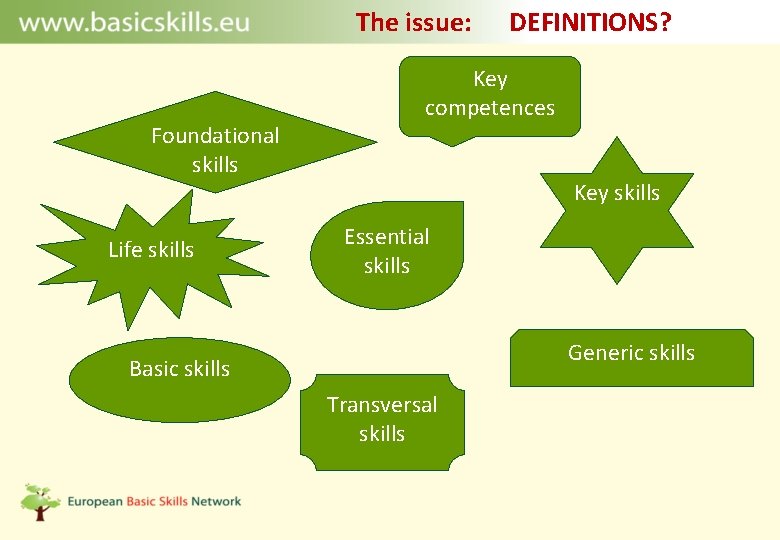
The issue: Foundational skills Life skills DEFINITIONS? Key competences Key skills Essential skills Generic skills Basic skills Transversal skills
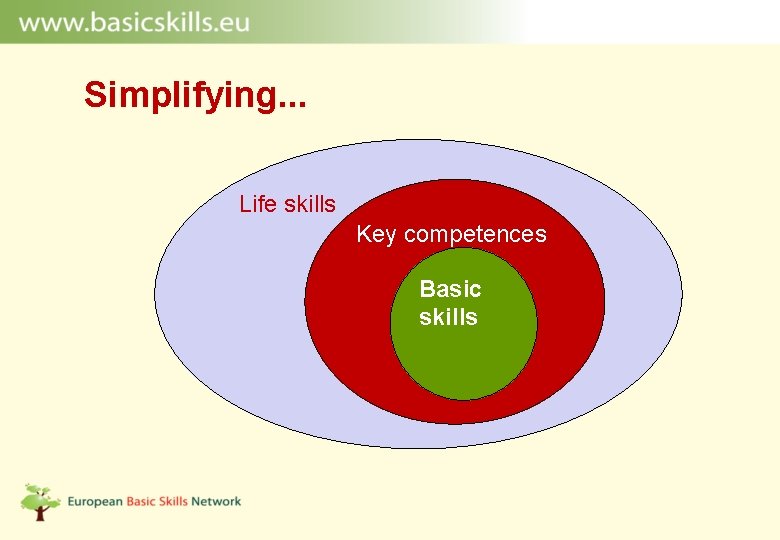
Simplifying. . . Life skills Key competences Basic skills
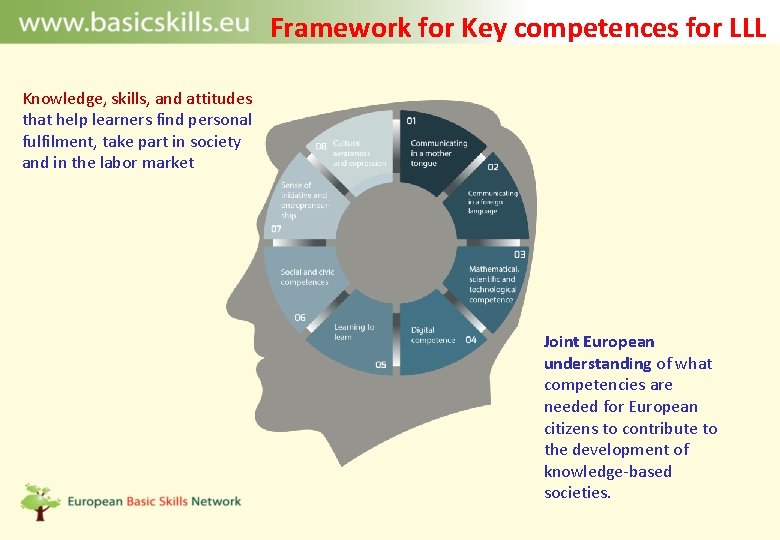
Framework for Key competences for LLL Knowledge, skills, and attitudes that help learners find personal fulfilment, take part in society and in the labor market Joint European understanding of what competencies are needed for European citizens to contribute to the development of knowledge-based societies.
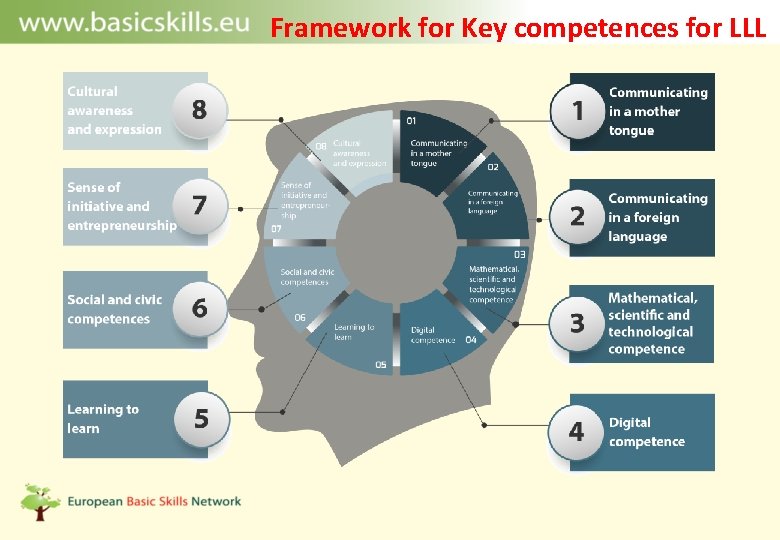
Framework for Key competences for LLL
Let’s talk about literacy. . . - Baseline literacy – a cognitive decoding process - Functional literacy: - a context dependent level, - a moving target - Literacy in the digital era: a new logic - Erosion, taboos, lack of awareness. . . - A hidden problem, an «inherited» challenge.
THE OECD surveys: a call to action 4 IALS (1994 -98) and ALL (2204 -2006) and now PIAAC 464 million adult Europeans are NOT functionally literate 4 Consequences?
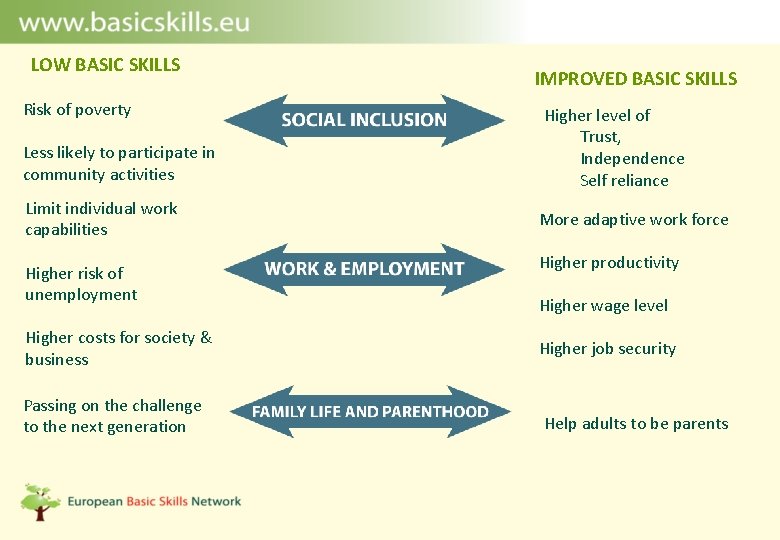
LOW BASIC SKILLS Risk of poverty Less likely to participate in community activities Limit individual work capabilities Higher risk of unemployment Higher costs for society & business Passing on the challenge to the next generation IMPROVED BASIC SKILLS Higher level of Trust, Independence Self reliance More adaptive work force Higher productivity Higher wage level Higher job security Help adults to be parents
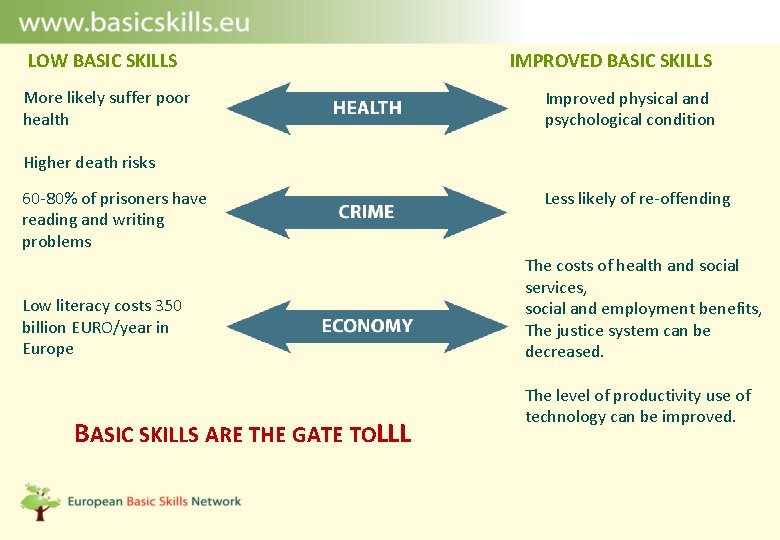
LOW BASIC SKILLS More likely suffer poor health IMPROVED BASIC SKILLS Improved physical and psychological condition Higher death risks 60 -80% of prisoners have reading and writing problems Low literacy costs 350 billion EURO/year in Europe BASIC SKILLS ARE THE GATE TOLLL Less likely of re-offending The costs of health and social services, social and employment benefits, The justice system can be decreased. The level of productivity use of technology can be improved.
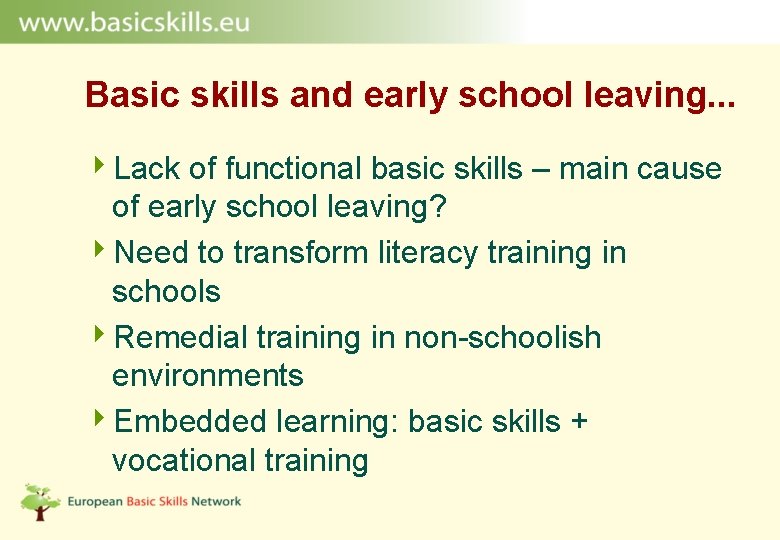
Basic skills and early school leaving. . . 4 Lack of functional basic skills – main cause of early school leaving? 4 Need to transform literacy training in schools 4 Remedial training in non-schoolish environments 4 Embedded learning: basic skills + vocational training
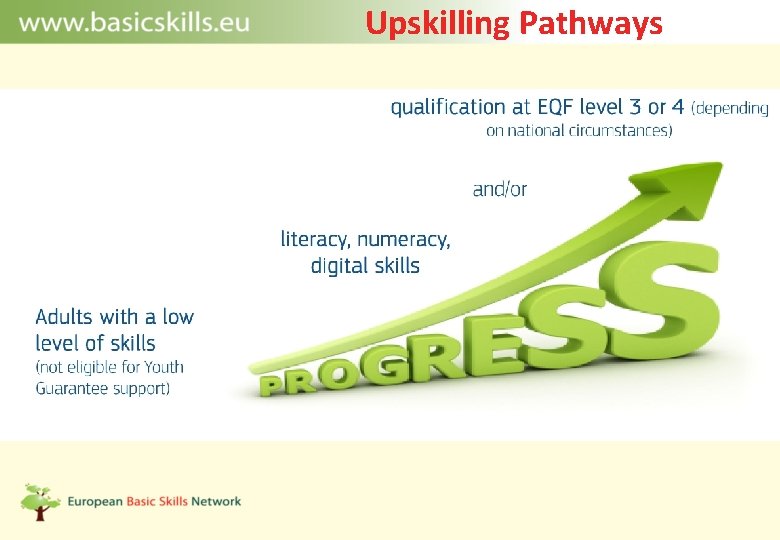
Upskilling Pathways
Political awareness: Upskilling Pathways 4 The Upskilling Pathways recommendation 4 From words to action: National follow-ups 4 An imposed task or a national priority? 4 Need for integrated, cohesive policy: 4 The EBSN’s Berlin declaration
EBSN’s Capacity Building Series Follow-up of Upskilling Pathways Important to involve policy level stakeholders outside Ad. Ed sector (= need for deeper insight into all issues relating to Basic Skills in Adults) Existing and new resources, organized and curated
Thematic focus in 2019 4 Integrated Basic Skills Policy 4 Basic skills for immigrant integration 4 Digital Inclusion 4 Intergenerational Learning, Family Learning 4 Basic skills at the work place
The EBSN’s Berlin Declaration EBSN: «. . . working to assist national and regional stakeholders in the creation and implementation of consistent, efficient and sustainable policies for the provision of basic skills learning. “ What do we mean by «consistent and coherent» ? What do we mean by «stakeholder cooperation» ? What makes policy sustainable?
The EBSN’s Berlin Declaration «In order to create flexible learning pathways to cater for the highly heterogeneous group of adults who need to improve their basic skills, policy makers will need to ensure cohesion and collaboration between a number of different elements of the basic skills system. ” Efficiency is the sum of many elements
The EBSN’s Berlin Declaration - “Policymakers should ensure that their plans identify and account for the learning needs of a wide range of adults and support them in accessing available learning pathways. - Learners should be involved in the development, and ongoing quality assurance, of learning programmes and policies. ”
The EBSN’s Berlin Declaration “Learning should be supported in formal, non -formal and informal settings, and in different domains of adults’ lives, such as family, community, faith, and work. ” The vision: National unified and coherent strategy + a variety of flexible implementation modes
The EBSN’s Berlin Declaration (VI) “Both access to the workplace and learning in the workplace should play a prominent part in any national strategy, but this should not be at the expense of learning in other settings, or learning designed to support other learning goals” Life-wide policy: for employability, for active citizenship, for inclusion, for health, for personal goals…
The EBSN’s Berlin Declaration «Specific diagnostic tools and systems of validation / accreditation should be developed. “ Frameworks, levels, goals, diagnostic tests, self-testing…. A common understanding: Capacity Building for all stakeholders
The EBSN’s Berlin Declaration «There should also be fully-financed provision for specific, compulsory and quality assured initial and continuing teacher and trainer education. ” Who are the teachers and trainers? What do they need to know? How do we ensure the quality of provision?
The way ahead 4 Awareness raising and attitude change 4 A common understanding 4 Governance and extensive stakeholder cooperation 4 Sustainable funding: from project to program 4 Constant evaluation and transformation
Questions for reflection 4 How aware Maltese stakeholders about this issue? 4 What are the main challenges and strengths of current policy? 4 What issues need to be given priority in the year ahead? 4 What will your own role and your institution’s be in this picture?
Stay tuned. . . 4 Pilot MOOC within the Capacity Building Series 4 Dates: May 6 th to 31 st 4 Theme = OER 1 4 Free admission For further contact: secretary. general@basicskills. eu
- Slides: 25