
POLICY 2419 REGULATIONS FOR THE EDUCATION OF STUDENTS



- Slides: 47
POLICY 2419: REGULATIONS FOR THE EDUCATION OF STUDENTS WITH EXCEPTIONALITIES SUMMARY OF REVISIONS July 20, 2017
LEARNING OBJECTIVES 1. Participants will become aware of the revisions to Policy 2419. 2. Participants will understand the staffing revisions Policy 2419 may require. 3. Participants will understand the changes in transition, intellectual disability eligibility and graduation requirements Policy 2419 will require. 2
Filing Date: Effective Date: July 13, 2017 August 14, 2017 Policy 2419 Is To Be Adopted By Each District’s Board of Education. 3
BACKGROUND • Revised to bring into compliance with: Ø Every Student Succeeds Act (ESSA); Ø Workforce Investment Opportunities Act (WIOA); Ø Federal guidance on Dispute Resolution; and Ø West Virginia College- and Career-Readiness Standards. • Repealed Policy 2419. 11: Rules For Requesting An Exception To The Regulations For The Education of Students with Exceptionalities and replaced in Policy 2419. • Clarified existing policy. 4
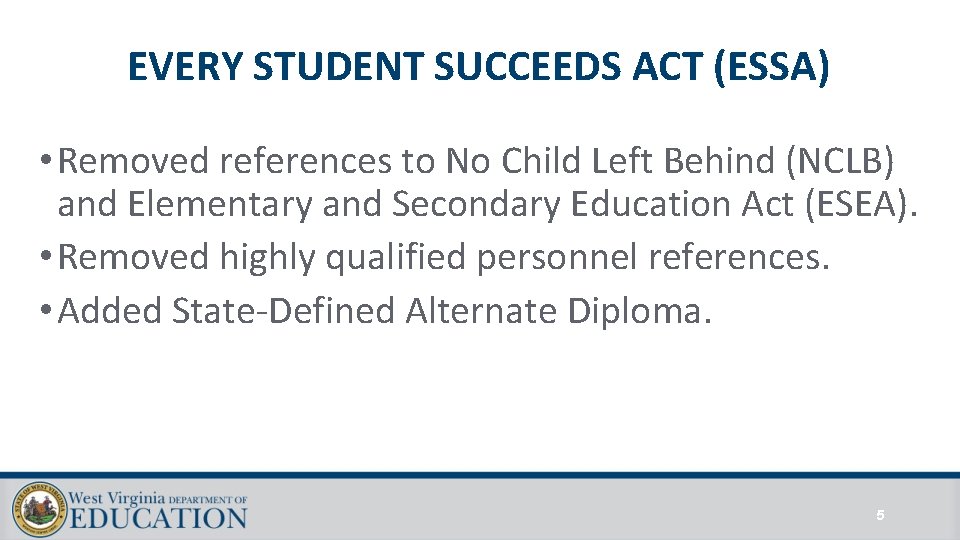
EVERY STUDENT SUCCEEDS ACT (ESSA) • Removed references to No Child Left Behind (NCLB) and Elementary and Secondary Education Act (ESEA). • Removed highly qualified personnel references. • Added State-Defined Alternate Diploma. 5
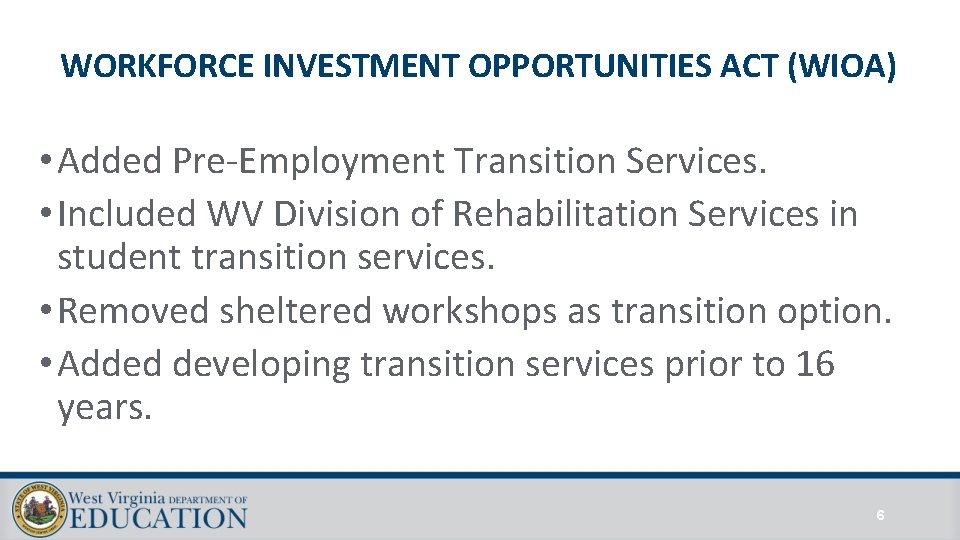
WORKFORCE INVESTMENT OPPORTUNITIES ACT (WIOA) • Added Pre-Employment Transition Services. • Included WV Division of Rehabilitation Services in student transition services. • Removed sheltered workshops as transition option. • Added developing transition services prior to 16 years. 6
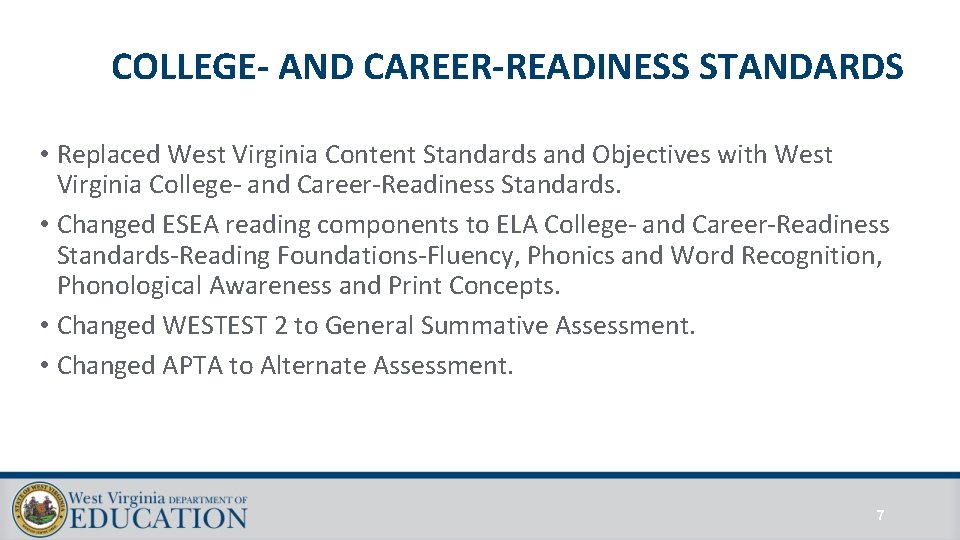
COLLEGE- AND CAREER-READINESS STANDARDS • Replaced West Virginia Content Standards and Objectives with West Virginia College- and Career-Readiness Standards. • Changed ESEA reading components to ELA College- and Career-Readiness Standards-Reading Foundations-Fluency, Phonics and Word Recognition, Phonological Awareness and Print Concepts. • Changed WESTEST 2 to General Summative Assessment. • Changed APTA to Alternate Assessment. 7
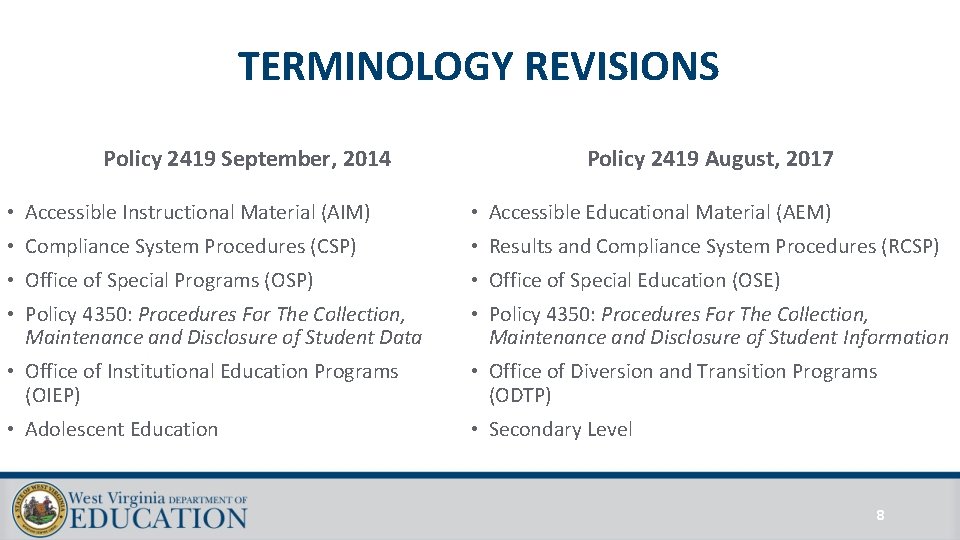
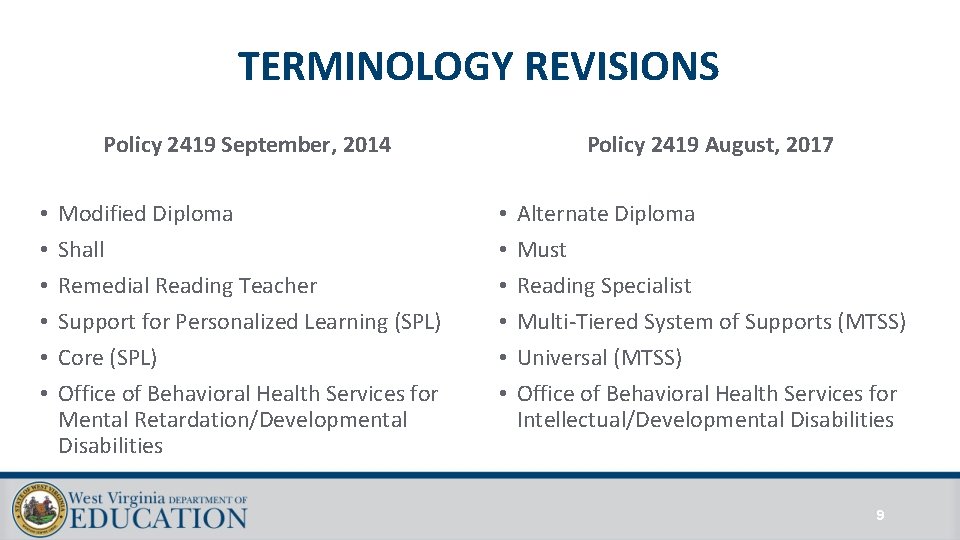
TERMINOLOGY REVISIONS Policy 2419 September, 2014 Policy 2419 August, 2017 • Accessible Instructional Material (AIM) • Accessible Educational Material (AEM) • Compliance System Procedures (CSP) • Results and Compliance System Procedures (RCSP) • Office of Special Programs (OSP) • Office of Special Education (OSE) • Policy 4350: Procedures For The Collection, Maintenance and Disclosure of Student Data • Policy 4350: Procedures For The Collection, Maintenance and Disclosure of Student Information • Office of Institutional Education Programs (OIEP) • Office of Diversion and Transition Programs (ODTP) • Adolescent Education • Secondary Level 8
TERMINOLOGY REVISIONS Policy 2419 September, 2014 • • • Modified Diploma Shall Remedial Reading Teacher Support for Personalized Learning (SPL) Core (SPL) Office of Behavioral Health Services for Mental Retardation/Developmental Disabilities Policy 2419 August, 2017 • • • Alternate Diploma Must Reading Specialist Multi-Tiered System of Supports (MTSS) Universal (MTSS) Office of Behavioral Health Services for Intellectual/Developmental Disabilities 9
CHAPTER 1 FREE APPROPRIATE PUBLIC EDUCATION 10
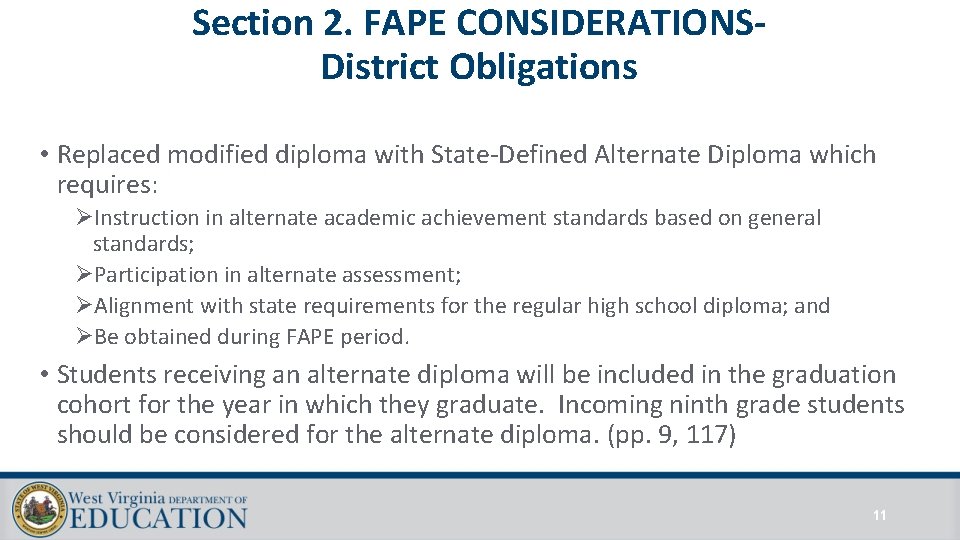
Section 2. FAPE CONSIDERATIONSDistrict Obligations • Replaced modified diploma with State-Defined Alternate Diploma which requires: ØInstruction in alternate academic achievement standards based on general standards; ØParticipation in alternate assessment; ØAlignment with state requirements for the regular high school diploma; and ØBe obtained during FAPE period. • Students receiving an alternate diploma will be included in the graduation cohort for the year in which they graduate. Incoming ninth grade students should be considered for the alternate diploma. (pp. 9, 117) 11
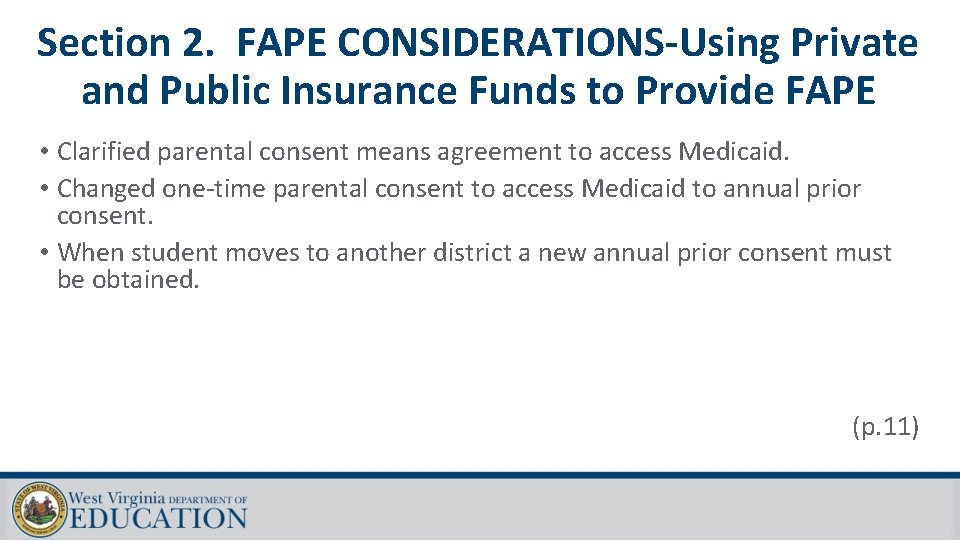
Section 2. FAPE CONSIDERATIONS-Using Private and Public Insurance Funds to Provide FAPE • Clarified parental consent means agreement to access Medicaid. • Changed one-time parental consent to access Medicaid to annual prior consent. • When student moves to another district a new annual prior consent must be obtained. (p. 11)
Section 3. EXCEPTIONS TO FAPE • Removed that FAPE obligation does not apply to three through five year old students who receive services from West Virginia Birth to Three program. • Added no obligation of FAPE for students who are homeschooled. SB 630 requires students participating in a virtual instruction program to enroll in public school. Home schooled students are not enrolled in public school and not entitled to FAPE. (p. 12) 13
CHAPTER 2 CHILD FIND 14
Section 3. REFERRALS • Added a member of the SAT must provide written assistance to parents who may need additional help to complete the referral. (p. 14) • SAT members are to receive training in the Multi-Tiered System of Supports (MTSS). (p. 14) • Added SAT’s responsibility to review persistent needs and allow parent review of recommendations regarding student’s program and provide feedback. (p. 15) 15
CHAPTER 3 EVALUATION/REEVALUATION 16
Section 2. PLANNING, CONDUCTING AND TIMELINES FOR A MULTIDISCIPLINARY EVALUATION • Clarified eighty-day timeline does not apply: ØIf parent repeatedly fails or refuses to produce student and ØParent and district must agree in writing that timeline will be extended when students change districts. (p. 18) • Revised timeline from 10 to 5 school days to request parent consent when additional evaluations requested by EC or IEPT. (p. 19) • Revised timeline from 10 to 5 days to provide prior written notice when parent requests additional evaluations. (p. 19) 17
Section 4. EVALUATION PROCEDURES • Added “For a child who is deaf or hard of hearing, a comprehensive language assessment in the child’s language and communication must be included in his/her comprehensive evaluation. ” (p. 23) • Added Functional Listening Evaluation (FLE) conducted to assess how a student’s listening abilities are affected by noise, distance and visual input in the student’s natural listening environment. (p. 123) 18
CHAPTER 4 ELIGIBILITY 19
Section 3. STATE ELIGIBILITY CRITERIA • Replaced exceptionality with disability in prong 2 of the three-prong test of eligibility. (p. 26) G. Gifted • Removed State Approved Test List For The Identification of Gifted Students in West Virginia. (Appendix) • Added third consideration under gifted eligibility. Students may be twice exceptional-gifted and disabled. For federal reporting purposes the disability is the primary exceptionality. This requirement accurately reflects the disabled population. Students who are twice exceptional will continue to receive gifted services addressed through the IEP. (p. 32) 20
Section 3. STATE ELIGIBILITY CRITERIA G. Gifted • Replaced Four Year Education Plan for gifted students with the Personalized Education Plan and added Dual Credit as a possible course. If a gifted student in grades nine through twelve is not eligible as exceptional gifted, the IEP Team must develop a plan. The Personalized Education Plan (PEP) and Four Year Education Plan serve the same purpose by appropriately addressing the student’s needs and including courses through the senior year, which are agreed to by the school, parent and student. The implementation and annual review of this plan are required of the district. (p. 32) 21
I. Intellectual Disability • Revised Intellectual Disability by: ØDefining most significant cognitive disabilities (moderate to severe intellectual disability); ØAligning adaptive functioning with the DSM-5 requiring a student to exhibit concurrent deficits in one of the following domains: Conceptual, Social or Practical; ØRequiring an observation if intellectual functioning and adaptive functioning are inconsistent; and ØAdding Severity Levels for Adaptive Functioning. (p. 33) 22
OTHER EXCEPTIONALITIES K. Other Health Impairment • Added ADHD diagnosis may be made by a school psychologist or licensed psychologist. (p. 34) L. Specific Learning Disability • Clarified when student participates in MTSS and receives targeted and/or intensive supports district must notify parents. (p. 36) M. Speech/Language Impairment • Replaced Articulation Development Chart with Articulation Development Norms. • Revised Suggested Guidelines for Stuttering Services for preschool and school-age students. (Appendix) 23
CHAPTER 5 INDIVIDUALIZED EDUCATION PROGRAMS 24
Section 2. IEP Development C. Considerations • Removed Consideration 10 and provided Accessible Educational Materials (AEM) Guidance. (p. 51) E. Goals and/or Objectives • Added requirement that lack of progress in receptive or expressive language of deaf or hard of hearing student must be explained in Present Levels of Educational Achievement and Functional Performance and reflected in the Goals and Objectives. (p. 51) 25
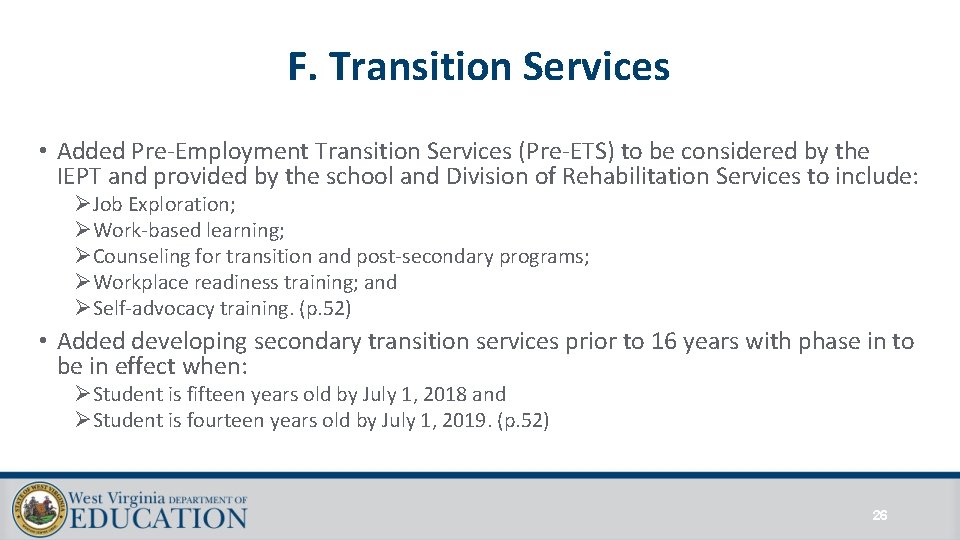
F. Transition Services • Added Pre-Employment Transition Services (Pre-ETS) to be considered by the IEPT and provided by the school and Division of Rehabilitation Services to include: ØJob Exploration; ØWork-based learning; ØCounseling for transition and post-secondary programs; ØWorkplace readiness training; and ØSelf-advocacy training. (p. 52) • Added developing secondary transition services prior to 16 years with phase in to be in effect when: ØStudent is fifteen years old by July 1, 2018 and ØStudent is fourteen years old by July 1, 2019. (p. 52) 26
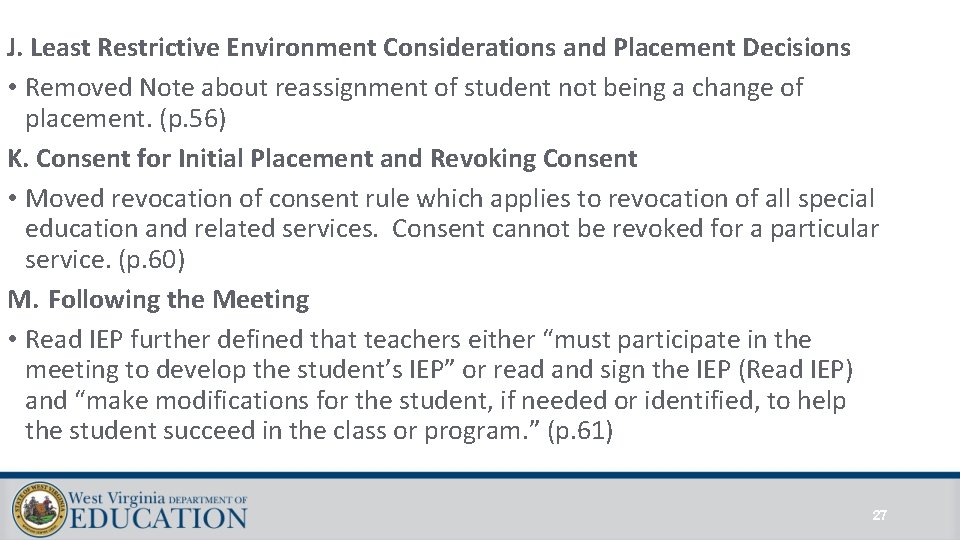
J. Least Restrictive Environment Considerations and Placement Decisions • Removed Note about reassignment of student not being a change of placement. (p. 56) K. Consent for Initial Placement and Revoking Consent • Moved revocation of consent rule which applies to revocation of all special education and related services. Consent cannot be revoked for a particular service. (p. 60) M. Following the Meeting • Read IEP further defined that teachers either “must participate in the meeting to develop the student’s IEP” or read and sign the IEP (Read IEP) and “make modifications for the student, if needed or identified, to help the student succeed in the class or program. ” (p. 61) 27
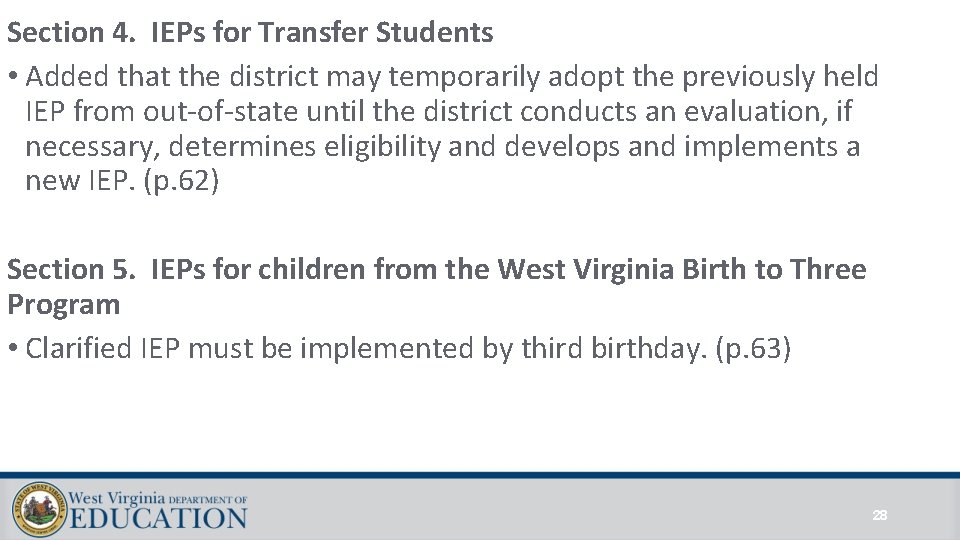
Section 4. IEPs for Transfer Students • Added that the district may temporarily adopt the previously held IEP from out-of-state until the district conducts an evaluation, if necessary, determines eligibility and develops and implements a new IEP. (p. 62) Section 5. IEPs for children from the West Virginia Birth to Three Program • Clarified IEP must be implemented by third birthday. (p. 63) 28
CHAPTER 6 ADMINISTRATION OF SERVICES 29
• Added the Federal Education Department General Accounting Rules requires districts to maintain records to show compliance with the IEP. (p. 65) 30
Section 4. Provisions of Staff-Adequate Staff Class Size Requirements for Instructional Period • Moved from Integrated Classrooms section to Class Size Requirements for Instructional Period section the suggestion that the special educator should meet with the “general educator on a consistent basis to provide support to the students and the general educator. ” (p. 67) 31
• Defined integrated classrooms. Integration occurs in general education when students with exceptional needs are provided required accommodations (supplementary aids and services). Added to policy students requiring accommodations must not exceed 30% of the total class enrollment in the four core academic subjects; i. e. English language arts, science, social studies and math. (p. 68) • Defined co-taught classrooms as two professionals in a single space and added students requiring specially designed instruction (special education) must not exceed 50% of the total class enrollment. (p. 68) • Revised for the co-taught classroom the special educator should not be assigned to more than one co-teaching classroom during one instructional block. (p. 68) 32
Special Education Classrooms for Students with Disabilities LEVEL I NEEDS • Added to Students with Level I needs WV Division of Rehabilitation Services and adult community providers. (p. 68) • For Students with Level I needs on page 69 Note: Close adult supervision may be provided on a temporary or occasional basis to students with Level I needs who are experiencing unique medical needs, specific short-term difficulties or when the close adult supervision is being faded for students previously identified with Level II needs. 33
LEVEL II & III NEEDS • Added to Students with Level II needs community-based work exploration, WV Division of Rehabilitation Services and adult community providers and removed sheltered workshops. (p. 69) • Removed “Optional” and added Division of Rehabilitation Services to Students with Level III needs. (p. 69) 34
Maximum Number of Students per Instructional Period Based on Level of Service • Changed Level I Service Needs for Early Learning Programs Grades K-5: ØK-2 remains 1 instructor to 6 students and Ø 3 -5 changed to 1 instructor to 8 students. (p. 70) 35
CHAPTER 7 DISCIPLINE 36
Section 3. Additional Disciplinary Considerations- A. Requesting an Expedited Hearing • Moved Section 2. D pertaining to requesting an expedited hearing to remove a student to an Interim Alternative Educational Setting (IAES), to 3. A. • Added and amended content of 2. D to Section 3. A: Requesting an Expedited Hearing to mirror language in federal regulations, including: Øall applicable timelines for resolution session, disclosure of evidence, due process hearing and DPHO’s decision; and Øthat a DPHO may either return the student to the original placement or order a change of placement to IAES for not more than 45 days. (p. 77) 37
CHAPTER 8 PRIVATE SCHOOL STUDENTS 38
Section 2. Students Voluntarily Enrolled by a Parent-I. Dispute Resolution • Moved Section 2. D, regarding a private school official’s right to file a state complaint to section 2. I. Dispute Resolution. • Added to section 2. I, a private school parent’s right to file a state complaint and the opportunity to voluntarily engage in mediation to resolve the matter. • New section 2. I reflects language in federal regulations. (p. 83) 39
CHAPTER 9 GENERAL SUPERVISION AND ACCOUNTABILITY FOR PERFORMANCE AND COMPLIANCE 40
Section 1. General Supervision. B. Responsibilities of the WVDE • Moved description of waiver request for extenuating circumstances when student numbers exceed staffing ratios. Waivers are submitted only when student numbers exceed staffing ratios. Waivers to staffing ratios may be requested in writing through OSE. Waivers may require an on-site visit, will be considered on a case-by-case basis and remain valid for the current school year. (p. 89) 41
CHAPTER 11 DISPUTE RESOLUTION 42
Section 1. Facilitated IEP Team Meeting • Section 1. B-added that the facilitated IEP procedures may be altered as a result of an agreement (e. g. , resolution or mediation) decision or order (i. e. , DPHO) and FIEP may be used as a preventative measure. (pp. 104 -105) Section 2. State Complaint Procedures • Section 2. A-added missing language from federal regulations. (p. 105) • Section 2. B. 7 -added missing language from federal regulations. (p. 106) Section 3. Mediation • Section 3. B. 7 -correct language from federal regulations. (p. 108) 43
Section 4. Due Process Complaints • Section 4 & 4. A-changed to reflect federal language. (pp. 108 -109) • Section 4. B-removed redundant language. (p. 109) • Section 4. D-moved into Section 4. C and organized for clarity. (p. 109) • Section 4. E-changed to reflect federal language. (pp. 110 -111) • Section 4. L-moved expedited hearing timelines and procedures to Chapter 7 -Discipline. (p. 77) 44
GLOSSARY • Added State-Defined Alternate Diploma (p. 117), Significant Cognitive Disabilities (p. 134), Functional Listening Evaluation (FLE) (p. 123) and Pre. Employment Transition Services (p. 131). 45
APPENDIX • Appendices supplement the body of the manual and are not to be adopted as, or considered to be, policy. (pp. 142 -152) 46
Office of Special Education Pat Homberg, Executive Director phomberg@k 12. wv. us Susan Beck, Assistant Director sbeck@k 12. wv. us 47