
Policies vs Threats by Albert Dorofeev Sony Corporation
Policies vs Threats by Albert Dorofeev, Sony Corporation 10 th International Common Criteria Conference, 2009 10 th ICCC, 2009 Policies vs Threats
Contents n Security Problem Definition – – n n n Assets Assumptions Threats Policies SPD through the use of Threats SPD through the use of Policies Examples of SPD to compare What happens to attacks and Threats Effect of using Policies 10 th ICCC, 2009 Policies vs Threats 2

Security Problem Definition n Assets n Assumptions Threats Policies n n 10 th ICCC, 2009 Policies vs Threats 3
Assets n “assets - entities that the owner of the TOE presumably places value upon. ” n Asset is an object that a customer places into our hands for safekeeping (yes, we also have our own secrets to keep) The security functionality of a product is usually mainly concerned with the operations on assets n n 10 th ICCC, 2009 Policies vs Threats 4
Assumptions n n n Assumptions are made on the operational environment in order to be able to provide security functionality Assumption = Limitation of the scope Assumption = Risk – Once an assumption does not hold, there is no guarantee that the product operates in a secure manner n n Always a trade-off between cost and risk Fewer assumptions = Lower risk 10 th ICCC, 2009 Policies vs Threats 5
Threats n n A threat is an adverse action performed by a threat agent on an asset Threats are always evolving as new attacks are discovered The list of threats is outdated as soon as it is published The solution applied by the schemes: – ST specifies the threats that are very specific to the product – The lab applies automatically all the ‘usual’ threats relevant to the category of the product 10 th ICCC, 2009 Policies vs Threats 6
SPD through Threats n n n Ideally: specific threats against the specific product Really: a disguise for the list of known attacks Result: immediately outdated at completion More: does not fit into the design flow Side effect: ST grows with every new attack and every new customer who has a peculiar threat 10 th ICCC, 2009 Policies vs Threats 7
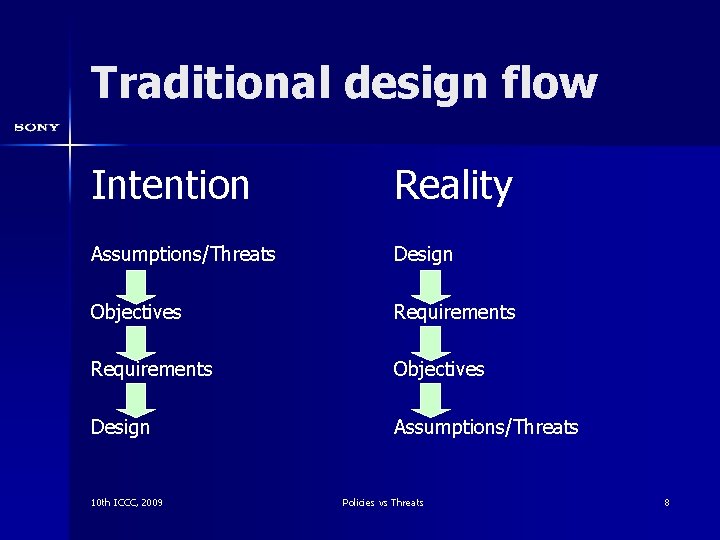
Traditional design flow Intention Reality Assumptions/Threats Design Objectives Requirements Objectives Design Assumptions/Threats 10 th ICCC, 2009 Policies vs Threats 8
Using security policies n n A positive forward statement of the product’s security capabilities, purpose and strengths Describe the functionality instead of the attacks Describe the security functionality relevant to the customer, not for self-defence Directly translate into positive Security Objectives 10 th ICCC, 2009 Policies vs Threats 9
Example : Assumptions/Threats n n n n A. Process-Card – Dedicated security procedures are assumed to be established for the delivery of the TOE between the parties and for the protection of the TOE outside of the control of the Developer before the final delivery to the User. A. Secure-Key - The cryptographic keys generated outside the TOE are assumed to be reliable, secret and adequately protected from disclosure. T. Logical_Attack – Since the TOE allows for software download, an attacker may attempt to use this capability to mount an attack against the TOE. T. Eavesdropping – The TOE and its communication channels may be monitored an attacker may attempt to inject data to mount an attack against the TOE. T. Physical_Probing – The TOE may be subjected to an attempt of a physical modification to bypass the protection. P. Access_controls - The Administrator can configure an access control policy that links the access control mechanisms with the TOE assets. P. Mode - The Administrator sets up the TOE and switches it to the Operational Mode before delivering to the User. 10 th ICCC, 2009 Policies vs Threats 10
Example : Policies n n n P. Confidentiality - The TOE must provide means to protect the confidentiality of the stored assets. P. Integrity - The TOE must provide means to protect the integrity of the stored assets. P. Transfer. Secret - The TOE must provide means to protect the confidentiality of assets during transfer to and from the outside of TOE. P. Transfer. Integrity - The TOE must provide means to protect the integrity of assets during transfer to and from the outside of TOE. P. Configure - The TOE must provide means to configure the level of protection for each of the assets. P. Keys - The keys generated for the use by TOE must be secure. The keys for the use by TOE must be generated and handled in a secure manner. 10 th ICCC, 2009 Policies vs Threats 11
Attacks and resulting Threats? n The lab is responsible for checking that the: – product operates in a useful manner – claimed functionality operates in the stated environment – product remains secure under the known attacks n n The lab verifies all these things regardless of whether you include them into the Security Target Best concentrate on the product, not on trying to do the job of the evaluation lab 10 th ICCC, 2009 Policies vs Threats 12
Effect of using Policies n n n Security Target explains what the product does instead of what it does not do. Security Target focuses on the security functionality for the customer, not on the security functionality of self-protection. Security Target becomes more streamlined and easier to write, understand evaluate. This approach fits perfectly with the “top-down” security design. Ultimately reduces the cost of both preparation and evaluation 10 th ICCC, 2009 Policies vs Threats 13
Thank you! Albert Dorofeev General Manager Sony Secure Communications Europe albert. dorofeev@eu. sony. com 10 th ICCC, 2009 Policies vs Threats
- Slides: 14