
POLI 112 POLITICAL INSTITUTIONS Session 2 Definition Nature

- Slides: 14
POLI 112 POLITICAL INSTITUTIONS Session 2 – Definition, Nature and Functions of Institutions Lecturer: Dr. R. E. V. GYAMPO, Department of Political Science, UG College of Education School of Continuing and Distance Education 2014/2015 – 2016/2017
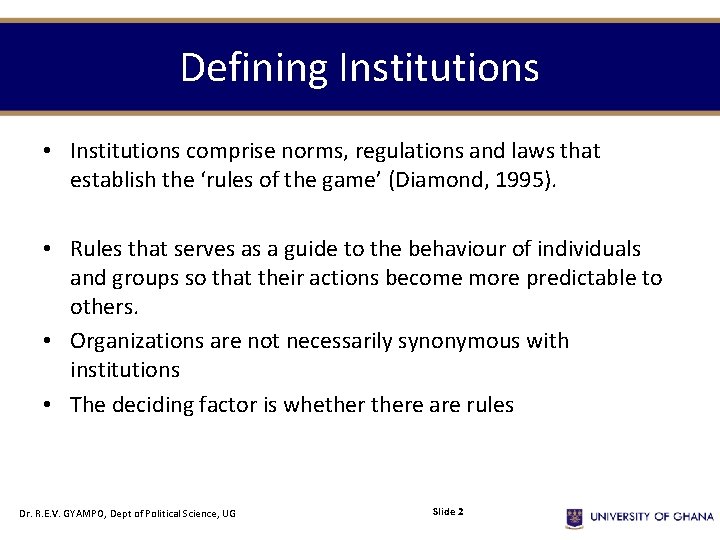
Defining Institutions • Institutions comprise norms, regulations and laws that establish the ‘rules of the game’ (Diamond, 1995). • Rules that serves as a guide to the behaviour of individuals and groups so that their actions become more predictable to others. • Organizations are not necessarily synonymous with institutions • The deciding factor is whethere are rules Dr. R. E. V. GYAMPO, Dept of Political Science, UG Slide 2
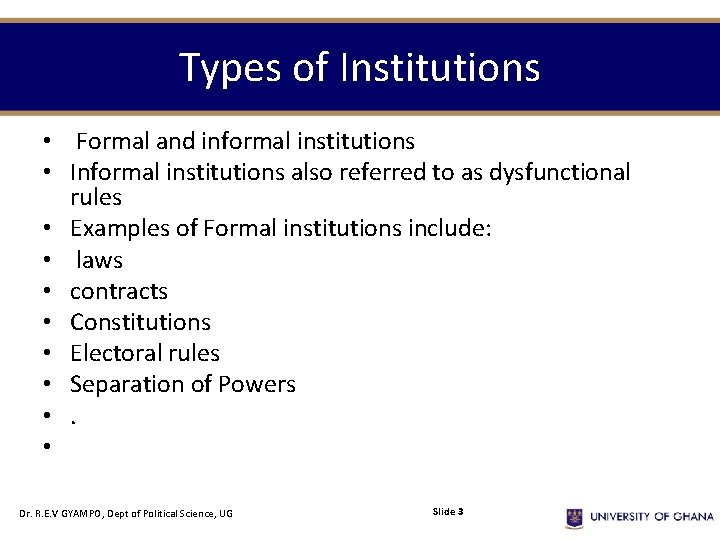
Types of Institutions • Formal and informal institutions • Informal institutions also referred to as dysfunctional rules • Examples of Formal institutions include: • laws • contracts • Constitutions • Electoral rules • Separation of Powers • . • Dr. R. E. V GYAMPO, Dept of Political Science, UG Slide 3
Types of Institutions • • • Informal institutions also include: Norms, Customs and Conventions Patron-Client Relations Spousal Relations Old-Boyism Ethnic cleavages Dr. R. E. V. GYAMPO Dept of Political Science, UG Slide 4
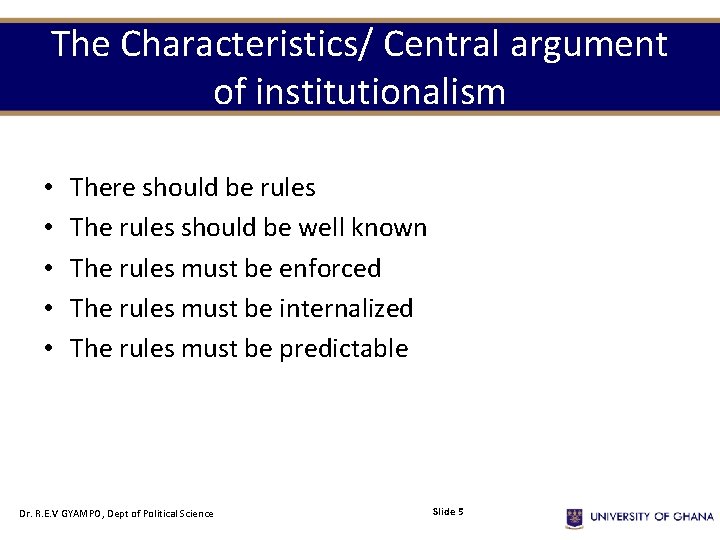
The Characteristics/ Central argument of institutionalism • • • There should be rules The rules should be well known The rules must be enforced The rules must be internalized The rules must be predictable Dr. R. E. V GYAMPO, Dept of Political Science Slide 5
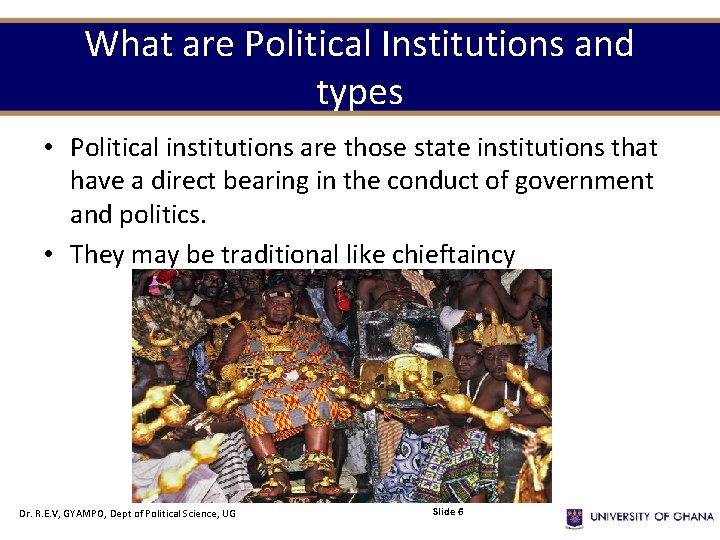
What are Political Institutions and types • Political institutions are those state institutions that have a direct bearing in the conduct of government and politics. • They may be traditional like chieftaincy Dr. R. E. V, GYAMPO, Dept of Political Science, UG Slide 6
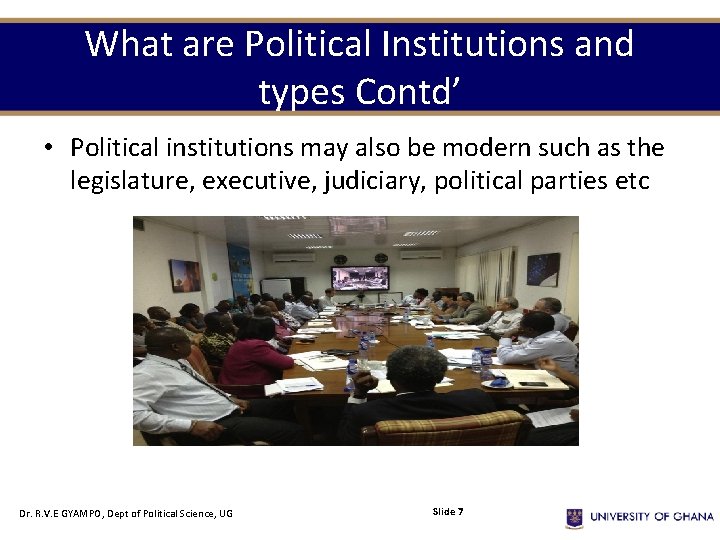
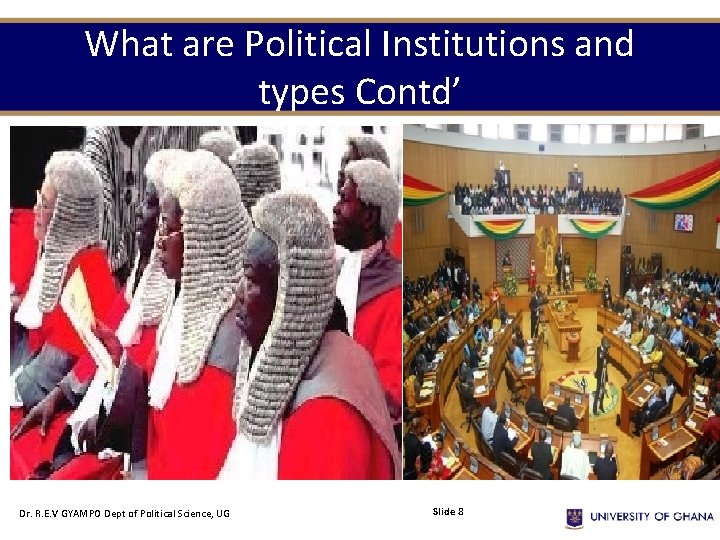
What are Political Institutions and types Contd’ • Political institutions may also be modern such as the legislature, executive, judiciary, political parties etc Dr. R. V. E GYAMPO, Dept of Political Science, UG Slide 7
What are Political Institutions and types Contd’ Dr. R. E. V GYAMPO Dept of Political Science, UG Slide 8
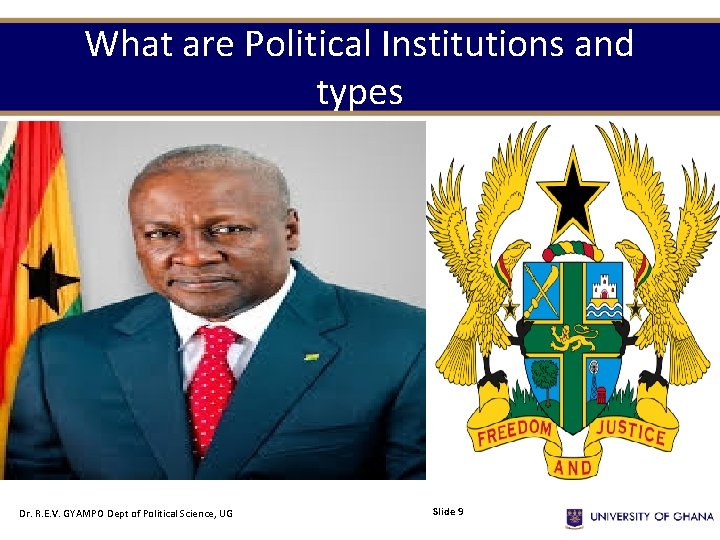
What are Political Institutions and types Dr. R. E. V. GYAMPO Dept of Political Science, UG Slide 9
The Role of Political Institutions • • Shaping social relations Avoiding uncertainties Restraining the exercise of power Predicting the outcome of Political Action Dr. R. E. V. GYAMPO Dept of Political Science, UG Slide 10
Making Political Institutions Effective • Political institutions in many African countries are weak, ineffective or moribund • There may be fine rules that are expected to govern the activities of these institutions • Nevertheless, the rules are simply kept on the shelves to gather dust- THEY ARE NOT IMPLEMENTED • Political institutions can only be made effective when the “rules of the game” are allowed to work without fear or favour; internalized and made predictable. Dr. R. E. V. GYAMPO Dept of Political Science, UG Slide 11
Reading list • Gyampo, R. E. V. The state of Political Institutions in Ghana, (Saarbrucken, Germany: Lambert Academic Publishing Inc. 2012) pp 1 -50 • March, J. and Olsen, J. “Elaborating the new Institutionalism”, In Rhodes, R. A W; Binder, S. A. and Rockman, B. A. The Oxford Handbook of Political Institutions (New York: Oxford University Press, 2006). pp 3 -22 Dr. R. E. V. GYAMPO Dept of Political Science, UG Slide 12
Reading List • See suggested reading list in modules and Study guide • The following are however essential: • Gyampo, R. E. V. The state of Political Institutions in Ghana, (Saarbrucken, Germany: Lambert Academic Publishing Inc. 2012) • Rhodes, R. A W; Binder, S. A. and Rockman, B. A. The Oxford Handbook of Political Institutions (New York: Oxford University Press, 2006). Dr. R. E. V. GYAMPO Dept of Political Science, UG Slide 13
Concluding Remark • Brace yourself for Lecture 2 which delves into the nature and scope of institutions • THANK YOU Dr. R. E. V. GYAMPO Dept of Political Science, UG Slide 14