
Polarized Thermal Emission from Interstellar Dust John Vaillancourt





- Slides: 32
Polarized Thermal Emission from Interstellar Dust John Vaillancourt Roger Hildebrand, Larry Kirby (U. Chicago) Giles Novak, Megan Krejny, Hua-bai Li (Northwestern) Darren Dowell (JPL/Caltech) Jackie Davidson, Jessie Dotson (NASA Ames) Martin Houde (U. Western Ontario) Alex Lazarian (U. Wisconsin - Madison) 12 Septembre
Overview • Polarization by emission in molecular clouds • Polarization spectra – 60 - 1000 m = 300 - 5000 GHz • Extension to … – Dark clouds and the diffuse ISM – Longer wavelengths: ~ 3 cm, ~ 1 GHz – New instruments (WMAP, Planck, SHARP, HAWC/SOFIA) John Vaillancourt 12 Sept
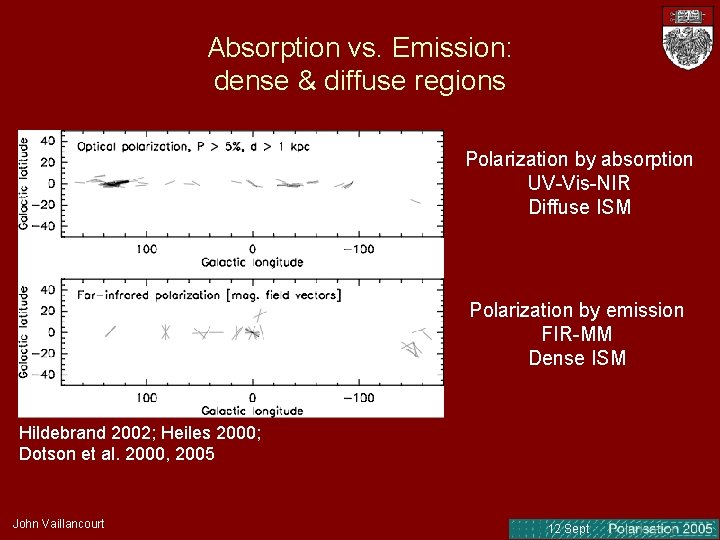
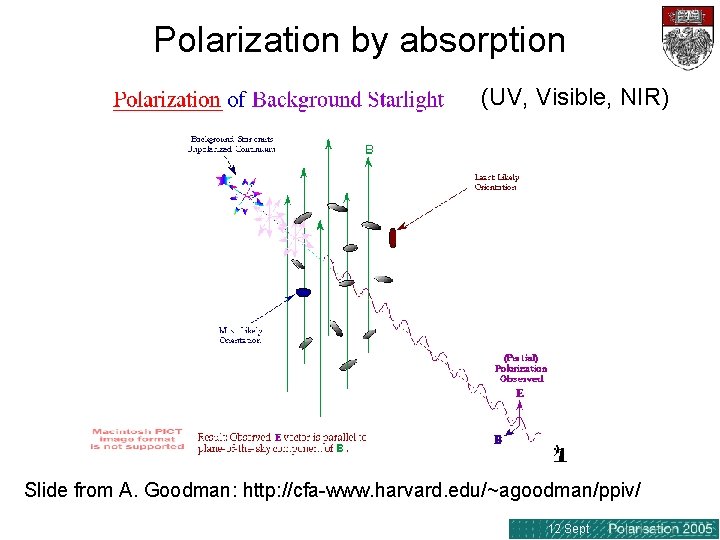
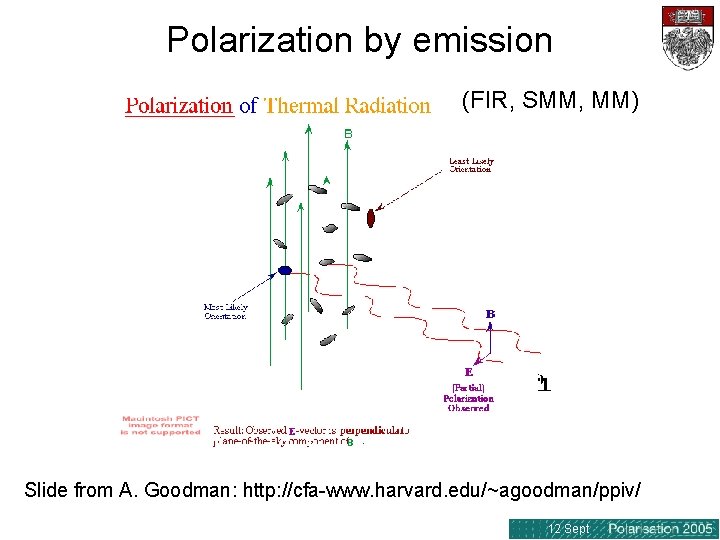
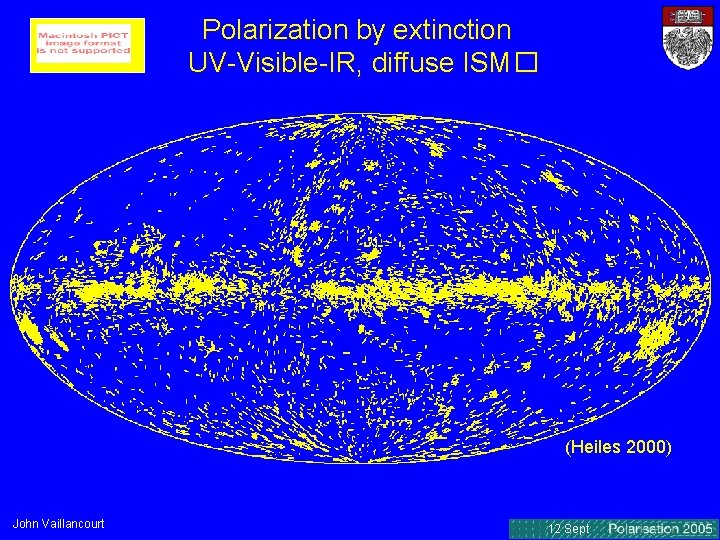
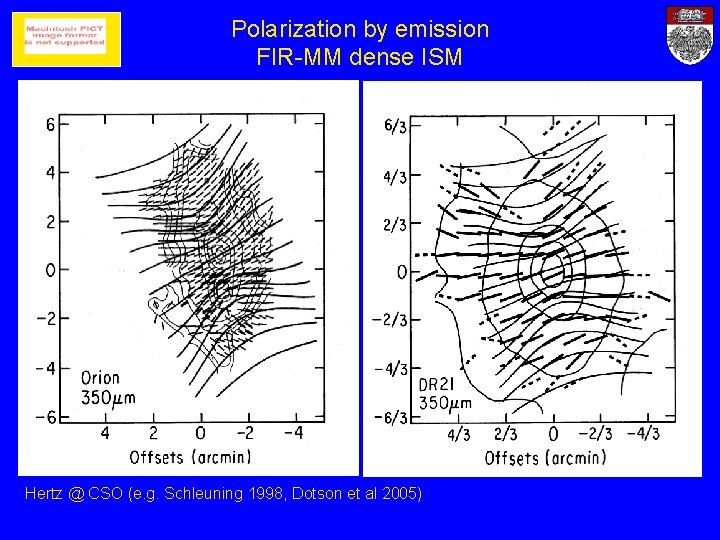
Absorption vs. Emission: dense & diffuse regions Polarization by absorption UV-Vis-NIR Diffuse ISM Polarization by emission FIR-MM Dense ISM Hildebrand 2002; Heiles 2000; Dotson et al. 2000, 2005 John Vaillancourt 12 Sept
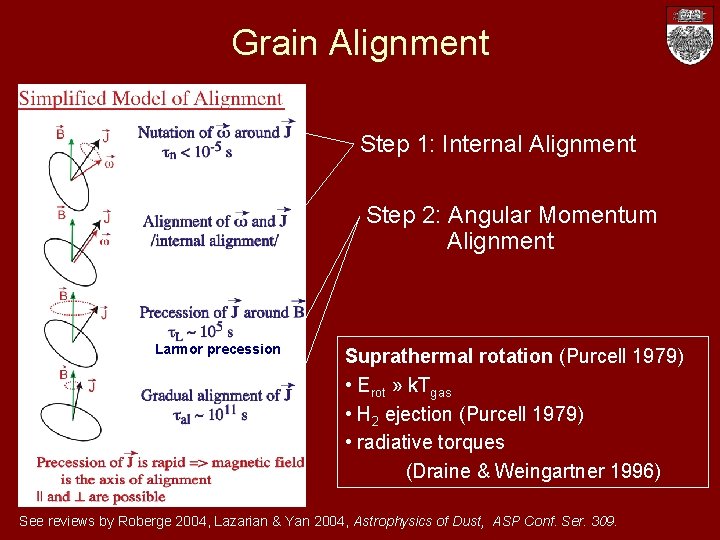
Grain Alignment Step 1: Internal Alignment Step 2: Angular Momentum Alignment Larmor precession Suprathermal rotation (Purcell 1979) • Erot » k. Tgas • H 2 ejection (Purcell 1979) • radiative torques (Draine & Weingartner 1996) See reviews by Roberge 2004, Lazarian & Yan 2004, Astrophysics of Dust, ASP Conf. Ser. 309.
Limits of Polarization by Absorption Visible extinction, AV (mag) Background star polarization near dark clouds: efficiency of grain alignment drops quickly for AV > 1 - 2 mag Polarization (%) Consistent with radiative torques from interstellar radiation field (ISRF) (Lazarian, Goodman, & Myers 1997; Arce et al. 1998; Whittet et al. 2001) How do we explain FIR polarization in dense clouds with AV ~ 10 - 30 ? - embedded stars Arce et al. 1998 - radiative torques more efficient for large grains; up to Av ~ 10 (Cho & Lazarian 2005 astroph/0505571)
Loss of alignment in dense clouds? Polarized Flux (P F) Schleuning 1998 OMC-1 • Pabs = Pemis • Polarized flux traces aligned grains in dense regions John Vaillancourt 12 Sept
Alignment near embedded stars 350 m W 3 W 51 W 3 A Vaillancourt et al. , in prep. Schluening et al. 2000 • Polarized flux (grayscale) vs. total flux (contours) – W 51 - PF maximum coincident with total flux maximum – W 3 - PF maximum coincident with H II region (W 3 A), not total flux (H II region is source of UV photons & radiative torques) John Vaillancourt 12 Sept
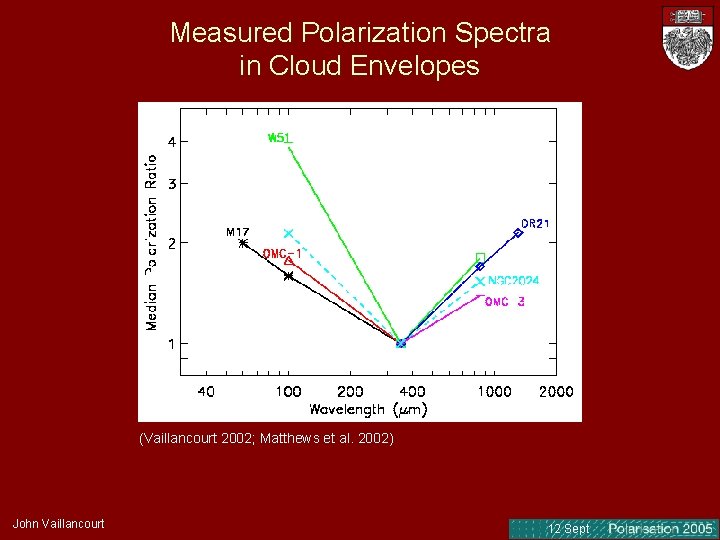
Dust properties & Polarization spectra • Extinction & polarization both drop with wavelength in near-IR, but diverge in UV – Large (> 0. 1 m) grains are better aligned than small grains • Silicate & water spectral features are polarized – Line shapes Grain shapes Ø oblate spheroids, axes ratio 0. 3 < a/b < 0. 9 • Carbon spectral features unpolarized – Silicate grains are better aligned than graphite (carbon) grains • Far-IR/sub-mm polarization spectrum has a minimum – multiple domains of aligned & unaligned grains at multiple temperatures. See reviews by Whittet (2003, 2005) John Vaillancourt 12 Sept
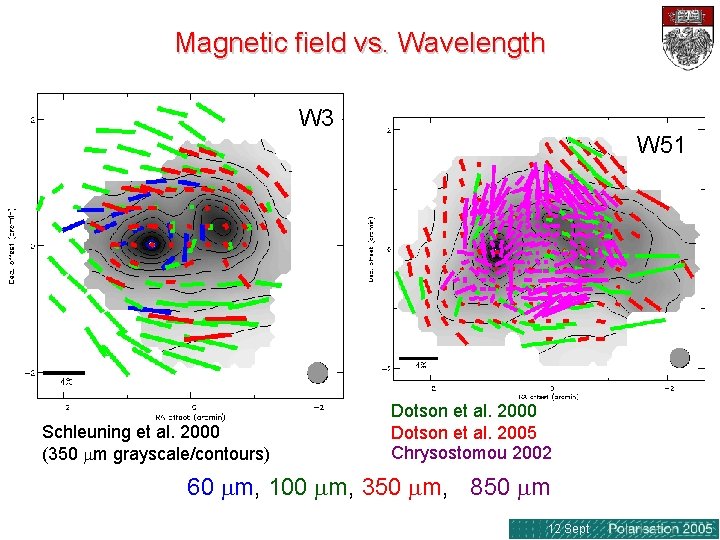
Magnetic field vs. Wavelength W 3 W 51 Schleuning et al. 2000 (350 m grayscale/contours) Dotson et al. 2000 Dotson et al. 2005 Chrysostomou 2002 60 m, 100 m, 350 m, 850 m John Vaillancourt 12 Sept
Measured Polarization Spectra in Cloud Envelopes (Vaillancourt 2002; Matthews et al. 2002) John Vaillancourt 12 Sept
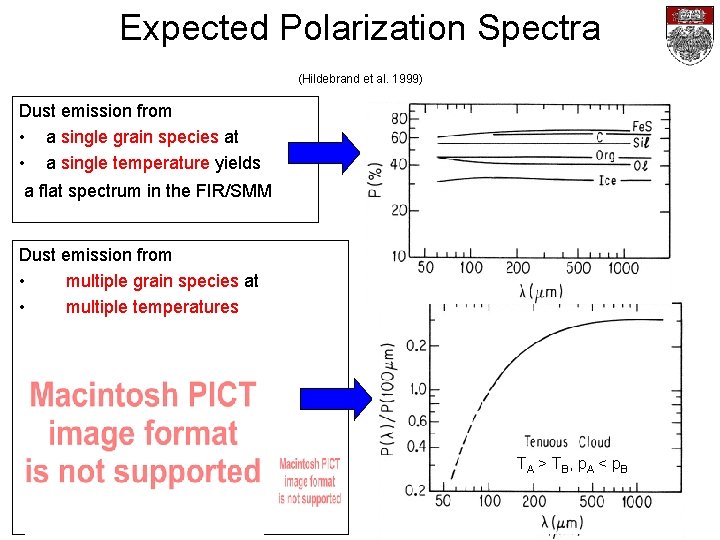
Expected Polarization Spectra (Hildebrand et al. 1999) Dust emission from • a single grain species at • a single temperature yields a flat spectrum in the FIR/SMM Dust emission from • multiple grain species at • multiple temperatures T > T , p < p. B TA > TBA, p. A >B p. B A
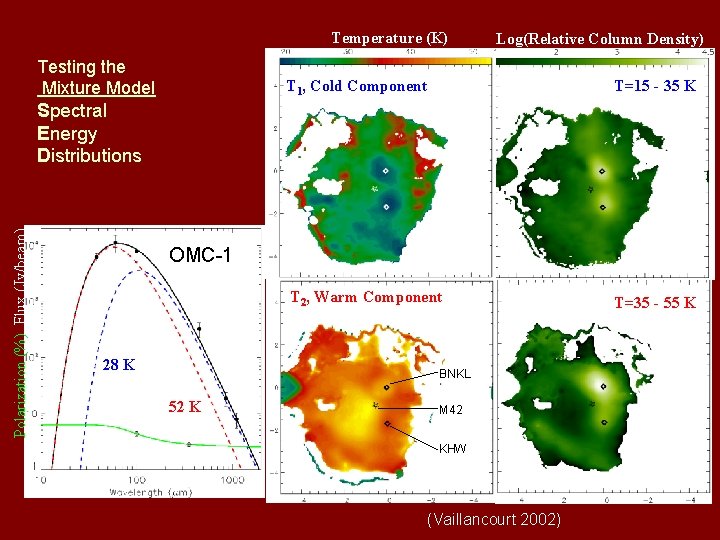
Model of Molecular Clouds A) Near embedded stars - warm dust, aligned via radiative torques B) Cooler dust away from stars; optically opaque clumps C) Cold surface layers exposed to the interstellar radiation field (ISRF) TA > T B > T C p. A p C > p B ISRF John Vaillancourt 12 Sept
Temperature (K) Testing the Mixture Model Log(Relative Column Density) T 1, Cold Component T=15 - 35 K T 2, Warm Component T=35 - 55 K Polarization (%), Flux (Jy/beam) Spectral Energy Distributions OMC-1 28 K BNKL 52 K M 42 KHW (Vaillancourt 2002)
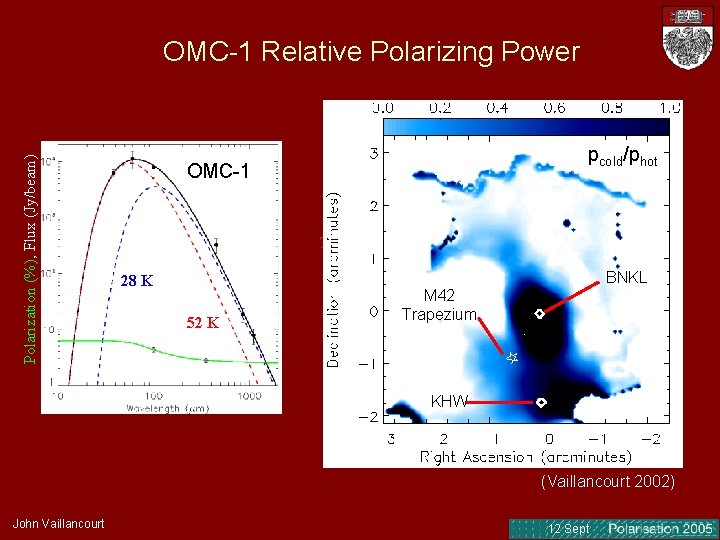
OMC-1 T=35 - 55 K 28 K 52 K Declination (arcmin) Polarization (%), Flux (Jy/beam) OMC-1 Relative Polarizing Power p /p pcold 1 / p 2 hot BNKL M 42 Trapezium KHW (Vaillancourt 2002) John Vaillancourt 12 Sept
Dense vs. Diffuse ISM • Molecular clouds – Dense, hot, turbulent – Power sources: stars, turbulence, ISRF • IR Cirrus (Milky Way & external galaxies) – Diffuse, cool, little/no turbulence – Power source: ISRF, isotropic – All grains exposed to same environment John Vaillancourt 12 Sept
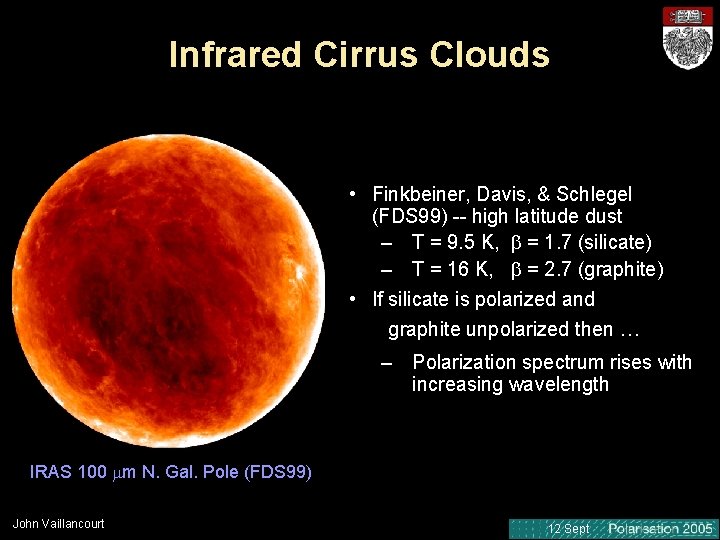
Infrared Cirrus Clouds • Finkbeiner, Davis, & Schlegel (FDS 99) -- high latitude dust – T = 9. 5 K, = 1. 7 (silicate) – T = 16 K, = 2. 7 (graphite) • If silicate is polarized and graphite unpolarized then … – Polarization spectrum rises with increasing wavelength IRAS 100 m N. Gal. Pole (FDS 99) John Vaillancourt 12 Sept
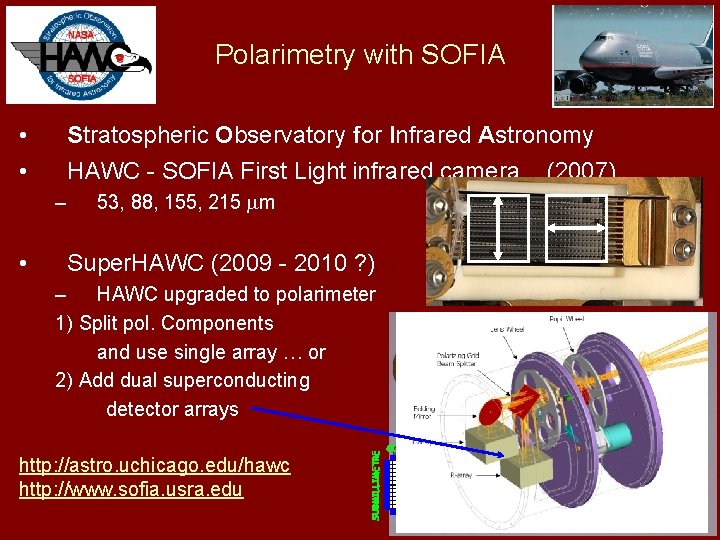
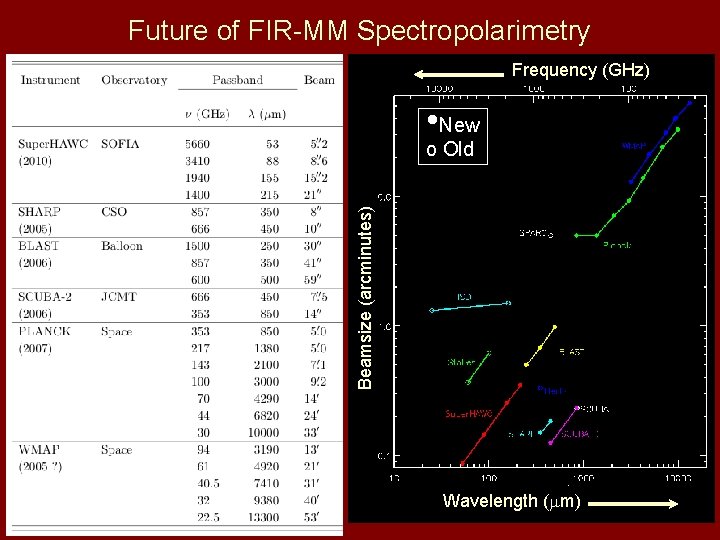
Polarimetry with SOFIA • • Stratospheric Observatory for Infrared Astronomy HAWC - SOFIA First Light infrared camera – • 53, 88, 155, 215 m Super. HAWC (2009 - 2010 ? ) – HAWC upgraded to polarimeter 1) Split pol. Components and use single array … or 2) Add dual superconducting detector arrays http: //astro. uchicago. edu/hawc http: //www. sofia. usra. edu (2007)
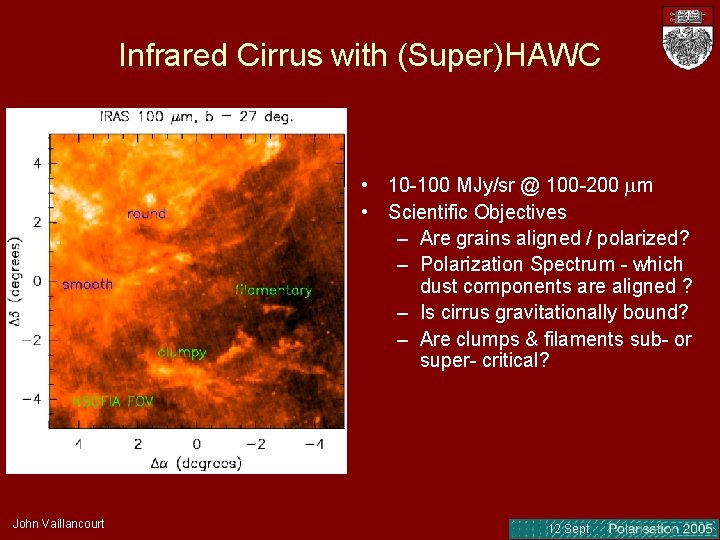
Infrared Cirrus with (Super)HAWC • 10 -100 MJy/sr @ 100 -200 m • Scientific Objectives – Are grains aligned / polarized? – Polarization Spectrum - which dust components are aligned ? – Is cirrus gravitationally bound? – Are clumps & filaments sub- or super- critical? John Vaillancourt 12 Sept
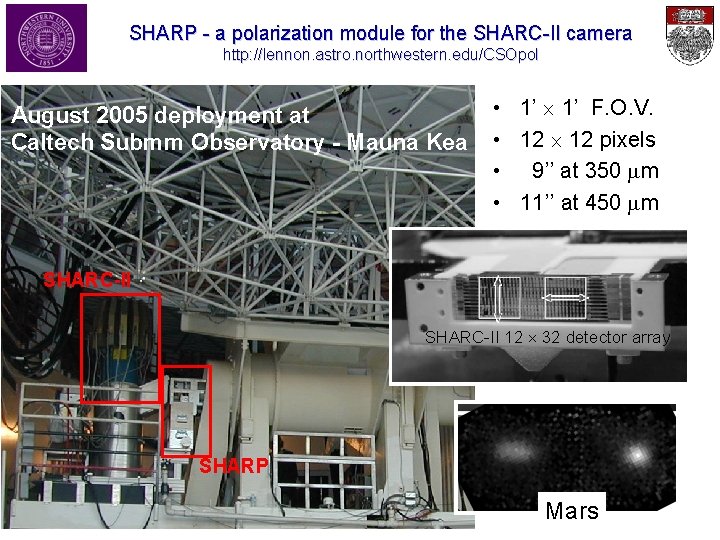
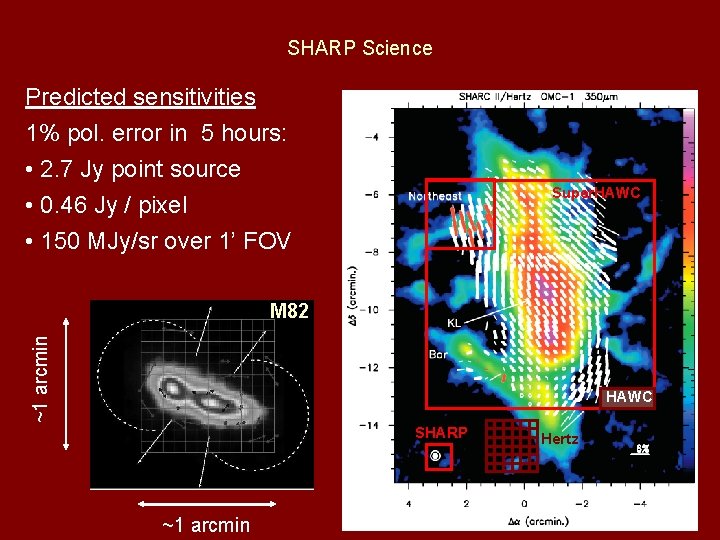
SHARP - a polarization module for the SHARC-II camera http: //lennon. astro. northwestern. edu/CSOpol August 2005 deployment at Caltech Submm Observatory - Mauna Kea • 1’ F. O. V. • 12 pixels • 9’’ at 350 m • 11’’ at 450 m SHARC-II M 82 SHARC-II 12 32 detector array SHARP Mars
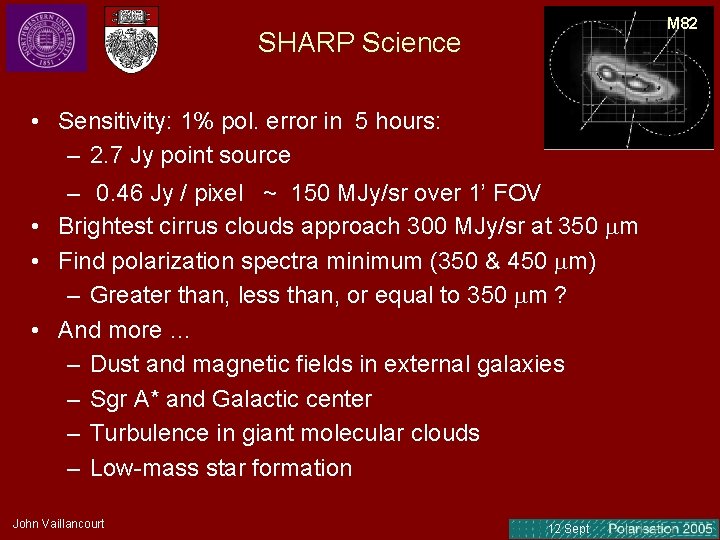
M 82 SHARP Science • Sensitivity: 1% pol. error in 5 hours: – 2. 7 Jy point source – 0. 46 Jy / pixel ~ 150 MJy/sr over 1’ FOV • Brightest cirrus clouds approach 300 MJy/sr at 350 m • Find polarization spectra minimum (350 & 450 m) – Greater than, less than, or equal to 350 m ? • And more … – Dust and magnetic fields in external galaxies – Sgr A* and Galactic center – Turbulence in giant molecular clouds Hertz – Low-mass star formation John Vaillancourt 12 Sept
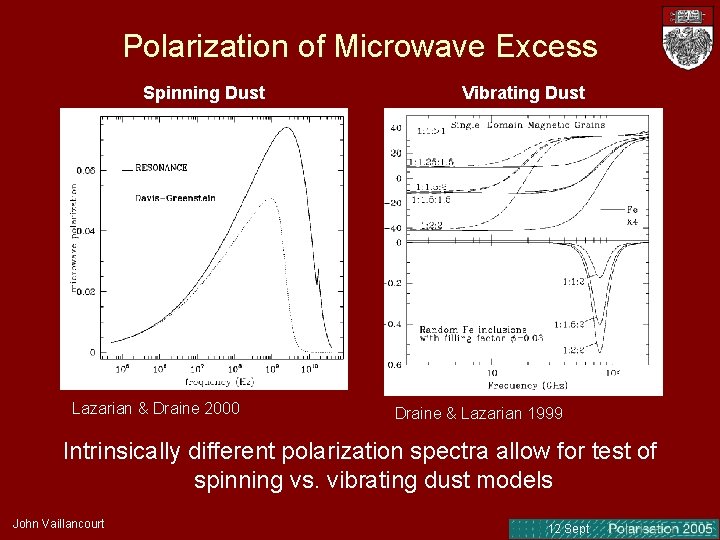
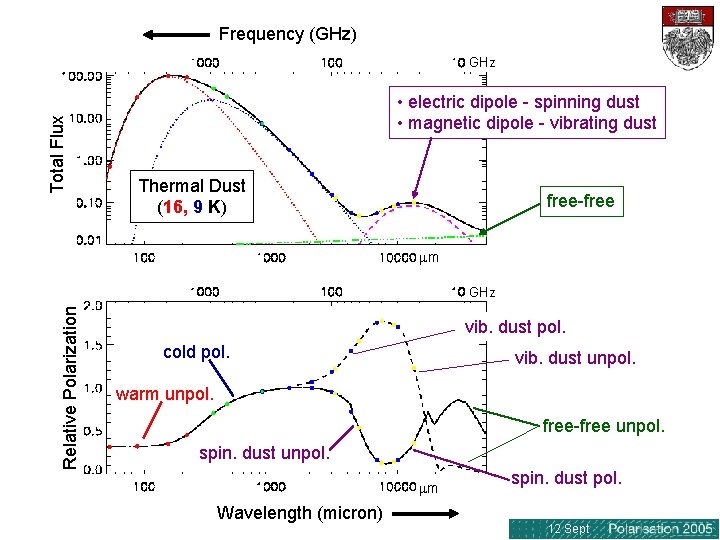
Microwave Polarization Spectrum Extending the Mixture Model • Microwave flux excess (1 -100 GHz) - “Foreground X” – Kogut et al. 1996, de Oliveira-Costa et al. 1997; Leitch et al. 1997 • • • – Excess in microwave flux beyond contributions from thermal dust, free-free, and synchrotron emission – Strong correlation with dust emission (IRAS-100, DIRBE-240) Possible sources – Electric dipole emission from small (< 0. 001 m) “spinning dust” grains (Draine & Lazarian 1998) – Magnetic dipole emission from large (0. 1 - 10 m) magnetic “vibrating dust” grains (Draine & Lazarian 1999) How much does the excess contribute to diffuse flux? Is the excess emission polarized ? John Vaillancourt 12 Sept
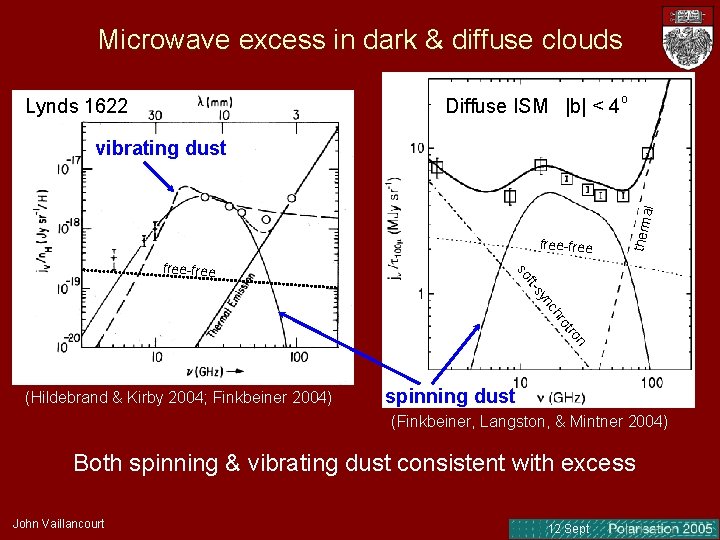
Microwave excess in dark & diffuse clouds Diffuse ISM |b| < 4 o Lynds 1622 free-free n tro ro ch yn t-s f so free-free therm al vibrating dust (Hildebrand & Kirby 2004; Finkbeiner 2004) spinning dust (Finkbeiner, Langston, & Mintner 2004) Both spinning & vibrating dust consistent with excess John Vaillancourt 12 Sept
Polarization of Microwave Excess Spinning Dust Lazarian & Draine 2000 Vibrating Dust Draine & Lazarian 1999 Intrinsically different polarization spectra allow for test of spinning vs. vibrating dust models John Vaillancourt 12 Sept
Frequency (GHz) Total Flux GHz • electric dipole - spinning dust • magnetic dipole - vibrating dust Thermal Dust (16, 9 K) free-free m Relative Polarization GHz vib. dust pol. cold pol. vib. dust unpol. warm unpol. free-free unpol. spin. dust unpol. m John Vaillancourt Wavelength (micron) spin. dust pol. 12 Sept
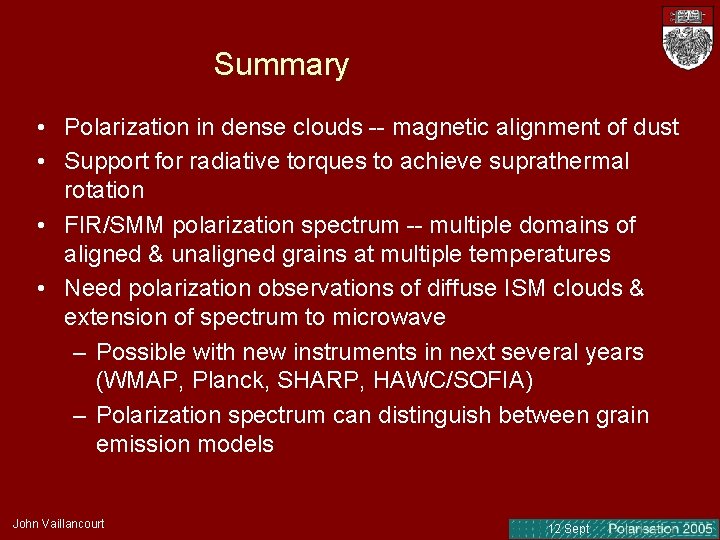
Summary • Polarization in dense clouds -- magnetic alignment of dust • Support for radiative torques to achieve suprathermal rotation • FIR/SMM polarization spectrum -- multiple domains of aligned & unaligned grains at multiple temperatures • Need polarization observations of diffuse ISM clouds & extension of spectrum to microwave – Possible with new instruments in next several years (WMAP, Planck, SHARP, HAWC/SOFIA) – Polarization spectrum can distinguish between grain emission models John Vaillancourt 12 Sept
John Vaillancourt 12 Sept
Future of FIR-MM Spectropolarimetry Frequency (GHz) • New Beamsize (arcminutes) o Old Wavelength ( m)
Polarization by absorption (UV, Visible, NIR) Slide from A. Goodman: http: //cfa-www. harvard. edu/~agoodman/ppiv/ John Vaillancourt 12 Sept
Polarization by emission (FIR, SMM, MM) Slide from A. Goodman: http: //cfa-www. harvard. edu/~agoodman/ppiv/ John Vaillancourt 12 Sept
SHARP Science Predicted sensitivities 1% pol. error in 5 hours: • 2. 7 Jy point source • 0. 46 Jy / pixel • 150 MJy/sr over 1’ FOV Super. HAWC ~1 arcmin M 82 HAWC SHARP ~1 arcmin Hertz
Polarization by extinction UV-Visible-IR, diffuse ISM� (Heiles 2000) John Vaillancourt 12 Sept
Polarization by emission FIR-MM dense ISM Hertz @ CSO (e. g. Schleuning 1998, Dotson et al 2005)