
Polarization transfer Bremsstrahlung process Bremsstrahlung process Linear polarization
Polarization transfer Bremsstrahlung process
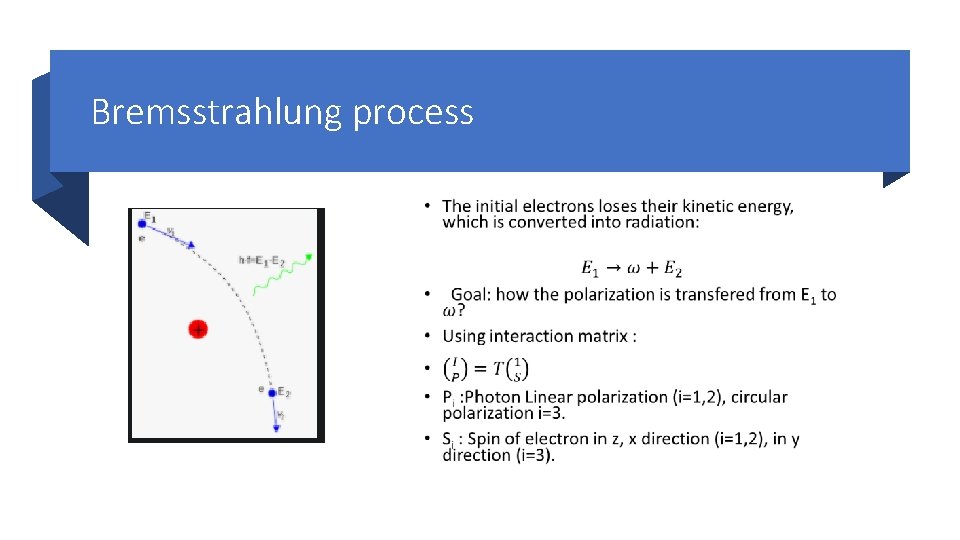
Bremsstrahlung process •
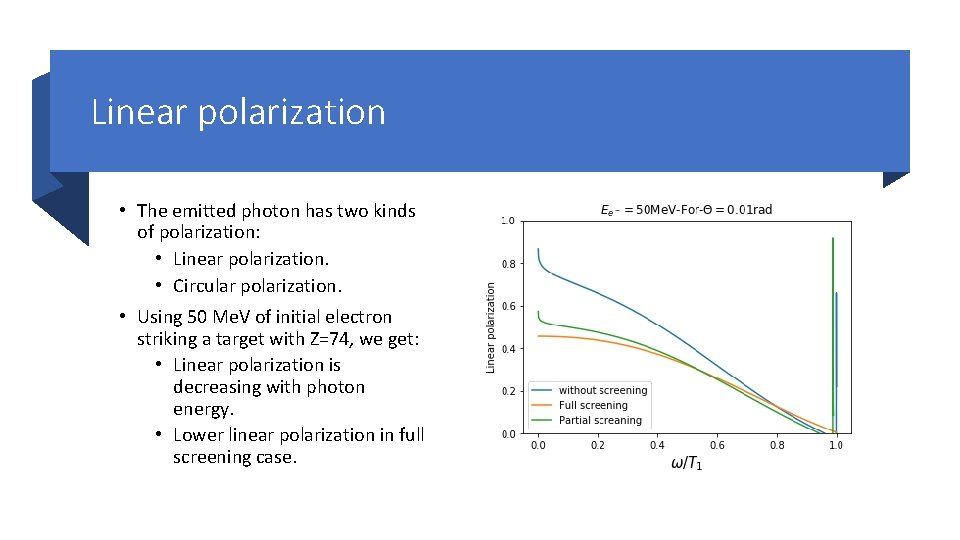
Linear polarization • The emitted photon has two kinds of polarization: • Linear polarization. • Circular polarization. • Using 50 Me. V of initial electron striking a target with Z=74, we get: • Linear polarization is decreasing with photon energy. • Lower linear polarization in full screening case.
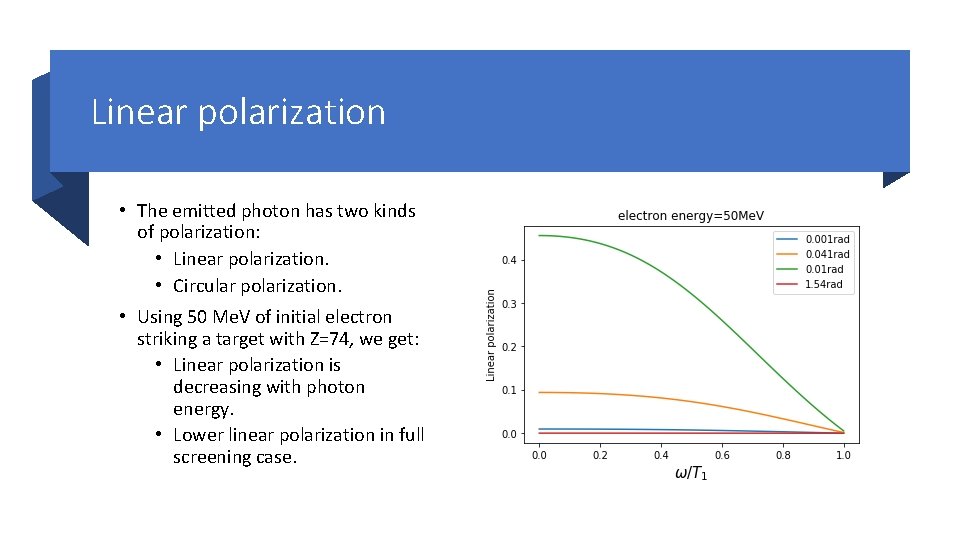
Linear polarization • The emitted photon has two kinds of polarization: • Linear polarization. • Circular polarization. • Using 50 Me. V of initial electron striking a target with Z=74, we get: • Linear polarization is decreasing with photon energy. • Lower linear polarization in full screening case.
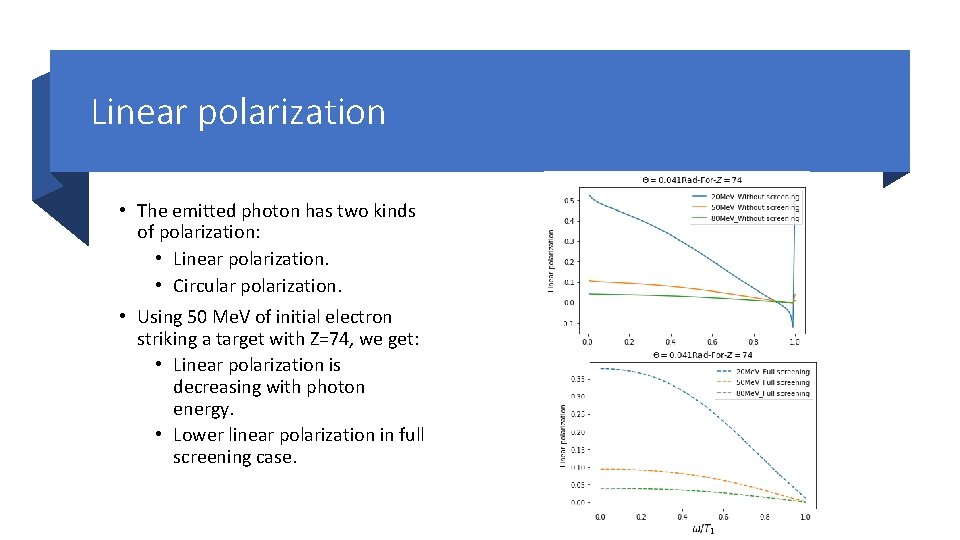
Linear polarization • The emitted photon has two kinds of polarization: • Linear polarization. • Circular polarization. • Using 50 Me. V of initial electron striking a target with Z=74, we get: • Linear polarization is decreasing with photon energy. • Lower linear polarization in full screening case.
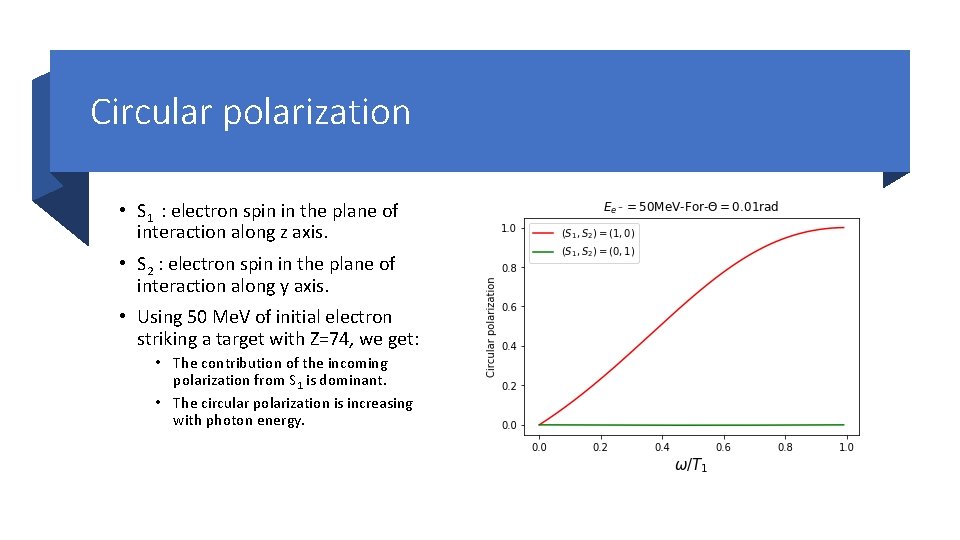
Circular polarization • S 1 : electron spin in the plane of interaction along z axis. • S 2 : electron spin in the plane of interaction along y axis. • Using 50 Me. V of initial electron striking a target with Z=74, we get: • The contribution of the incoming polarization from S 1 is dominant. • The circular polarization is increasing with photon energy.
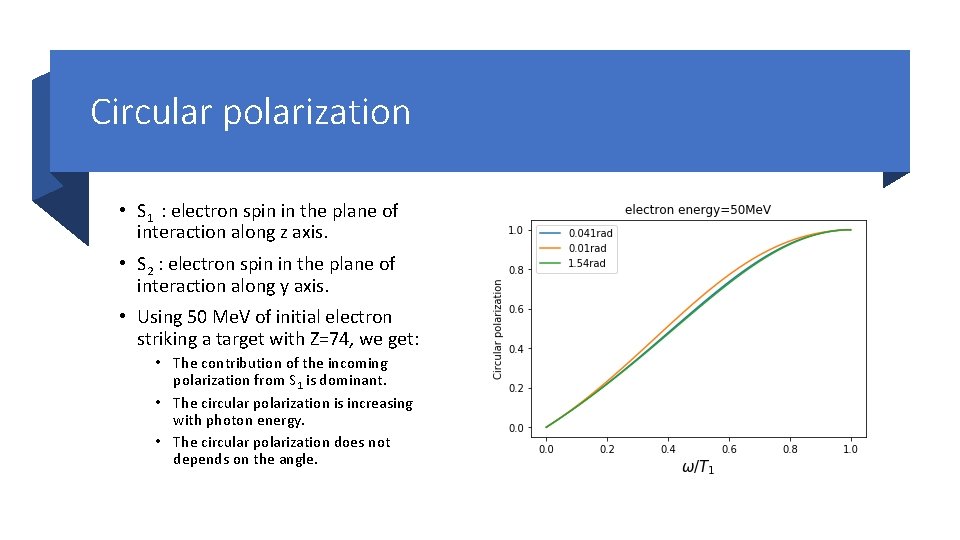
Circular polarization • S 1 : electron spin in the plane of interaction along z axis. • S 2 : electron spin in the plane of interaction along y axis. • Using 50 Me. V of initial electron striking a target with Z=74, we get: • The contribution of the incoming polarization from S 1 is dominant. • The circular polarization is increasing with photon energy. • The circular polarization does not depends on the angle.
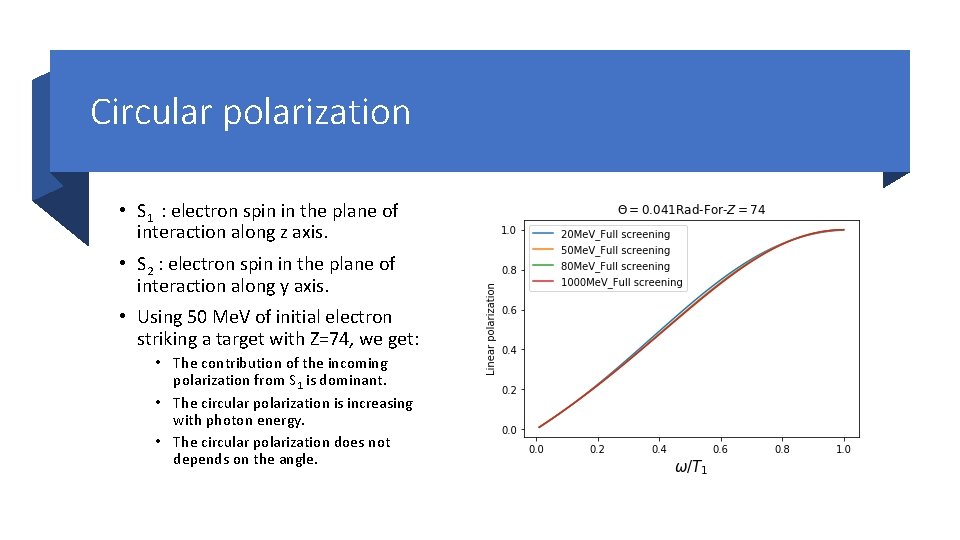
Circular polarization • S 1 : electron spin in the plane of interaction along z axis. • S 2 : electron spin in the plane of interaction along y axis. • Using 50 Me. V of initial electron striking a target with Z=74, we get: • The contribution of the incoming polarization from S 1 is dominant. • The circular polarization is increasing with photon energy. • The circular polarization does not depends on the angle.
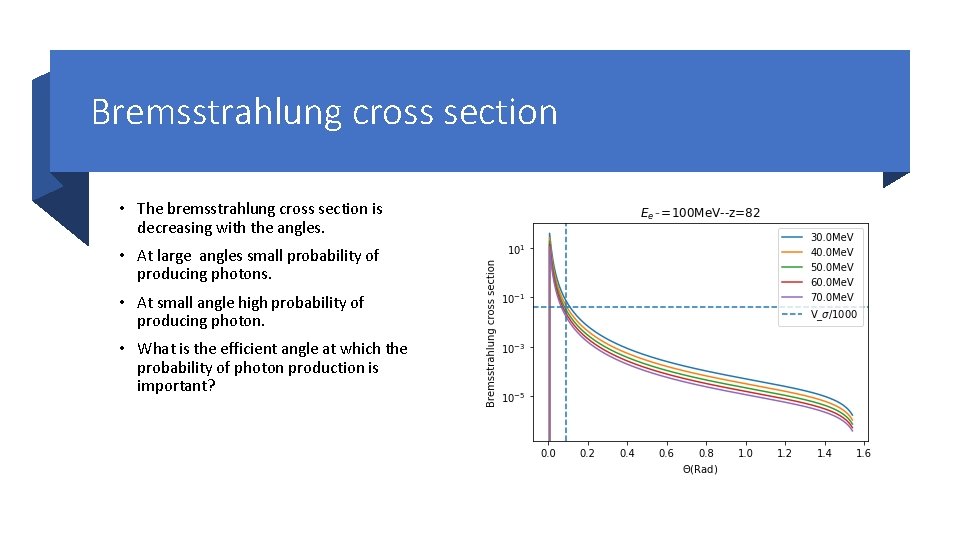
Bremsstrahlung cross section • The bremsstrahlung cross section is decreasing with the angles. • At large angles small probability of producing photons. • At small angle high probability of producing photon. • What is the efficient angle at which the probability of photon production is important?
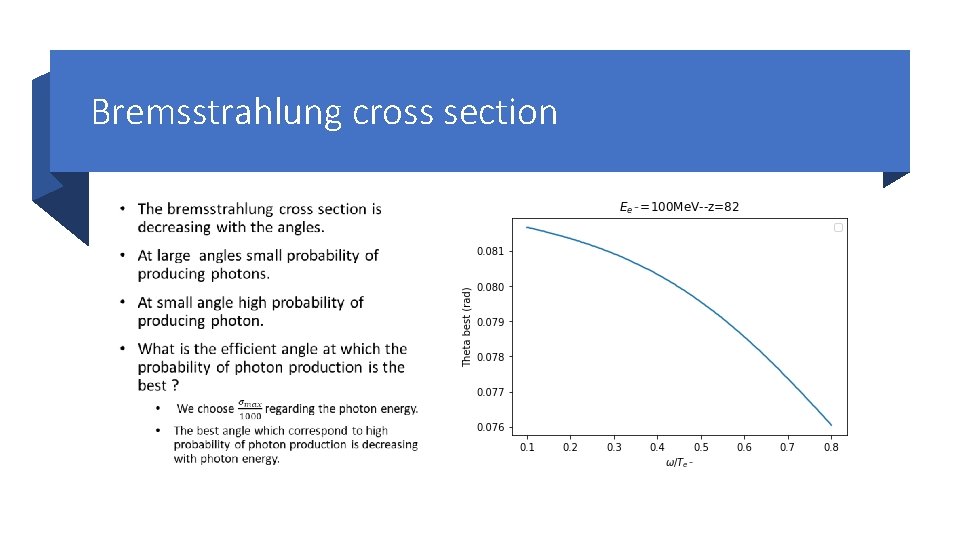
Bremsstrahlung cross section •
- Slides: 10