
Polarization of Light from Basics to Instruments in
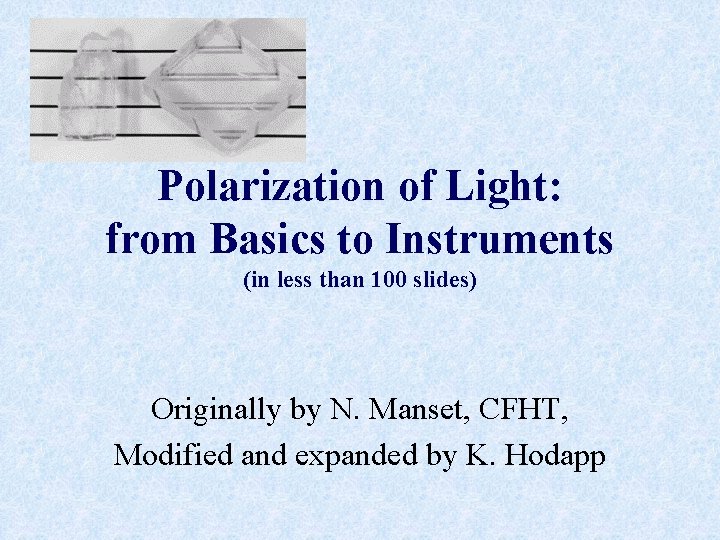
Polarization of Light: from Basics to Instruments (in less than 100 slides) Originally by N. Manset, CFHT, Modified and expanded by K. Hodapp
Part I: Different polarization states of light • Light as an electromagnetic wave • Mathematical and graphical descriptions of polarization • Linear, circular, elliptical light • Polarized, unpolarized light N. Manset / CFHT Polarization of Light: Basics to Instruments 2
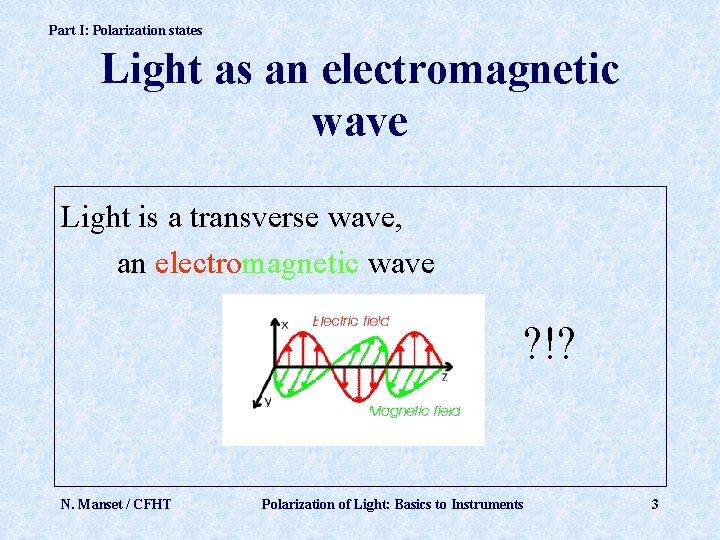
Part I: Polarization states Light as an electromagnetic wave Light is a transverse wave, an electromagnetic wave ? !? N. Manset / CFHT Polarization of Light: Basics to Instruments 3
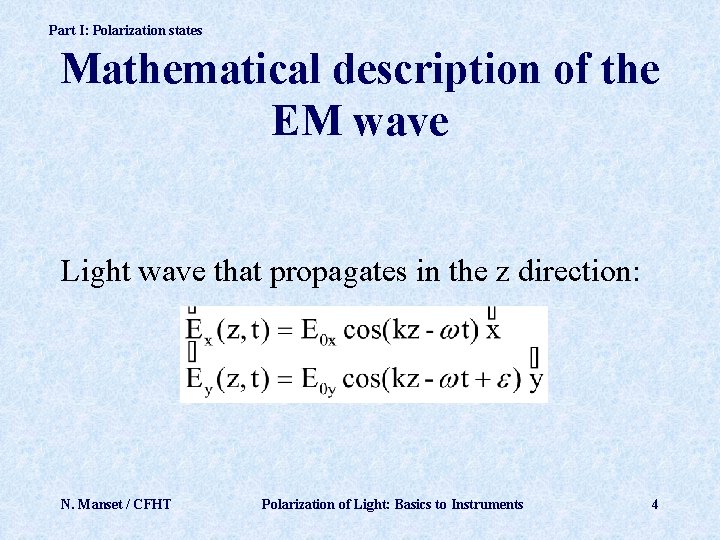
Part I: Polarization states Mathematical description of the EM wave Light wave that propagates in the z direction: N. Manset / CFHT Polarization of Light: Basics to Instruments 4
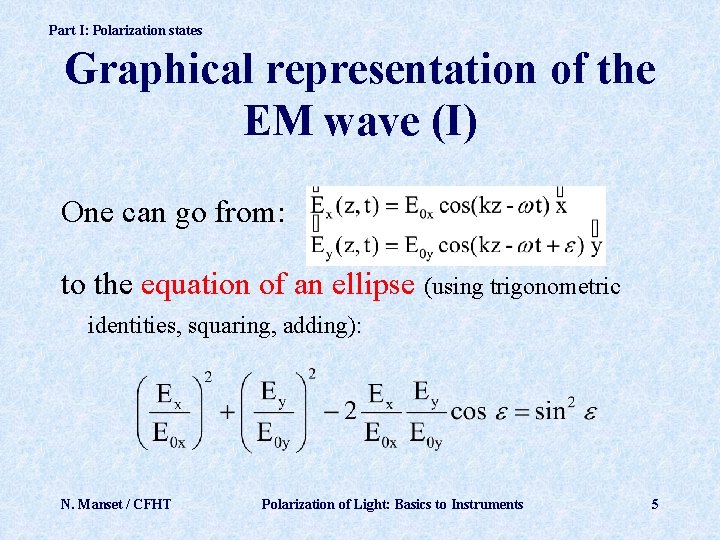
Part I: Polarization states Graphical representation of the EM wave (I) One can go from: to the equation of an ellipse (using trigonometric identities, squaring, adding): N. Manset / CFHT Polarization of Light: Basics to Instruments 5

Part I: Polarization states Graphical representation of the EM wave (II) An ellipse can be represented by 4 quantities: 1. size of minor axis 2. size of major axis 3. orientation (angle) 4. sense (CW, CCW) Light can be represented by 4 quantities. . . N. Manset / CFHT Polarization of Light: Basics to Instruments 6
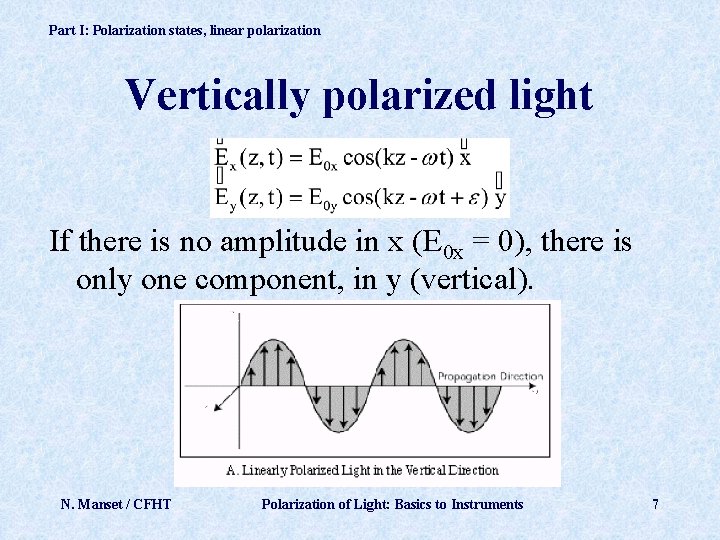
Part I: Polarization states, linear polarization Vertically polarized light If there is no amplitude in x (E 0 x = 0), there is only one component, in y (vertical). N. Manset / CFHT Polarization of Light: Basics to Instruments 7
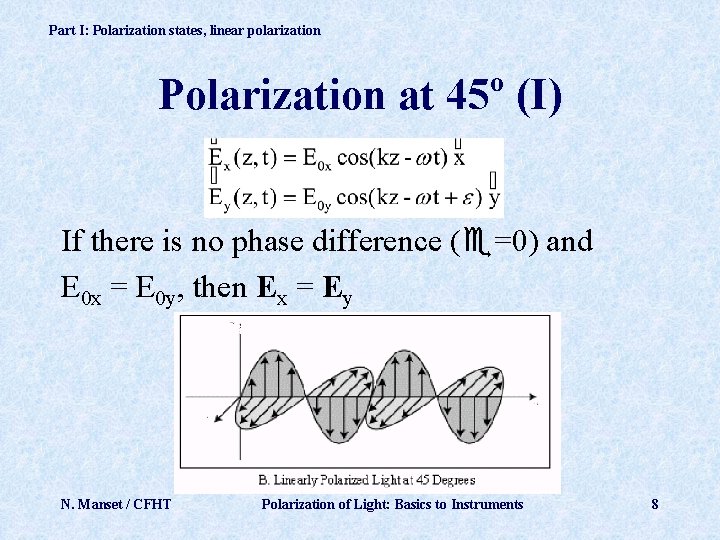
Part I: Polarization states, linear polarization Polarization at 45º (I) If there is no phase difference ( =0) and E 0 x = E 0 y, then Ex = Ey N. Manset / CFHT Polarization of Light: Basics to Instruments 8
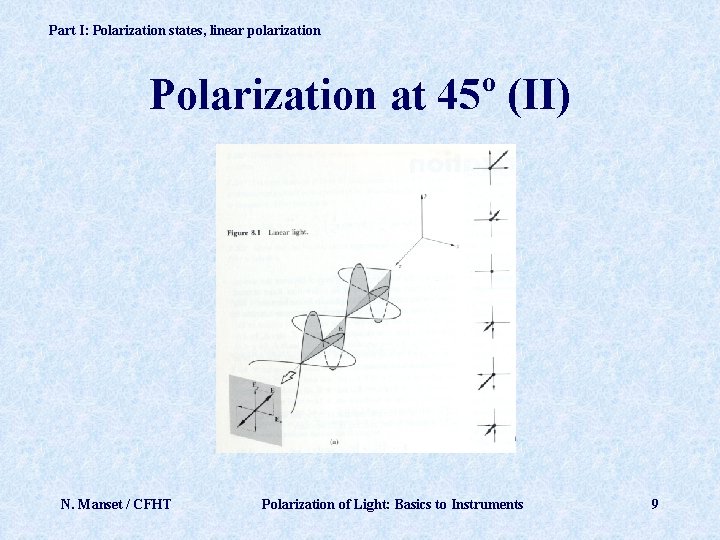
Part I: Polarization states, linear polarization Polarization at 45º (II) N. Manset / CFHT Polarization of Light: Basics to Instruments 9
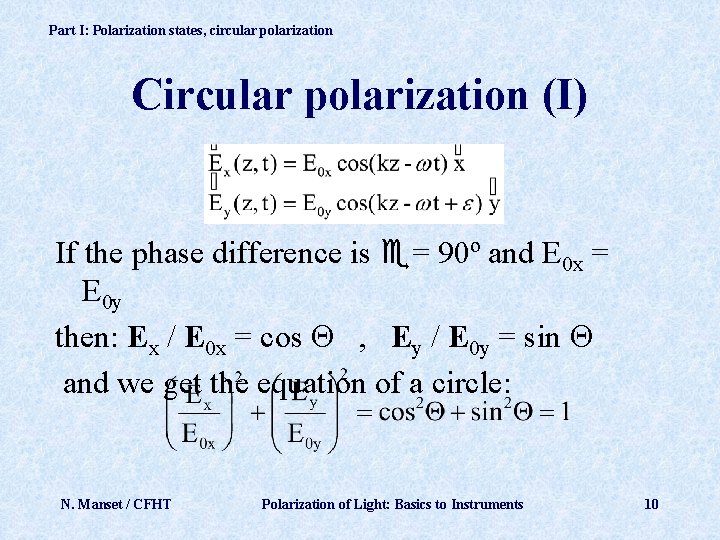
Part I: Polarization states, circular polarization Circular polarization (I) If the phase difference is = 90º and E 0 x = E 0 y then: Ex / E 0 x = cos , Ey / E 0 y = sin and we get the equation of a circle: N. Manset / CFHT Polarization of Light: Basics to Instruments 10
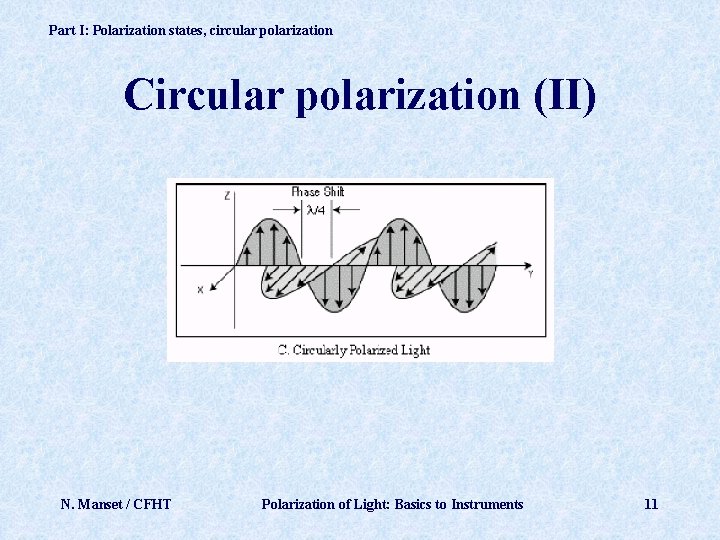
Part I: Polarization states, circular polarization Circular polarization (II) N. Manset / CFHT Polarization of Light: Basics to Instruments 11
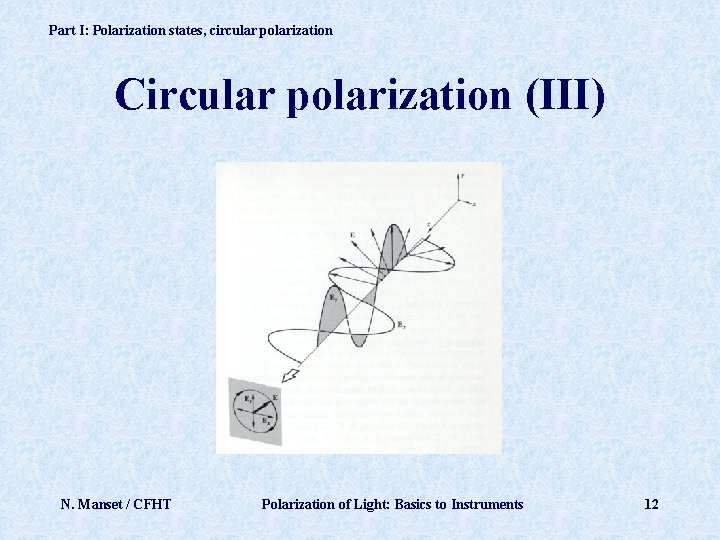
Part I: Polarization states, circular polarization Circular polarization (III) N. Manset / CFHT Polarization of Light: Basics to Instruments 12
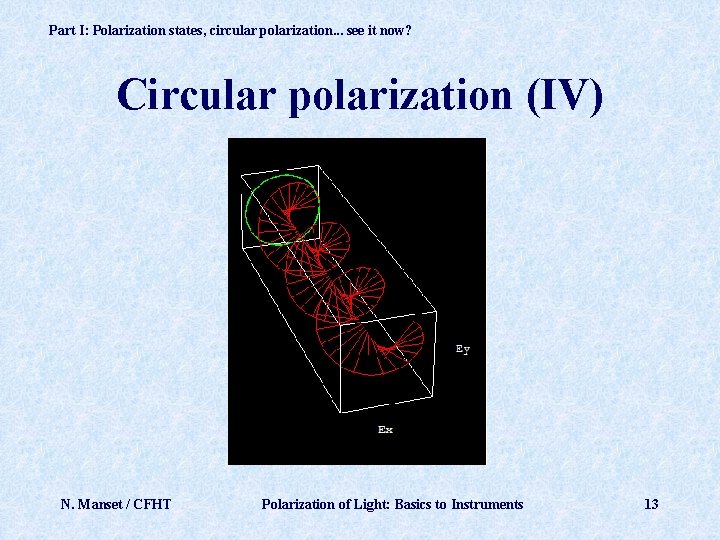
Part I: Polarization states, circular polarization. . . see it now? Circular polarization (IV) N. Manset / CFHT Polarization of Light: Basics to Instruments 13
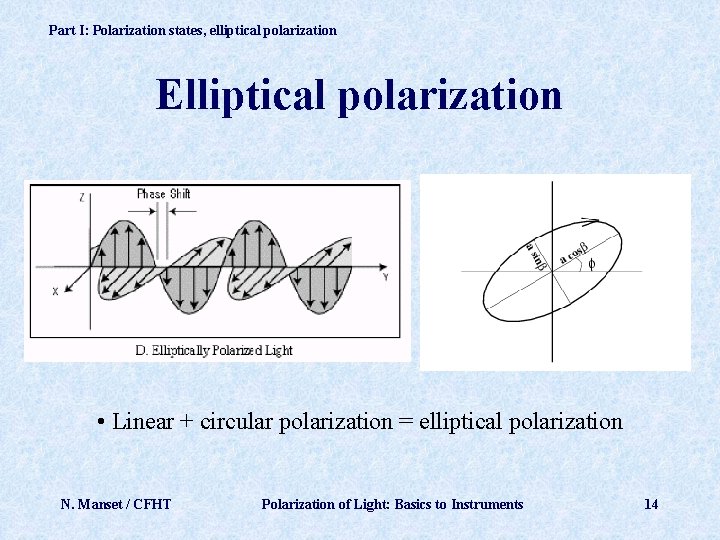
Part I: Polarization states, elliptical polarization Elliptical polarization • Linear + circular polarization = elliptical polarization N. Manset / CFHT Polarization of Light: Basics to Instruments 14
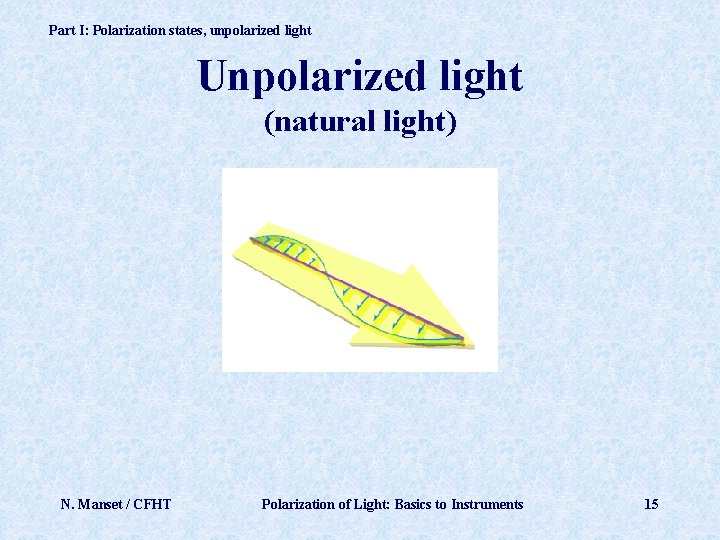
Part I: Polarization states, unpolarized light Unpolarized light (natural light) N. Manset / CFHT Polarization of Light: Basics to Instruments 15
Part II: Stokes parameters and Mueller matrices • Stokes parameters, Stokes vector • Stokes parameters for linear and circular polarization • Stokes parameters and polarization P • Mueller matrices, Mueller calculus • Jones formalism N. Manset / CFHT Polarization of Light: Basics to Instruments 16
Part II: Stokes parameters A tiny itsy-bitsy little bit of history. . . • 1669: Bartholinus discovers double refraction in calcite • 17 th – 19 th centuries: Huygens, Malus, Brewster, Biot, Fresnel and Arago, Nicol. . . • 19 th century: unsuccessful attempts to describe unpolarized light in terms of amplitudes • 1852: Sir George Gabriel Stokes took a very different approach and discovered that polarization can be described in terms of observables using an experimental definition N. Manset / CFHT Polarization of Light: Basics to Instruments 17
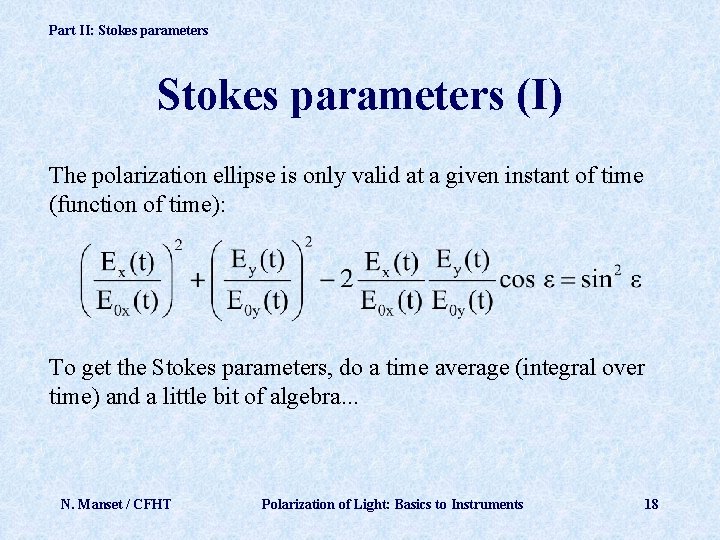
Part II: Stokes parameters (I) The polarization ellipse is only valid at a given instant of time (function of time): To get the Stokes parameters, do a time average (integral over time) and a little bit of algebra. . . N. Manset / CFHT Polarization of Light: Basics to Instruments 18
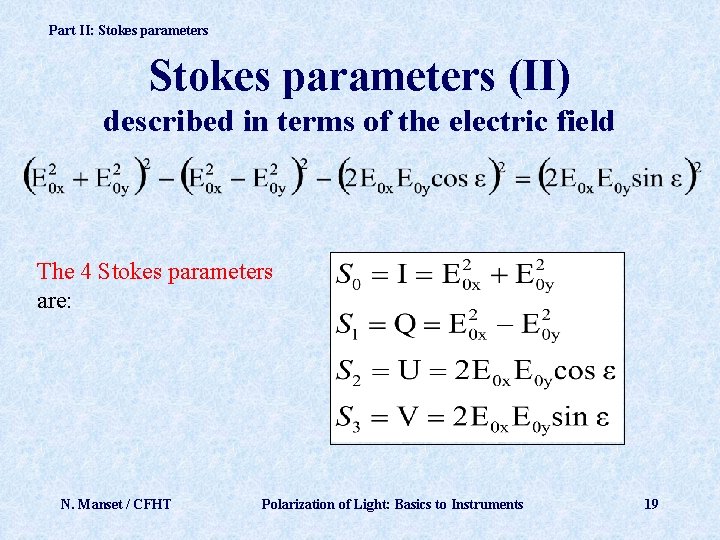
Part II: Stokes parameters (II) described in terms of the electric field The 4 Stokes parameters are: N. Manset / CFHT Polarization of Light: Basics to Instruments 19
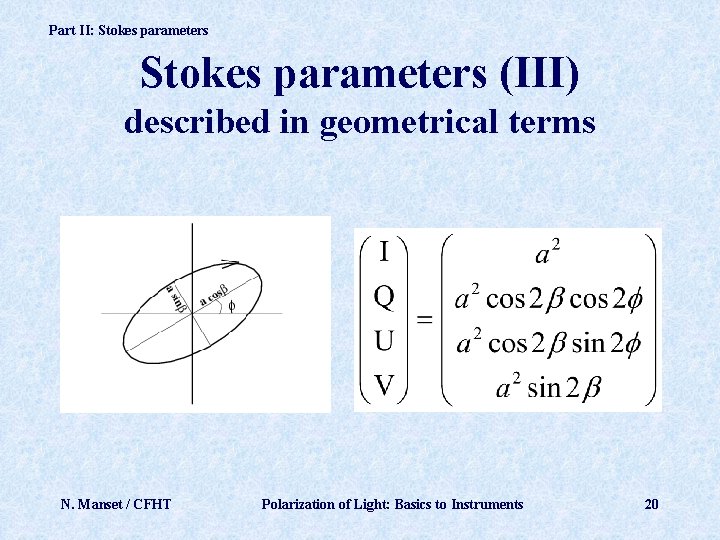
Part II: Stokes parameters (III) described in geometrical terms N. Manset / CFHT Polarization of Light: Basics to Instruments 20
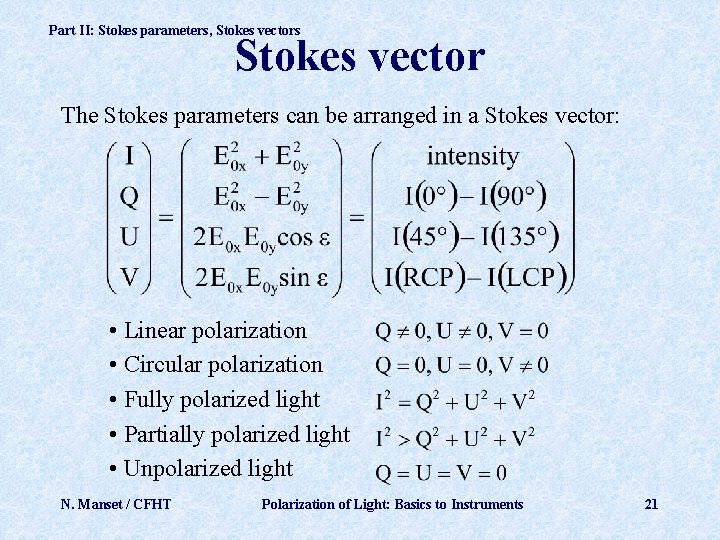
Part II: Stokes parameters, Stokes vectors Stokes vector The Stokes parameters can be arranged in a Stokes vector: • Linear polarization • Circular polarization • Fully polarized light • Partially polarized light • Unpolarized light N. Manset / CFHT Polarization of Light: Basics to Instruments 21
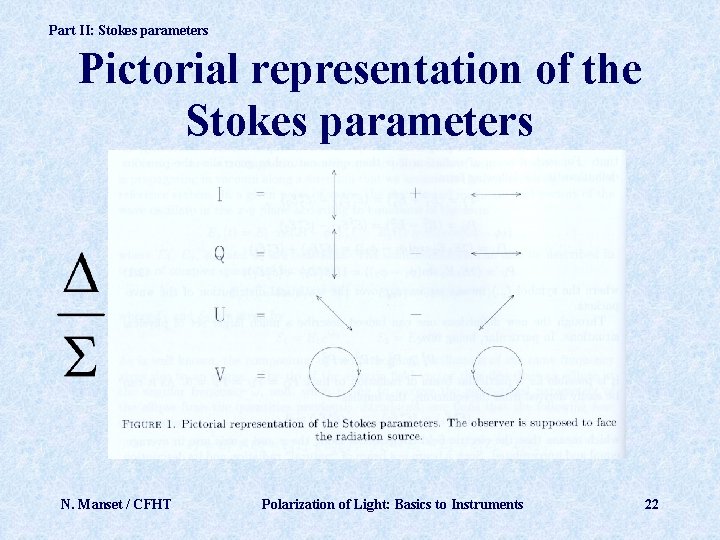
Part II: Stokes parameters Pictorial representation of the Stokes parameters N. Manset / CFHT Polarization of Light: Basics to Instruments 22
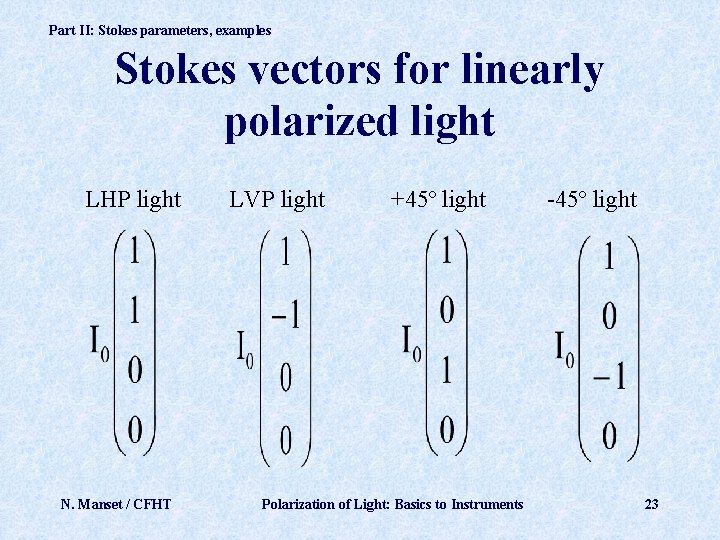
Part II: Stokes parameters, examples Stokes vectors for linearly polarized light LHP light N. Manset / CFHT LVP light +45º light Polarization of Light: Basics to Instruments -45º light 23
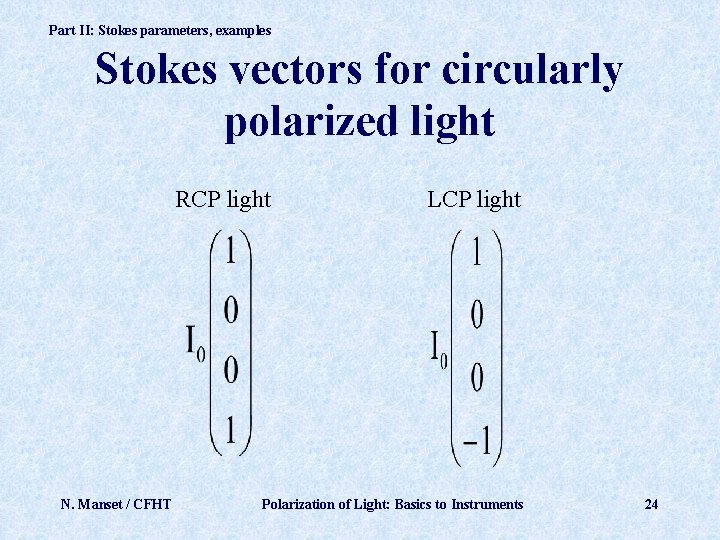
Part II: Stokes parameters, examples Stokes vectors for circularly polarized light RCP light N. Manset / CFHT LCP light Polarization of Light: Basics to Instruments 24
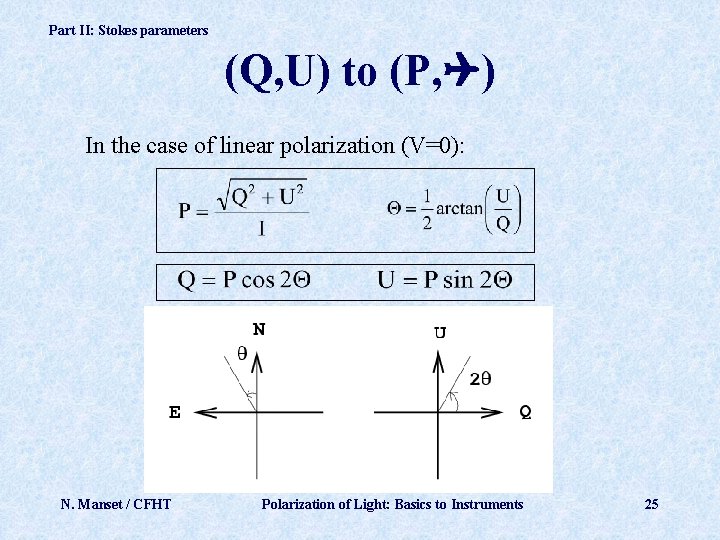
Part II: Stokes parameters (Q, U) to (P, ) In the case of linear polarization (V=0): N. Manset / CFHT Polarization of Light: Basics to Instruments 25
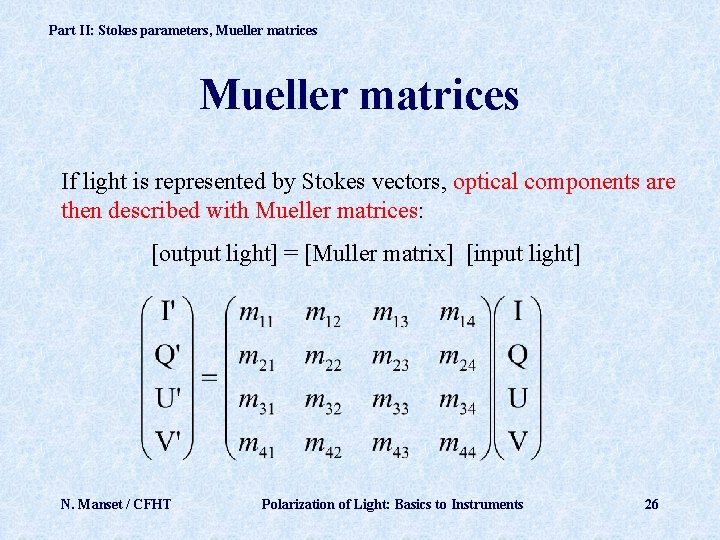
Part II: Stokes parameters, Mueller matrices If light is represented by Stokes vectors, optical components are then described with Mueller matrices: [output light] = [Muller matrix] [input light] N. Manset / CFHT Polarization of Light: Basics to Instruments 26
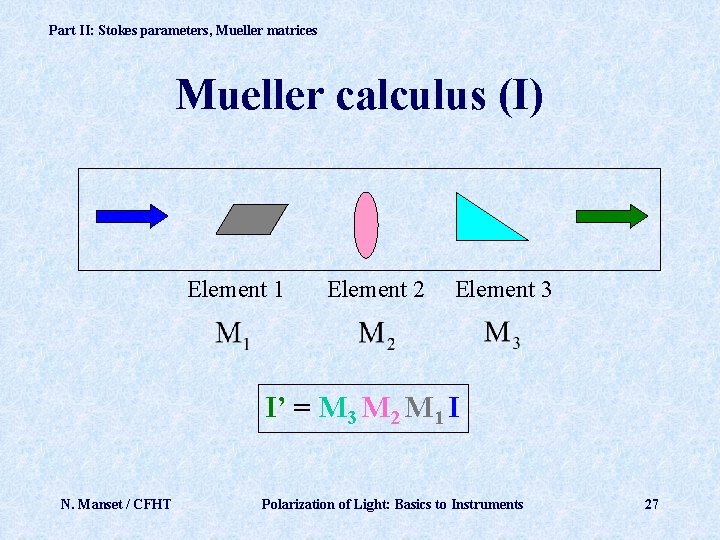
Part II: Stokes parameters, Mueller matrices Mueller calculus (I) Element 1 Element 2 Element 3 I’ = M 3 M 2 M 1 I N. Manset / CFHT Polarization of Light: Basics to Instruments 27
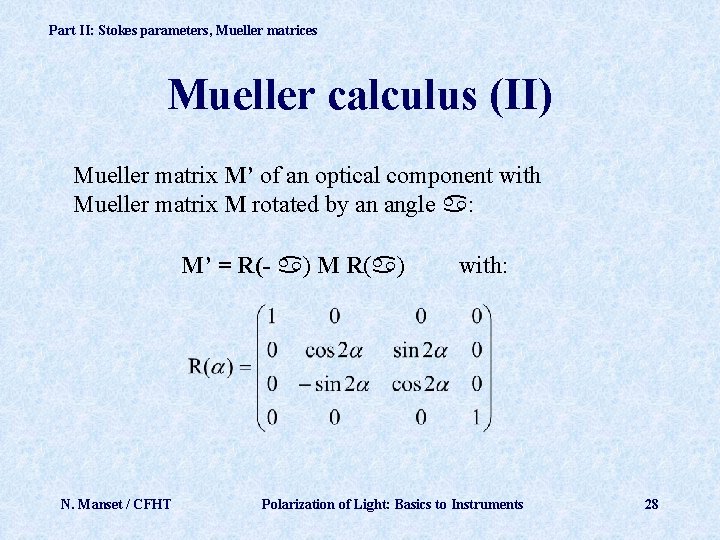
Part II: Stokes parameters, Mueller matrices Mueller calculus (II) Mueller matrix M’ of an optical component with Mueller matrix M rotated by an angle : M’ = R(- ) M R( ) N. Manset / CFHT with: Polarization of Light: Basics to Instruments 28
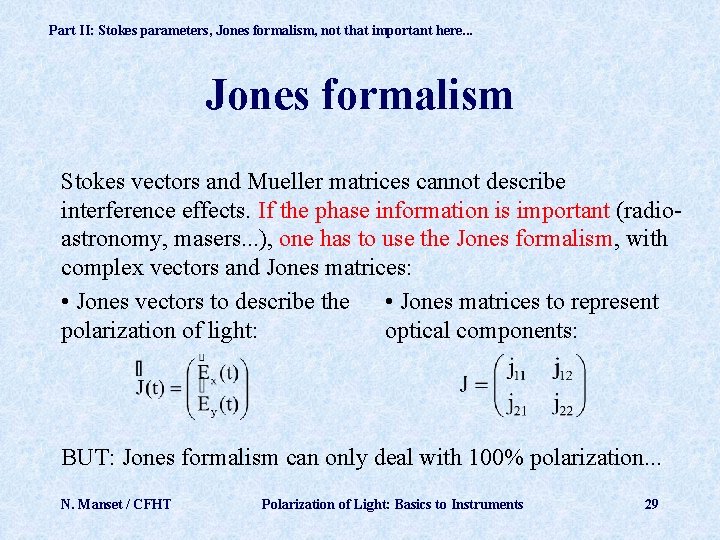
Part II: Stokes parameters, Jones formalism, not that important here. . . Jones formalism Stokes vectors and Mueller matrices cannot describe interference effects. If the phase information is important (radioastronomy, masers. . . ), one has to use the Jones formalism, with complex vectors and Jones matrices: • Jones vectors to describe the • Jones matrices to represent polarization of light: optical components: BUT: Jones formalism can only deal with 100% polarization. . . N. Manset / CFHT Polarization of Light: Basics to Instruments 29
Part III: Optical components for polarimetry • Complex index of refraction • Polarizers • Retarders N. Manset / CFHT Polarization of Light: Basics to Instruments 30
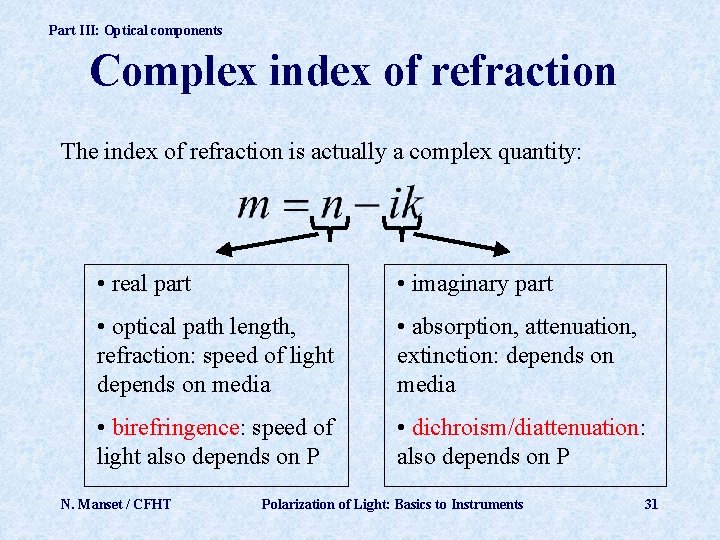
Part III: Optical components Complex index of refraction The index of refraction is actually a complex quantity: • real part • imaginary part • optical path length, refraction: speed of light depends on media • absorption, attenuation, extinction: depends on media • birefringence: speed of light also depends on P • dichroism/diattenuation: also depends on P N. Manset / CFHT Polarization of Light: Basics to Instruments 31
Part III: Optical components, polarizers Polarizers absorb one component of the polarization but not the other. The input is natural light, the output is polarized light (linear, circular, elliptical). They work by dichroism, birefringence, reflection, or scattering. N. Manset / CFHT Polarization of Light: Basics to Instruments 32
![Part III: Optical components, polarizers Wire-grid polarizers (I) [dichroism] • Mainly used in the](http://slidetodoc.com/presentation_image/4eb568c8f083c12e41edeb2c369f3d7e/image-33.jpg "Part III: Optical components, polarizers Wire-grid polarizers (I) [dichroism] • Mainly used in the")
Part III: Optical components, polarizers Wire-grid polarizers (I) [dichroism] • Mainly used in the IR and longer wavelengths • Grid of parallel conducting wires with a spacing comparable to the wavelength of observation • Electric field vector parallel to the wires is attenuated because of currents induced in the wires N. Manset / CFHT Polarization of Light: Basics to Instruments 33
![Part III: Optical components, polarizers Wide-grid polarizers (II) [dichroism] N. Manset / CFHT Polarization](http://slidetodoc.com/presentation_image/4eb568c8f083c12e41edeb2c369f3d7e/image-34.jpg "Part III: Optical components, polarizers Wide-grid polarizers (II) [dichroism] N. Manset / CFHT Polarization")
Part III: Optical components, polarizers Wide-grid polarizers (II) [dichroism] N. Manset / CFHT Polarization of Light: Basics to Instruments 34
![Part III: Optical components, polarizers Dichroic crystals [dichroism] Dichroic crystals absorb one polarization state](http://slidetodoc.com/presentation_image/4eb568c8f083c12e41edeb2c369f3d7e/image-35.jpg "Part III: Optical components, polarizers Dichroic crystals [dichroism] Dichroic crystals absorb one polarization state")
Part III: Optical components, polarizers Dichroic crystals [dichroism] Dichroic crystals absorb one polarization state over the other one. Example: tourmaline. N. Manset / CFHT Polarization of Light: Basics to Instruments 35
![Part III: Optical components, polarizers – Polaroids, like in sunglasses! Polaroids [dichroism] Made by](http://slidetodoc.com/presentation_image/4eb568c8f083c12e41edeb2c369f3d7e/image-36.jpg "Part III: Optical components, polarizers – Polaroids, like in sunglasses! Polaroids [dichroism] Made by")
Part III: Optical components, polarizers – Polaroids, like in sunglasses! Polaroids [dichroism] Made by heating and stretching a sheet of PVA laminated to a supporting sheet of cellulose acetate treated with iodine solution (H-type polaroid). Invented in 1928. N. Manset / CFHT Polarization of Light: Basics to Instruments 36
![Part III: Optical components, polarizers Crystal polarizers (I) [birefringence] • Optically anisotropic crystals •](http://slidetodoc.com/presentation_image/4eb568c8f083c12e41edeb2c369f3d7e/image-37.jpg "Part III: Optical components, polarizers Crystal polarizers (I) [birefringence] • Optically anisotropic crystals •")
Part III: Optical components, polarizers Crystal polarizers (I) [birefringence] • Optically anisotropic crystals • Mechanical model: • the crystal is anisotropic, which means that the electrons are bound with different ‘springs’ depending on the orientation • different ‘spring constants’ gives different propagation speeds, therefore different indices of refraction, therefore 2 output beams N. Manset / CFHT Polarization of Light: Basics to Instruments 37
![Part III: Optical components, polarizers Crystal polarizers (II) [birefringence] isotropic crystal (sodium chloride) anisotropic](http://slidetodoc.com/presentation_image/4eb568c8f083c12e41edeb2c369f3d7e/image-38.jpg "Part III: Optical components, polarizers Crystal polarizers (II) [birefringence] isotropic crystal (sodium chloride) anisotropic")
Part III: Optical components, polarizers Crystal polarizers (II) [birefringence] isotropic crystal (sodium chloride) anisotropic crystal (calcite) The 2 output beams are polarized (orthogonally). N. Manset / CFHT Polarization of Light: Basics to Instruments 38
![Part III: Optical components, polarizers Crystal polarizers (IV) [birefringence] • Crystal polarizers used as:](http://slidetodoc.com/presentation_image/4eb568c8f083c12e41edeb2c369f3d7e/image-39.jpg "Part III: Optical components, polarizers Crystal polarizers (IV) [birefringence] • Crystal polarizers used as:")
Part III: Optical components, polarizers Crystal polarizers (IV) [birefringence] • Crystal polarizers used as: • Beam displacers, • Beam splitters, • Polarizers, • Analyzers, . . . • Examples: Nicol prism, Glan. Thomson polarizer, Glan or Glan. Foucault prism, Wollaston prism, Thin-film polarizer, . . . N. Manset / CFHT Polarization of Light: Basics to Instruments 39
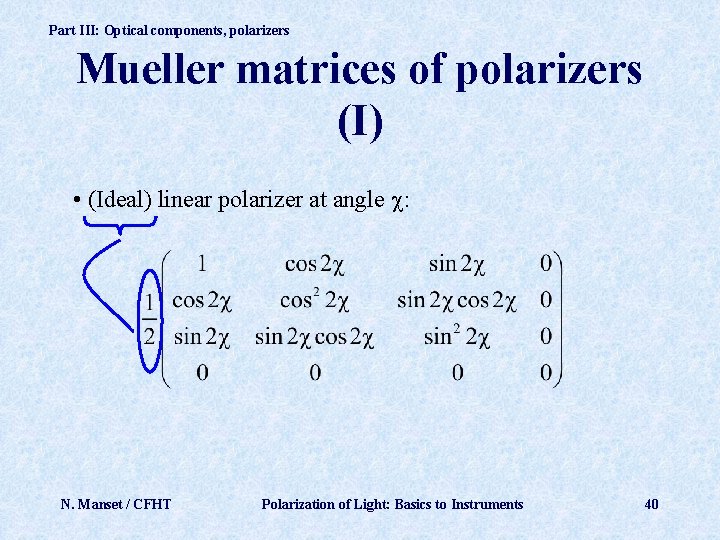
Part III: Optical components, polarizers Mueller matrices of polarizers (I) • (Ideal) linear polarizer at angle : N. Manset / CFHT Polarization of Light: Basics to Instruments 40
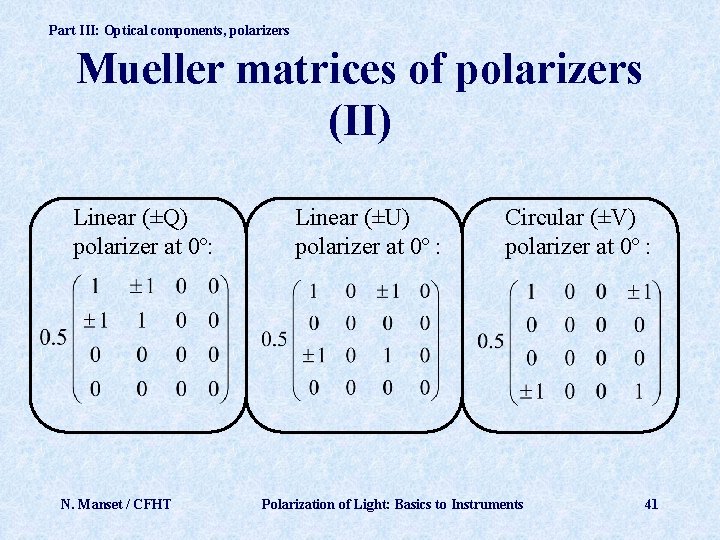
Part III: Optical components, polarizers Mueller matrices of polarizers (II) Linear (±Q) polarizer at 0º: N. Manset / CFHT Linear (±U) polarizer at 0º : Circular (±V) polarizer at 0º : Polarization of Light: Basics to Instruments 41
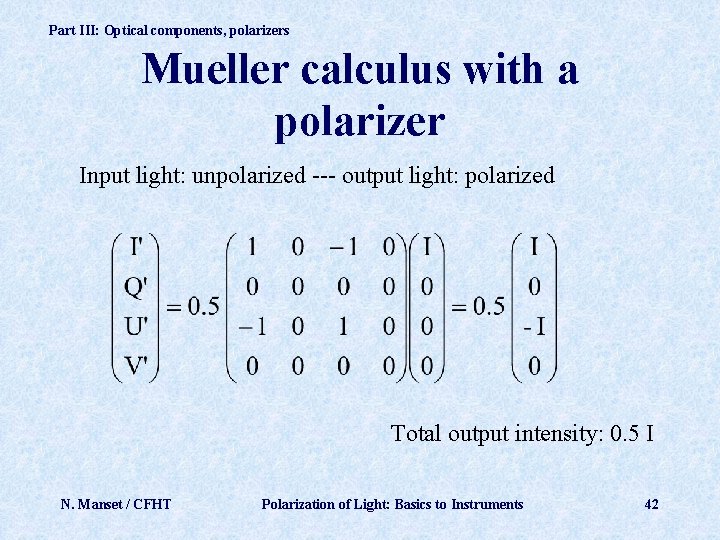
Part III: Optical components, polarizers Mueller calculus with a polarizer Input light: unpolarized --- output light: polarized Total output intensity: 0. 5 I N. Manset / CFHT Polarization of Light: Basics to Instruments 42
Part III: Optical components, retarders Retarders • In retarders, one polarization gets ‘retarded’, or delayed, with respect to the other one. There is a final phase difference between the 2 components of the polarization. Therefore, the polarization is changed. • Most retarders are based on birefringent materials (quartz, mica, polymers) that have different indices of refraction depending on the polarization of the incoming light. N. Manset / CFHT Polarization of Light: Basics to Instruments 43
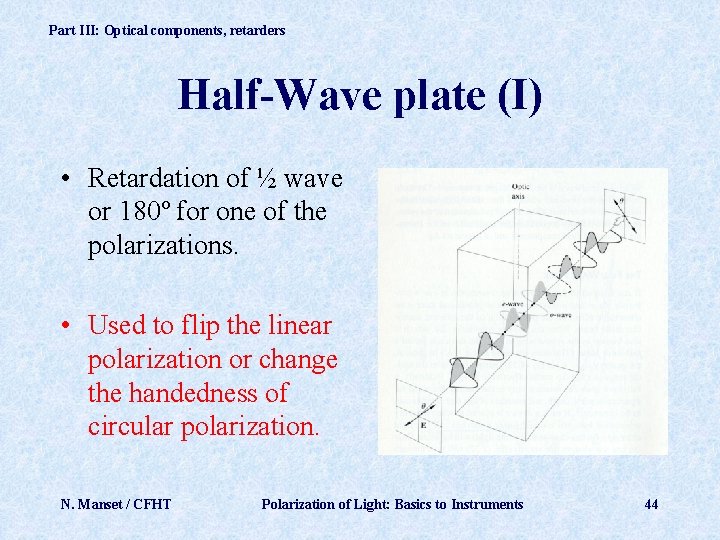
Part III: Optical components, retarders Half-Wave plate (I) • Retardation of ½ wave or 180º for one of the polarizations. • Used to flip the linear polarization or change the handedness of circular polarization. N. Manset / CFHT Polarization of Light: Basics to Instruments 44
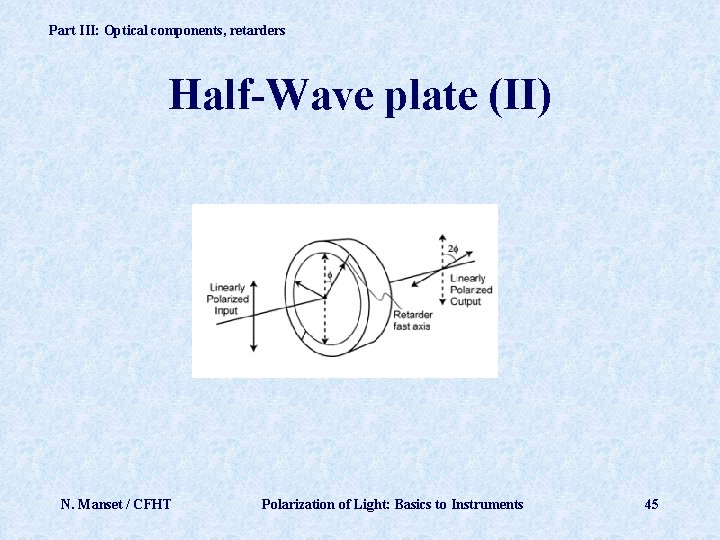
Part III: Optical components, retarders Half-Wave plate (II) N. Manset / CFHT Polarization of Light: Basics to Instruments 45
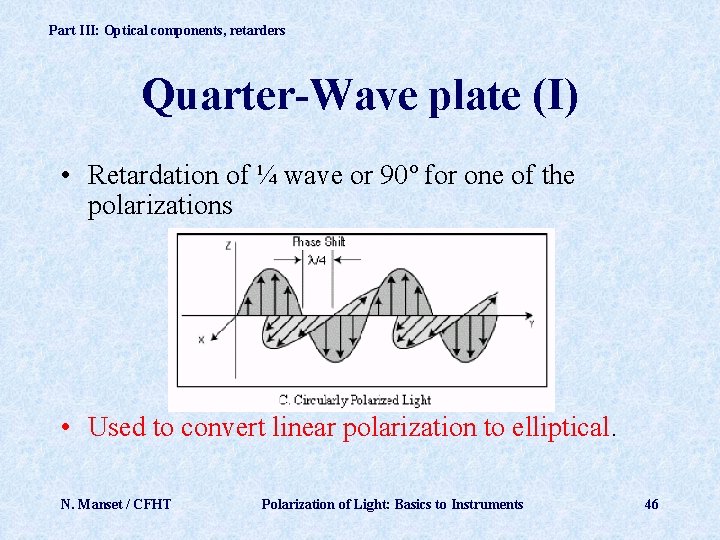
Part III: Optical components, retarders Quarter-Wave plate (I) • Retardation of ¼ wave or 90º for one of the polarizations • Used to convert linear polarization to elliptical. N. Manset / CFHT Polarization of Light: Basics to Instruments 46
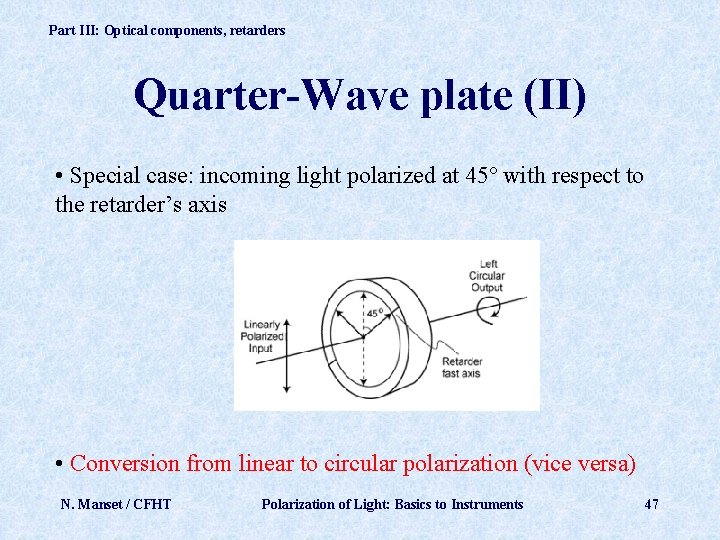
Part III: Optical components, retarders Quarter-Wave plate (II) • Special case: incoming light polarized at 45º with respect to the retarder’s axis • Conversion from linear to circular polarization (vice versa) N. Manset / CFHT Polarization of Light: Basics to Instruments 47
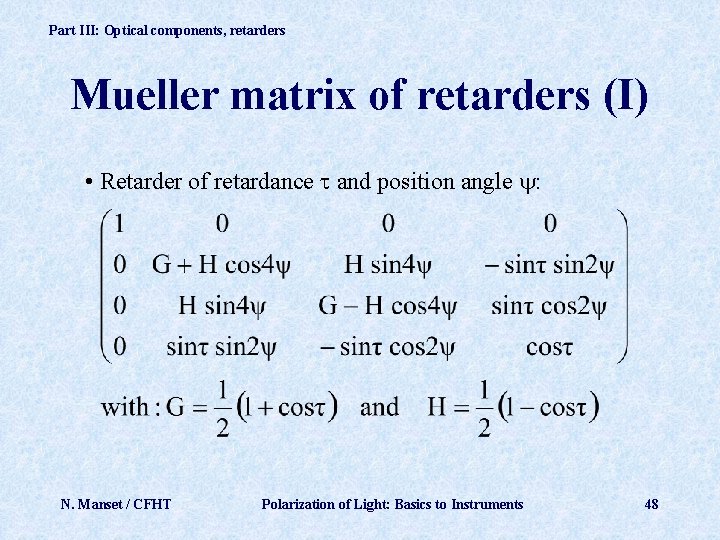
Part III: Optical components, retarders Mueller matrix of retarders (I) • Retarder of retardance and position angle : N. Manset / CFHT Polarization of Light: Basics to Instruments 48
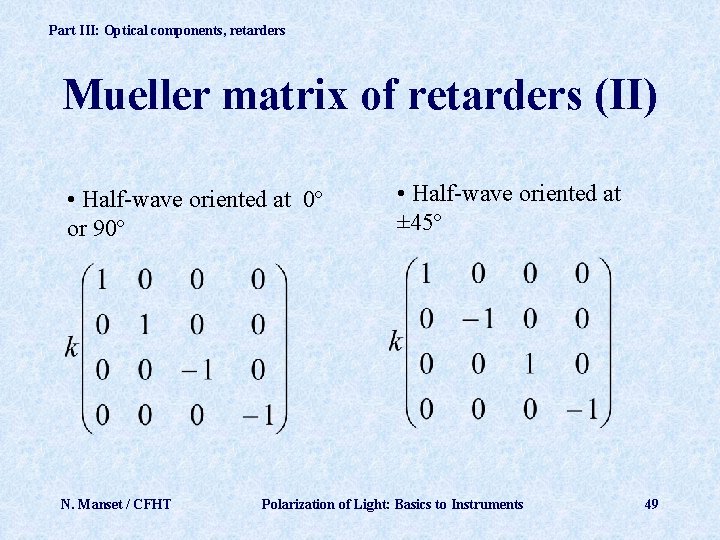
Part III: Optical components, retarders Mueller matrix of retarders (II) • Half-wave oriented at 0º or 90º N. Manset / CFHT • Half-wave oriented at ± 45º Polarization of Light: Basics to Instruments 49
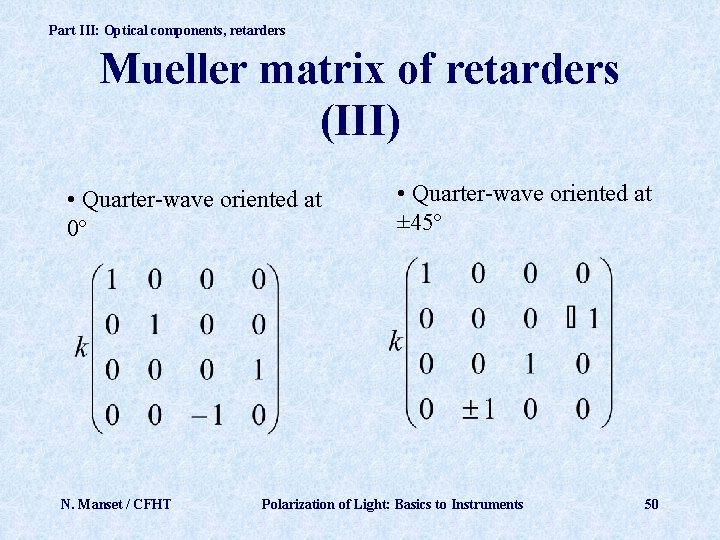
Part III: Optical components, retarders Mueller matrix of retarders (III) • Quarter-wave oriented at 0º N. Manset / CFHT • Quarter-wave oriented at ± 45º Polarization of Light: Basics to Instruments 50
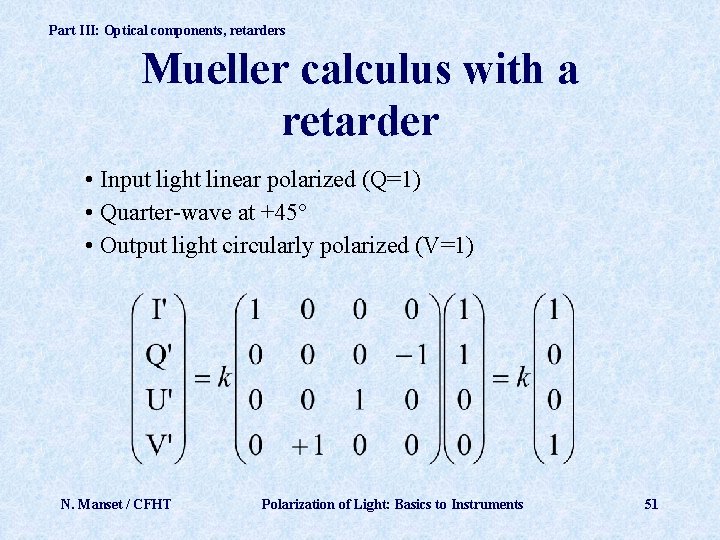
Part III: Optical components, retarders Mueller calculus with a retarder • Input light linear polarized (Q=1) • Quarter-wave at +45º • Output light circularly polarized (V=1) N. Manset / CFHT Polarization of Light: Basics to Instruments 51
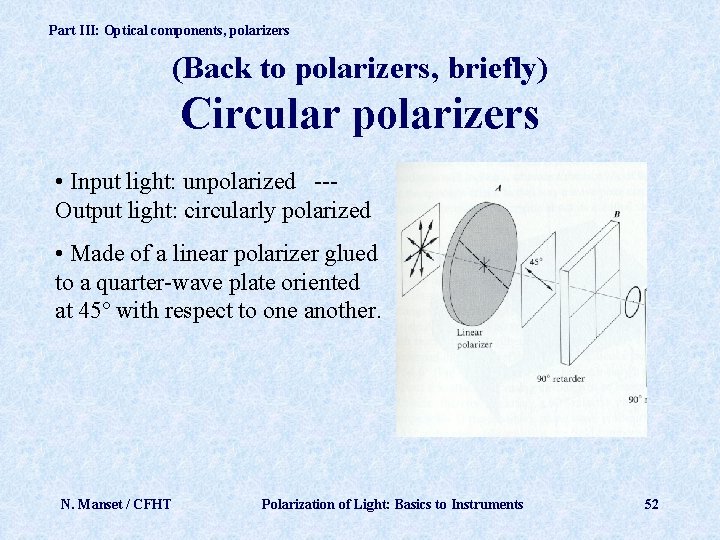
Part III: Optical components, polarizers (Back to polarizers, briefly) Circular polarizers • Input light: unpolarized --Output light: circularly polarized • Made of a linear polarizer glued to a quarter-wave plate oriented at 45º with respect to one another. N. Manset / CFHT Polarization of Light: Basics to Instruments 52
Part III: Optical components, retarders Achromatic retarders (I) • Retardation depends on wavelength • Achromatic retarders: made of 2 different materials with opposite variations of index of refraction as a function of wavelength • Pancharatnam achromatic retarders: made of 3 identical plates rotated w/r one another • Superachromatic retarders: 3 pairs of quartz and Mg. F 2 plates N. Manset / CFHT Polarization of Light: Basics to Instruments 53
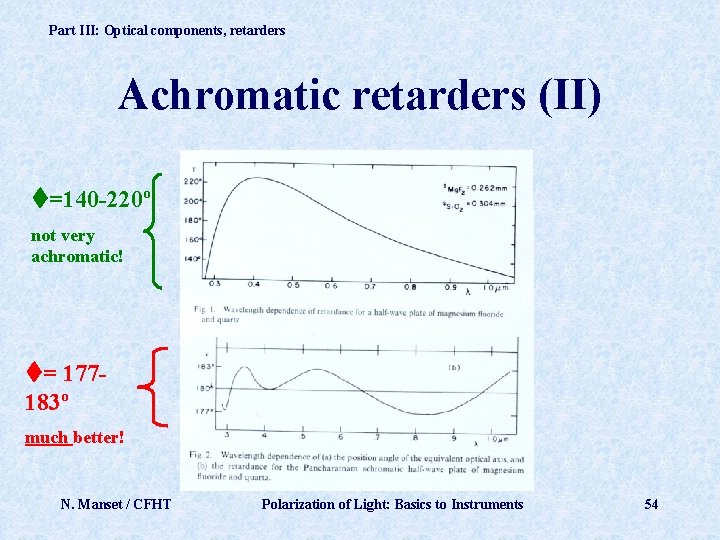
Part III: Optical components, retarders Achromatic retarders (II) =140 -220º not very achromatic! = 177183º much better! N. Manset / CFHT Polarization of Light: Basics to Instruments 54
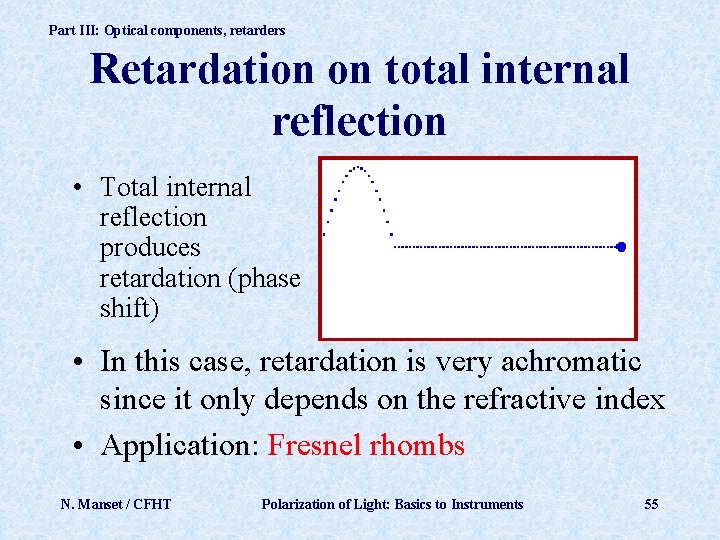
Part III: Optical components, retarders Retardation on total internal reflection • Total internal reflection produces retardation (phase shift) • In this case, retardation is very achromatic since it only depends on the refractive index • Application: Fresnel rhombs N. Manset / CFHT Polarization of Light: Basics to Instruments 55
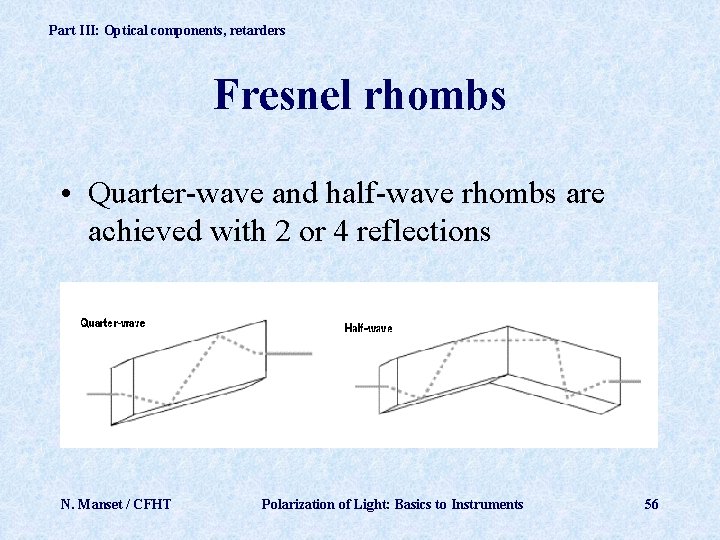
Part III: Optical components, retarders Fresnel rhombs • Quarter-wave and half-wave rhombs are achieved with 2 or 4 reflections N. Manset / CFHT Polarization of Light: Basics to Instruments 56
Part III: Optical components, retarders Other retarders • Soleil-Babinet: variable retardation to better than 0. 01 waves • Nematic liquid crystals. . . Liquid crystal variable retarders. . . Ferroelectric liquid crystals. . . Piezo-elastic modulators. . . Pockels and Kerr cells. . . N. Manset / CFHT Polarization of Light: Basics to Instruments 57
Part IV: Polarimeters • Polaroid-type polarimeters • Dual-beam polarimeters N. Manset / CFHT Polarization of Light: Basics to Instruments 58
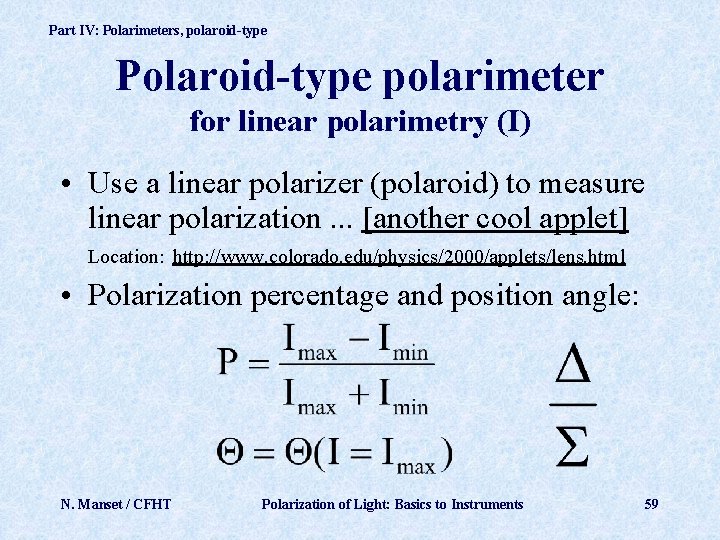
Part IV: Polarimeters, polaroid-type Polaroid-type polarimeter for linear polarimetry (I) • Use a linear polarizer (polaroid) to measure linear polarization. . . [another cool applet] Location: http: //www. colorado. edu/physics/2000/applets/lens. html • Polarization percentage and position angle: N. Manset / CFHT Polarization of Light: Basics to Instruments 59
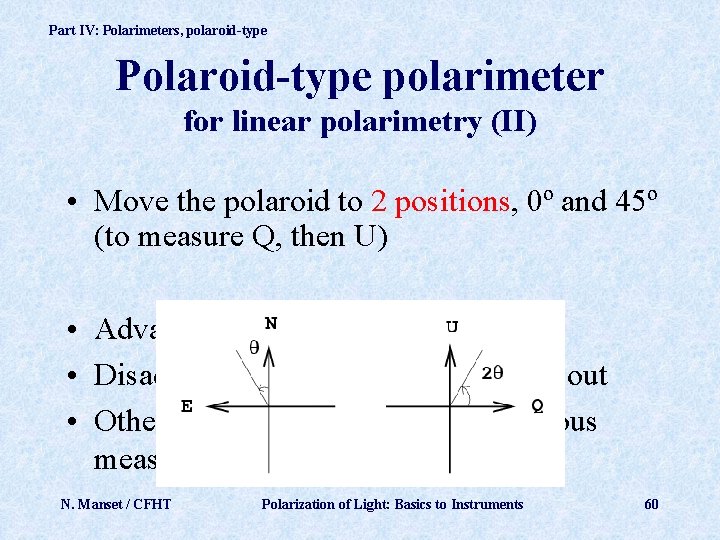
Part IV: Polarimeters, polaroid-type Polaroid-type polarimeter for linear polarimetry (II) • Move the polaroid to 2 positions, 0º and 45º (to measure Q, then U) • Advantage: very simple to make • Disadvantage: half of the light is cut out • Other disadvantages: non-simultaneous measurements, cross-talk. . . N. Manset / CFHT Polarization of Light: Basics to Instruments 60
Part IV: Polarimeters, polaroid-type Polaroid-type polarimeter for circular polarimetry • Polaroids are not sensitive to circular polarization, so convert circular polarization to linear first, by using a quarter-wave plate • Polarimeter now uses a quarter-wave plate and a polaroid • Same disadvantages as before N. Manset / CFHT Polarization of Light: Basics to Instruments 61
Part IV: Polarimeters, dual-beam type Dual-beam polarimeters Principle • Instead of cutting out one polarization and keeping the other one (polaroid), split the 2 polarization states and keep them both • Use a Wollaston prism as an analyzer • Disadvantages: need 2 detectors (PMTs, APDs) or an array; end up with 2 ‘pixels’ with different gain • Solution: rotate the Wollaston or keep it fixed and use a half-wave plate to switch the 2 beams N. Manset / CFHT Polarization of Light: Basics to Instruments 62
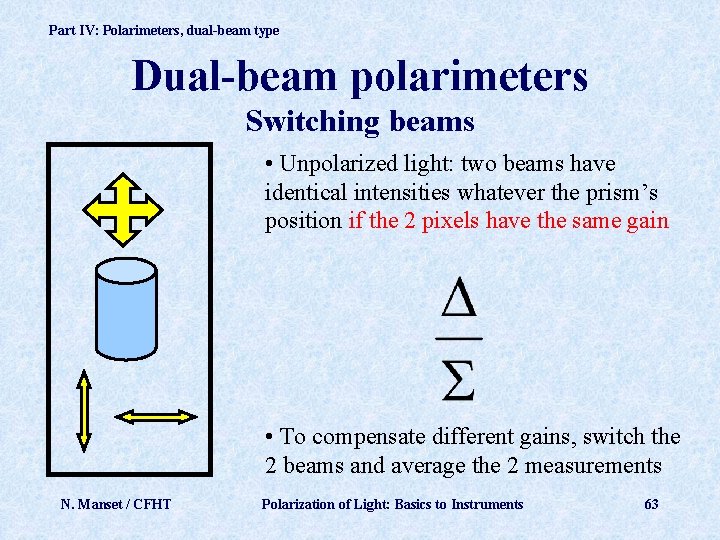
Part IV: Polarimeters, dual-beam type Dual-beam polarimeters Switching beams • Unpolarized light: two beams have identical intensities whatever the prism’s position if the 2 pixels have the same gain • To compensate different gains, switch the 2 beams and average the 2 measurements N. Manset / CFHT Polarization of Light: Basics to Instruments 63
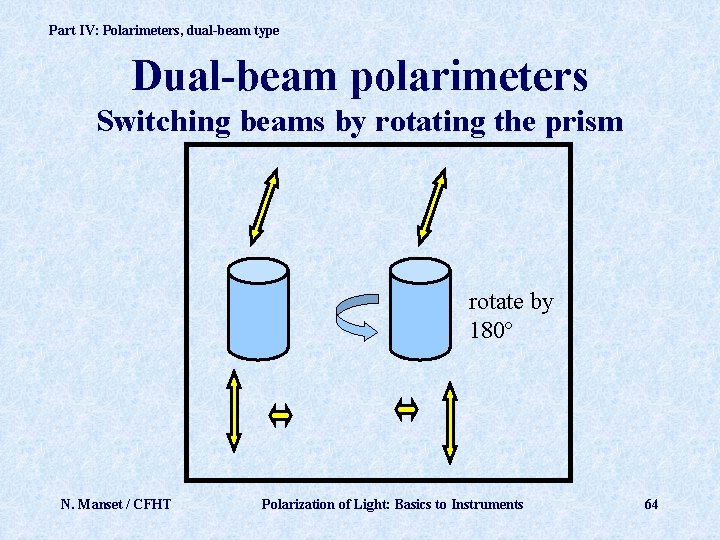
Part IV: Polarimeters, dual-beam type Dual-beam polarimeters Switching beams by rotating the prism rotate by 180º N. Manset / CFHT Polarization of Light: Basics to Instruments 64
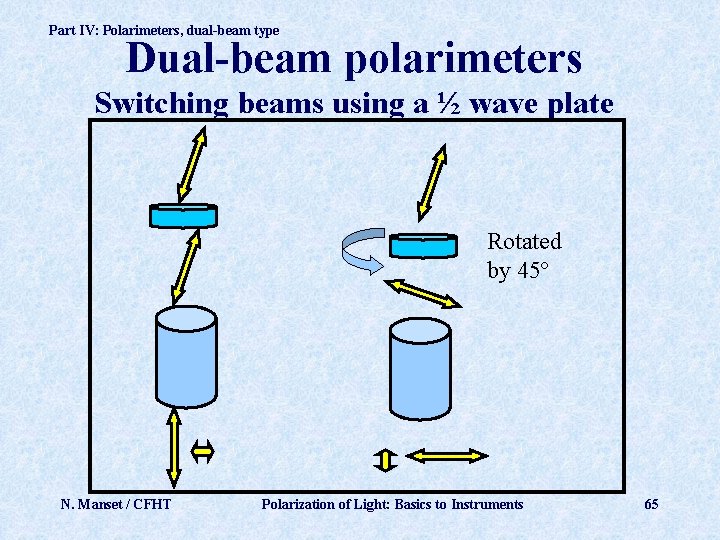
Part IV: Polarimeters, dual-beam type Dual-beam polarimeters Switching beams using a ½ wave plate Rotated by 45º N. Manset / CFHT Polarization of Light: Basics to Instruments 65
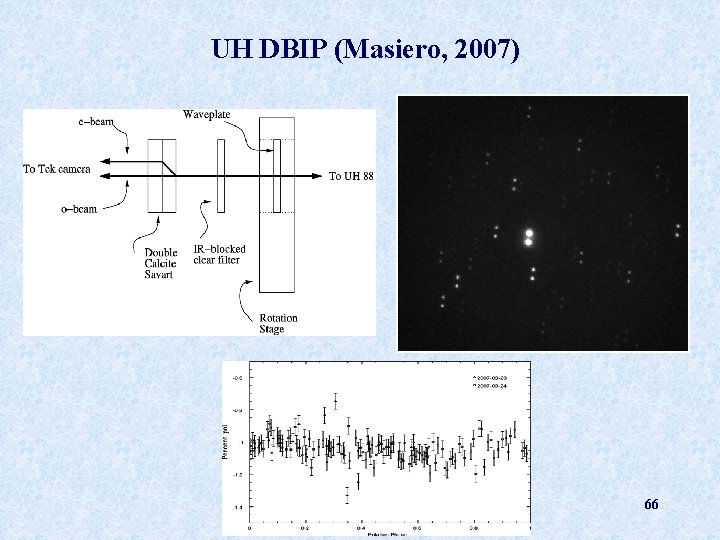
UH DBIP (Masiero, 2007) Polarization of Light: Basics to Instruments 66
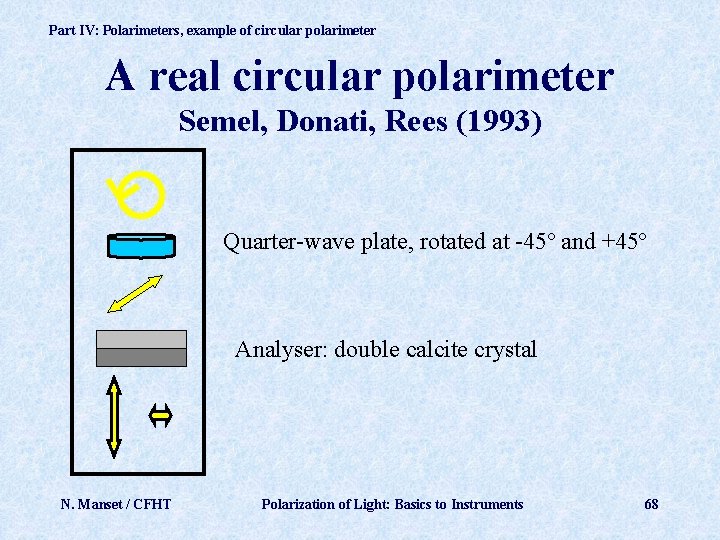
Part IV: Polarimeters, example of circular polarimeter A real circular polarimeter Semel, Donati, Rees (1993) Quarter-wave plate, rotated at -45º and +45º Analyser: double calcite crystal N. Manset / CFHT Polarization of Light: Basics to Instruments 68
Part IV: Polarimeters, summary Polarimeters - Summary • 2 types: – polaroid-type: easy to make but ½ light is lost, and affected by variable atmospheric transmission – dual-beam type: no light lost but affected by gain differences and variable transmission problems • Linear polarimetry: – analyzer, rotatable ü 2 positions minimum – analyzer + half-wave plate • Circular polarimetry: – analyzer + quarter-wave plate N. Manset / CFHT ü 1 position minimum Polarization of Light: Basics to Instruments 69
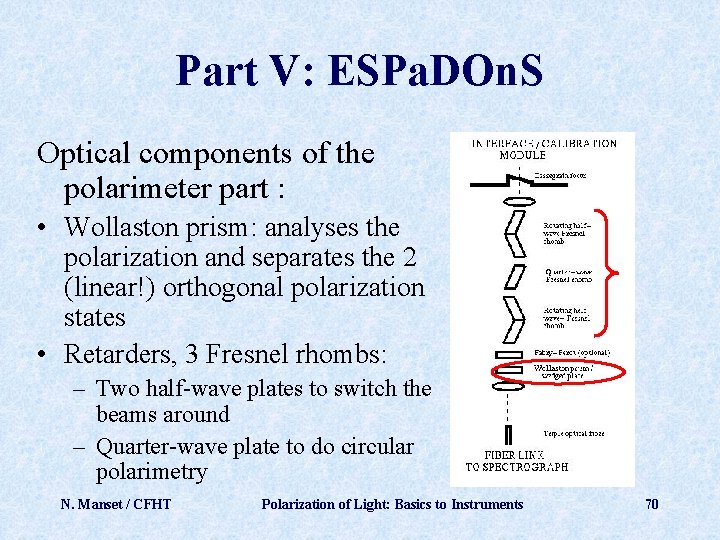
Part V: ESPa. DOn. S Optical components of the polarimeter part : • Wollaston prism: analyses the polarization and separates the 2 (linear!) orthogonal polarization states • Retarders, 3 Fresnel rhombs: – Two half-wave plates to switch the beams around – Quarter-wave plate to do circular polarimetry N. Manset / CFHT Polarization of Light: Basics to Instruments 70
Part V: ESPa. DOn. S, circular polarimetry mode ESPa. DOn. S: circular polarimetry • Fixed quarter-wave rhomb • Rotating bottom half-wave, at 22. 5º increments • Top half-wave rotates continuously at about 1 Hz to average out linear polarization when measuring circular polarization N. Manset / CFHT Polarization of Light: Basics to Instruments 71
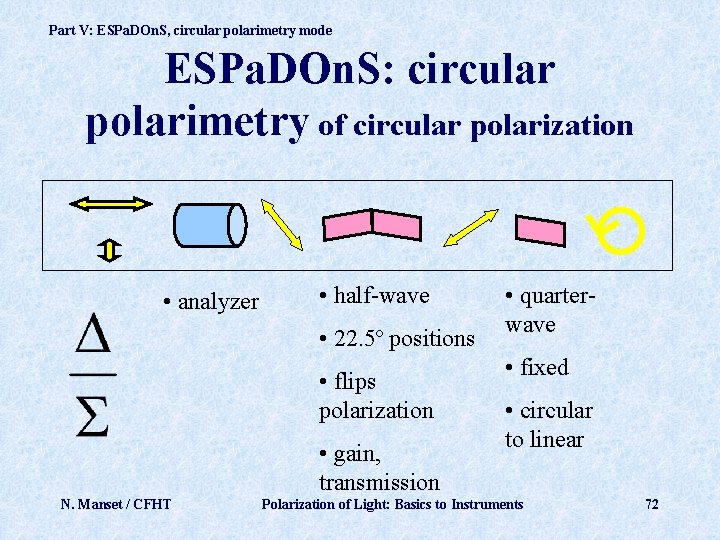
Part V: ESPa. DOn. S, circular polarimetry mode ESPa. DOn. S: circular polarimetry of circular polarization • analyzer • half-wave • 22. 5º positions • flips polarization • gain, transmission N. Manset / CFHT • quarterwave • fixed • circular to linear Polarization of Light: Basics to Instruments 72
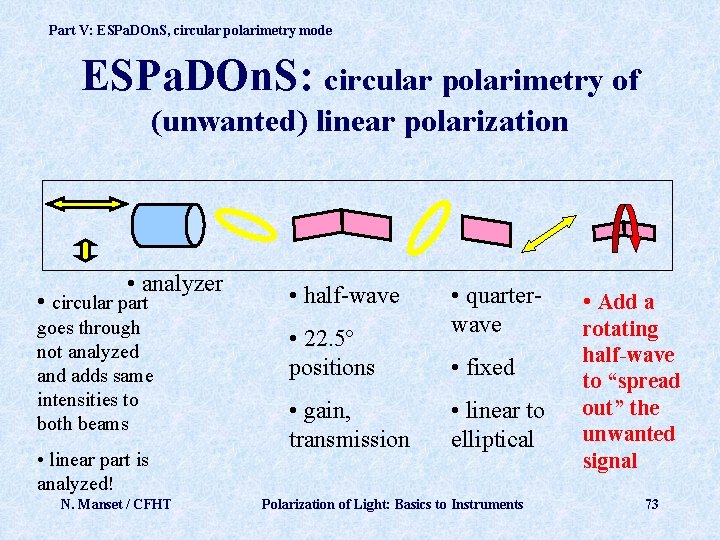
Part V: ESPa. DOn. S, circular polarimetry mode ESPa. DOn. S: circular polarimetry of (unwanted) linear polarization • analyzer • circular part • half-wave goes through not analyzed and adds same intensities to both beams • 22. 5º positions • linear part is analyzed! N. Manset / CFHT • gain, transmission • quarterwave • fixed • linear to elliptical Polarization of Light: Basics to Instruments • Add a rotating half-wave to “spread out” the unwanted signal 73
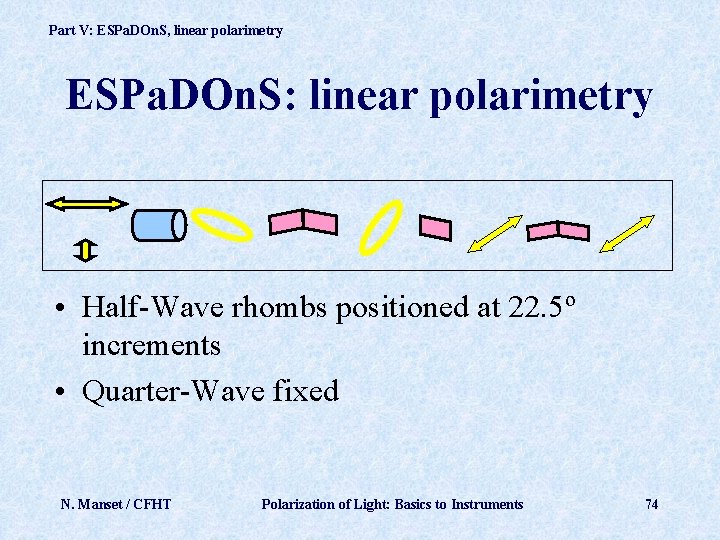
Part V: ESPa. DOn. S, linear polarimetry ESPa. DOn. S: linear polarimetry • Half-Wave rhombs positioned at 22. 5º increments • Quarter-Wave fixed N. Manset / CFHT Polarization of Light: Basics to Instruments 74
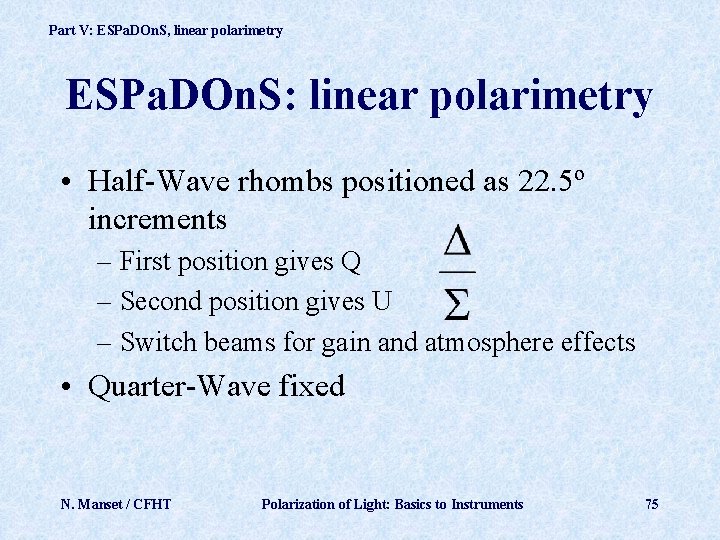
Part V: ESPa. DOn. S, linear polarimetry ESPa. DOn. S: linear polarimetry • Half-Wave rhombs positioned as 22. 5º increments – First position gives Q – Second position gives U – Switch beams for gain and atmosphere effects • Quarter-Wave fixed N. Manset / CFHT Polarization of Light: Basics to Instruments 75
Part V: ESPa. DOn. S, summary ESPa. DOn. S - Summary • ESPa. DOn. S can do linear and circular polarimetry (quarter-wave plate) • Beams are switched around to do the measurements, compensate for gain and atmospheric effects • Fesnel rhombs are very achromatic N. Manset / CFHT Polarization of Light: Basics to Instruments 76
Credits for pictures and movies • Christoph Keller’s home page – his 5 lectures http: //www. noao. edu/noao/staff/keller/ • “Basic Polarisation techniques and devices”, Meadowlark Optics Inc. http: //www. meadowlark. com/ • Optics, E. Hecht and Astronomical Polarimetry, J. Tinbergen • Planets, Stars and Nebulae Studied With Photopolarimetry, T. Gehrels • Circular polarization movie http: //www. optics. arizona. edu/jcwyant/Jose. Diaz/Polarization-Circular. htm • Unpolarized light movie http: //www. colorado. edu/physics/2000/polarization. II. html • Reflection of wave http: //www. physicsclassroom. com/mmedia/waves/fix. html • ESPa. DOn. S web page and documents N. Manset / CFHT Polarization of Light: Basics to Instruments 77
References/Further reading On the Web • Very short and quick introduction, no equation http: //www. cfht. hawaii. edu/~manset/Polar. Intro_eng. html • Easy fun page with Applets, on polarizing filters http: //www. colorado. edu/physics/2000/polarization. I. html • Polarization short course http: //www. glenbrook. k 12. il. us/gbssci/phys/Class/light/u 12 l 1 e. html • “Instrumentation for Astrophysical Spectropolarimetry”, a series of 5 lectures given at the IAC Winter School on Astrophysical Spectropolarimetry, November 2000 – http: //www. noao. edu/noao/staff/keller/lectures/index. html N. Manset / CFHT Polarization of Light: Basics to Instruments 78
References/Further reading Polarization basics • Polarized Light, D. Goldstein – excellent book, easy read, gives a lot of insight, highly recommended • Undergraduate textbooks, either will do: – Optics, E. Hecht – Waves, F. S. Crawford, Berkeley Physics Course vol. 3 N. Manset / CFHT Polarization of Light: Basics to Instruments 79
References/Further reading Astronomy, easy/intermediate • Astronomical Polarimetry, J. Tinbergen – instrumentation-oriented • La polarisation de la lumière et l'observation astronomique, J. -L. Leroy – astronomy-oriented • Planets, Stars and Nebulae Studied With Photopolarimetry, T. Gehrels – old but classic • 3 papers by K. Serkowski – instrumentation-oriented N. Manset / CFHT Polarization of Light: Basics to Instruments 80
References/Further reading Astronomy, advanced • Introduction to Spectropolarimetry, J. C. del Toro Iniesta – radiative transfer – ouch! • Astrophysical Spectropolarimetry, Trujillo-Bueno et al. (eds) – applications to astronomy N. Manset / CFHT Polarization of Light: Basics to Instruments 81
- Slides: 80