
Polarization of Light And dispersion of light too
- Slides: 20
Polarization of Light And dispersion of light, too
Dispersion of light • Visible light = full spectrum wavelengths range from 400 nm to 700 nm • Different wavelengths have ever so slightly different indices of refraction when passing through materials such as glass, plastic, or water (and probably others) • Dispersion is the effect of these differences on the appearance of refracted light: • https: //phet. colorado. edu/sims/html/bendinglight/latest/bending-light_en. html
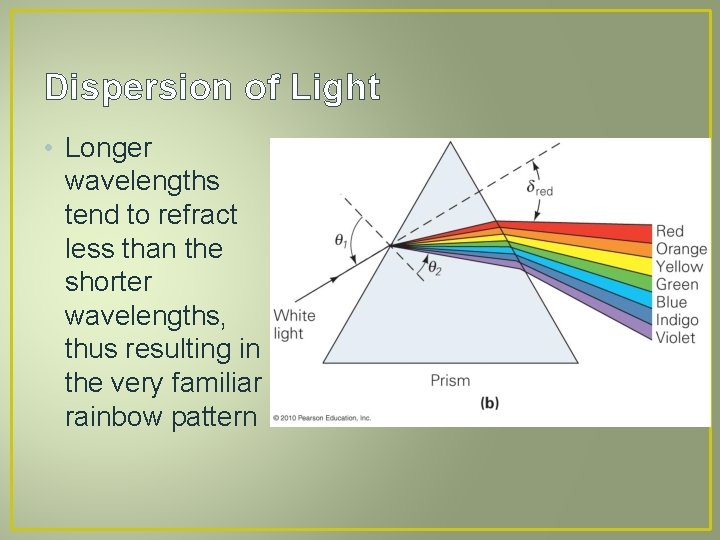
Dispersion of Light • Longer wavelengths tend to refract less than the shorter wavelengths, thus resulting in the very familiar rainbow pattern
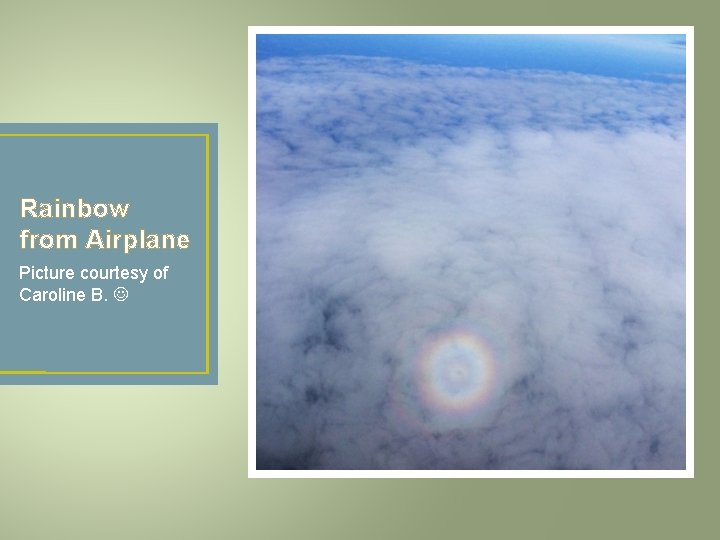
Rainbow from Airplane Picture courtesy of Caroline B.
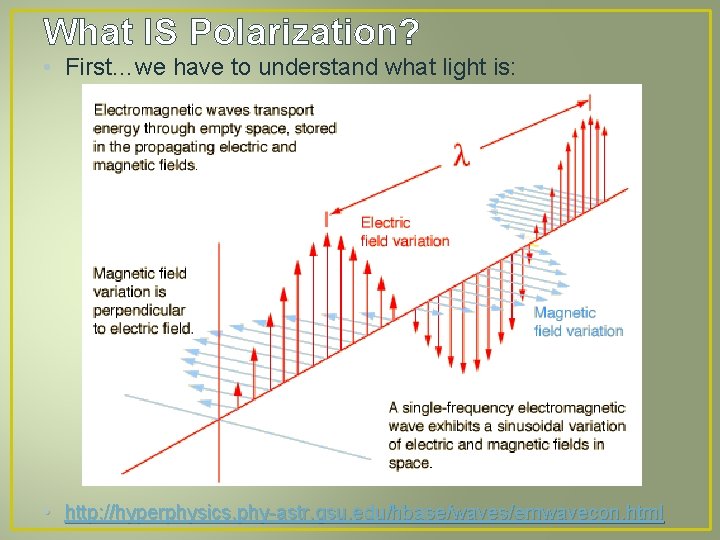
What IS Polarization? • First…we have to understand what light is: • http: //hyperphysics. phy-astr. gsu. edu/hbase/waves/emwavecon. html
Electromagnetic Radiation • Electric fields and magnetic fields vary in strength simultaneously and perpendicularly to each other. • Both E and B vary following a sinusoidal pattern, resulting in what appears to be a transverse wave…but one that does not require a medium. • Electric and magnetic fields exist in the vacuum of space, so EM waves (light) can travel through space.
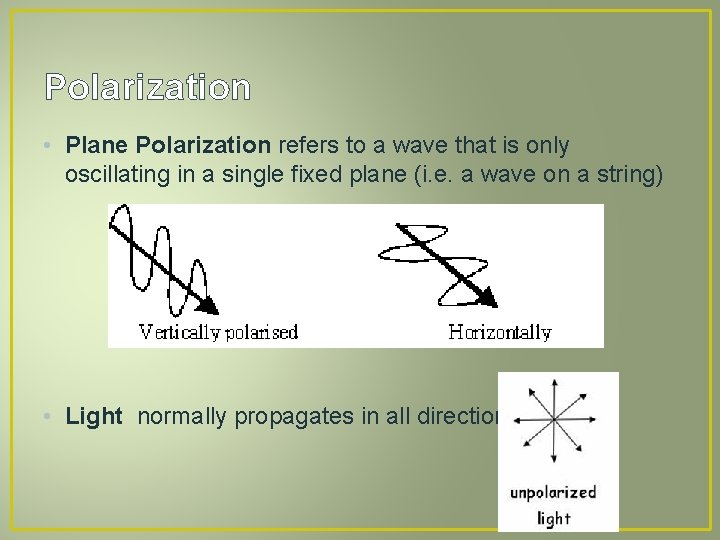
Polarization • Plane Polarization refers to a wave that is only oscillating in a single fixed plane (i. e. a wave on a string) • Light normally propagates in all directions:
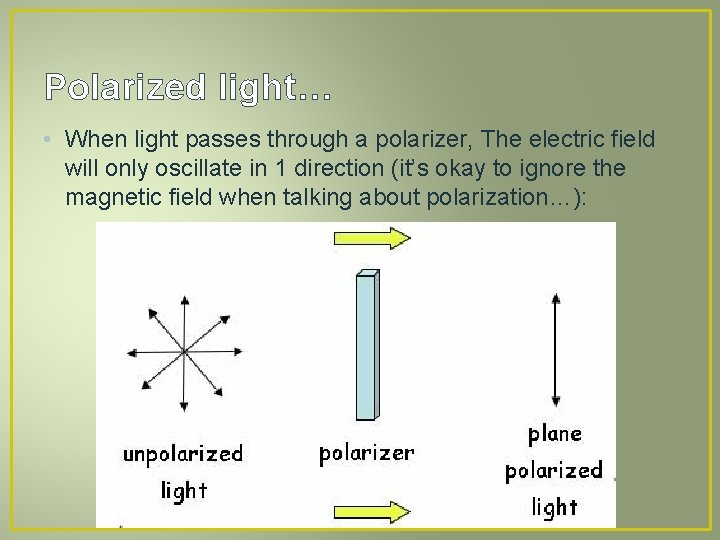
Polarized light… • When light passes through a polarizer, The electric field will only oscillate in 1 direction (it’s okay to ignore the magnetic field when talking about polarization…):
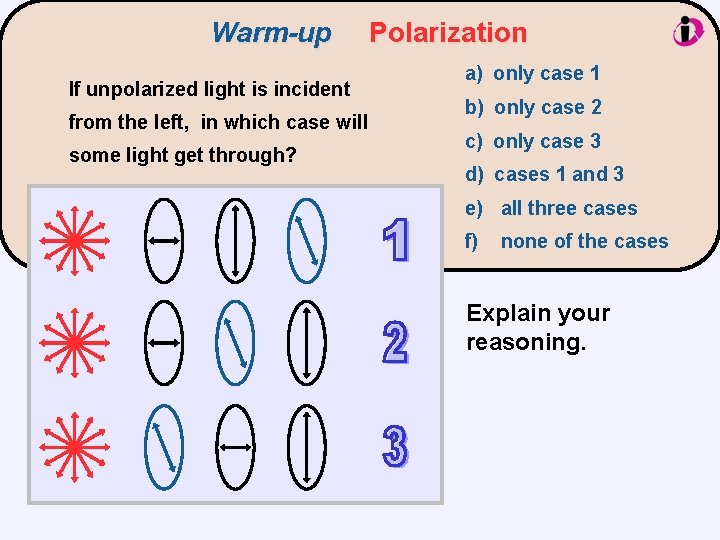
Warm-up If unpolarized light is incident from the left, in which case will some light get through? Polarization a) only case 1 b) only case 2 c) only case 3 d) cases 1 and 3 e) all three cases f) none of the cases Explain your reasoning.
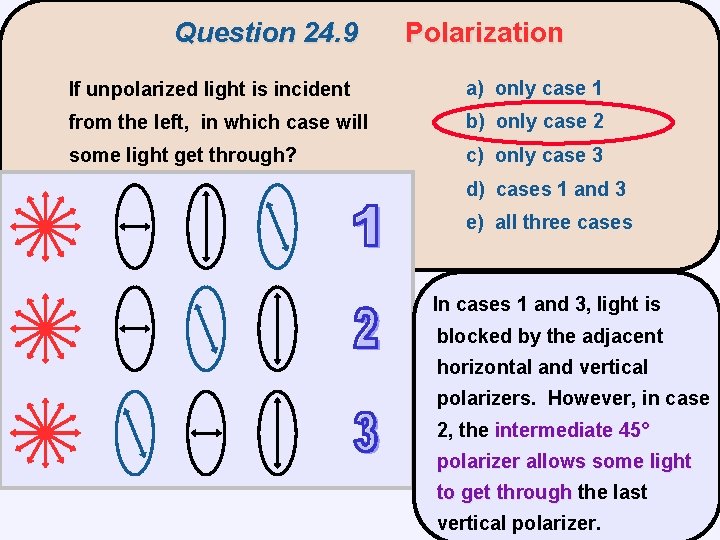
Question 24. 9 Polarization If unpolarized light is incident a) only case 1 from the left, in which case will b) only case 2 some light get through? c) only case 3 d) cases 1 and 3 e) all three cases In cases 1 and 3, light is blocked by the adjacent horizontal and vertical polarizers. However, in case 2, the intermediate 45° polarizer allows some light to get through the last vertical polarizer.
Polarizers and Analyzers • Polarizer: A material that has a molecular structure that will only allow one specific orientation of electric field (from the light) to pass through. • Analyzer: A polarizer that is specifically used to determine if light is polarized (and in what direction)
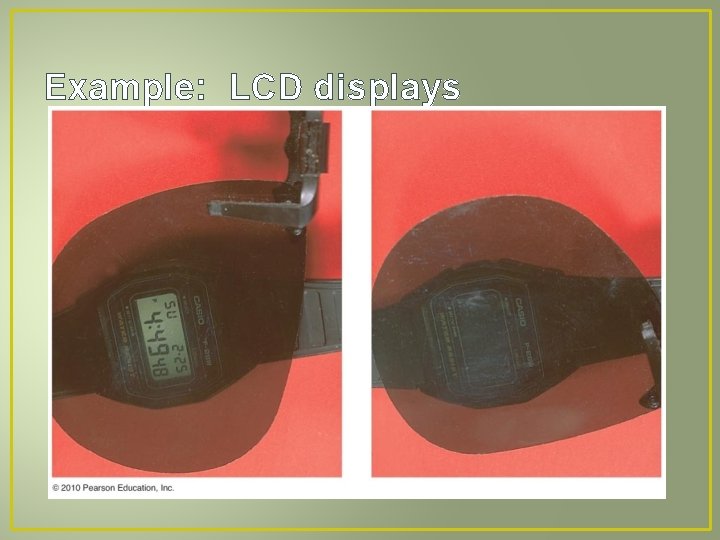
Example: LCD displays
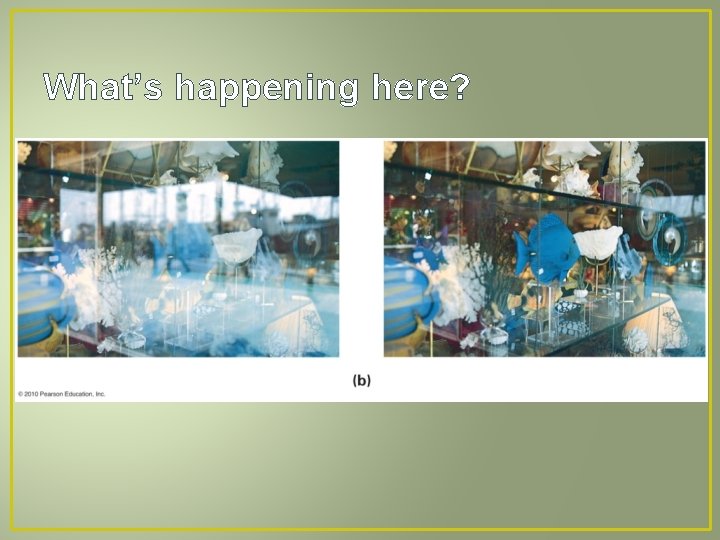
What’s happening here?
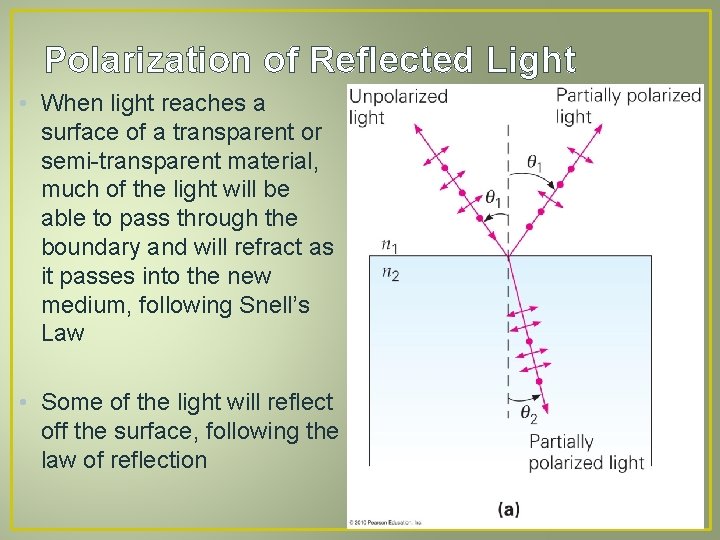
Polarization of Reflected Light • When light reaches a surface of a transparent or semi-transparent material, much of the light will be able to pass through the boundary and will refract as it passes into the new medium, following Snell’s Law • Some of the light will reflect off the surface, following the law of reflection
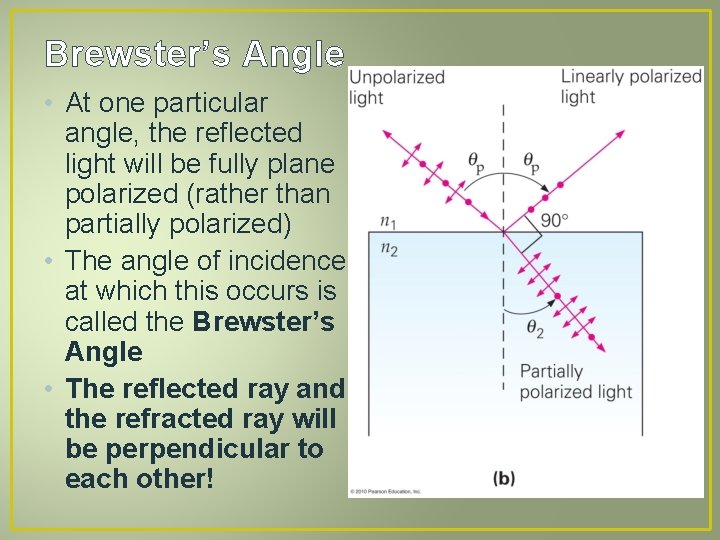
Brewster’s Angle • At one particular angle, the reflected light will be fully plane polarized (rather than partially polarized) • The angle of incidence at which this occurs is called the Brewster’s Angle • The reflected ray and the refracted ray will be perpendicular to each other!
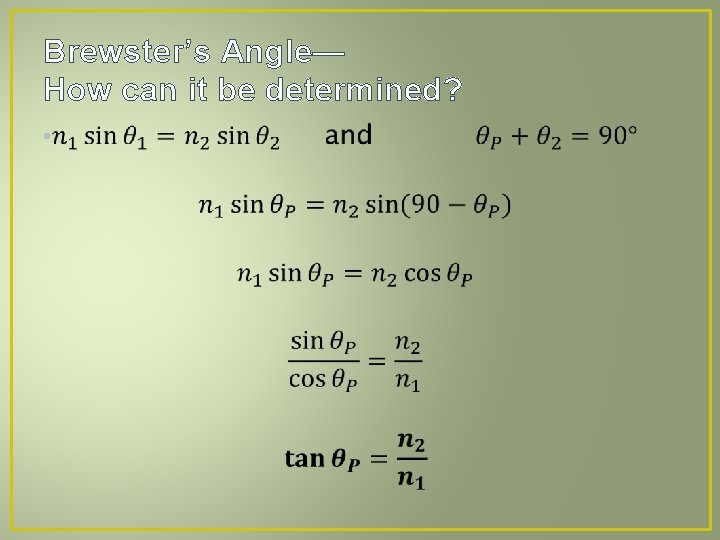
Brewster’s Angle— How can it be determined? •
Brewster’s Angle— noteworthy notes • Brewster’s Angle depends on the indices of refraction for the 2 media, and nothing else. • The angle between the angle of refraction and the angle of reflection is always 90° at the Brewster’s Angle
Polarizing Filters (Polaroids) • Most common method of producing polarized light is by using filter • When 2 filters are used in sequence, the first polaroid the light passes through is called the Polarizer • The second filter the light passes through is called the Analyzer
Exploration lab: Polarization • You will now be determining the relationship between the angle the electric field makes with a polarizer and the intensity of the light that passes through the polarizer • Use the Light Intensity meter and the polarization equipment provided. • Attach the light intensity meter to a ring stand so that it is positioned directly in the center of the polarizer • Choose one of the polarizing filters to be the "polarizer", and maintain the position of that filter so that "0" is always in the same position. • The other filter will be the analyzer, and you will rotate it every 5° and record the light intensity throughout the entire 360°
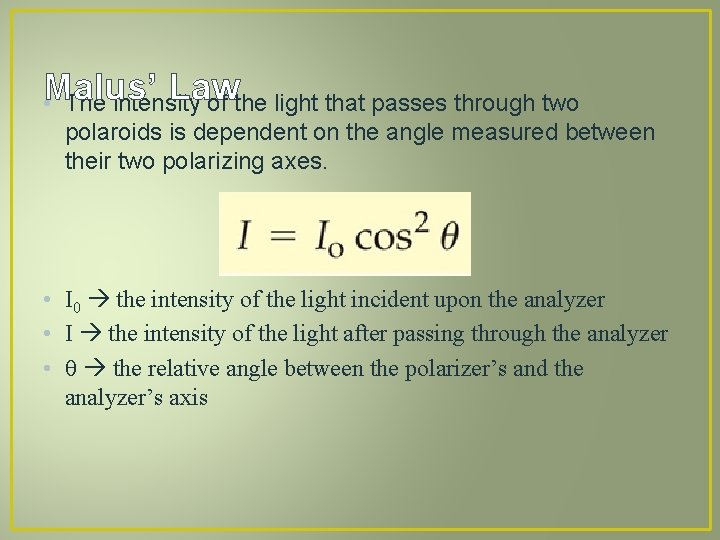
Malus’ Law • The intensity of the light that passes through two polaroids is dependent on the angle measured between their two polarizing axes. • I 0 the intensity of the light incident upon the analyzer • I the intensity of the light after passing through the analyzer • q the relative angle between the polarizer’s and the analyzer’s axis