
Polarization of Gamma Rays Using Compton Scattering Midn
- Slides: 11
Polarization of Gamma Rays Using Compton Scattering Midn 2/c Tim Fitzgerald Advised by Dr. Daryl Hartley 2 May 2005 Sponsored by the National Science Foundation
Introduction • Purpose – Want to determine characteristics of excited nuclear states – Show that types of gamma rays can have either “electric” or “magnetic” nature • Method – Excite nuclei of Mg-24 and Mg-25 using proton beam – Collect gamma rays with detector – Analyze results
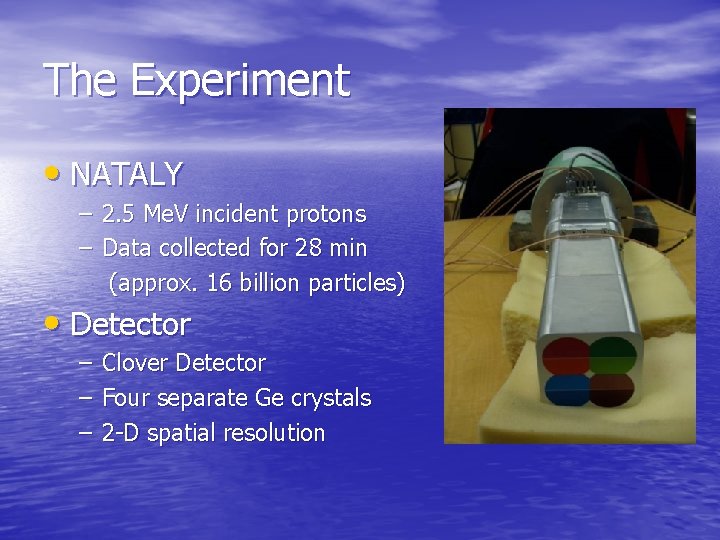
The Experiment • NATALY – 2. 5 Me. V incident protons – Data collected for 28 min (approx. 16 billion particles) • Detector – – – Clover Detector Four separate Ge crystals 2 -D spatial resolution
The Experiment • Protons excite nucleus
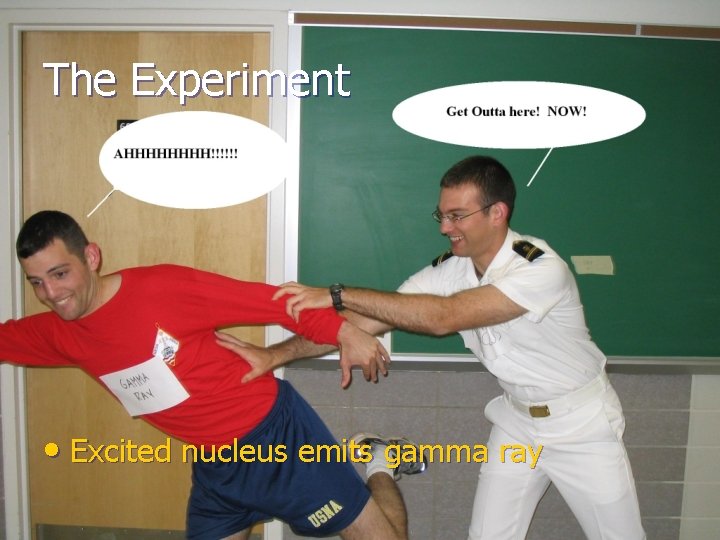
The Experiment • Excited nucleus emits gamma ray
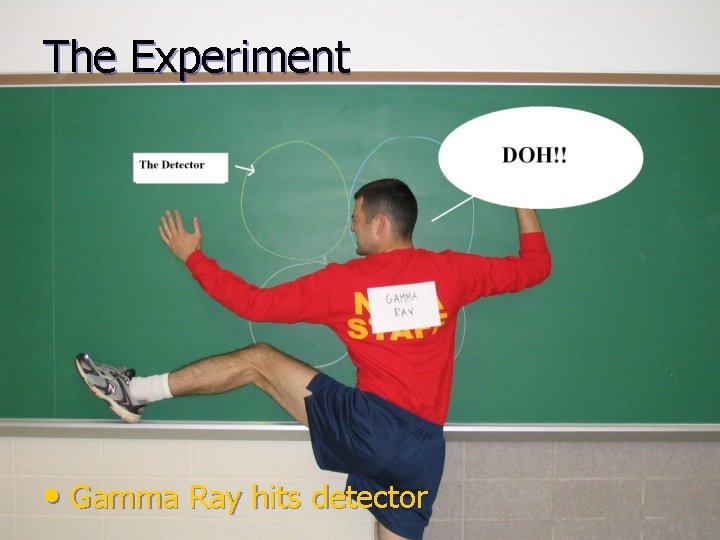
The Experiment • Gamma Ray hits detector
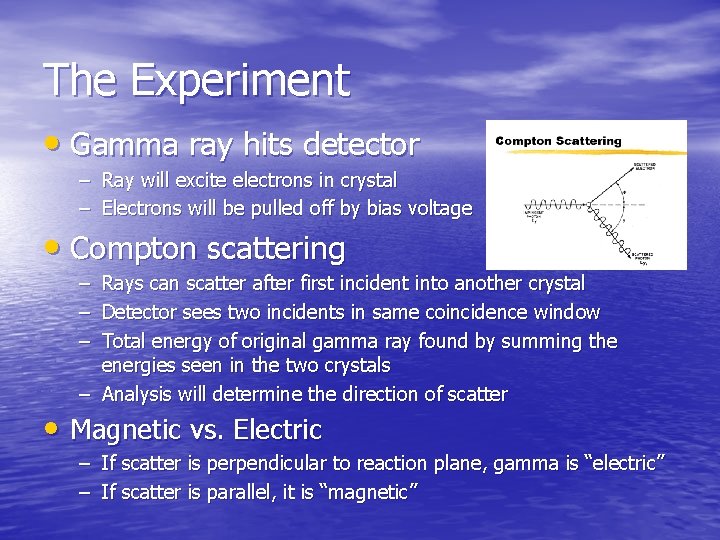
The Experiment • Gamma ray hits detector – Ray will excite electrons in crystal – Electrons will be pulled off by bias voltage • Compton scattering – – – Rays can scatter after first incident into another crystal Detector sees two incidents in same coincidence window Total energy of original gamma ray found by summing the energies seen in the two crystals – Analysis will determine the direction of scatter • Magnetic vs. Electric – If scatter is perpendicular to reaction plane, gamma is “electric” – If scatter is parallel, it is “magnetic”
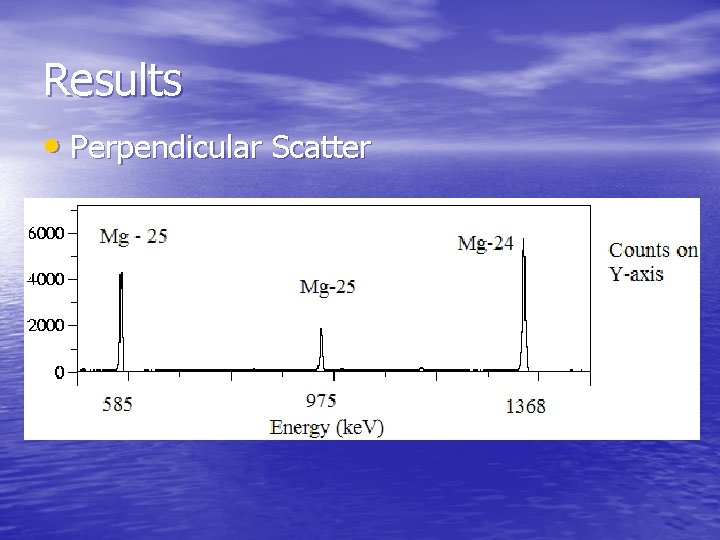
Results • Perpendicular Scatter
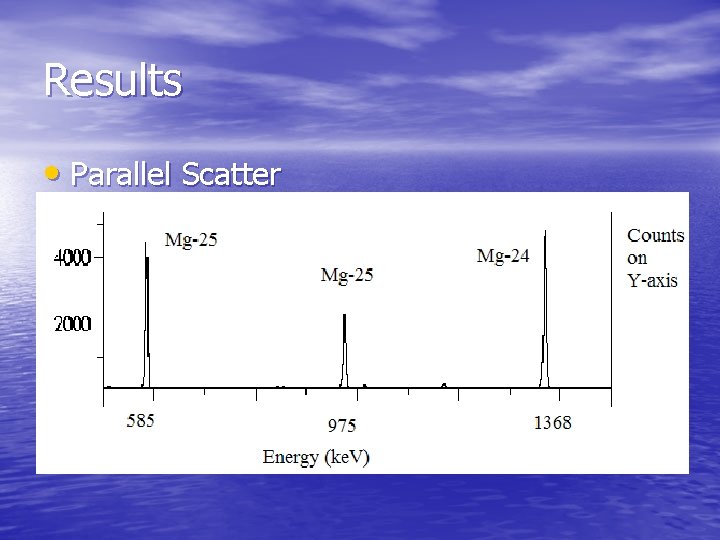
Results • Parallel Scatter
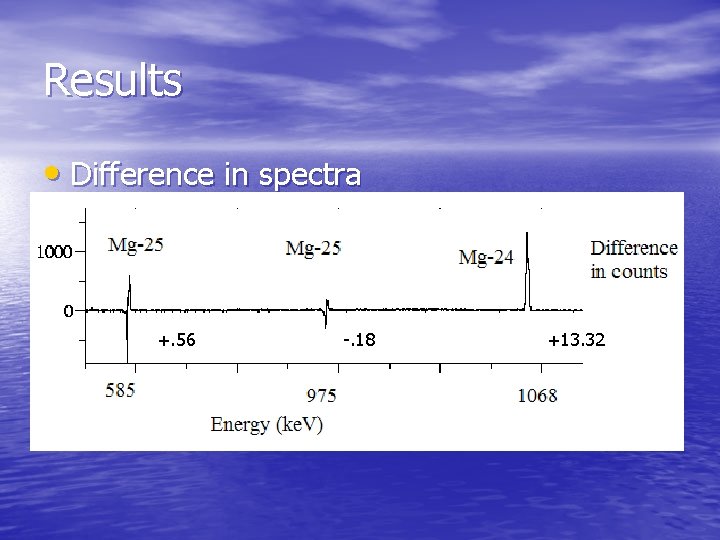
Results • Difference in spectra +. 56 -. 18 +13. 32
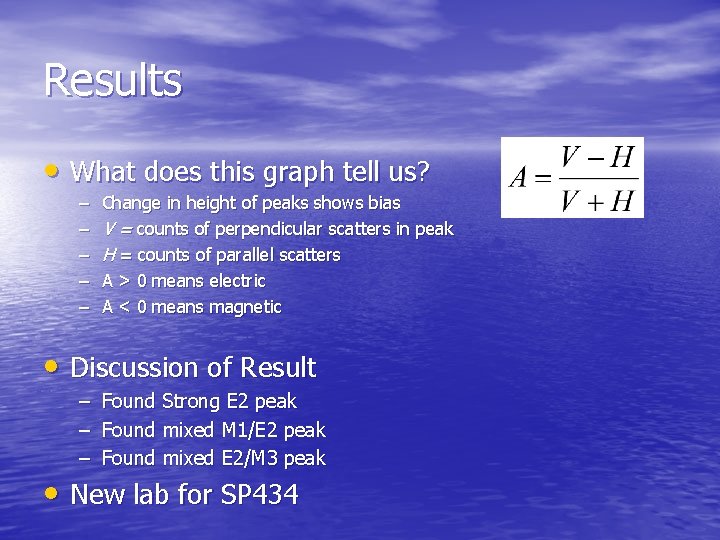
Results • What does this graph tell us? – – – Change in height of peaks shows bias V = counts of perpendicular scatters in peak H = counts of parallel scatters A > 0 means electric A < 0 means magnetic • Discussion of Result – – – Found Strong E 2 peak Found mixed M 1/E 2 peak Found mixed E 2/M 3 peak • New lab for SP 434