
Polarization Measurements of TNOs and Centaurs Stefano Bagnulo
Polarization Measurements of TNOs and Centaurs Stefano Bagnulo (ESO Santiago de Chile) Antonella Barucci (Obs. Paris-Meudon) Irina Belskaya (Univ. Kharkiv) Hermann Boehnhardt (MPS Katlenburg-Lindau) Ludmilla Kolokolova (Univ. Maryland) Karri Muinonen (Univ. Helsinki)

. . . The time-to-leave-the-room-slide. . .

. . . The good, the bad, and the ugly. . .
The Physical Link Light scattering of minor (atmosphereless) bodies – like TNOs - in the solar system allows to measure: 1. global albedo & size photometry (vis. + submm) 2. composition of surface spectroscopy (vis. + IR) 3. micro-roughness & grain albedo photometry & polarimetry (vis. ) physical interpretations of measurements mentioned in items 1 -3 are intimately linked and require consistent/complementary modeling approach
Polarization & Opposition Surge • Light reflection at surface produces – linear polarization (phase angle dependant) – opposition surge (low phase angle only) • Contributing physical effects – shadowing effect – coherent back-scattering properties of surface grains on microscopic scale proper modeling approach • Some physical constraints – polarimetry lots of SNR (~500 -1000) – TNOs/Centaurs: low phase angles < 1. 5/5 deg
Object Selection & Observations • Object selection criteria – (relatively) bright (V<21 mag) SNR ( big objects) – good coverage of phase angle range phase curve – albedo & spectrum measured model constraints • Telescope & instrument – VLT 8. 2 m + FORS 1 (in service mode: 1 -2 h every 1 -3 weeks) linear polarimetry in broadband filters + R filter photometry (quasi-simultaneous) • Objects observed (2 campaigns) – 28798 Ixion (Plutino): R phot. + R lin. pol. (0. 2 – 1. 35 deg) – 2060 Chiron (Centaur): R phot. + BVR lin. pol. (1. 4 – 4. 2 deg) (additional goal: wavelength dependence of lin. pol. ) – 50000 Quaoar (CDO): R phot. + R lin. pol. (0. 25 – 1. 25 deg)
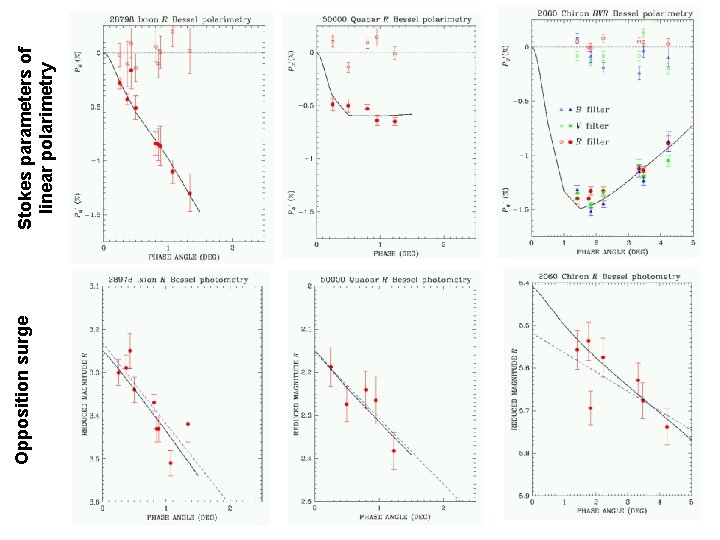
Opposition surge Stokes parameters of linear polarimetry
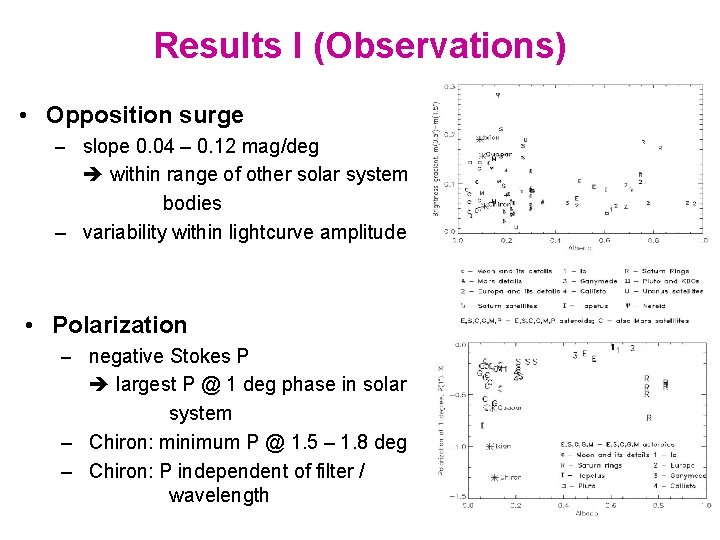
Results I (Observations) • Opposition surge – slope 0. 04 – 0. 12 mag/deg within range of other solar system bodies – variability within lightcurve amplitude • Polarization – negative Stokes P largest P @ 1 deg phase in solar system – Chiron: minimum P @ 1. 5 – 1. 8 deg – Chiron: P independent of filter / wavelength
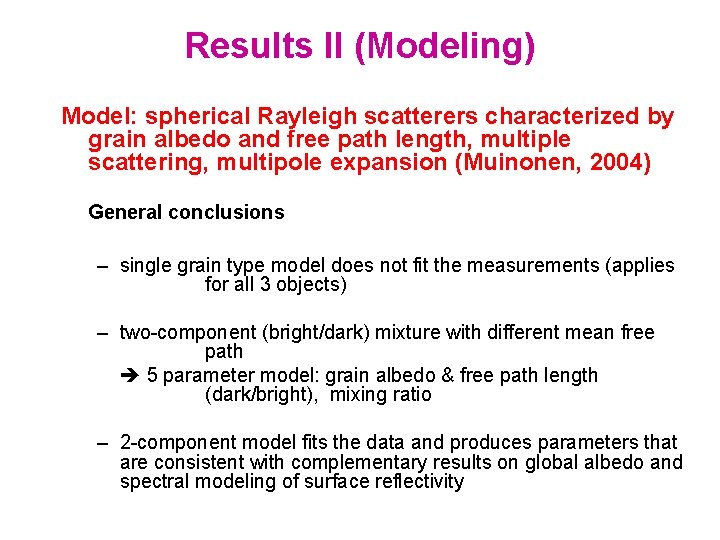
Results II (Modeling) Model: spherical Rayleigh scatterers characterized by grain albedo and free path length, multiple scattering, multipole expansion (Muinonen, 2004) General conclusions – single grain type model does not fit the measurements (applies for all 3 objects) – two-component (bright/dark) mixture with different mean free path 5 parameter model: grain albedo & free path length (dark/bright), mixing ratio – 2 -component model fits the data and produces parameters that are consistent with complementary results on global albedo and spectral modeling of surface reflectivity
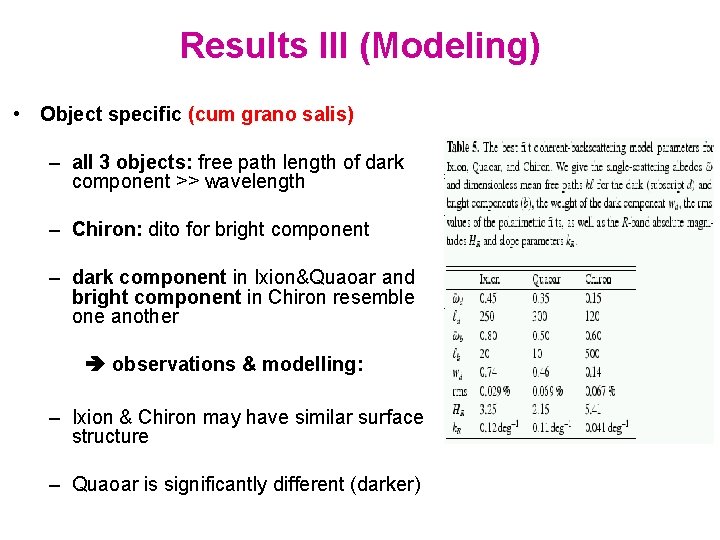
Results III (Modeling) • Object specific (cum grano salis) – all 3 objects: free path length of dark component >> wavelength – Chiron: dito for bright component – dark component in Ixion&Quaoar and bright component in Chiron resemble one another observations & modelling: – Ixion & Chiron may have similar surface structure – Quaoar is significantly different (darker)
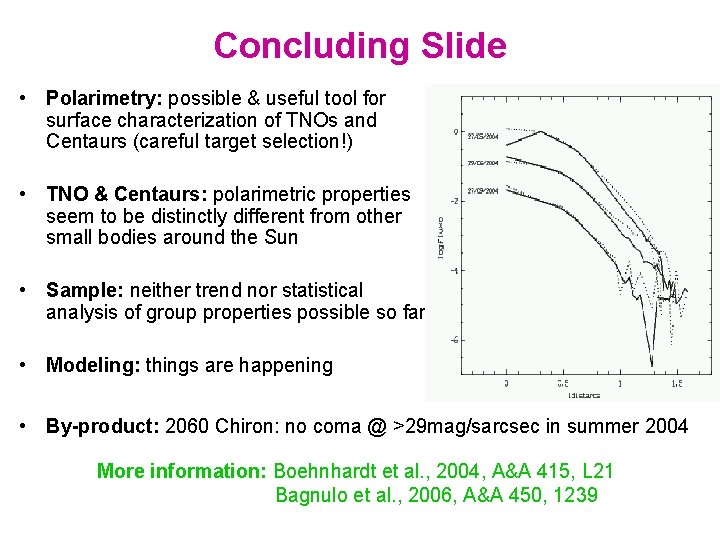
Concluding Slide • Polarimetry: possible & useful tool for surface characterization of TNOs and Centaurs (careful target selection!) • TNO & Centaurs: polarimetric properties seem to be distinctly different from other small bodies around the Sun • Sample: neither trend nor statistical analysis of group properties possible so far • Modeling: things are happening • By-product: 2060 Chiron: no coma @ >29 mag/sarcsec in summer 2004 More information: Boehnhardt et al. , 2004, A&A 415, L 21 Bagnulo et al. , 2006, A&A 450, 1239

. . . To the audience: Thank you for your patience. . . To thoses who went outside: I hope you had a good time. . .
- Slides: 12