
Polarization Effects and Ionic Bonding in a Polar
Polarization Effects and Ionic Bonding in a Polar Diatomic : the Ca. F+ X 1Σ+ state Stephen L. Coy, Joshua H. Baraban, Robert W. Field (Chemistry, MIT) and Bryan M. Wong (Materials Chemistry, Sandia) “electrostatic theories give the correct order of magnitude, but do not give satisfactory quantitative agreement with experiment. ” “the difficulty is that of taking account of covalent bonding and polarization, which are closely related, but not identical, phenomena. ” Leslie E. Orgel in Transition Metal Chemistry Ligand Field Theory, 1960. 30 September 2020 OSU Coy, Baraban, Field, Wong 1
Polarization Effects and Ionic Bonding in a Polar Diatomic : the Ca. F+ X 1Σ+ state Stephen L. Coy, Joshua H. Baraban, Robert W. Field (Chemistry, MIT) and Bryan M. Wong (Materials Cheistry, Sandia) • Ca. F is a prototype for highly-polar one-electron systems. Its Rydberg spectroscopy is a probe of ion core properties. • The chirped pulse mmwave spectroscopy of collisionally-cooled Rydberg systems like Ba. F and Ca. F has the potential to increase spectroscopic resolution from 0. 05 cm-1 to about 1 MHz (1500 -fold improvement). The first new result is expected to be improved dipole-dipole polarizabilities, including the polarizability anisotropy. • Polarizability is window on electronic structure and the R-dependent evolution of ionic character. Polarizabilities are the controling properties in gas and condensed phase optical and electromagnetic properties and have been extensively calculated. • We have used ab-initio calculations to evaluate polarizability properties and ionic character of the Ca. F ion core. Comparison is mode to a common one-electron effective potential (in standard form and modified for self-consistency) , to experimental data, and to MQDT calculations. • We focus today on the interpretation of the ab-initio results. 30 September 2020 OSU Coy, Baraban, Field, Wong 2

Polarization Effects and Ionic Bonding in a Polar Diatomic Summary Outline • • • Overview of polarizability. General perturbation theory expansion, symmetry restrictions for C∞, v, and for spherical symmetry Effective potential models for polar diatomics: two-center Arif-Jungen-Roche (AJR) form, AJR modified to be self-consistent (SC-AJR) Ab-initio results for Ca. F+ and for Ca. F+ + e-. Ab-initio results converted to spectroscopicly relevant effective multipoles and polarizabilities using (a) the AJR and SC-AJR parametrization, (b) modelfree approach using the electron-position-dependence of effective multipole moments. Ab-initio results for dipole and quadrupole strongly constrain charge separation and the difference in atomic polarizabilities in a two-center potential. A two-center effective potential that matches ab-initio dipole and quadrupole disagrees with model-free ab-initio results for Ca. F+ polarizability anisotropy and for the octupole moment. Distributed multipoles and / or polarizabilities would probably be more accurate (but is it necessary). 30 September 2020 OSU Coy, Baraban, Field, Wong 3
Experimental and theoretical Importance of polarizability Polarizability is a fascinating and important subject. Applications include the following • Collisions and black body rad effects on atomic clock transitions (Ca(II) of current interest) which determines the ultimate accuracy. • Magic wavelength studies of molecular systems (λ where electronic states have the same dipole polarizability) eliminates dependence on stochastic external fields. • Cooling and trapping of atoms • Non linear optical properties of gases and crystals • Frequency dependence of polarizability related to electronic structure and the Born Oppenheimer separation of nuclear and electronic motion. (esp. by Zon group) • Stability of data in a quantum computer. • Transition frequencies and term values of Rydberg levels, especially non-penetrating states. e. g. Mitroy, Safronova, Clark(2010)JPhys. B, 43, 202001 Theory and Applications of atomic and ionic polarizabilities. 30 September 2020 OSU Coy, Baraban, Field, Wong 4

Describing and Determining Polarizability Describing • Describes the interaction of a atomic, molecular or ionic system with a dynamic or static electric field, field gradient, or higher derivative of the field. • Is described by a general expansion in perturbation theory of successively higher orders in Cartesian coordinates (less frequently in spherical tensor form for polarizablities). • Becomes useful in a symmetry reduced perturbation expansion identifying the number of independent parameters for atomic or molecular systems. Determining • Ab initio calculations (Bryan Wong and Josh Baraban in collaboration with John Stanton using CFOUR) • Analysis of OODR Rydberg spectra and MQDT solution using an effective potential. (RWField group) • Analysis of mmwave Rydberg spectra can lead to increase in resolution. • Rich literature (Maroulis, Fowler and Madden, A J Stone, Safronova, . . . ), David Buckingham made the greatest early contributions to theory and experiments. A bibliography covering 1955 to today would be quite extensive. 30 September 2020 OSU Coy, Baraban, Field, Wong 5
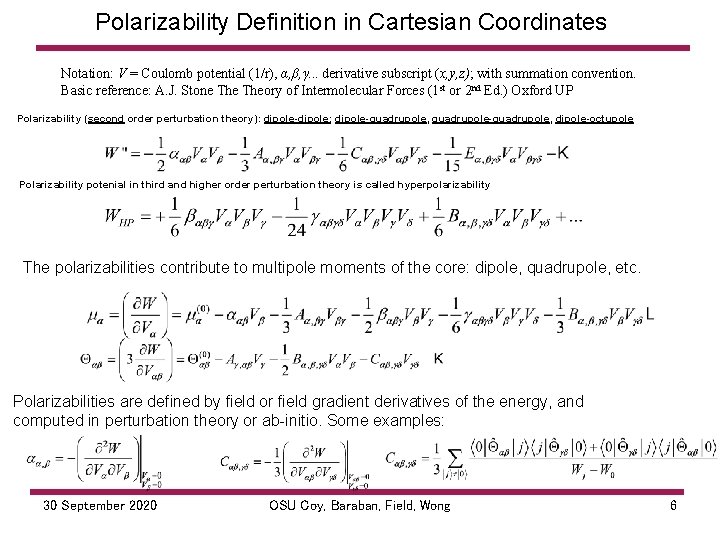
Polarizability Definition in Cartesian Coordinates Notation: V = Coulomb potential (1/r), α, β, γ. . . derivative subscript (x, y, z); with summation convention. Basic reference: A. J. Stone Theory of Intermolecular Forces (1 st or 2 nd Ed. ) Oxford UP Polarizability (second order perturbation theory): dipole-dipole; dipole-quadrupole, quadrupole-quadrupole, dipole-octupole Polarizability potenial in third and higher order perturbation theory is called hyperpolarizability The polarizabilities contribute to multipole moments of the core: dipole, quadrupole, etc. Polarizabilities are defined by field or field gradient derivatives of the energy, and computed in perturbation theory or ab initio. Some examples: 30 September 2020 OSU Coy, Baraban, Field, Wong 6
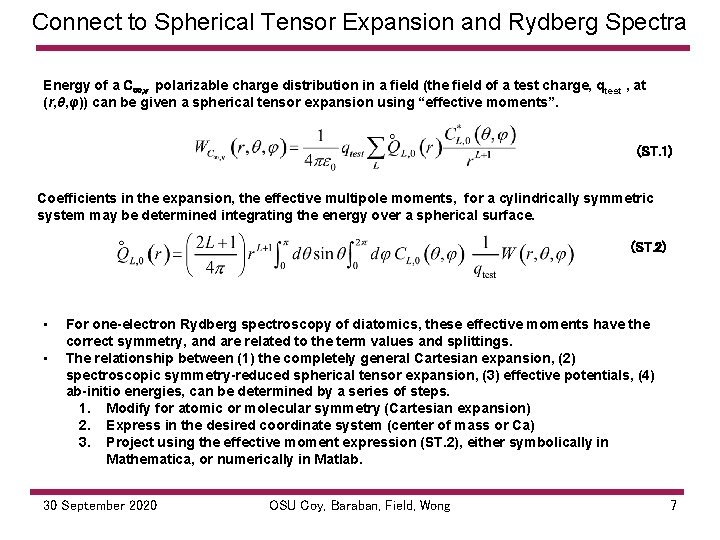
Connect to Spherical Tensor Expansion and Rydberg Spectra Energy of a C∞, v polarizable charge distribution in a field (the field of a test charge, q test , at (r, θ, φ)) can be given a spherical tensor expansion using “effective moments”. (ST. 1) Coefficients in the expansion, the effective multipole moments, for a cylindrically symmetric system may be determined integrating the energy over a spherical surface. (ST. 2) • • For one-electron Rydberg spectroscopy of diatomics, these effective moments have the correct symmetry, and are related to the term values and splittings. The relationship between (1) the completely general Cartesian expansion, (2) spectroscopic symmetry-reduced spherical tensor expansion, (3) effective potentials, (4) ab-initio energies, can be determined by a series of steps. 1. Modify for atomic or molecular symmetry (Cartesian expansion) 2. Express in the desired coordinate system (center of mass or Ca) 3. Project using the effective moment expression (ST. 2), either symbolically in Mathematica, or numerically in Matlab. 30 September 2020 OSU Coy, Baraban, Field, Wong 7
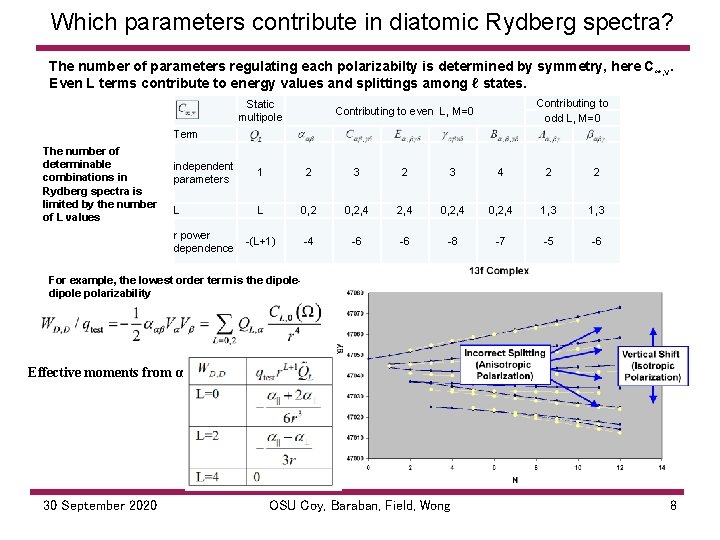
Which parameters contribute in diatomic Rydberg spectra? The number of parameters regulating each polarizabilty is determined by symmetry, here C ∞, v. Even L terms contribute to energy values and splittings among ℓ states. Contributing to Static Contributing to even L, M=0 Term The number of determinable combinations in Rydberg spectra is limited by the number of L values multipole odd L, M=0 independent parameters 1 2 3 4 2 2 L L 0, 2, 4 0, 2, 4 1, 3 (L+1) 4 6 6 8 7 5 6 r power dependence For example, the lowest order term is the dipole polarizability Effective moments from α 30 September 2020 OSU Coy, Baraban, Field, Wong 8
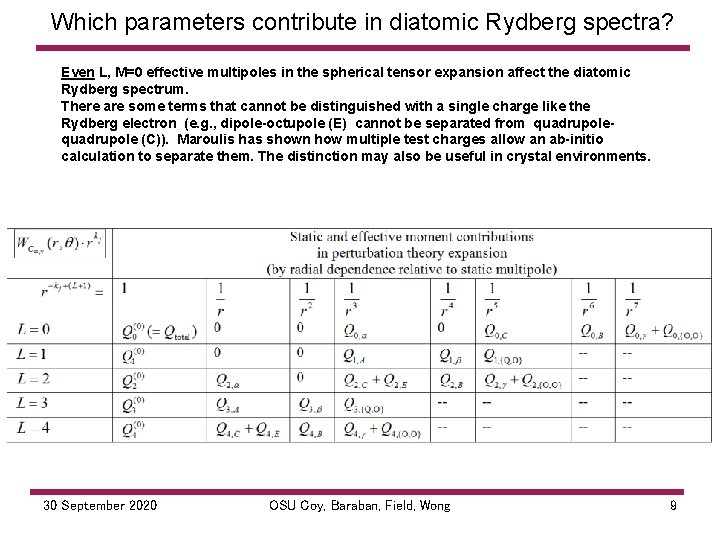
Which parameters contribute in diatomic Rydberg spectra? Even L, M=0 effective multipoles in the spherical tensor expansion affect the diatomic Rydberg spectrum. There are some terms that cannot be distinguished with a single charge like the Rydberg electron (e. g. , dipole-octupole (E) cannot be separated from quadrupole (C)). Maroulis has shown how multiple test charges allow an ab-initio calculation to separate them. The distinction may also be useful in crystal environments. 30 September 2020 OSU Coy, Baraban, Field, Wong 9
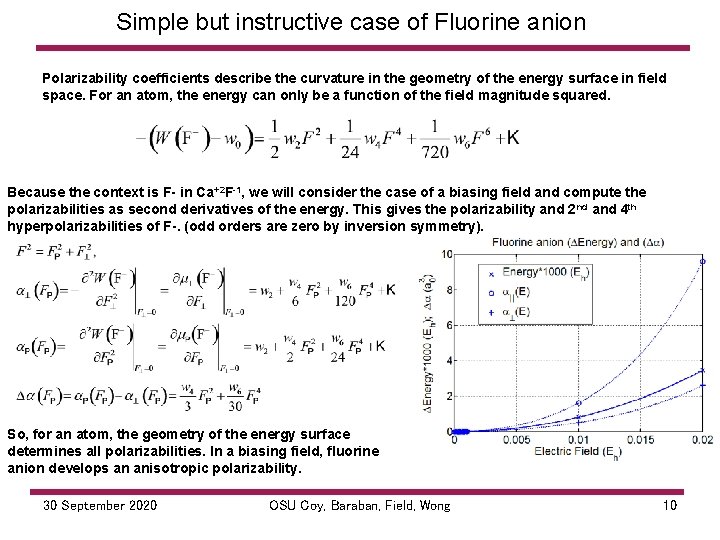
Simple but instructive case of Fluorine anion Polarizability coefficients describe the curvature in the geometry of the energy surface in field space. For an atom, the energy can only be a function of the field magnitude squared. Because the context is F- in Ca+2 F-1, we will consider the case of a biasing field and compute the polarizabilities as second derivatives of the energy. This gives the polarizability and 2 nd and 4 th hyperpolarizabilities of F-. (odd orders are zero by inversion symmetry). So, for an atom, the geometry of the energy surface determines all polarizabilities. In a biasing field, fluorine anion develops an anisotropic polarizability. 30 September 2020 OSU Coy, Baraban, Field, Wong 10
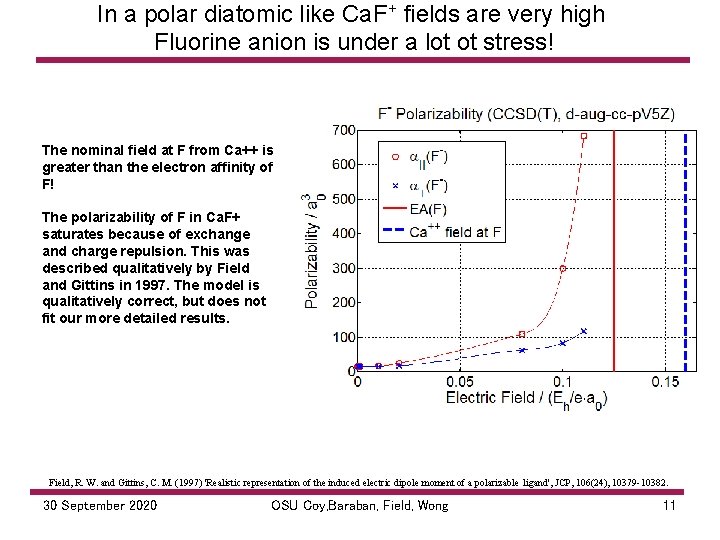
In a polar diatomic like Ca. F+ fields are very high Fluorine anion is under a lot ot stress! The nominal field at F from Ca++ is greater than the electron affinity of F! The polarizability of F in Ca. F+ saturates because of exchange and charge repulsion. This was described qualitatively by Field and Gittins in 1997. The model is qualitatively correct, but does not fit our more detailed results. Field, R. W. and Gittins, C. M. (1997) 'Realistic representation of the induced electric dipole moment of a polarizable ligand', JCP, 106(24), 10379 -10382. 30 September 2020 OSU Coy, Baraban, Field, Wong 11
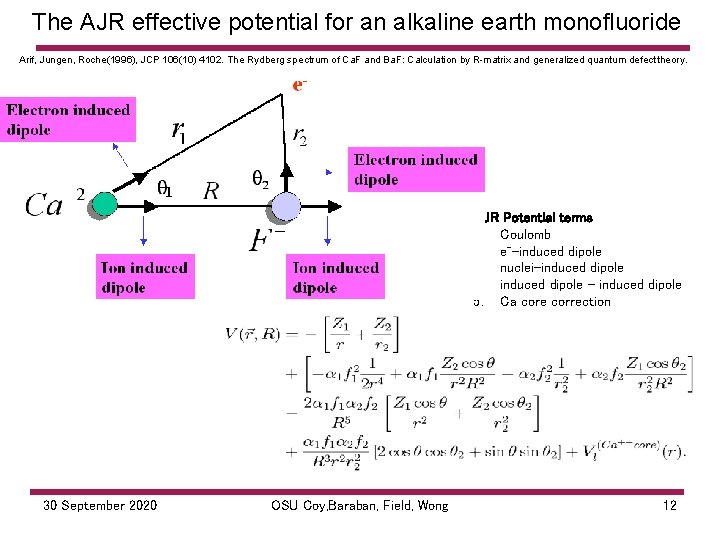
The AJR effective potential for an alkaline earth monofluoride Arif, Jungen, Roche(1996), JCP 106(10) 4102. The Rydberg spectrum of Ca. F and Ba. F: Calculation by R matrix and generalized quantum defect theory. 1 AJR Potential terms 1. Coulomb 2. e--induced dipole 3. nuclei-induced dipole 4. induced dipole – induced dipole 5. Ca core correction 30 September 2020 OSU Coy, Baraban, Field, Wong 12
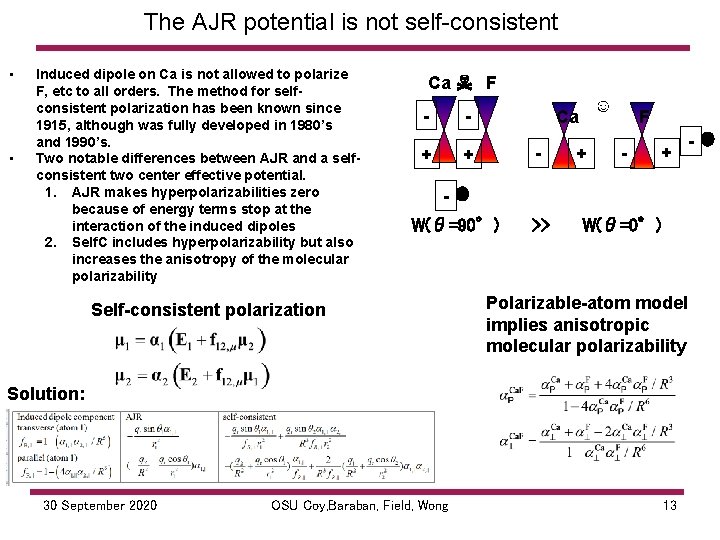
The AJR potential is not self consistent • • Induced dipole on Ca is not allowed to polarize F, etc to all orders. The method for selfconsistent polarization has been known since 1915, although was fully developed in 1980’s and 1990’s. Two notable differences between AJR and a selfconsistent two center effective potential. 1. AJR makes hyperpolarizabilities zero because of energy terms stop at the interaction of the induced dipoles 2. Self. C includes hyperpolarizability but also increases the anisotropy of the molecular polarizability Ca ☠ F - - + ☺ Ca - + + F - + W(θ=90°) Self-consistent polarization >> W(θ=0°) Polarizable-atom model implies anisotropic molecular polarizability Solution: 30 September 2020 OSU Coy, Baraban, Field, Wong 13 -
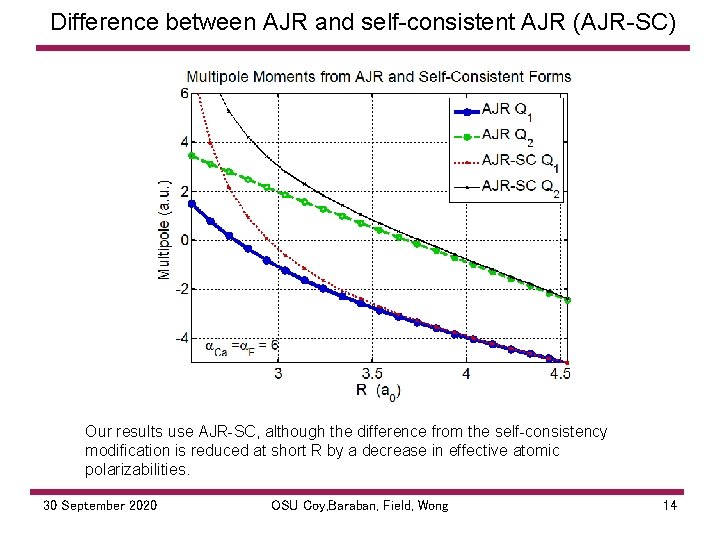
Difference between AJR and self consistent AJR (AJR SC) Our results use AJR SC, although the difference from the self consistency modification is reduced at short R by a decrease in effective atomic polarizabilities. 30 September 2020 OSU Coy, Baraban, Field, Wong 14
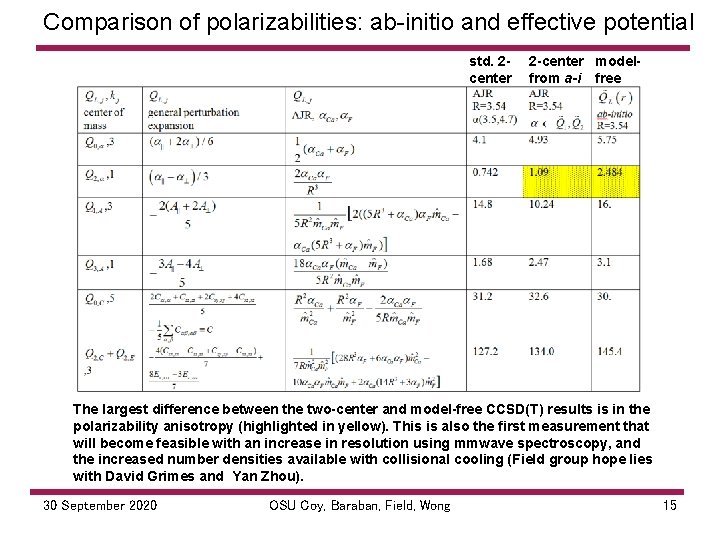
Comparison of polarizabilities: ab initio and effective potential std. 2 center 2 -center modelfrom a-i free The largest difference between the two-center and model-free CCSD(T) results is in the polarizability anisotropy (highlighted in yellow). This is also the first measurement that will become feasible with an increase in resolution using mmwave spectroscopy, and the increased number densities available with collisional cooling (Field group hope lies with David Grimes and Yan Zhou). 30 September 2020 OSU Coy, Baraban, Field, Wong 15
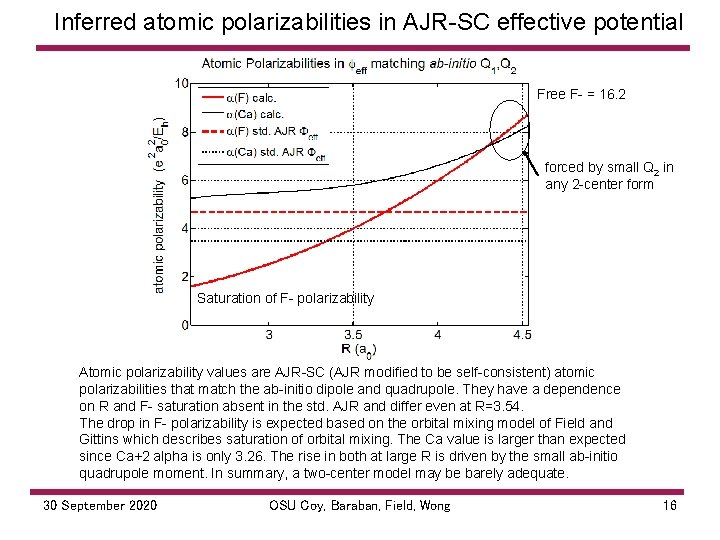
Inferred atomic polarizabilities in AJR SC effective potential Free F = 16. 2 forced by small Q 2 in any 2 center form Saturation of F polarizability Atomic polarizability values are AJR SC (AJR modified to be self consistent) atomic polarizabilities that match the ab initio dipole and quadrupole. They have a dependence on R and F saturation absent in the std. AJR and differ even at R=3. 54. The drop in F polarizability is expected based on the orbital mixing model of Field and Gittins which describes saturation of orbital mixing. The Ca value is larger than expected since Ca+2 alpha is only 3. 26. The rise in both at large R is driven by the small ab initio quadrupole moment. In summary, a two center model may be barely adequate. 30 September 2020 OSU Coy, Baraban, Field, Wong 16
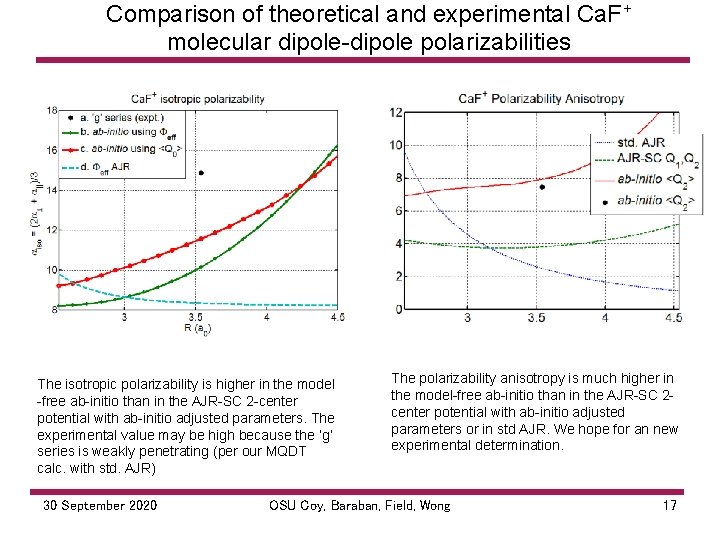
Comparison of theoretical and experimental Ca. F+ molecular dipole polarizabilities The isotropic polarizability is higher in the model free ab initio than in the AJR SC 2 center potential with ab initio adjusted parameters. The experimental value may be high because the ‘g’ series is weakly penetrating (per our MQDT calc. with std. AJR) 30 September 2020 The polarizability anisotropy is much higher in the model free ab initio than in the AJR SC 2 center potential with ab initio adjusted parameters or in std AJR. We hope for an new experimental determination. OSU Coy, Baraban, Field, Wong 17
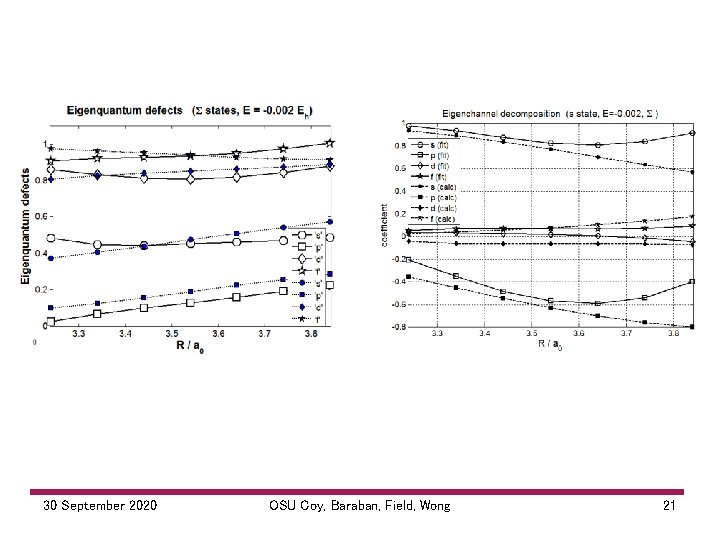
Polarization Effects and Ionic Bonding in a Polar Diatomic : the Ca. F+ X 1Σ+ state Stephen L. Coy, Joshua H. Baraban, Robert W. Field (Chemistry, MIT) and Bryan M. Wong (Materials Cheistry, Sandia) Conclusions • • Ab-initio results for dipole and quadrupole strongly constrain charge separation and the difference in atomic polarizabilities in a two-center potential. A two-center effective potential that matches ab-initio dipole and quadrupole disagrees with model-free ab-initio results for polarizability anisotropy and for the octupole moment. Distributed multipoles and / or polarizabilities would probably be more accurate (but necessary? ). Ab-initio results for Ca. F+ and for Ca. F+ + e- fit well to a Morse potential that match the experimental rotational an vibrational parameters (in exptra slides). MQDT results using std AJR agree pretty well for eigenquantum defects and eigenchannel decompositions at R=3. 54, but disagree in R-dependence (in extra slides). The level to which adjusted polarizabilities in a two-center potential will correct the R-dependent disagreement between our MQDT calculations and the experimental QDT fit has not yet been determined. 30 September 2020 OSU Coy, Baraban, Field, Wong 18
Additional Slides 30 September 2020 OSU Coy, Baraban, Field, Wong 19
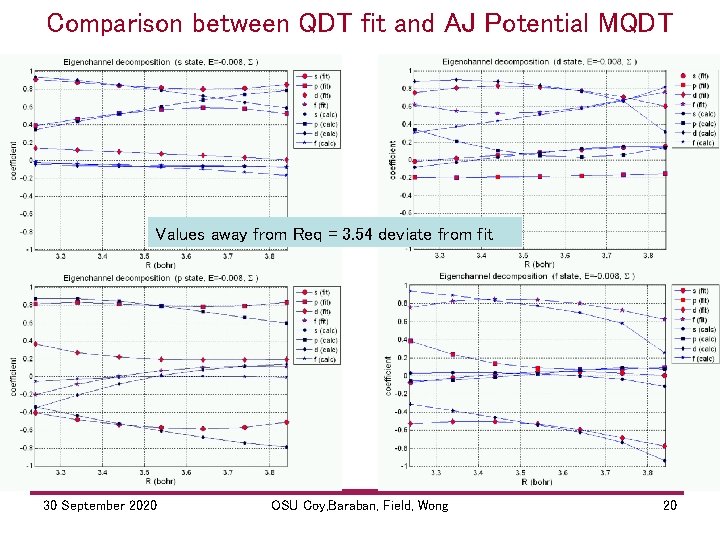
Comparison between QDT fit and AJ Potential MQDT Values away from Req = 3. 54 deviate from fit 30 September 2020 OSU Coy, Baraban, Field, Wong 20
30 September 2020 OSU Coy, Baraban, Field, Wong 21
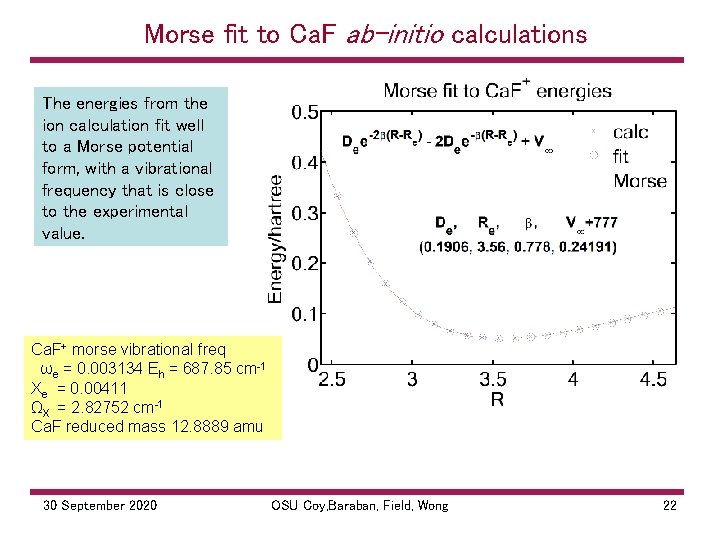
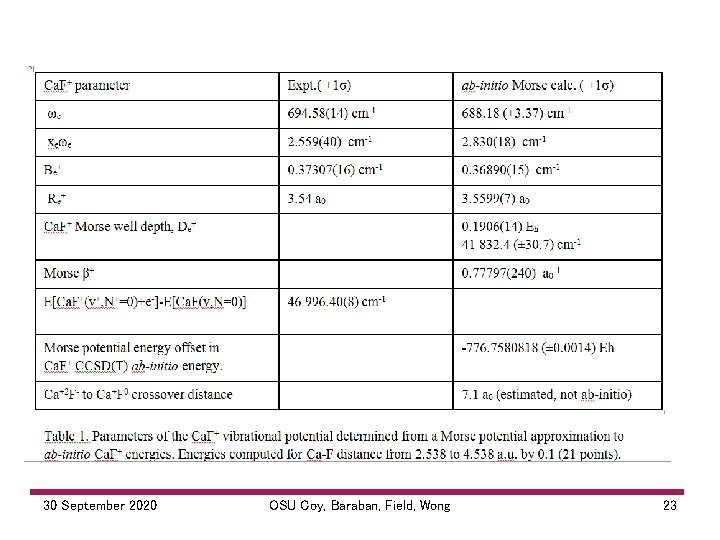
Morse fit to Ca. F ab-initio calculations The energies from the ion calculation fit well to a Morse potential form, with a vibrational frequency that is close to the experimental value. Ca. F+ morse vibrational freq ωe = 0. 003134 Eh = 687. 85 cm 1 Xe = 0. 00411 ΩX = 2. 82752 cm 1 Ca. F reduced mass 12. 8889 amu 30 September 2020 OSU Coy, Baraban, Field, Wong 22
30 September 2020 OSU Coy, Baraban, Field, Wong 23
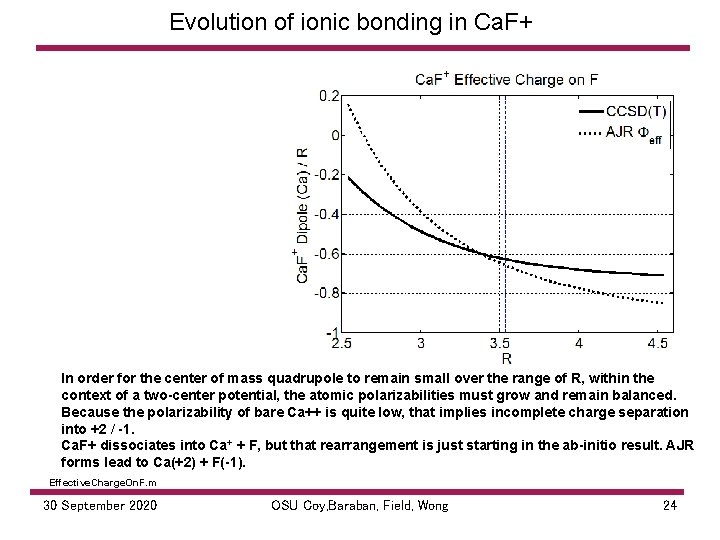
Evolution of ionic bonding in Ca. F+ In order for the center of mass quadrupole to remain small over the range of R, within the context of a two-center potential, the atomic polarizabilities must grow and remain balanced. Because the polarizability of bare Ca++ is quite low, that implies incomplete charge separation into +2 / -1. Ca. F+ dissociates into Ca+ + F, but that rearrangement is just starting in the ab-initio result. AJR forms lead to Ca(+2) + F(-1). Effective. Charge. On. F. m 30 September 2020 OSU Coy, Baraban, Field, Wong 24
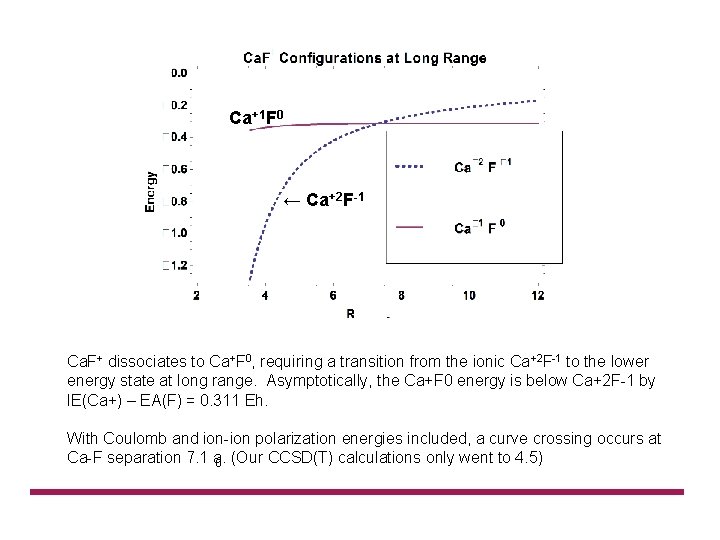
Ca+1 F 0 ← Ca+2 F-1 Ca. F+ dissociates to Ca+F 0, requiring a transition from the ionic Ca+2 F 1 to the lower energy state at long range. Asymptotically, the Ca+F 0 energy is below Ca+2 F 1 by IE(Ca+) – EA(F) = 0. 311 Eh. With Coulomb and ion polarization energies included, a curve crossing occurs at Ca F separation 7. 1 a 0. (Our CCSD(T) calculations only went to 4. 5)
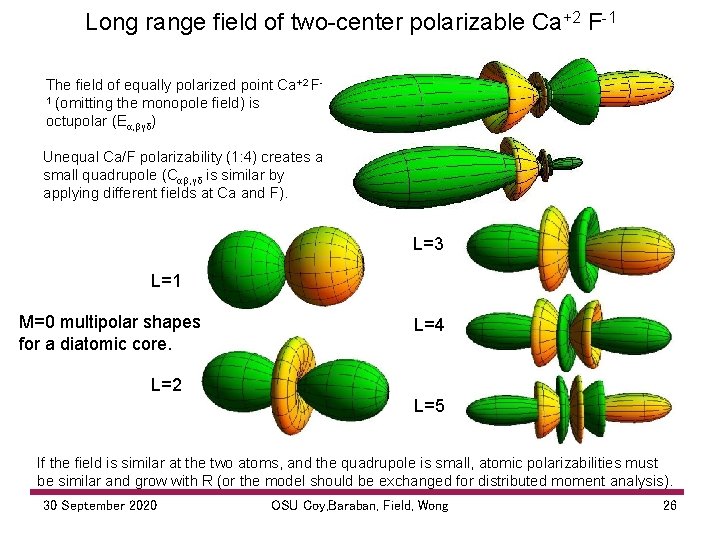
Long range field of two center polarizable Ca+2 F 1 The field of equally polarized point Ca+2 F 1 (omitting the monopole field) is octupolar (Eα, βγδ) Unequal Ca/F polarizability (1: 4) creates a small quadrupole (Cαβ, γδ is similar by applying different fields at Ca and F). L=3 L=1 M=0 multipolar shapes for a diatomic core. L=4 L=2 L=5 If the field is similar at the two atoms, and the quadrupole is small, atomic polarizabilities must be similar and grow with R (or the model should be exchanged for distributed moment analysis). 30 September 2020 OSU Coy, Baraban, Field, Wong 26
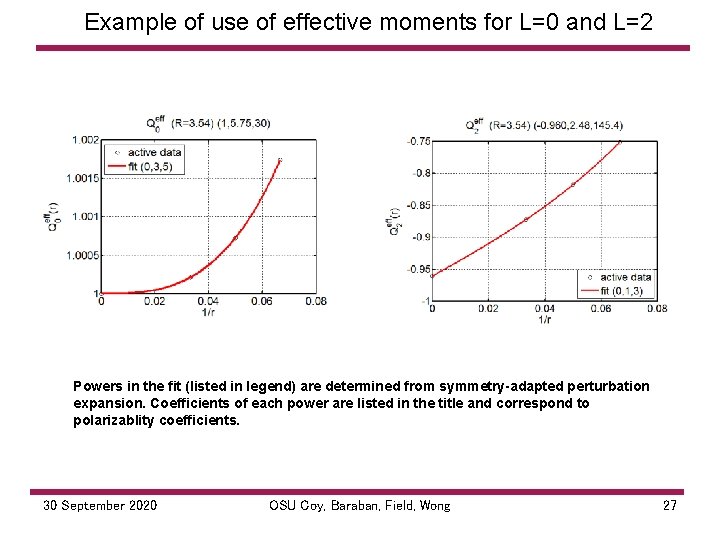
Example of use of effective moments for L=0 and L=2 Powers in the fit (listed in legend) are determined from symmetry-adapted perturbation expansion. Coefficients of each power are listed in the title and correspond to polarizablity coefficients. 30 September 2020 OSU Coy, Baraban, Field, Wong 27
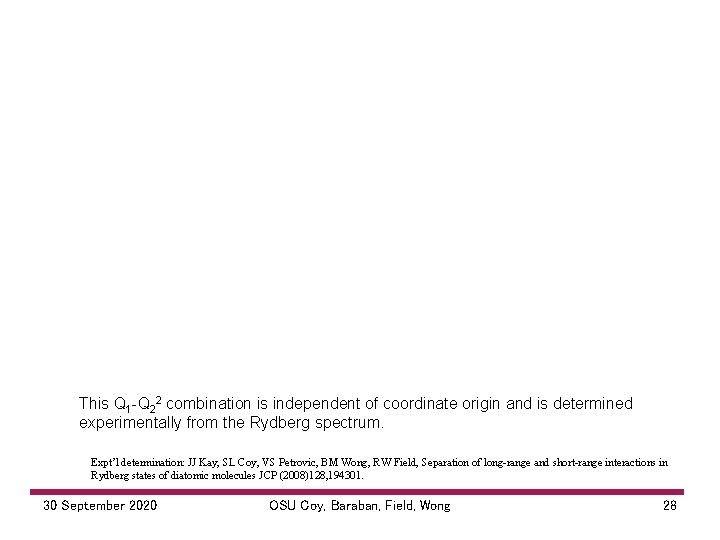
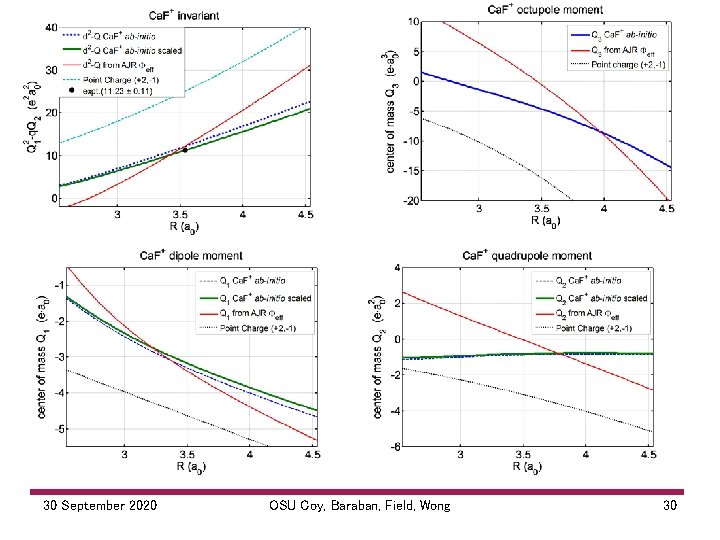
This Q 1 Q 22 combination is independent of coordinate origin and is determined experimentally from the Rydberg spectrum. Expt’l determination: JJ Kay, SL Coy, VS Petrovic, BM Wong, RW Field, Separation of long-range and short-range interactions in Rydberg states of diatomic molecules JCP (2008)128, 194301. 30 September 2020 OSU Coy, Baraban, Field, Wong 28
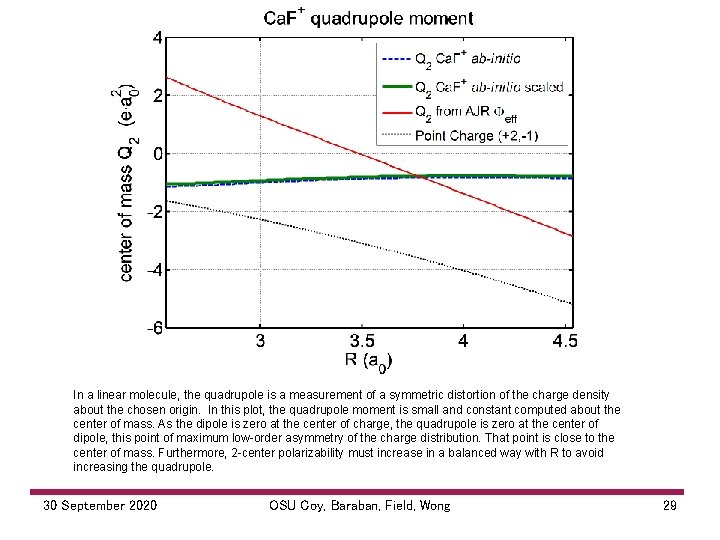
In a linear molecule, the quadrupole is a measurement of a symmetric distortion of the charge density about the chosen origin. In this plot, the quadrupole moment is small and constant computed about the center of mass. As the dipole is zero at the center of charge, the quadrupole is zero at the center of dipole, this point of maximum low order asymmetry of the charge distribution. That point is close to the center of mass. Furthermore, 2 center polarizability must increase in a balanced way with R to avoid increasing the quadrupole. 30 September 2020 OSU Coy, Baraban, Field, Wong 29
30 September 2020 OSU Coy, Baraban, Field, Wong 30
- Slides: 30