
Polarised neutron reflectivity Frdric OTT Laboratoire Lon Brillouin
Polarised neutron reflectivity Frédéric OTT Laboratoire Léon Brillouin fott@cea. fr
Outline n Reflectivity n n n Instrumentation Examples Superlattices n n General principles Polarised neutrons Non colinear magnetism GMR Interface magnetism Resources ECNS’ 2003 Introductory Course
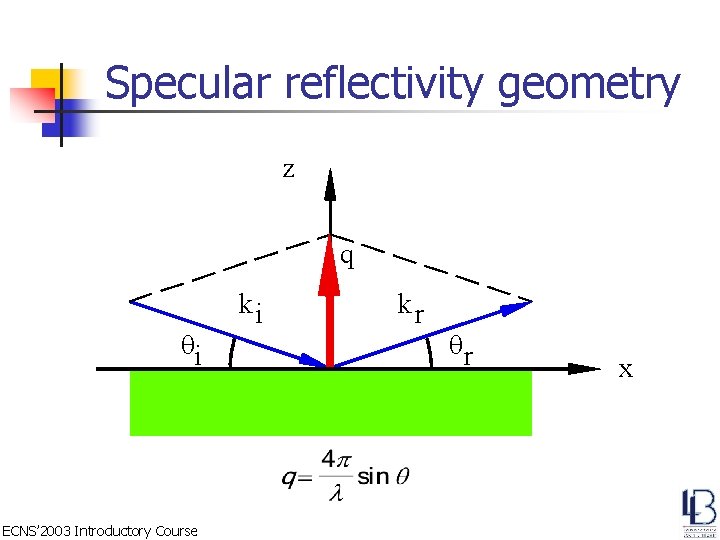
Specular reflectivity geometry z q qi ECNS’ 2003 Introductory Course ki kr qr x
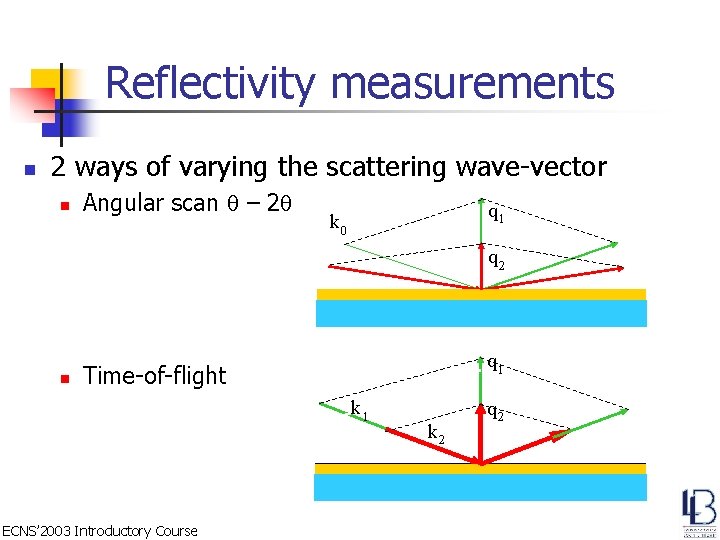
Reflectivity measurements n 2 ways of varying the scattering wave-vector n Angular scan q – 2 q q 1 k 0 q 2 n q 1 Time-of-flight k 1 ECNS’ 2003 Introductory Course k 2 q 2

Neutron-matter interaction Optical approximation. n n Interaction neutron-nucleus n Isotropic and ponctual Zeeman interaction n Neutron spin – magnetic field Neutron-nucleus Neutron-magnetic field Neutron-magnetisation ECNS’ 2003 Introductory Course
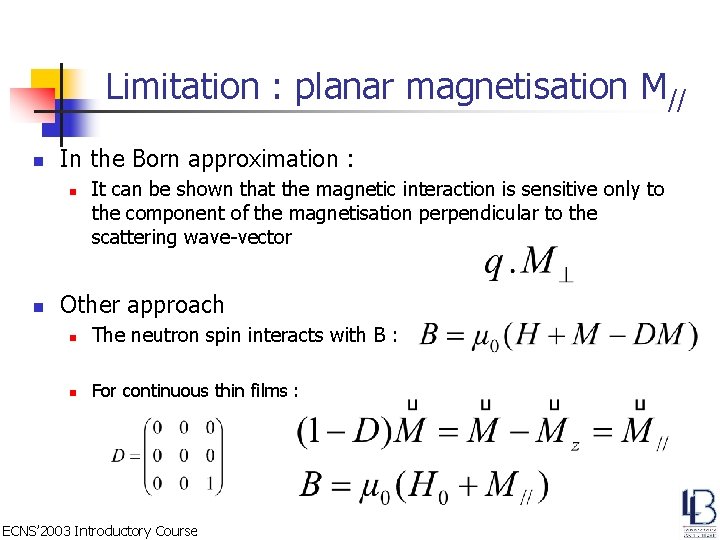
Limitation : planar magnetisation M// n In the Born approximation : n n It can be shown that the magnetic interaction is sensitive only to the component of the magnetisation perpendicular to the scattering wave-vector Other approach n The neutron spin interacts with B : n For continuous thin films : ECNS’ 2003 Introductory Course
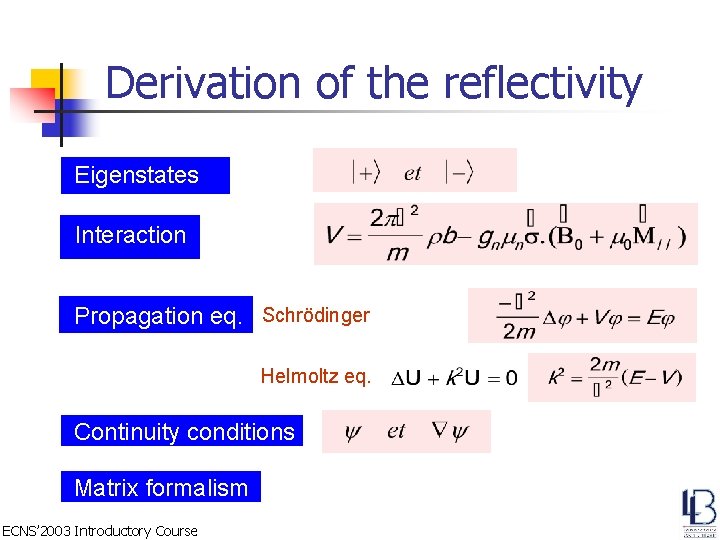
Neutrons Derivation of the reflectivity Eigenstates Interaction Propagation eq. Schrödinger Helmoltz eq. Continuity conditions Matrix formalism ECNS’ 2003 Introductory Course
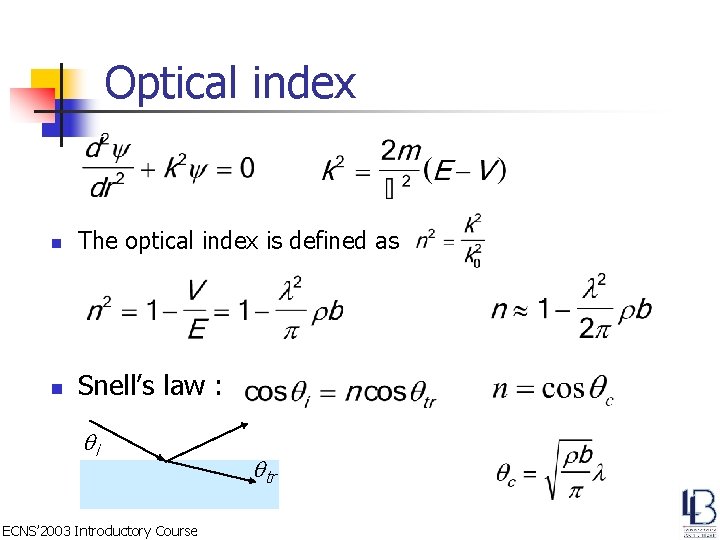
Optical index n The optical index is defined as n Snell’s law : qi ECNS’ 2003 Introductory Course qtr
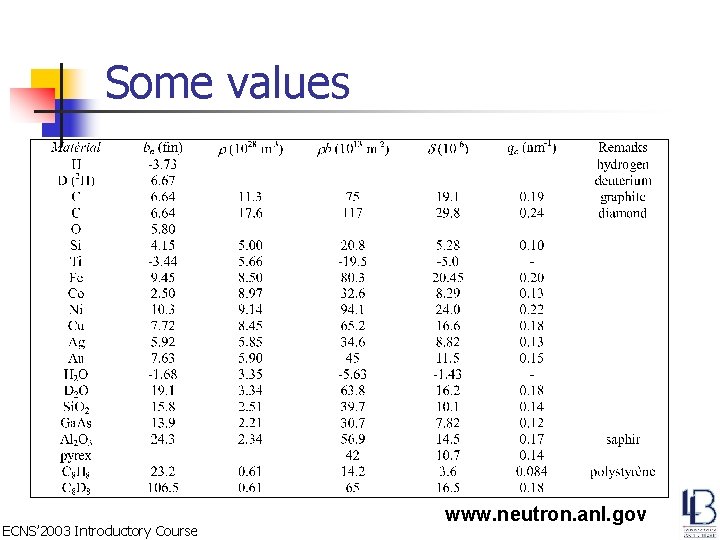
Some values ECNS’ 2003 Introductory Course www. neutron. anl. gov

Reflection on a substrate z 1 r t Vacuum « 0 » Z = 0 Substrate « s » Continuity conditions ECNS’ 2003 Introductory Course
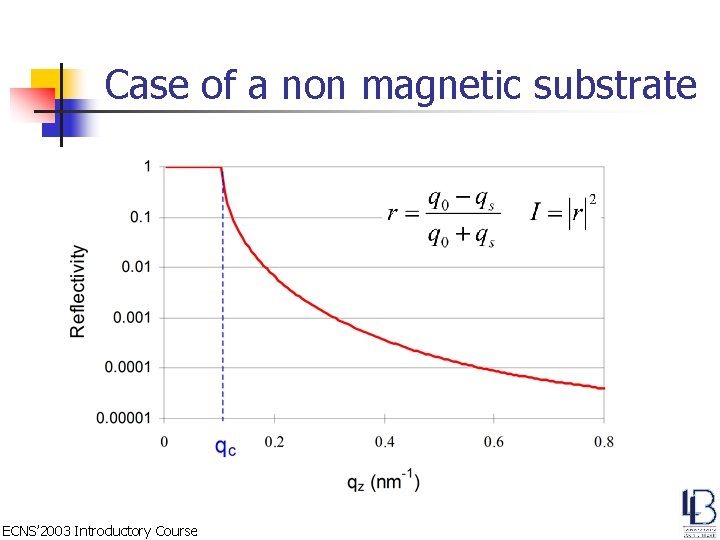
Case of a non magnetic substrate ECNS’ 2003 Introductory Course
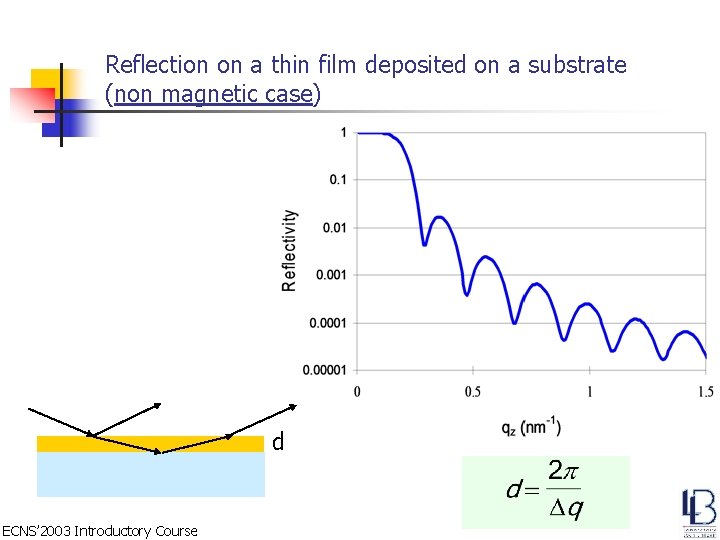
Reflection on a thin film deposited on a substrate (non magnetic case) d ECNS’ 2003 Introductory Course

Example Cu(500 Å)/Cr(90 Å) on silicon 2 p/590 2 p/90 ECNS’ 2003 Introductory Course

The neutron n spin 1/2 particle (® associated magnetic moment µn) n Interacts with the magnetic fields B (aligned along z): n Neutron in an eigenstate ( ) : stays in this state n Quantified neutron along (Ox) ( ECNS’ 2003 Introductory Course ): precession around Bz
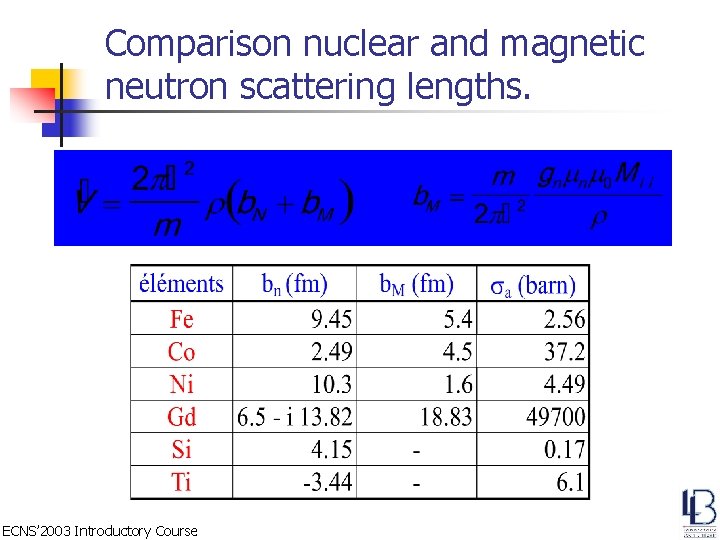
Comparison nuclear and magnetic neutron scattering lengths. n ECNS’ 2003 Introductory Course
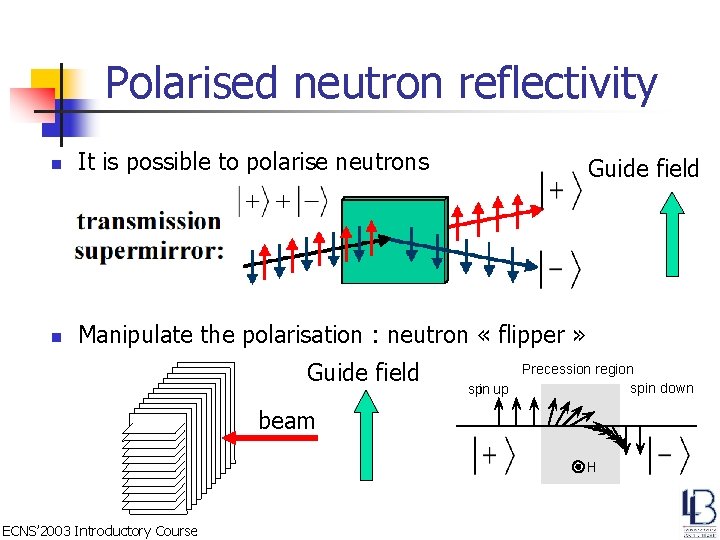
Polarised neutron reflectivity n It is possible to polarise neutrons n Manipulate the polarisation : neutron « flipper » Guide field Precession region spin down spin up beam H ECNS’ 2003 Introductory Course
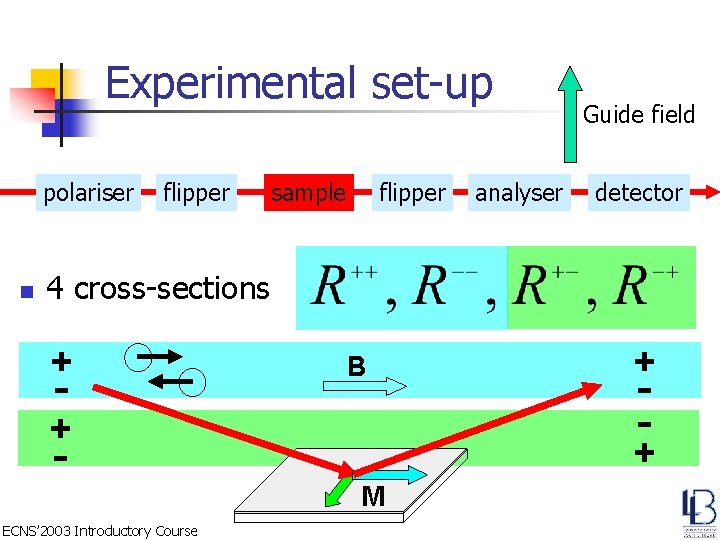
Experimental set-up polariser n flipper sample flipper analyser Guide field detector 4 cross-sections + - B + - - + M ECNS’ 2003 Introductory Course +

M // B n Sample transfert matrix + B - M ECNS’ 2003 Introductory Course +
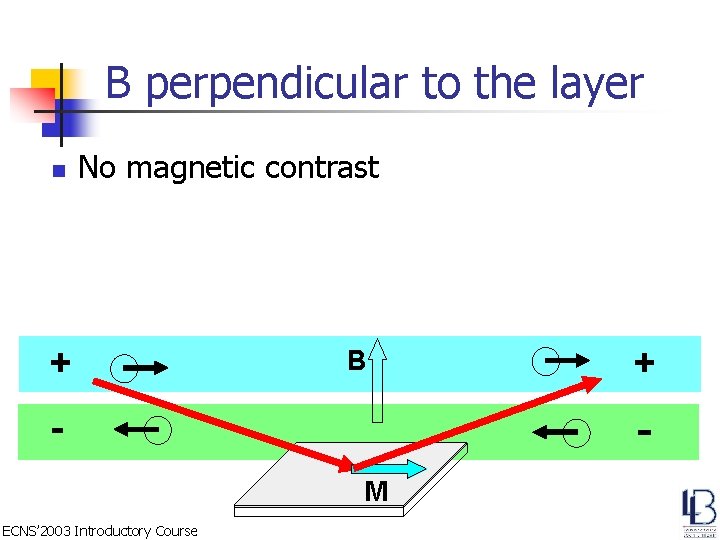
B perpendicular to the layer n No magnetic contrast + B - M ECNS’ 2003 Introductory Course +
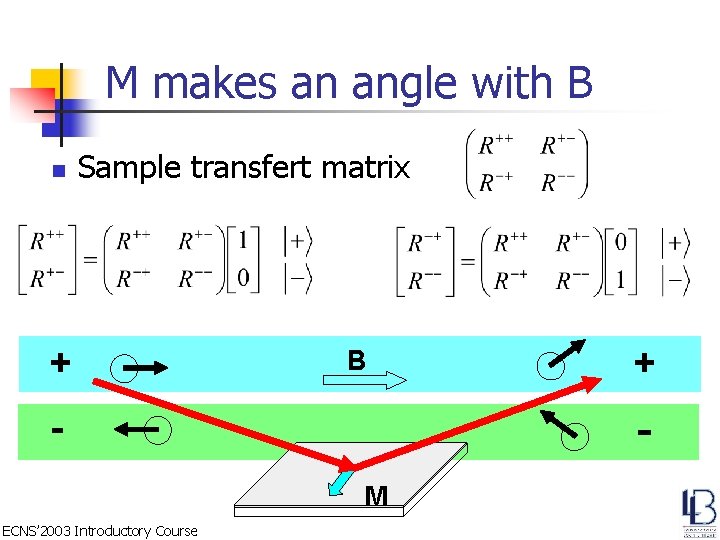
M makes an angle with B n Sample transfert matrix + B - M ECNS’ 2003 Introductory Course +
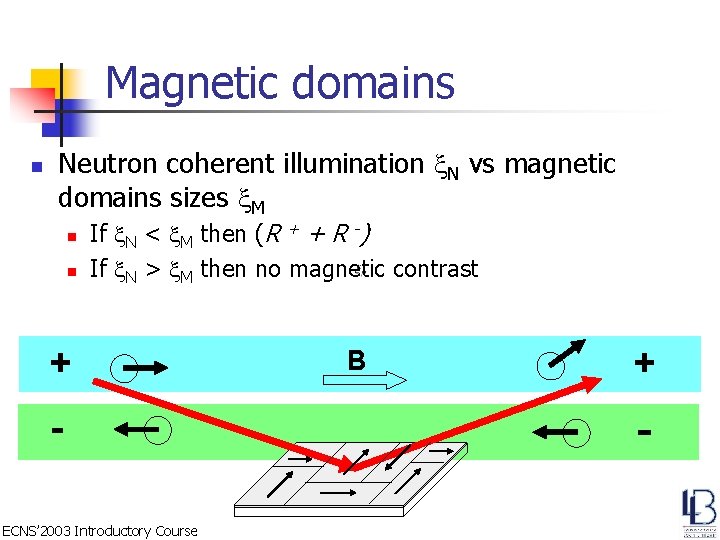
Magnetic domains n Neutron coherent illumination x. N vs magnetic domains sizes x. M n n If x. N < x. M then (R + + R -) If x. N > x. M then no magnetic contrast + ECNS’ 2003 Introductory Course B + -
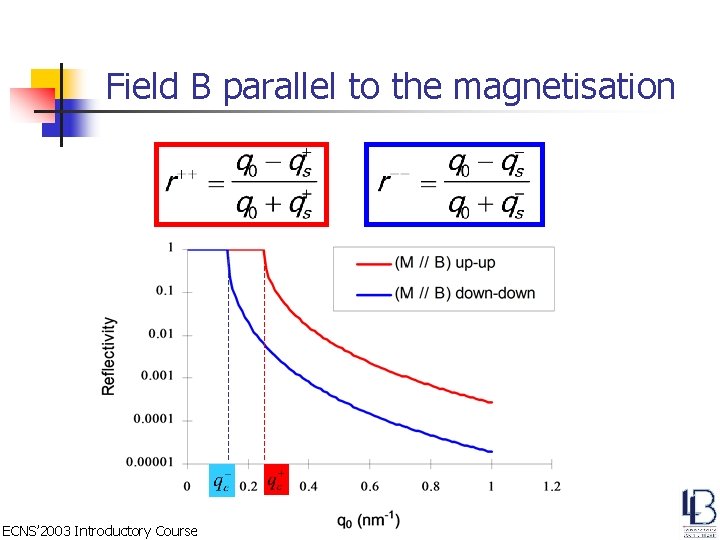
Field B parallel to the magnetisation ECNS’ 2003 Introductory Course
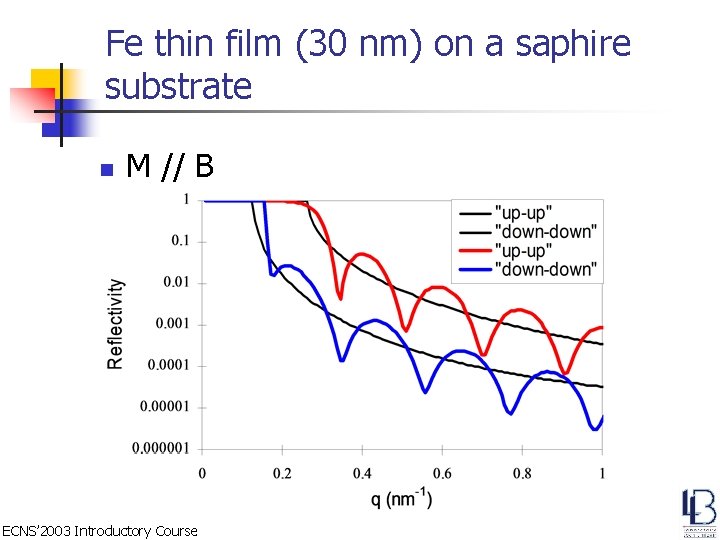
Fe thin film (30 nm) on a saphire substrate n M // B ECNS’ 2003 Introductory Course
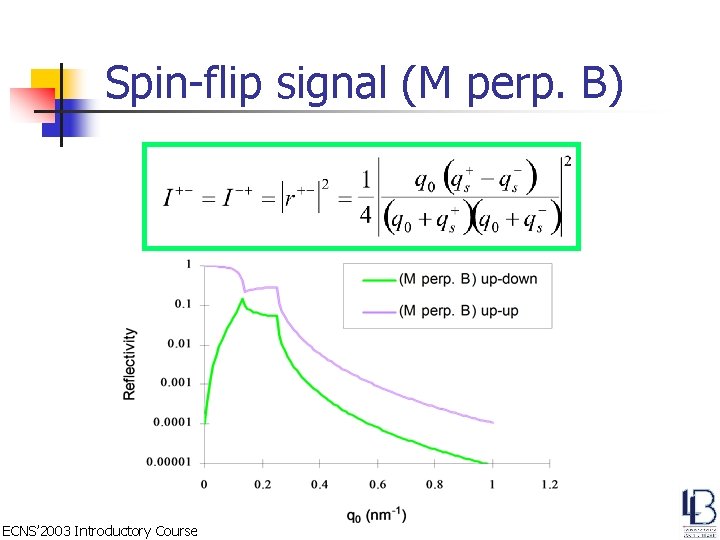
Spin-flip signal (M perp. B) ECNS’ 2003 Introductory Course
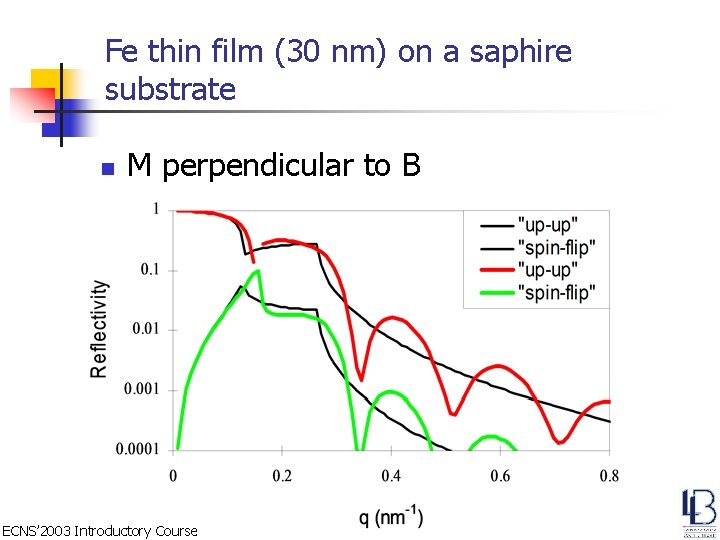
Fe thin film (30 nm) on a saphire substrate n M perpendicular to B ECNS’ 2003 Introductory Course
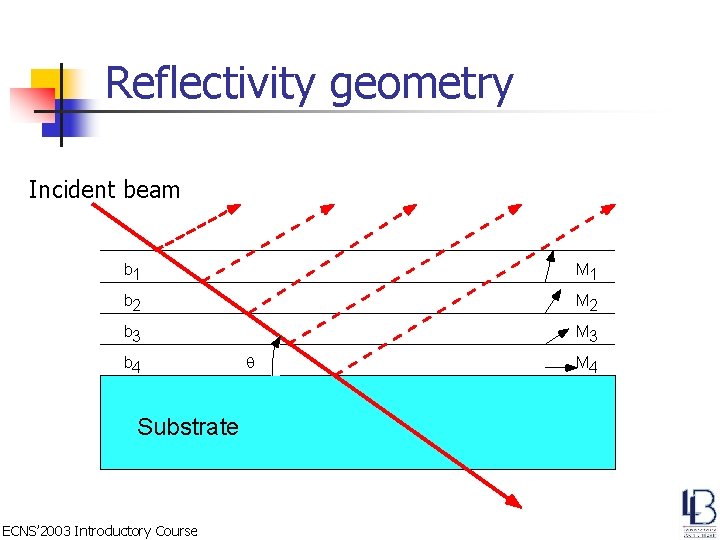
Reflectivity geometry Incident beam b 1 M 1 b 2 M 2 b 3 M 3 b 4 Substrate ECNS’ 2003 Introductory Course q M 4
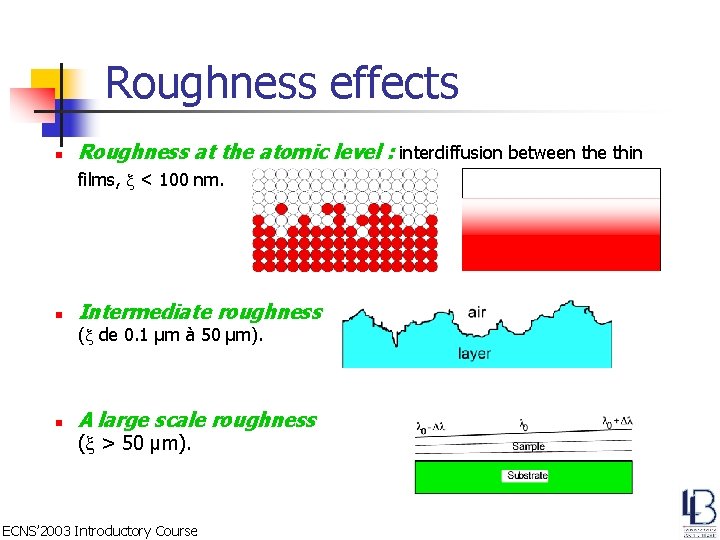
Roughness effects n Roughness at the atomic level : interdiffusion between the thin films, x < 100 nm. n Intermediate roughness (x de 0. 1 µm à 50 µm). n A large scale roughness (x > 50 µm). ECNS’ 2003 Introductory Course
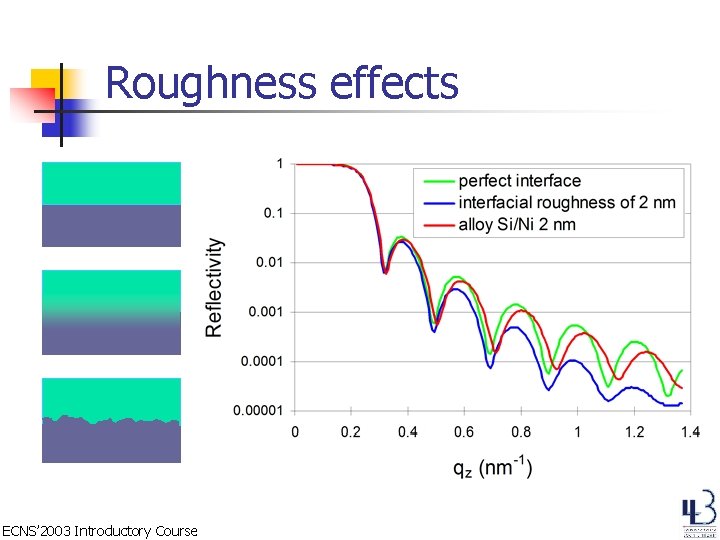
Roughness effects ECNS’ 2003 Introductory Course
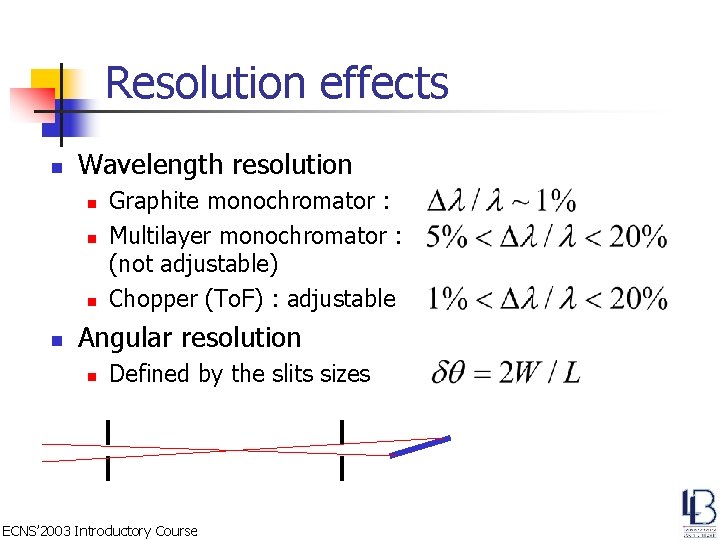
Resolution effects n Wavelength resolution n n Graphite monochromator : Multilayer monochromator : (not adjustable) Chopper (To. F) : adjustable Angular resolution n Defined by the slits sizes ECNS’ 2003 Introductory Course
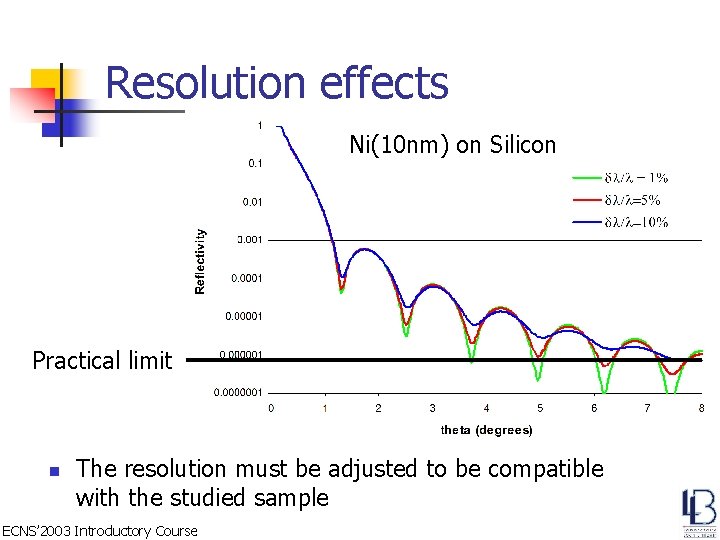
Resolution effects Ni(10 nm) on Silicon Practical limit n The resolution must be adjusted to be compatible with the studied sample ECNS’ 2003 Introductory Course
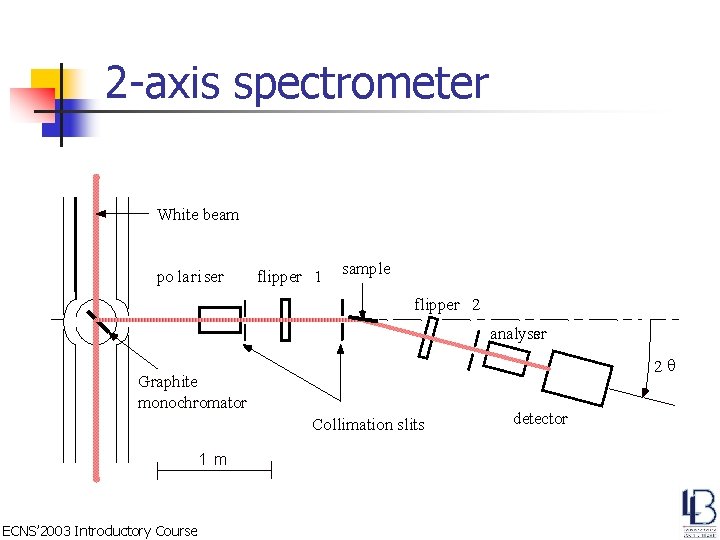
2 -axis spectrometer White beam po lari ser flipper 1 sample flipper 2 analyser s 2 q Graphite monochromator Collimation slits 1 m ECNS’ 2003 Introductory Course detector
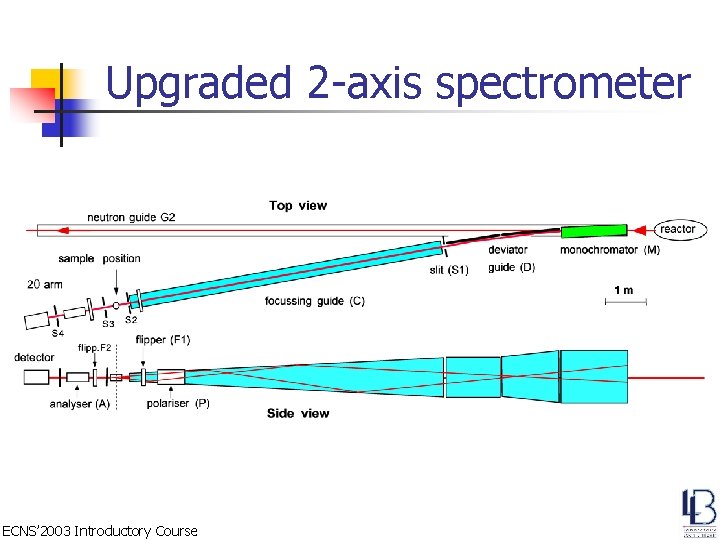
Upgraded 2 -axis spectrometer ECNS’ 2003 Introductory Course
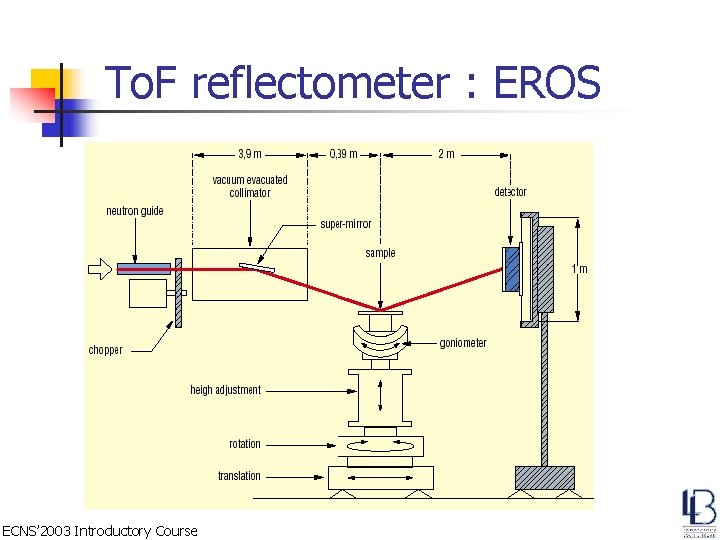
To. F reflectometer : EROS ECNS’ 2003 Introductory Course
PNR range of studies n n Multilayers Superconductors Non colinear magnetism Interface magnetism ECNS’ 2003 Introductory Course
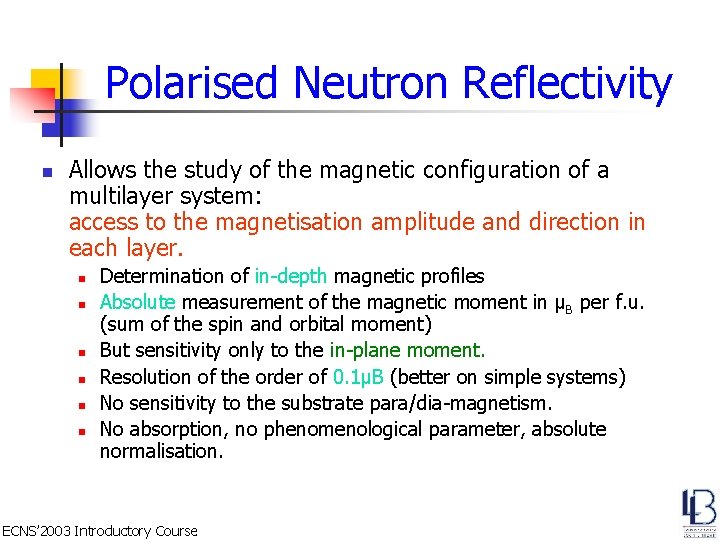
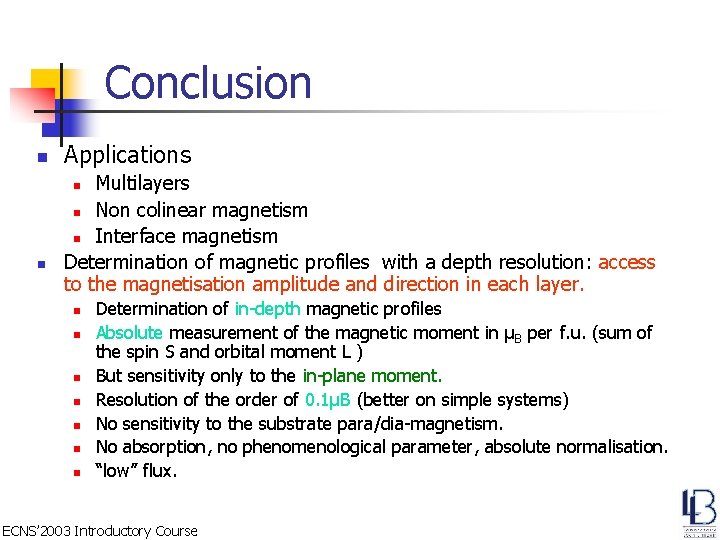
Polarised Neutron Reflectivity n Allows the study of the magnetic configuration of a multilayer system: access to the magnetisation amplitude and direction in each layer. n n n Determination of in-depth magnetic profiles Absolute measurement of the magnetic moment in µB per f. u. (sum of the spin and orbital moment) But sensitivity only to the in-plane moment. Resolution of the order of 0. 1µB (better on simple systems) No sensitivity to the substrate para/dia-magnetism. No absorption, no phenomenological parameter, absolute normalisation. ECNS’ 2003 Introductory Course
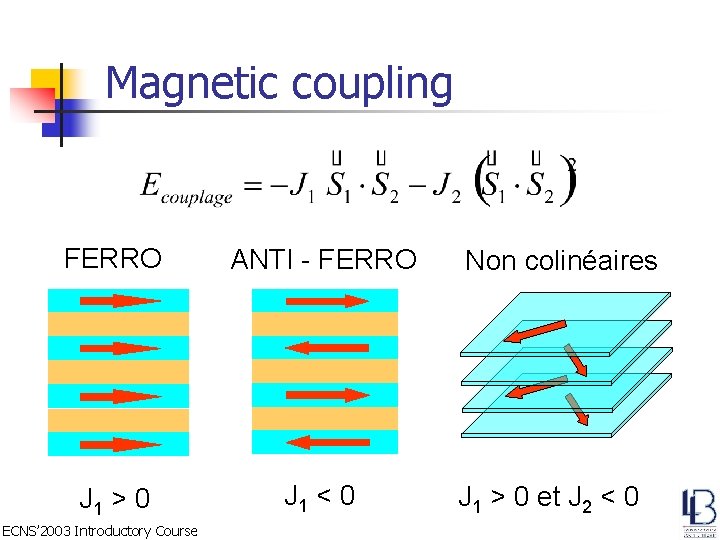
Magnetic coupling FERRO ANTI - FERRO J 1 > 0 J 1 < 0 ECNS’ 2003 Introductory Course Non colinéaires J 1 > 0 et J 2 < 0
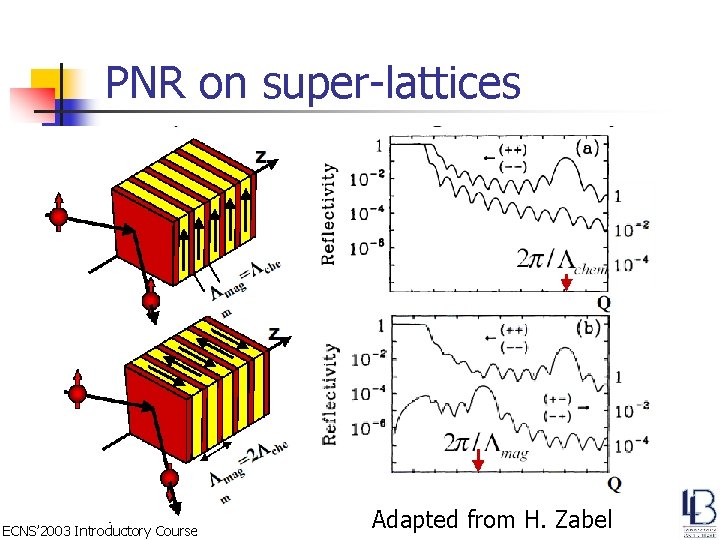
PNR on super-lattices ECNS’ 2003 Introductory Course Adapted from H. Zabel
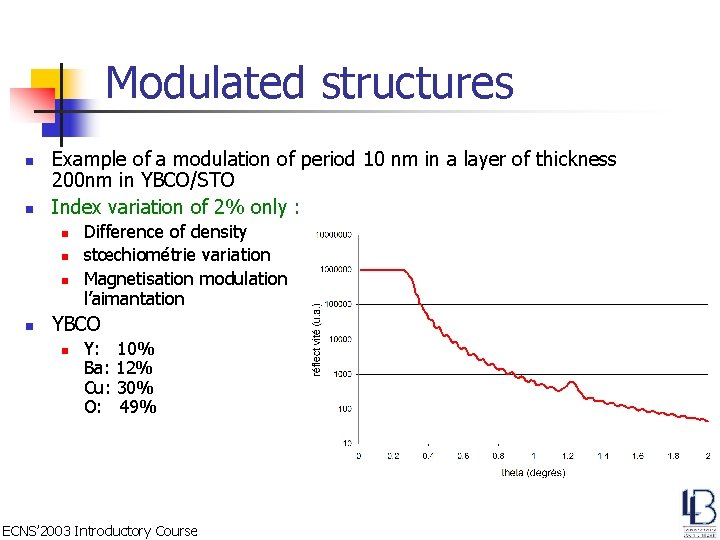
Modulated structures n n Example of a modulation of period 10 nm in a layer of thickness 200 nm in YBCO/STO Index variation of 2% only : n n Difference of density stœchiométrie variation Magnetisation modulation de l’aimantation YBCO n Y: 10% Ba: 12% Cu: 30% O: 49% ECNS’ 2003 Introductory Course

Example: magnetisation modulation n La 0. 3 Sr 0. 7 Mn. O 3 film ECNS’ 2003 Introductory Course
![Exchange coupling in super-lattices [Ga. Mn. As/Ga. As] n Super-lattice (Ga. Mn. As)m/(Ga. As)n](http://slidetodoc.com/presentation_image_h/2ebc5246d651b71f4074b632288ef453/image-40.jpg "Exchange coupling in super-lattices [Ga. Mn. As/Ga. As] n Super-lattice (Ga. Mn. As)m/(Ga. As)n")
Exchange coupling in super-lattices [Ga. Mn. As/Ga. As] n Super-lattice (Ga. Mn. As)m/(Ga. As)n where 8<m<16 et 4<n<8 Mn doping 6 -7% Magnetisation of 0. 03 T (27 k. A/m) No antiferromagnetic coupling is observed. ECNS’ 2003 Introductory Course
![Magnetic ordering in multilayers [ Fe/Si ]n @ 300 K; 2. 8 m. T](http://slidetodoc.com/presentation_image_h/2ebc5246d651b71f4074b632288ef453/image-41.jpg "Magnetic ordering in multilayers [ Fe/Si ]n @ 300 K; 2. 8 m. T")
Magnetic ordering in multilayers [ Fe/Si ]n @ 300 K; 2. 8 m. T n n K. Fronc (Polish. Acad. Sc. ) Ga. As//[Fe(2. 4 nm)Si(1. 2 nm)]n magnetic AF order at 300 K non collinear coupling at 200 K @ 7 K; 20 m. T ECNS’ 2003 Introductory Course @ 200 K; 20 m. T
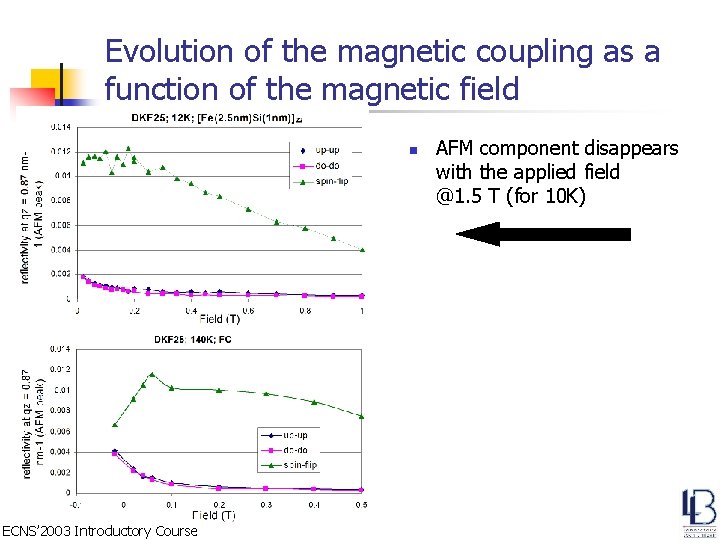
Evolution of the magnetic coupling as a function of the magnetic field n ECNS’ 2003 Introductory Course AFM component disappears with the applied field @1. 5 T (for 10 K)
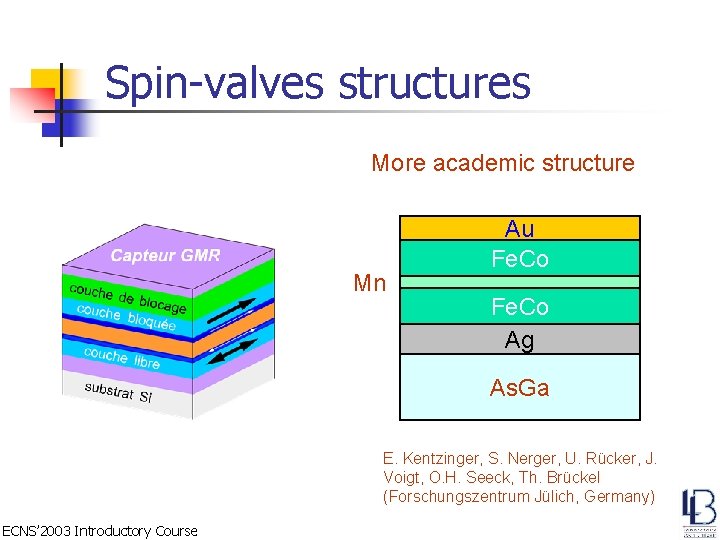
Spin-valves structures More academic structure Mn Au Fe. Co Ag As. Ga E. Kentzinger, S. Nerger, U. Rücker, J. Voigt, O. H. Seeck, Th. Brückel (Forschungszentrum Jülich, Germany) ECNS’ 2003 Introductory Course
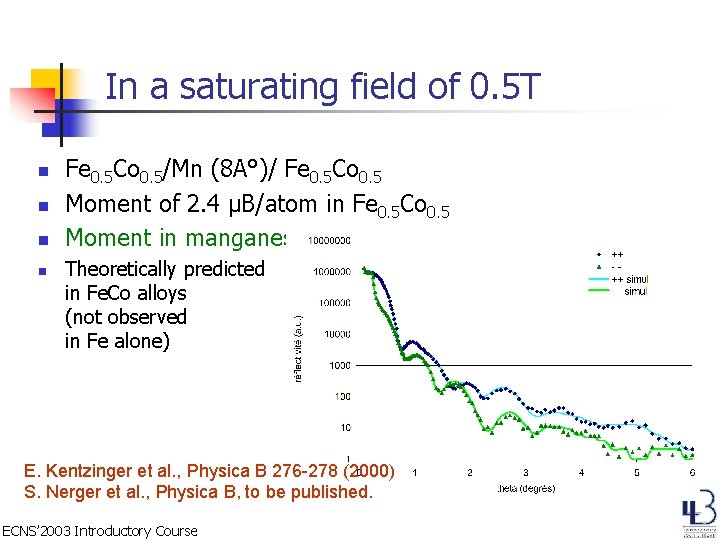
In a saturating field of 0. 5 T n n Fe 0. 5 Co 0. 5/Mn (8 A°)/ Fe 0. 5 Co 0. 5 Moment of 2. 4 µB/atom in Fe 0. 5 Co 0. 5 Moment in manganese of 0. 8µB/atom! Theoretically predicted in Fe. Co alloys (not observed in Fe alone) E. Kentzinger et al. , Physica B 276 -278 (2000) S. Nerger et al. , Physica B, to be published. ECNS’ 2003 Introductory Course
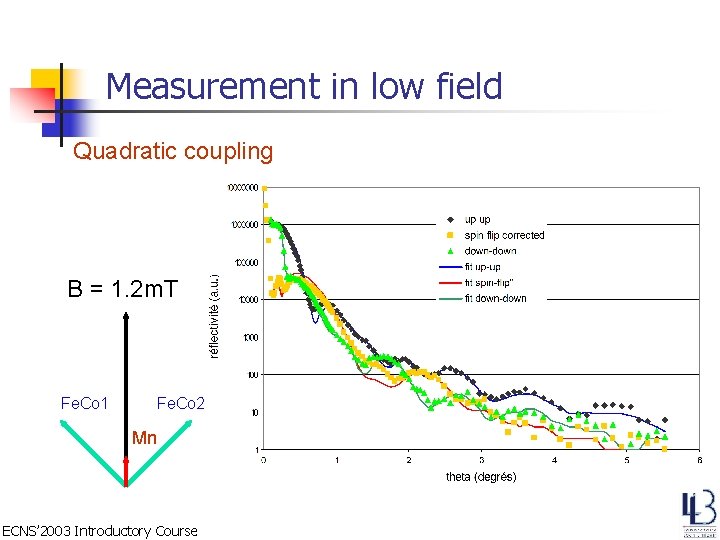
Measurement in low field Quadratic coupling B = 1. 2 m. T Fe. Co 1 Fe. Co 2 Mn ECNS’ 2003 Introductory Course
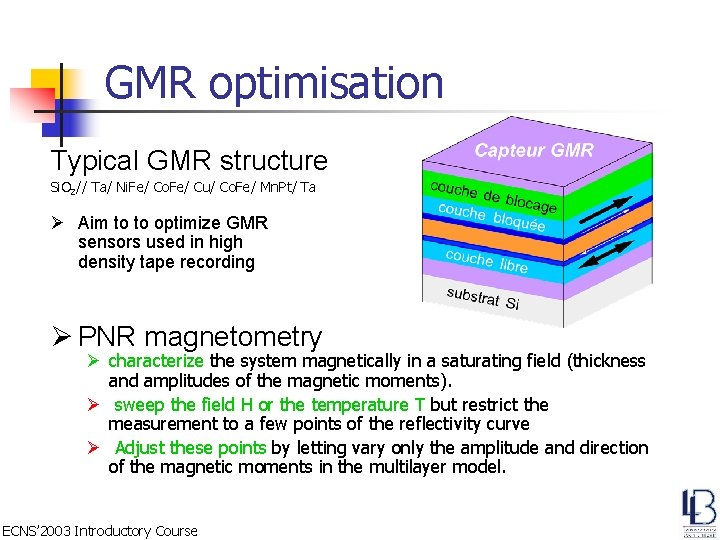
GMR optimisation Typical GMR structure Si. O 2// Ta/ Ni. Fe/ Co. Fe/ Cu/ Co. Fe/ Mn. Pt/ Ta Ø Aim to to optimize GMR sensors used in high density tape recording Ø PNR magnetometry Ø characterize the system magnetically in a saturating field (thickness and amplitudes of the magnetic moments). Ø sweep the field H or the temperature T but restrict the measurement to a few points of the reflectivity curve Ø Adjust these points by letting vary only the amplitude and direction of the magnetic moments in the multilayer model. ECNS’ 2003 Introductory Course
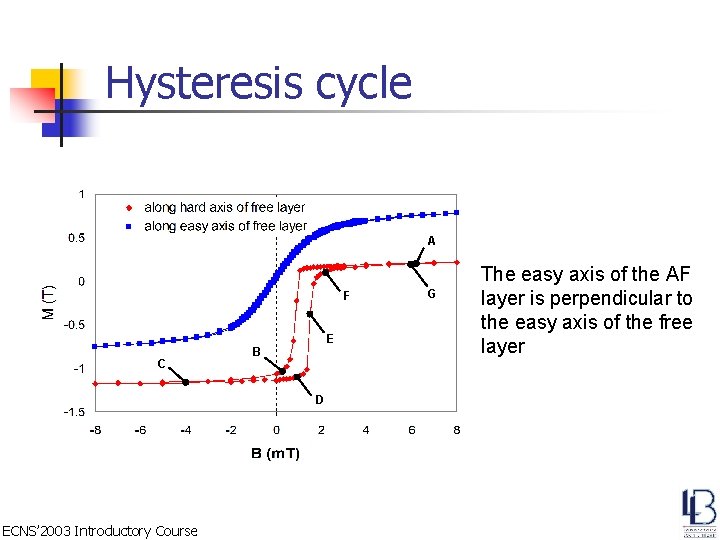
Hysteresis cycle A F C E B D ECNS’ 2003 Introductory Course G The easy axis of the AF layer is perpendicular to the easy axis of the free layer

PNR magnetometry Ø Magnetisation of the different layers as a function of the applied field Ni. Fe Co. Fe Cu Co. Fe Mn. Pt A (6 m. T) D (+1 m. T) ECNS’ 2003 Introductory Course B (0. 5 m. T) E (1. 5 m. T) C (-4 m. T) G (6 m. T)
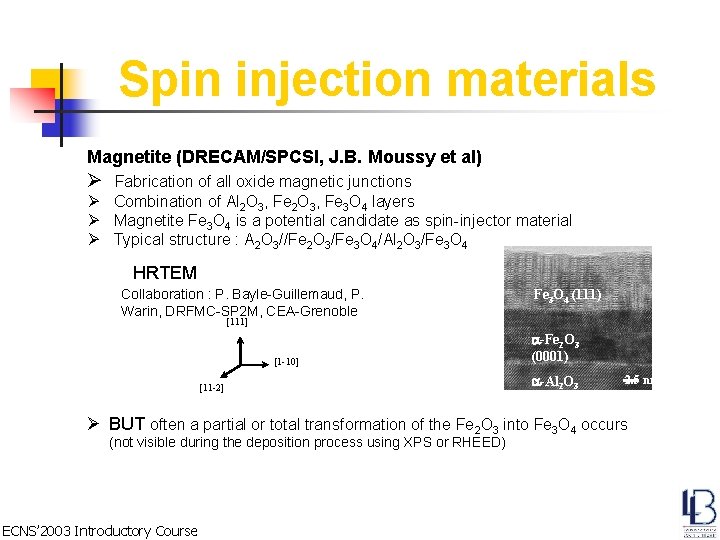
Spin injection materials Magnetite (DRECAM/SPCSI, J. B. Moussy et al) Ø Fabrication of all oxide magnetic junctions Ø Combination of Al 2 O 3, Fe 3 O 4 layers Ø Magnetite Fe 3 O 4 is a potential candidate as spin-injector material Ø Typical structure : A 2 O 3//Fe 2 O 3/Fe 3 O 4/Al 2 O 3/Fe 3 O 4 HRTEM Collaboration : P. Bayle-Guillemaud, P. Warin, DRFMC-SP 2 M, CEA-Grenoble Fe 3 O 4 (111) [111] [1 -10] [11 -2] a-Fe 2 O 3 (0001) a-Al 2 O 3 (0001) 2. 5 nm Ø BUT often a partial or total transformation of the Fe 2 O 3 into Fe 3 O 4 occurs (not visible during the deposition process using XPS or RHEED) ECNS’ 2003 Introductory Course

PNR characterisation Ø Neutron reflectivity allows to very quickly check the presence or absence of Fe 2 O 3 layer (by using the magnetic contrast) Ø Information on the magnetic moments : Ø the transformed layer has a reduced magnetic moment M = 2. 5 µB/f. u. M = 1. 75 µB/f. u. Al 2 O 3 ECNS’ 2003 Introductory Course The transformation process is not yet understood
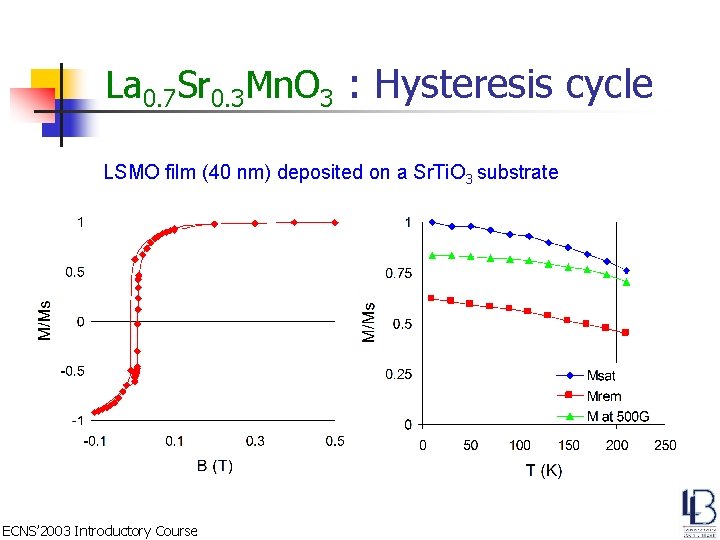
La 0. 7 Sr 0. 3 Mn. O 3 : Hysteresis cycle LSMO film (40 nm) deposited on a Sr. Ti. O 3 substrate ECNS’ 2003 Introductory Course

Reflectivity measurements. n LSMO on Mg. O (68 nm) ECNS’ 2003 Introductory Course LSMO on STO (56 nm)
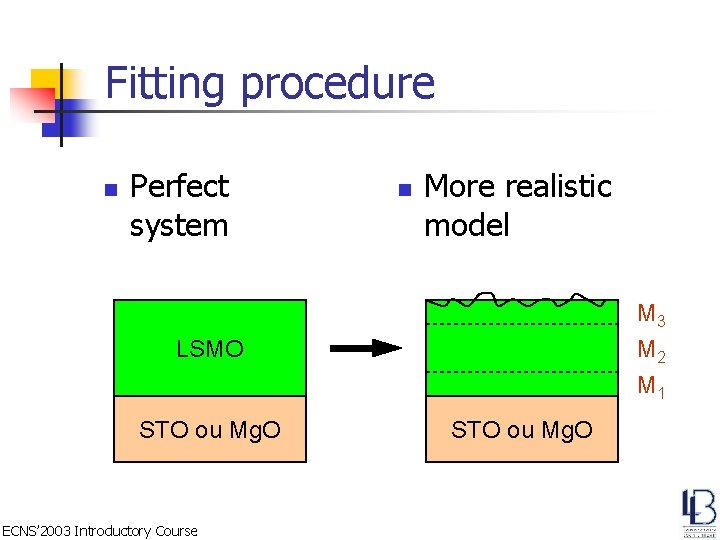
Fitting procedure n Perfect system n More realistic model M 3 M 2 M 1 LSMO STO ou Mg. O ECNS’ 2003 Introductory Course STO ou Mg. O
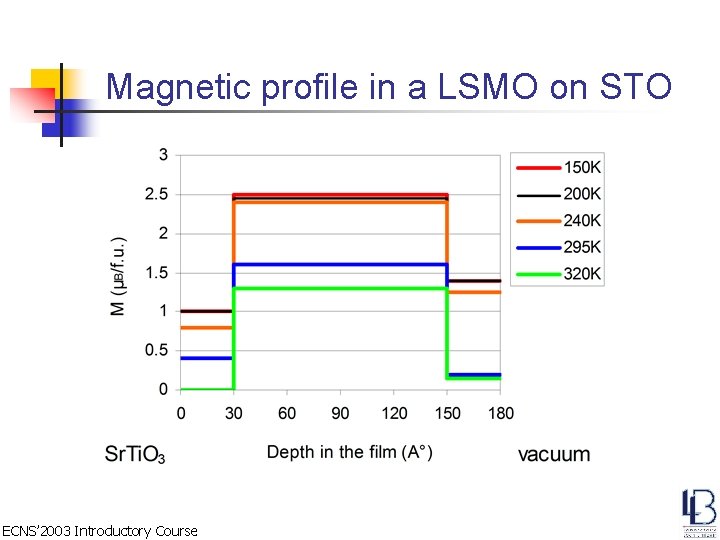
Magnetic profile in a LSMO on STO ECNS’ 2003 Introductory Course
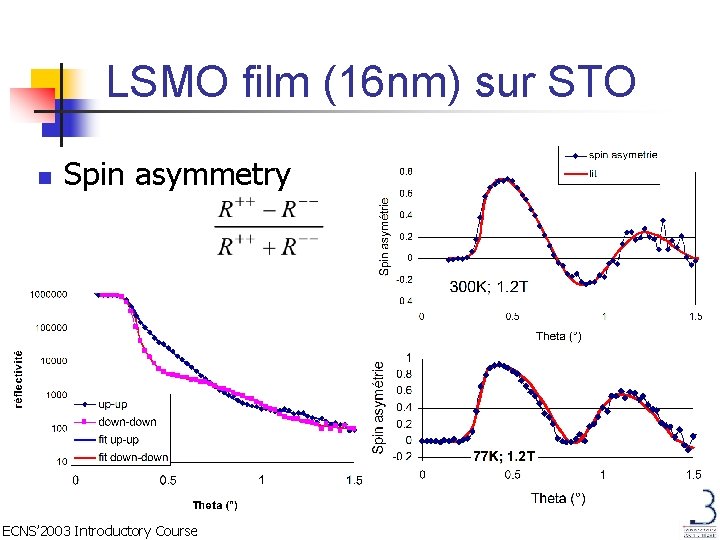
LSMO film (16 nm) sur STO n Spin asymmetry ECNS’ 2003 Introductory Course
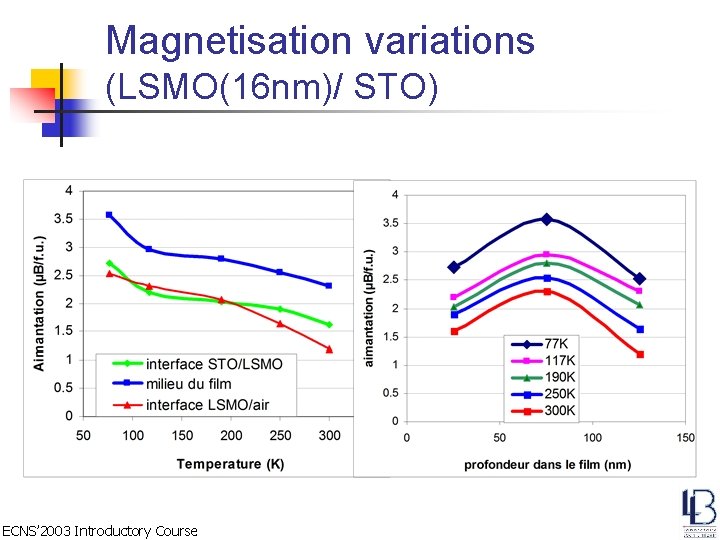
Magnetisation variations (LSMO(16 nm)/ STO) ECNS’ 2003 Introductory Course
Conclusion n Applications Multilayers n Non colinear magnetism n Interface magnetism Determination of magnetic profiles with a depth resolution: access to the magnetisation amplitude and direction in each layer. n n n n n Determination of in-depth magnetic profiles Absolute measurement of the magnetic moment in µB per f. u. (sum of the spin S and orbital moment L ) But sensitivity only to the in-plane moment. Resolution of the order of 0. 1µB (better on simple systems) No sensitivity to the substrate para/dia-magnetism. No absorption, no phenomenological parameter, absolute normalisation. “low” flux. ECNS’ 2003 Introductory Course
Bibliography n A few recent general references n n n H. Zabel et al, Physica B 276 -278 (2000) 17 -21. « Neutron Reflectometry on magnetic thin films » H. Zabel et al, J. Phys. : Condens. Matter 15 (2003) S 505 -S 517. Polarized neutron reflectivity and scattering studies of magnetic heterostructures. G. P. Felcher, J. Applied Physics 87 (2000) 5431 Neutron reflectometry as a tool to study magnetism G. Fragneto-Cusani, J. Phys. : Condens. Matter 13 (2001) 49734989 Other ressources n n n www-llb. cea. fr/prism/PRISM. html http: //www. neutron. anl. gov/software. html All existing reflectometers : http: //www. studsvik. uu. se/research/NR/reflect. htm ECNS’ 2003 Introductory Course
- Slides: 58