
POLARIMETRY POLARIMETRY The substances that turn the polarized
POLARIMETRY
POLARIMETRY • The substances that turn the polarized light plane to the right or left are optically active substances. The substances that turn the polarized light plane to the right are called dextrojir, and the ones turning to the left are called levojir. (+) sign is put in front of those which are turned right and (-) sign is put in front of those which are turned left.
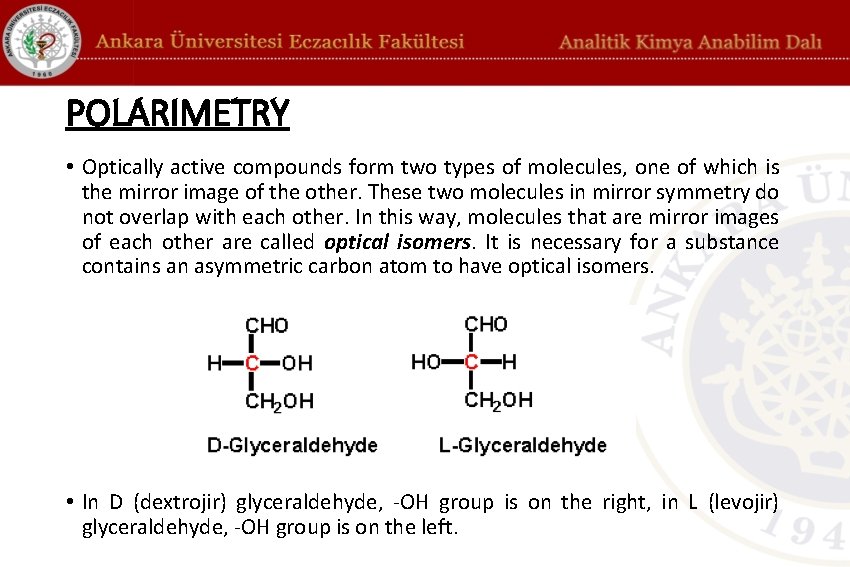
POLARIMETRY • Optically active compounds form two types of molecules, one of which is the mirror image of the other. These two molecules in mirror symmetry do not overlap with each other. In this way, molecules that are mirror images of each other are called optical isomers. It is necessary for a substance contains an asymmetric carbon atom to have optical isomers. • In D (dextrojir) glyceraldehyde, -OH group is on the right, in L (levojir) glyceraldehyde, -OH group is on the left.
POLARIMETER • The instrument which measures the rotation angle of polarized light plane is called polarimeter. Polarimeters are used to determine the concentration and molecular size and to control foodstuffs. • A polarimeter consists of two polarizers, one of which rotates in a vertical plane and the other is stable. Calcite crystals are used as polarizers. The stable calcite crystal is called polarizer, the rotatable is called analyzer (A polarizer is a device that introduces a beam of undefined electromagnetic waves into a defined polarization).
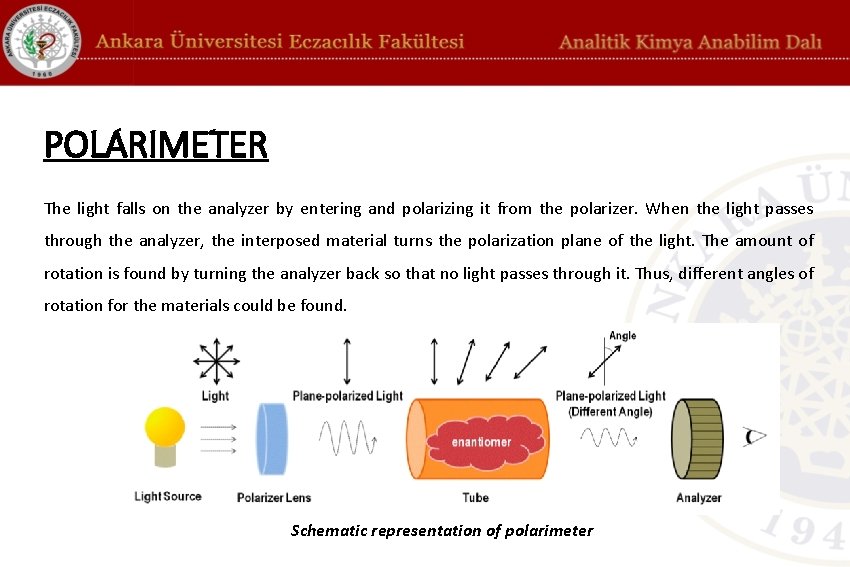
POLARIMETER The light falls on the analyzer by entering and polarizing it from the polarizer. When the light passes through the analyzer, the interposed material turns the polarization plane of the light. The amount of rotation is found by turning the analyzer back so that no light passes through it. Thus, different angles of rotation for the materials could be found. Schematic representation of polarimeter
FACTORS AFFECTING THE ANGLE OF ROTATION • Temperature • The wavelength of the light used (if the wavelength is smaller, the angle of rotation will be large) • Path length which the light pass through • Structure of the substance • Concentration of the substance • Since the aim of the polarimetry is to determine the concentration by taking advantage of the measured angle of rotation, the work to be done is to keep the factors constant except concentration and establish a connection between the concentration and the angle of rotation.
• The compound which has the asymmetric carbon atom is also optically active. Optical activity is ability of a material to deflect a polarized light from its plane. • When planar polarized light interacts with asymmetric organic or inorganic compounds, the plane angle of polarized light changes. • Each of the optically active substances, which turns the polarizer light direction to right and left, are called the enantiomer.
DETERMINATION WITH POLARIMETER • Determination of molecular size, • Determination of concentration, • Control of the foodstuffs • Determination of the purity of materials produced in scientific research • At the production plants where the chemical industry stands out
USAGE AREAS OF POLARIMETER • Pharmacy; It is used to measure the concentration of some optically active • compounds in produced pharmaceutical products. • Cosmetic Industry; It is used for the quality control of the used essences and aromatic oils. • Food Industry; It is used in the quality control of the produced foods and in determining the upper and lower limits of the additives. Generally, it is utilized the optical activity of substances which contains sugar.
DETERMINATION OF GLUCOSE MONOHYDRATE • 1 M stock solution is prepared. (19. 817 g glucose monohydrate dissolved in 100 m. L water in volumetric flask) • 0. 1 M, 0. 15 M, 0. 20 M, 0. 25 M and 0. 50 M standard solutions are prepared by this stock solution. • A sample of unknown concentration will be given to you by your teaching assistant. • The small tube is filled with pure water so that no air bubble is left, and it is placed in the center of the reading compartment of the device and the lid is closed. By looking at the microscope hole of the device, the color of the double compartments is equalized. If the right-hand pane is darker, the LEFT key is pressed until the color is equalized. If the lefthand pane is darker, the RIGHT key is pressed until the color is equalized. When the colors are equal, press the ZERO SET key. The screen displays a red zero. Then the samples to be read are placed in the reading compartment so that no air bubbles remain in the tube. Looking at the microscope glass, the colors of the double pane are equalized, and the red numbers shown on the screen are recorded. • The recorded values are plotted against the concentration and the calibration graph is created and the regression equation is calculated. • The given sample is measured in the same way and the obtained value is substituted in the regression equation and the concentration of the sample is calculated.
REFERENCES 1. Fundamentals of Analytical Chemistry, D. A. Skoog, D. M. West, Hollar, F. J. Crouch S. R. , IIX. Ed. 2004 2. Principles of Instrumental Analysis, D. A. Skoog, Hollar, F. J. Crouch S. R. , II. Ed. 1981 3. Analitik Kimya II, F. Onur, A. Ü. Eczacılık Fakültesi Yayınları No. 101, 2011 4. Analitik Kimya Pratikleri Kantitatif Analiz, F. Onur (Ed. ), A. Ü. Eczacılık Fakültesi Yayınları No. 111, 2014
- Slides: 11