
Polare Stratosphrenwolken Polar Stratospheric Clouds PSC http www
- Slides: 42
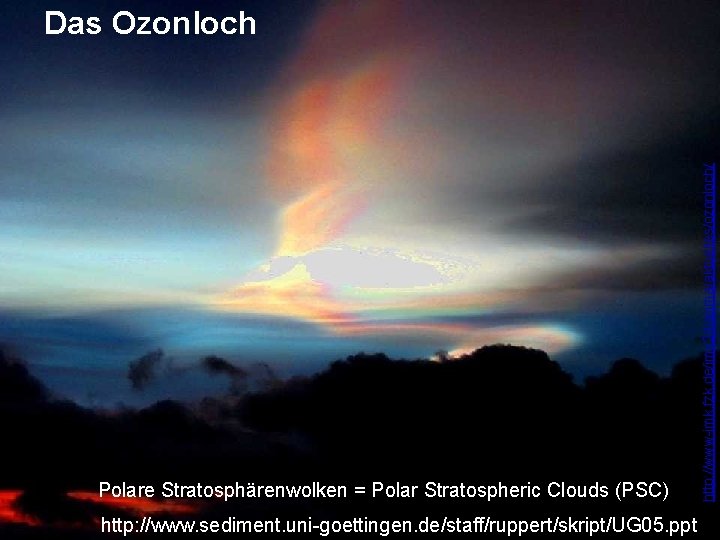
Polare Stratosphärenwolken = Polar Stratospheric Clouds (PSC) http: //www. sediment. uni-goettingen. de/staff/ruppert/skript/UG 05. ppt http: //www-imk. fzk. de/imk 2/kasima/aktuelles/ozonloch/ Das Ozonloch
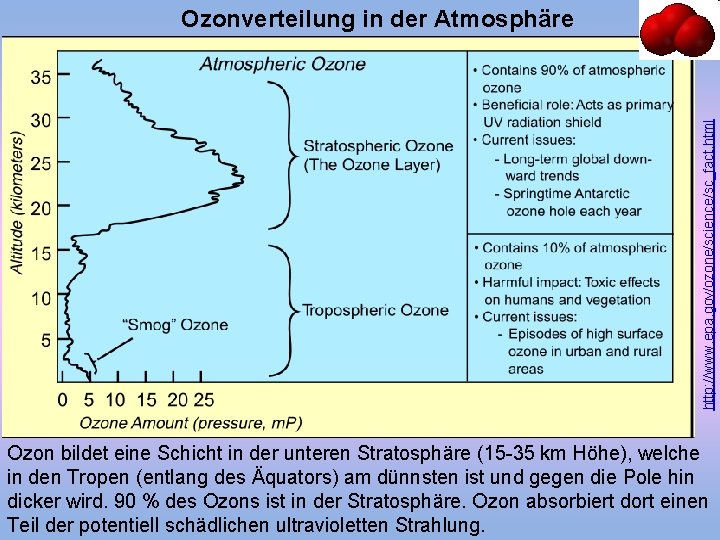
http: //www. epa. gov/ozone/science/sc_fact. html Ozonverteilung in der Atmosphäre Ozon bildet eine Schicht in der unteren Stratosphäre (15 -35 km Höhe), welche in den Tropen (entlang des Äquators) am dünnsten ist und gegen die Pole hin dicker wird. 90 % des Ozons ist in der Stratosphäre. Ozon absorbiert dort einen Teil der potentiell schädlichen ultravioletten Strahlung.
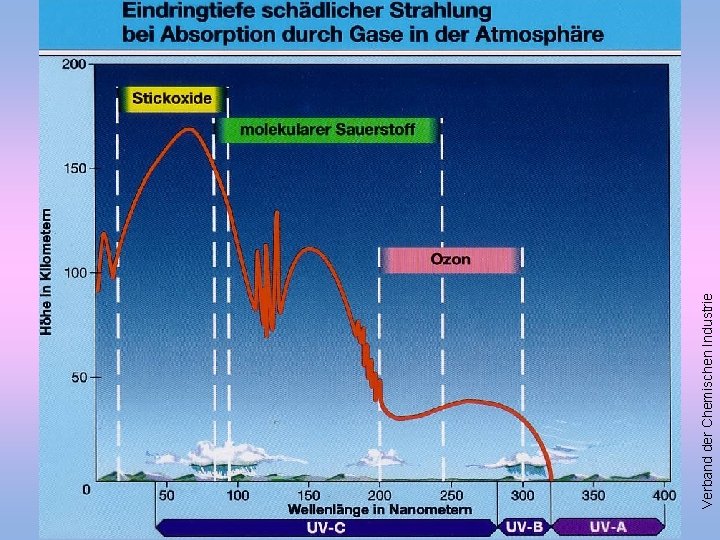
Verband der Chemischen Industrie
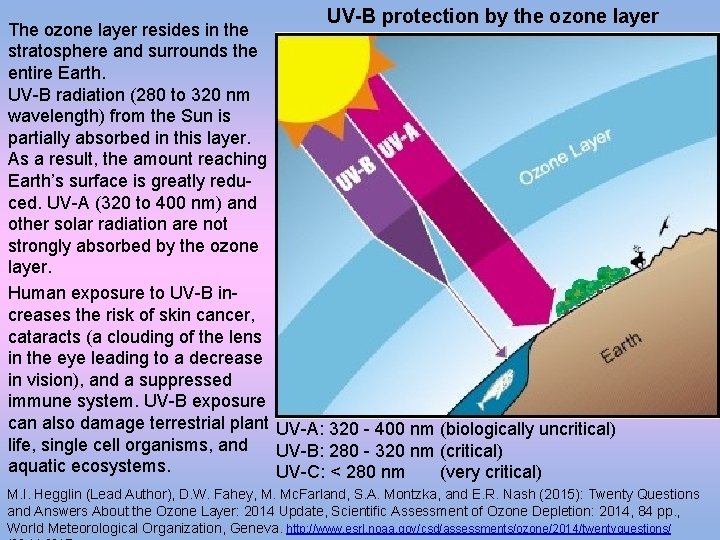
UV-B protection by the ozone layer The ozone layer resides in the stratosphere and surrounds the entire Earth. UV-B radiation (280 to 320 nm wavelength) from the Sun is partially absorbed in this layer. As a result, the amount reaching Earth’s surface is greatly reduced. UV-A (320 to 400 nm) and other solar radiation are not strongly absorbed by the ozone layer. Human exposure to UV-B increases the risk of skin cancer, cataracts (a clouding of the lens in the eye leading to a decrease in vision), and a suppressed immune system. UV-B exposure can also damage terrestrial plant UV-A: 320 - 400 nm (biologically uncritical) life, single cell organisms, and UV-B: 280 - 320 nm (critical) aquatic ecosystems. UV-C: < 280 nm (very critical) M. I. Hegglin (Lead Author), D. W. Fahey, M. Mc. Farland, S. A. Montzka, and E. R. Nash (2015): Twenty Questions and Answers About the Ozone Layer: 2014 Update, Scientific Assessment of Ozone Depletion: 2014, 84 pp. , World Meteorological Organization, Geneva. http: //www. esrl. noaa. gov/csd/assessments/ozone/2014/twentyquestions/
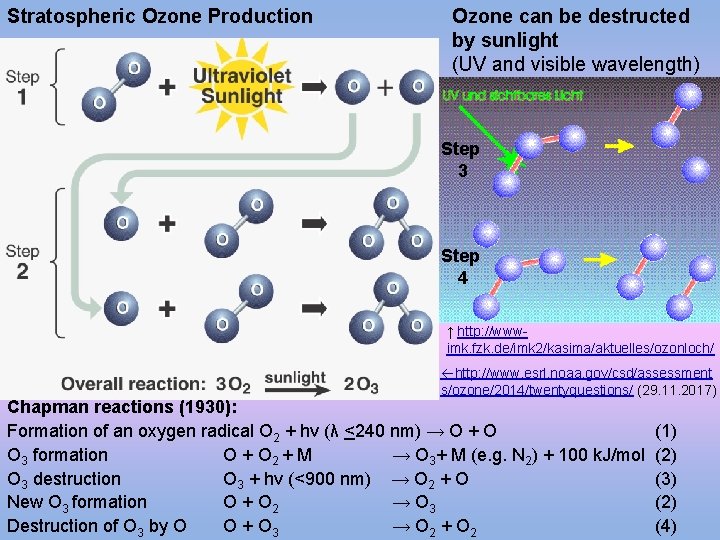
Stratospheric Ozone Production Ozone can be destructed by sunlight (UV and visible wavelength) Step 3 Step 4 ↑ http: //wwwimk. fzk. de/imk 2/kasima/aktuelles/ozonloch/ http: //www. esrl. noaa. gov/csd/assessment s/ozone/2014/twentyquestions/ (29. 11. 2017) Chapman reactions (1930): Formation of an oxygen radical O 2 + hν (λ <240 nm) → O + O O 3 formation O + O 2 + M → O 3+ M (e. g. N 2) + 100 k. J/mol O 3 destruction O 3 + hν (<900 nm) → O 2 + O New O 3 formation O + O 2 → O 3 Destruction of O 3 by O O + O 3 → O 2 + O 2 (1) (2) (3) (2) (4)
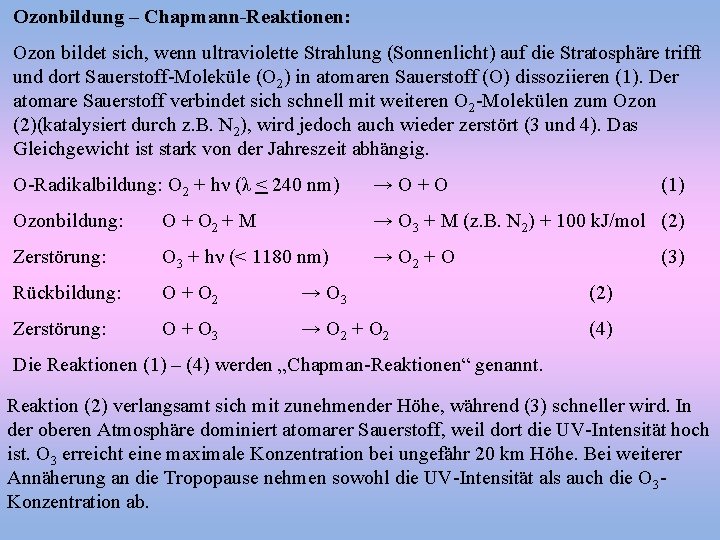
Ozonbildung – Chapmann-Reaktionen: Ozon bildet sich, wenn ultraviolette Strahlung (Sonnenlicht) auf die Stratosphäre trifft und dort Sauerstoff-Moleküle (O 2) in atomaren Sauerstoff (O) dissoziieren (1). Der atomare Sauerstoff verbindet sich schnell mit weiteren O 2 -Molekülen zum Ozon (2)(katalysiert durch z. B. N 2), wird jedoch auch wieder zerstört (3 und 4). Das Gleichgewicht ist stark von der Jahreszeit abhängig. O-Radikalbildung: O 2 + hν (λ < 240 nm) →O+O (1) Ozonbildung: O + O 2 + M → O 3 + M (z. B. N 2) + 100 k. J/mol (2) Zerstörung: O 3 + hν (< 1180 nm) → O 2 + O Rückbildung: O + O 2 → O 3 (2) Zerstörung: O + O 3 → O 2 + O 2 (4) (3) Die Reaktionen (1) – (4) werden „Chapman-Reaktionen“ genannt. Reaktion (2) verlangsamt sich mit zunehmender Höhe, während (3) schneller wird. In der oberen Atmosphäre dominiert atomarer Sauerstoff, weil dort die UV-Intensität hoch ist. O 3 erreicht eine maximale Konzentration bei ungefähr 20 km Höhe. Bei weiterer Annäherung an die Tropopause nehmen sowohl die UV-Intensität als auch die O 3 Konzentration ab.
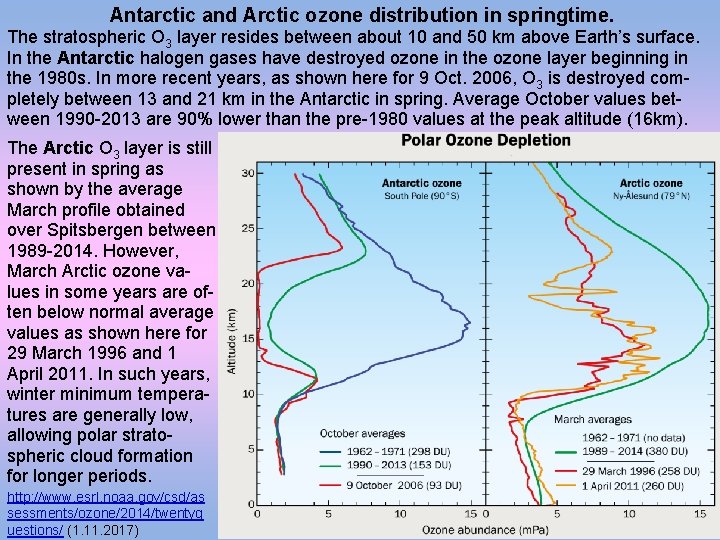
Antarctic and Arctic ozone distribution in springtime. The stratospheric O 3 layer resides between about 10 and 50 km above Earth’s surface. In the Antarctic halogen gases have destroyed ozone in the ozone layer beginning in the 1980 s. In more recent years, as shown here for 9 Oct. 2006, O 3 is destroyed completely between 13 and 21 km in the Antarctic in spring. Average October values between 1990 -2013 are 90% lower than the pre-1980 values at the peak altitude (16 km). The Arctic O 3 layer is still present in spring as shown by the average March profile obtained over Spitsbergen between 1989 -2014. However, March Arctic ozone values in some years are often below normal average values as shown here for 29 March 1996 and 1 April 2011. In such years, winter minimum temperatures are generally low, allowing polar stratospheric cloud formation for longer periods. http: //www. esrl. noaa. gov/csd/as sessments/ozone/2014/twentyq uestions/ (1. 11. 2017)
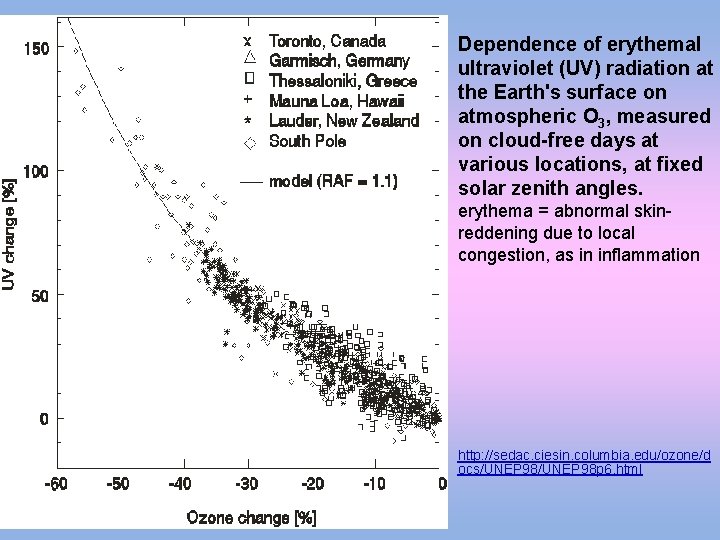
Dependence of erythemal ultraviolet (UV) radiation at the Earth's surface on atmospheric O 3, measured on cloud-free days at various locations, at fixed solar zenith angles. erythema = abnormal skinreddening due to local congestion, as in inflammation http: //sedac. ciesin. columbia. edu/ozone/d ocs/UNEP 98 p 6. html
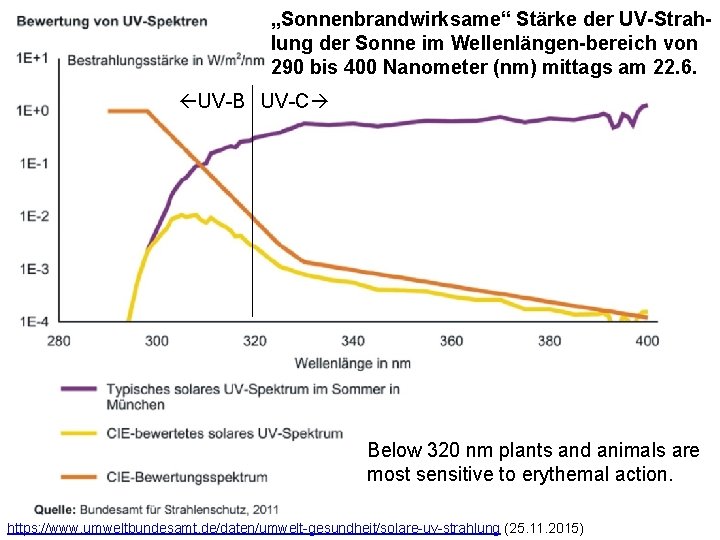
„Sonnenbrandwirksame“ Stärke der UV-Strahlung der Sonne im Wellenlängen-bereich von 290 bis 400 Nanometer (nm) mittags am 22. 6. UV-B UV-C Below 320 nm plants and animals are most sensitive to erythemal action. https: //www. umweltbundesamt. de/daten/umwelt-gesundheit/solare-uv-strahlung (25. 11. 2015)
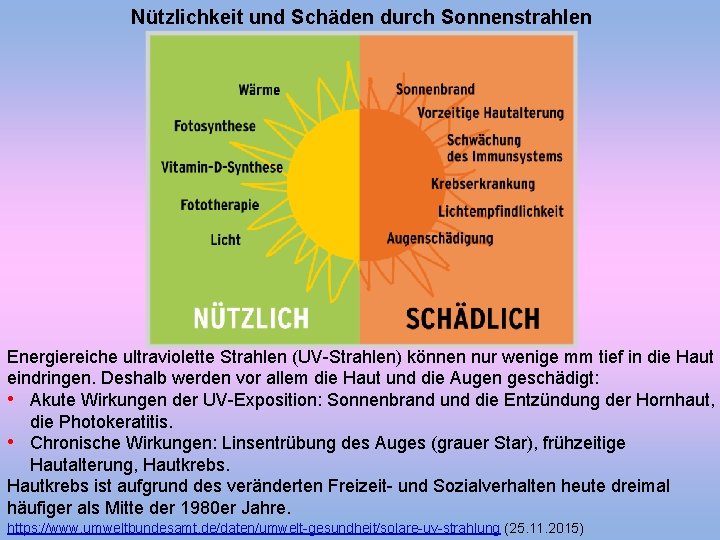
Nützlichkeit und Schäden durch Sonnenstrahlen Energiereiche ultraviolette Strahlen (UV-Strahlen) können nur wenige mm tief in die Haut eindringen. Deshalb werden vor allem die Haut und die Augen geschädigt: • Akute Wirkungen der UV-Exposition: Sonnenbrand und die Entzündung der Hornhaut, die Photokeratitis. • Chronische Wirkungen: Linsentrübung des Auges (grauer Star), frühzeitige Hautalterung, Hautkrebs ist aufgrund des veränderten Freizeit- und Sozialverhalten heute dreimal häufiger als Mitte der 1980 er Jahre. https: //www. umweltbundesamt. de/daten/umwelt-gesundheit/solare-uv-strahlung (25. 11. 2015)
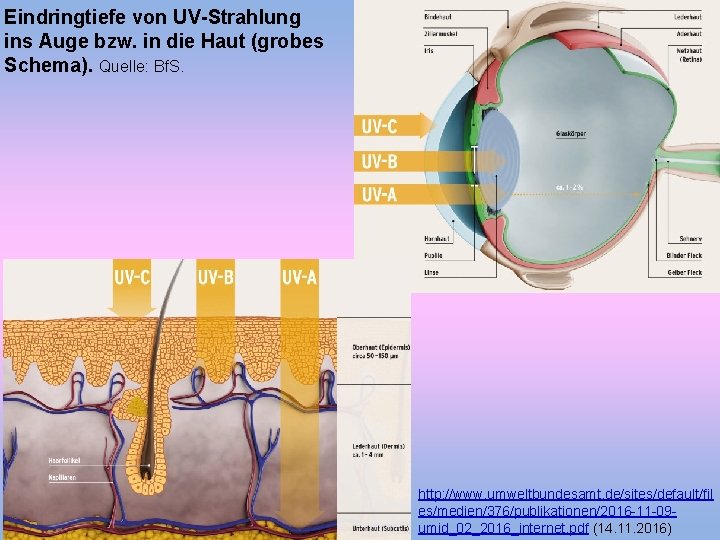
Eindringtiefe von UV-Strahlung ins Auge bzw. in die Haut (grobes Schema). Quelle: Bf. S. http: //www. umweltbundesamt. de/sites/default/fil es/medien/376/publikationen/2016 -11 -09 umid_02_2016_internet. pdf (14. 11. 2016)
Biologische Wirksamkeit einer erhöhten UV-B-Strahlung II Mensch: • Hautkrebs (Melanome) (teilweise verusacht durch Freizeitverhalten) • Gutartige Geschwülste (Nicht-Melanome) • Vorzeitige Alterung der Haut • Aktinische Keratose (Hautveränderung unter UV-B-Licht, Vorstadium Hautkrebs) • Katarakte (Grauer Star) und andere Augenkrankheiten • Suppression des Immunsystems Gewässerorganismen: UV-B-Strahlung kann in klaren Gewässern bis in 20 m Tiefe vordringen. Plankton ist besonders sensitiv. Klein-Lebewesen, wie Jungfische, Krebse und Shrimps, die an der Oberfläche leben, sind ebenfalls verletzlich. Diese Organismen bilden die Basis der ozeanischen Nahrungskette (Störung des ozeanischen Ökosystems) Pflanzen • Die Erträge werden zunächst bis zu Ozonverlusten von etwa -3% besser, da die Pflanzen mehr Energie in Form von UV-Licht erhalten. • Der Ertrag nimmt bei Ozonverlusten von -40% drastisch ab (Einwirkung auf CO 2 -Gehalt der Atmosphäre). • Die allgemeine Widerstandskraft gegen Krankheiten erhöht sich mit zunehmender Belastung. • Der Proteingehalt steigt mit zunehmender UV-Belastung zu, der Kohlenhydratgehalt sinkt.
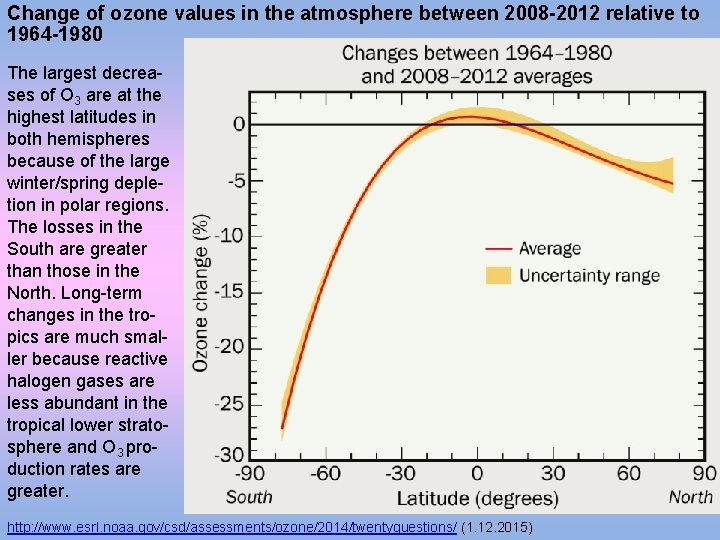
Change of ozone values in the atmosphere between 2008 -2012 relative to 1964 -1980 The largest decreases of O 3 are at the highest latitudes in both hemispheres because of the large winter/spring depletion in polar regions. The losses in the South are greater than those in the North. Long-term changes in the tropics are much smaller because reactive halogen gases are less abundant in the tropical lower stratosphere and O 3 production rates are greater. http: //www. esrl. noaa. gov/csd/assessments/ozone/2014/twentyquestions/ (1. 12. 2015)
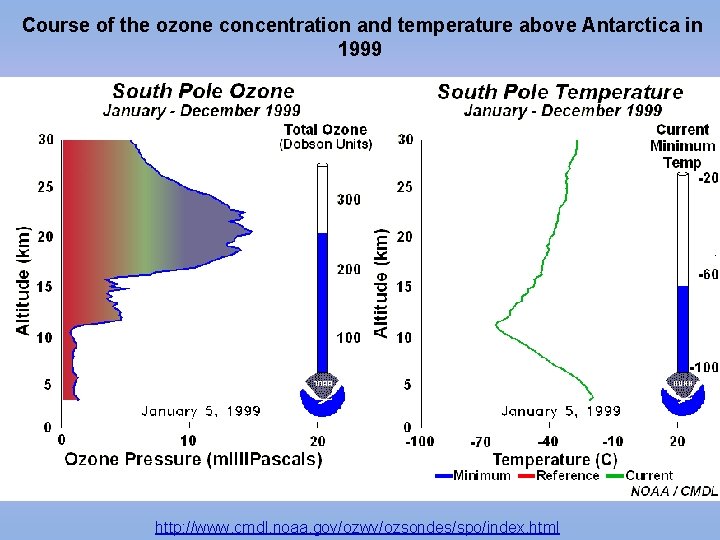
Course of the ozone concentration and temperature above Antarctica in 1999 http: //www. cmdl. noaa. gov/ozwv/ozsondes/spo/index. html
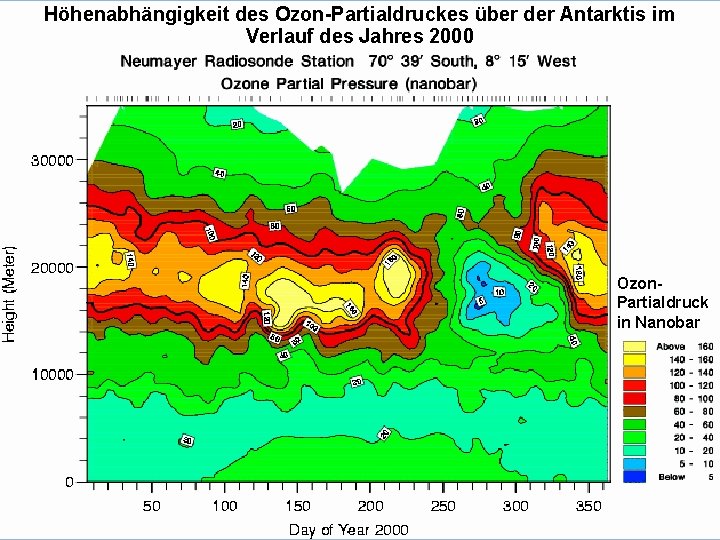
Höhenabhängigkeit des Ozon-Partialdruckes über der Antarktis im Verlauf des Jahres 2000 Ozon. Partialdruck in Nanobar
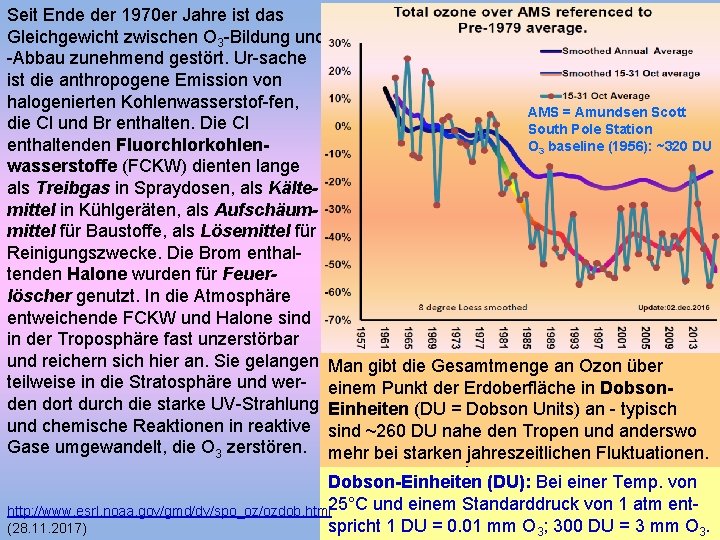
Seit Ende der 1970 er Jahre ist das Gleichgewicht zwischen O 3 -Bildung und -Abbau zunehmend gestört. Ur-sache ist die anthropogene Emission von halogenierten Kohlenwasserstof-fen, AMS = Amundsen Scott die Cl und Br enthalten. Die Cl South Pole Station O 3 baseline (1956): ~320 DU enthaltenden Fluorchlorkohlenwasserstoffe (FCKW) dienten lange als Treibgas in Spraydosen, als Kältemittel in Kühlgeräten, als Aufschäummittel für Baustoffe, als Lösemittel für Reinigungszwecke. Die Brom enthaltenden Halone wurden für Feuerlöscher genutzt. In die Atmosphäre entweichende FCKW und Halone sind in der Troposphäre fast unzerstörbar und reichern sich hier an. Sie gelangen Man gibt die Gesamtmenge an Ozon über teilweise in die Stratosphäre und wer- einem Punkt der Erdoberfläche in Dobsonden dort durch die starke UV-Strahlung Einheiten (DU = Dobson Units) an - typisch und chemische Reaktionen in reaktive sind ~260 DU nahe den Tropen und anderswo Gase umgewandelt, die O 3 zerstören. mehr bei starken jahreszeitlichen Fluktuationen. Ozon < 220 DU Ozonloch. Dobson-Einheiten (DU): Bei einer Temp. von http: //www. esrl. noaa. gov/gmd/dv/spo_oz/ozdob. html 25°C und einem Standarddruck von 1 atm entspricht 1 DU = 0. 01 mm O 3; 300 DU = 3 mm O 3. (28. 11. 2017)
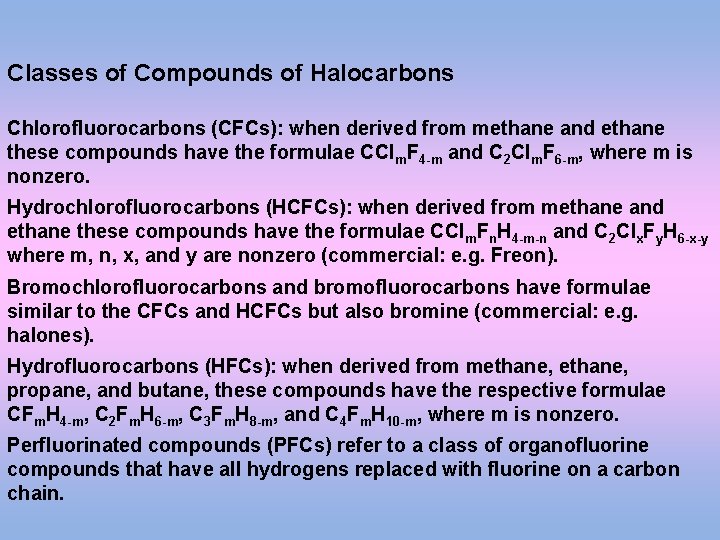
Classes of Compounds of Halocarbons Chlorofluorocarbons (CFCs): when derived from methane and ethane these compounds have the formulae CClm. F 4 -m and C 2 Clm. F 6 -m, where m is nonzero. Hydrochlorofluorocarbons (HCFCs): when derived from methane and ethane these compounds have the formulae CClm. Fn. H 4 -m-n and C 2 Clx. Fy. H 6 -x-y where m, n, x, and y are nonzero (commercial: e. g. Freon). Bromochlorofluorocarbons and bromofluorocarbons have formulae similar to the CFCs and HCFCs but also bromine (commercial: e. g. halones). Hydrofluorocarbons (HFCs): when derived from methane, propane, and butane, these compounds have the respective formulae CFm. H 4 -m, C 2 Fm. H 6 -m, C 3 Fm. H 8 -m, and C 4 Fm. H 10 -m, where m is nonzero. Perfluorinated compounds (PFCs) refer to a class of organofluorine compounds that have all hydrogens replaced with fluorine on a carbon chain.
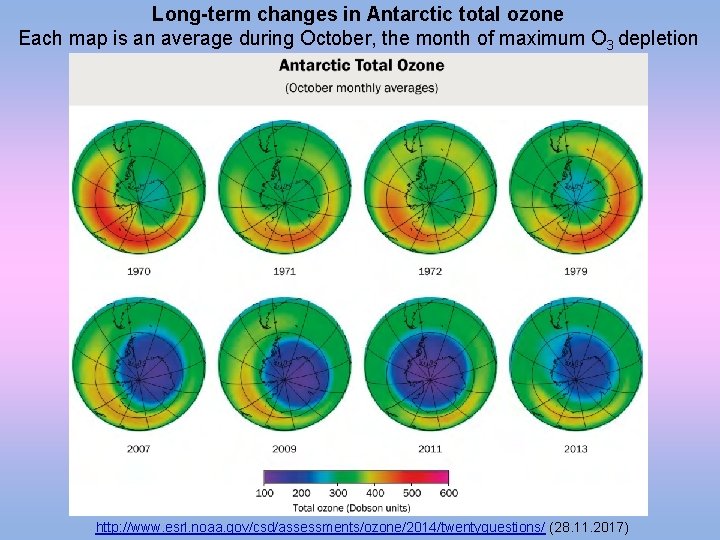
Long-term changes in Antarctic total ozone Each map is an average during October, the month of maximum O 3 depletion http: //www. esrl. noaa. gov/csd/assessments/ozone/2014/twentyquestions/ (28. 11. 2017)
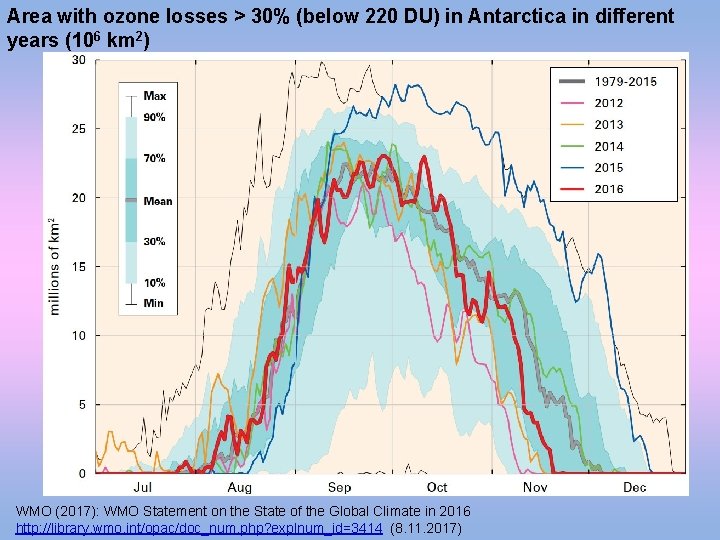
Area with ozone losses > 30% (below 220 DU) in Antarctica in different years (106 km 2) WMO (2017): WMO Statement on the State of the Global Climate in 2016 http: //library. wmo. int/opac/doc_num. php? explnum_id=3414 (8. 11. 2017)
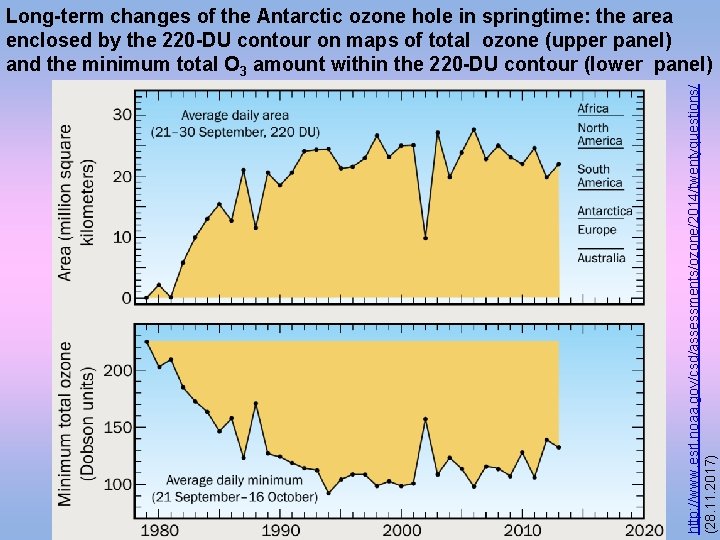
http: //www. esrl. noaa. gov/csd/assessments/ozone/2014/twentyquestions/ (28. 11. 2017) Long-term changes of the Antarctic ozone hole in springtime: the area enclosed by the 220 -DU contour on maps of total ozone (upper panel) and the minimum total O 3 amount within the 220 -DU contour (lower panel)
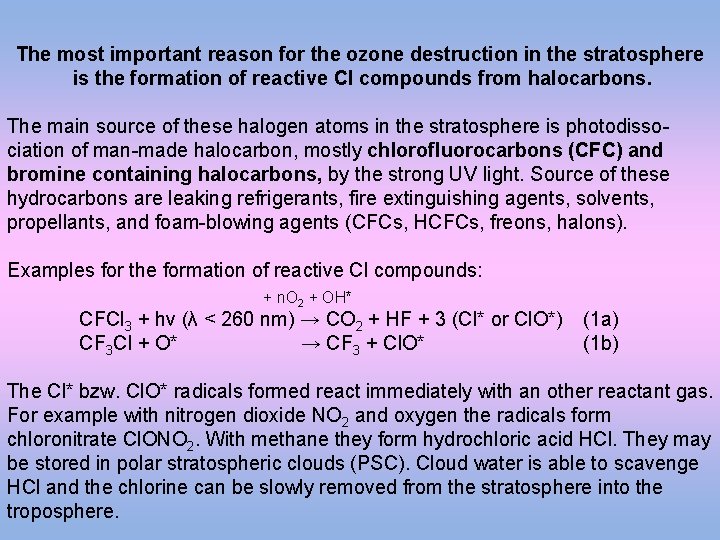
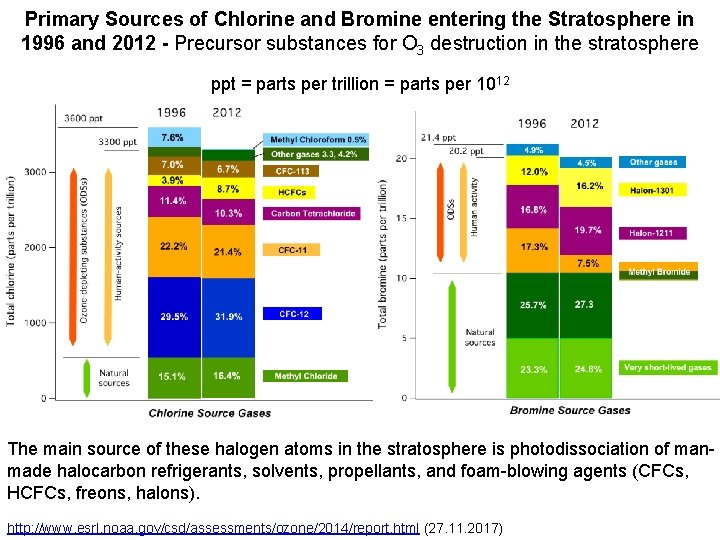
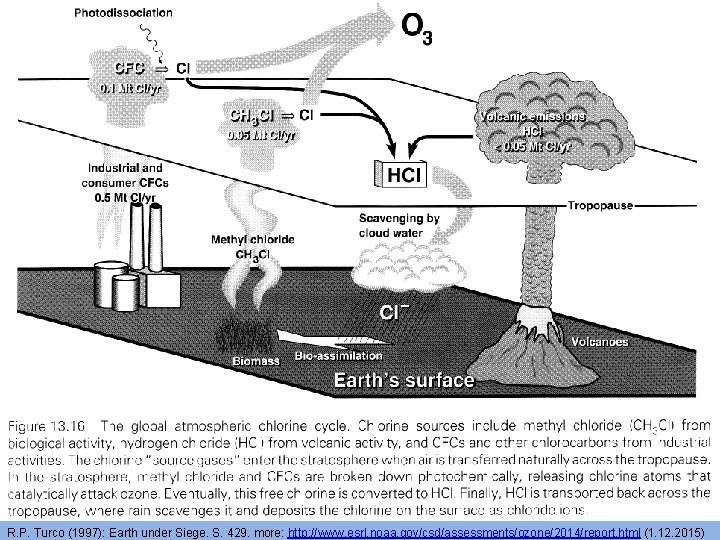
The most important reason for the ozone destruction in the stratosphere is the formation of reactive Cl compounds from halocarbons. The main source of these halogen atoms in the stratosphere is photodissociation of man-made halocarbon, mostly chlorofluorocarbons (CFC) and bromine containing halocarbons, by the strong UV light. Source of these hydrocarbons are leaking refrigerants, fire extinguishing agents, solvents, propellants, and foam-blowing agents (CFCs, HCFCs, freons, halons). Examples for the formation of reactive Cl compounds: + n. O 2 + OH* CFCl 3 + hν (λ < 260 nm) → CO 2 + HF + 3 (Cl* or Cl. O*) CF 3 Cl + O* → CF 3 + Cl. O* (1 a) (1 b) The Cl* bzw. Cl. O* radicals formed react immediately with an other reactant gas. For example with nitrogen dioxide NO 2 and oxygen the radicals form chloronitrate Cl. ONO 2. With methane they form hydrochloric acid HCl. They may be stored in polar stratospheric clouds (PSC). Cloud water is able to scavenge HCl and the chlorine can be slowly removed from the stratosphere into the troposphere.
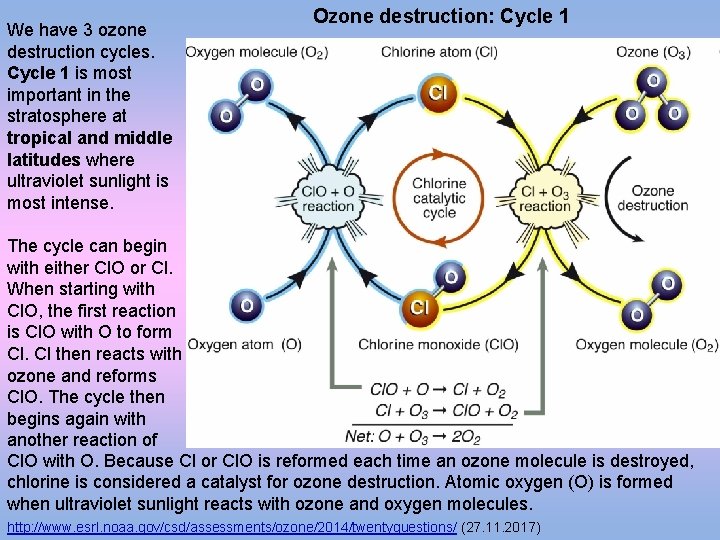
We have 3 ozone destruction cycles. Cycle 1 is most important in the stratosphere at tropical and middle latitudes where ultraviolet sunlight is most intense. Ozone destruction: Cycle 1 The cycle can begin with either Cl. O or Cl. When starting with Cl. O, the first reaction is Cl. O with O to form Cl. Cl then reacts with ozone and reforms Cl. O. The cycle then begins again with another reaction of Cl. O with O. Because Cl or Cl. O is reformed each time an ozone molecule is destroyed, chlorine is considered a catalyst for ozone destruction. Atomic oxygen (O) is formed when ultraviolet sunlight reacts with ozone and oxygen molecules. http: //www. esrl. noaa. gov/csd/assessments/ozone/2014/twentyquestions/ (27. 11. 2017)
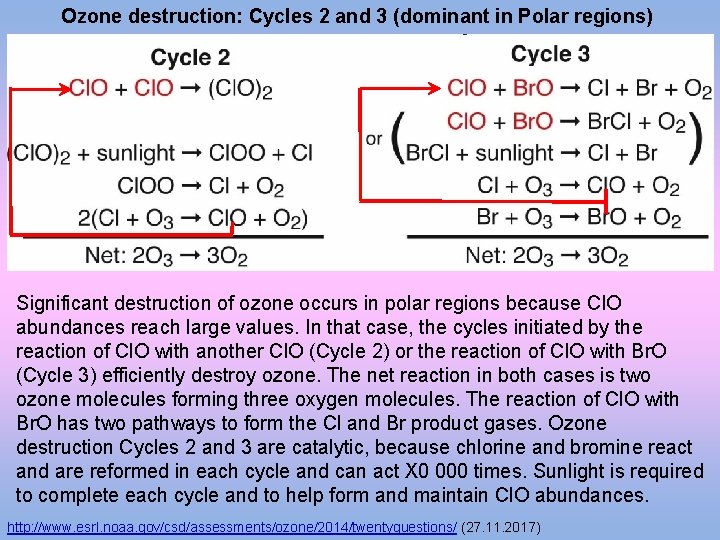
Ozone destruction: Cycles 2 and 3 (dominant in Polar regions) Significant destruction of ozone occurs in polar regions because Cl. O abundances reach large values. In that case, the cycles initiated by the reaction of Cl. O with another Cl. O (Cycle 2) or the reaction of Cl. O with Br. O (Cycle 3) efficiently destroy ozone. The net reaction in both cases is two ozone molecules forming three oxygen molecules. The reaction of Cl. O with Br. O has two pathways to form the Cl and Br product gases. Ozone destruction Cycles 2 and 3 are catalytic, because chlorine and bromine react and are reformed in each cycle and can act X 0 000 times. Sunlight is required to complete each cycle and to help form and maintain Cl. O abundances. http: //www. esrl. noaa. gov/csd/assessments/ozone/2014/twentyquestions/ (27. 11. 2017)
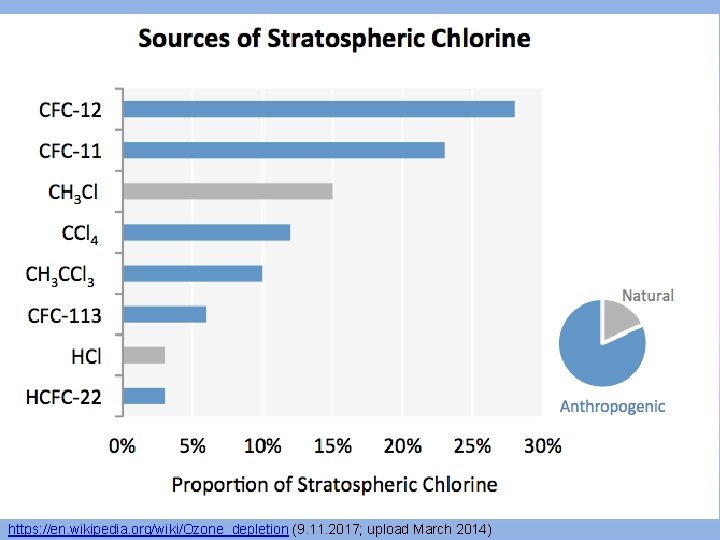
https: //en. wikipedia. org/wiki/Ozone_depletion (9. 11. 2017; upload March 2014)
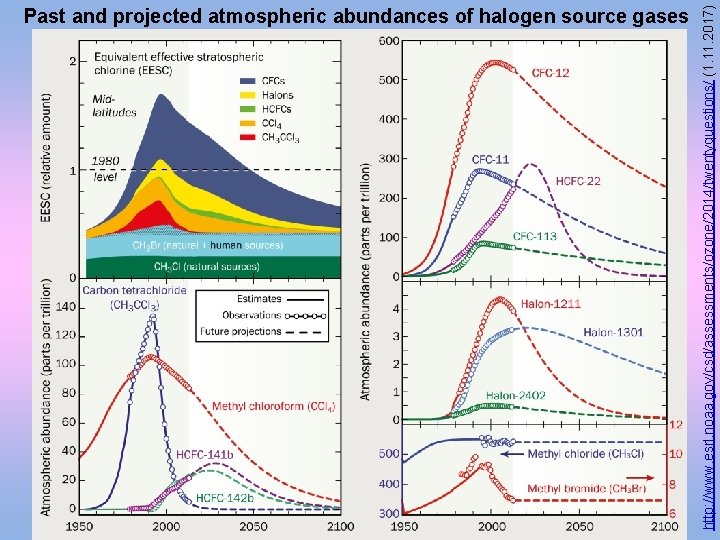
Primary Sources of Chlorine and Bromine entering the Stratosphere in 1996 and 2012 - Precursor substances for O 3 destruction in the stratosphere ppt = parts per trillion = parts per 1012 The main source of these halogen atoms in the stratosphere is photodissociation of manmade halocarbon refrigerants, solvents, propellants, and foam-blowing agents (CFCs, HCFCs, freons, halons). http: //www. esrl. noaa. gov/csd/assessments/ozone/2014/report. html (27. 11. 2017)
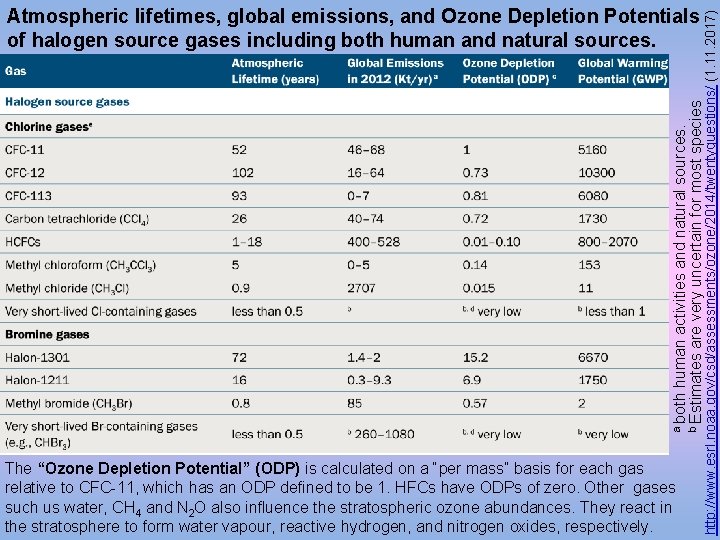
http: //www. esrl. noaa. gov/csd/assessments/ozone/2014/twentyquestions/ (1. 11. 2017) a both b Estimates human activities and natural sources. are very uncertain for most species Atmospheric lifetimes, global emissions, and Ozone Depletion Potentials of halogen source gases including both human and natural sources. The “Ozone Depletion Potential” (ODP) is calculated on a “per mass” basis for each gas relative to CFC-11, which has an ODP defined to be 1. HFCs have ODPs of zero. Other gases such us water, CH 4 and N 2 O also influence the stratospheric ozone abundances. They react in the stratosphere to form water vapour, reactive hydrogen, and nitrogen oxides, respectively.
R. P. Turco (1997): Earth under Siege. S. 429. more: http: //www. esrl. noaa. gov/csd/assessments/ozone/2014/report. html (1. 12. 2015)
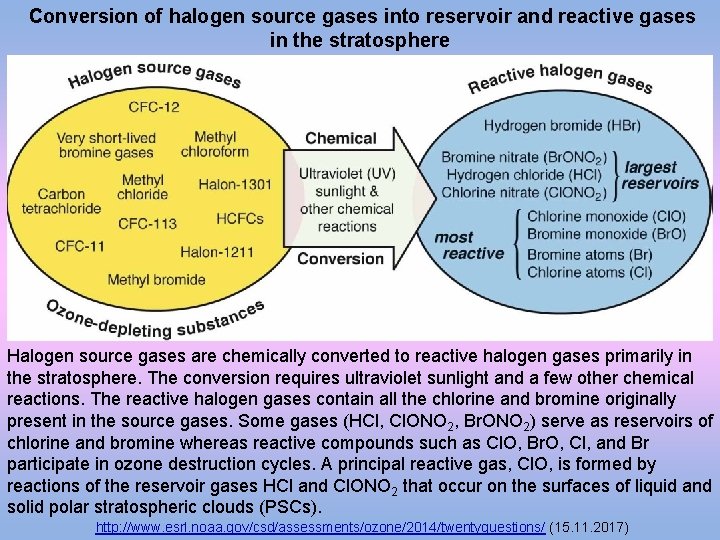
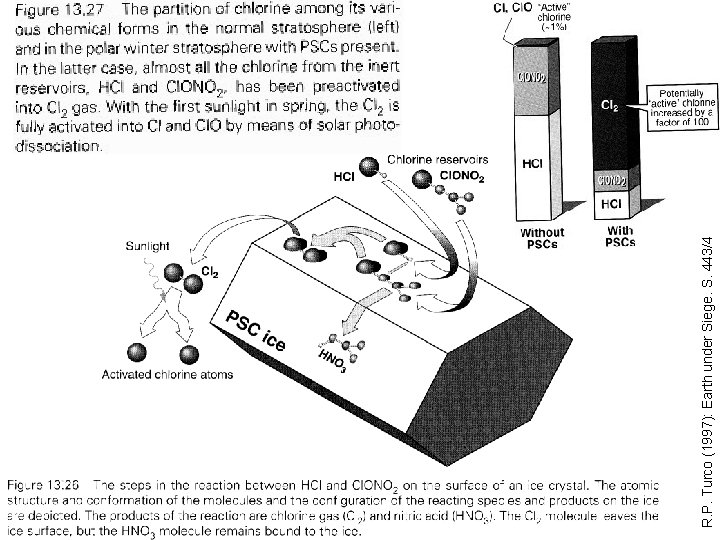
Conversion of halogen source gases into reservoir and reactive gases in the stratosphere Halogen source gases are chemically converted to reactive halogen gases primarily in the stratosphere. The conversion requires ultraviolet sunlight and a few other chemical reactions. The reactive halogen gases contain all the chlorine and bromine originally present in the source gases. Some gases (HCl, Cl. ONO 2, Br. ONO 2) serve as reservoirs of chlorine and bromine whereas reactive compounds such as Cl. O, Br. O, Cl, and Br participate in ozone destruction cycles. A principal reactive gas, Cl. O, is formed by reactions of the reservoir gases HCl and Cl. ONO 2 that occur on the surfaces of liquid and solid polar stratospheric clouds (PSCs). http: //www. esrl. noaa. gov/csd/assessments/ozone/2014/twentyquestions/ (15. 11. 2017)
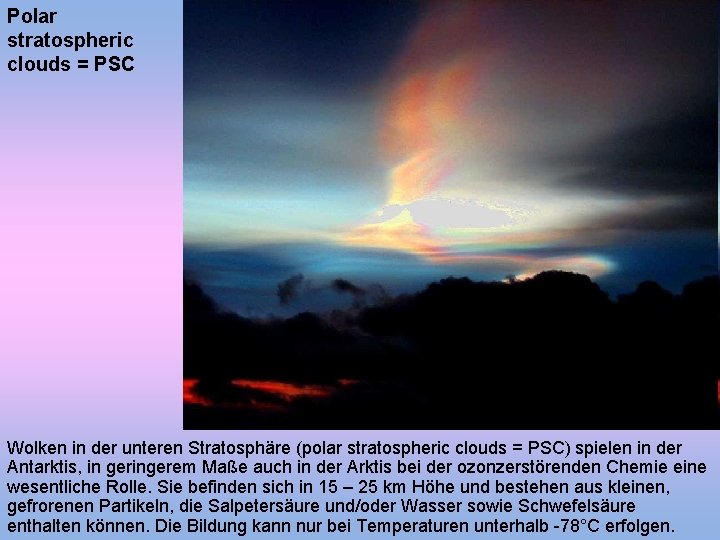
Polar stratospheric clouds = PSC Wolken in der unteren Stratosphäre (polar stratospheric clouds = PSC) spielen in der Antarktis, in geringerem Maße auch in der Arktis bei der ozonzerstörenden Chemie eine wesentliche Rolle. Sie befinden sich in 15 – 25 km Höhe und bestehen aus kleinen, gefrorenen Partikeln, die Salpetersäure und/oder Wasser sowie Schwefelsäure enthalten können. Die Bildung kann nur bei Temperaturen unterhalb -78°C erfolgen.
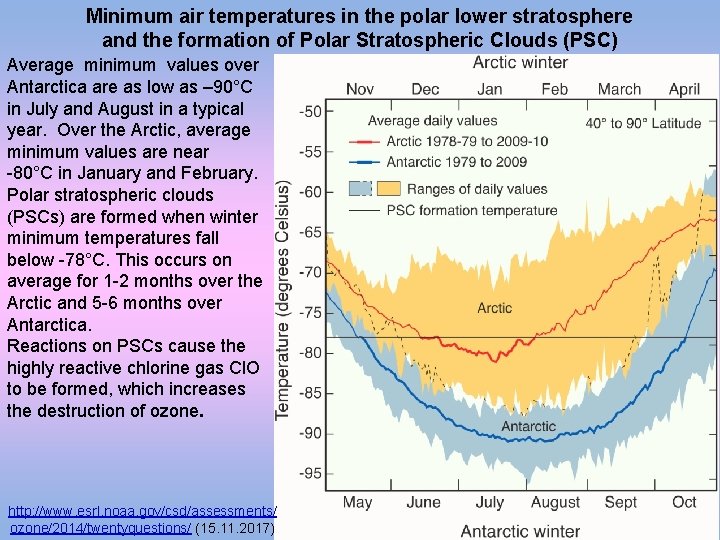
Minimum air temperatures in the polar lower stratosphere and the formation of Polar Stratospheric Clouds (PSC) Average minimum values over Antarctica are as low as – 90°C in July and August in a typical year. Over the Arctic, average minimum values are near -80°C in January and February. Polar stratospheric clouds (PSCs) are formed when winter minimum temperatures fall below -78°C. This occurs on average for 1 -2 months over the Arctic and 5 -6 months over Antarctica. Reactions on PSCs cause the highly reactive chlorine gas Cl. O to be formed, which increases the destruction of ozone. http: //www. esrl. noaa. gov/csd/assessments/ ozone/2014/twentyquestions/ (15. 11. 2017)
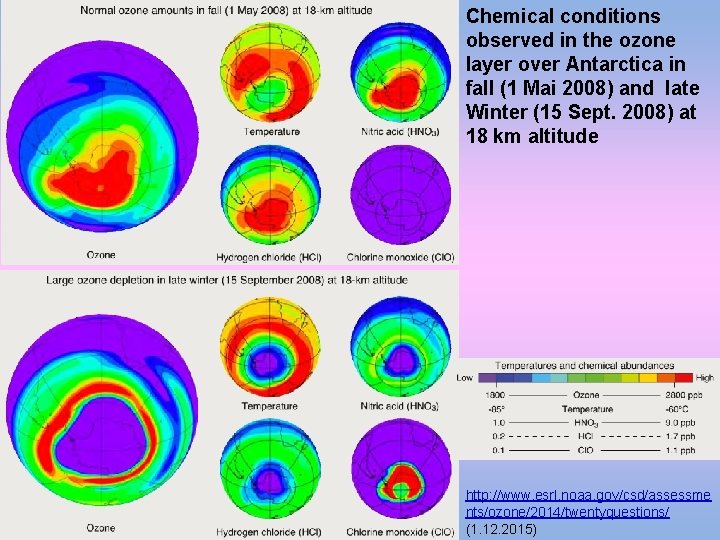
Chemical conditions observed in the ozone layer over Antarctica in fall (1 Mai 2008) and late Winter (15 Sept. 2008) at 18 km altitude http: //www. esrl. noaa. gov/csd/assessme nts/ozone/2014/twentyquestions/ (1. 12. 2015)
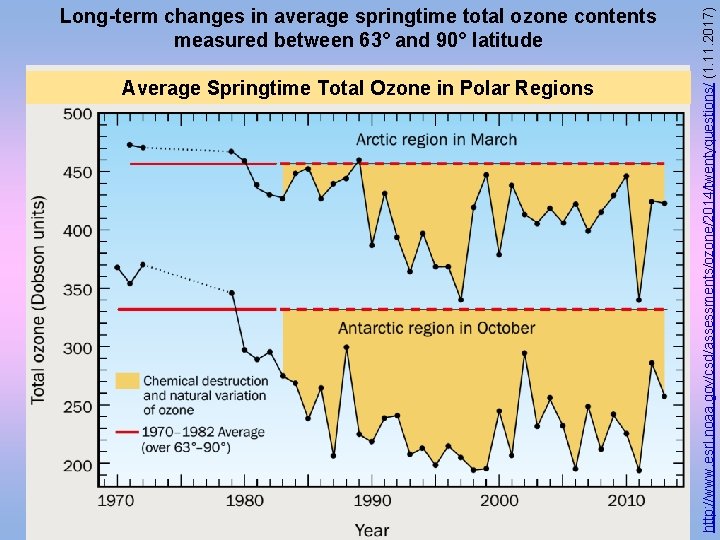
Average Springtime Total Ozone in Polar Regions http: //www. esrl. noaa. gov/csd/assessments/ozone/2014/twentyquestions/ (1. 11. 2017) Long-term changes in average springtime total ozone contents measured between 63° and 90° latitude
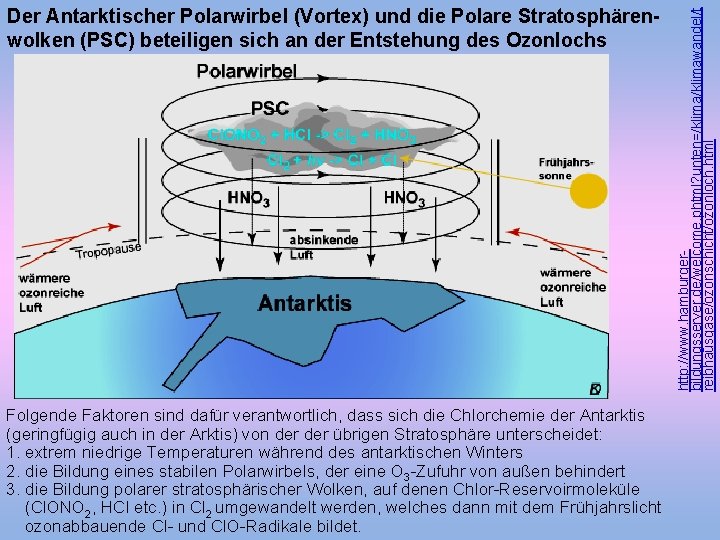
Folgende Faktoren sind dafür verantwortlich, dass sich die Chlorchemie der Antarktis (geringfügig auch in der Arktis) von der übrigen Stratosphäre unterscheidet: 1. extrem niedrige Temperaturen während des antarktischen Winters 2. die Bildung eines stabilen Polarwirbels, der eine O 3 -Zufuhr von außen behindert 3. die Bildung polarer stratosphärischer Wolken, auf denen Chlor-Reservoirmoleküle (Cl. ONO 2, HCl etc. ) in Cl 2 umgewandelt werden, welches dann mit dem Frühjahrslicht ozonabbauende Cl- und Cl. O-Radikale bildet. http: //www. hamburgerbildungsserver. de/welcome. phtml? unten=/klimawandel/t reibhausgase/ozonschicht/ozonloch. html Der Antarktischer Polarwirbel (Vortex) und die Polare Stratosphärenwolken (PSC) beteiligen sich an der Entstehung des Ozonlochs
R. P. Turco (1997): Earth under Siege. S. 443/4
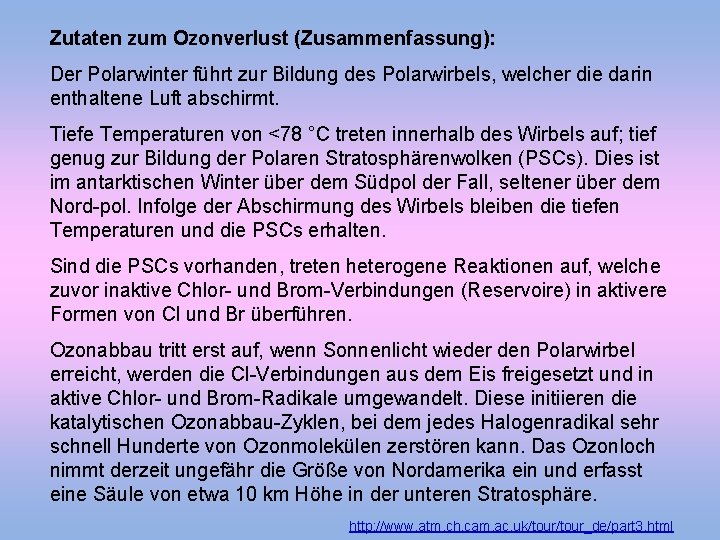
Zutaten zum Ozonverlust (Zusammenfassung): Der Polarwinter führt zur Bildung des Polarwirbels, welcher die darin enthaltene Luft abschirmt. Tiefe Temperaturen von <78 °C treten innerhalb des Wirbels auf; tief genug zur Bildung der Polaren Stratosphärenwolken (PSCs). Dies ist im antarktischen Winter über dem Südpol der Fall, seltener über dem Nord-pol. Infolge der Abschirmung des Wirbels bleiben die tiefen Temperaturen und die PSCs erhalten. Sind die PSCs vorhanden, treten heterogene Reaktionen auf, welche zuvor inaktive Chlor- und Brom-Verbindungen (Reservoire) in aktivere Formen von Cl und Br überführen. Ozonabbau tritt erst auf, wenn Sonnenlicht wieder den Polarwirbel erreicht, werden die Cl-Verbindungen aus dem Eis freigesetzt und in aktive Chlor- und Brom-Radikale umgewandelt. Diese initiieren die katalytischen Ozonabbau-Zyklen, bei dem jedes Halogenradikal sehr schnell Hunderte von Ozonmolekülen zerstören kann. Das Ozonloch nimmt derzeit ungefähr die Größe von Nordamerika ein und erfasst eine Säule von etwa 10 km Höhe in der unteren Stratosphäre. http: //www. atm. ch. cam. ac. uk/tour_de/part 3. html
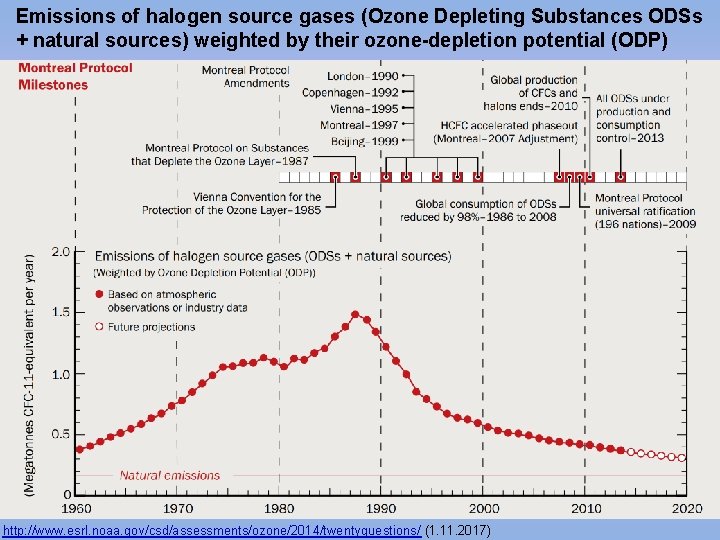
Emissions of halogen source gases (Ozone Depleting Substances ODSs + natural sources) weighted by their ozone-depletion potential (ODP) http: //www. esrl. noaa. gov/csd/assessments/ozone/2014/twentyquestions/ (1. 11. 2017)
http: //www. esrl. noaa. gov/csd/assessments/ozone/2014/twentyquestions/ (1. 11. 2017) Past and projected atmospheric abundances of halogen source gases
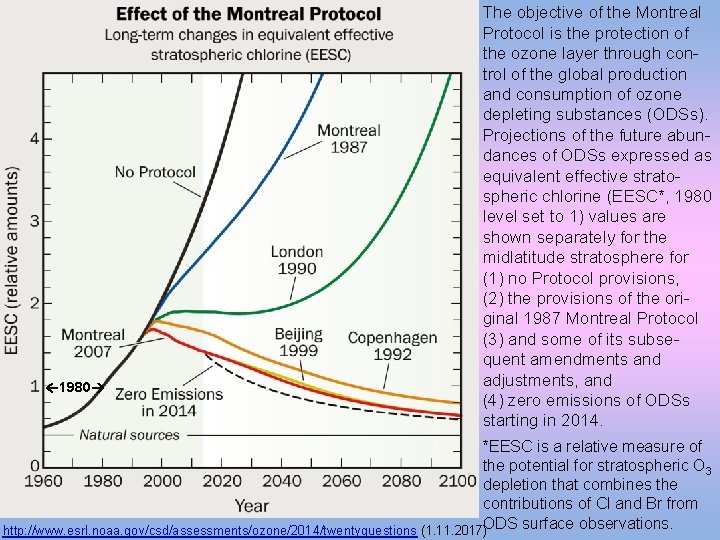
1980 The objective of the Montreal Protocol is the protection of the ozone layer through control of the global production and consumption of ozone depleting substances (ODSs). Projections of the future abundances of ODSs expressed as equivalent effective stratospheric chlorine (EESC*, 1980 level set to 1) values are shown separately for the midlatitude stratosphere for (1) no Protocol provisions, (2) the provisions of the original 1987 Montreal Protocol (3) and some of its subsequent amendments and adjustments, and (4) zero emissions of ODSs starting in 2014. *EESC is a relative measure of the potential for stratospheric O 3 depletion that combines the contributions of Cl and Br from ODS surface observations. http: //www. esrl. noaa. gov/csd/assessments/ozone/2014/twentyquestions (1. 11. 2017)
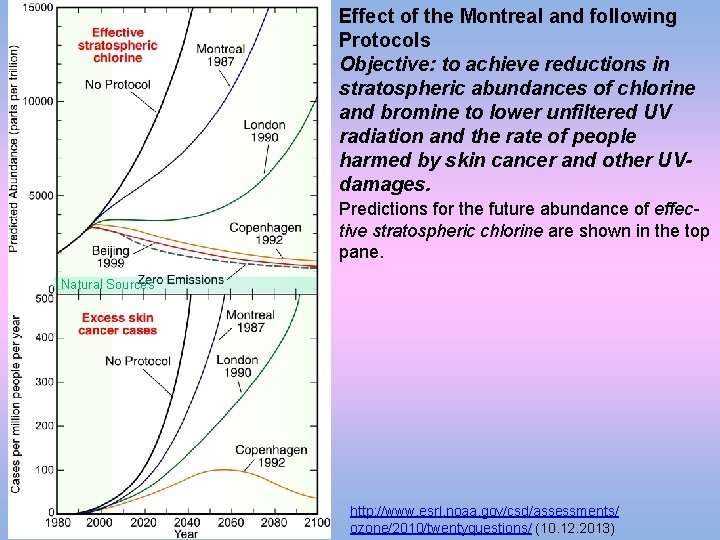
Effect of the Montreal and following Protocols Objective: to achieve reductions in stratospheric abundances of chlorine and bromine to lower unfiltered UV radiation and the rate of people harmed by skin cancer and other UVdamages. Predictions for the future abundance of effective stratospheric chlorine are shown in the top pane. Natural Sources http: //www. esrl. noaa. gov/csd/assessments/ ozone/2010/twentyquestions/ (10. 12. 2013)
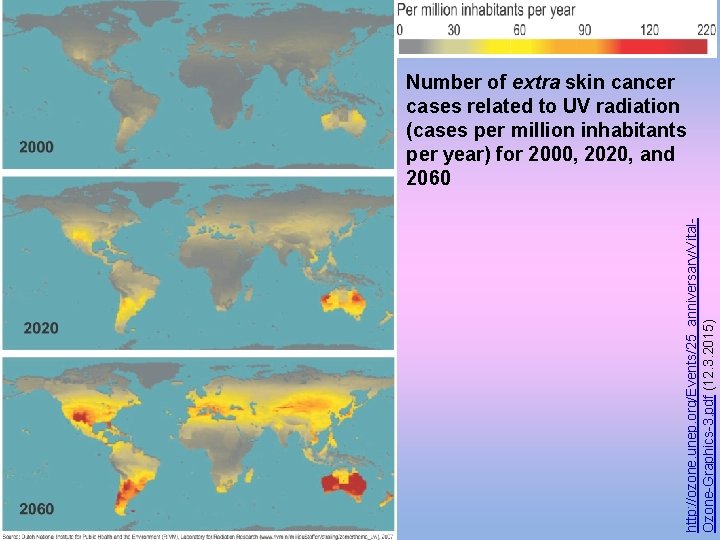
http: //ozone. unep. org/Events/25_anniversary/Vital. Ozone-Graphics-3. pdf (12. 3. 2015) Number of extra skin cancer cases related to UV radiation (cases per million inhabitants per year) for 2000, 2020, and 2060
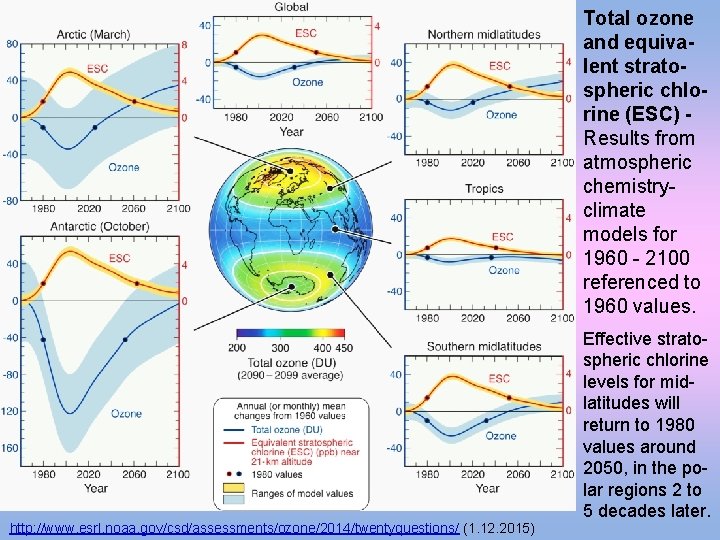
Total ozone and equivalent stratospheric chlorine (ESC) Results from atmospheric chemistryclimate models for 1960 - 2100 referenced to 1960 values. http: //www. esrl. noaa. gov/csd/assessments/ozone/2014/twentyquestions/ (1. 12. 2015) Effective stratospheric chlorine levels for midlatitudes will return to 1980 values around 2050, in the polar regions 2 to 5 decades later.
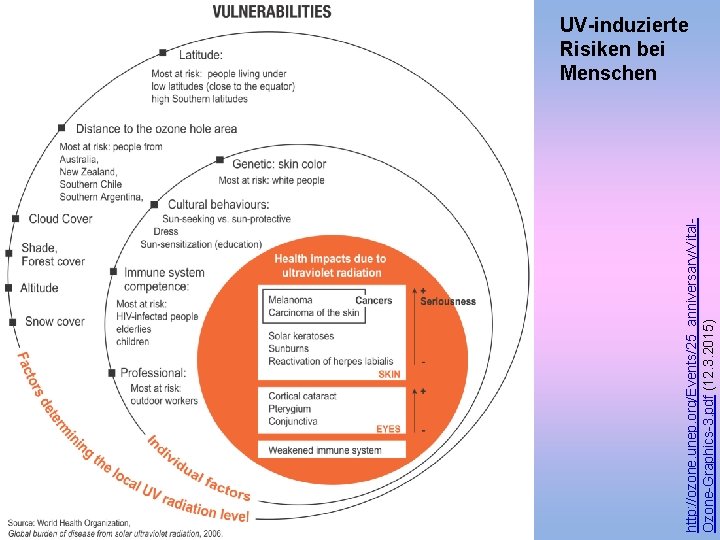
http: //ozone. unep. org/Events/25_anniversary/Vital. Ozone-Graphics-3. pdf (12. 3. 2015) UV-induzierte Risiken bei Menschen