
Polar Plot Introduction The polar plot of sinusoidal
![Steps to draw Polar Plot conti… �Step 7: Put Im [G(jω) ]=0, determine the](https://slidetodoc.com/presentation_image_h2/cc63bdf1179ffba6a14ba3f93acebece/image-5.jpg "Steps to draw Polar Plot conti… �Step 7: Put Im [G(jω) ]=0, determine the")
![Type 0 system conti… �Step 6: Put Im [G(jω)]=0](https://slidetodoc.com/presentation_image_h2/cc63bdf1179ffba6a14ba3f93acebece/image-10.jpg "Type 0 system conti… �Step 6: Put Im [G(jω)]=0")
![Type 1 system conti… �Step 6: Put Im [G(jω)]=0](https://slidetodoc.com/presentation_image_h2/cc63bdf1179ffba6a14ba3f93acebece/image-15.jpg "Type 1 system conti… �Step 6: Put Im [G(jω)]=0")
![�Step 6: Put Im [G(jω)]=0](https://slidetodoc.com/presentation_image_h2/cc63bdf1179ffba6a14ba3f93acebece/image-23.jpg "�Step 6: Put Im [G(jω)]=0")

- Slides: 56
Polar Plot
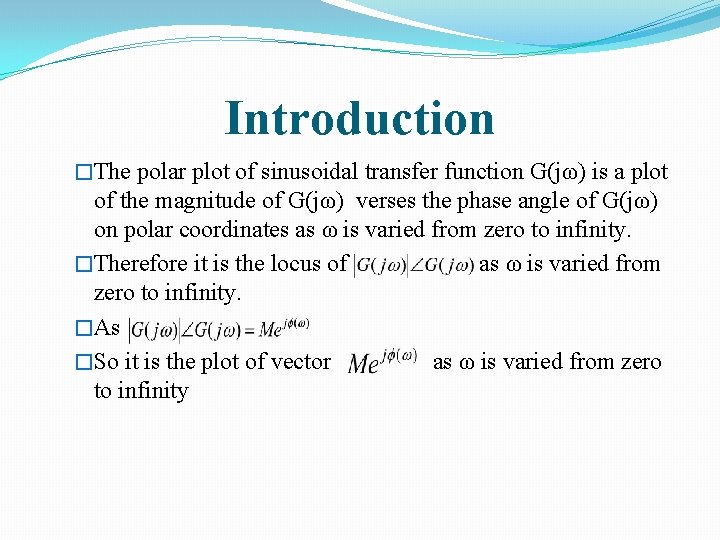
Introduction �The polar plot of sinusoidal transfer function G(jω) is a plot of the magnitude of G(jω) verses the phase angle of G(jω) on polar coordinates as ω is varied from zero to infinity. �Therefore it is the locus of as ω is varied from zero to infinity. �As �So it is the plot of vector as ω is varied from zero to infinity
Introduction conti… �In the polar plot the magnitude of G(jω) is plotted as the distance from the origin while phase angle is measured from positive real axis. �+ angle is taken for anticlockwise direction. �Polar plot is also known as Nyquist Plot. �Adv: it depicts the frequency response characteristics over a the entire w in a single plot. �Disadv: Plot does not indicate the contribution of each individual factor of the open loop transfer function.
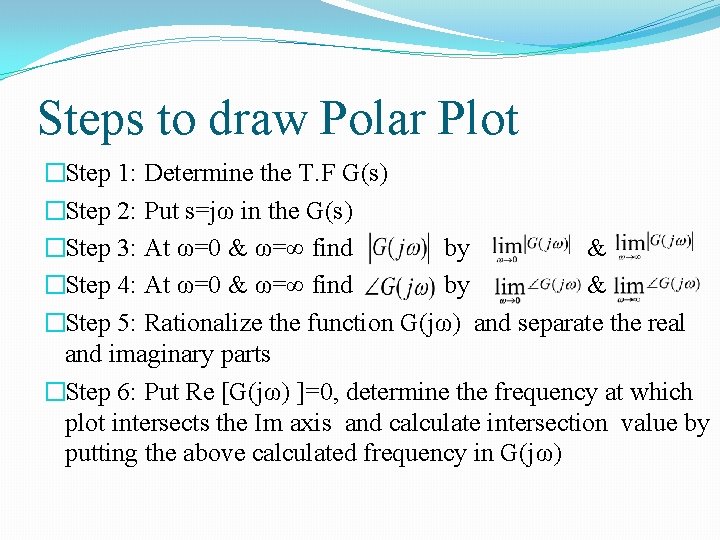
Steps to draw Polar Plot �Step 1: Determine the T. F G(s) �Step 2: Put s=jω in the G(s) �Step 3: At ω=0 & ω=∞ find by & �Step 4: At ω=0 & ω=∞ find by & �Step 5: Rationalize the function G(jω) and separate the real and imaginary parts �Step 6: Put Re [G(jω) ]=0, determine the frequency at which plot intersects the Im axis and calculate intersection value by putting the above calculated frequency in G(jω)
Steps to draw Polar Plot conti… �Step 7: Put Im [G(jω) ]=0, determine the frequency at which plot intersects the real axis and calculate intersection value by putting the above calculated frequency in G(jω) �Step 8: Sketch the Polar Plot with the help of above information
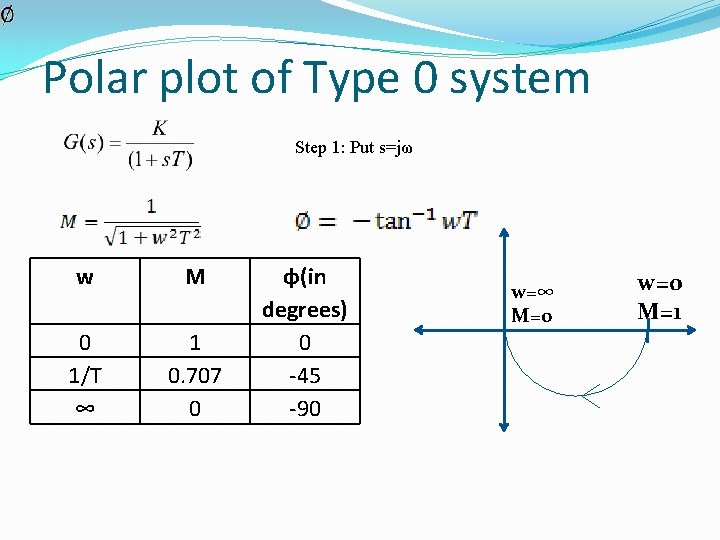
Polar plot of Type 0 system Step 1: Put s=jω w M 0 1/T ∞ 1 0. 707 0 ɸ(in degrees) 0 -45 -90 w=∞ M=0 w=0 M=1
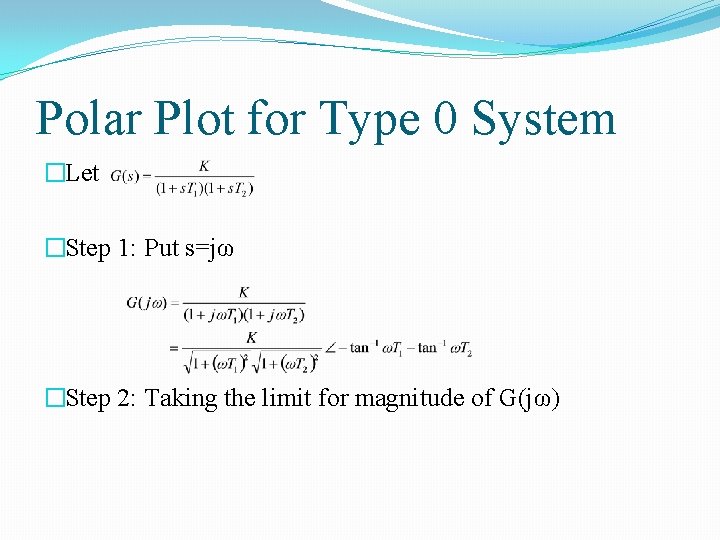
Polar Plot for Type 0 System �Let �Step 1: Put s=jω �Step 2: Taking the limit for magnitude of G(jω)
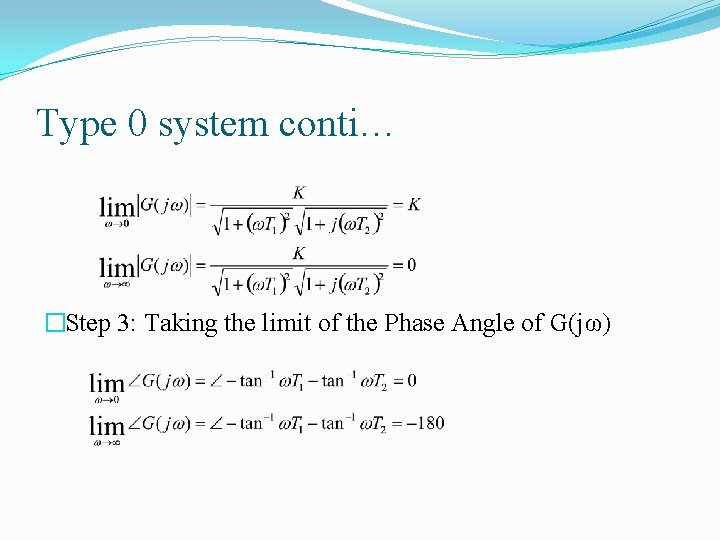
Type 0 system conti… �Step 3: Taking the limit of the Phase Angle of G(jω)
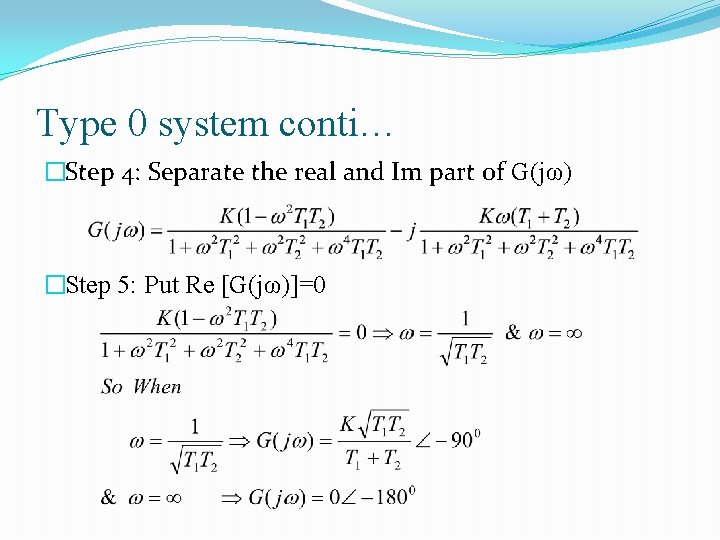
Type 0 system conti… �Step 4: Separate the real and Im part of G(jω) �Step 5: Put Re [G(jω)]=0
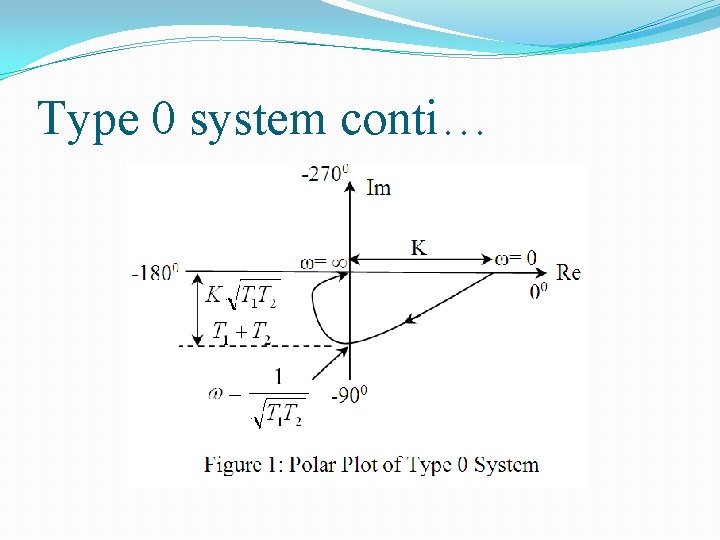
Type 0 system conti… �Step 6: Put Im [G(jω)]=0
Type 0 system conti…
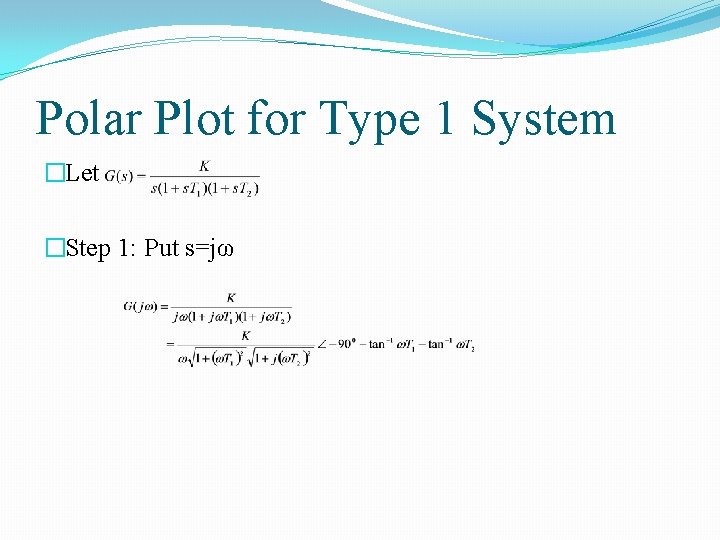
Polar Plot for Type 1 System �Let �Step 1: Put s=jω
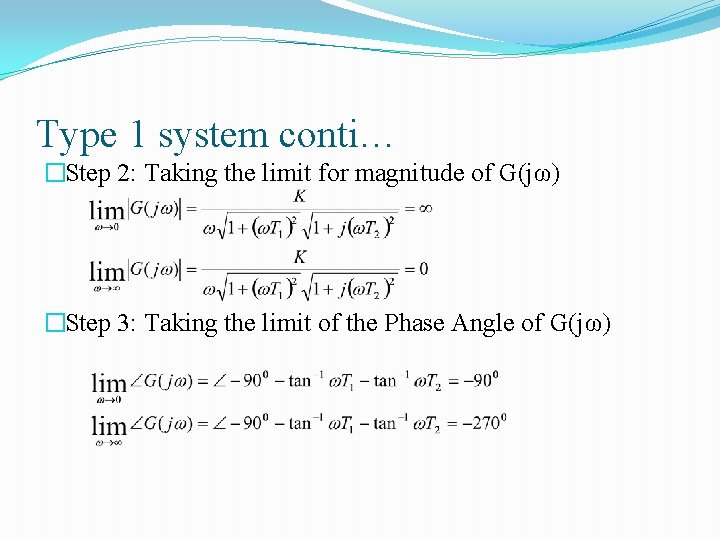
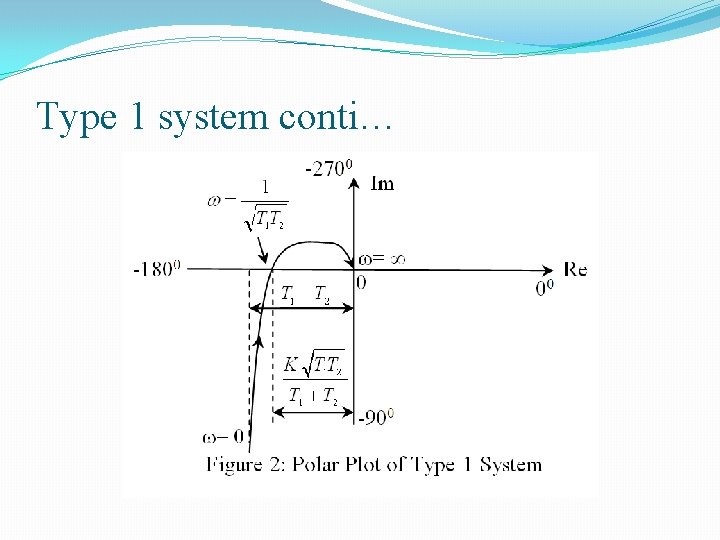
Type 1 system conti… �Step 2: Taking the limit for magnitude of G(jω) �Step 3: Taking the limit of the Phase Angle of G(jω)
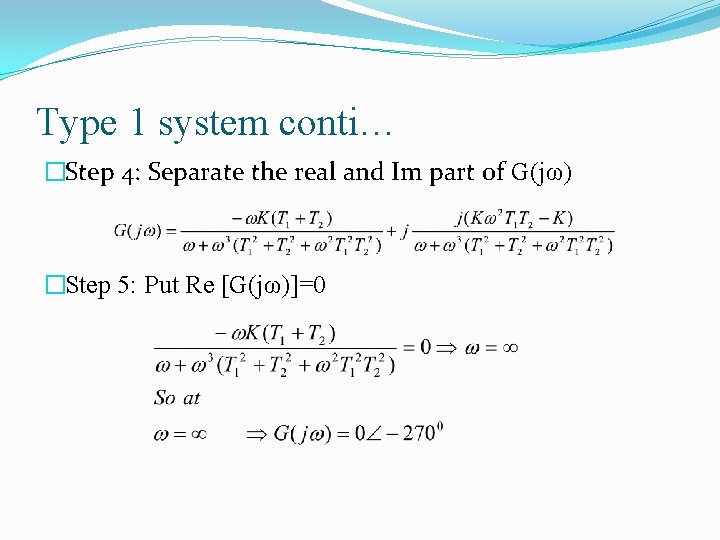
Type 1 system conti… �Step 4: Separate the real and Im part of G(jω) �Step 5: Put Re [G(jω)]=0
Type 1 system conti… �Step 6: Put Im [G(jω)]=0
Type 1 system conti…
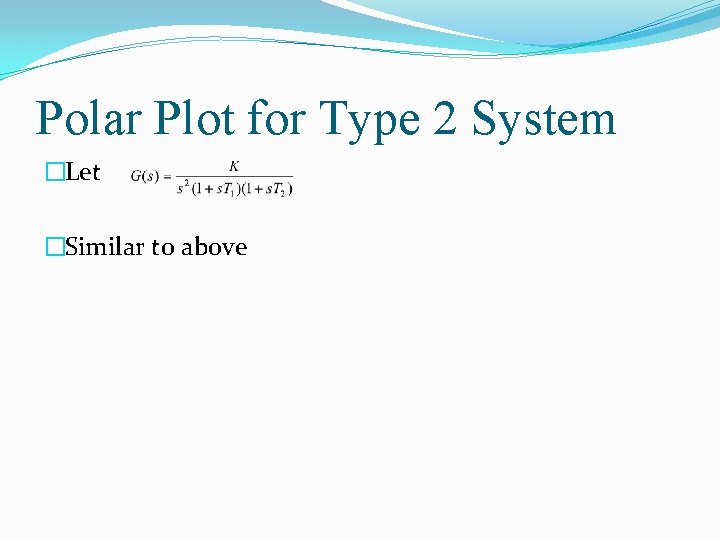
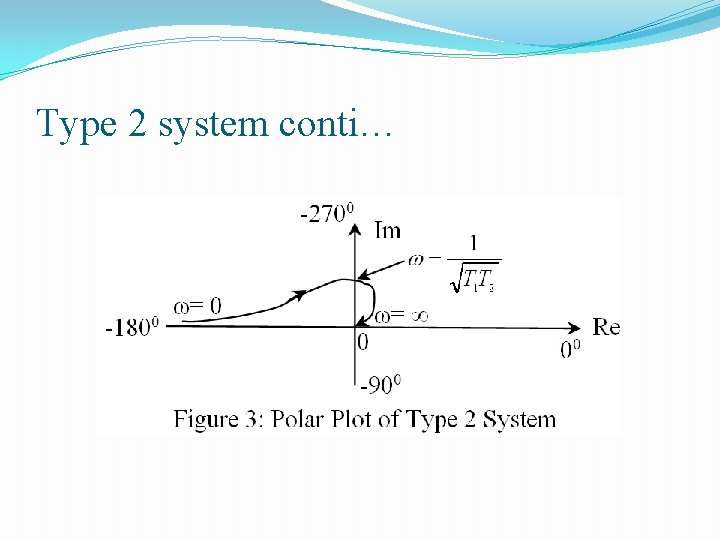
Polar Plot for Type 2 System �Let �Similar to above
Type 2 system conti…
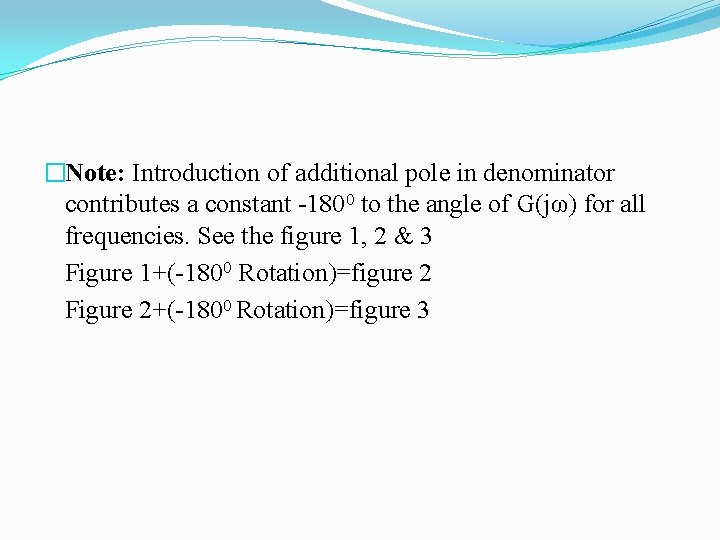
�Note: Introduction of additional pole in denominator contributes a constant -1800 to the angle of G(jω) for all frequencies. See the figure 1, 2 & 3 Figure 1+(-1800 Rotation)=figure 2 Figure 2+(-1800 Rotation)=figure 3
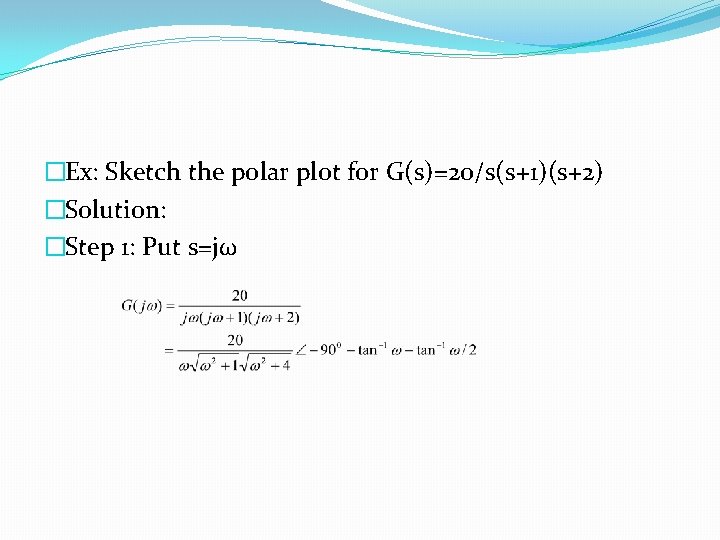
�Ex: Sketch the polar plot for G(s)=20/s(s+1)(s+2) �Solution: �Step 1: Put s=jω
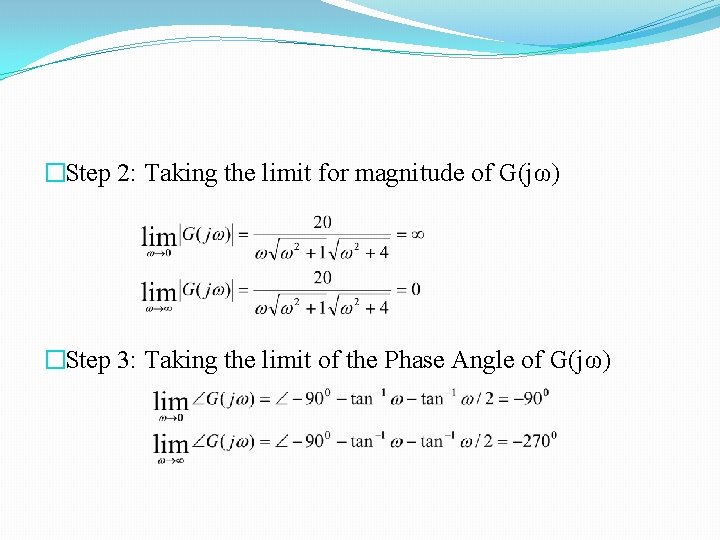
�Step 2: Taking the limit for magnitude of G(jω) �Step 3: Taking the limit of the Phase Angle of G(jω)
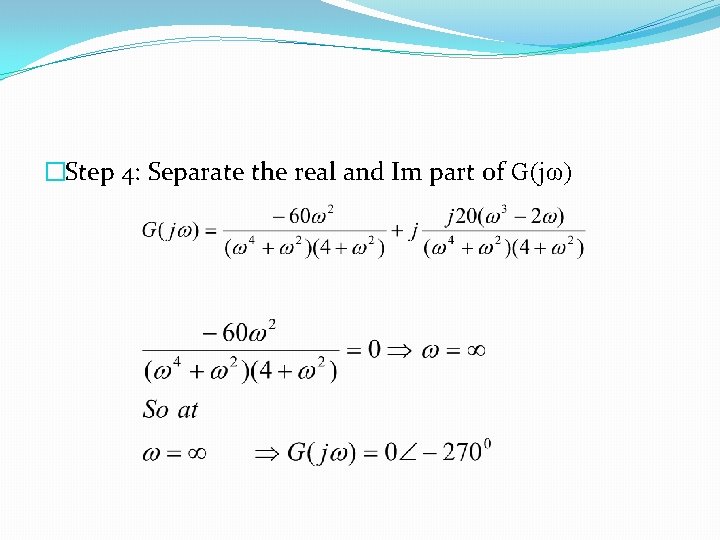
�Step 4: Separate the real and Im part of G(jω)
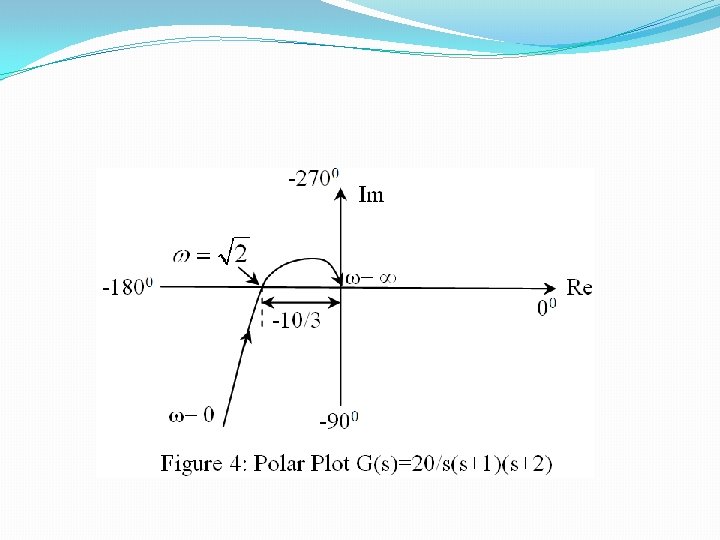
�Step 6: Put Im [G(jω)]=0
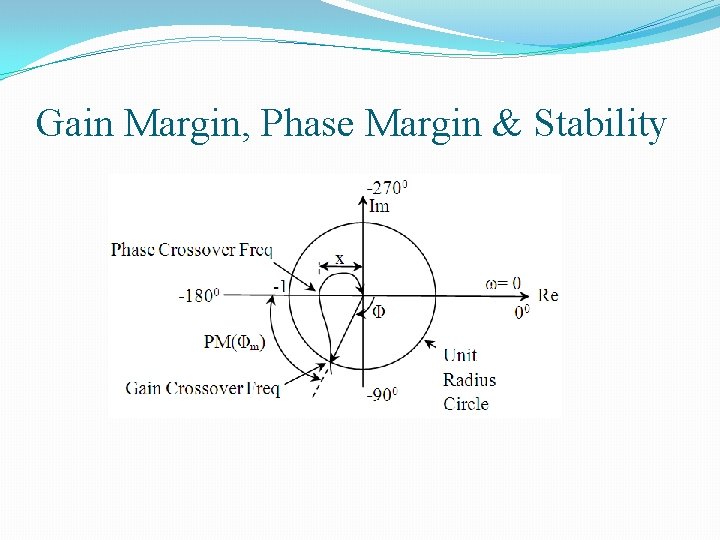
Gain Margin, Phase Margin & Stability
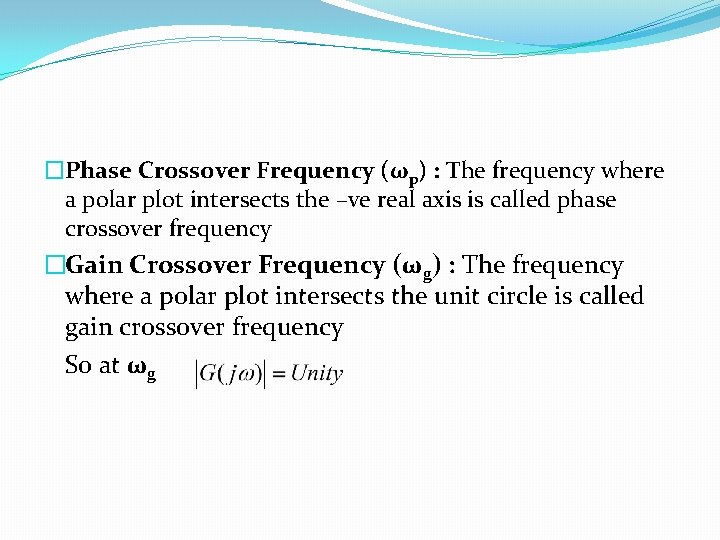
�Phase Crossover Frequency (ωp) : The frequency where a polar plot intersects the –ve real axis is called phase crossover frequency �Gain Crossover Frequency (ωg) : The frequency where a polar plot intersects the unit circle is called gain crossover frequency So at ωg
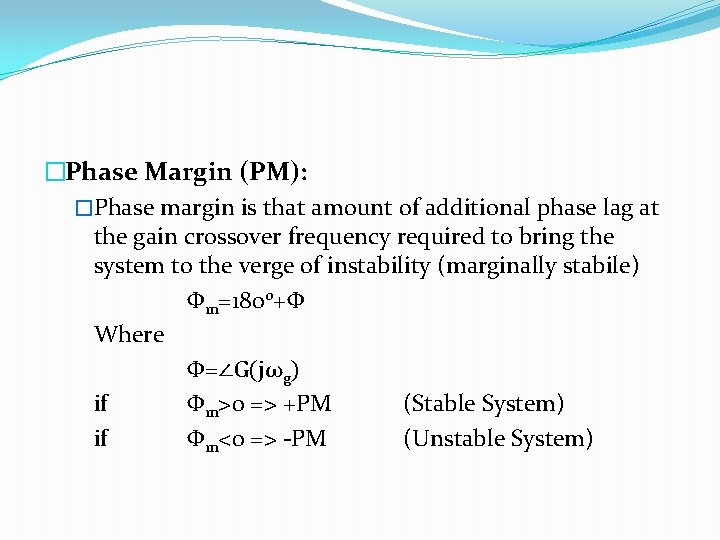
�Phase Margin (PM): �Phase margin is that amount of additional phase lag at the gain crossover frequency required to bring the system to the verge of instability (marginally stabile) Φm=1800+Φ Where Φ=∠G(jωg) if Φm>0 => +PM (Stable System) if Φm<0 => -PM (Unstable System)
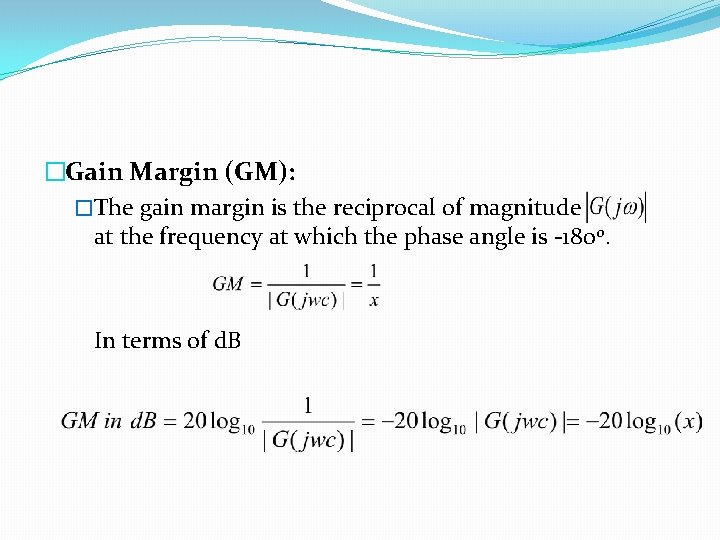
�Gain Margin (GM): �The gain margin is the reciprocal of magnitude at the frequency at which the phase angle is -1800. In terms of d. B
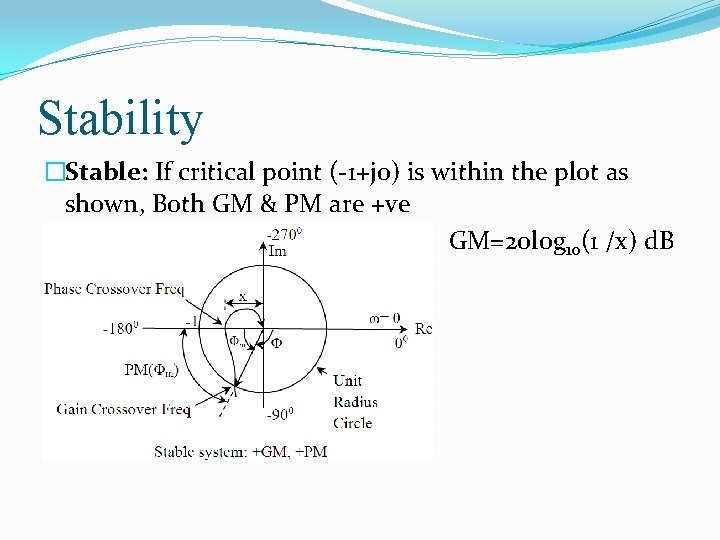
Stability �Stable: If critical point (-1+j 0) is within the plot as shown, Both GM & PM are +ve GM=20 log 10(1 /x) d. B
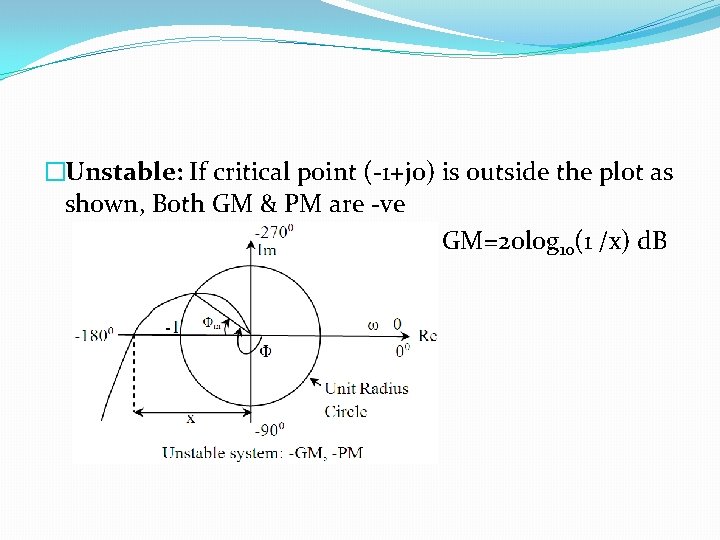
�Unstable: If critical point (-1+j 0) is outside the plot as shown, Both GM & PM are -ve GM=20 log 10(1 /x) d. B
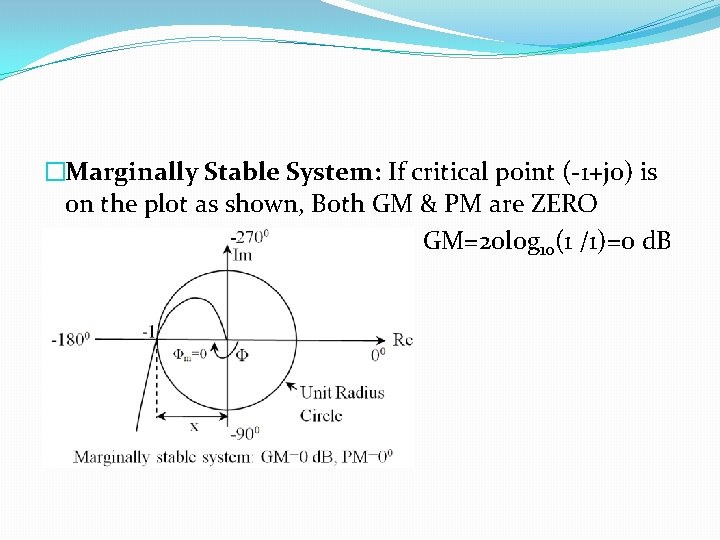
�Marginally Stable System: If critical point (-1+j 0) is on the plot as shown, Both GM & PM are ZERO GM=20 log 10(1 /1)=0 d. B
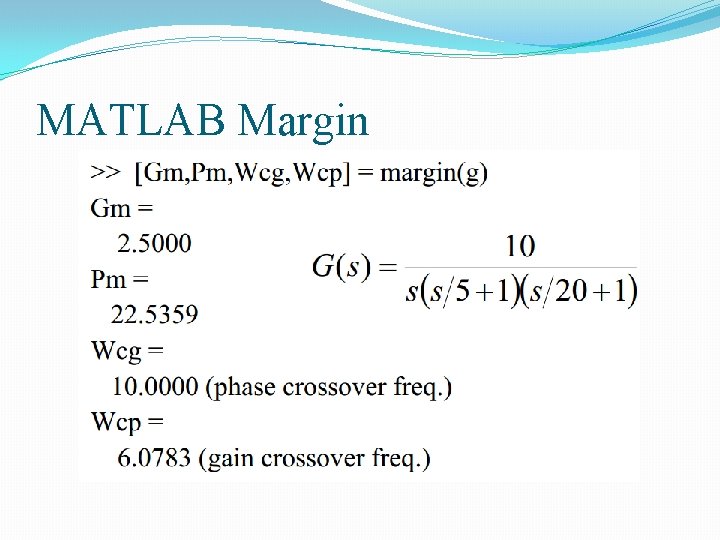
MATLAB Margin
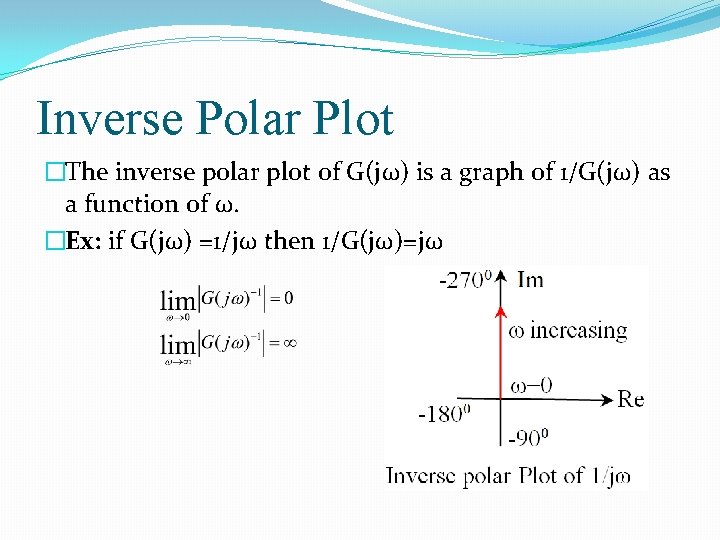
Inverse Polar Plot �The inverse polar plot of G(jω) is a graph of 1/G(jω) as a function of ω. �Ex: if G(jω) =1/jω then 1/G(jω)=jω
Books �Automatic Control system By S. Hasan Saeed �Katson publication
Nyquist plot �It gives information about both absolute stability and relative stability �From Nyquist plot of open loop transfer function, relative stability of closed loop system can be obtained. �We can find out frequency domain specifications. �It is a graphical technique and does not require the exact determination of closed loop poles.
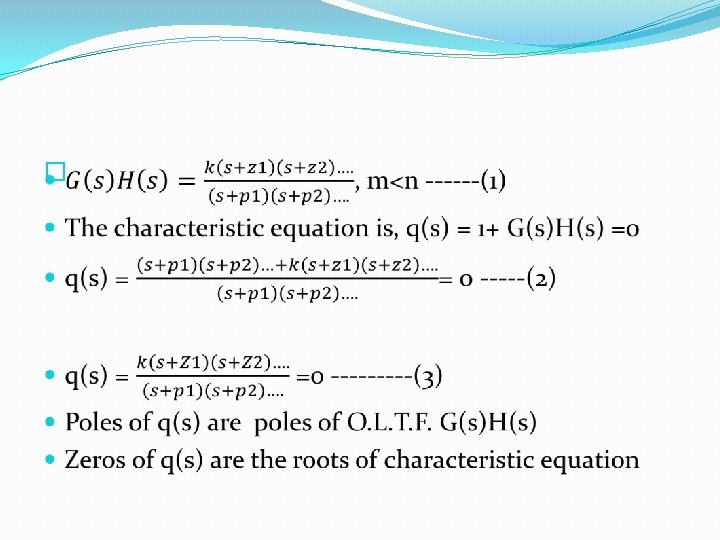
�For system to be stable, roots of ch eq must lie in LHS of S plane i. e. zeros of q(s) must lie in LHS of S plane. �Zeros of ch eq are closed loop poles. �If any of the zeros of q(s)lie in RHS, the system is unstable. �The Nyquist stability criterion is based on the principle of argument. �Principle of argument is related with theory of mapping.
Encirclement: Counting no of encirclement: �A point is said to be encircled by a closed path if it is found to lie inside that closed path �Anticlockwise dir as ref, N = 1 �N = -2 �N = 0
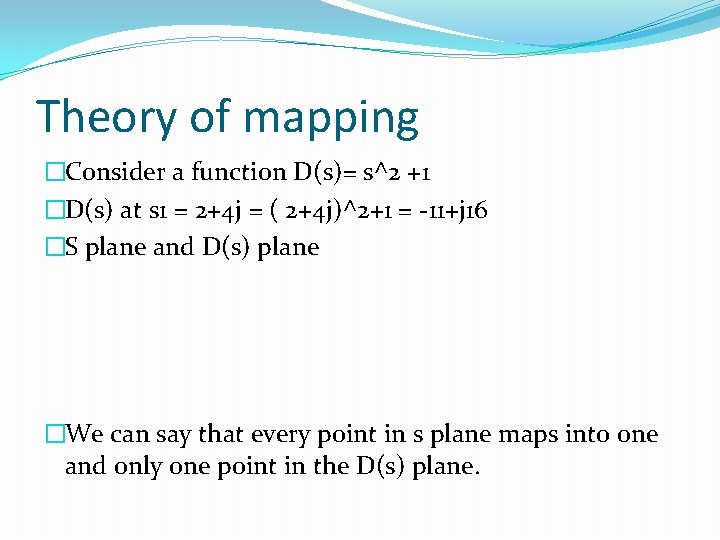
Theory of mapping �Consider a function D(s)= s^2 +1 �D(s) at s 1 = 2+4 j = ( 2+4 j)^2+1 = -11+j 16 �S plane and D(s) plane �We can say that every point in s plane maps into one and only one point in the D(s) plane.
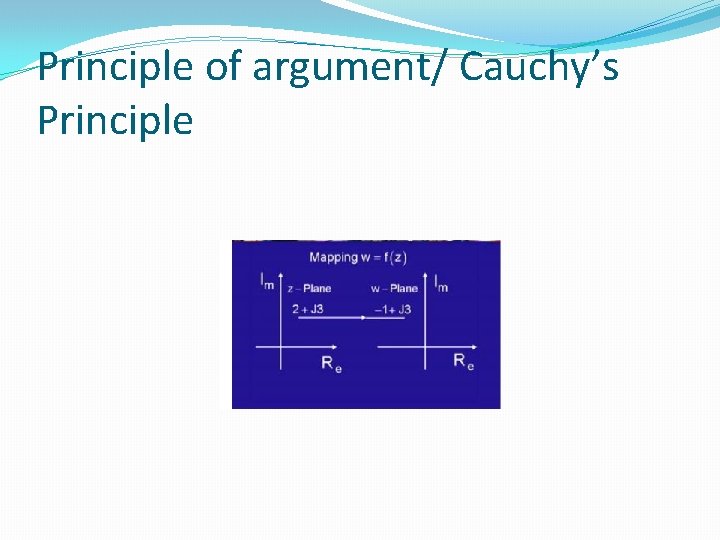
Principle of argument/ Cauchy’s Principle
Principle of Argument �Mapping theorem states that the mapped locus T’(s) encircles the new origin of F plane as many times as the difference between the no of zeros and poles of F(s) which are encircled by T(s) path in s plane �N = Z-P �N = Encirclement of origin of F plane �P , Z= No of poles and zeros of F(s) encircled by T(s) path in s plane �Remember from the Cauchy criterion that the number N of times that the plot of G(s)H(s) encircles -1 is equal to the number Z of zeros of 1 + G(s)H(s) enclosed by the frequency contour minus the number P of poles of 1 + G(s)H(s) enclosed by the frequency contour (N = Z - P).
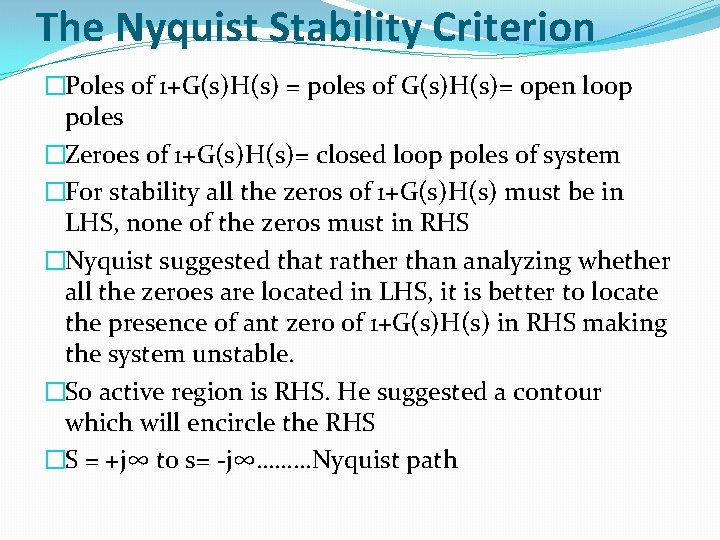
The Nyquist Stability Criterion �Poles of 1+G(s)H(s) = poles of G(s)H(s)= open loop poles �Zeroes of 1+G(s)H(s)= closed loop poles of system �For stability all the zeros of 1+G(s)H(s) must be in LHS, none of the zeros must in RHS �Nyquist suggested that rather than analyzing whether all the zeroes are located in LHS, it is better to locate the presence of ant zero of 1+G(s)H(s) in RHS making the system unstable. �So active region is RHS. He suggested a contour which will encircle the RHS �S = +j∞ to s= -j∞………Nyquist path
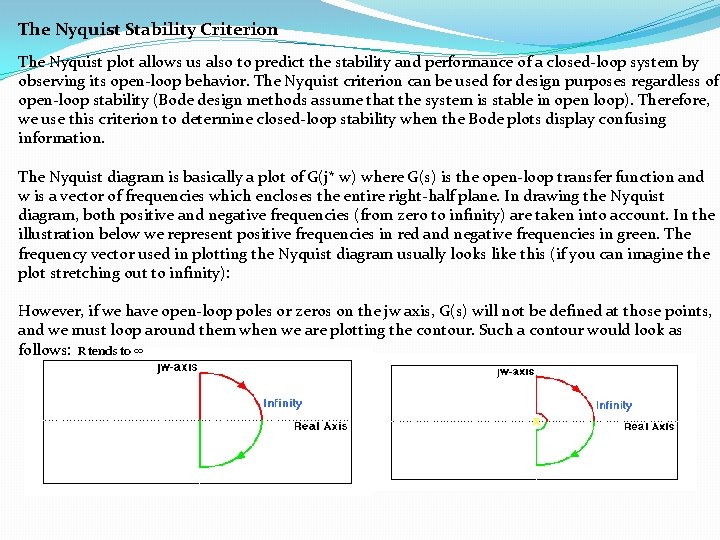
The Nyquist Stability Criterion The Nyquist plot allows us also to predict the stability and performance of a closed-loop system by observing its open-loop behavior. The Nyquist criterion can be used for design purposes regardless of open-loop stability (Bode design methods assume that the system is stable in open loop). Therefore, we use this criterion to determine closed-loop stability when the Bode plots display confusing information. The Nyquist diagram is basically a plot of G(j* w) where G(s) is the open-loop transfer function and w is a vector of frequencies which encloses the entire right-half plane. In drawing the Nyquist diagram, both positive and negative frequencies (from zero to infinity) are taken into account. In the illustration below we represent positive frequencies in red and negative frequencies in green. The frequency vector used in plotting the Nyquist diagram usually looks like this (if you can imagine the plot stretching out to infinity): However, if we have open-loop poles or zeros on the jw axis, G(s) will not be defined at those points, and we must loop around them when we are plotting the contour. Such a contour would look as follows: R tends to ∞
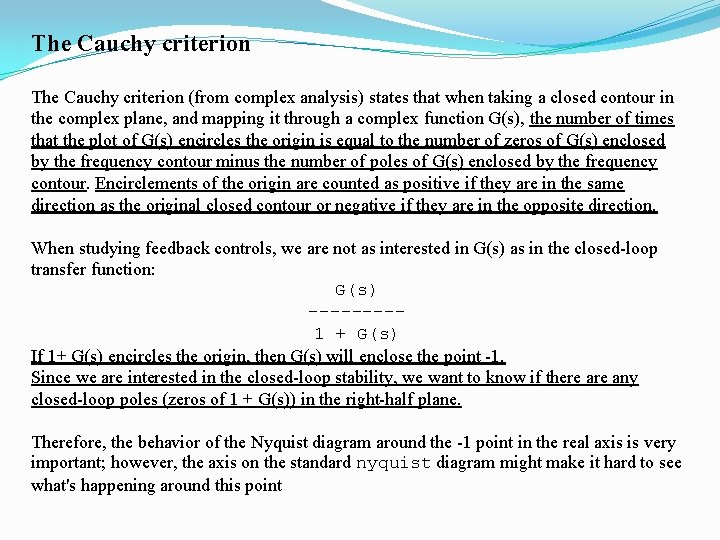
The Cauchy criterion (from complex analysis) states that when taking a closed contour in the complex plane, and mapping it through a complex function G(s), the number of times that the plot of G(s) encircles the origin is equal to the number of zeros of G(s) enclosed by the frequency contour minus the number of poles of G(s) enclosed by the frequency contour. Encirclements of the origin are counted as positive if they are in the same direction as the original closed contour or negative if they are in the opposite direction. When studying feedback controls, we are not as interested in G(s) as in the closed-loop transfer function: G(s) ----1 + G(s) If 1+ G(s) encircles the origin, then G(s) will enclose the point -1. Since we are interested in the closed-loop stability, we want to know if there any closed-loop poles (zeros of 1 + G(s)) in the right-half plane. Therefore, the behavior of the Nyquist diagram around the -1 point in the real axis is very important; however, the axis on the standard nyquist diagram might make it hard to see what's happening around this point
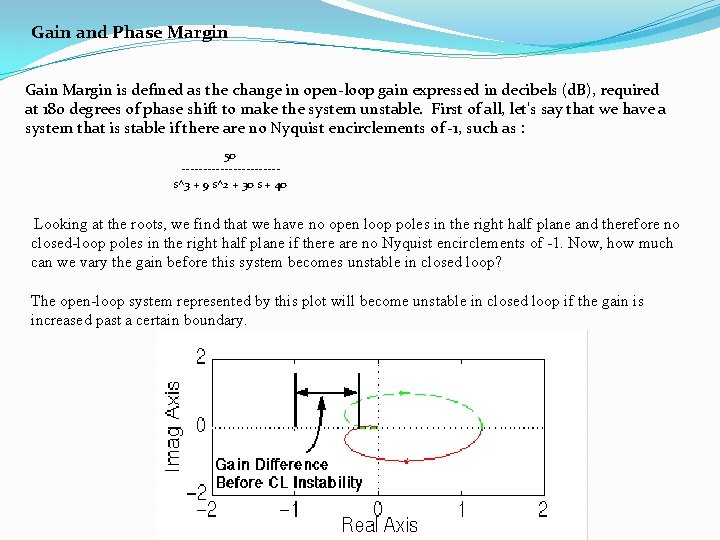
Gain and Phase Margin Gain Margin is defined as the change in open-loop gain expressed in decibels (d. B), required at 180 degrees of phase shift to make the system unstable. First of all, let's say that we have a system that is stable if there are no Nyquist encirclements of -1, such as : 50 -----------s^3 + 9 s^2 + 30 s + 40 Looking at the roots, we find that we have no open loop poles in the right half plane and therefore no closed-loop poles in the right half plane if there are no Nyquist encirclements of -1. Now, how much can we vary the gain before this system becomes unstable in closed loop? The open-loop system represented by this plot will become unstable in closed loop if the gain is increased past a certain boundary.
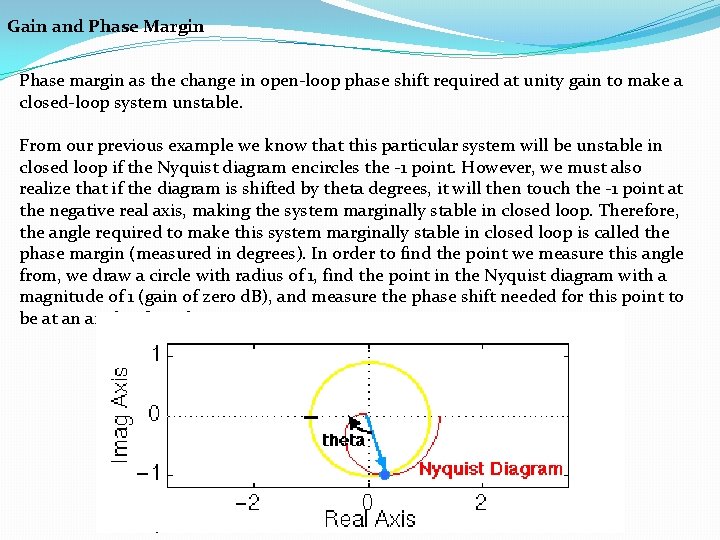
Gain and Phase Margin Phase margin as the change in open-loop phase shift required at unity gain to make a closed-loop system unstable. From our previous example we know that this particular system will be unstable in closed loop if the Nyquist diagram encircles the -1 point. However, we must also realize that if the diagram is shifted by theta degrees, it will then touch the -1 point at the negative real axis, making the system marginally stable in closed loop. Therefore, the angle required to make this system marginally stable in closed loop is called the phase margin (measured in degrees). In order to find the point we measure this angle from, we draw a circle with radius of 1, find the point in the Nyquist diagram with a magnitude of 1 (gain of zero d. B), and measure the phase shift needed for this point to be at an angle of 180 deg.
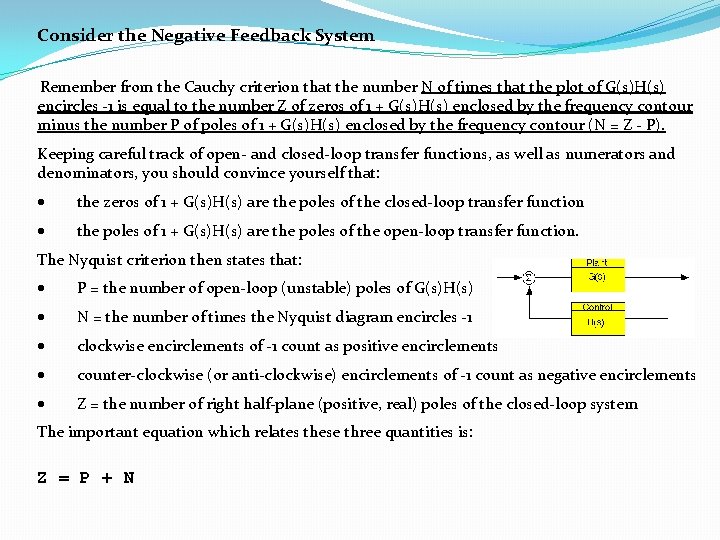
Consider the Negative Feedback System Remember from the Cauchy criterion that the number N of times that the plot of G(s)H(s) encircles -1 is equal to the number Z of zeros of 1 + G(s)H(s) enclosed by the frequency contour minus the number P of poles of 1 + G(s)H(s) enclosed by the frequency contour (N = Z - P). Keeping careful track of open- and closed-loop transfer functions, as well as numerators and denominators, you should convince yourself that: · the zeros of 1 + G(s)H(s) are the poles of the closed-loop transfer function · the poles of 1 + G(s)H(s) are the poles of the open-loop transfer function. The Nyquist criterion then states that: · P = the number of open-loop (unstable) poles of G(s)H(s) · N = the number of times the Nyquist diagram encircles -1 · clockwise encirclements of -1 count as positive encirclements · counter-clockwise (or anti-clockwise) encirclements of -1 count as negative encirclements · Z = the number of right half-plane (positive, real) poles of the closed-loop system The important equation which relates these three quantities is: Z = P + N
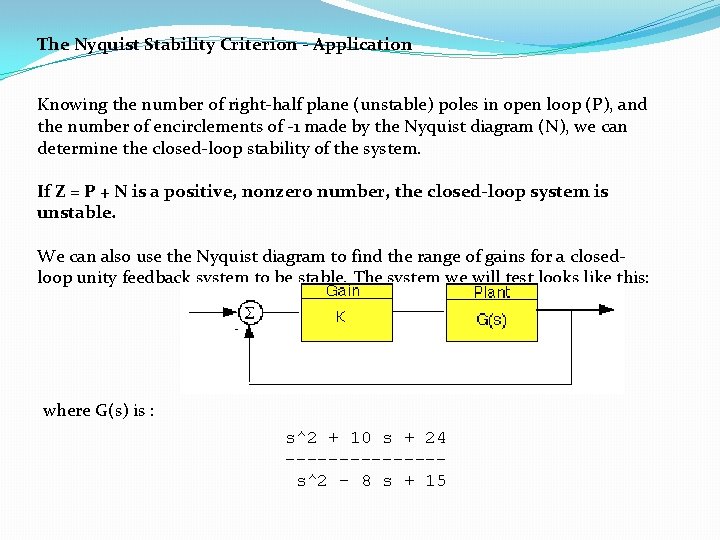
The Nyquist Stability Criterion - Application Knowing the number of right-half plane (unstable) poles in open loop (P), and the number of encirclements of -1 made by the Nyquist diagram (N), we can determine the closed-loop stability of the system. If Z = P + N is a positive, nonzero number, the closed-loop system is unstable. We can also use the Nyquist diagram to find the range of gains for a closedloop unity feedback system to be stable. The system we will test looks like this: where G(s) is : s^2 + 10 s + 24 -------s^2 - 8 s + 15
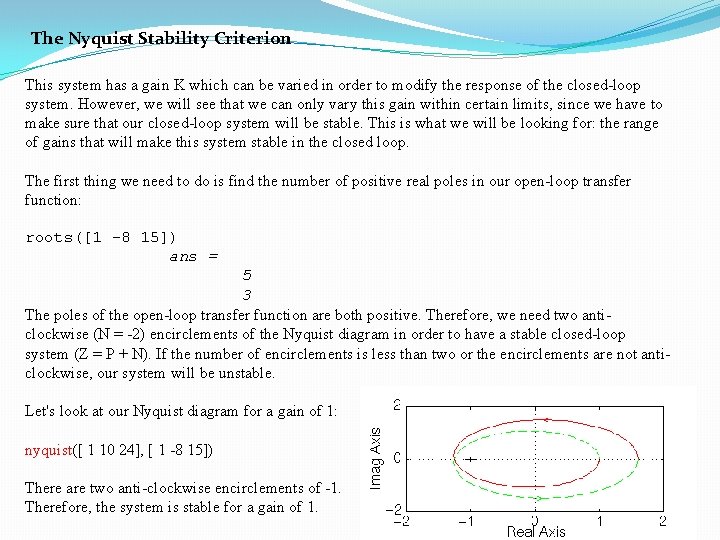
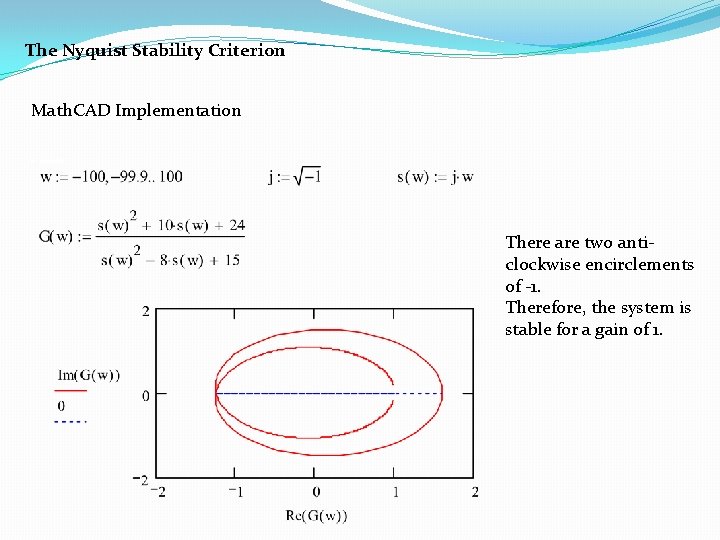
The Nyquist Stability Criterion This system has a gain K which can be varied in order to modify the response of the closed-loop system. However, we will see that we can only vary this gain within certain limits, since we have to make sure that our closed-loop system will be stable. This is what we will be looking for: the range of gains that will make this system stable in the closed loop. The first thing we need to do is find the number of positive real poles in our open-loop transfer function: roots([1 -8 15]) ans = 5 3 The poles of the open-loop transfer function are both positive. Therefore, we need two anticlockwise (N = -2) encirclements of the Nyquist diagram in order to have a stable closed-loop system (Z = P + N). If the number of encirclements is less than two or the encirclements are not anticlockwise, our system will be unstable. Let's look at our Nyquist diagram for a gain of 1: nyquist([ 1 10 24], [ 1 -8 15]) There are two anti-clockwise encirclements of -1. Therefore, the system is stable for a gain of 1.
The Nyquist Stability Criterion Math. CAD Implementation There are two anticlockwise encirclements of -1. Therefore, the system is stable for a gain of 1.
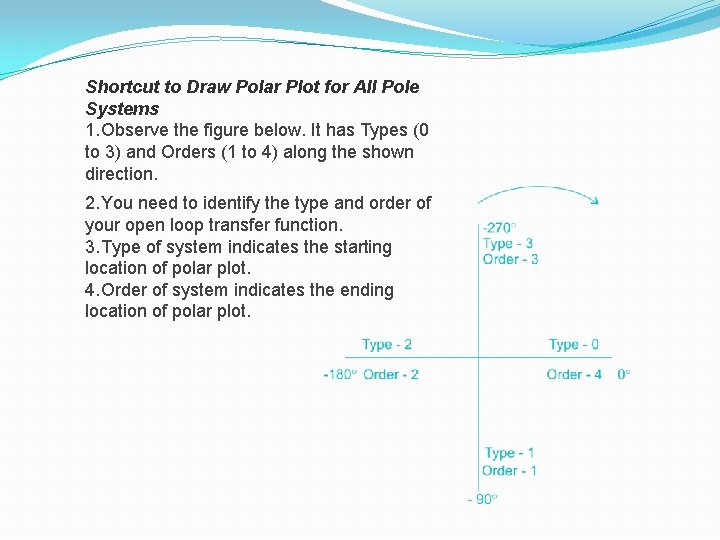
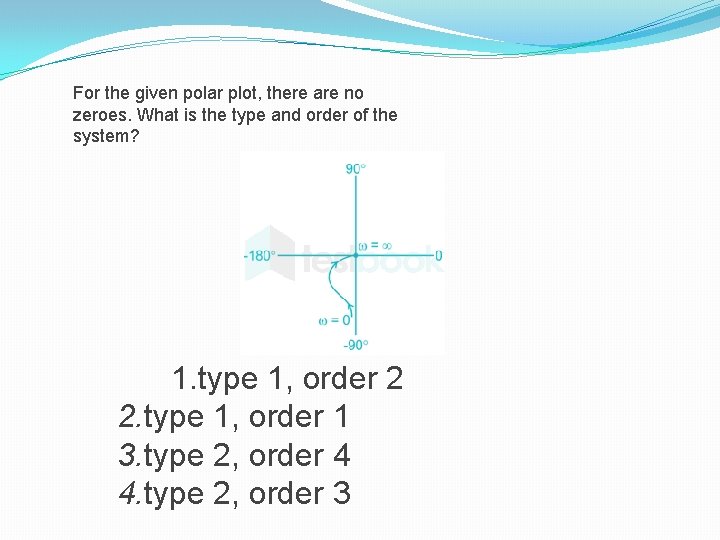
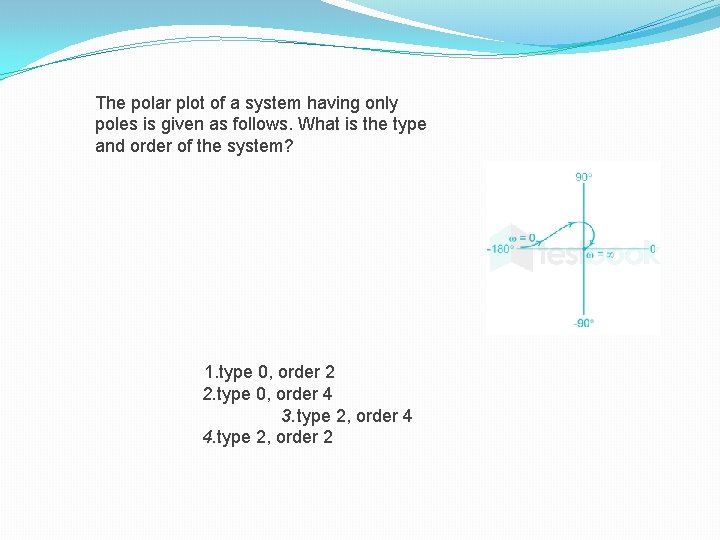
Shortcut to Draw Polar Plot for All Pole Systems 1. Observe the figure below. It has Types (0 to 3) and Orders (1 to 4) along the shown direction. 2. You need to identify the type and order of your open loop transfer function. 3. Type of system indicates the starting location of polar plot. 4. Order of system indicates the ending location of polar plot.
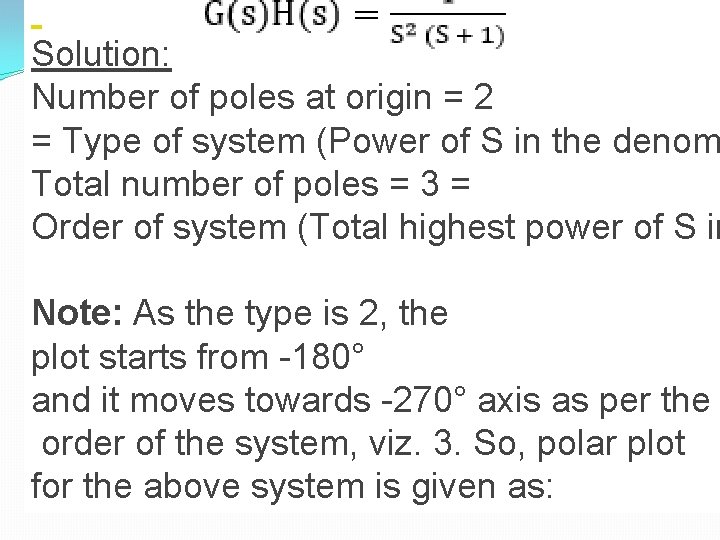
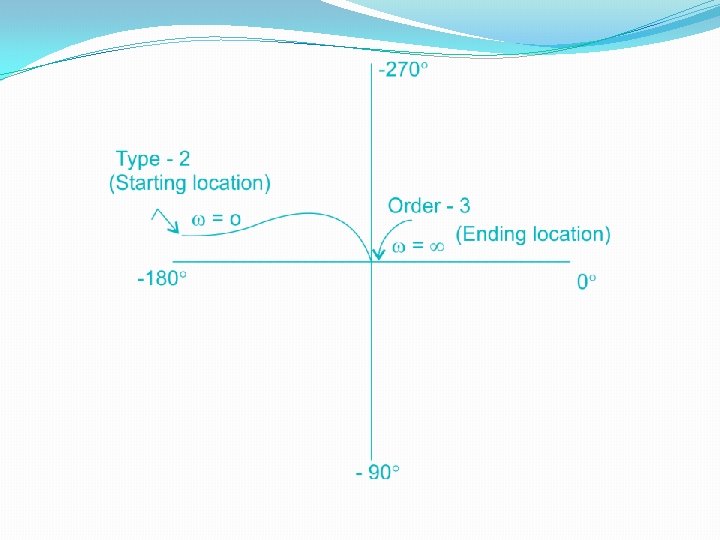
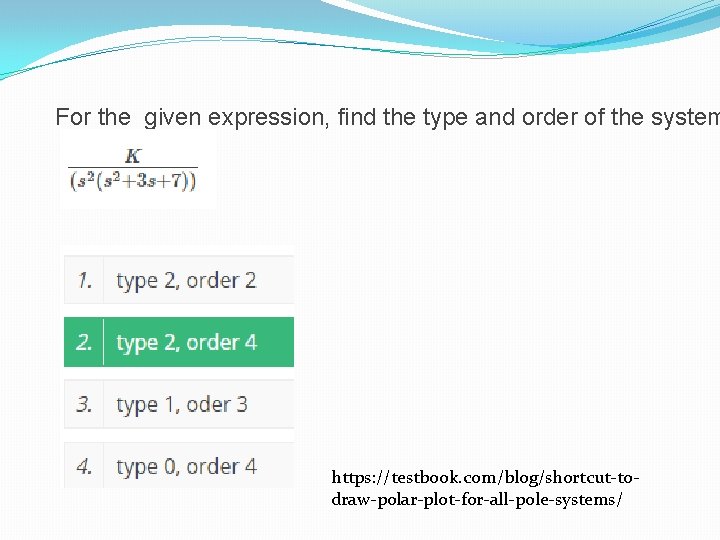
Solution: Number of poles at origin = 2 = Type of system (Power of S in the denom Total number of poles = 3 = Order of system (Total highest power of S in Note: As the type is 2, the plot starts from -180° and it moves towards -270° axis as per the order of the system, viz. 3. So, polar plot for the above system is given as:
For the given polar plot, there are no zeroes. What is the type and order of the system? 1. type 1, order 2 2. type 1, order 1 3. type 2, order 4 4. type 2, order 3
The polar plot of a system having only poles is given as follows. What is the type and order of the system? 1. type 0, order 2 2. type 0, order 4 3. type 2, order 4 4. type 2, order 2
For the given expression, find the type and order of the system https: //testbook. com/blog/shortcut-todraw-polar-plot-for-all-pole-systems/