
POISON GAS By Charley Kate Barcroft Introduction According
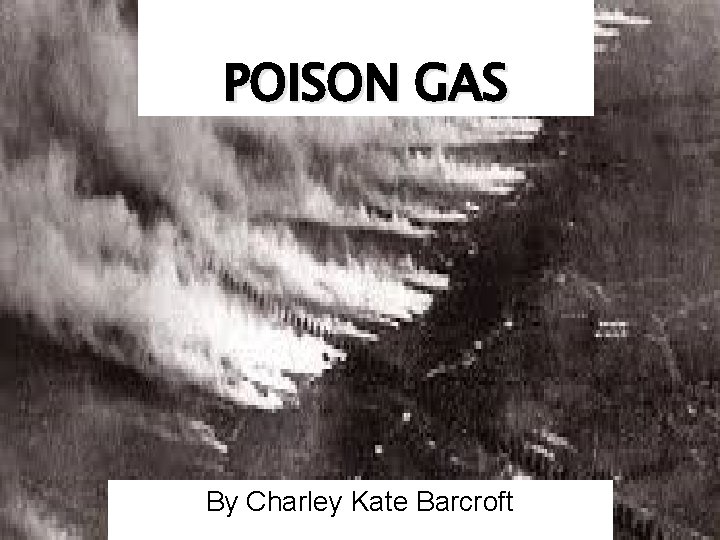
POISON GAS By Charley Kate Barcroft
Introduction � � � According to BBC News, on January 31, 1915, General Max Hoffman of Germany climbed to the top of a church in Bolimow; he witnessed the very first major gas attack. When he got to the top of the churh, he saw 18, 000 gas shells rain down the Russian line that were filled with xylyl bromide, which was a form of tear gas. Unfortunately, the weather was so cold that the tear gas attack failed. In April, Germany invented poison gas, which was used to kill soldiers.

What was Poison Gas? � � Poison gas was a new method to kill enemies during World War I. It was first used by the Germans on April 22, 1915 at the battle of Ypres in Belgium. Poison gas was extremely convenient because trench warfare was put into practice. Within the trenches, no one knew when they were going to be exposed to gas. If they smelled gas, then the poison had already reached their system, which made it the most terrifying method in World War 1.
Types of Poison Gases � � � Mustard Gas Chlorine Gas Phosgene Gas Bromine Chloropicrin Three most commonly used gases; these gases will be discussed

Mustard Gas � � � Used by the Germans in 1917 Enclosed in artillery shells and grenades Described as having no odor More difficult to be protected from mustard gas than chlorine or phosgene gas; the chemical can still have negative effects on the body One drop could affect people within ten cubic meters (approximately 353 cubic feet). It is the most widely-used gas.

Chlorine Gas � � First chemical gas used by the Germans in 1915 Released from pressurized cylinders and caused thousands of French Algerian troops to die from suffocation Described as a green cloud of chlorine Quick to affect soldiers

Phosgene Gas � � � Invented after the usage of chlorine gas Used in Germany’s and the Allies’s armies Chlorine used in the Phosgene gas because it had the vapor to create the new gas Slow to affect the soldiers; took several hours or days for victims to notice the symptoms As more of this gas was inhaled, victims experienced less coughing.

What are the Effects of Poison Gas? � Mustard Eyes: irritation, redness, burning, inflammation, blindness � Skin: red spots that soon turn to blisters � Direct attack through inhaling: pain and swelling in the nose and throat; blisters develop and seal the airway � � Chlorine Destroys the respiratory organs � Causes the victim to choke within seconds � Reacts with water in the airways; forms hydrochloric acid that swells and blocks lung tissue, causing the victim to suffocate � � Phosgene Coughing � choking �
Wilfred Owen’s “Dulce et Decorum Est” � Background information: Wilfred Owen lived in the trenches for three years on the Western front. � His poem was written in 1917 � � � Witnessed his friend being exposed to chlorine gas because his friend did not put on his gas mask in time. Described his friend having the symptoms of chlorine gas exposure Used the description of chlorine gas as a “green sea” of a “thick green light” He was not as affected by the chlorine as his friend since he was wearing a gas mask. His gas mask over his face was described as seeing through “misty panes”
Ways that Soldiers Prevented Themselves from Being Gassed � Gas Masks Sometimes known as the “small box respirator” because the soldiers were able to breathe without breathing in toxins from the gas � Put over the face to protect people from gas exposure � Standard-issue mask (1917) protected people from chlorine and phosgene � Did not fully protect soldiers against mustard gas � � Canaries Soldiers caged them and dropped the cages in the selected trench. � If the canaries were alive after a certain amount of time, then there was no poison gas present. If the canaries were dead, then there was gas in the trench. �

QUIZ There are 8 questions. Types of questions: 1) Fill-in-the-Blank 2) Multiple Choice 3) Short Answer If any answers are “none of the above, ” the correct answer must be written
QUESTION 1 What are three most commonly used poison gases in World War 1? a) Mustard gas, bromine gas, tear gas b) Phosgene gas, chlorine gas, bromine gas c) Chlorine gas, mustard gas, phosgene gas d) None of the above
ANSWER The correct answer is C) Chlorine gas, mustard gas, and phosgene gas

QUESTION 2 _______ wrote a poem in 1917 describing his experience witnessing a gas attack.
ANSWER Wilfred Owen wrote a poem in 1917 describing his experience witnessing a chlorine gas attack.
QUESTION 3 Why did the tear gas attack in 1915 fail? a) The xylyl bromide was not effective b) The gas attack did not fail c) Not enough shells rained down on the Russian lines for it to be successful d) None of the above
ANSWER The correct answer is D) None of the above. The correct answer is “the cold weather prevented the attack from succeeding. ”
QUESTION 4 What animal was used to check for poison gas? a) Rats b) Canaries c) No animal was used d) None of the aboe
ANSWER The correct answer is B) canaries
QUESTION 5 Describe three (3) effects that mustard gas has on the victim
ANSWERS VARY BETWEEN THESE ANSWERS � Skin irritation �Redness �Burning �Inflammation �Blindness �Red spots �Blisters �Swelling in the nose and throat
QUESTION 6 Explain why gas masks do not fully protect the soldiers from being exposed to mustard gas
ANSWER Gas masks do not fully protect soldiers from being exposed from mustard gas because they can still be exposed through the body.
QUESTION 7 Phosgene gas was created after the usage of which gas? a) Mustard gas b) Chlorine gas c) None of the above d) Tear gas
ANSWER The correct answer is B) Chlorine gas
QUESTION 8 Wilfred Owen’s friend was exposed to ____ gas because _______.
ANSWER Wilfred Owen’s friend was exposed to chlorine gas because he describes the gas as being green. 1) Other possible answer for the second fill in the blank: He describes the gas as a “green sea” OR a “thick, green light” 2) His friend had the symptoms of chlorine gas
BONUS QUESTION!! Draw a picture describing one of the three options 1) General Max Hoffman’s view of the first major gas attack 2) Chlorine gas 3) How soldiers used canaries to check for poison gas in the trenches
- Slides: 28