
Pointing Devices and Transfer Functions 1 Albrecht Schmidt
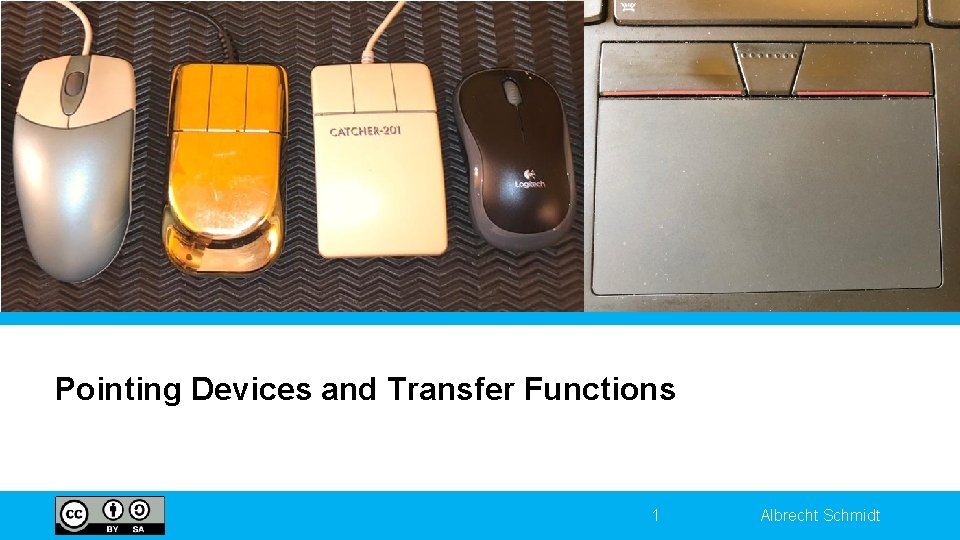
Pointing Devices and Transfer Functions 1 Albrecht Schmidt
Learning Goals § Understand … § controller resistance (isometric, isotonic, elastic) § rate control and position control § how a transfer function works § Know § about the Buxton collection of interaction devices § what fundamental shortcomings a single pointing device brings § how to design a transfer function Pointing Devices and Transfer Functions 2 Albrecht Schmidt
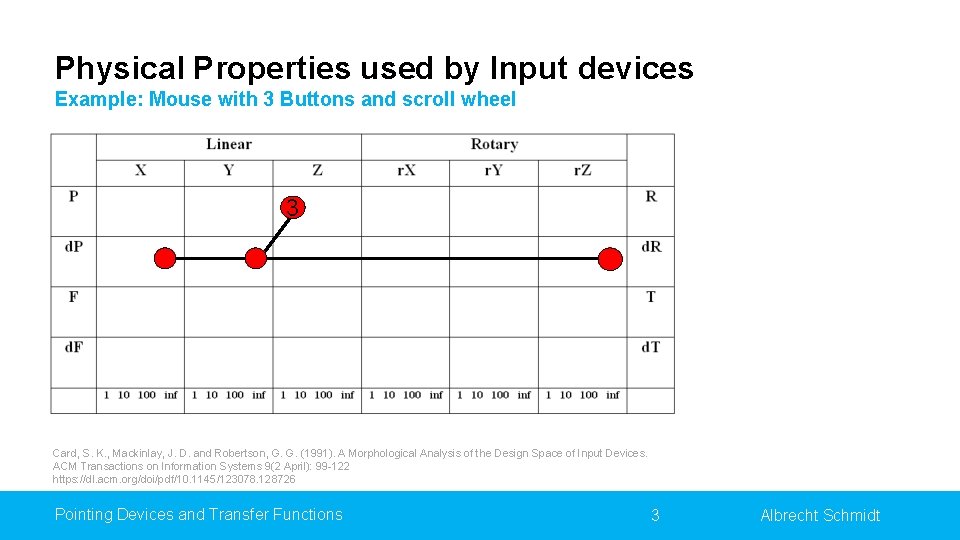
Physical Properties used by Input devices Example: Mouse with 3 Buttons and scroll wheel 3 Card, S. K. , Mackinlay, J. D. and Robertson, G. G. (1991). A Morphological Analysis of the Design Space of Input Devices. ACM Transactions on Information Systems 9(2 April): 99 -122 https: //dl. acm. org/doi/pdf/10. 1145/123078. 128726 Pointing Devices and Transfer Functions 3 Albrecht Schmidt
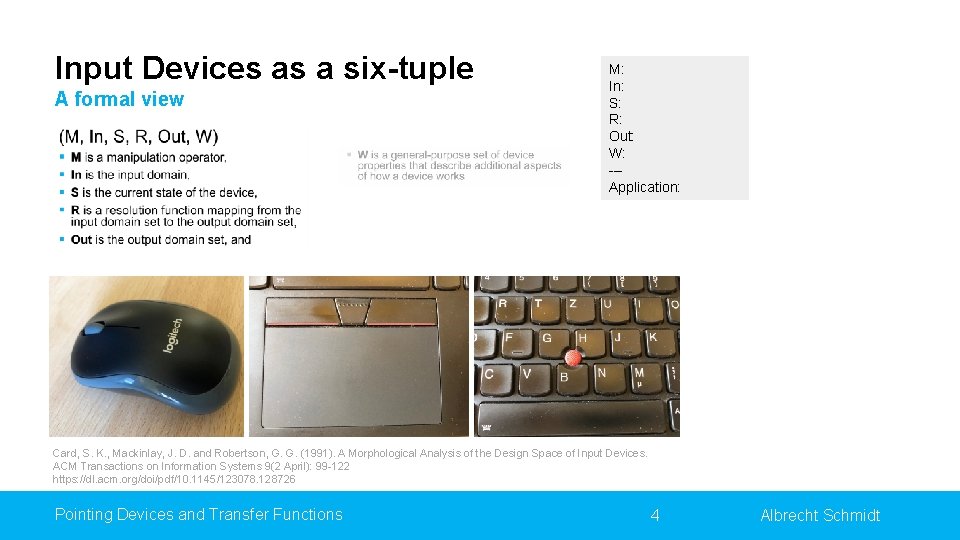
Input Devices as a six-tuple A formal view M: In: S: R: Out: W: --Application: Card, S. K. , Mackinlay, J. D. and Robertson, G. G. (1991). A Morphological Analysis of the Design Space of Input Devices. ACM Transactions on Information Systems 9(2 April): 99 -122 https: //dl. acm. org/doi/pdf/10. 1145/123078. 128726 Pointing Devices and Transfer Functions 4 Albrecht Schmidt
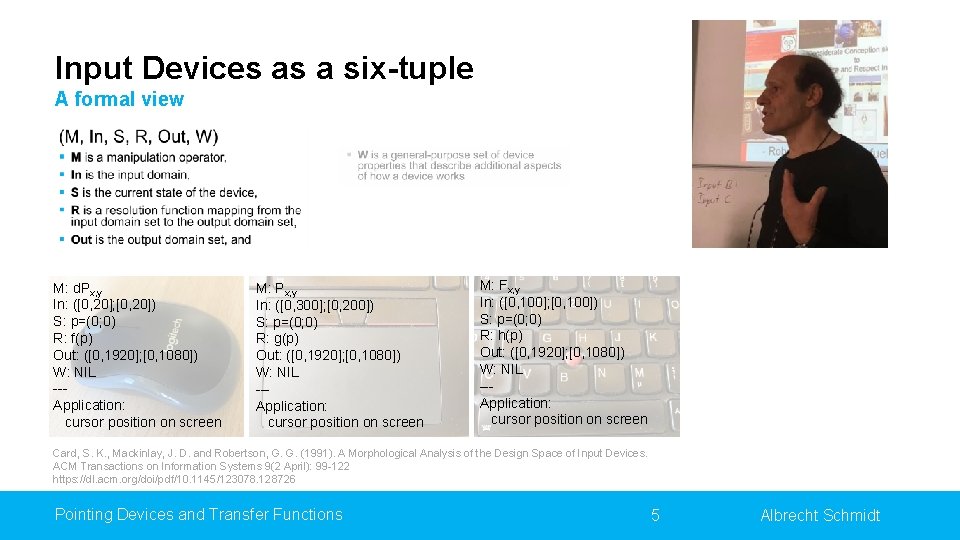
Input Devices as a six-tuple A formal view M: d. Px, y In: ([0, 20]; [0, 20]) S: p=(0; 0) R: f(p) Out: ([0, 1920]; [0, 1080]) W: NIL --Application: cursor position on screen M: Px, y In: ([0, 300]; [0, 200]) S: p=(0; 0) R: g(p) Out: ([0, 1920]; [0, 1080]) W: NIL --Application: cursor position on screen M: Fx, y In: ([0, 100]; [0, 100]) S: p=(0; 0) R: h(p) Out: ([0, 1920]; [0, 1080]) W: NIL --Application: cursor position on screen Card, S. K. , Mackinlay, J. D. and Robertson, G. G. (1991). A Morphological Analysis of the Design Space of Input Devices. ACM Transactions on Information Systems 9(2 April): 99 -122 https: //dl. acm. org/doi/pdf/10. 1145/123078. 128726 Pointing Devices and Transfer Functions 5 Albrecht Schmidt
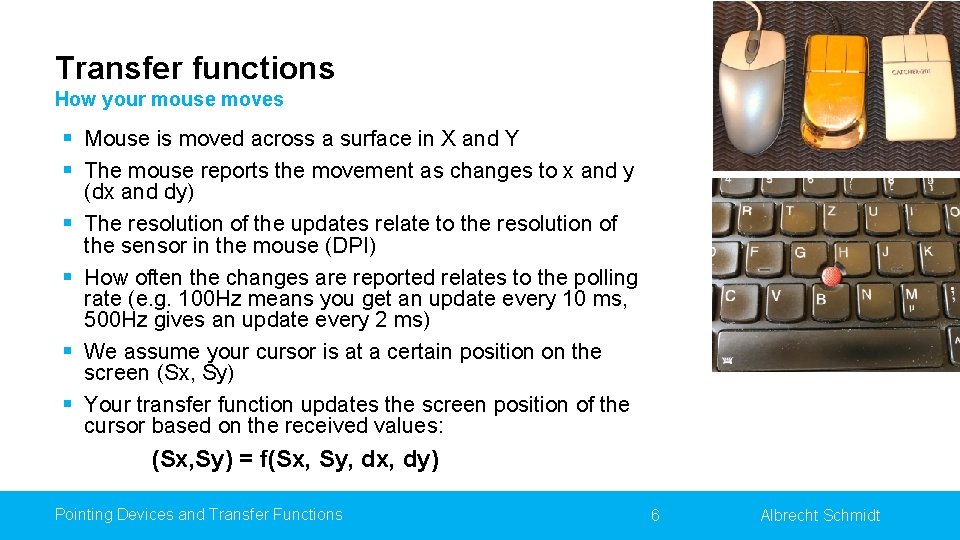
Transfer functions How your mouse moves § Mouse is moved across a surface in X and Y § The mouse reports the movement as changes to x and y § § (dx and dy) The resolution of the updates relate to the resolution of the sensor in the mouse (DPI) How often the changes are reported relates to the polling rate (e. g. 100 Hz means you get an update every 10 ms, 500 Hz gives an update every 2 ms) We assume your cursor is at a certain position on the screen (Sx, Sy) Your transfer function updates the screen position of the cursor based on the received values: (Sx, Sy) = f(Sx, Sy, dx, dy) Pointing Devices and Transfer Functions 6 Albrecht Schmidt
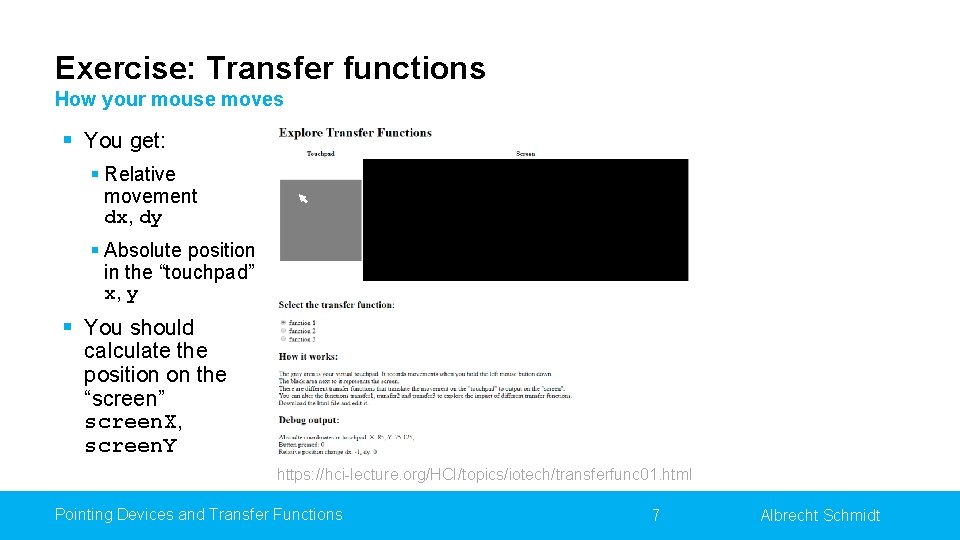
Exercise: Transfer functions How your mouse moves § You get: § Relative movement dx, dy § Absolute position in the “touchpad” x, y § You should calculate the position on the “screen” screen. X, screen. Y https: //hci-lecture. org/HCI/topics/iotech/transferfunc 01. html Pointing Devices and Transfer Functions 7 Albrecht Schmidt
Pointing Devices with 2 DOF § Pointing devices such as § Mouse § Trackpad § Track ball § Touch screen § Eye gaze §… § Beyond the desktop § Interactive surfaces § Pointing gestures § Gaze and attention §… Pointing Devices and Transfer Functions 8 Albrecht Schmidt
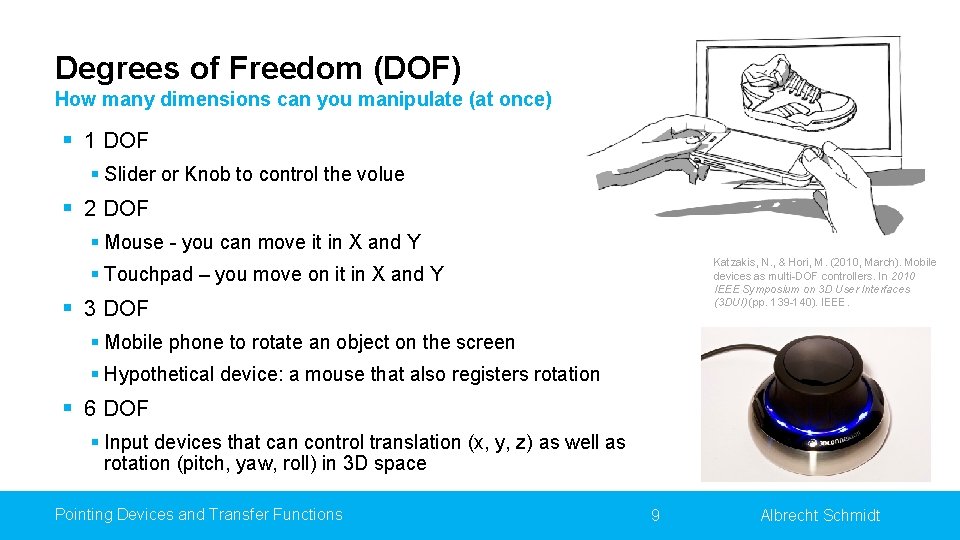
Degrees of Freedom (DOF) How many dimensions can you manipulate (at once) § 1 DOF § Slider or Knob to control the volue § 2 DOF § Mouse - you can move it in X and Y Katzakis, N. , & Hori, M. (2010, March). Mobile devices as multi-DOF controllers. In 2010 IEEE Symposium on 3 D User Interfaces (3 DUI) (pp. 139 -140). IEEE. § Touchpad – you move on it in X and Y § 3 DOF § Mobile phone to rotate an object on the screen § Hypothetical device: a mouse that also registers rotation § 6 DOF § Input devices that can control translation (x, y, z) as well as rotation (pitch, yaw, roll) in 3 D space Pointing Devices and Transfer Functions 9 Albrecht Schmidt
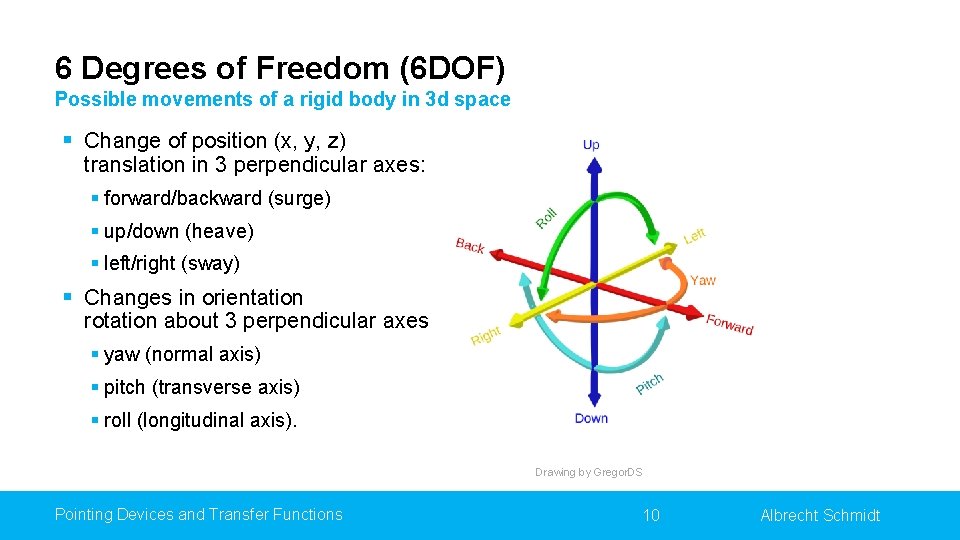
6 Degrees of Freedom (6 DOF) Possible movements of a rigid body in 3 d space § Change of position (x, y, z) translation in 3 perpendicular axes: § forward/backward (surge) § up/down (heave) § left/right (sway) § Changes in orientation rotation about 3 perpendicular axes § yaw (normal axis) § pitch (transverse axis) § roll (longitudinal axis). Drawing by Gregor. DS Pointing Devices and Transfer Functions 10 Albrecht Schmidt
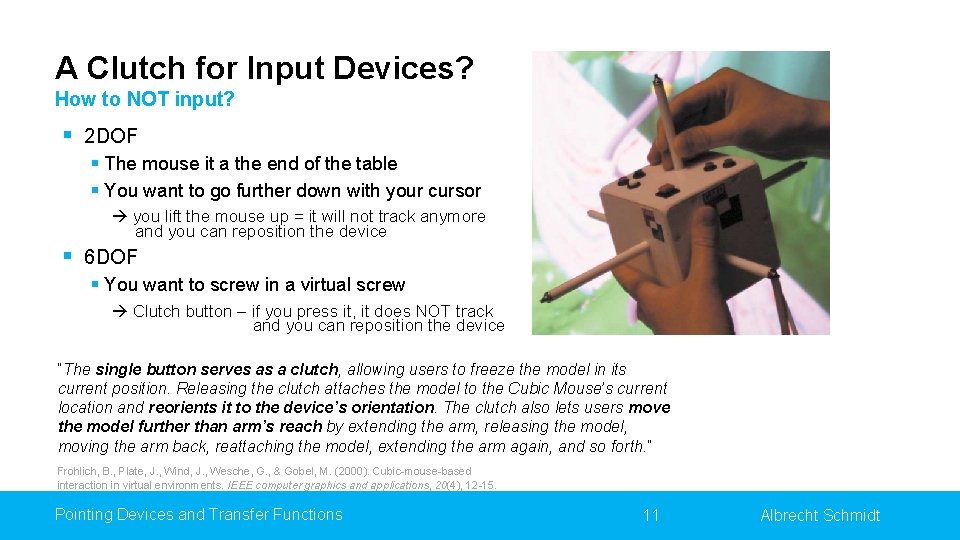
A Clutch for Input Devices? How to NOT input? § 2 DOF § The mouse it a the end of the table § You want to go further down with your cursor you lift the mouse up = it will not track anymore and you can reposition the device § 6 DOF § You want to screw in a virtual screw Clutch button – if you press it, it does NOT track and you can reposition the device “The single button serves as a clutch, allowing users to freeze the model in its current position. Releasing the clutch attaches the model to the Cubic Mouse’s current location and reorients it to the device’s orientation. The clutch also lets users move the model further than arm’s reach by extending the arm, releasing the model, moving the arm back, reattaching the model, extending the arm again, and so forth. ” Frohlich, B. , Plate, J. , Wind, J. , Wesche, G. , & Gobel, M. (2000). Cubic-mouse-based interaction in virtual environments. IEEE computer graphics and applications, 20(4), 12 -15. Pointing Devices and Transfer Functions 11 Albrecht Schmidt
Classification of Pointing devices § Degrees of Freedom (DOF) / Dimensions § 2 DOF, 6 DOF § § 1 D / 2 D / 3 D Direct vs. indirect integration with the visual representation § Touch screen is direct § § Mouse, trackpad, trackpoint are indirect Discreet vs. continuous resolution of the sensing § Touch screen is discreet § § Mouse is continuous Absolute vs. Relative movement/position used as input § Touch screen is absolute § Mouse is relative Pointing Devices and Transfer Functions 12 Albrecht Schmidt
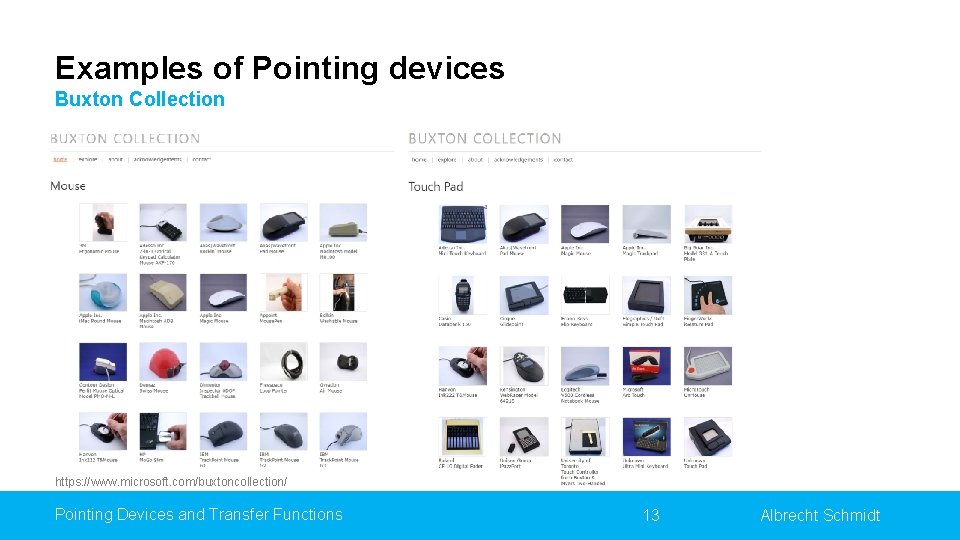
Examples of Pointing devices Buxton Collection https: //www. microsoft. com/buxtoncollection/ Pointing Devices and Transfer Functions 13 Albrecht Schmidt
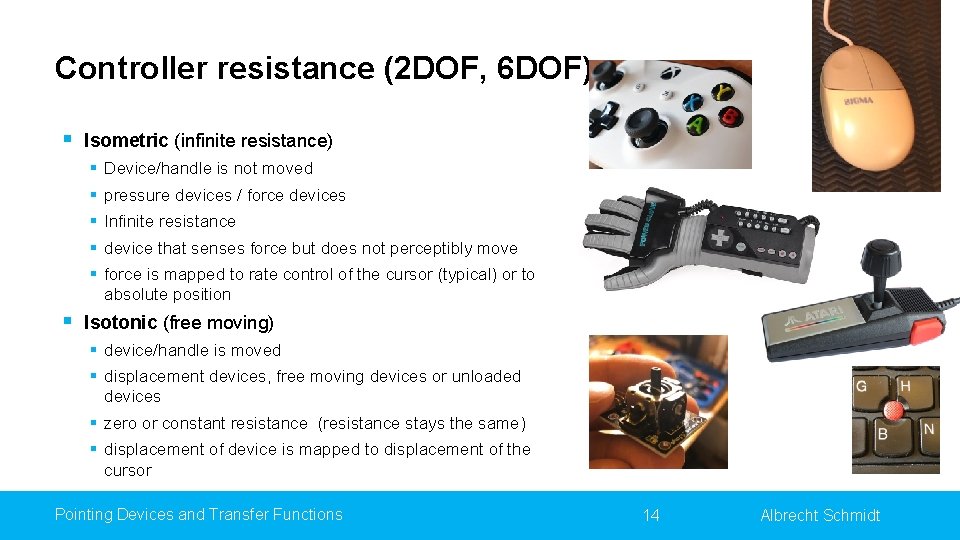
Controller resistance (2 DOF, 6 DOF) § Isometric (infinite resistance) § Device/handle is not moved § pressure devices / force devices § Infinite resistance § device that senses force but does not perceptibly move § force is mapped to rate control of the cursor (typical) or to absolute position § Isotonic (free moving) § device/handle is moved § displacement devices, free moving devices or unloaded devices § zero or constant resistance (resistance stays the same) § displacement of device is mapped to displacement of the cursor Pointing Devices and Transfer Functions 14 Albrecht Schmidt
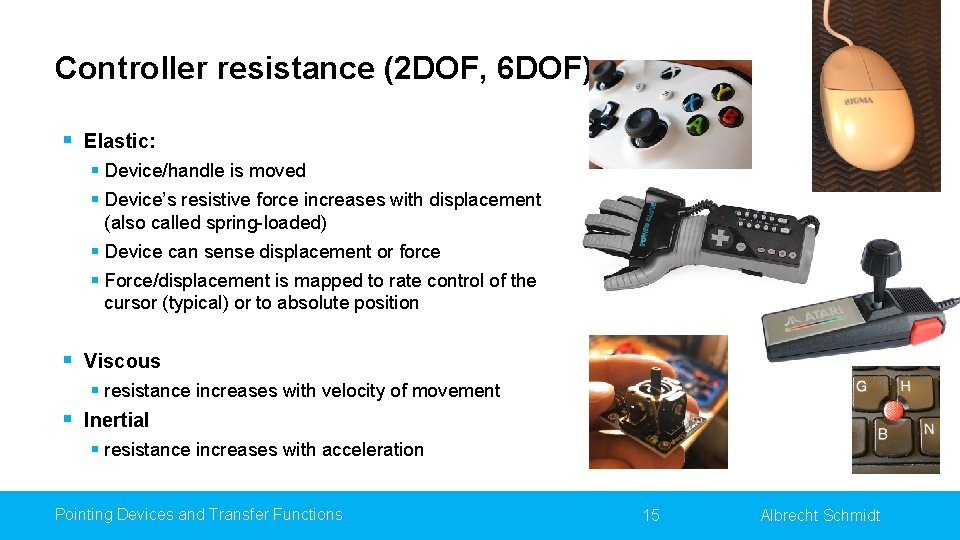
Controller resistance (2 DOF, 6 DOF) § Elastic: § Device/handle is moved § Device’s resistive force increases with displacement (also called spring-loaded) § Device can sense displacement or force § Force/displacement is mapped to rate control of the cursor (typical) or to absolute position § Viscous § resistance increases with velocity of movement § Inertial § resistance increases with acceleration Pointing Devices and Transfer Functions 15 Albrecht Schmidt
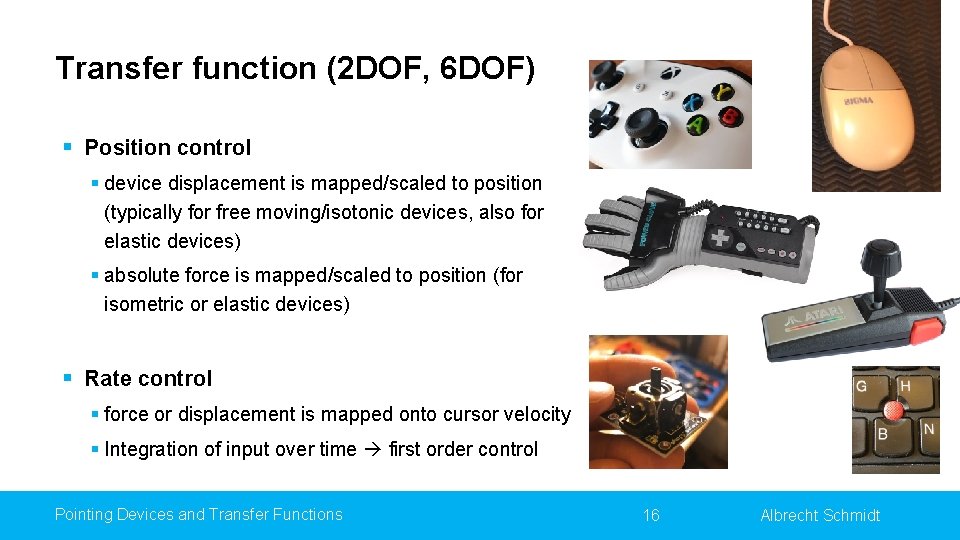
Transfer function (2 DOF, 6 DOF) § Position control § device displacement is mapped/scaled to position (typically for free moving/isotonic devices, also for elastic devices) § absolute force is mapped/scaled to position (for isometric or elastic devices) § Rate control § force or displacement is mapped onto cursor velocity § Integration of input over time first order control Pointing Devices and Transfer Functions 16 Albrecht Schmidt
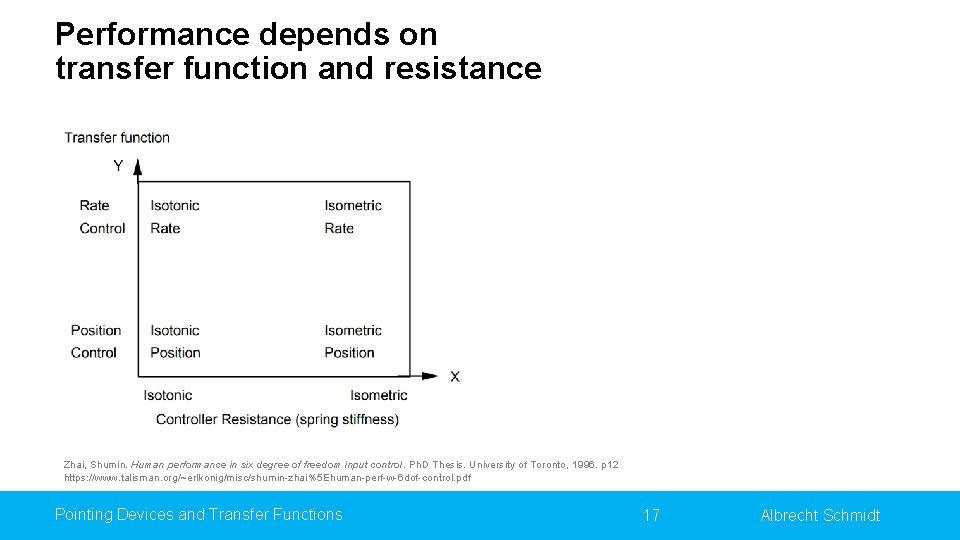
Performance depends on transfer function and resistance Zhai, Shumin. Human performance in six degree of freedom input control. Ph. D Thesis. University of Toronto, 1996. p 12 https: //www. talisman. org/~erlkonig/misc/shumin-zhai%5 Ehuman-perf-w-6 dof-control. pdf Pointing Devices and Transfer Functions 17 Albrecht Schmidt
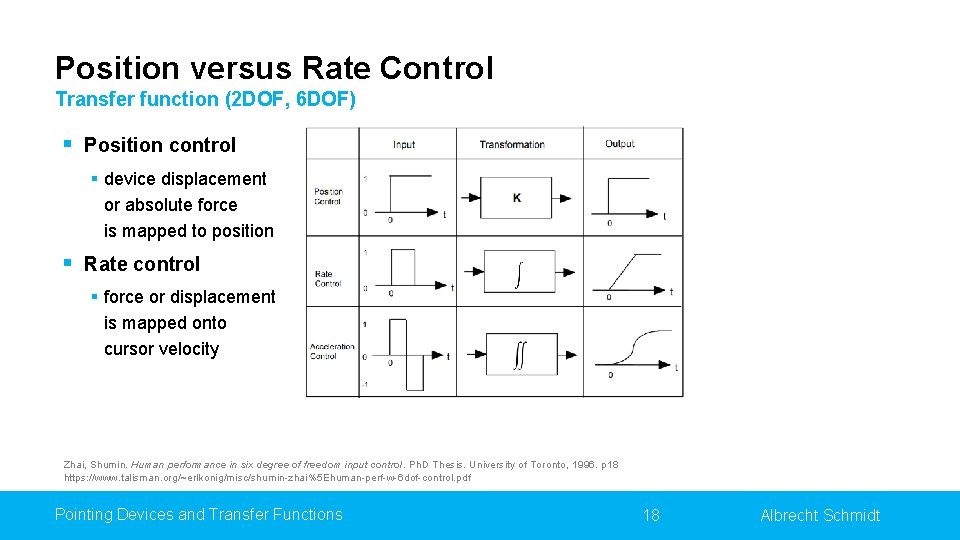
Position versus Rate Control Transfer function (2 DOF, 6 DOF) § Position control § device displacement or absolute force is mapped to position § Rate control § force or displacement is mapped onto cursor velocity Zhai, Shumin. Human performance in six degree of freedom input control. Ph. D Thesis. University of Toronto, 1996. p 18 https: //www. talisman. org/~erlkonig/misc/shumin-zhai%5 Ehuman-perf-w-6 dof-control. pdf Pointing Devices and Transfer Functions 18 Albrecht Schmidt
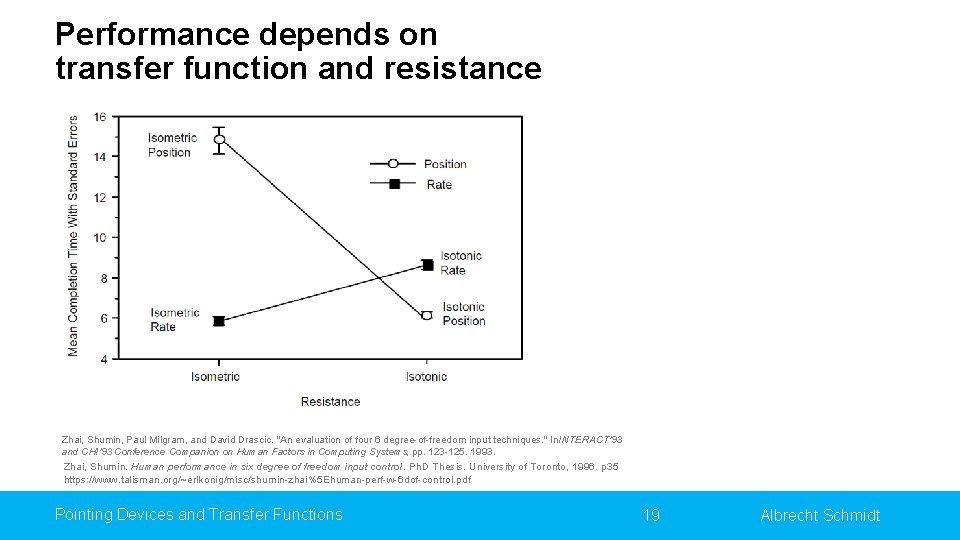
Performance depends on transfer function and resistance Zhai, Shumin, Paul Milgram, and David Drascic. "An evaluation of four 6 degree-of-freedom input techniques. " In. INTERACT'93 and CHI'93 Conference Companion on Human Factors in Computing Systems, pp. 123 -125. 1993. Zhai, Shumin. Human performance in six degree of freedom input control. Ph. D Thesis. University of Toronto, 1996. p 35 https: //www. talisman. org/~erlkonig/misc/shumin-zhai%5 Ehuman-perf-w-6 dof-control. pdf Pointing Devices and Transfer Functions 19 Albrecht Schmidt
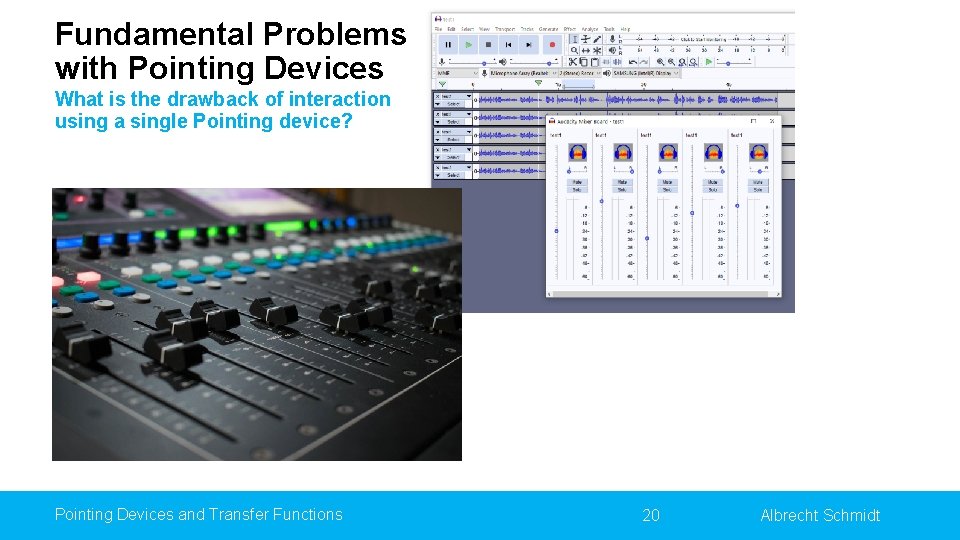
Fundamental Problems with Pointing Devices What is the drawback of interaction using a single Pointing device? Pointing Devices and Transfer Functions 20 Albrecht Schmidt
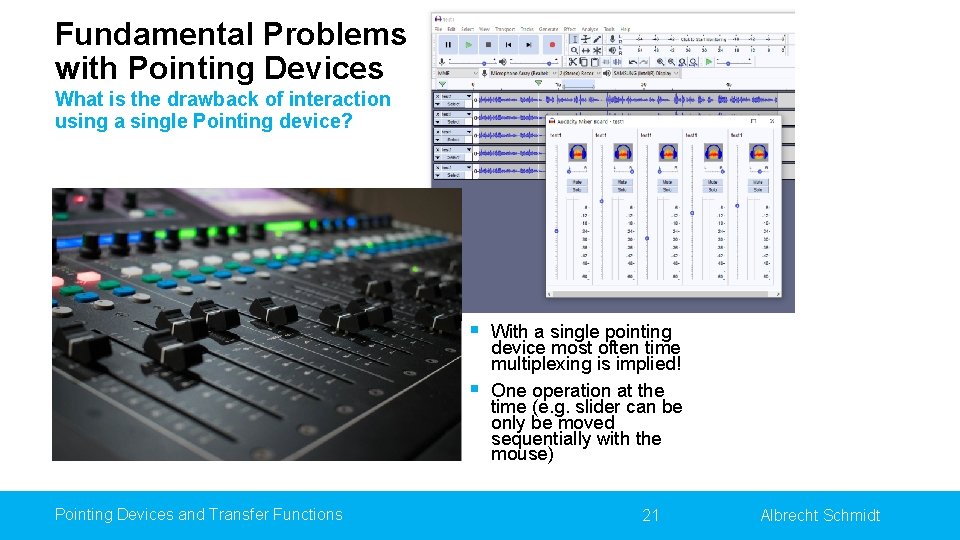
Fundamental Problems with Pointing Devices What is the drawback of interaction using a single Pointing device? § § Pointing Devices and Transfer Functions With a single pointing device most often time multiplexing is implied! One operation at the time (e. g. slider can be only be moved sequentially with the mouse) 21 Albrecht Schmidt
Did you understand this block? Can you answer these questions? § What does the Buxton collection include? § What is a transfer function? § Assume you a have screen where you need very precise at the left and only very coarse pointing at the right of the screen. How could you design a transfer function to support this? § Explain the concept of controller resistance and give examples. § When is it better to use rate control? When is position control more effective? § What are the problems of having a single pointing device? § Why do input device often need a clutch? Pointing Devices and Transfer Functions 22 Albrecht Schmidt
Reference § § Zhai, Shumin. Human performance in six degree of freedom input control. Ph. D Thesis. University of Toronto, 1996. p 35 https: //www. talisman. org/~erlkonig/misc/shuminzhai%5 Ehuman-perf-w-6 dof-control. pdf Zhai, Shumin, Paul Milgram, and David Drascic. "An evaluation of four 6 degree-of-freedom input techniques. " In INTERACT'93 and CHI'93 Conference Companion on Human Factors in Computing Systems, pp. 123 -125. 1993. Card, S. K. , Mackinlay, J. D. and Robertson, G. G. (1991). A Morphological Analysis of the Design Space of Input Devices. ACM Transactions on Information Systems 9(2 April): 99 -122 https: //dl. acm. org/doi/pdf/10. 1145/123078. 128726 Buxton, B. https: //www. microsoft. com/buxtoncollection/ Pointing Devices and Transfer Functions 23 Albrecht Schmidt
License This file is licensed under the Creative Commons Attribution-Share Alike 4. 0 (CC BY-SA) license: https: //creativecommons. org/licenses/by-sa/4. 0 Attribution: Albrecht Schmidt For more content see: https: //hci-lecture. de 24 Albrecht Schmidt
- Slides: 24