
Pointing and Stabilization of Lightweight Balloon Borne Telescopes
Pointing and Stabilization of Lightweight Balloon Borne Telescopes presented at the Sw. RI LCANS 09 Balloon Workshop on Bridging the Gap To Space Lightweight Science Payloads on High-Altitude Long-Duration Balloons and Airships 26 October 2009 Larry Germann Left Hand Design Corporation 1
The Purpose of a Precision Pointing System • • • Perform line-of-sight stabilization – Correct atmospheric turbulence – Correct vehicle base motion – Correct vibration of optical elements – Correct force or torque disturbances – Correct friction-induced pointing errors Perform scanning function to extend the Field of Regard beyond the telescope’s Field of View Perform chopping function Perform dither function Quickly slew and stare among a field of targets 2
When a Precision Pointing System is Needed • When the required pointing stability cannot be achieved by the platform attitude control system • When the field-of-regard requirement is larger than the instrument’s achievable field-of-view • When chopping is required to calibrate the optical sensor 3
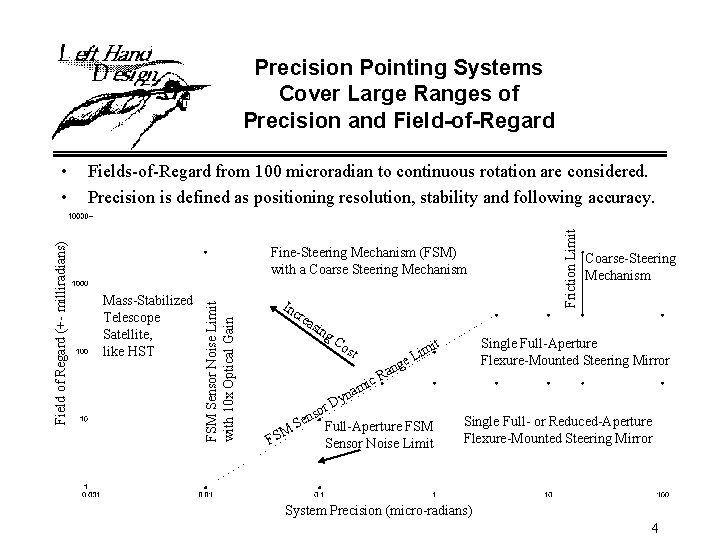
Fine-Steering Mechanism (FSM) with a Coarse Steering Mechanism Mass-Stabilized Telescope Satellite, like HST Inc rea sin g. C t os t e ic am yn ng Ra Coarse-Steering Mechanism Single Full-Aperture Flexure-Mounted Steering Mirror i Lim D or s n Se Full-Aperture FSM M FS Sensor Noise Limit Friction Limit Fields-of-Regard from 100 microradian to continuous rotation are considered. Precision is defined as positioning resolution, stability and following accuracy. FSM Sensor Noise Limit with 10 x Optical Gain • • Field of Regard (+- milliradians) Precision Pointing Systems Cover Large Ranges of Precision and Field-of-Regard Single Full- or Reduced-Aperture Flexure-Mounted Steering Mirror System Precision (micro-radians) 4
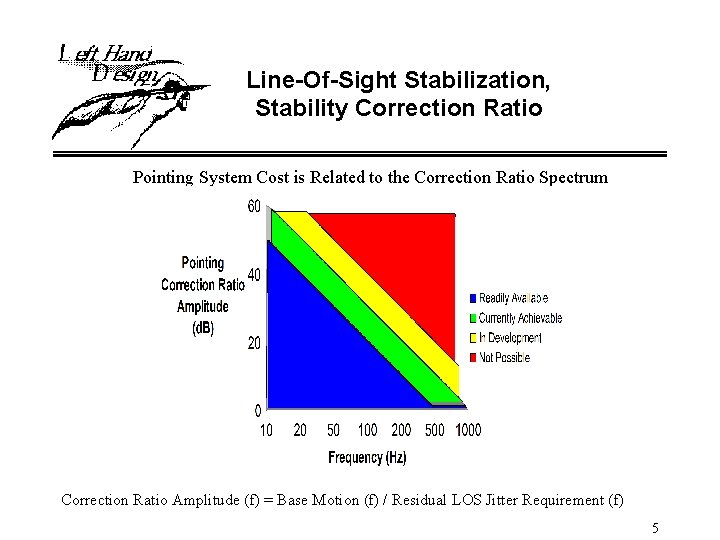
Line-Of-Sight Stabilization, Stability Correction Ratio Pointing System Cost is Related to the Correction Ratio Spectrum Correction Ratio Amplitude (f) = Base Motion (f) / Residual LOS Jitter Requirement (f) 5
Dominant Sources of Vehicle Base Motion • LEO Spacecraft – Thermal Shock from Transitions into & from Umbra – Attitude Control System (ACS) exciting vehicle bending modes – Solar Array Drives • High-Altitude Lighter-Than-Air – ACS exciting pendulum & suspension cable bending modes – Payload Mechanisms – Station-Keeping Propulsion, if applicable • High-Altitude Heavier-Than-Air – Air Turbulence exciting vehicle bending modes – Propulsion 6
Typical Precision Pointing System Components • • The components of a typical precision pointing system include: – Beam-expander telescope – Fine-steering mechanism or fast-steering mechanism: two-axis reducedaperture, full-aperture steering mirror or isolation system – Coarse-pointing mechanism: vehicle attitude control system, two-axis gimbaled telescope or full-aperture steering mirror Payload motion sensor suite: inertially or optically referenced In general, both fine-and course-pointing mechanisms are required when system dynamic range >10^5 @1 k. Hz or >10^6 @10 Hz is required, exceptions include a mass-stabilized satellite ACS for the single pointing stage Flexure-mounted fine-steering mechanism is required when system following accuracy requirement exceeds friction- or hysteresis-induced limits 7
Fine- and Coarse. Pointing Mechanisms • • Coarse-Pointing Mechanism – Performs large-angle motions – Can be vehicle ACS or a bearing-mounted mechanism – Keeps FPM near the center of its travel range Fine-Pointing Mechanism – Performs high-frequency portions of pointing motions – Performs high-acceleration motions – Accurately follows commands – Corrects or rejects base motion and force and torque disturbances – Can be reaction-compensated (a. k. a. momentum compensated) 8
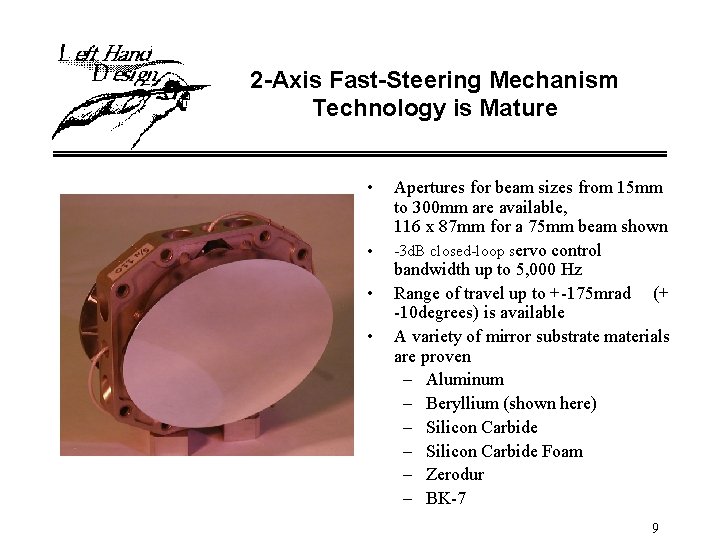
2 -Axis Fast-Steering Mechanism Technology is Mature • • Apertures for beam sizes from 15 mm to 300 mm are available, 116 x 87 mm for a 75 mm beam shown -3 d. B closed-loop servo control bandwidth up to 5, 000 Hz Range of travel up to +-175 mrad (+ -10 degrees) is available A variety of mirror substrate materials are proven – Aluminum – Beryllium (shown here) – Silicon Carbide Foam – Zerodur – BK-7 9
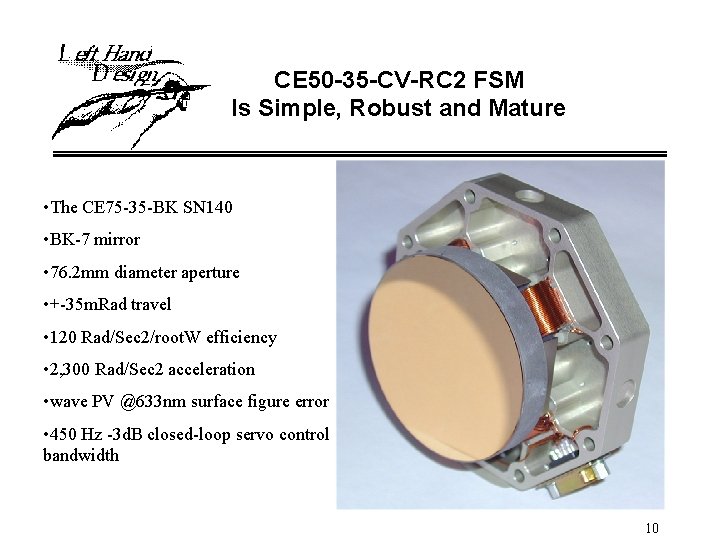
CE 50 -35 -CV-RC 2 FSM Is Simple, Robust and Mature • The CE 75 -35 -BK SN 140 • BK-7 mirror • 76. 2 mm diameter aperture • +-35 m. Rad travel • 120 Rad/Sec 2/root. W efficiency • 2, 300 Rad/Sec 2 acceleration • wave PV @633 nm surface figure error • 450 Hz -3 d. B closed-loop servo control bandwidth 10
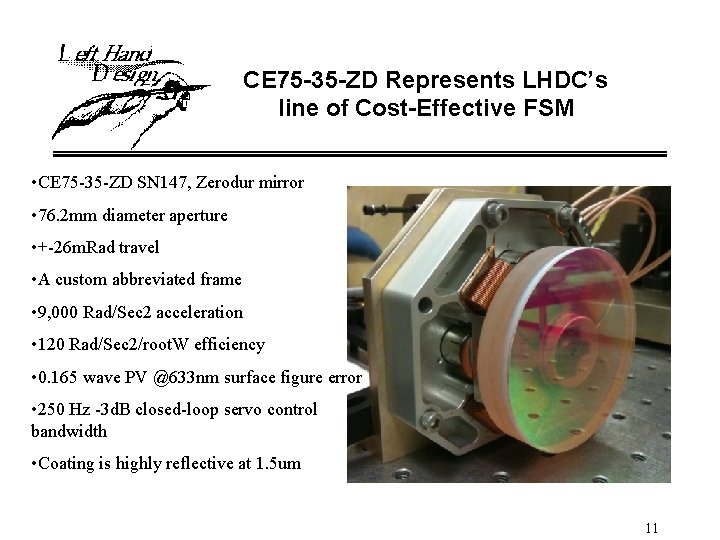
CE 75 -35 -ZD Represents LHDC’s line of Cost-Effective FSM • CE 75 -35 -ZD SN 147, Zerodur mirror • 76. 2 mm diameter aperture • +-26 m. Rad travel • A custom abbreviated frame • 9, 000 Rad/Sec 2 acceleration • 120 Rad/Sec 2/root. W efficiency • 0. 165 wave PV @633 nm surface figure error • 250 Hz -3 d. B closed-loop servo control bandwidth • Coating is highly reflective at 1. 5 um 11
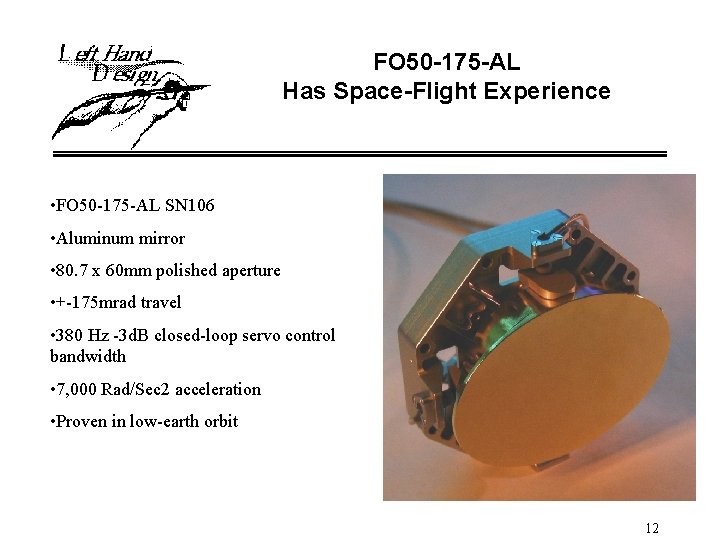
FO 50 -175 -AL Has Space-Flight Experience • FO 50 -175 -AL SN 106 • Aluminum mirror • 80. 7 x 60 mm polished aperture • +-175 mrad travel • 380 Hz -3 d. B closed-loop servo control bandwidth • 7, 000 Rad/Sec 2 acceleration • Proven in low-earth orbit 12
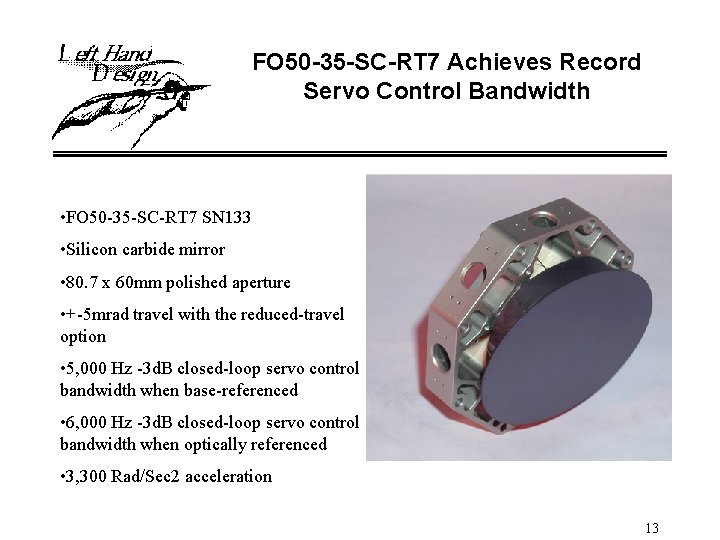
FO 50 -35 -SC-RT 7 Achieves Record Servo Control Bandwidth • FO 50 -35 -SC-RT 7 SN 133 • Silicon carbide mirror • 80. 7 x 60 mm polished aperture • +-5 mrad travel with the reduced-travel option • 5, 000 Hz -3 d. B closed-loop servo control bandwidth when base-referenced • 6, 000 Hz -3 d. B closed-loop servo control bandwidth when optically referenced • 3, 300 Rad/Sec 2 acceleration 13
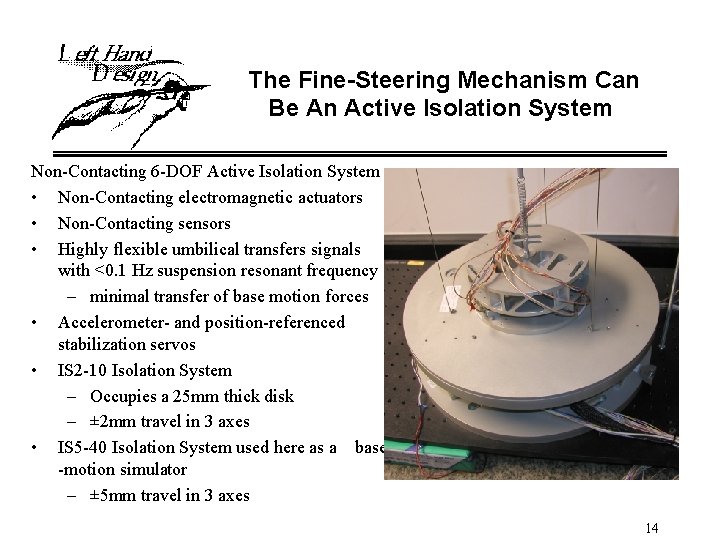
The Fine-Steering Mechanism Can Be An Active Isolation System Non-Contacting 6 -DOF Active Isolation System • Non-Contacting electromagnetic actuators • Non-Contacting sensors • Highly flexible umbilical transfers signals with <0. 1 Hz suspension resonant frequency – minimal transfer of base motion forces • Accelerometer- and position-referenced stabilization servos • IS 2 -10 Isolation System – Occupies a 25 mm thick disk – ± 2 mm travel in 3 axes • IS 5 -40 Isolation System used here as a base -motion simulator – ± 5 mm travel in 3 axes 14
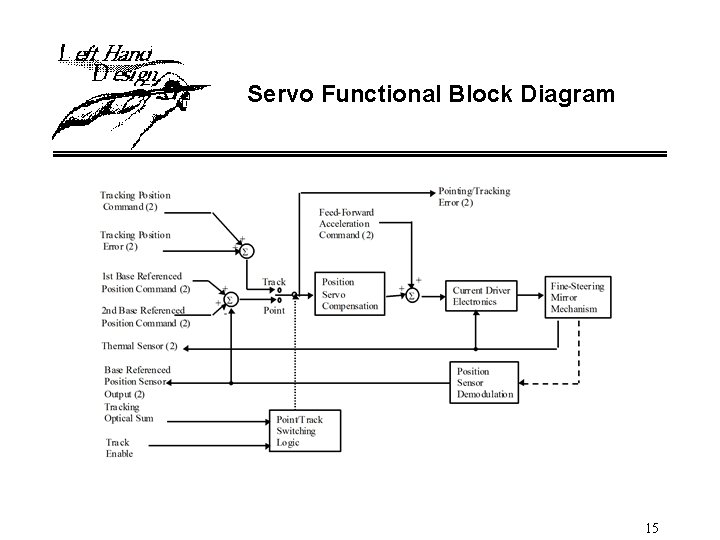
Servo Functional Block Diagram 15
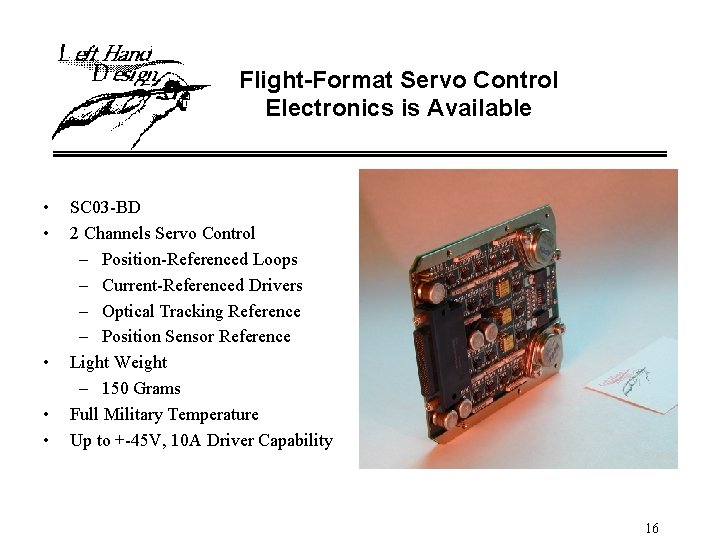
Flight-Format Servo Control Electronics is Available • • • SC 03 -BD 2 Channels Servo Control – Position-Referenced Loops – Current-Referenced Drivers – Optical Tracking Reference – Position Sensor Reference Light Weight – 150 Grams Full Military Temperature Up to +-45 V, 10 A Driver Capability 16
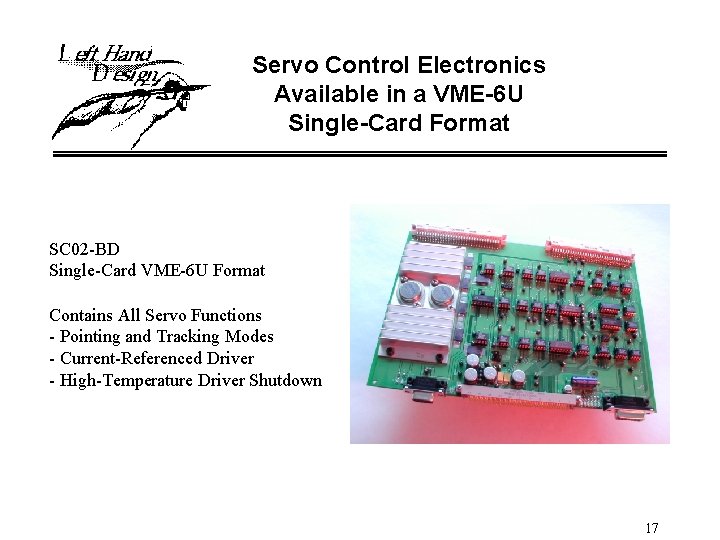
Servo Control Electronics Available in a VME-6 U Single-Card Format SC 02 -BD Single-Card VME-6 U Format Contains All Servo Functions - Pointing and Tracking Modes - Current-Referenced Driver - High-Temperature Driver Shutdown 17
Components of Pointing Accuracy • Fine- and course-steering mechanism pointing accuracy is defined in several ways: – Positioning resolution and position reporting resolution – Line-of-sight jitter and position reporting noise – Short-term positioning drift and position reporting drift – Long-term positioning drift and position reporting drift – Positioning thermal sensitivity and position reporting thermal sensitivity – Positioning linearity and position reporting linearity 18
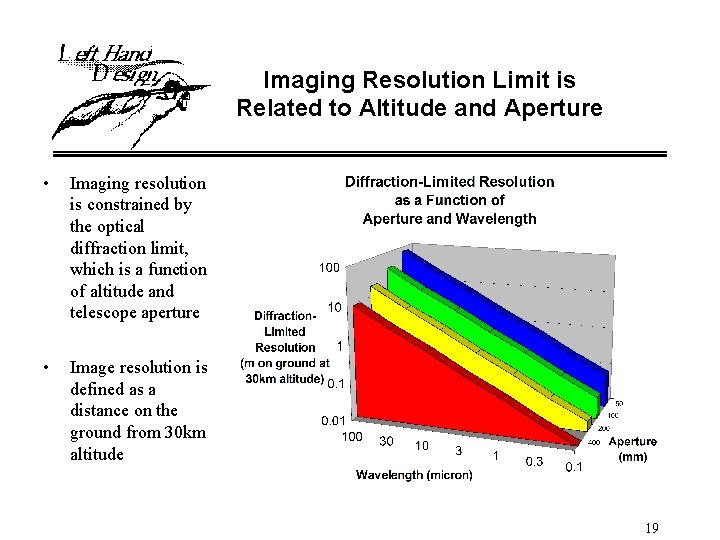
Imaging Resolution Limit is Related to Altitude and Aperture • Imaging resolution is constrained by the optical diffraction limit, which is a function of altitude and telescope aperture • Image resolution is defined as a distance on the ground from 30 km altitude 19
Positioning and Reporting Linearity • Positioning linearity is defined as the difference between commanded and achieved position over the operating ranges of travel and temperature – Dominated by friction, disturbances and position sensor error – Position sensor error is dominated by thermal sensitivity – Typically not much better than 0. 04% of travel • Reporting linearity is the difference between reported and achieved position over the operating ranges of travel and temperature – Dominated by position sensor error 20
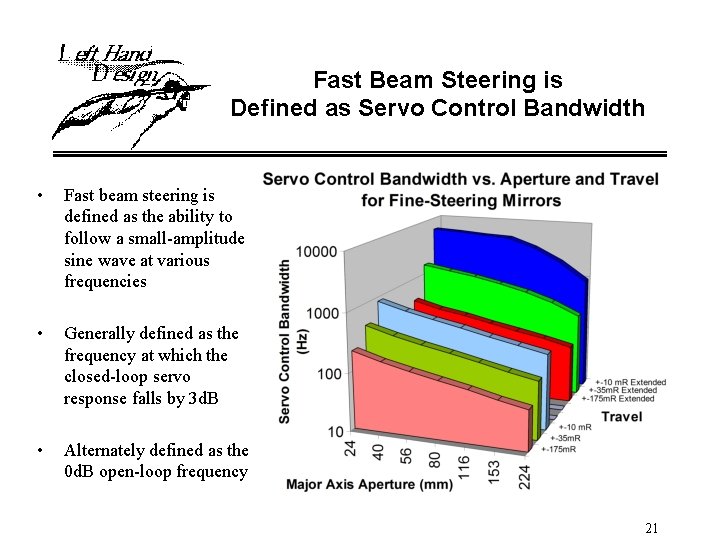
Fast Beam Steering is Defined as Servo Control Bandwidth • Fast beam steering is defined as the ability to follow a small-amplitude sine wave at various frequencies • Generally defined as the frequency at which the closed-loop servo response falls by 3 d. B • Alternately defined as the 0 d. B open-loop frequency 21
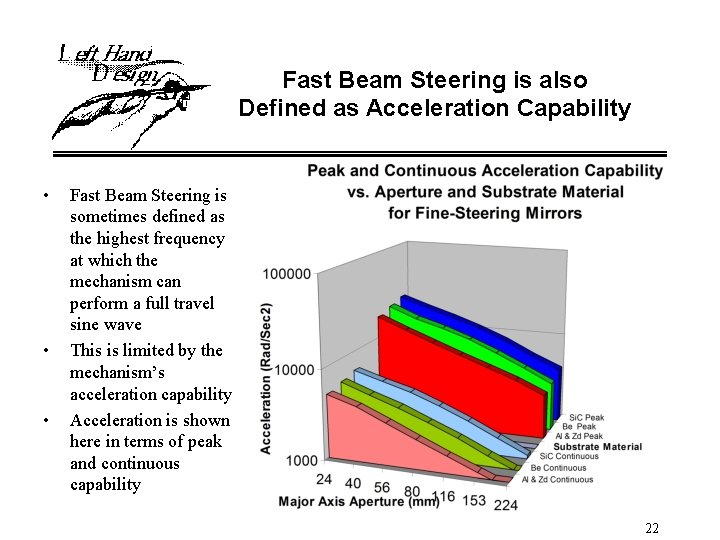
Fast Beam Steering is also Defined as Acceleration Capability • • • Fast Beam Steering is sometimes defined as the highest frequency at which the mechanism can perform a full travel sine wave This is limited by the mechanism’s acceleration capability Acceleration is shown here in terms of peak and continuous capability 22
Non-Linear Characteristics Limit Positioning Accuracy • Friction-induced pointing error – Typically associated with ball or sleeve bearings – Peaks at turn-around condition (stick-slip) – Friction-induced error amplitude can be readily estimated • Peak Pointing Error ~ 2 * Friction Torque / Inertia / Bandwidth 2 • Hysteresis-induced pointing error – Typically associated with ceramic actuators – Typically quantified in terms of % of travel range – Effect are similar to friction effects 23
Precision Pointing Systems Offer Many Benefits • • Extended Dynamic Range, – Up to 9 orders of magnitude – Up to +-180 degree Field of Regard – As low as nanoradian line-of-sight stability High servo control bandwidth, up to 5, 000 Hz – Correct disturbances up to 1, 000 Hz Stable Line-of-Sight – Correct for platform vibrations – Correct for aero turbulence Agile Beam-Steering for scanning, chopping, dither, etc. – Up to 15, 000 rad/sec 2 acceleration – Up to 30 rad/sec rate 24
Many Precision Pointing Instruments are Suitable for Near-Space Platforms • • • LIDAR measurements of forest canopy LIDAR measurements of foliage, carbon stock under canopy LIDAR measurements of targets under foliage or camouflage LIDAR topology measurements under foliage 0. 1 m resolution over a 20 km circle on ground from 100 km altitude 0. 03 m resolution over a 6 km circle on ground from 30 km altitude 25
- Slides: 25