
Pointers to pointers multidimensional arrays Pointers to pointers
![Multi-dimensional arrays Can be created in few ways: 1. Automatically: int m[2][3]; // 2](https://slidetodoc.com/presentation_image_h/7794408fde5b24d94cf1b04931032720/image-9.jpg "Multi-dimensional arrays Can be created in few ways: 1. Automatically: int m[2][3]; // 2")
![Automatic multi-dimensional arrays #define R 2 #define C 3 int m[R][C]; int* m_ptr= &(m[0][0]);](https://slidetodoc.com/presentation_image_h/7794408fde5b24d94cf1b04931032720/image-10.jpg "Automatic multi-dimensional arrays #define R 2 #define C 3 int m[R][C]; int* m_ptr= &(m[0][0]);")
![Automatic multi-dimensional arrays #define R 2 #define C 3 int m[R][C]; int* m_ptr; for](https://slidetodoc.com/presentation_image_h/7794408fde5b24d94cf1b04931032720/image-11.jpg "Automatic multi-dimensional arrays #define R 2 #define C 3 int m[R][C]; int* m_ptr; for")
![Automatic multi-dimensional arrays int A[R][C]; Like a matrix A[0][0] A[0][1] … A[0][c-1] … …](https://slidetodoc.com/presentation_image_h/7794408fde5b24d94cf1b04931032720/image-12.jpg "Automatic multi-dimensional arrays int A[R][C]; Like a matrix A[0][0] A[0][1] … A[0][c-1] … …")
![Semi-dynamic multi-dimensional arrays 2. Semi-dynamic: Define an array of pointers: int* m[5]; // allocates](https://slidetodoc.com/presentation_image_h/7794408fde5b24d94cf1b04931032720/image-13.jpg "Semi-dynamic multi-dimensional arrays 2. Semi-dynamic: Define an array of pointers: int* m[5]; // allocates")
![Automatic multi-dimensional arrays as arguments to functions int x[5][7]; // 5 rows, 7 columns](https://slidetodoc.com/presentation_image_h/7794408fde5b24d94cf1b04931032720/image-18.jpg "Automatic multi-dimensional arrays as arguments to functions int x[5][7]; // 5 rows, 7 columns")
![Pointers to arrays (of size X): int foo (char m[][20]); m is a pointer](https://slidetodoc.com/presentation_image_h/7794408fde5b24d94cf1b04931032720/image-20.jpg "Pointers to arrays (of size X): int foo (char m[][20]); m is a pointer")
![Pointers to arrays (of size X): Explicit declaration: char (*arr_2 d)[20]; // arr_2 d](https://slidetodoc.com/presentation_image_h/7794408fde5b24d94cf1b04931032720/image-21.jpg "Pointers to arrays (of size X): Explicit declaration: char (*arr_2 d)[20]; // arr_2 d")
![Pointers to arrays (of size X): char (*m)[5]; m 22 char *m[5];](https://slidetodoc.com/presentation_image_h/7794408fde5b24d94cf1b04931032720/image-22.jpg "Pointers to arrays (of size X): char (*m)[5]; m 22 char *m[5];")
![Pointers to arrays (of size X): char (*m)[5]; m After initialization: char arr[5]; m=](https://slidetodoc.com/presentation_image_h/7794408fde5b24d94cf1b04931032720/image-23.jpg "Pointers to arrays (of size X): char (*m)[5]; m After initialization: char arr[5]; m=")
![Pointers to arrays (of size X): char (*m)[5]; sizeof (m) = sizeof(void*) sizeof (*m)](https://slidetodoc.com/presentation_image_h/7794408fde5b24d94cf1b04931032720/image-24.jpg "Pointers to arrays (of size X): char (*m)[5]; sizeof (m) = sizeof(void*) sizeof (*m)")
![Multi-dimensional arrays as arguments to functions void foo( int matrix[ROWS_NUM][COLS_NUM] ) { 26](https://slidetodoc.com/presentation_image_h/7794408fde5b24d94cf1b04931032720/image-26.jpg "Multi-dimensional arrays as arguments to functions void foo( int matrix[ROWS_NUM][COLS_NUM] ) { 26")
![Multi-dimensional arrays as arguments to functions void foo( int matrix[ROWS_NUM][COLS_NUM] ){ [ROWS_NUM] What is](https://slidetodoc.com/presentation_image_h/7794408fde5b24d94cf1b04931032720/image-27.jpg "Multi-dimensional arrays as arguments to functions void foo( int matrix[ROWS_NUM][COLS_NUM] ){ [ROWS_NUM] What is")
![Multi-dimensional arrays as arguments to functions void foo( int (*matrix )[COLS_NUM] ) { (*](https://slidetodoc.com/presentation_image_h/7794408fde5b24d94cf1b04931032720/image-28.jpg "Multi-dimensional arrays as arguments to functions void foo( int (*matrix )[COLS_NUM] ) { (*")
![Multi-dimensional arrays as arguments to functions void foo( int (*matrix)[COLS_NUM] ) {. . .](https://slidetodoc.com/presentation_image_h/7794408fde5b24d94cf1b04931032720/image-29.jpg "Multi-dimensional arrays as arguments to functions void foo( int (*matrix)[COLS_NUM] ) {. . .")
![Multi-dimensional arrays as arguments to functions void foo( int (*matrix)[COLS_NUM] ) {. . 30](https://slidetodoc.com/presentation_image_h/7794408fde5b24d94cf1b04931032720/image-30.jpg "Multi-dimensional arrays as arguments to functions void foo( int (*matrix)[COLS_NUM] ) {. . 30")
![Multi-dimensional arrays as arguments to functions void foo( int (*matrix)[COLS_NUM] ) {. . matrix[r][c]](https://slidetodoc.com/presentation_image_h/7794408fde5b24d94cf1b04931032720/image-31.jpg "Multi-dimensional arrays as arguments to functions void foo( int (*matrix)[COLS_NUM] ) {. . matrix[r][c]")
![Multi-dimensional arrays as arguments to functions void foo( int (*matrix)[COLS_NUM] ) {. . .](https://slidetodoc.com/presentation_image_h/7794408fde5b24d94cf1b04931032720/image-32.jpg "Multi-dimensional arrays as arguments to functions void foo( int (*matrix)[COLS_NUM] ) {. . .")
![Multi-dimensional arrays as arguments to functions void foo( int (*matrix)[COLS_NUM] ) {. . .](https://slidetodoc.com/presentation_image_h/7794408fde5b24d94cf1b04931032720/image-33.jpg "Multi-dimensional arrays as arguments to functions void foo( int (*matrix)[COLS_NUM] ) {. . .")
![argv & argc: example $ prog 1 –u danny –p 1234 argc == argv[0]](https://slidetodoc.com/presentation_image_h/7794408fde5b24d94cf1b04931032720/image-36.jpg "argv & argc: example $ prog 1 –u danny –p 1234 argc == argv[0]")
- Slides: 36
Pointers to pointers & multidimensional arrays
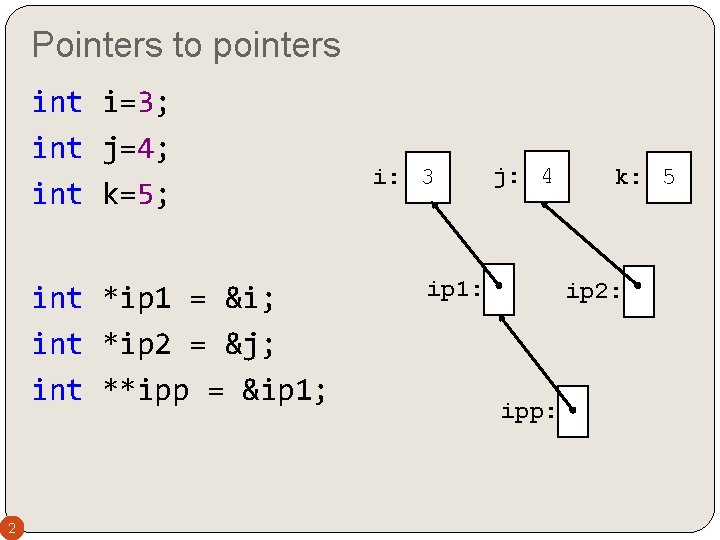
Pointers to pointers int i=3; int j=4; int k=5; int *ip 1 = &i; int *ip 2 = &j; int **ipp = &ip 1; 2 i: 3 j: 4 ip 1: k: 5 ip 2: ipp:
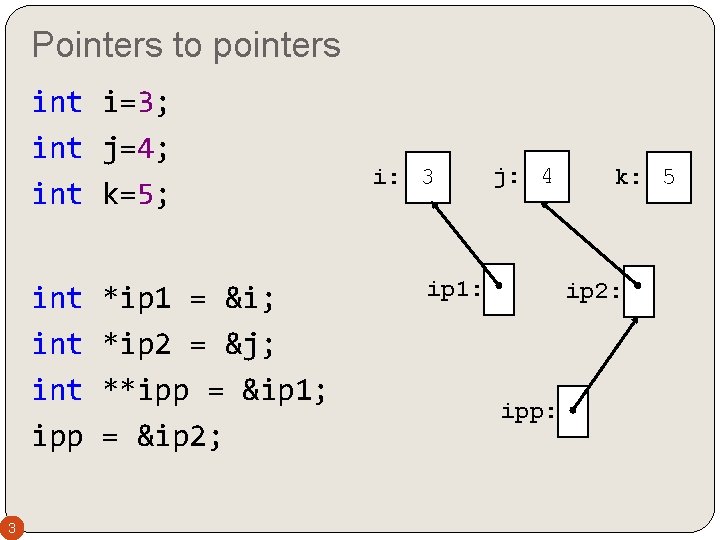
Pointers to pointers int i=3; int j=4; int k=5; int *ip 1 = &i; int *ip 2 = &j; int **ipp = &ip 1; ipp = &ip 2; 3 i: 3 j: 4 ip 1: k: 5 ip 2: ipp:
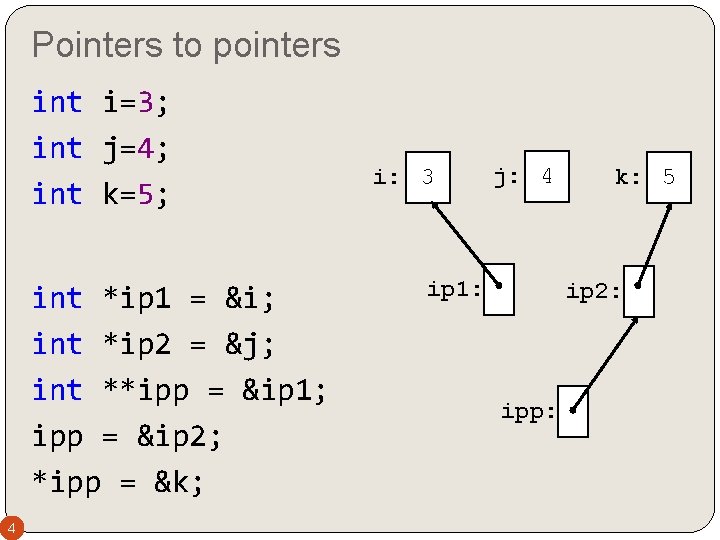
Pointers to pointers int i=3; int j=4; int k=5; int *ip 1 = &i; int *ip 2 = &j; int **ipp = &ip 1; ipp = &ip 2; *ipp = &k; 4 i: 3 j: 4 ip 1: k: 5 ip 2: ipp:
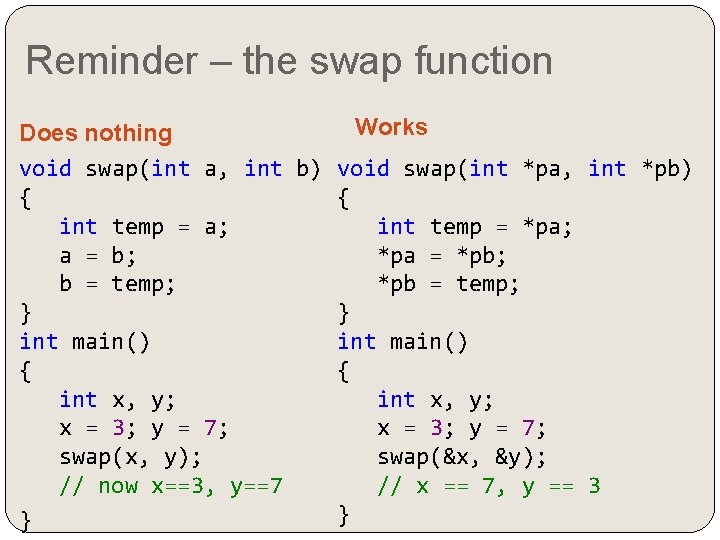
Reminder – the swap function Works Does nothing void swap(int a, int b) void swap(int *pa, int *pb) { { int temp = a; int temp = *pa; a = b; *pa = *pb; b = temp; *pb = temp; } } int main() { { int x, y; x = 3; y = 7; swap(x, y); swap(&x, &y); // now x==3, y==7 // x == 7, y == 3 } }
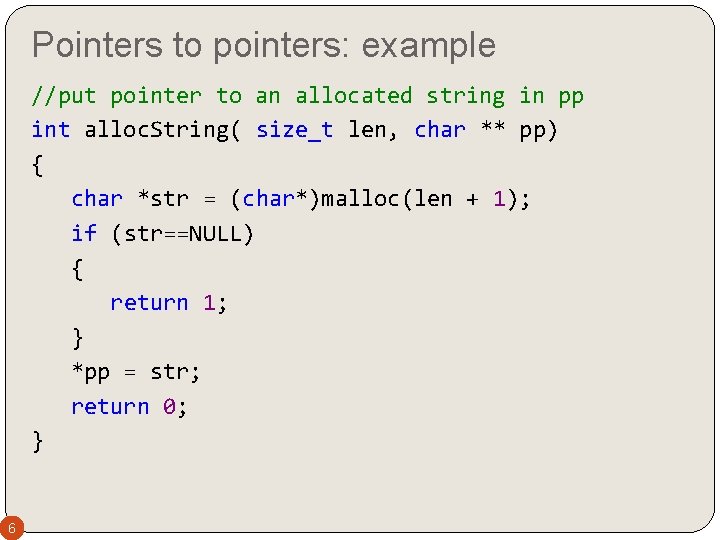
Pointers to pointers: example //put pointer to an allocated string in pp int alloc. String( size_t len, char ** pp) { char *str = (char*)malloc(len + 1); if (str==NULL) { return 1; } *pp = str; return 0; } 6
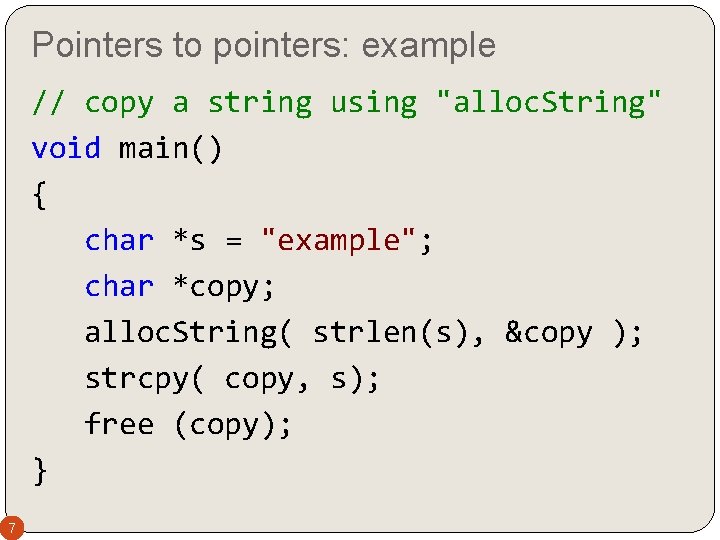
Pointers to pointers: example // copy a string using "alloc. String" void main() { char *s = "example"; char *copy; alloc. String( strlen(s), © ); strcpy( copy, s); free (copy); } 7
Multi-dimensional arrays 8
Multi-dimensional arrays Can be created in few ways: 1. Automatically: int m[2][3]; // 2 rows, 3 columns �continuous memory (divided to 2 blocks) �access: m[row][col] = 0; 9
Automatic multi-dimensional arrays #define R 2 #define C 3 int m[R][C]; int* m_ptr= &(m[0][0]); size_t i; for (i=0; i<R*C; ++i) { printf(“%dn”, *(m_ptr++) ); } 10
Automatic multi-dimensional arrays #define R 2 #define C 3 int m[R][C]; int* m_ptr; for (m_ptr= &(m[0][0]); m_ptr<=&(m[R-1][C-1]); ++m_ptr) { printf(“%dn”, *m_ptr ); 11 }
Automatic multi-dimensional arrays int A[R][C]; Like a matrix A[0][0] A[0][1] … A[0][c-1] … … A[i][0] A[i][1] … A[i][c-1] … … A[R-1][0] A[R-1][1] … A[R-1][C-1] Row-major ordering A[0] A 12 A[i] A A • • • [0] • • • [i] [C-1] [0] A[R-1] A A A • • • [i] • • • [R-1] [C-1] [0] [C-1] A+i*C*4 Starting address of A[i] A+(R-1)*C*4
Semi-dynamic multi-dimensional arrays 2. Semi-dynamic: Define an array of pointers: int* m[5]; // allocates memory for 5 pointers for (i=0; i<5; ++i) { m[i] = (int*) malloc( 7*sizeof(int) ); // m[i] now points to a memory for 7 ints } 13
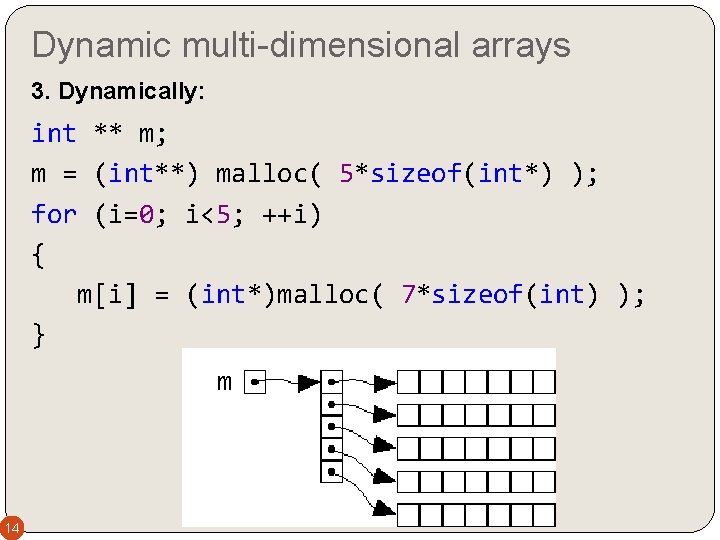
Dynamic multi-dimensional arrays 3. Dynamically: int ** m; m = (int**) malloc( 5*sizeof(int*) ); for (i=0; i<5; ++i) { m[i] = (int*)malloc( 7*sizeof(int) ); } m 14
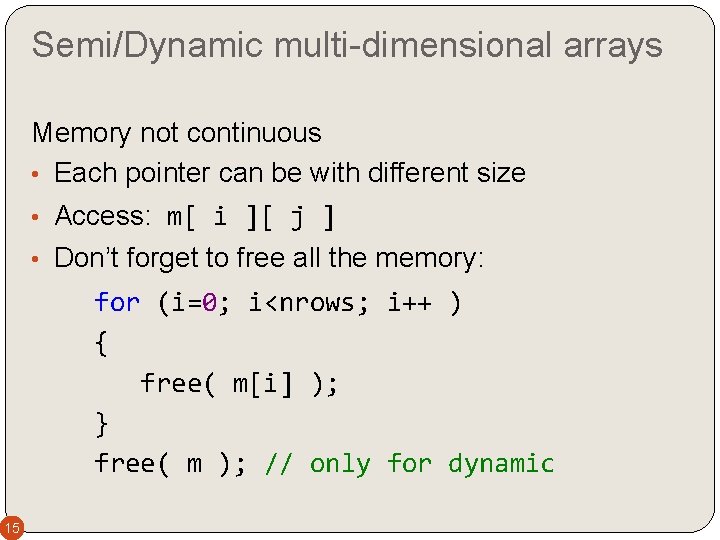
Semi/Dynamic multi-dimensional arrays Memory not continuous • Each pointer can be with different size • Access: m[ i ][ j ] • Don’t forget to free all the memory: for (i=0; i<nrows; i++ ) { free( m[i] ); } free( m ); // only for dynamic 15
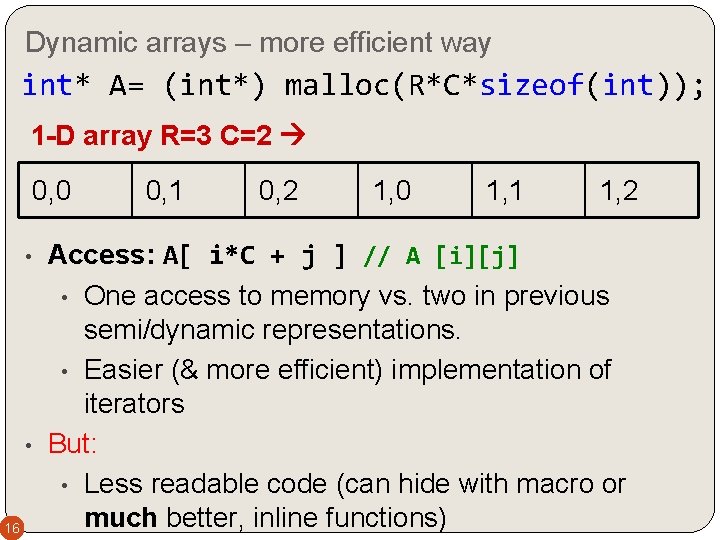
Dynamic arrays – more efficient way int* A= (int*) malloc(R*C*sizeof(int)); 1 -D array R=3 C=2 0, 0 • • 16 0, 1 0, 2 1, 0 1, 1 1, 2 Access: A[ i*C + j ] // A [i][j] • One access to memory vs. two in previous semi/dynamic representations. • Easier (& more efficient) implementation of iterators But: • Less readable code (can hide with macro or much better, inline functions)
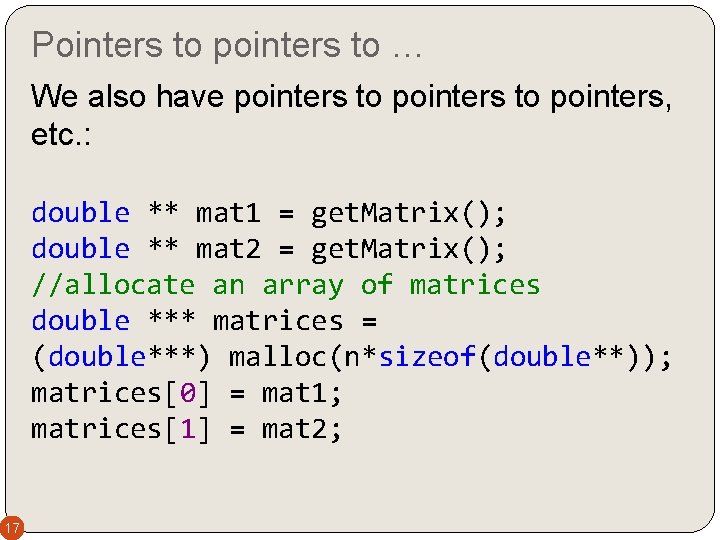
Pointers to pointers to … We also have pointers to pointers, etc. : double ** mat 1 = get. Matrix(); double ** mat 2 = get. Matrix(); //allocate an array of matrices double *** matrices = (double***) malloc(n*sizeof(double**)); matrices[0] = mat 1; matrices[1] = mat 2; 17
Automatic multi-dimensional arrays as arguments to functions int x[5][7]; // 5 rows, 7 columns When sending ‘x’ as an argument to a function, only the 1 st index can be omitted: • void func( int x[5][7] ) //ok • void func( int x[][] ) //does not compile • void func( int * x[] ) //something else • void func( int ** x ) //something else 18
Why ? 19
Pointers to arrays (of size X): int foo (char m[][20]); m is a pointer to an array of 20 chars. Therefore: sizeof (m) = sizeof (void*); sizeof (*m) = 20*sizeof (char); 20
Pointers to arrays (of size X): Explicit declaration: char (*arr_2 d)[20]; // arr_2 d is a pointer // not initialized Using typedef: typdef char arr_2 d_20[20]; arr_2 d_20 *p_arr_2 d; But: typdef char arr_2 d[][]; // comp. error 21
Pointers to arrays (of size X): char (*m)[5]; m 22 char *m[5];
Pointers to arrays (of size X): char (*m)[5]; m After initialization: char arr[5]; m= &arr; arr 23 char *m[5];
Pointers to arrays (of size X): char (*m)[5]; sizeof (m) = sizeof(void*) sizeof (*m) = 5*sizeof(char) 24 char *m[5]; sizeof (m) = 5*sizeof (char*) = 5*sizeof (void*) sizeof (*m) = sizeof (char*)= sizeof (void*)
Multi-dimensional arrays as arguments to functions 25
Multi-dimensional arrays as arguments to functions void foo( int matrix[ROWS_NUM][COLS_NUM] ) { 26
Multi-dimensional arrays as arguments to functions void foo( int matrix[ROWS_NUM][COLS_NUM] ){ [ROWS_NUM] What is really sent? 27
Multi-dimensional arrays as arguments to functions void foo( int (*matrix )[COLS_NUM] ) { (* pointer to an array of COLS_NUM ints! 28
Multi-dimensional arrays as arguments to functions void foo( int (*matrix)[COLS_NUM] ) {. . . 29 matrix[r][c]
Multi-dimensional arrays as arguments to functions void foo( int (*matrix)[COLS_NUM] ) {. . 30 matrix[r][c] (*(matrix+r))[c]
Multi-dimensional arrays as arguments to functions void foo( int (*matrix)[COLS_NUM] ) {. . matrix[r][c] (*(matrix+r))[c] matrix is a pointer to int[COLS_NUM]. addition is done in this units. This is why COLS_NUM is needed! 31
Multi-dimensional arrays as arguments to functions void foo( int (*matrix)[COLS_NUM] ) {. . . matrix[r][c]. . . (*(matrix+r))[c]. . . *((*(matrix+r)) + c) 32
Multi-dimensional arrays as arguments to functions void foo( int (*matrix)[COLS_NUM] ) {. . . matrix[r][c]. . . (*(matrix+r))[c]. . . *((*(matrix+r)) + c) == *(matrix+r*COLS_NUM+c) The compiler is probably optimizing the internal computation to this. 33
Example of dynamic multidimensional array: argv, argc We want to pass parameters to the program running via the shell 34
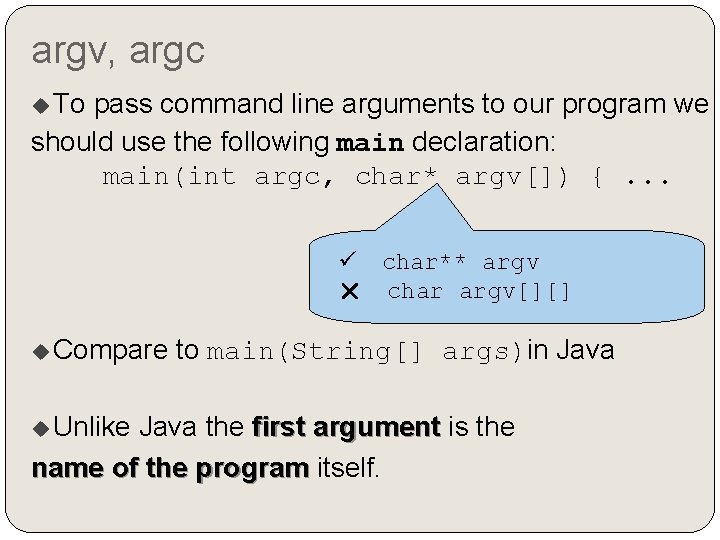
argv, argc To pass command line arguments to our program we should use the following main declaration: main(int argc, char* argv[]) {. . . char** argv char argv[][] Compare Unlike to main(String[] args)in Java the first argument is the name of the program itself.
argv & argc: example $ prog 1 –u danny –p 1234 argc == argv[0] argv[1]. . . argv[4] 5 == “prog 1” == “-u” == “ 1234” Always: argv[argc] == NULL (redundant since we are also given argc)