
Point of View Why is it important It
- Slides: 11
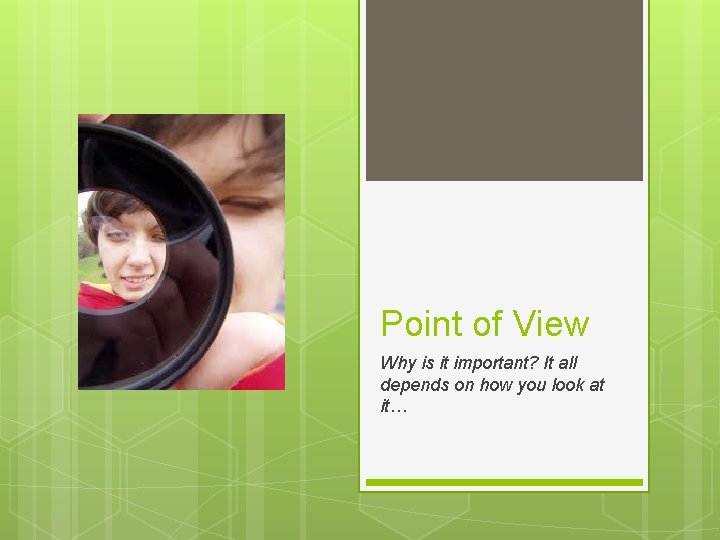
Point of View Why is it important? It all depends on how you look at it…
“The Basics” Point of View (POV) is the perspective from which a story is told.
1 st Person POV DEFINITION The narrator is part of the story. You know that a story is in the 1 st person because the narrator says “I”. Discussion: What are the benefits of 1 st person narration?
Purpose for WHY an Author Might Use 1 st Person POV The reader will generally develop more empathy for that character because their journey is the one that we are experiencing.
2 nd Person POV DEFINITION: When the reader is part of the story. The narrator is speaking to the reader. You know a story is in the 2 nd Person because the narrator says “you” as if he/she is speaking to YOU, the reader. (You don’t see this POV too often with fiction. ) Discussion: Why might an author use 2 nd person?
Purpose for WHY an Author Might Use 2 nd Person POV If the author really wants the reader to think about something, this POV works best; it’s a more “aggressive” way to engage the reader. The reader can’t be passive.
3 rd Person Limited DEFINITION The narrator is outside the story, telling the story through the perspective of one character—in other words, the narrator is LIMITED to the thoughts and perspective of one character. You know that a story is written from a 3 rd Person Limited perspective because the narrator uses “he, she, they, it” but isn’t part of the story and only seems to know the thoughts of one character.
Purpose for WHY an Author Might Use 3 rd Person Limited POV The author might want us to understand a character, but also see the bigger picture a little better than what we would see if we were entirely in the head of a character (1 st Person POV). We are able to develop empathy for, or understanding of, a character, but we remain more objective.
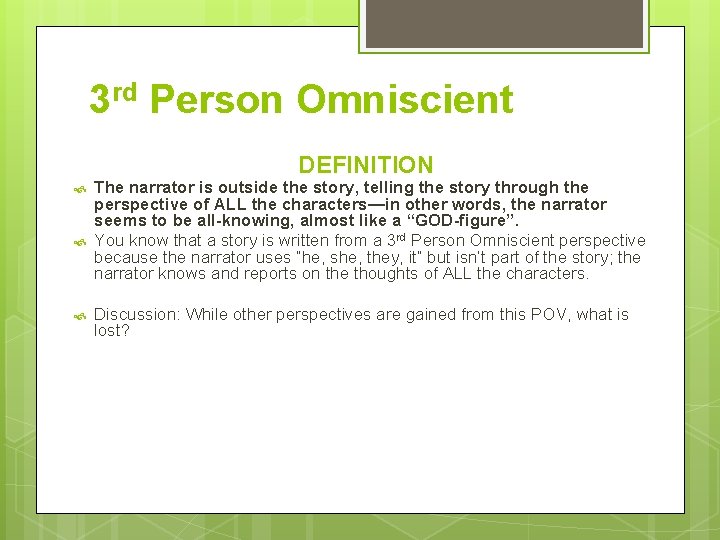
3 rd Person Omniscient DEFINITION The narrator is outside the story, telling the story through the perspective of ALL the characters—in other words, the narrator seems to be all-knowing, almost like a “GOD-figure”. You know that a story is written from a 3 rd Person Omniscient perspective because the narrator uses “he, she, they, it” but isn’t part of the story; the narrator knows and reports on the thoughts of ALL the characters. Discussion: While other perspectives are gained from this POV, what is lost?
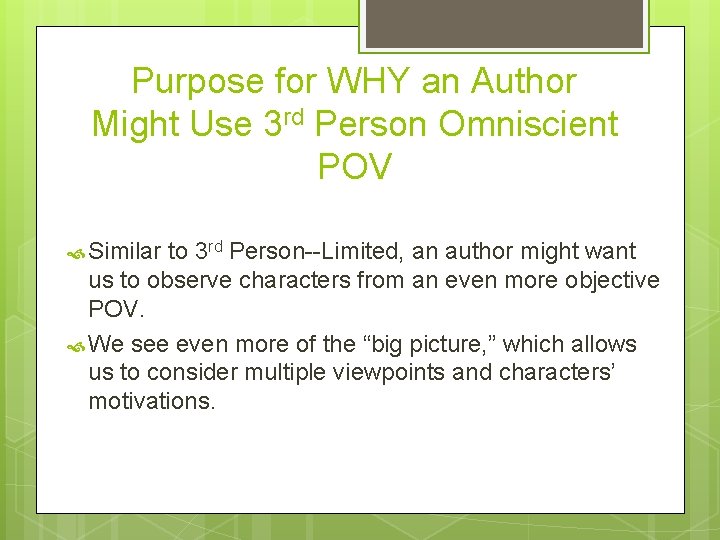
Purpose for WHY an Author Might Use 3 rd Person Omniscient POV Similar to 3 rd Person--Limited, an author might want us to observe characters from an even more objective POV. We see even more of the “big picture, ” which allows us to consider multiple viewpoints and characters’ motivations.
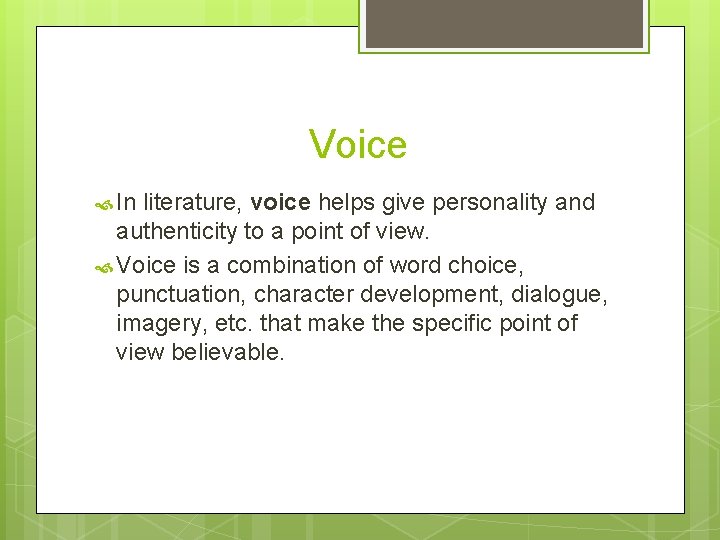
Voice In literature, voice helps give personality and authenticity to a point of view. Voice is a combination of word choice, punctuation, character development, dialogue, imagery, etc. that make the specific point of view believable.