
Point of View the position of the narrator

- Slides: 12
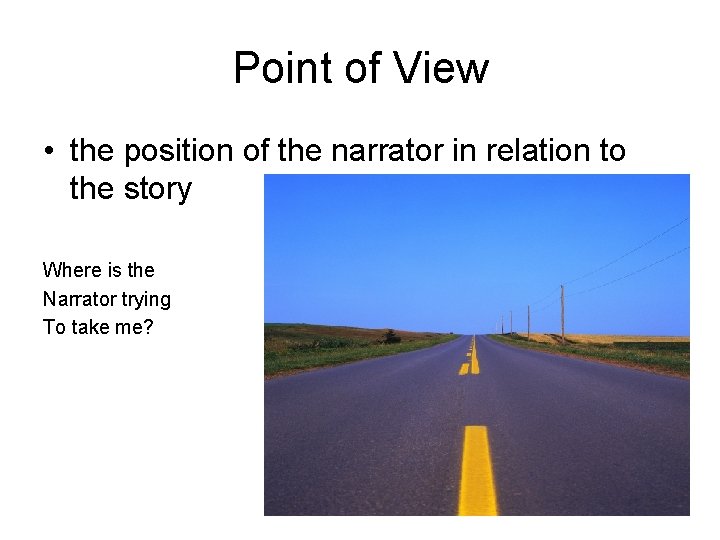
Point of View • the position of the narrator in relation to the story Where is the Narrator trying To take me?
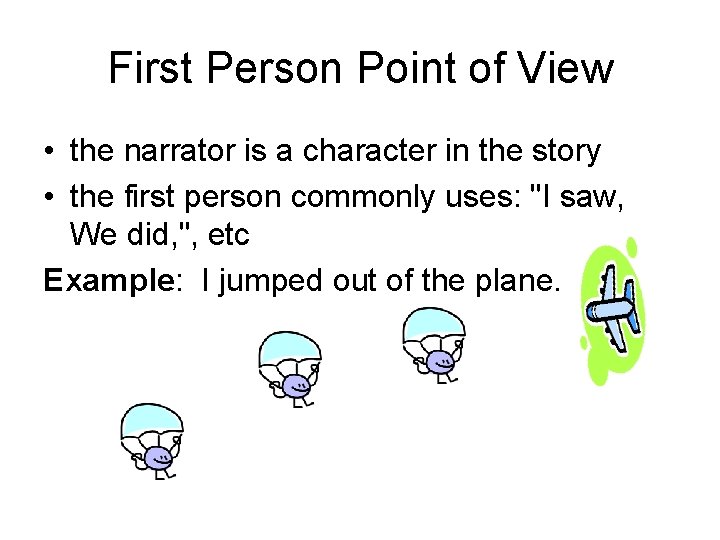
First Person Point of View • the narrator is a character in the story • the first person commonly uses: "I saw, We did, ", etc Example: I jumped out of the plane.
Objective Point of View • can record only what is seen and heard. It cannot comment, interpret, or enter a character's mind. The purest example of a story told from the objective point would be one written entirely in dialogue.
Omniscient Point of View • The story is told by the author, using the third person, and his knowledge and choices are unlimited. He can interpret the behavior of his characters; he can comment, if he wishes, on the significance of the story he is telling.
Limited Omniscient Point of View The author tells the story in the third person, but he tells it from the viewpoint of one character in the story
Anaphora • Repetition of the same word or phrase at the beginning of successive clauses or verses.
Anaphora The deliberate repetition of a word or phrase at the beginning of several successive verses, clauses, or paragraphs Example: "We shall fight on the beaches, we shall fight on the landing grounds, we shall fight in the fields and in the streets, we shall fight in the hills" (Winston S. Churchill).
Hyperbole • An extravagant statement; the use of exaggerated terms for the purpose of emphasis or heightened effect.
Metaphor • An implied comparison between two unlike things that actually have something important in common.
Simile • A stated comparison (usually formed with "like" or "as") between two fundamentally dissimilar things that have certain qualities in common.
Chiasmus • A verbal pattern in which the second half of an expression is balanced against the first but with the parts reversed.