
Point of care test results increase short term
- Slides: 33
Point of care test results increase short term abstinence in adolescent women Lauren Simendinger; Jennifer Reed, MD Jill Huppert, M. D. , M. P. H. Cincinnati Children's Hospital Medical Center March 2008
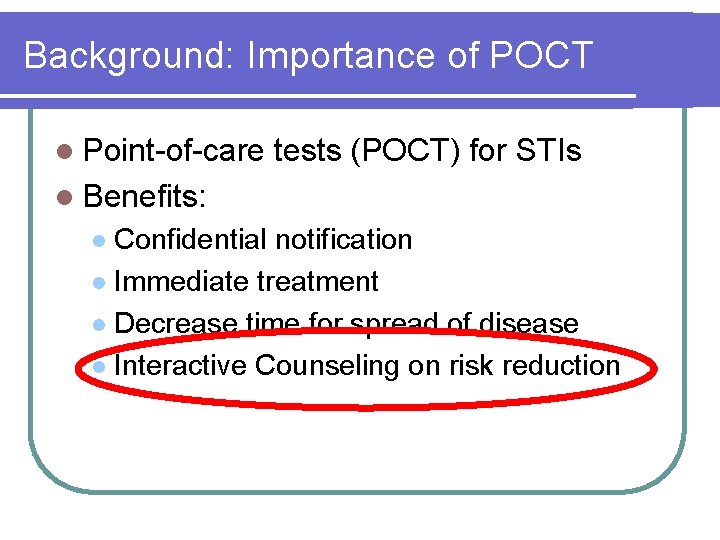
Background: Importance of POCT l Point-of-care tests (POCT) for STIs l Benefits: Confidential notification l Immediate treatment l Decrease time for spread of disease l Interactive Counseling on risk reduction l
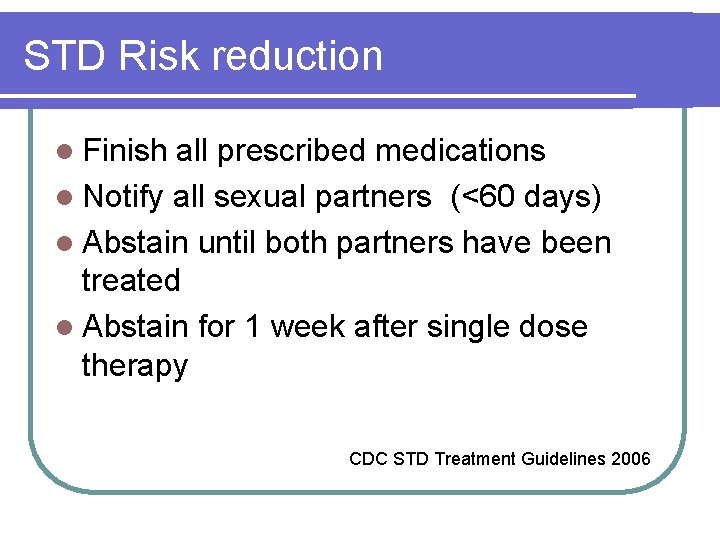
STD Risk reduction l Finish all prescribed medications l Notify all sexual partners (<60 days) l Abstain until both partners have been treated l Abstain for 1 week after single dose therapy CDC STD Treatment Guidelines 2006
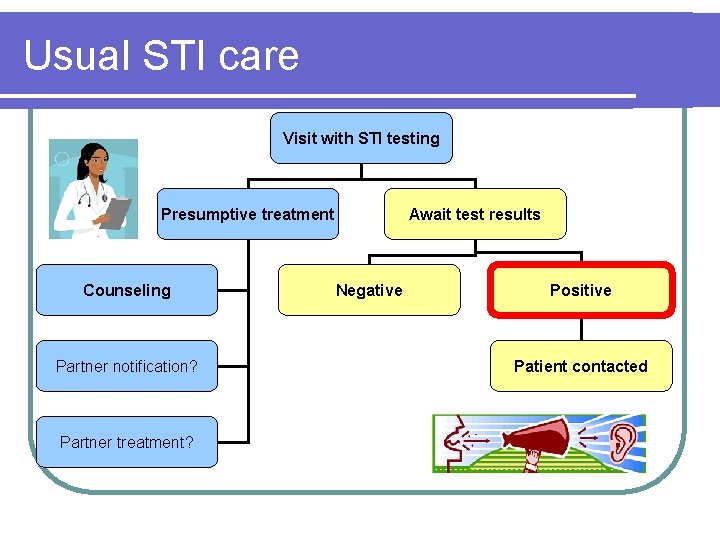
Usual STI care Visit with STI testing Presumptive treatment Counseling Partner notification? Partner treatment? Await test results Negative Positive Patient contacted
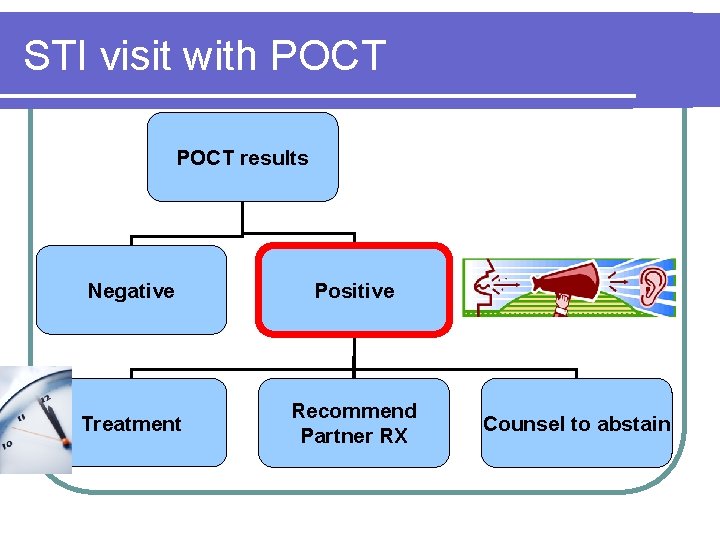
STI visit with POCT results Negative Positive Treatment Recommend Partner RX Counsel to abstain
Questions: l Did she understand STI test results? l Did she follow my advice?
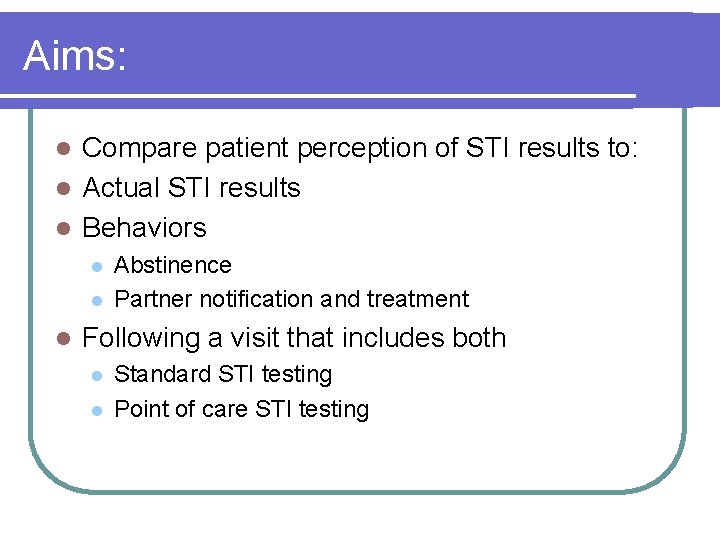
Aims: Compare patient perception of STI results to: l Actual STI results l Behaviors l l Abstinence Partner notification and treatment Following a visit that includes both l l Standard STI testing Point of care STI testing
Methods: STI tests l Females recruited from Teen Clinic or ED for an STI study l Baseline data: Demographics l Self reported symptoms and risk behaviors l Provider diagnosis l Treatment given at visit if indicated l l Samples for wet mount, Rapid trich test, CT and GC tests
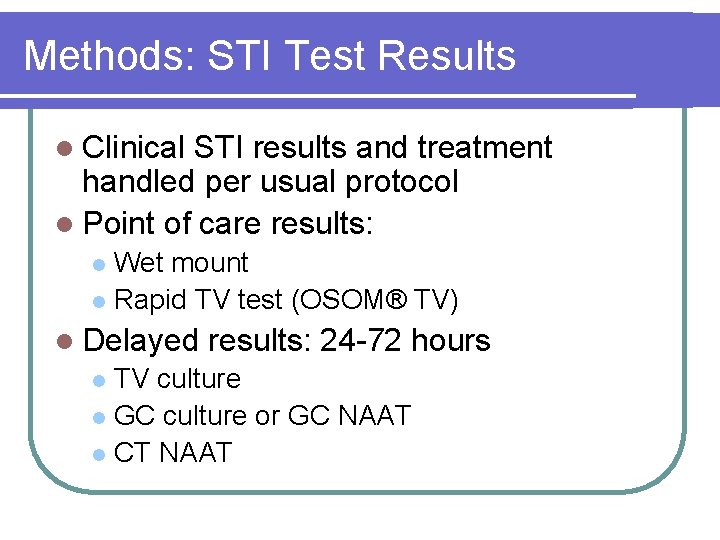
Methods: STI Test Results l Clinical STI results and treatment handled per usual protocol l Point of care results: Wet mount l Rapid TV test (OSOM® TV) l l Delayed results: 24 -72 hours TV culture l GC culture or GC NAAT l CT NAAT l
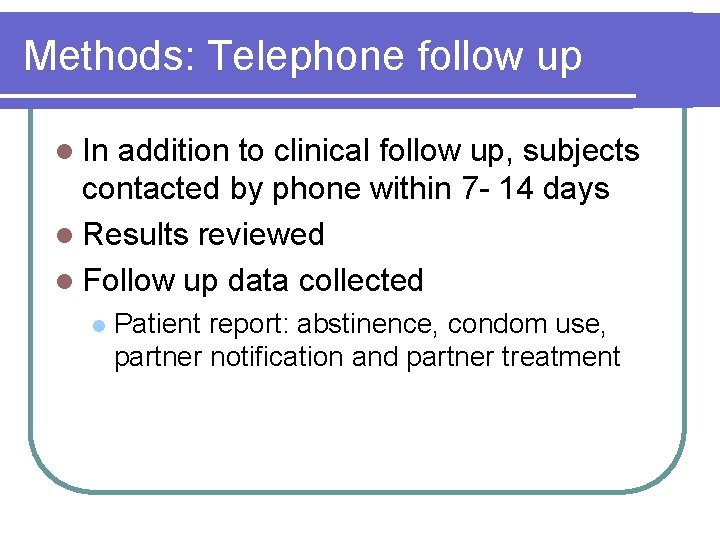
Methods: Telephone follow up l In addition to clinical follow up, subjects contacted by phone within 7 - 14 days l Results reviewed l Follow up data collected l Patient report: abstinence, condom use, partner notification and partner treatment
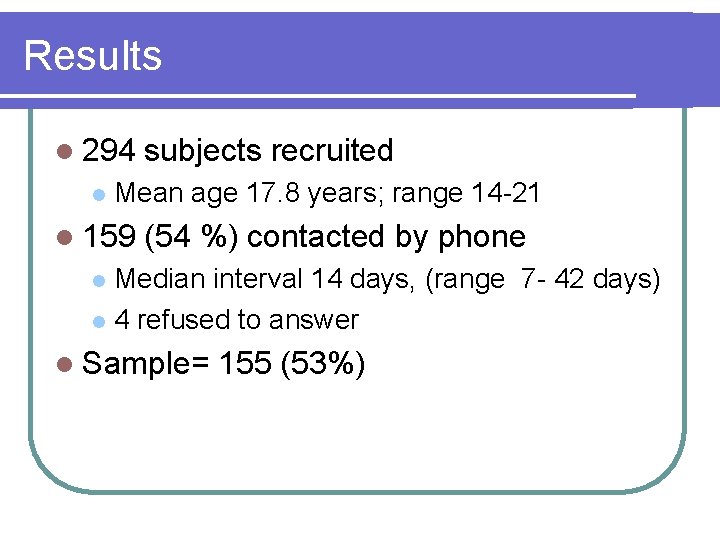
Results l 294 l subjects recruited Mean age 17. 8 years; range 14 -21 l 159 (54 %) contacted by phone Median interval 14 days, (range 7 - 42 days) l 4 refused to answer l l Sample= 155 (53%)
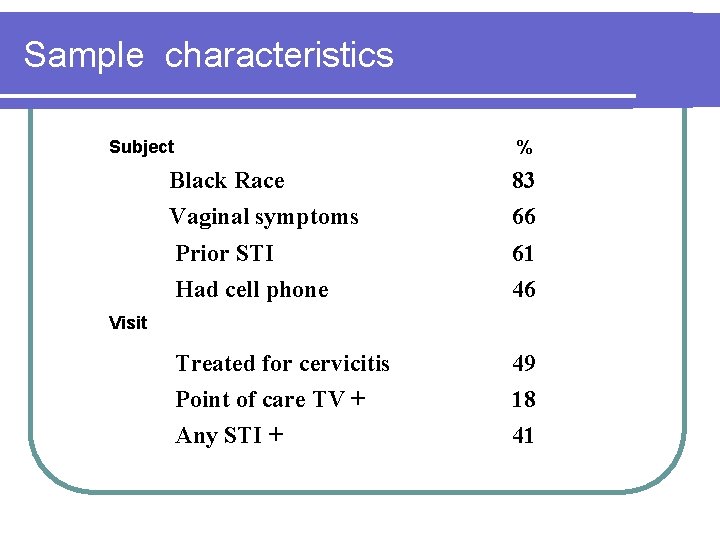
Sample characteristics Subject % Black Race Vaginal symptoms 83 66 Prior STI 61 Had cell phone 46 Treated for cervicitis Point of care TV + Any STI + 49 18 41 Visit
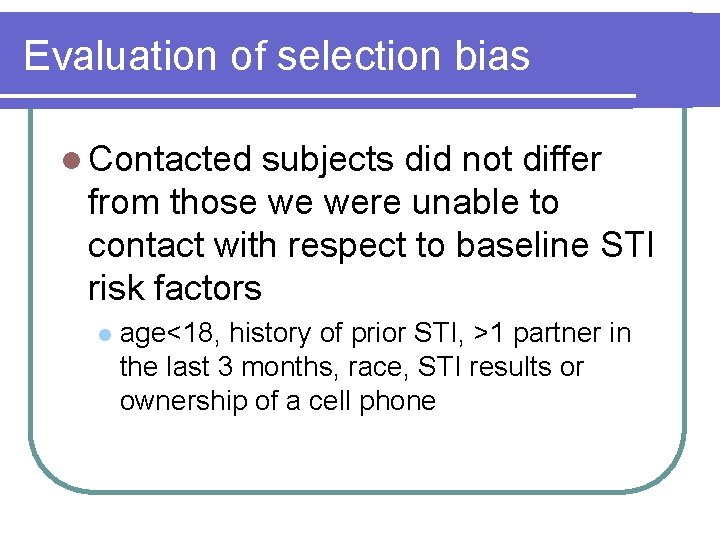
Evaluation of selection bias l Contacted subjects did not differ from those we were unable to contact with respect to baseline STI risk factors l age<18, history of prior STI, >1 partner in the last 3 months, race, STI results or ownership of a cell phone
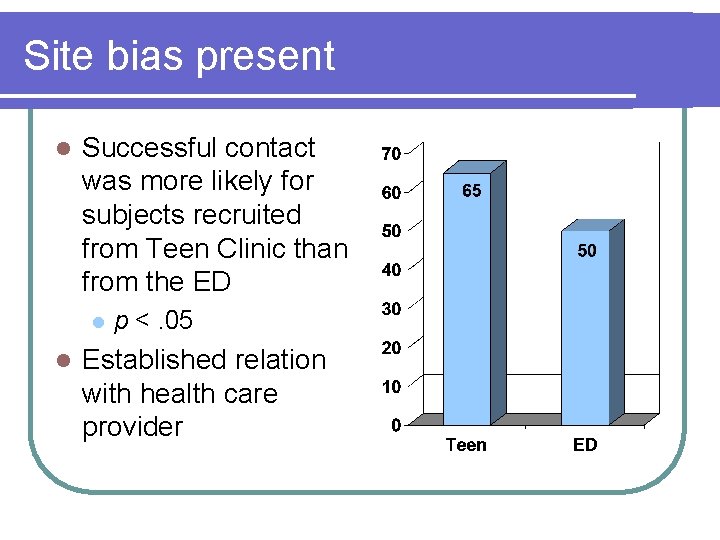
Site bias present l Successful contact was more likely for subjects recruited from Teen Clinic than from the ED l l p <. 05 Established relation with health care provider
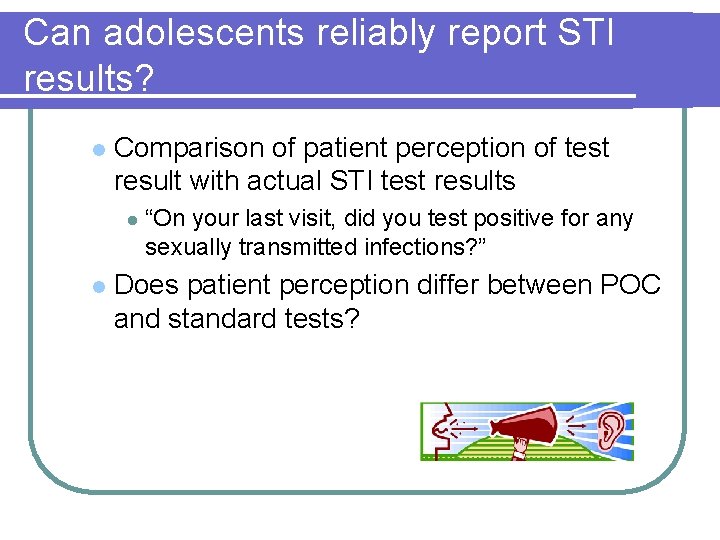
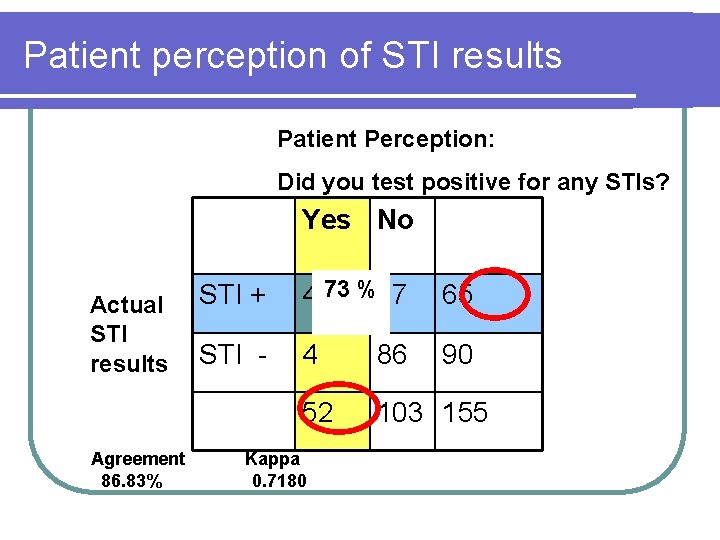
Can adolescents reliably report STI results? l Comparison of patient perception of test result with actual STI test results l l “On your last visit, did you test positive for any sexually transmitted infections? ” Does patient perception differ between POC and standard tests?
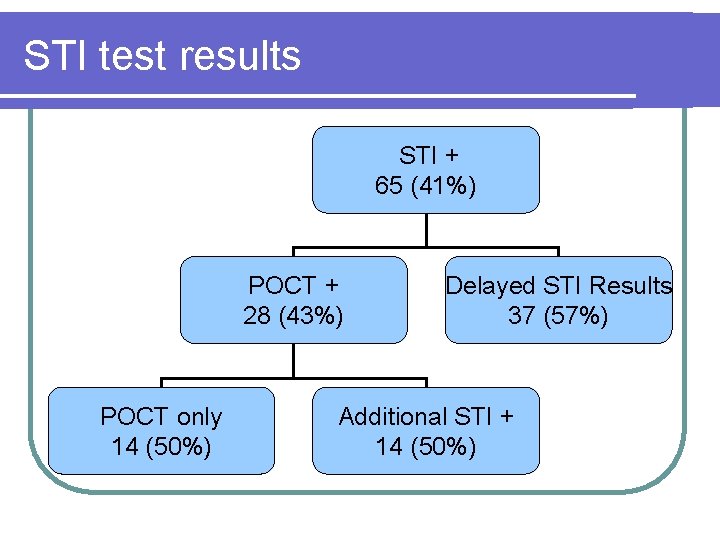
STI test results STI + 65 (41%) POCT + 28 (43%) POCT only 14 (50%) Delayed STI Results 37 (57%) Additional STI + 14 (50%)
Patient perception of STI results Patient Perception: Did you test positive for any STIs? Yes No Actual STI results Agreement 86. 83% STI + 4873 %17 65 STI - 4 86 90 52 103 155 Kappa 0. 7180
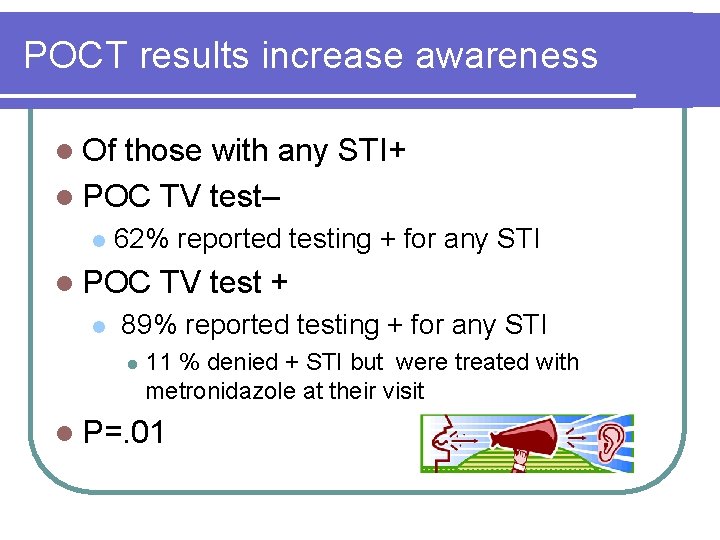
POCT results increase awareness l Of those with any STI+ l POC TV test– l 62% reported testing + for any STI l POC l TV test + 89% reported testing + for any STI l 11 % denied + STI but were treated with metronidazole at their visit l P=. 01
Does knowledge affect behavior? l What is the effect of knowledge of test results on sexual risk behaviors? l Is anyone listening?
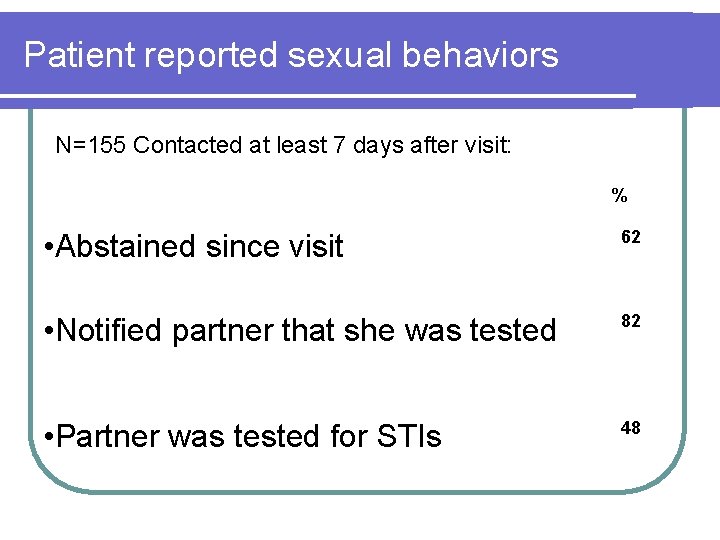
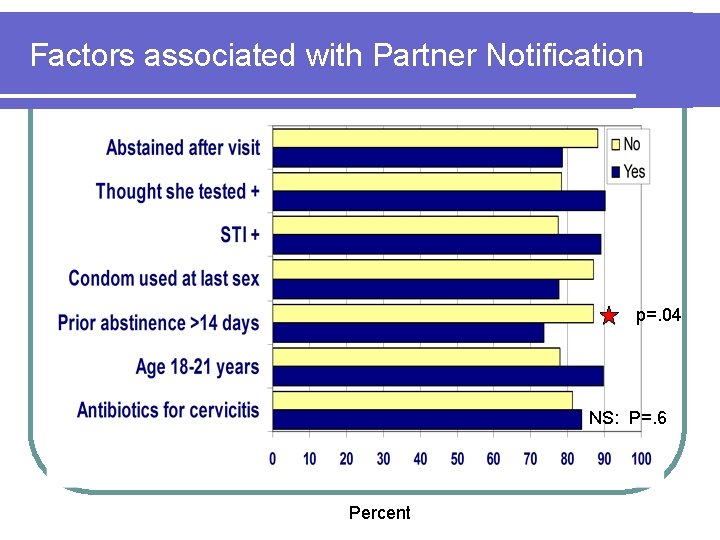
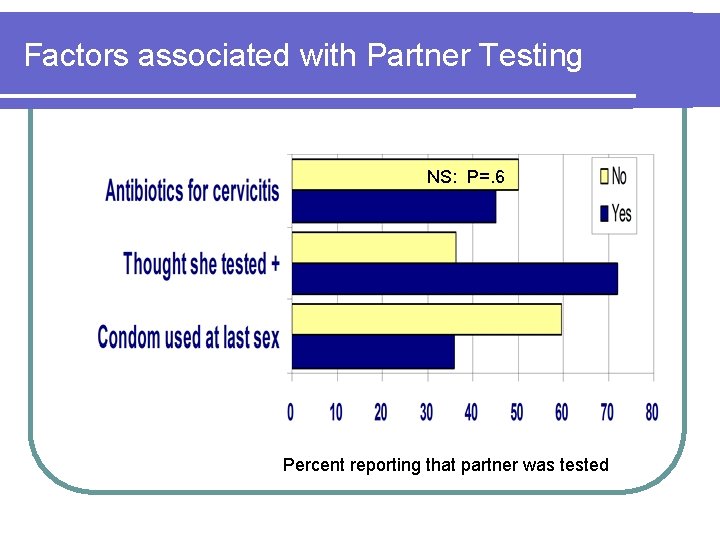
Patient reported sexual behaviors N=155 Contacted at least 7 days after visit: % • Abstained since visit 62 • Notified partner that she was tested 82 • Partner was tested for STIs 48
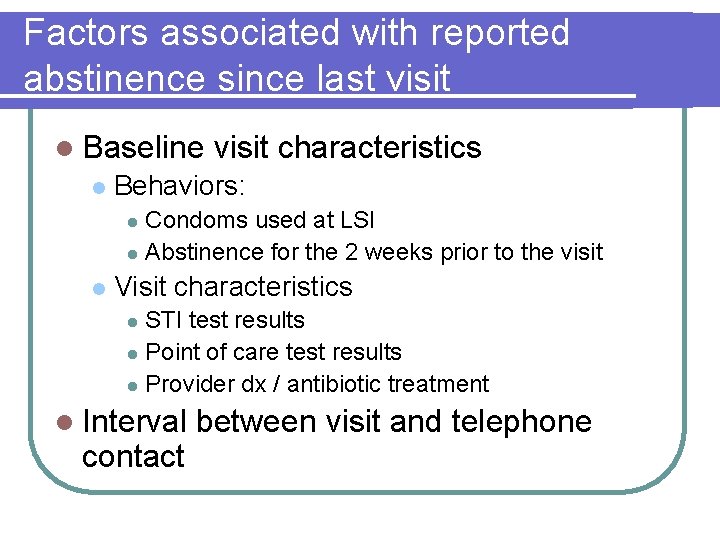
Factors associated with reported abstinence since last visit l Baseline l visit characteristics Behaviors: Condoms used at LSI l Abstinence for the 2 weeks prior to the visit l l Visit characteristics STI test results l Point of care test results l Provider dx / antibiotic treatment l l Interval contact between visit and telephone
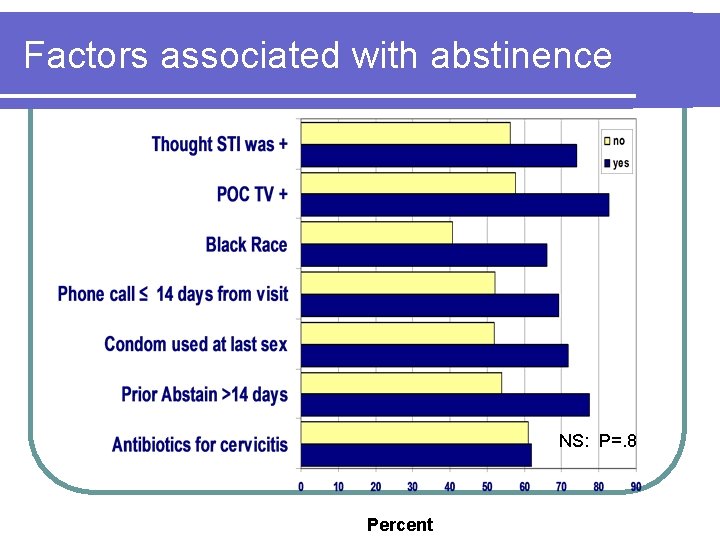
Factors associated with abstinence NS: P=. 8 Percent
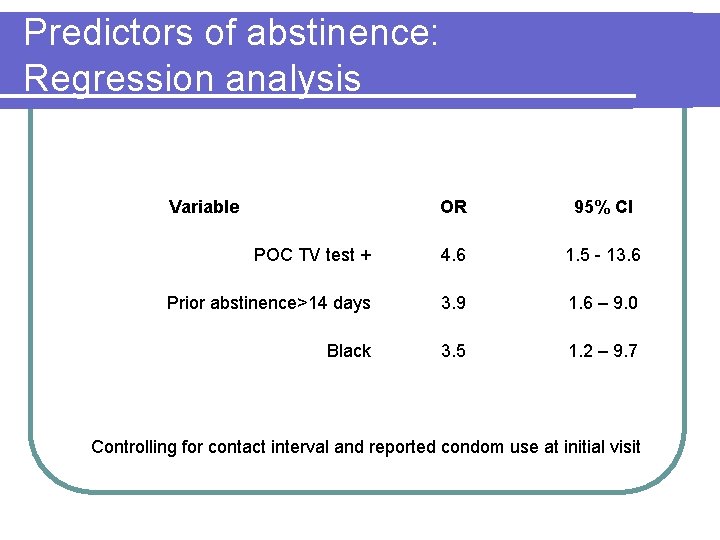
Predictors of abstinence: Regression analysis Variable OR 95% CI POC TV test + 4. 6 1. 5 - 13. 6 Prior abstinence>14 days 3. 9 1. 6 – 9. 0 Black 3. 5 1. 2 – 9. 7 Controlling for contact interval and reported condom use at initial visit
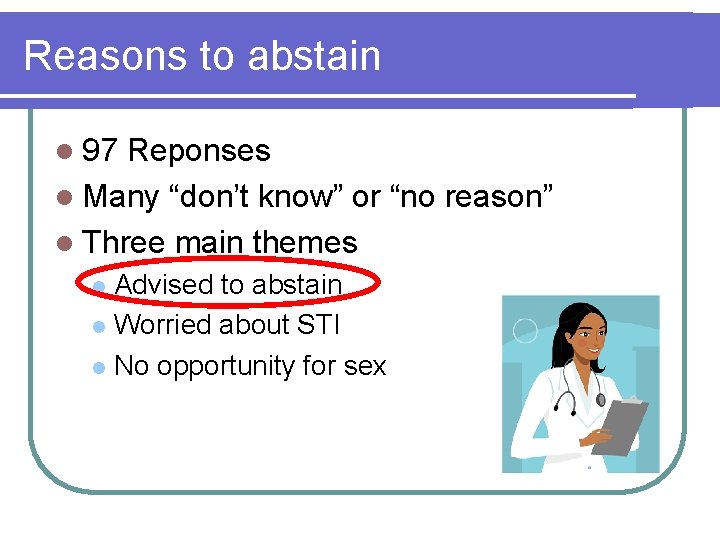
Reasons to abstain l 97 Reponses l Many “don’t know” or “no reason” l Three main themes Advised to abstain l Worried about STI l No opportunity for sex l
Factors associated with Partner Notification p=. 04 NS: P=. 6 Percent
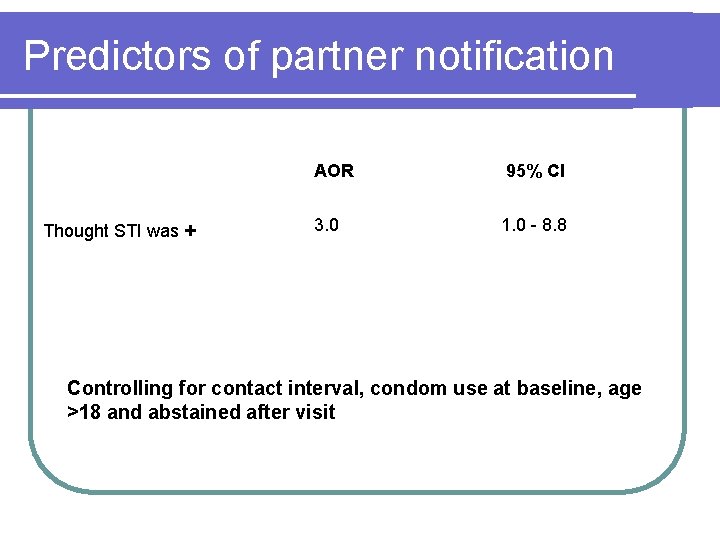
Predictors of partner notification Thought STI was + AOR 95% CI 3. 0 1. 0 - 8. 8 Controlling for contact interval, condom use at baseline, age >18 and abstained after visit
Factors associated with Partner Testing NS: P=. 6 Percent reporting that partner was tested
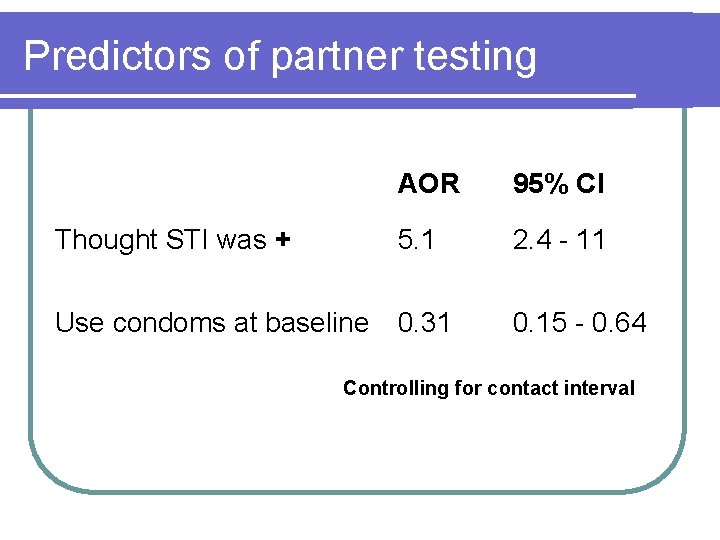
Predictors of partner testing AOR 95% CI Thought STI was + 5. 1 2. 4 - 11 Use condoms at baseline 0. 31 0. 15 - 0. 64 Controlling for contact interval
Conclusions l In adolescent women, POC test results and perception of STI results increase post visit safe sex behaviors that are recommended by the CDC: Abstinence l Partner notification l Partner treatment l l Empiric antibiotic therapy does not affect behaviors
Limitations l Small numbers l Telephone contact vs. face to face interview l Patient report “socially desirable” answers
Implications l Program l l Policy l l Importance of notifying all +, regardless of treatment Standardization of written / oral instructions Other avenues for follow up Patient access to medical records / test results Research l Better measures of outcomes needed
Thanks l Co-authors l l l Research assistants l l Grace Kim Mentors l l l Lauren Simendinger Jen Reed Lorah Dorn David Bernstein Clinical colleagues l TNTC
Support l Genzyme l Diagnostics Test kits and reagents l NIH/NIAID l K 23 l Trustee l Grant Cincinnati Children’s Hospital Research Foundation l Moral l Brian Volck