
Point de dpart In Leon 2 A you
- Slides: 8
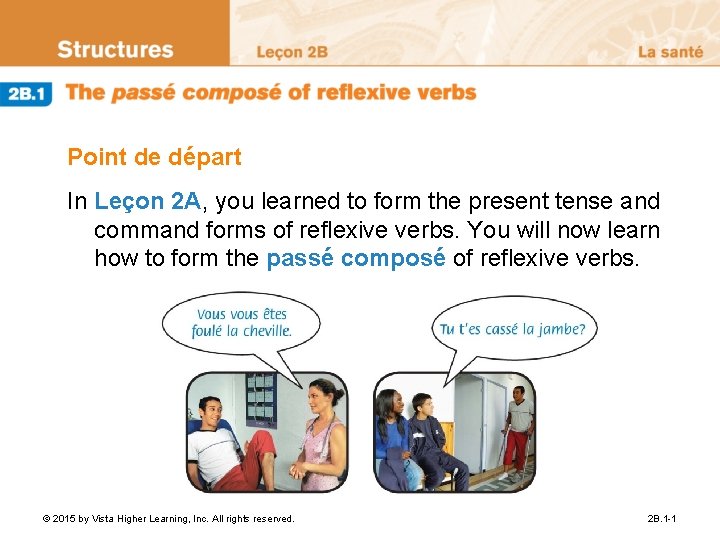
Point de départ In Leçon 2 A, you learned to form the present tense and command forms of reflexive verbs. You will now learn how to form the passé composé of reflexive verbs. © 2015 by Vista Higher Learning, Inc. All rights reserved. 2 B. 1 -1
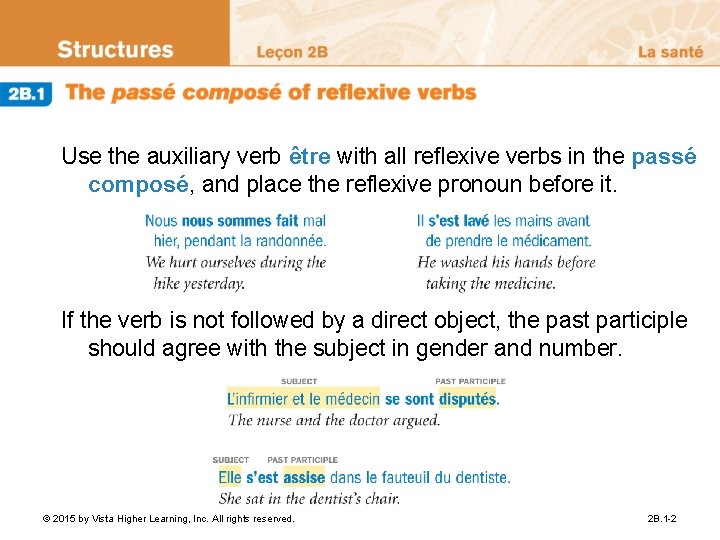
Use the auxiliary verb être with all reflexive verbs in the passé composé, and place the reflexive pronoun before it. If the verb is not followed by a direct object, the past participle should agree with the subject in gender and number. © 2015 by Vista Higher Learning, Inc. All rights reserved. 2 B. 1 -2
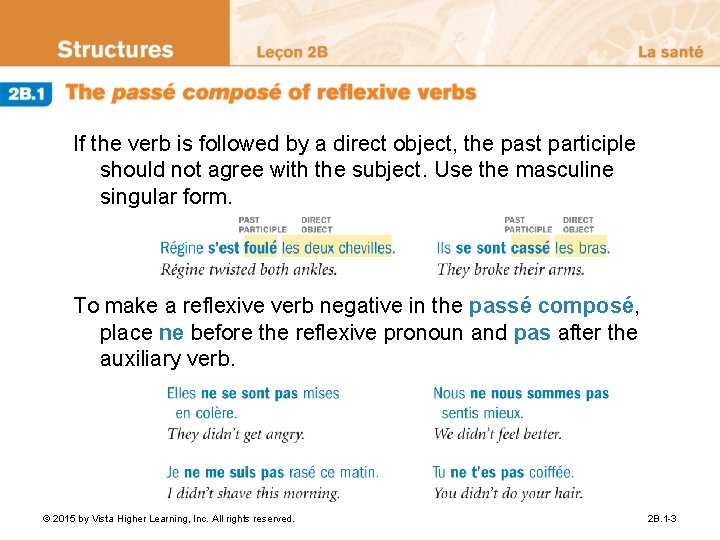
If the verb is followed by a direct object, the past participle should not agree with the subject. Use the masculine singular form. To make a reflexive verb negative in the passé composé, place ne before the reflexive pronoun and pas after the auxiliary verb. © 2015 by Vista Higher Learning, Inc. All rights reserved. 2 B. 1 -3
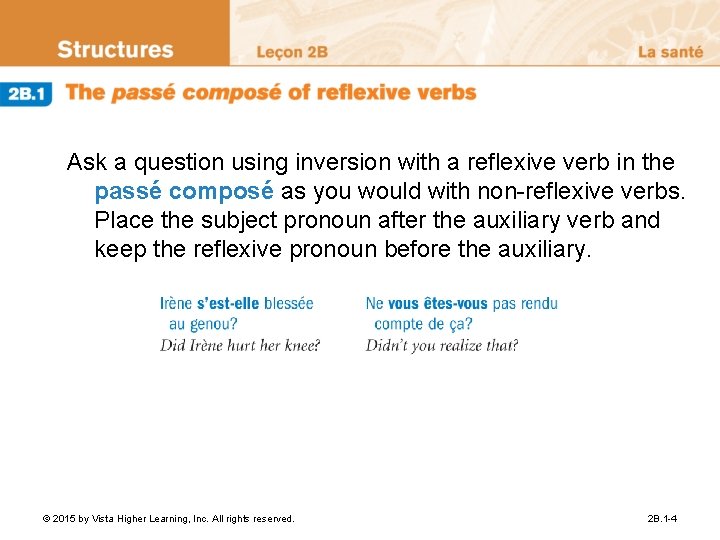
Ask a question using inversion with a reflexive verb in the passé composé as you would with non-reflexive verbs. Place the subject pronoun after the auxiliary verb and keep the reflexive pronoun before the auxiliary. © 2015 by Vista Higher Learning, Inc. All rights reserved. 2 B. 1 -4
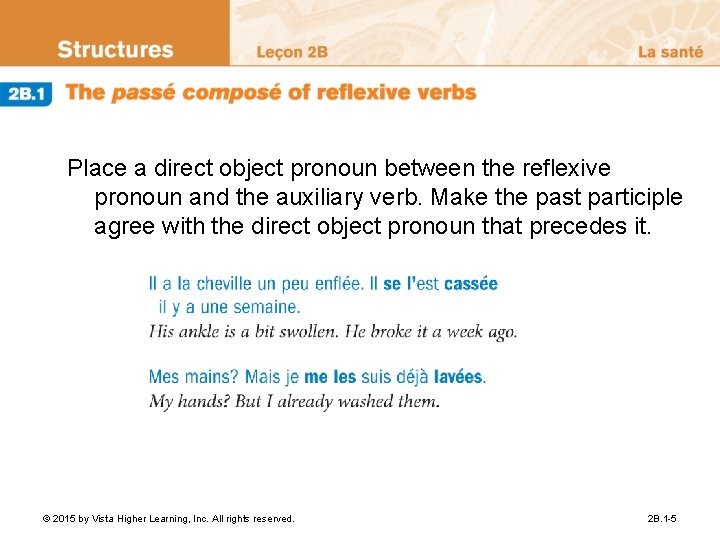
Place a direct object pronoun between the reflexive pronoun and the auxiliary verb. Make the past participle agree with the direct object pronoun that precedes it. © 2015 by Vista Higher Learning, Inc. All rights reserved. 2 B. 1 -5
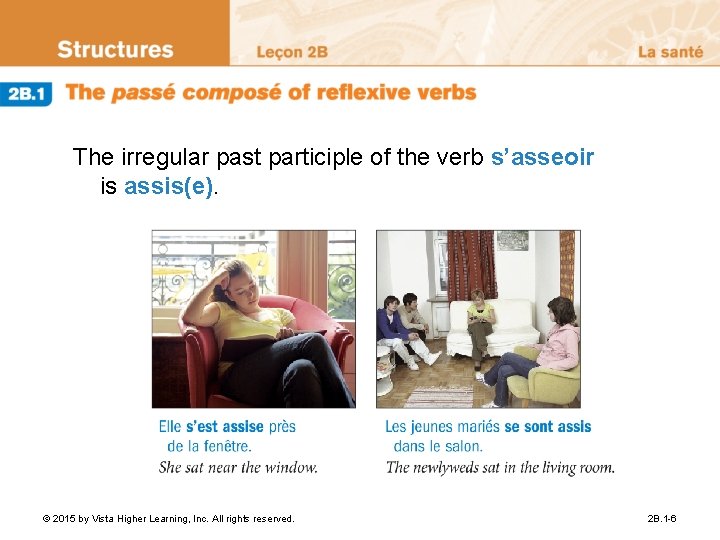
The irregular past participle of the verb s’asseoir is assis(e). © 2015 by Vista Higher Learning, Inc. All rights reserved. 2 B. 1 -6
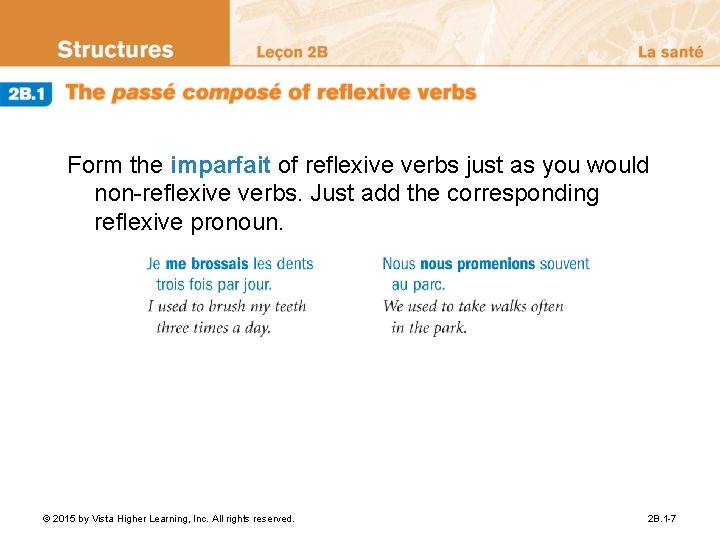
Form the imparfait of reflexive verbs just as you would non-reflexive verbs. Just add the corresponding reflexive pronoun. © 2015 by Vista Higher Learning, Inc. All rights reserved. 2 B. 1 -7
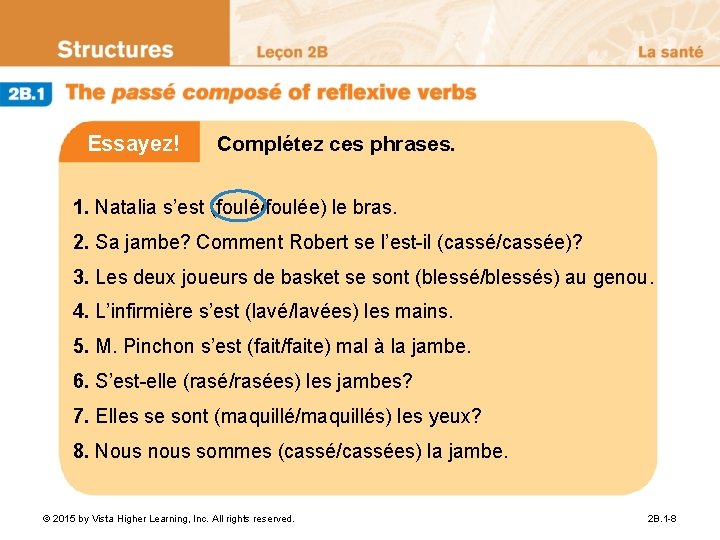
Essayez! Complétez ces phrases. 1. Natalia s’est (foulé/foulée) le bras. 2. Sa jambe? Comment Robert se l’est-il (cassé/cassée)? 3. Les deux joueurs de basket se sont (blessé/blessés) au genou. 4. L’infirmière s’est (lavé/lavées) les mains. 5. M. Pinchon s’est (fait/faite) mal à la jambe. 6. S’est-elle (rasé/rasées) les jambes? 7. Elles se sont (maquillé/maquillés) les yeux? 8. Nous nous sommes (cassé/cassées) la jambe. © 2015 by Vista Higher Learning, Inc. All rights reserved. 2 B. 1 -8