
Point de dpart French uses two main tenses


- Slides: 11
Point de départ French uses two main tenses to talk about past events: the passé composé, and the imparfait. In this lesson, you will learn how to use the passé composé, to express actions that began and ended in the past. © by Vista Higher Learning, Inc. All rights reserved. 6 A. 2 -1
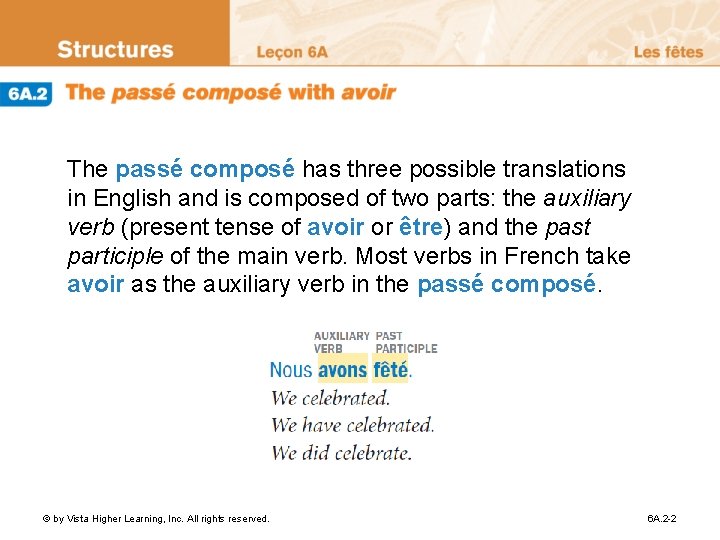
The passé composé has three possible translations in English and is composed of two parts: the auxiliary verb (present tense of avoir or être) and the past participle of the main verb. Most verbs in French take avoir as the auxiliary verb in the passé composé. © by Vista Higher Learning, Inc. All rights reserved. 6 A. 2 -2
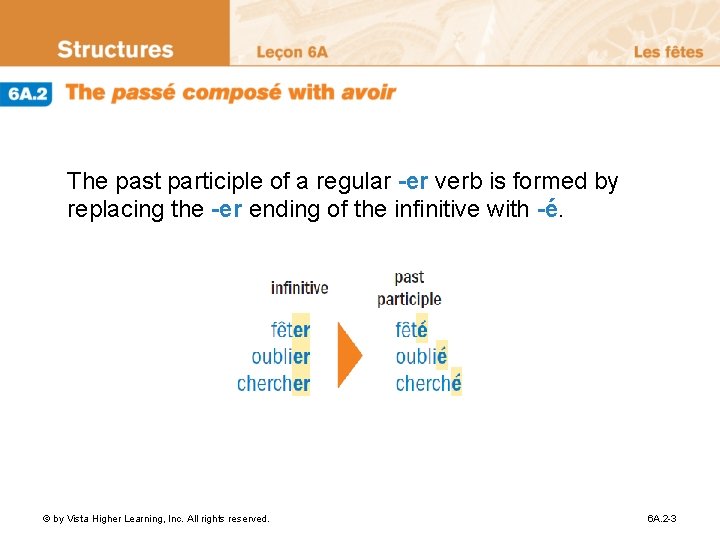
The past participle of a regular -er verb is formed by replacing the -er ending of the infinitive with -é. © by Vista Higher Learning, Inc. All rights reserved. 6 A. 2 -3
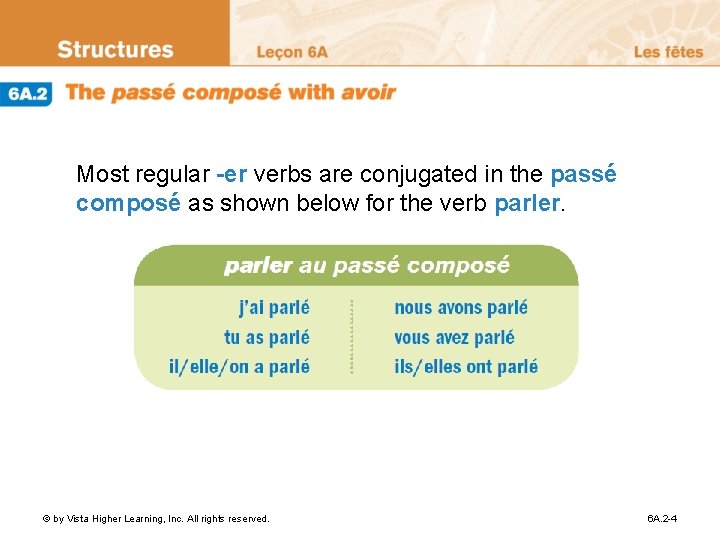
Most regular -er verbs are conjugated in the passé composé as shown below for the verb parler. © by Vista Higher Learning, Inc. All rights reserved. 6 A. 2 -4
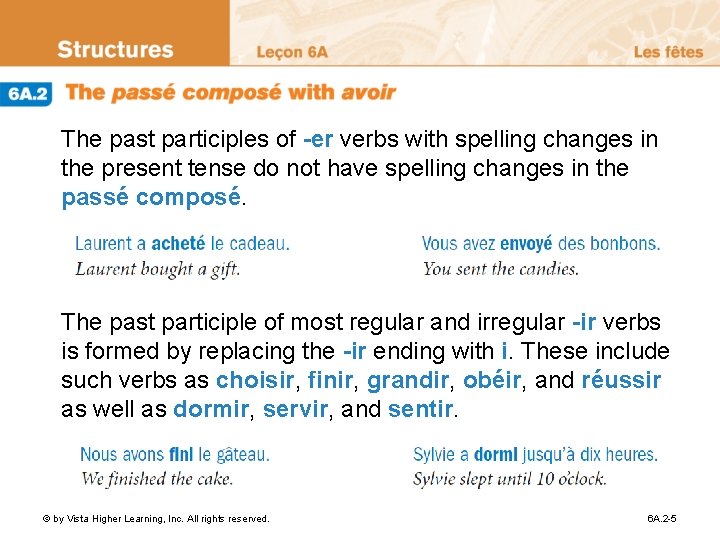
The past participles of -er verbs with spelling changes in the present tense do not have spelling changes in the passé composé. The past participle of most regular and irregular -ir verbs is formed by replacing the -ir ending with i. These include such verbs as choisir, finir, grandir, obéir, and réussir as well as dormir, servir, and sentir. © by Vista Higher Learning, Inc. All rights reserved. 6 A. 2 -5
The adverbs hier (yesterday) and avant-hier (the day before yesterday) are used often with the passé composé. © by Vista Higher Learning, Inc. All rights reserved. 6 A. 2 -6
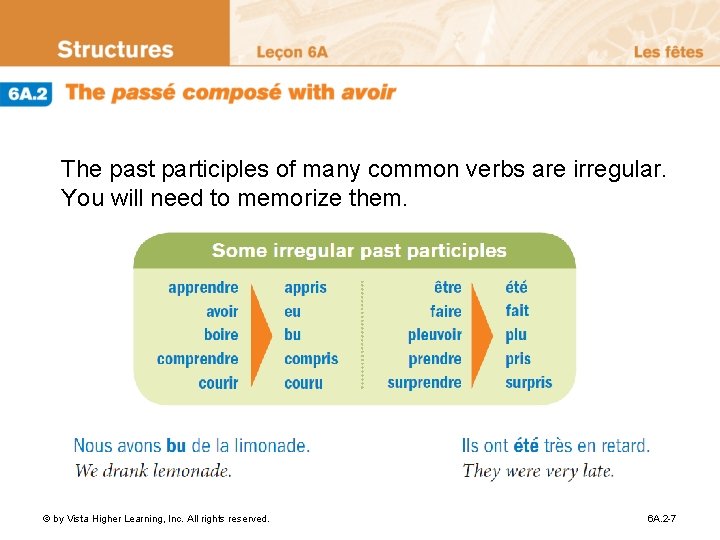
The past participles of many common verbs are irregular. You will need to memorize them. © by Vista Higher Learning, Inc. All rights reserved. 6 A. 2 -7
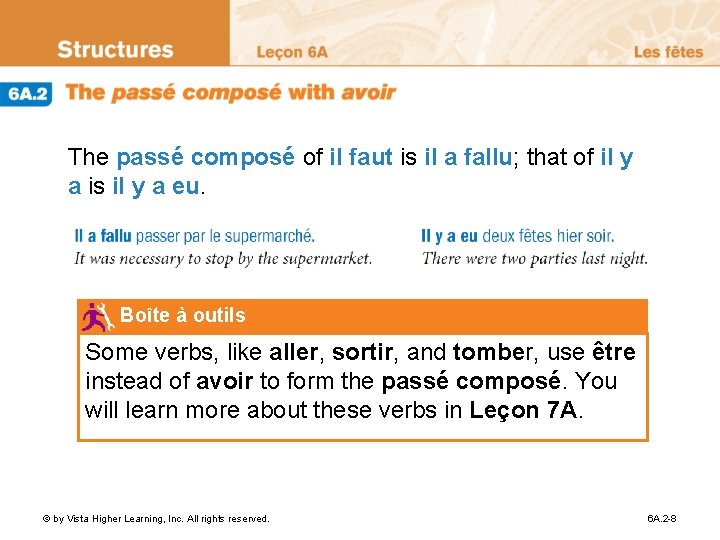
The passé composé of il faut is il a fallu; that of il y a is il y a eu. Boîte à outils Some verbs, like aller, sortir, and tomber, use être instead of avoir to form the passé composé. You will learn more about these verbs in Leçon 7 A. © by Vista Higher Learning, Inc. All rights reserved. 6 A. 2 -8
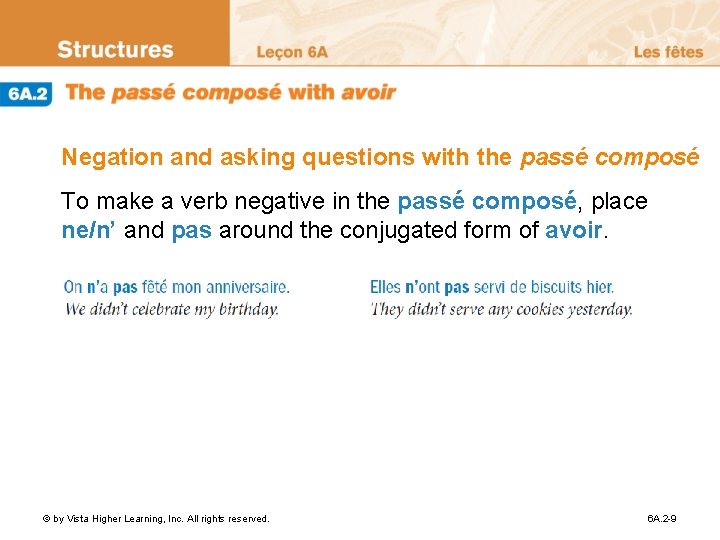
Negation and asking questions with the passé composé To make a verb negative in the passé composé, place ne/n’ and pas around the conjugated form of avoir. © by Vista Higher Learning, Inc. All rights reserved. 6 A. 2 -9
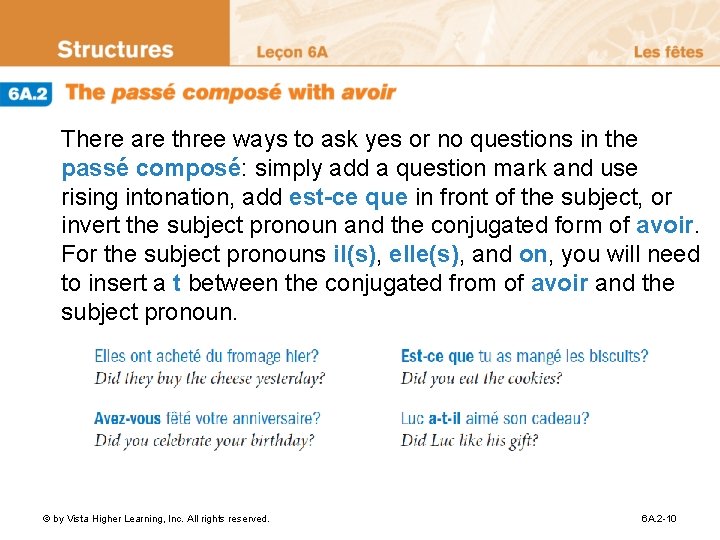
There are three ways to ask yes or no questions in the passé composé: simply add a question mark and use rising intonation, add est-ce que in front of the subject, or invert the subject pronoun and the conjugated form of avoir. For the subject pronouns il(s), elle(s), and on, you will need to insert a t between the conjugated from of avoir and the subject pronoun. © by Vista Higher Learning, Inc. All rights reserved. 6 A. 2 -10
© by Vista Higher Learning, Inc. All rights reserved. 6 A. 2 -11