
Point Cloud Processing Ali Hosseininaveh Table of Contents
Point Cloud Processing Ali Hosseininaveh
Table of Contents • Introduction – Typical and advance Point cloud Processing operations • PCL programming – How to install PCL and how to use the codes • • Data Storage Formats Segmentation Classification Filtering Registration Dynamic Registration Surface Reconstruction Visualization and Texturing
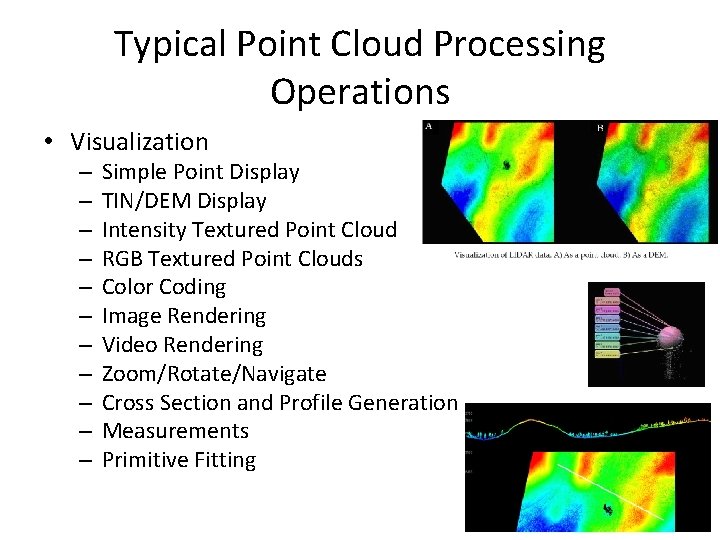
Typical Point Cloud Processing Operations • Visualization – – – Simple Point Display TIN/DEM Display Intensity Textured Point Cloud RGB Textured Point Clouds Color Coding Image Rendering Video Rendering Zoom/Rotate/Navigate Cross Section and Profile Generation Measurements Primitive Fitting
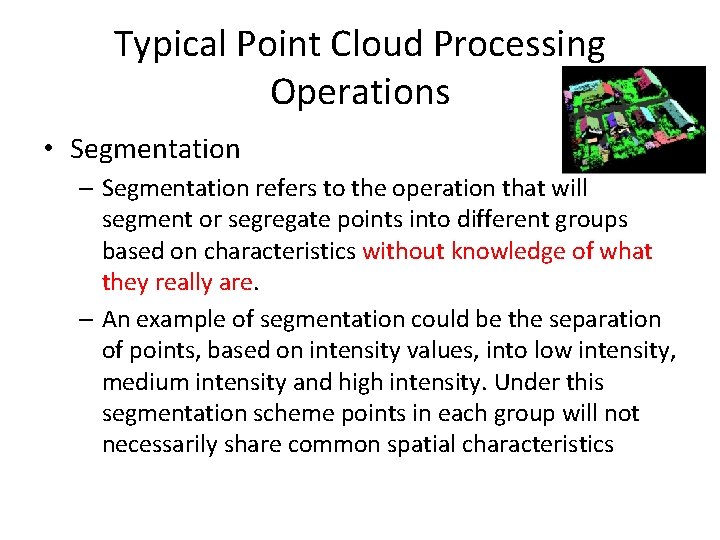
Typical Point Cloud Processing Operations • Segmentation – Segmentation refers to the operation that will segment or segregate points into different groups based on characteristics without knowledge of what they really are. – An example of segmentation could be the separation of points, based on intensity values, into low intensity, medium intensity and high intensity. Under this segmentation scheme points in each group will not necessarily share common spatial characteristics
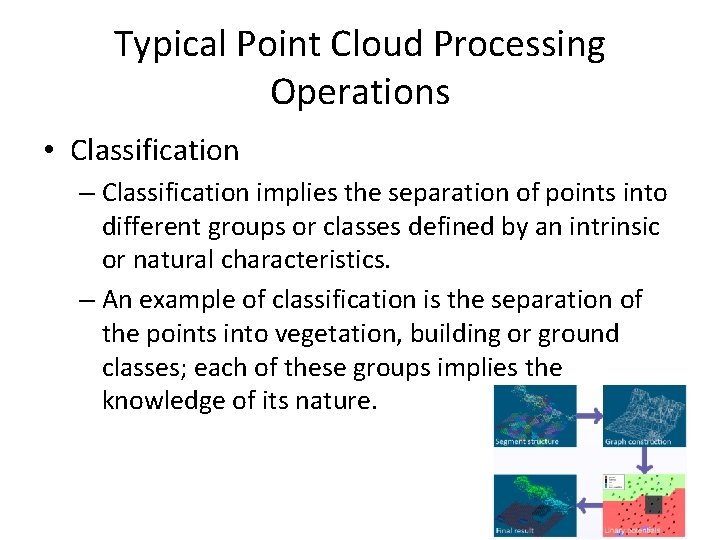
Typical Point Cloud Processing Operations • Classification – Classification implies the separation of points into different groups or classes defined by an intrinsic or natural characteristics. – An example of classification is the separation of the points into vegetation, building or ground classes; each of these groups implies the knowledge of its nature.
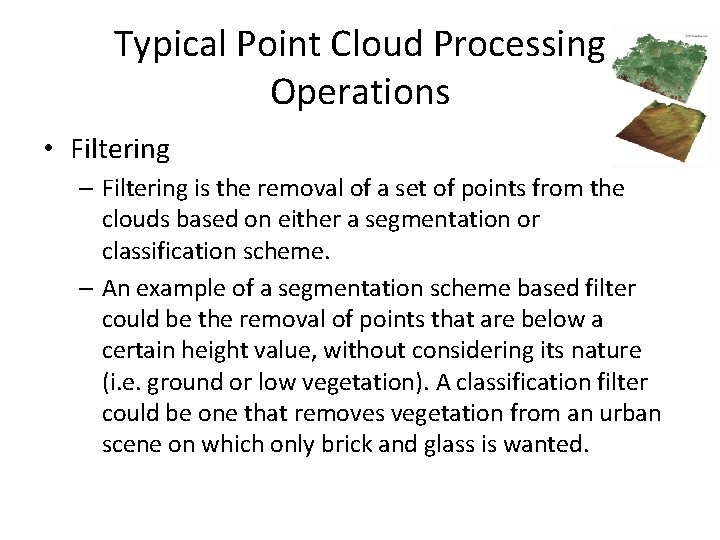
Typical Point Cloud Processing Operations • Filtering – Filtering is the removal of a set of points from the clouds based on either a segmentation or classification scheme. – An example of a segmentation scheme based filter could be the removal of points that are below a certain height value, without considering its nature (i. e. ground or low vegetation). A classification filter could be one that removes vegetation from an urban scene on which only brick and glass is wanted.
![Typical Point Cloud Processing Operations • Transformation – Rotation and Transformation [R: t] –](http://slidetodoc.com/presentation_image_h2/a9a57f7d45b5a4ac6b4d8b9aed8802ec/image-7.jpg "Typical Point Cloud Processing Operations • Transformation – Rotation and Transformation [R: t] –")
Typical Point Cloud Processing Operations • Transformation – Rotation and Transformation [R: t] – Cropping – Merging – Geo‐Referencing • A transformation in which a point cloud with coordinates in arbitrary sensor space is converted into a geodetic coordinate frame is called geo‐referencing. • Gridding and sub‐sampling – The process of converting the point cloud into a regularly spaced data set by means of interpolation is called gridding
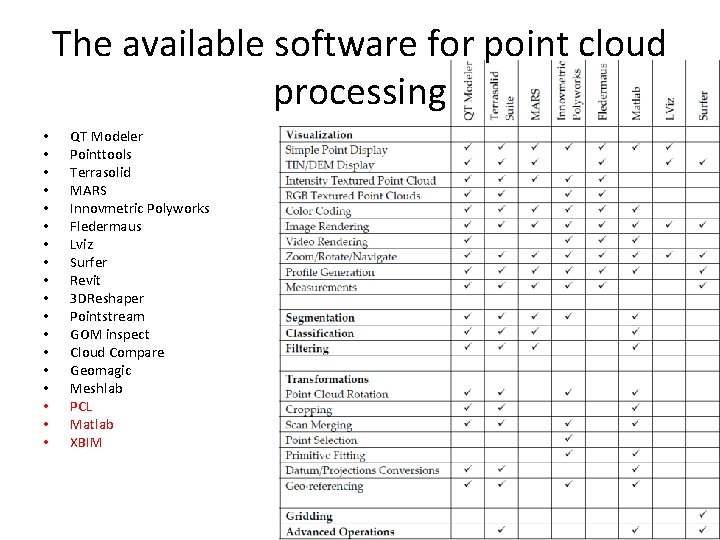
The available software for point cloud processing • • • • • QT Modeler Pointtools Terrasolid MARS Innovmetric Polyworks Fledermaus Lviz Surfer Revit 3 DReshaper Pointstream GOM inspect Cloud Compare Geomagic Meshlab PCL Matlab XBIM
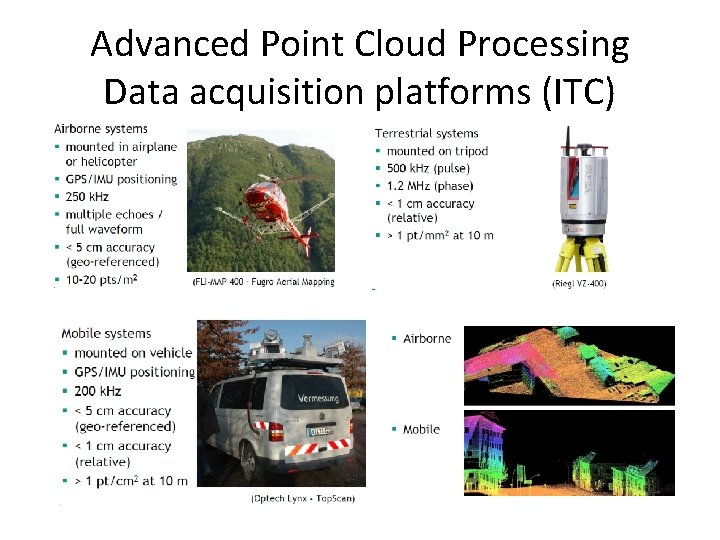
Advanced Point Cloud Processing Data acquisition platforms (ITC)

Advanced Point Cloud Processing (ITC) • Segmentation and Classification – 3 D Building Modelling – Curbstones – Road Marking – Poles of traffic signs and lights – Building Façade extraction, Modelling and Texturing
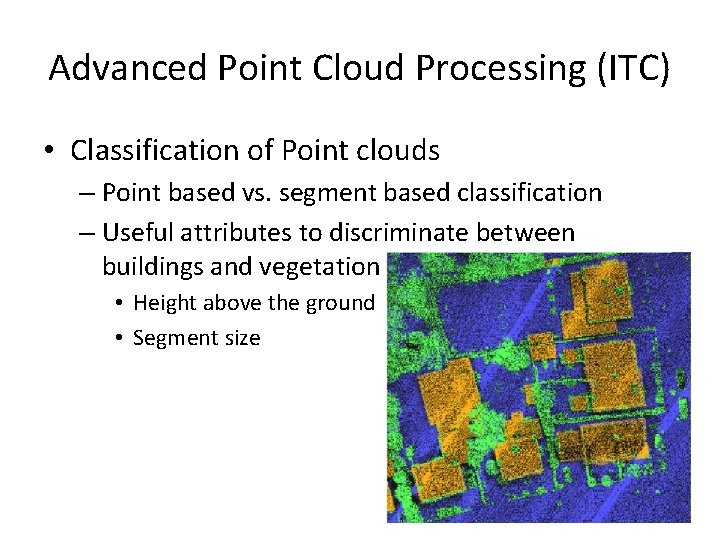
Advanced Point Cloud Processing (ITC) • Classification of Point clouds – Point based vs. segment based classification – Useful attributes to discriminate between buildings and vegetation • Height above the ground • Segment size
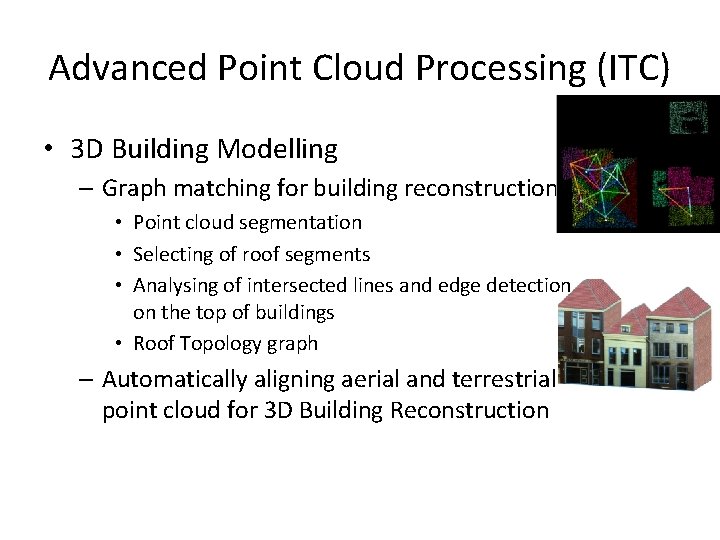
Advanced Point Cloud Processing (ITC) • 3 D Building Modelling – Graph matching for building reconstruction • Point cloud segmentation • Selecting of roof segments • Analysing of intersected lines and edge detection on the top of buildings • Roof Topology graph – Automatically aligning aerial and terrestrial point cloud for 3 D Building Reconstruction
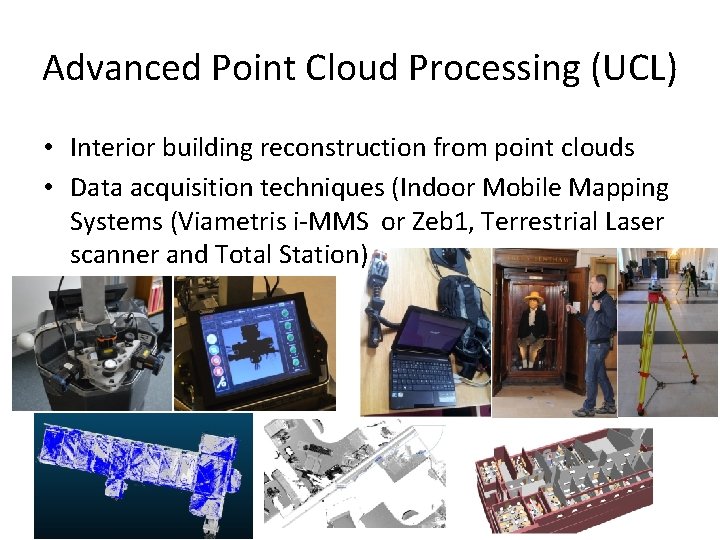
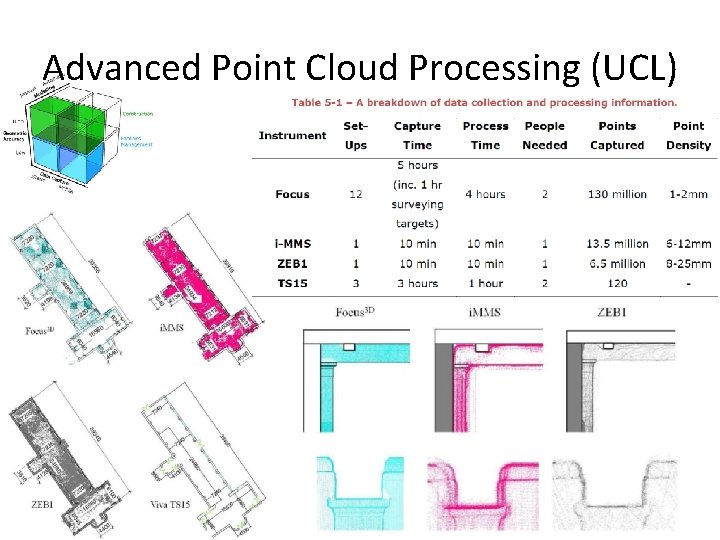
Advanced Point Cloud Processing (UCL) • Interior building reconstruction from point clouds • Data acquisition techniques (Indoor Mobile Mapping Systems (Viametris i‐MMS or Zeb 1, Terrestrial Laser scanner and Total Station)
Advanced Point Cloud Processing (UCL)
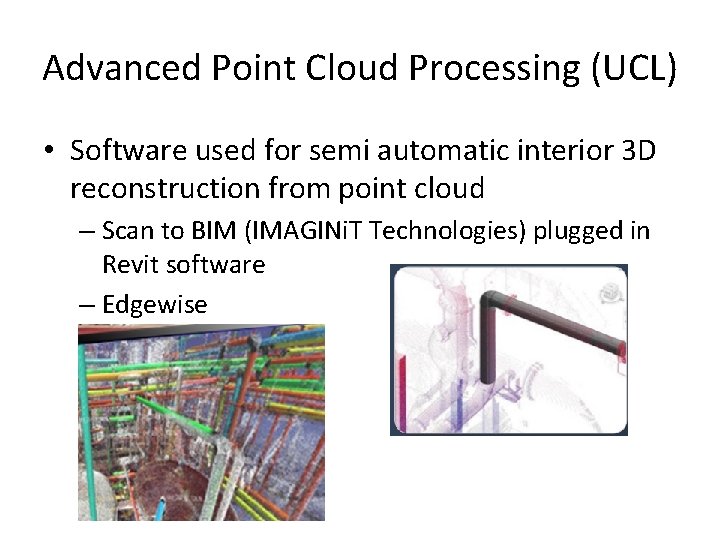
Advanced Point Cloud Processing (UCL) • Software used for semi automatic interior 3 D reconstruction from point cloud – Scan to BIM (IMAGINi. T Technologies) plugged in Revit software – Edgewise

Advanced Point Cloud Processing (UCL) • A Fully automatic 3 D reconstruction algorithm ( Thomson, 2016) • Libraries used for developing the algorithm: – e. Xtensible Building Information Modelling (x. BIM) toolkit (http: //docs. xbim. net/) – Point cloud Library (PCL)
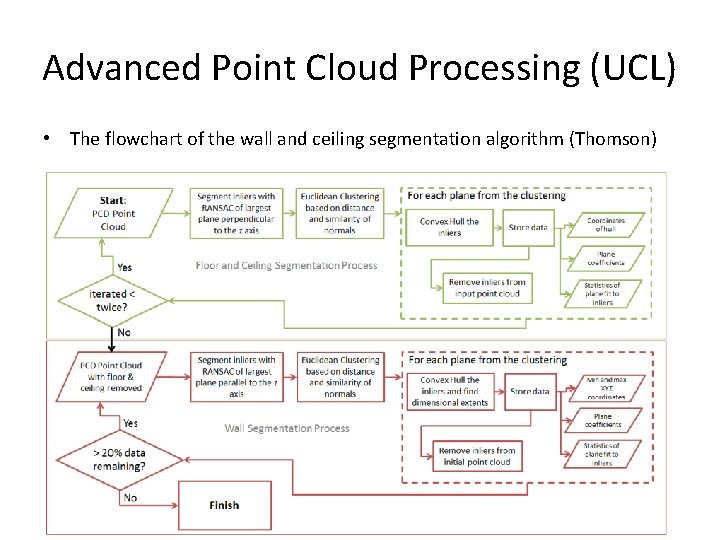
Advanced Point Cloud Processing (UCL) • The flowchart of the wall and ceiling segmentation algorithm (Thomson)

Advanced Point Cloud Processing (UCL) • Flowchart of the IFC construction process (Thomson)

Advanced Point Cloud Processing (UCL) • Some spatial reasoning rules for better reconstruction: – Reject small walls – Extend large walls – Merge close planes with similar normal – Reject walls with low point density
Advanced Point Cloud Processing (ISPRS) • Development of new methodologies, algorithms and applications for point cloud processing • Information extraction from point clouds, including low‐level feature extraction, segmentation and classification • Point cloud registration and fusion • Cloud Computing and high‐performance computing for massive point cloud processing • Geospatial Big Data processing for point clouds • Point cloud rendering and streaming for massive point clouds • Point cloud processing for building information modelling (BIM) • Ubiquitous point cloud sensing
- Slides: 20