
Poetry Unit Objectives Students will be able to

Poetry Unit
Objectives Students will be able to read and understand poetry on grade -level. Students will know, identify, and understand the importance of poetry terms (sound devices, figurative language, form, etc. ) Students will be able to identify themes of poems.
Form is the structure of a poem (i. e. how are the words laid out on the page) Lines Stanzas-poems versions of a paragraph Traditional-follow strict rules and regular patterns Epic Sonnet Haiku Organic-NO RULES! Free verse Concrete
Examples Traditional: Organic: Surgeons must be very careful we’re everyanything more than believe When they take the knife! (with a spin Underneath their fine incisions leap Stirs the Culprit—Life! alive we’re alive) --Emily Dickinson we‘re wonderful on times one --E. E. Cummings
Practice Page 741

Sound Devices
Sound Devices Appropriately, these relate to how a poem SOUNDS. Repetition- repeat a sound, word, group of words, or line Alliteration-repeating the consonant sounds at the beginning of a word Assonance-repeating the vowel sounds in words that don’t end in the same consonant (why? ) Consonance-repeating the consonant sounds in and at the end of words.
But first…RHYME End rhyme-this is when the last words in a line of poetry have the same vowel (+consonant) sound at the end. Internal rhyme-this is when there are rhyming words within one line of poetry. Slant rhyme-close, but not quite an actual rhyme (chair and cheer).
And…RHYTHM This is created by “the pattern of stressed and unstressed syllables in each line of poetry. ” For now, count the number of syllables per line. We will talk more about this later!
Repetition How the danger sinks and swells, By the sinking or the swelling in the anger of the bells, Of the bells, Bells, bells— In the clamor and the clangor of the bells! How does the repetition make you feel? What does that tell you about the purpose in the poem?
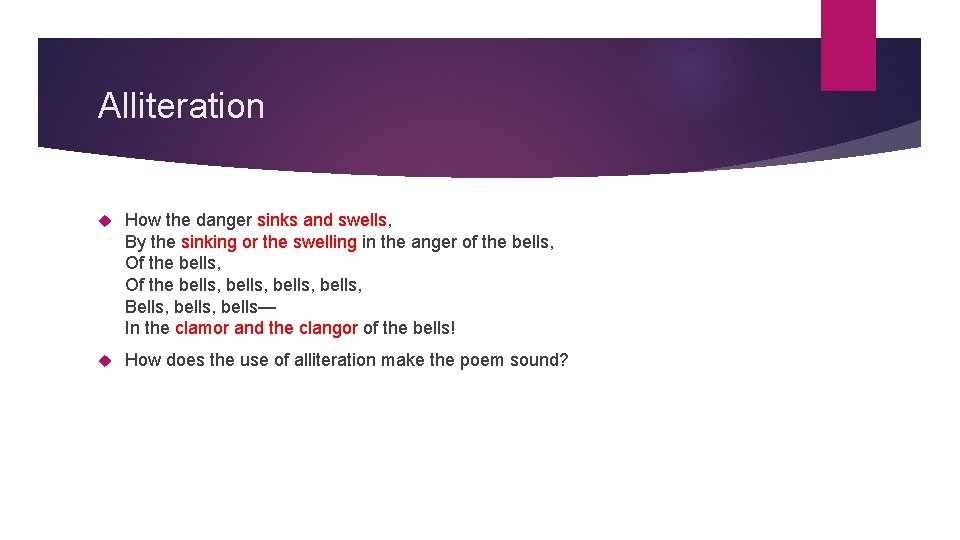
Alliteration How the danger sinks and swells, By the sinking or the swelling in the anger of the bells, Of the bells, Bells, bells— In the clamor and the clangor of the bells! How does the use of alliteration make the poem sound?
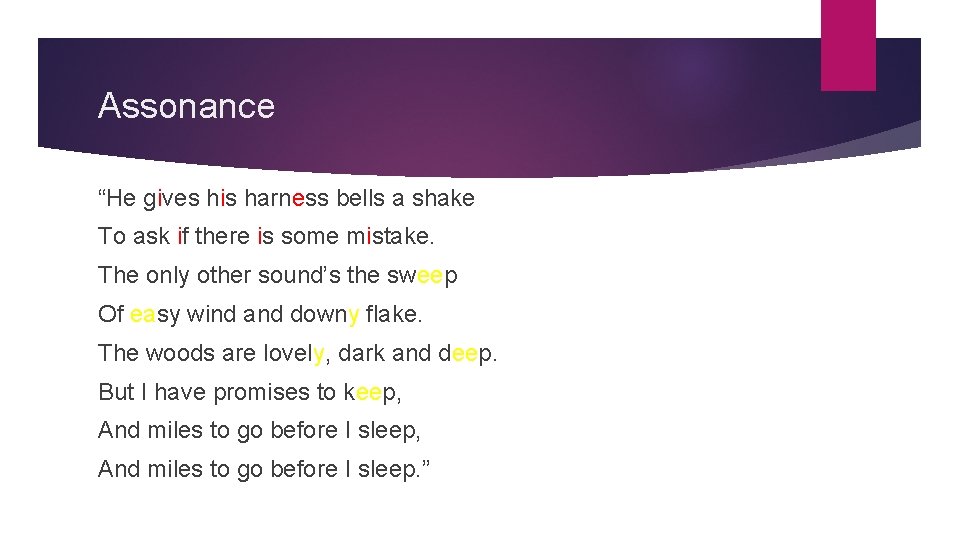
Assonance “He gives his harness bells a shake To ask if there is some mistake. The only other sound’s the sweep Of easy wind and downy flake. The woods are lovely, dark and deep. But I have promises to keep, And miles to go before I sleep. ”
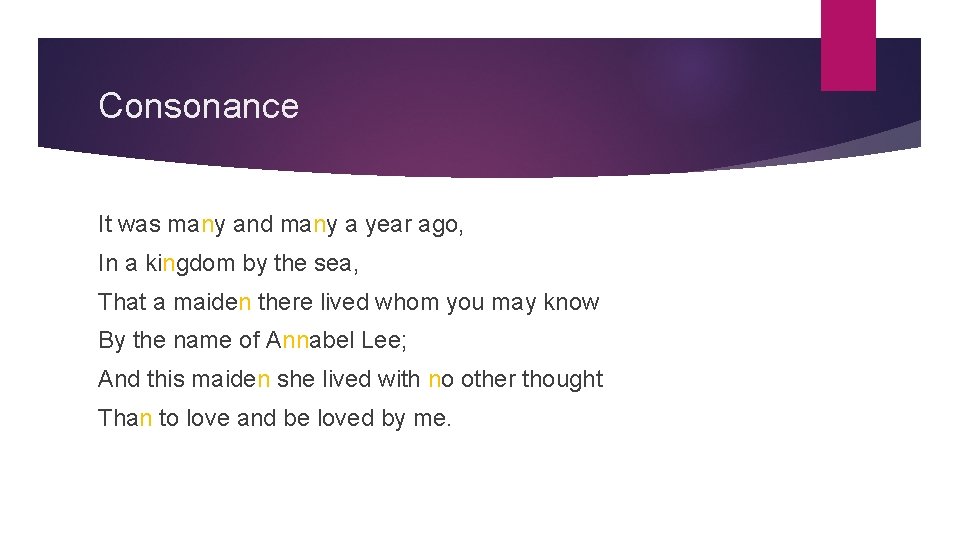
Consonance It was many and many a year ago, In a kingdom by the sea, That a maiden there lived whom you may know By the name of Annabel Lee; And this maiden she lived with no other thought Than to love and be loved by me.
Figurative Language
Figurative language This is use of language/description that is not literal. Simile: a comparison of two unlike things that draws attention to the fact that the description is using comparison. This is often indicated with words like ‘like’, ‘as’, and ‘just so. ’ Metaphor: a comparison of two unlike things that does not draw attention to the comparison, but calls one thing something else. Personification: giving human qualities to something that is not human. Hyperbole: extreme exaggeration.
Simile-Page 750 The whiskey on your breath Could make a small boy dizzy; But I hung on like death: Such waltzing was not easy. What is being compared? What does it tell the reader?
Simile – Page 752 She begins, and my grandmother joins her. Mother and daughter sing like young girls. If my father were alive, he would play his accordion and sway like a boat. Two similes Second simile: why use a boat to help us understand her father’s actions? Shift?
Metaphor – Page 778 -779 Audacious socks, Two metaphors my feet became How is this different from a simile? two woolen Why use metaphors instead? Shift? fish, two long sharks of lapis blue shot With golden thread…
Personification – Page 782 small What object is personified? white What is the effect? afraid of heights whispering in the cold, dark carton to the rest of the dozen.

Practice
“O What is that Sound? ” 1. Who is/are the speaker(s)? 2. What sound devices are used in the poem? 1. Rhyme 2. Assonance 3. Consonance 4. Alliteration 5. Repetition
“The Road Not Taken” Rhyme Scheme Rhythm (number of syllables per line) Symbolism
On your own Annotate the poem for the following things: Sound devices (alliteration, assonance, consonance, repetition, rhyme) Figurative language (simile, metaphor, personification, hyperbole) Shifts Rhythm
Sonnets ELIZABETHAN POETRY
Definition “A sonnet is a lyric poem of 14 lines, commonly written in iambic pentameter. Sonnets are often classified as Petrarchan or Shakespearean. The Shakespearean, or Elizabethan, sonnet consists of three quatrains and a final couplet. The typical rhyme scheme is abab cdcd efef gg. ”
Iambic pentameter A metrical pattern of five feet (iambs), or units, each of which is made up of two syllables, the first unstressed and the second stressed. “This is the most common meter used in English poetry; ” it sounds most like a normal speaking voice. “My lips, two blushing pilgrims, ready stand. ”
The Seven Ages of Man-Iambic pentameter “All the world’s a stage, And all the men and women merely players: They have their exits and their entrances; And one man in his time plays many parts…”
The Seven Ages of Man How many syllables in each line? How many feet? Which syllables are stressed? Which syllables are unstressed?
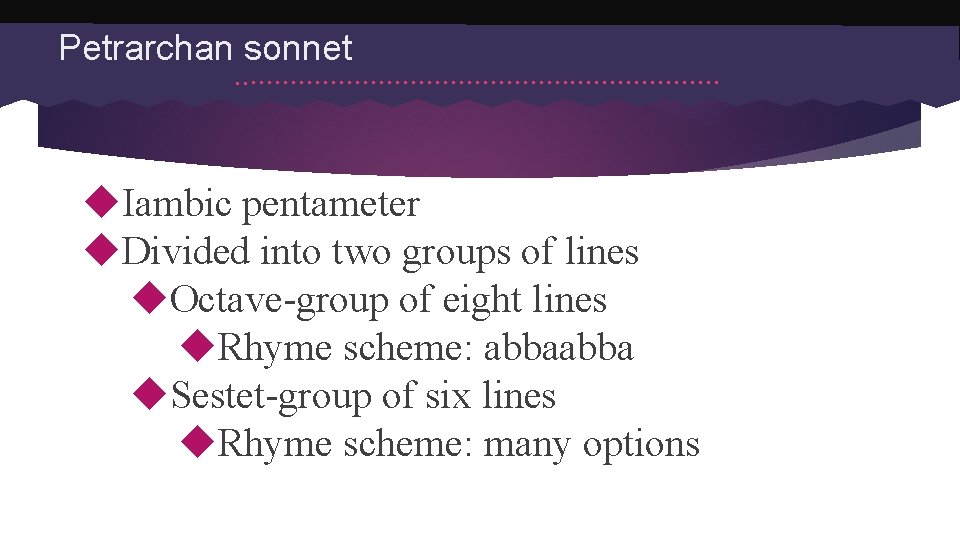
Petrarchan sonnet Iambic pentameter Divided into two groups of lines Octave-group of eight lines Rhyme scheme: abba Sestet-group of six lines Rhyme scheme: many options
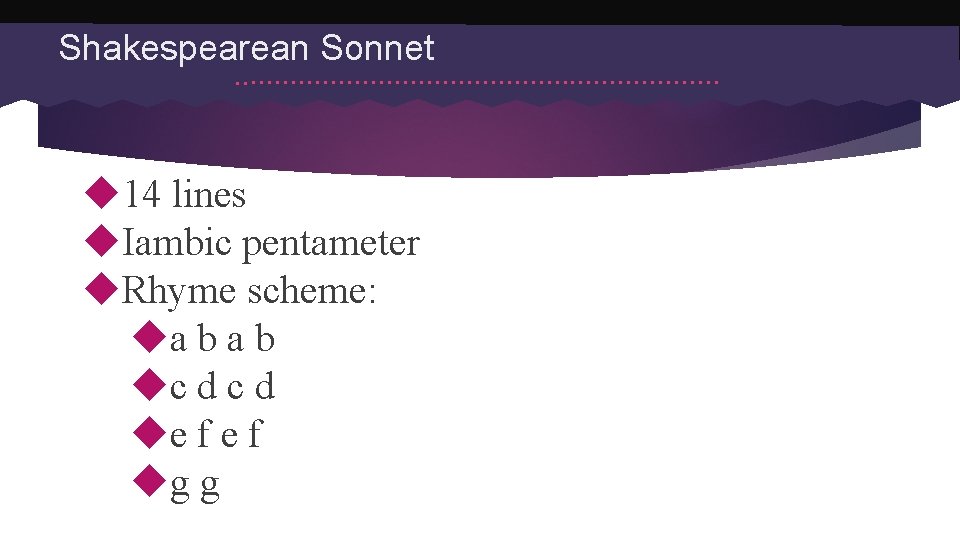
Shakespearean Sonnet 14 lines Iambic pentameter Rhyme scheme: a b c d e f g g
Shakespearean Sonnet Quatrain-Groups of four lines Couplet-Two rhyming lines Found at the end of a Shakespearean sonnet
Practice Sonnet #1 - Read and summarize. Then put brackets around each of the three quatrains and the couplet. Sonnet #2 - Read and summarize. Circle each of the iams in the sonnet. Then put the stressed (‘) and unstressed (u) symbol above each syllable. Sonnet #3 - Read and summarize. Identify the rhyme scheme. Sonnet #4 - Read and summarize. How do you know this is a Shakespearean sonnet?
Subject of Shakespearean sonnets What do the four sonnets we read have in common? Who do they seem to be addressed to? What do they talk about? How do they describe/talk about love?
Shakespearean Tragedy CHARACTERISTICS
What is a tragedy? Think of an event you have seen on the news or heard about that you would consider a tragedy. Based on those examples, how do you define tragedy?
Tragedy A drama that ends in catastrophe-most often death-for the main characters. Shakespeare’s tragedies also include comic moments Why might he choose to do this?

Dramatic Conventions
Tragic Hero Protagonist, or central character--the one you (the reader/audience) identify with Usually fails or dies because of a character flaw or cruel twist of fate Often has a high status; shows strength
Antagonist The force working against the protagonist Can be another character, a group of characters, or something nonhuman such as nature or society
*Foil* A character whose personality and attitude contrast sharply with those of another character Highlights both characters’ traits Example: a timid character makes a talkative one seem even more talkative Example: a mean person makes a nice person seem even kinder
Soliloquy A speech given by a character alone on stage Lets the audience know what the character is thinking or feeling Why are these necessary in plays?
Aside A character’s remark, either to the audience or to another character, that others on stage do not hear Reveals the character’s private thoughts
Dramatic Irony When the audience knows more than the characters Helps build suspense
Comic relief A humorous scene or speech intended to lighten the mood Serves to heighten the seriousness of the main action by contrast What happens when you see something funny at a funeral?
Allusion Not an illusion A reference, within a work, to something that the audience is expected to know What might Shakespeare’s audience have been familiar with (think time period)? Mythology Bible
- Slides: 45