
Poetry Unit BW 2316 Take out a blank

Poetry Unit
BW: 2/3/16 • Take out a blank sheet of notebook paper • Complete the quick write below: Which is the more powerful form of communication— visual (pictures, body language, etc. ) or verbal (words— written or spoken? Explain. Homework: Finish “Painting is Superior to Poetry” questions if not finished in class
For Today • Read back through the essay “Painting is Superior to Poetry” • Write a short summary (2 -3 sentences) of each “chunk” of the text • Discuss the summaries with your group mates to make sure you all have a solid understanding of the text
For classwork/homework • After you have discussed the text, answer the questions on the back of the essay. • You must answer in COMPLETE sentences. • Make sure your explain yourself thoroughly and give text evidence for support!
BW 2/4/16 • Take out your “Painting is Superior to Poetry” questions. • Make sure your name is on them and turn them in to the basket. • Take out a blank sheet of notebook paper and something to write with. Homework: Complete figurative language practice if not finished in class
Poetry Guided Notes
Poetry • Poetry is a type of literature that uses the sounds, rhythms, and meanings of words to describe the world in striking and imaginative ways • Comes in many forms, from structured traditional verse to contemporary poems that follow few rules
Poetry organization • Poetry is divided into lines—groups of words. • In some poems, the first word of each line is capitalized. • A sentence in a poem may stretch over several lines. • For this reason, you should NOT stop at the end of each line when reading a poem, but instead stop at the end of each sentence. • Lines of poetry are organized into units of meaning called stanzas. These are like “poetry paragraphs” • The lines in a stanza work to express one key idea. • A blank line, called a stanza break, signals that one stanza has ended and a new stanza is beginning.
Poetry Organization (cont. ) • Shift—a change or a turn in the poem • Can be a change in subject or opinion • Usually shows us the speaker has realized something or changed in some way • Commonly happen in the middle or towards the end
Poetry Sound Devices • Refrain—a line or group of lines that is repeated at regular intervals in a poem; reminds readers of a key idea, image, or event • Rhythm—the “beat” of a poem • Rhyme—the repetition of vowel and consonant sounds at the ends of words (ex: tin and pin) • Rhyme scheme—pattern of rhyme in a poem
Poetry Sound Devices (cont. ) • Alliteration—the repetition of consonant sounds in the beginnings of words (ex: slippery slope) • Repetition—the use of any element of language (sound, word, or phrase) more than once • Onomatopoeia—the use of words that imitate sounds (ex: splat, hiss, gurgle, buzz, pow)
Poetic Language • Imagery—creating vivid word pictures using words that appeal to the five senses • Figurative language—language that is not meant to be taken literally; 3 most common types of figurative language are similes, metaphors, and personification. • Simile—uses the words like or as to compare to seemingly unlike things • Ex: His hands were as cold as steel. • Metaphor—describes one thing as if it were something else • Ex: My chores were a mountain waiting to be climbed. • Personification—gives human qualities to a nonhuman subject • Ex: The fingertips of the rain tapped a steady beat on the windowpane.
Figurative Language (continued) • Diction—word choice • Hyperbole—an extreme exaggeration • I’m so hungry I could eat a horse. • It’s been raining forever!
Poetic Form and Structure • Narrative—tells a story in verse; have elements similar to short stories (ex: plot and characters) • Haiku— 3 line Japanese form that describes something in nature • 1 st and 3 rd lines each have 5 syllables, and the 2 nd line has 7 syllables • Lyric—poetry that expresses the thoughts and feelings of a single speaker, often in highly musical verse • Ballads—song-like poems that tell stories; often deal with adventure or romance
Poetic Form and Structure Continued • Concrete—poems that are shaped to look like their subjects; poet arranges lines to create a picture on the page • Limericks—humorous, rhyming, 5 line poems with a specific rhythm pattern and rhyme scheme • Free Verse—poetry defined by its lack of structure; has no regular meter, rhyme, fixed line length, or specific stanza pattern
BW 2. 5. 16 • Take out your figurative language practice from yesterday • Make sure you have something (NOT A PENCIL) to write with—you may borrow a marker or colored pencil from the front of the room as long as you return it Homework: Finish questions 1 -8 pg. 581 if not finished in class today
BW 2. 8. 16 • Take out your homework—questions from pg. 581 • Make sure your name is on them and turn in to the basket • Take out a blank sheet of notebook paper. • • Head it “Bellringers Week of 2/8” You must keep up with this ALL WEEK! You will turn in your completed bellringers for this week on Friday for a grade. If you don’t have it, you get a 0. Homework: Write either a lyric poem, a concrete poem, or a haiku of your own (pg. 599 has instructions). DUE TOMORROW!
Bellringer 2/8/16 Directions: Read the examples carefully. Determine which figurative language technique is being used (Simile, Metaphor, Personification, Hyperbole) 1. Like burnt-out torches by a sick man's bed 2. Drip-hiss-drip-hiss fall the raindrops / on the oaken log which burns, and steams, and smokes the ceiling beams. / Drip-hiss-the rain never stops. 3. When the stars threw down their spears, / And water'd heaven with their tears, 4. The moon was a ghostly galleon tossed upon cloudy seas,
For Today • Answer questions 1 -3 pg. 590 (COMPLETE SENTENCES) • Write either a lyric poem, a concrete poem, or a haiku of your own (pg. 599 has instructions). • Your poem and 3 questions are due tomorrow!
BW 2. 9. 16 • Take out the poem you wrote last night for homework. • Make sure your name is on it and turn in to the basket. • Take out your Bellringers sheet for this week. Homework: Write a poem that contains a metaphor (assignment on pg. 619). DUE TOMORROW!
Bellringer 2. 9. 16 Directions: Read the examples carefully. Determine which figurative language technique is being used (Simile, Metaphor, Personification, Hyperbole) 5. I do not care to talk to you although / Your speech evokes a thousand sympathies, 6. The sun was shining on the sea, / Shining with all his might: 7. The leaves are little yellow fish / swimming in the river. 8. The old clock down in the parlor / Like a sleepless mourner grieves,
For Today • Take out your blue Literature Textbook • Turn to page 603 • We will read the poems aloud together on pages 603 -608
After Reading • Answer questions 3, 4, and 5 pg. 609 (Reading questions, NOT Vocabulary) • Write a poem that contains a metaphor (assignment on pg. 619). • Your questions and poem are due at the start of class tomorrow!
BW 2. 10. 16 • Take out the metaphor poem your wrote last night for homework • Make sure your name is on it and turn in to the basket • Take out your bellringers sheet for this week Homework: Finish TPFASTT if not finished in class
Bellringer 2. 10. 16 Directions: Read the examples carefully. Determine which figurative language technique is being used (Simile, Metaphor, Personification, Hyperbole) 9. By the lakes that thus outspread / Their lone waters, lone and dead / Their sad waters, sad and chilly 10. Fame is a bee. / It has a song -- / It has a sting – 11. He would write, but his hours are as busy / As bees in the sun, 12. My words are little jars / For you to take and put upon a shelf. Their shapes are quaint and beautiful, / And they have many pleasant colors and lusters
BW 2. 11. 16 • Take out your TPFASTT for “How I Learned English” • Make sure your name is on it and be ready to go over answers together • Take out your bellringers sheet for this week Homework: Finish questions if not finished in class--1 and 4 pg. 654 and 2, 3, and 4 on pg. 655
Bellringer 2. 11. 16 Directions: Read the examples carefully. Determine which figurative language technique is being used (Simile, Metaphor, Personification, Hyperbole) 13. All round the house is the jet-black night; / It stares through the window-pane; It crawls in the corners, hiding from the light, 14. Oh, never, if I live to a million, / Shall I feel such a grievous pain. 15. But words are things, and a small drop of ink, / Falling, like dew, upon a thought produces 16. And then my heart with pleasure fills, / And dances with the daffodils.
For Today • Read the poems on pg. 650 -654. • Discuss the poems and answer questions: • 1 and 4 pg. 654 • 2, 3, and 4 on pg. 655 (Reading questions, NOT Vocabulary)
BW 2. 16 • Take out questions from pg. 654 -655. • Make sure your name is on it and turn in to the basket • Take out your bellringers sheet for this week. Homework: Write poem mimicking one of the 3 examples from class—due Monday
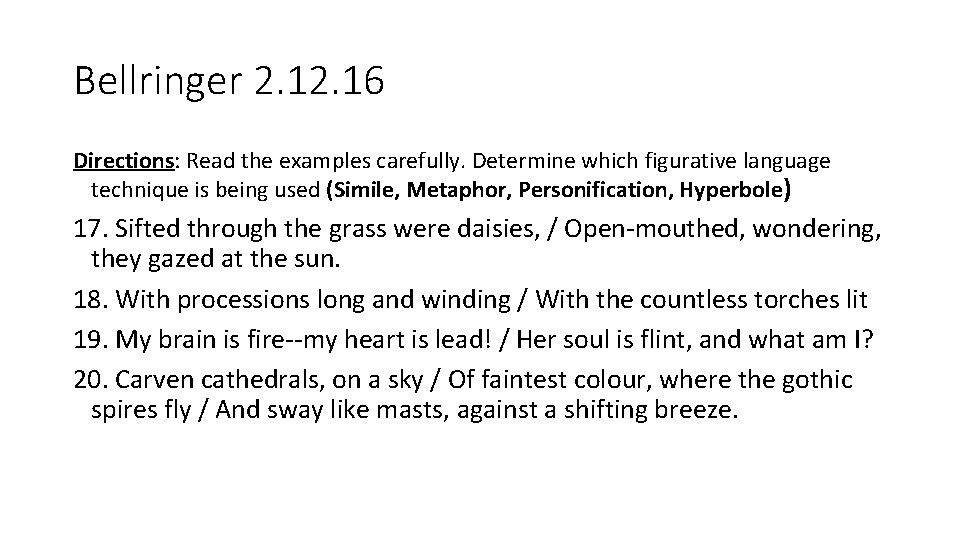
Bellringer 2. 16 Directions: Read the examples carefully. Determine which figurative language technique is being used (Simile, Metaphor, Personification, Hyperbole) 17. Sifted through the grass were daisies, / Open-mouthed, wondering, they gazed at the sun. 18. With processions long and winding / With the countless torches lit 19. My brain is fire--my heart is lead! / Her soul is flint, and what am I? 20. Carven cathedrals, on a sky / Of faintest colour, where the gothic spires fly / And sway like masts, against a shifting breeze.
- Slides: 30