
Poetry for Physicians Can Literature and Arts Make
- Slides: 25
Poetry for Physicians: Can Literature and Arts Make You a Better Doctor? Johanna Shapiro, Ph. D. Department of Family Medicine, UC Irvine College of Medicine November, 2002
OBJECTIVES n n Understand how literature and the arts can be used as tools for professional development Describe how studying literature and art can increase physician empathy for patients’ ( and physicians’) experience Demonstrate how literature and artapproaches can help us think differently and more creatively about patients Understand how exposure to literature and art can reduce physician frustration and burn-out
Why Literature and Art?
Old Folk Proverb n Question: – What is truer than the truth? n Answer: – A good story
You can miss a lot by sticking to the point - Traditional Hmong saying
SCIENCE CAN ONLY ASCERTAIN WHAT IS, BUT NOT WHAT SHOULD BE - Albert Einstein
Similarities between Doctors, Poets, and Artists Confront mortality and death n Create order from chaos n Relief of suffering n Concern with healing n Combine emotional distance (steadiness) with emotional engagement (tenderness) n
How is a Patient Like a Poem? Should make us feel something, as well as cognitively apprehend n Are sometimes allusive, indirect, mysterious rather than straightforward and direct n Pack complexity and multiple meanings into a small space n Require careful, empathic attention to truly understand n
What “Skills” Can Literature and the Arts Help Us (Re)Discover? n n n n Close attention and interpretation Empathy for multiple perspectives Emotional connectivity and engagement Whole person understanding Creative imagination and curiosity Sensitivity to the meaning of patient experience Renewal of joy and meaning in the practice of medicine
What Can We Learn from Literature and the Arts? Patients can disclose authentically what their illness experience is like
Chemotherapy - Aimee Grunberger sorry can’t leave just yet two kids so little still cry when they stub a toe need help sticking bandaid can’t go right now got a class reunion book on reserve four tickets to Vancouver no refunds reading up on survivors card-playing grandma number on her arm ten-car pile-up wheelchair for life hopeless coma awoke one morning bone-cracking tumor size of the sun
Couldn’t help it teacher made me said to lay my head on the desk but everyone else can leave heavy door slams not so fast lady I’ll tell you why for nothing that’s why for the hell of it some number came up so what you gonna do huh just plain spiteful put my affairs in order ten notarized final wishes now my bald skull lonely breast broken heart hunch over the muddy curb in the filthy wind no place in particular wait for light to change
What Else Can We Learn from Literature and the Arts? Physicians can explore their own experience as doctors
Night on Call - Rita Iovino, M. D. There are sometimes such moments of magic, when the sky and mountains melt into the dawn when the blue-purple horizon yields to the sun, and the trek home becomes a moment of epiphany. Everything is still and only the faint noise of sparrows permeates the air. The exhaustion and sweat and scrubs become an exclamation of rebirth. The gift of being a doctor is magnified like dandelions blowing in the wind, and one knows the skill of giving life, the gift of alleviating pain; the long night suturing becomes a dream because now one more person becomes whole by your latex gloves. The sun breaks into a million bright lights as you go home to sleep.
What Else Can We Learn from Literature and the Arts? Patients can say things to doctors that otherwise might remain hidden
What Else Can We Learn from Literature and the Arts? Physicians can reflect on their patients in new and unexpected ways
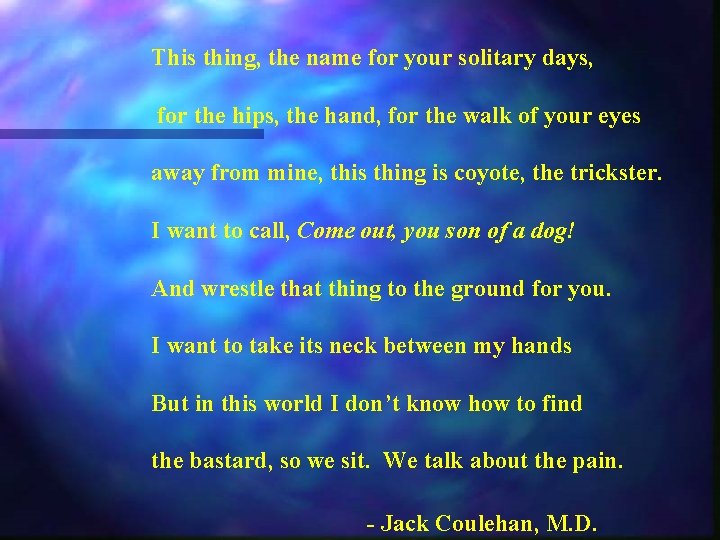
This thing, the name for your solitary days, for the hips, the hand, for the walk of your eyes away from mine, this thing is coyote, the trickster. I want to call, Come out, you son of a dog! And wrestle that thing to the ground for you. I want to take its neck between my hands But in this world I don’t know how to find the bastard, so we sit. We talk about the pain. - Jack Coulehan, M. D.