
Poetry By Tara Cavanaugh and David Jagusch ED
Poetry By Tara Cavanaugh and David Jagusch ED 205 P
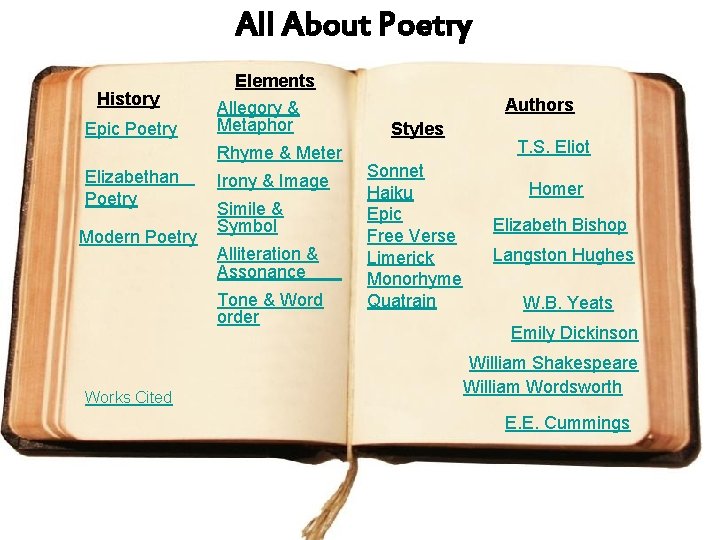
All About Poetry History Epic Poetry Elements Allegory & Metaphor Rhyme & Meter Elizabethan Poetry Modern Poetry Irony & Image Simile & Symbol Alliteration & Assonance Tone & Word order Works Cited Authors Styles Sonnet Haiku Epic Free Verse Limerick Monorhyme Quatrain T. S. Eliot Homer Elizabeth Bishop Langston Hughes W. B. Yeats Emily Dickinson William Shakespeare William Wordsworth E. E. Cummings
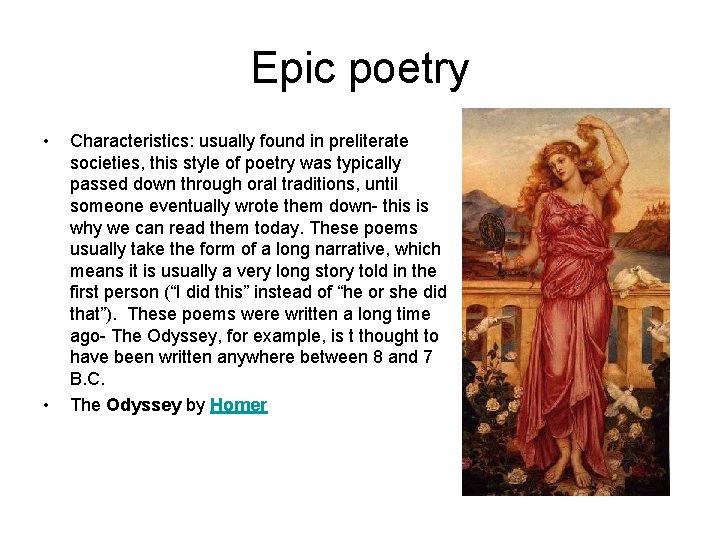
Epic poetry • • Characteristics: usually found in preliterate societies, this style of poetry was typically passed down through oral traditions, until someone eventually wrote them down- this is why we can read them today. These poems usually take the form of a long narrative, which means it is usually a very long story told in the first person (“I did this” instead of “he or she did that”). These poems were written a long time ago- The Odyssey, for example, is t thought to have been written anywhere between 8 and 7 B. C. The Odyssey by Homer
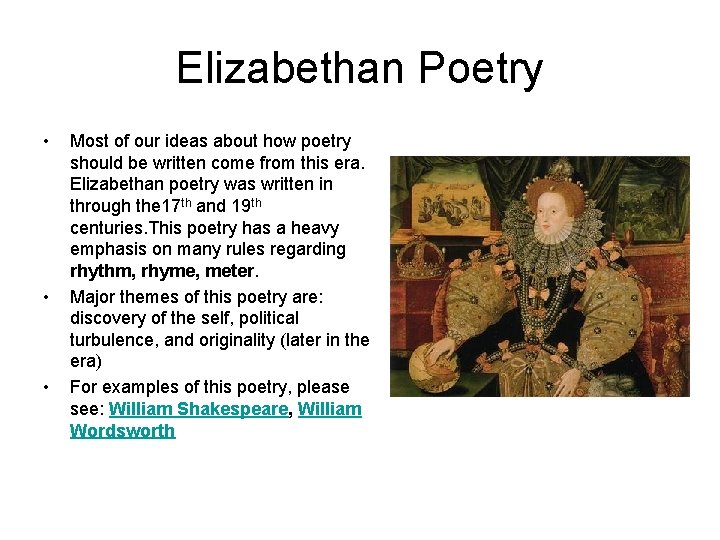
Elizabethan Poetry • • • Most of our ideas about how poetry should be written come from this era. Elizabethan poetry was written in through the 17 th and 19 th centuries. This poetry has a heavy emphasis on many rules regarding rhythm, rhyme, meter. Major themes of this poetry are: discovery of the self, political turbulence, and originality (later in the era) For examples of this poetry, please see: William Shakespeare, William Wordsworth
Modern Poetry • • • In modernism, we see poets breaking the rules of gentlemanly Elizabethan poetry, and forming new definitions of what makes a poem interesting. No longer did poetry have to follow rules about rhythm, rhyme, and meter. Poetry from this era ranges from small poems about an image (see E. E. Cummings), to long, sprawling epics written in several languages (see T. S. Eliot). For more examples of 20 th and 21 st century poetry, see below: Elizabeth Bishop Langston Hughes
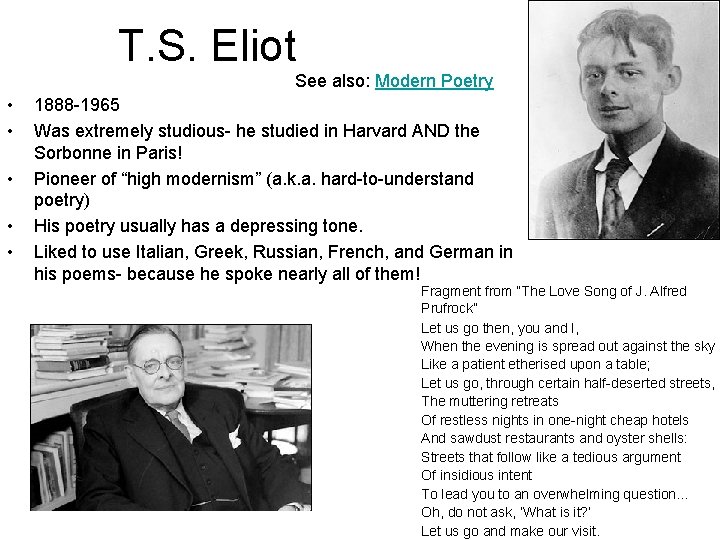
T. S. Eliot See also: Modern Poetry • • • 1888 -1965 Was extremely studious- he studied in Harvard AND the Sorbonne in Paris! Pioneer of “high modernism” (a. k. a. hard-to-understand poetry) His poetry usually has a depressing tone. Liked to use Italian, Greek, Russian, French, and German in his poems- because he spoke nearly all of them! Fragment from “The Love Song of J. Alfred Prufrock” Let us go then, you and I, When the evening is spread out against the sky Like a patient etherised upon a table; Let us go, through certain half-deserted streets, The muttering retreats Of restless nights in one-night cheap hotels And sawdust restaurants and oyster shells: Streets that follow like a tedious argument Of insidious intent To lead you to an overwhelming question… Oh, do not ask, ‘What is it? ’ Let us go and make our visit.
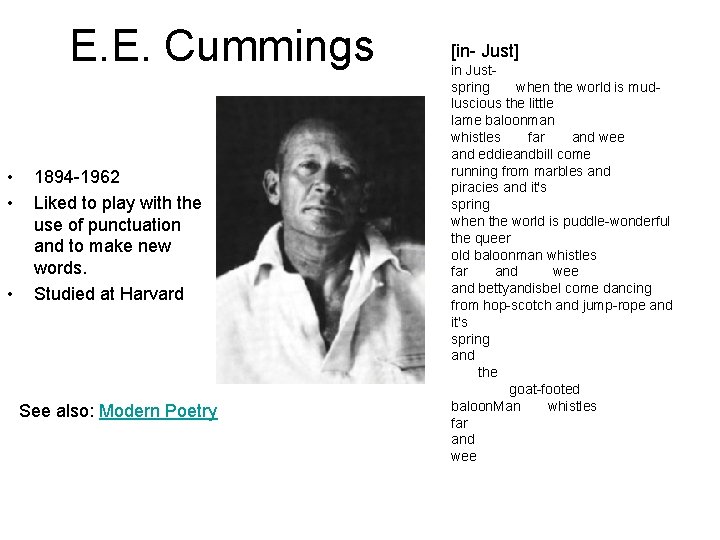
E. E. Cummings • • • 1894 -1962 Liked to play with the use of punctuation and to make new words. Studied at Harvard See also: Modern Poetry [in- Just] in Justspring when the world is mudluscious the little lame baloonman whistles far and wee and eddieandbill come running from marbles and piracies and it's spring when the world is puddle-wonderful the queer old baloonman whistles far and wee and bettyandisbel come dancing from hop-scotch and jump-rope and it's spring and the goat-footed baloon. Man whistles far and wee
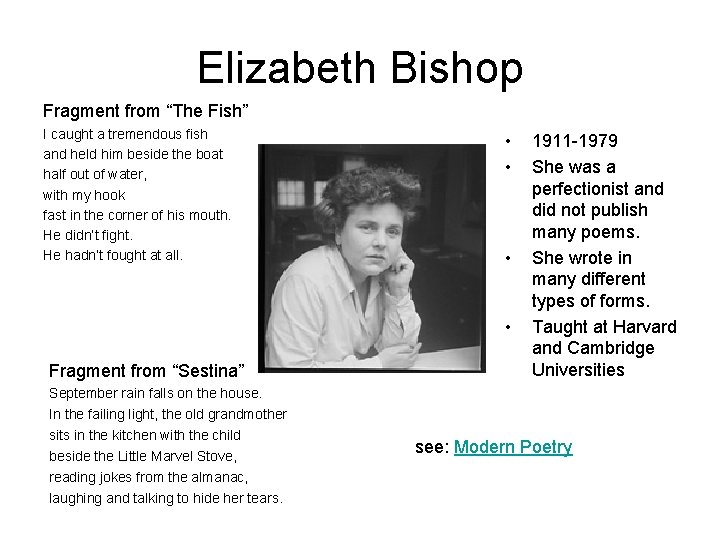
Elizabeth Bishop Fragment from “The Fish” I caught a tremendous fish and held him beside the boat half out of water, with my hook fast in the corner of his mouth. He didn’t fight. He hadn’t fought at all. • • Fragment from “Sestina” September rain falls on the house. In the failing light, the old grandmother sits in the kitchen with the child beside the Little Marvel Stove, reading jokes from the almanac, laughing and talking to hide her tears. 1911 -1979 She was a perfectionist and did not publish many poems. She wrote in many different types of forms. Taught at Harvard and Cambridge Universities see: Modern Poetry
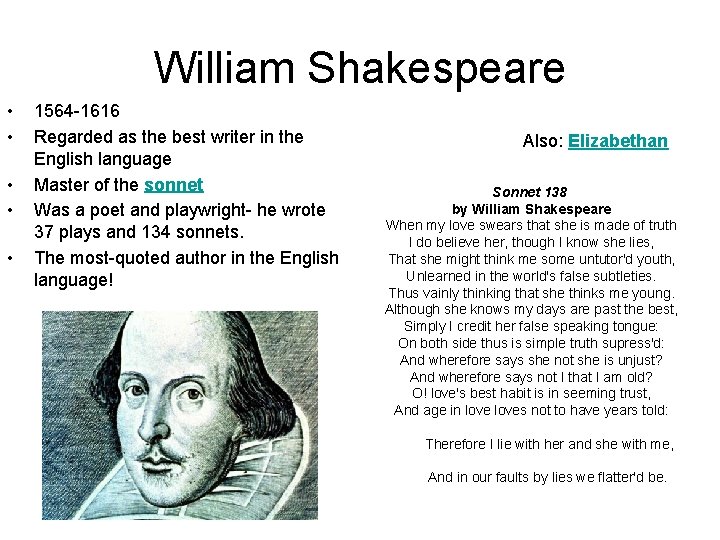
William Shakespeare • • • 1564 -1616 Regarded as the best writer in the English language Master of the sonnet Was a poet and playwright- he wrote 37 plays and 134 sonnets. The most-quoted author in the English language! Also: Elizabethan Sonnet 138 by William Shakespeare When my love swears that she is made of truth I do believe her, though I know she lies, That she might think me some untutor'd youth, Unlearned in the world's false subtleties. Thus vainly thinking that she thinks me young. Although she knows my days are past the best, Simply I credit her false speaking tongue: On both side thus is simple truth supress'd: And wherefore says she not she is unjust? And wherefore says not I that I am old? O! love's best habit is in seeming trust, And age in loves not to have years told: Therefore I lie with her and she with me, And in our faults by lies we flatter'd be.
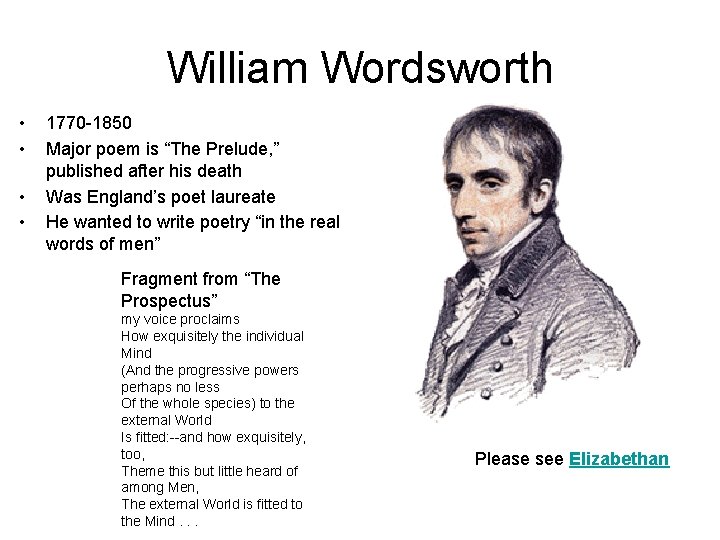
William Wordsworth • • 1770 -1850 Major poem is “The Prelude, ” published after his death Was England’s poet laureate He wanted to write poetry “in the real words of men” Fragment from “The Prospectus” my voice proclaims How exquisitely the individual Mind (And the progressive powers perhaps no less Of the whole species) to the external World Is fitted: --and how exquisitely, too, Theme this but little heard of among Men, The external World is fitted to the Mind. . . Please see Elizabethan
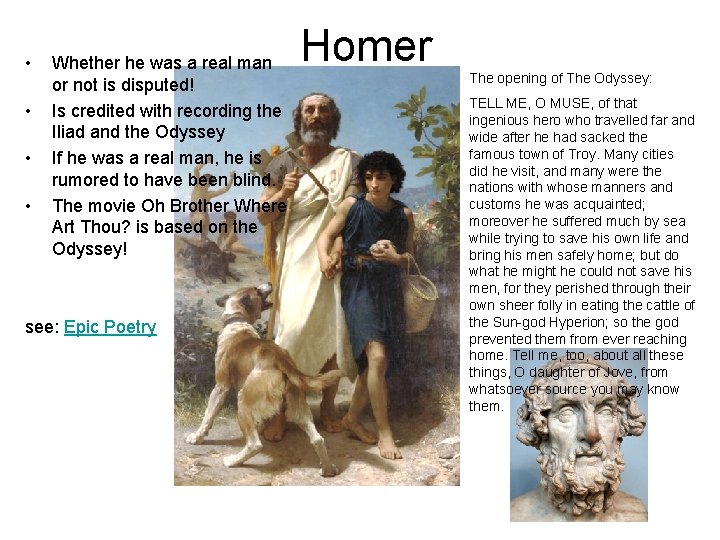
• • Whether he was a real man or not is disputed! Is credited with recording the Iliad and the Odyssey If he was a real man, he is rumored to have been blind. The movie Oh Brother Where Art Thou? is based on the Odyssey! see: Epic Poetry Homer The opening of The Odyssey: TELL ME, O MUSE, of that ingenious hero who travelled far and wide after he had sacked the famous town of Troy. Many cities did he visit, and many were the nations with whose manners and customs he was acquainted; moreover he suffered much by sea while trying to save his own life and bring his men safely home; but do what he might he could not save his men, for they perished through their own sheer folly in eating the cattle of the Sun-god Hyperion; so the god prevented them from ever reaching home. Tell me, too, about all these things, O daughter of Jove, from whatsoever source you may know them.
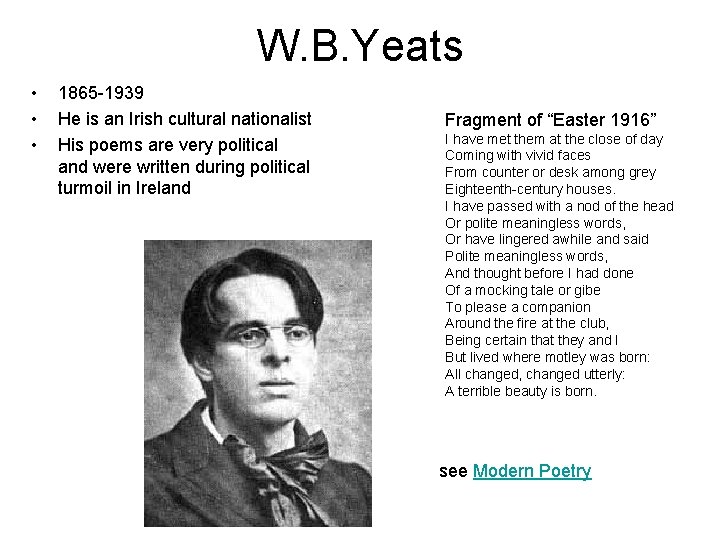
W. B. Yeats • • • 1865 -1939 He is an Irish cultural nationalist His poems are very political and were written during political turmoil in Ireland Fragment of “Easter 1916” I have met them at the close of day Coming with vivid faces From counter or desk among grey Eighteenth-century houses. I have passed with a nod of the head Or polite meaningless words, Or have lingered awhile and said Polite meaningless words, And thought before I had done Of a mocking tale or gibe To please a companion Around the fire at the club, Being certain that they and I But lived where motley was born: All changed, changed utterly: A terrible beauty is born. see Modern Poetry
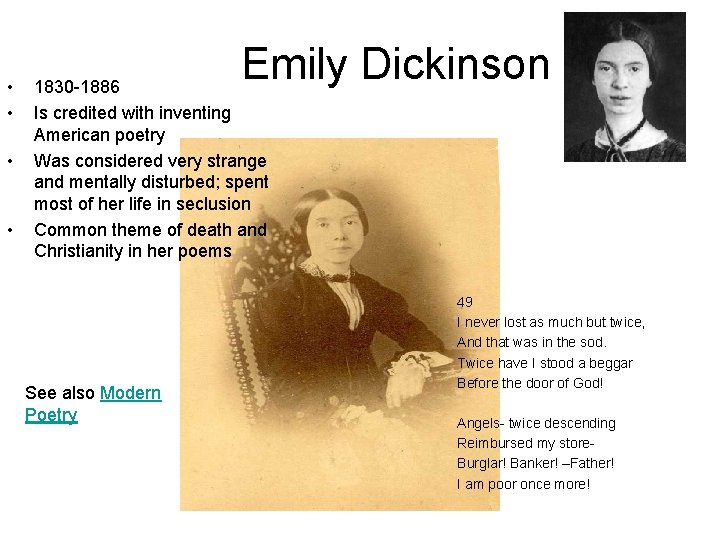
• • Emily Dickinson 1830 -1886 Is credited with inventing American poetry Was considered very strange and mentally disturbed; spent most of her life in seclusion Common theme of death and Christianity in her poems See also Modern Poetry 49 I never lost as much but twice, And that was in the sod. Twice have I stood a beggar Before the door of God! Angels- twice descending Reimbursed my store. Burglar! Banker! –Father! I am poor once more!
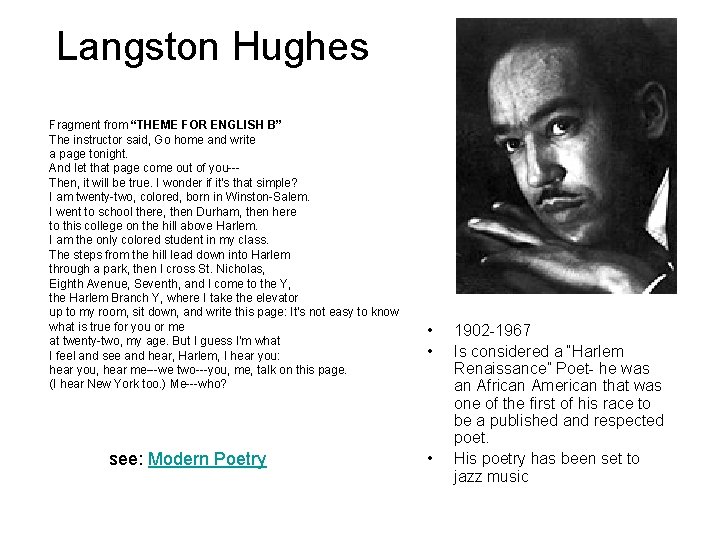
Langston Hughes Fragment from “THEME FOR ENGLISH B” The instructor said, Go home and write a page tonight. And let that page come out of you--- Then, it will be true. I wonder if it's that simple? I am twenty-two, colored, born in Winston-Salem. I went to school there, then Durham, then here to this college on the hill above Harlem. I am the only colored student in my class. The steps from the hill lead down into Harlem through a park, then I cross St. Nicholas, Eighth Avenue, Seventh, and I come to the Y, the Harlem Branch Y, where I take the elevator up to my room, sit down, and write this page: It's not easy to know what is true for you or me at twenty-two, my age. But I guess I'm what I feel and see and hear, Harlem, I hear you: hear you, hear me---we two---you, me, talk on this page. (I hear New York too. ) Me---who? see: Modern Poetry • • • 1902 -1967 Is considered a “Harlem Renaissance” Poet- he was an African American that was one of the first of his race to be a published and respected poet. His poetry has been set to jazz music
And if you’re hankering for even more information about poetry… • • • http: //en. wikipedia. org/wiki/Epic_of_Gilgamesh http: //en. wikipedia. org/wiki/Epic_poetry http: //en. wikipedia. org/wiki/Odyssey http: //en. wikipedia. org/wiki/English_poetry#The_Restoration_and_1 8 th_century http: //en. wikipedia. org/wiki/William_Wordsworth http: //en. wikipedia. org/wiki/John_Keats http: //en. wikipedia. org/wiki/William_Shakespeare http: //en. wikipedia. org/wiki/English_poetry#The_20 th_century Norton’s Anthology of Modern and Contemporary Poetry, 3 rd ed. Volumes 1 and 2 http: //en. wikipedia. org/wiki/Slam_poetry
An allegory tells a story that can be read symbolically. Interpreting an allegory is complicated because you need to be aware of what each symbol in the narrative refers to. Allegories thus reinforces symbolic meaning. Closely related to similes, metaphors immediately identify one object or idea with another, in one or more aspects. The meaning of a poem frequently depends on the success of a metaphor. Like a simile, a metaphor expands the sense and clarifies the meaning of something.
The basic definition of rhyme is two words that sound alike. The vowel sound of two words is the same, but the initial consonant sound is different. . Rhyme helps to unify a poem; it also repeats a sound that links one concept to another, thus helping to determine the structure of a poem. There are true rhymes (bear, care) and slant rhymes (lying, mine). Meter is the rhythm established by a poem, and it is usually dependent not only on the number of syllables in a line but also on the way those syllables are accented. This rhythm is often described as a pattern of stressed and unstressed syllables.
Something concrete and representational. Literal images appeal to our sense of realistic perception. There also figurative images that appeal to our imagination. Poetic imagery alters or shapes the way we see what the poem is describing. Irony refers to a difference between the way something appears and what is actually true. Irony allows us to say something but to mean something else, whether we are being sarcastic, exaggerating, or understating. Irony is generally more restrained than sarcasm, even though the effect might be the same. The key to irony is often the tone, which is sometimes harder to detect in poetry than in speech.
The word like signifies a direct comparison between two things that are alike in a certain way. Usually one of the elements of a simile is concrete and the other abstract. Sometimes similes force us to consider how the two things being compared are dissimilar, but the relationship between two dissimilar things can break down easily, so similes must be rendered delicately and carefully. A symbol works two ways: It is something itself, and it also suggests something deeper. It is crucial to distinguish a symbol from a metaphor: Metaphors are comparisons between two seemingly dissimilar things; symbols associate two things, but their meaning is both literal and figurative. No symbols have absolute meanings, and, by their nature, we cannot read them at face value. Rather than beginning an inquiry into symbols by asking what they mean, it is better to begin by asking what they could mean, or what they have meant.
Alliteration occurs when the initial sounds of a word, beginning either with a consonant or a vowel, are repeated in close succession. The function of alliteration, like rhyme, might be to accentuate the beauty of language in a given context, or to unite words or concepts through a kind of repetition. Alliteration, like rhyme, can follow specific patterns. Sometimes the consonants aren't always the initial ones, but they are generally the stressed syllables. Assonance occurs when the vowel sound within a word matches the same sound in a nearby word, but the surrounding consonant sounds are different. "Tune" and "June" are rhymes; "tune" and "food" are assonant. The function of assonance is frequently the same as end rhyme or alliteration: All serve to give a sense of continuity or fluidity to the verse.
The tone of a poem is roughly equivalent to the mood it creates in the reader. Much depends on interpretation. A poem gives its readers clues about how to feel about it. The tone may be based on a number of other conventions that the poem uses, such as meter or repetition. Tone is not in any way divorced from the other elements of poetry; it is directly dependent on them. Word order matters, sometimes for clarity of meaning, and sometimes for effect. Readers should always question why poets have chosen a particular order, whether the choice is conventional or just the opposite.
A Sonnet is a poem consisting of 14 lines (iambic pentameter) with a particular rhyming scheme. Examples of a rhyming scheme: #1) abab cdcd efef gg #2) abba cddc effe gg #3) abba cdcd cd Example: Sonnet of Demeter--Italian Sonnet Oh the pirate stars, they have no mercy! Masquerading as hope they tell their lies; Only the young can hear their lullabies. But I am barren and I am thirsty Since she has gone. No hope is there for me. I will roam and curse this earth and these skies-Death from life which Zeus sovereign denies. My heart's ill shall the whole world's illness be Till she is returned-- my daughter, my blood-From the dark hand of Hades to my care. With my tears these mortals shall know a flood To show Poseidon's realm desert and bare. No myrtle shall flower, no cypress bud Till the gods release her. . . and my despair.
Haiku (also called nature or seasonal haiku) is an unrhymed Japanese verse consisting of three unrhymed lines of five, seven, and five syllables (5, 7, 5) or 17 syllables in all. Haiku is usually written in the present tense and focuses on nature (seasons). Example: Come on let us see All the real flowers of this Sorrowful world ~Basho 1644 -1694
An Epic is a long narrative poem celebrating the adventures and achievements of a hero. . . epics deal with the traditions, mythical or historical, of a nation. Examples: Beowulf, The Iliad and the Odyssey, the Aeneid, Gilgamesh
Free Verse is an irregular form of poetry in which the content free of traditional rules of versification, (freedom from fixed meter or rhyme). In moving from line to line, the poet's main consideration is where to insert line breaks. Some ways of doing this include breaking the line where there is a natural pause or at a point of suspense for the reader. Authors: Walt Whitman, Ezra Pound, T. S. Elliot Example: “I celebrate myself, And what I assume you shall assume, For every atom belonging to me as good belongs to you. ” ~Walt Whitman, Song of Myself
A Limerick is a rhymed humorous, and or nonsense poem of five lines. With a rhyming scheme of: a-a-bb-a. Example: I love ta see the morning sun that's how I tell the days begun. Birds all singing a happy song it tis the place where I belong. Far from school without the nun
A poem in which all the lines have the same end rhyme. Example: I was sitting in my chair wanting to become a millionaire It won't happen I'm well aware but I still think its very unfair I have even said a little prayer but I don't have that special flair And my bodies in great despair I think I look more like a pear But at least I still have my hair and a table to play solitaire
A poem consisting of four lines of verse with a specific rhyming scheme. Quatrain rhyming scheme’s: #1) abab #2) abba -- envelope rhyme #3) aabb #4) aaba, bbcb, ccdc, dddd -- chain rhyme
- Slides: 28