
Poetry Anthology Revision GCSE English Literature Paper 1
![GCSE English Literature Paper 1 Shakespeare and the 19 th. Century Novel [64 marks]](https://slidetodoc.com/presentation_image_h2/44dea18f0a832316ea122a00f0fb59c2/image-2.jpg "GCSE English Literature Paper 1 Shakespeare and the 19 th. Century Novel [64 marks]")
![Paper 2 Modern Texts and Poetry 2 h 15 m [96 marks] ØSection A](https://slidetodoc.com/presentation_image_h2/44dea18f0a832316ea122a00f0fb59c2/image-3.jpg "Paper 2 Modern Texts and Poetry 2 h 15 m [96 marks] ØSection A")

- Slides: 32
Poetry Anthology Revision
GCSE English Literature Paper 1 Shakespeare and the 19 th. Century Novel [64 marks] Paper 2 Modern Texts and Poetry 2 h 15 m [96 marks] üSection A – Shakespeare (Merchant of Venice) [30 marks] ØSection B – The 19 th-century novel (The Strange Case of Dr Jekyll and Mr Hyde) [30 marks] ØSection A – modern prose or drama (Animal Farm) [34 marks] ØSection B – Poetry (anthology) [30 marks] A 01 =12 A 02=12 A 03=6 ØSection C – Unseen poetry [32 marks]
Paper 2 Modern Texts and Poetry 2 h 15 m [96 marks] ØSection A – modern prose or drama (Animal Farm) [34 marks] ØSection B – Poetry (anthology) [30 marks] A 01 =12 A 02=12 A 03=6 ØSection C – Unseen poetry [32 marks] Q 1 = 24 marks A 01=12 A 02=12 Q 2 = 8 marks A 02=8 MUST BE COMPARATIVE
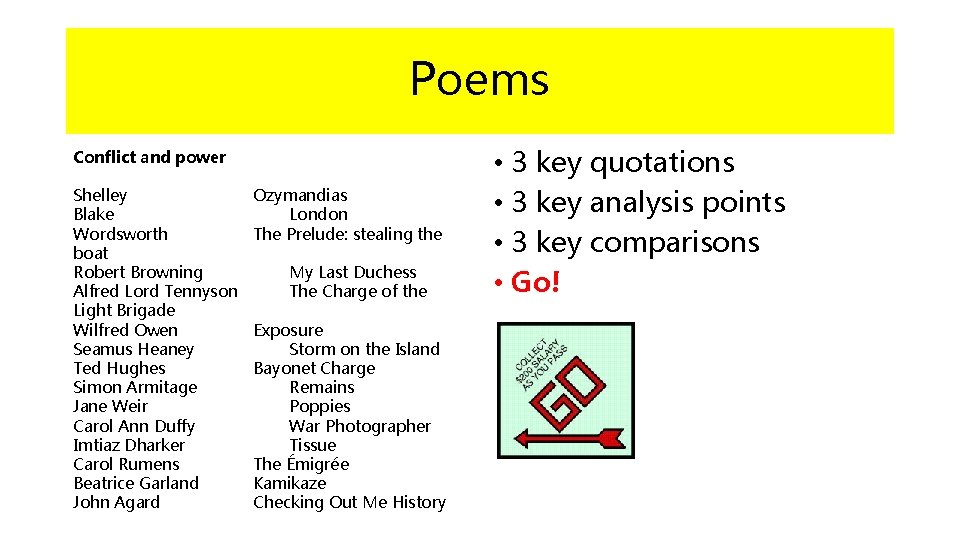
Poems Conflict and power Shelley Blake Wordsworth boat Robert Browning Alfred Lord Tennyson Light Brigade Wilfred Owen Seamus Heaney Ted Hughes Simon Armitage Jane Weir Carol Ann Duffy Imtiaz Dharker Carol Rumens Beatrice Garland John Agard Ozymandias London The Prelude: stealing the My Last Duchess The Charge of the Exposure Storm on the Island Bayonet Charge Remains Poppies War Photographer Tissue The Émigrée Kamikaze Checking Out Me History • 3 key quotations • 3 key analysis points • 3 key comparisons • Go!
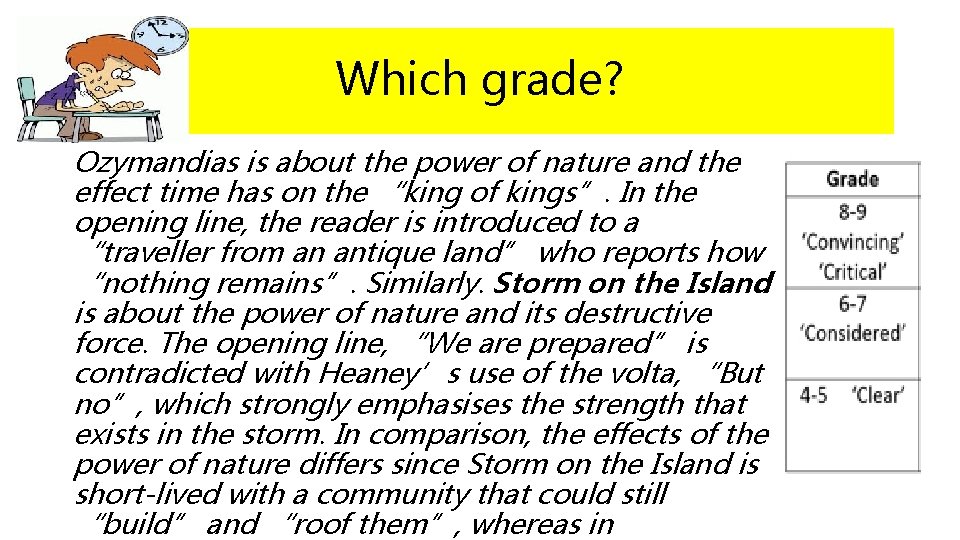
Which grade? Ozymandias is about the power of nature and the effect time has on the “king of kings”. In the opening line, the reader is introduced to a “traveller from an antique land” who reports how “nothing remains”. Similarly. Storm on the Island is about the power of nature and its destructive force. The opening line, “We are prepared” is contradicted with Heaney’s use of the volta, “But no”, which strongly emphasises the strength that exists in the storm. In comparison, the effects of the power of nature differs since Storm on the Island is short-lived with a community that could still “build” and “roof them”, whereas in
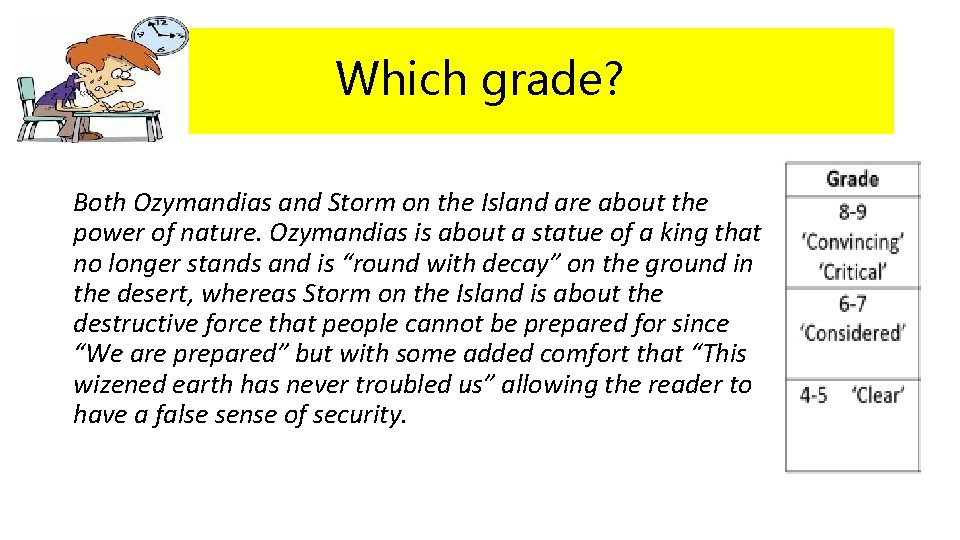
Which grade? Both Ozymandias and Storm on the Island are about the power of nature. Ozymandias is about a statue of a king that no longer stands and is “round with decay” on the ground in the desert, whereas Storm on the Island is about the destructive force that people cannot be prepared for since “We are prepared” but with some added comfort that “This wizened earth has never troubled us” allowing the reader to have a false sense of security.
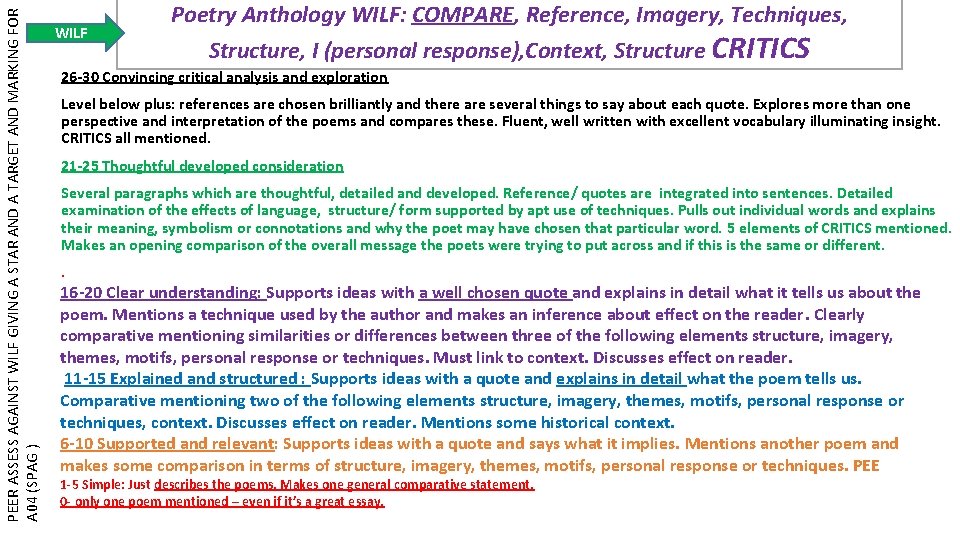
PEER ASSESS AGAINST WILF GIVING A STAR AND A TARGET AND MARKING FOR A 04 (SPAG ) WILF Poetry Anthology WILF: COMPARE, Reference, Imagery, Techniques, Structure, I (personal response), Context, Structure CRITICS 26 -30 Convincing critical analysis and exploration Level below plus: references are chosen brilliantly and there are several things to say about each quote. Explores more than one perspective and interpretation of the poems and compares these. Fluent, well written with excellent vocabulary illuminating insight. CRITICS all mentioned. 21 -25 Thoughtful developed consideration Several paragraphs which are thoughtful, detailed and developed. Reference/ quotes are integrated into sentences. Detailed examination of the effects of language, structure/ form supported by apt use of techniques. Pulls out individual words and explains their meaning, symbolism or connotations and why the poet may have chosen that particular word. 5 elements of CRITICS mentioned. Makes an opening comparison of the overall message the poets were trying to put across and if this is the same or different. . 16 -20 Clear understanding: Supports ideas with a well chosen quote and explains in detail what it tells us about the poem. Mentions a technique used by the author and makes an inference about effect on the reader. Clearly comparative mentioning similarities or differences between three of the following elements structure, imagery, themes, motifs, personal response or techniques. Must link to context. Discusses effect on reader. 11 -15 Explained and structured : Supports ideas with a quote and explains in detail what the poem tells us. Comparative mentioning two of the following elements structure, imagery, themes, motifs, personal response or techniques, context. Discusses effect on reader. Mentions some historical context. 6 -10 Supported and relevant: Supports ideas with a quote and says what it implies. Mentions another poem and makes some comparison in terms of structure, imagery, themes, motifs, personal response or techniques. PEE 1 -5 Simple: Just describes the poems. Makes one general comparative statement. 0 - only one poem mentioned – even if it’s a great essay.
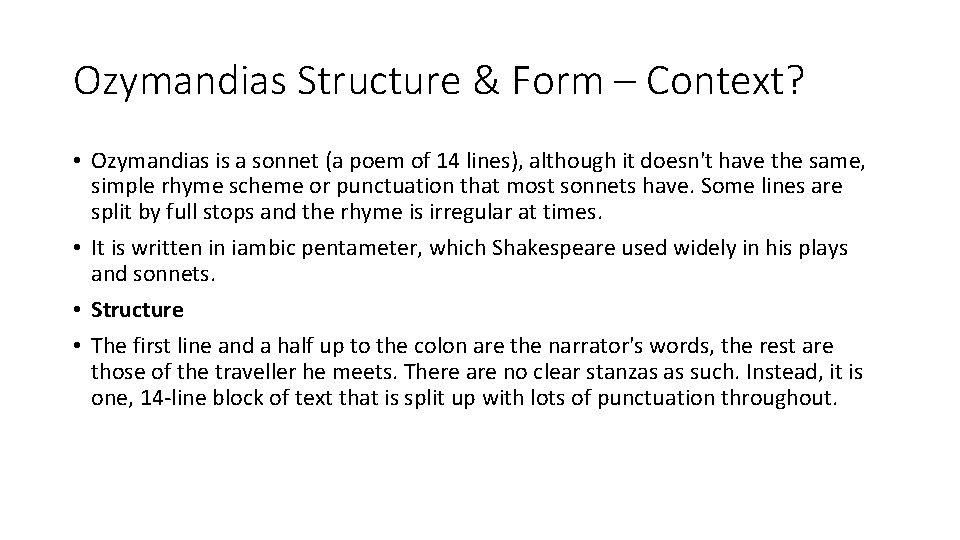
Ozymandias Structure & Form – Context? • Ozymandias is a sonnet (a poem of 14 lines), although it doesn't have the same, simple rhyme scheme or punctuation that most sonnets have. Some lines are split by full stops and the rhyme is irregular at times. • It is written in iambic pentameter, which Shakespeare used widely in his plays and sonnets. • Structure • The first line and a half up to the colon are the narrator's words, the rest are those of the traveller he meets. There are no clear stanzas as such. Instead, it is one, 14 -line block of text that is split up with lots of punctuation throughout.
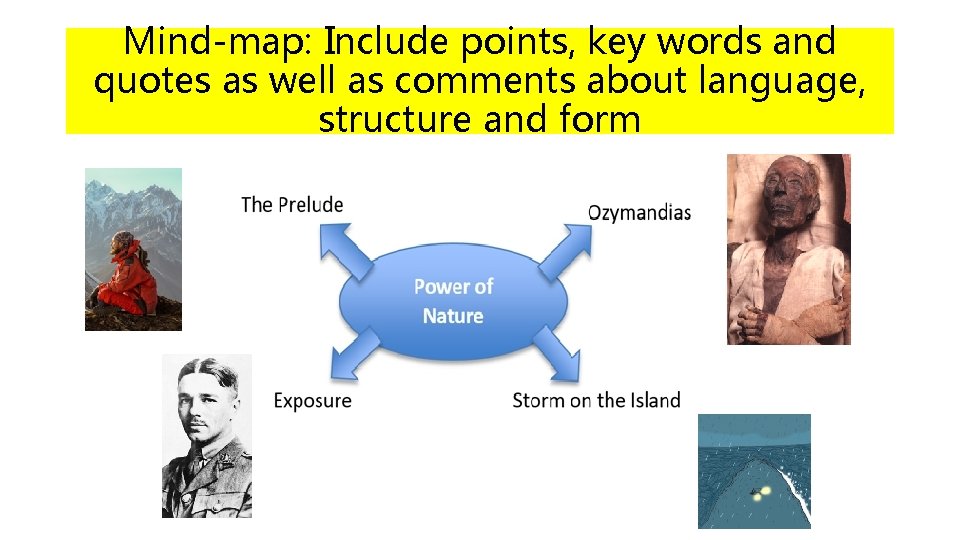
Mind-map: Include points, key words and quotes as well as comments about language, structure and form
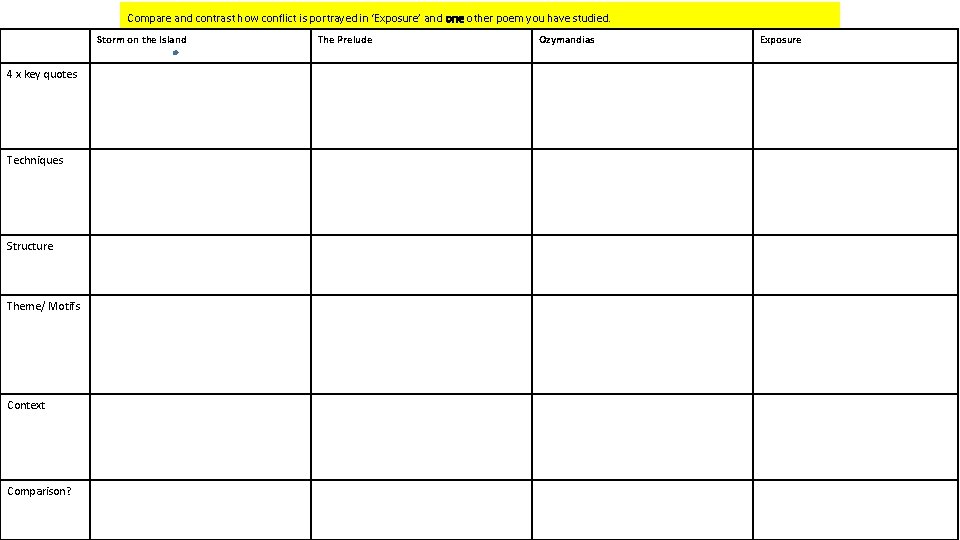
Compare and contrast how conflict is portrayed in ‘Exposure’ and one other poem you have studied. Storm on the Island 4 x key quotes Techniques Structure Theme/ Motifs Context Comparison? The Prelude Ozymandias Exposure
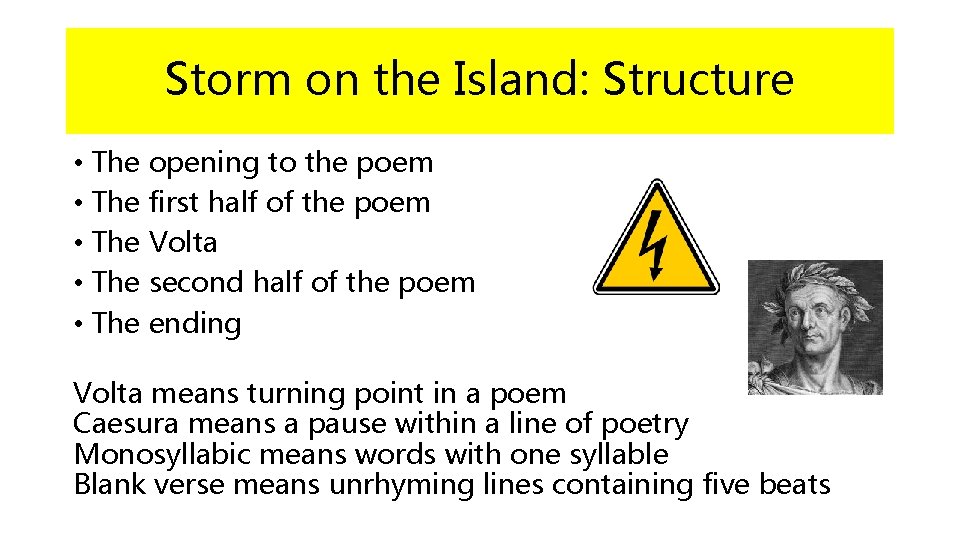
Storm on the Island: Structure • The opening to the poem • The first half of the poem • The Volta • The second half of the poem • The ending Volta means turning point in a poem Caesura means a pause within a line of poetry Monosyllabic means words with one syllable Blank verse means unrhyming lines containing five beats
Seamus Heaney • Seamus Heaney is widely recognized as one of the major poets of the 20 th century. A native of Northern Ireland, Heaney was raised in County Derry and spent much of his life living in Dublin, Southern Ireland. • He won the Nobel Prize for Literature in 1995 "for works of lyrical beauty and ethical depth, which exalt everyday miracles and the living past. ” • As a poet from Northern Ireland, Heaney used his work to reflect upon the "Troubles, " the oftenviolent political struggles that plagued the country during Heaney’s young adulthood. The poet sought to weave the ongoing Irish troubles into a broader historical frame embracing the general human situation.
The Prelude
Poetic form Why blank verse? • Unrhyming lines • Five beats (iambic pentameter) • Used by Shakespeare a lot • Mimics natural ‘de dum’ rhythm of speech • Mimics heartbeat Why first person? Where is the volta? Highlight positive and negative images in different colours to identify the volta
Context: A 03 Romanticism • William Wordsworth (1770 -1850) is one of the most famous poets in the history of English Literature. He was born in Cockermouth in Cumbria, in the Lake District. He came to believe in a kind of PANTHEISM where nature represented god and his works (rather than organised religions like Christianity). • He went to Cambridge University and from there he set off on a walking tour of Europe, coming into contact with the French Revolution. He fell in love with a French woman and she had a child.
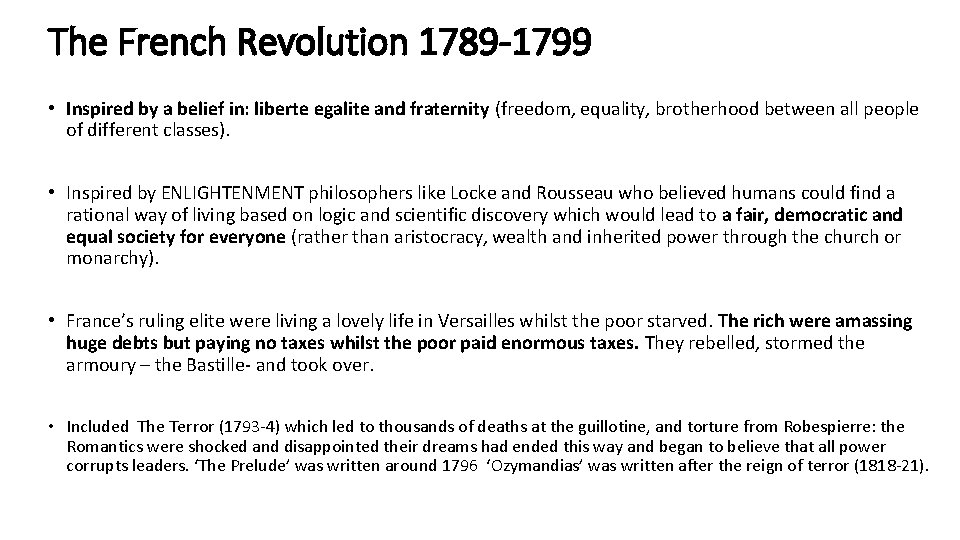
The French Revolution 1789 -1799 • Inspired by a belief in: liberte egalite and fraternity (freedom, equality, brotherhood between all people of different classes). • Inspired by ENLIGHTENMENT philosophers like Locke and Rousseau who believed humans could find a rational way of living based on logic and scientific discovery which would lead to a fair, democratic and equal society for everyone (rather than aristocracy, wealth and inherited power through the church or monarchy). • France’s ruling elite were living a lovely life in Versailles whilst the poor starved. The rich were amassing huge debts but paying no taxes whilst the poor paid enormous taxes. They rebelled, stormed the armoury – the Bastille- and took over. • Included The Terror (1793 -4) which led to thousands of deaths at the guillotine, and torture from Robespierre: the Romantics were shocked and disappointed their dreams had ended this way and began to believe that all power corrupts leaders. ‘The Prelude’ was written around 1796 ‘Ozymandias’ was written after the reign of terror (1818 -21).
Samuel Taylor Coleridge stayed with Wordsworth and his sister Dorothy in 1796. They worked together on poems which became the collection called Lyrical Ballads, published two years later. This volume is a key text in the school of poetry known as 'The Romantics'. “Poetry is the spontaneous overflow of powerful feelings: it takes its origin from emotion recollected in tranquility. ”
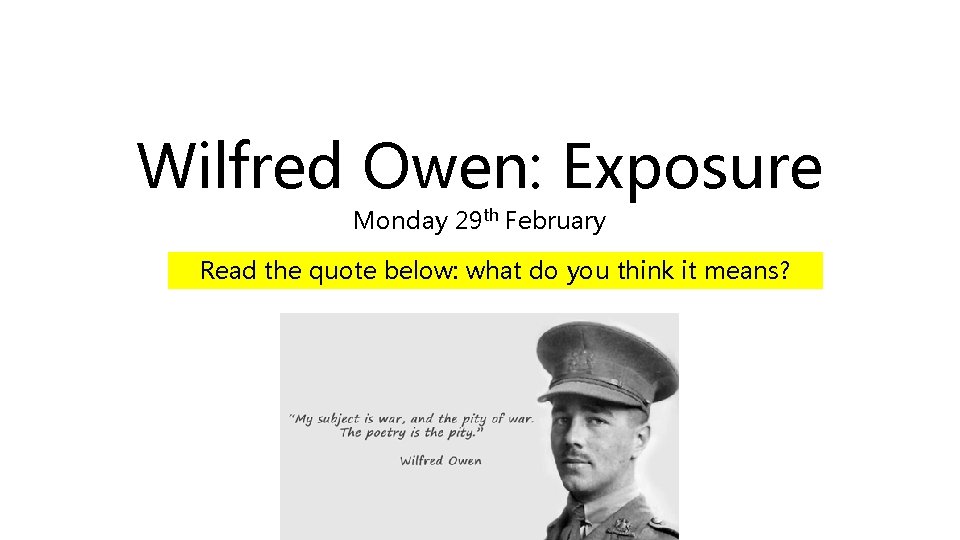
Wilfred Owen: Exposure Monday 29 th February Read the quote below: what do you think it means?
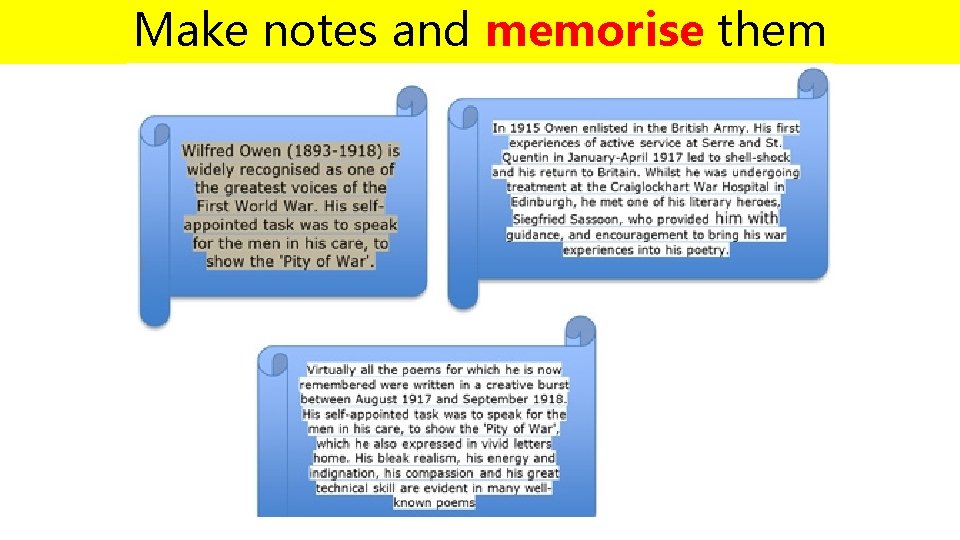
Make notes and memorise them
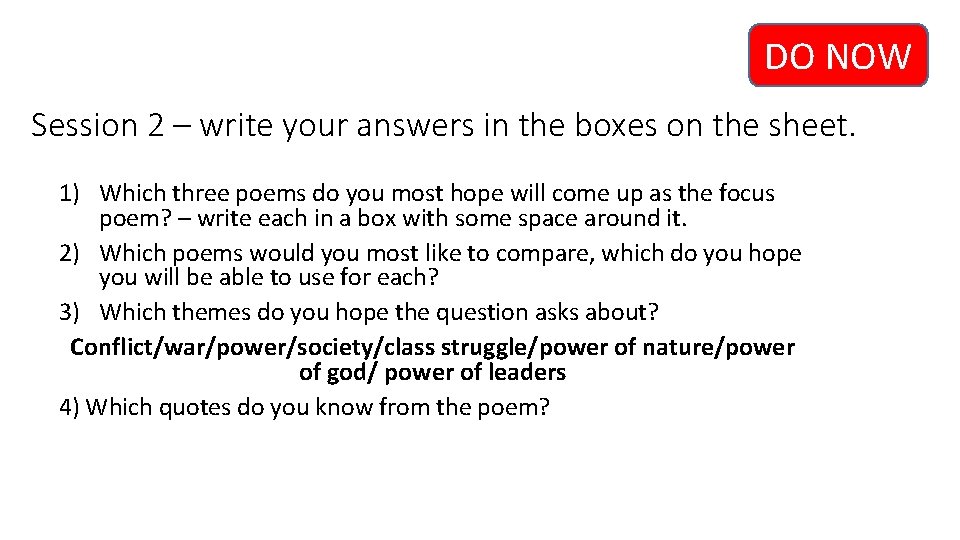
DO NOW Session 2 – write your answers in the boxes on the sheet. 1) Which three poems do you most hope will come up as the focus poem? – write each in a box with some space around it. 2) Which poems would you most like to compare, which do you hope you will be able to use for each? 3) Which themes do you hope the question asks about? Conflict/war/power/society/class struggle/power of nature/power of god/ power of leaders 4) Which quotes do you know from the poem?
1)Focus 2)Comparison Poem 3) 4)
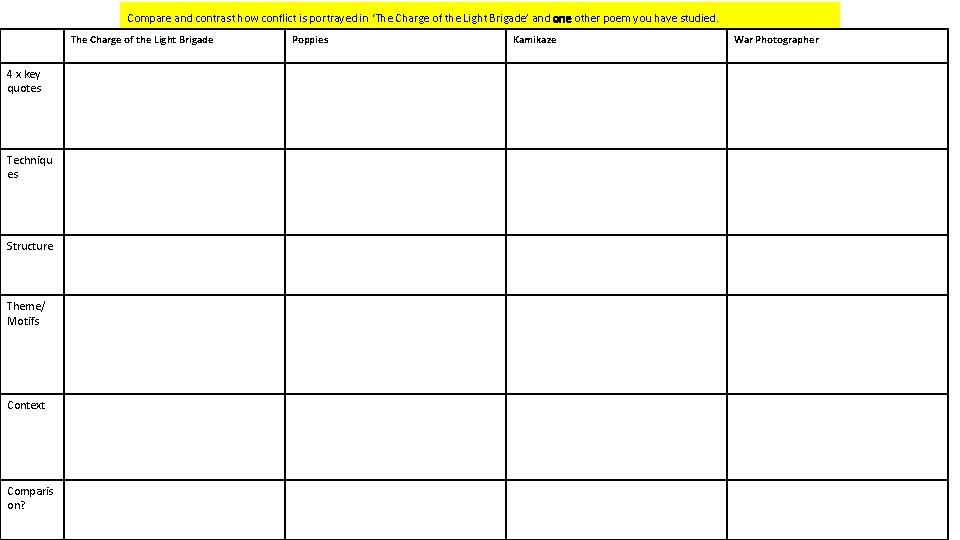
Compare and contrast how conflict is portrayed in ‘The Charge of the Light Brigade’ and one other poem you have studied. The Charge of the Light Brigade 4 x key quotes Techniqu es Structure Theme/ Motifs Context Comparis on? Poppies Kamikaze War Photographer
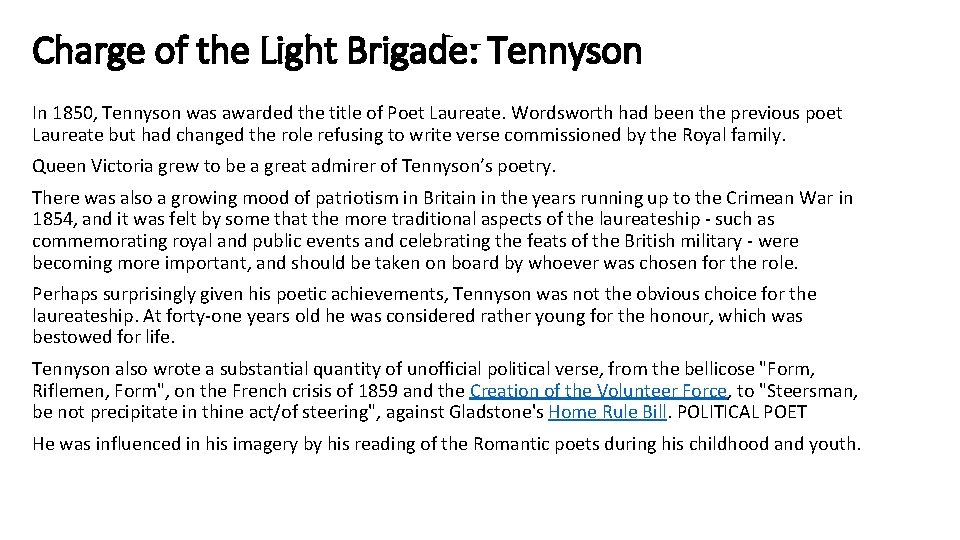
Charge of the Light Brigade: Tennyson In 1850, Tennyson was awarded the title of Poet Laureate. Wordsworth had been the previous poet Laureate but had changed the role refusing to write verse commissioned by the Royal family. Queen Victoria grew to be a great admirer of Tennyson’s poetry. There was also a growing mood of patriotism in Britain in the years running up to the Crimean War in 1854, and it was felt by some that the more traditional aspects of the laureateship - such as commemorating royal and public events and celebrating the feats of the British military - were becoming more important, and should be taken on board by whoever was chosen for the role. Perhaps surprisingly given his poetic achievements, Tennyson was not the obvious choice for the laureateship. At forty-one years old he was considered rather young for the honour, which was bestowed for life. Tennyson also wrote a substantial quantity of unofficial political verse, from the bellicose "Form, Riflemen, Form", on the French crisis of 1859 and the Creation of the Volunteer Force, to "Steersman, be not precipitate in thine act/of steering", against Gladstone's Home Rule Bill. POLITICAL POET He was influenced in his imagery by his reading of the Romantic poets during his childhood and youth.
Context: the Crimean War • The Crimean War was fought between Britain and Imperial Russia from 1853 -1856. For the first time in history, newspapers carried eye-witness reports as well as detailing not just the triumphs of war but the mistakes and horrors as well. • The most significant moment in the Crimea came during the Battle of Balaclava. An order given to the British army's cavalry division (known as the Light Brigade) was misunderstood and 600 cavalrymen ended charging down a narrow valley straight into the fire of Russian cannons. Over 150 British soldiers were killed, and more than 120 were wounded. At home the news of the disaster was a sensation and a nation that had until then embraced British military exploits abroad began to question the politicians and generals who led them. http: //www. bbc. co. uk/schools/gcsebitesize/english_literature/poetryconflict/chargelightbrigade 2. shtml STRUCTURE: This poem is comprised of six numbered stanzas varying in length from six to twelve lines. Each line is in dimeter, which means it has two stressed syllables; moreover, each stressed syllable is followed by two unstressed syllables, making the rhythm dactylic. The use of “falling” rhythm, in which the stress is on the first beat of each metrical unit, and then “falls off” for the rest of the length of the meter, is appropriate in a poem about the devastating fall of the British brigade. The rhyme scheme varies with each stanza. Often, Tennyson uses the same rhyme (and occasionally even the same final word) for several consecutive lines: “Flashed all their sabres bare / Flashed as they turned in air / Sab’ring the gunners there. ” The poem also makes use of anaphora, in which the same word is repeated at the beginning of several consecutive lines: “Cannon to right of them / Cannon to left of them / Cannon in front of them. ” Here the method creates a sense of unrelenting assault; at each line our eyes meet the word “cannon, ” just as the soldiers meet their flying shells at each turn.
Poppies: Structure • 19 lines out of 35 have breaks in the middle of the lines - marked by commas or more strongly by full-stops. These breaks are called caesuras. • This careful variation in form suggests the inner emotion of a narrator who is trying to remain calm and composed but is breaking with sadness inside. • The biggest movement in the poem, however, is in the narrative structure – how the story is told. The time sequence keeps changing along with her emotions. It goes from "Three days before" (line 1) to "Before you left" (line 3) to "After you'd gone" (line 23) to "later" (line 25) and the present in "this is where it has led me" on line 26. It ends with her suspended, on the hill, between the present and the past.
• 'Poppies: ‘Weir grew up in Northern England Italy. She is a textile designer. • Jane Weir's poems are made and measured dreamcoats. They are exquisite garments which clothes and enfold us in her imagination. ’ Simon Armitage • Weir’s poem ‘Poppies’ was commissioned by Duffy as part of a collection of ten contemporary war poems which were published in the Guardian in 2009, as part of a response to the escalating conflict in Afghanistan and the Iraq inquiry. • Weir describes being surprised by the ‘overwhelming response’ she had from readers across Europe to ‘Poppies’. Many of the readers who contacted her were mothers of soldiers killed in action in recent conflicts. She commented in an interview that, ‘I wrote the piece from a woman's perspective, which is quite rare, as most poets who write about war have been men. As the mother of two teenage boys, I tried to put across how I might feel if they were fighting in a war zone. ’ • Weir has acknowledged that ‘A lot of my poems are narrative driven or scenarios’, and in ‘Poppies’ she tells the ‘story’ of a mother’s experience of pain and loss as her son leaves home to go to war. She has indicated that: ‘I was subliminally thinking of Susan Owen [mother of Wilfred]… and families of soldiers killed in any war when I wrote this poem. This poem attempts on one level to address female experience and is consciously a political act. ’ Weir has commented that she likes the adventure of ‘cross dressing’ in terms of her use of language, often borrowing from the ‘language of other genres, be it fashion, art… and so on’. This is apparent in ‘Poppies’ where the tactile language of fashion and textiles seems to permeate the text. Her poems have been described as ‘multi-sensory explosions’.
Kamikaze
Kamikaze Structure Narrative poem with no formal structure. 6 stanzas 3 sentences and only 3 full-stops Shifts in speakers and shifts in time across the stanzas. The story is recounted in one voice but the ending gives someone else’s words directly.
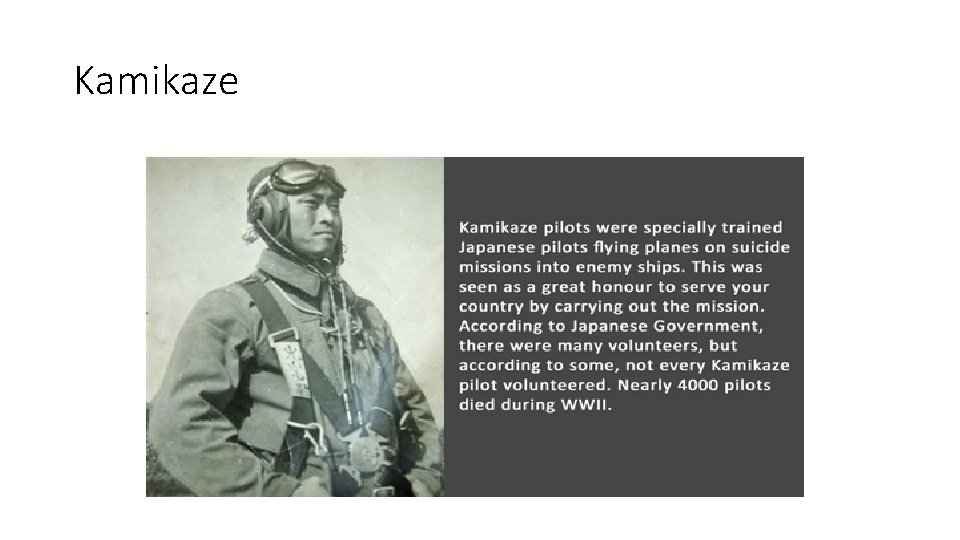
Beatrice Garland Female writer: female perspective from the daughter of the pilot. Garland said: ‘I spend a lot of the day listening to other people’s worlds’ Consider how the poem reflects contemporary debates about dying for your country and the role of ‘suicide missions’ in our culture. Garland has no links to Japan or to WW 1 – this poem is not about her own experiences. Kamikaze Pilots: Kamikaze means literally: divine wind
Keywords Embarked = left Incantations = spells Bunting= those triangles they hang at parties Translucent = see through Swathes = thick strokes Shoals = groups of fishes Cairns = stone piles Breakers = waves breaking on the shore http: //www. bbc. co. uk/news/magazine-26256048
War Photographer Structure: conventional stanzas (rhymed iambic lines); each ends with couplet, as if to conclude argument. Poem moves from series of observations to a clear conclusion. How does this reflect themes?
Carol Ann Duffy – War Photographer • Duffy was inspired to write this poem by her friendship with a war photographer. She was especially intrigued by the peculiar challenge faced by these people whose job requires them to record terrible, horrific events without being able to directly help their subjects. • Duffy perhaps shares an affinity with these photojournalists - while they use the medium of photography to convey certain truths about the human condition, she uses words and poetry. Dame Carol Ann Duffy DBE FRSL is a Scottish poet and playwright. She is Professor of Contemporary Poetry at Manchester Metropolitan University, and was appointed Britain's Poet Laureate in May 2009. She is the first woman, the first Scot, and the first openly LGBT person to hold the position. Duffy has been quoted as saying that she is ‘not interested, as a poet, in words like “plash” – Seamus Heaney words, interesting words. I like to use simple words, but in a complicated way’; and in the same Guardian profile, ‘Childhood is like a long greenhouse where everything is growing, it's lush and steamy. It's where poems come from’ (31 August 2002).