
Poetry ancient Greek poieo I create Words formed


- Slides: 47
Poetry ancient Greek: ποιεω (poieo) = I create Words formed together to display a vivid picture and evoke an emotion Figurative language is use often in poetry.
Key elements (parts) to poetry • Stanzas are a series of lines grouped together and separated by an empty line from other stanzas. They are the equivalent of a paragraph in an essay. One way to identify a stanza is to count the number of lines. • Rhyme is the repetition of similar word sounds. In poetry, the most common kind of rhyme is the end rhyme. • Rhythm is the sound pattern in the poem- almost written to a beat. However, most modern poetry no longer follows strict rules of meter or rhyme. • Figurative Language is used to give a creative edge and paint a mental picture for readers: Alliteration, Simile, Metaphor, Onomatopoeia, Personification.
Where can you find poems? • David wrote the book of Psalms, which is FULL of poetry! • Children’s books like Dr. Seuss! • Music! Just listen… Jamie Grace- Beautiful Day I Give My Hallelujah
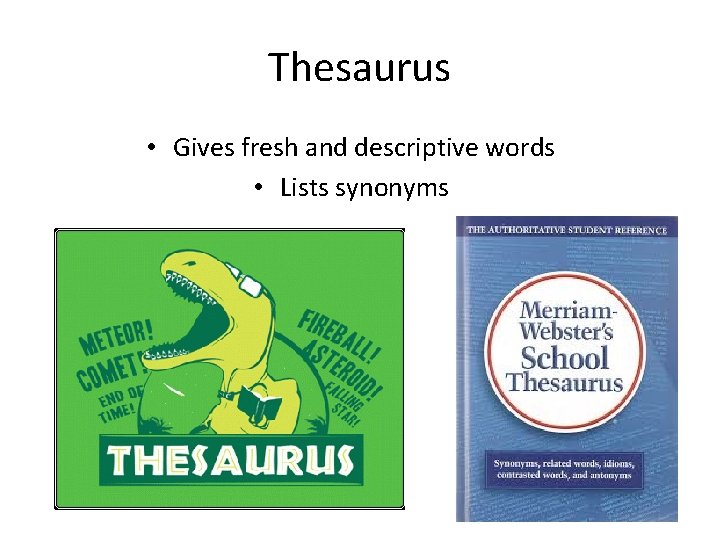
Thesaurus • Gives fresh and descriptive words • Lists synonyms
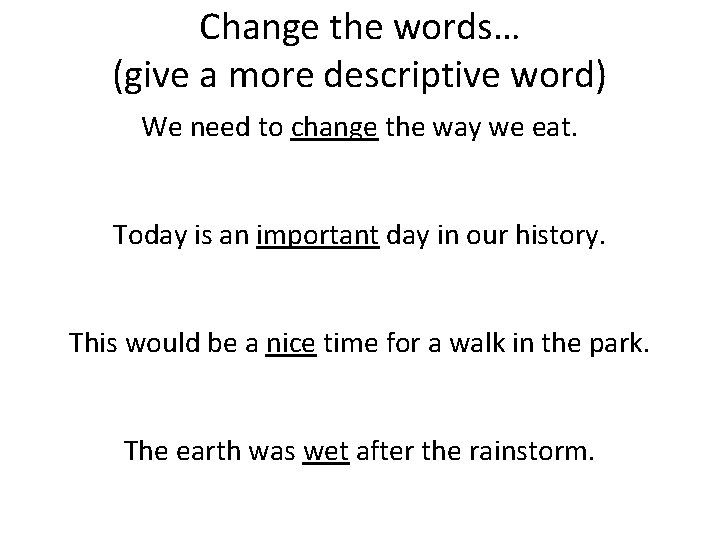
Change the words… (give a more descriptive word) We need to change the way we eat. Today is an important day in our history. This would be a nice time for a walk in the park. The earth was wet after the rainstorm.
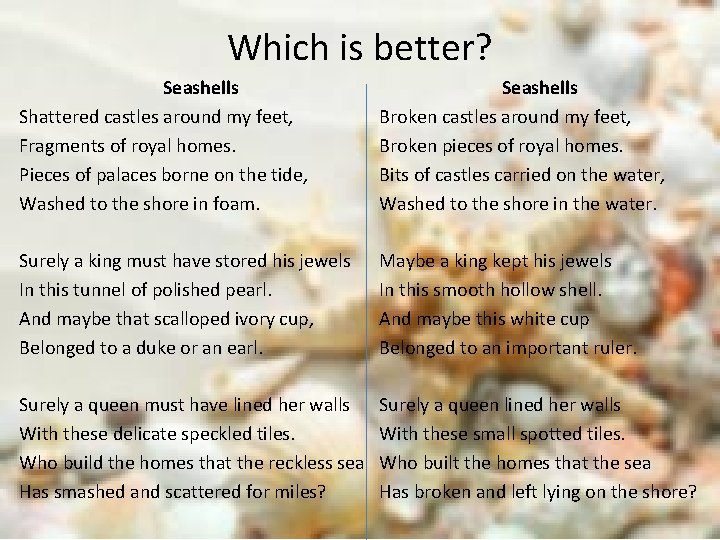
Which is better? Seashells Shattered castles around my feet, Fragments of royal homes. Pieces of palaces borne on the tide, Washed to the shore in foam. Seashells Broken castles around my feet, Broken pieces of royal homes. Bits of castles carried on the water, Washed to the shore in the water. Surely a king must have stored his jewels In this tunnel of polished pearl. And maybe that scalloped ivory cup, Belonged to a duke or an earl. Maybe a king kept his jewels In this smooth hollow shell. And maybe this white cup Belonged to an important ruler. Surely a queen must have lined her walls With these delicate speckled tiles. Who build the homes that the reckless sea Has smashed and scattered for miles? Surely a queen lined her walls With these small spotted tiles. Who built the homes that the sea Has broken and left lying on the shore?
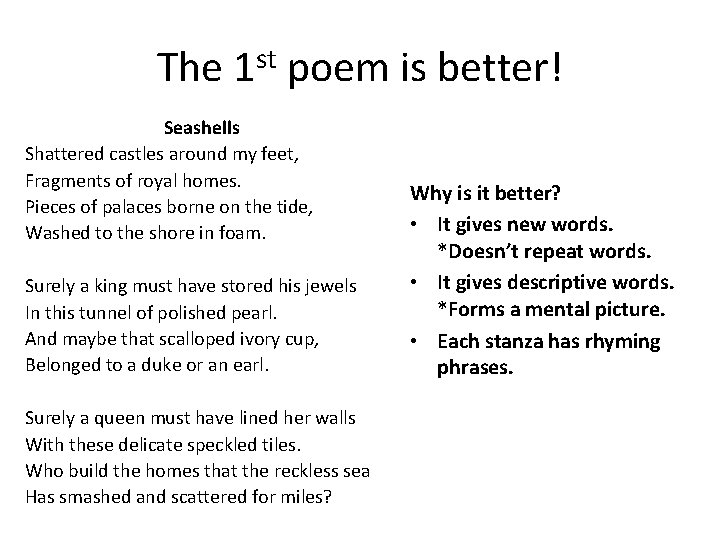
The 1 st poem is better! Seashells Shattered castles around my feet, Fragments of royal homes. Pieces of palaces borne on the tide, Washed to the shore in foam. Surely a king must have stored his jewels In this tunnel of polished pearl. And maybe that scalloped ivory cup, Belonged to a duke or an earl. Surely a queen must have lined her walls With these delicate speckled tiles. Who build the homes that the reckless sea Has smashed and scattered for miles? Why is it better? • It gives new words. *Doesn’t repeat words. • It gives descriptive words. *Forms a mental picture. • Each stanza has rhyming phrases.
Recitation What does “recitation” mean? to recite orally from memory Orally- out loud From memory- no notes/memorize Your assignment: *Look at Recitation directions/rubric on blog
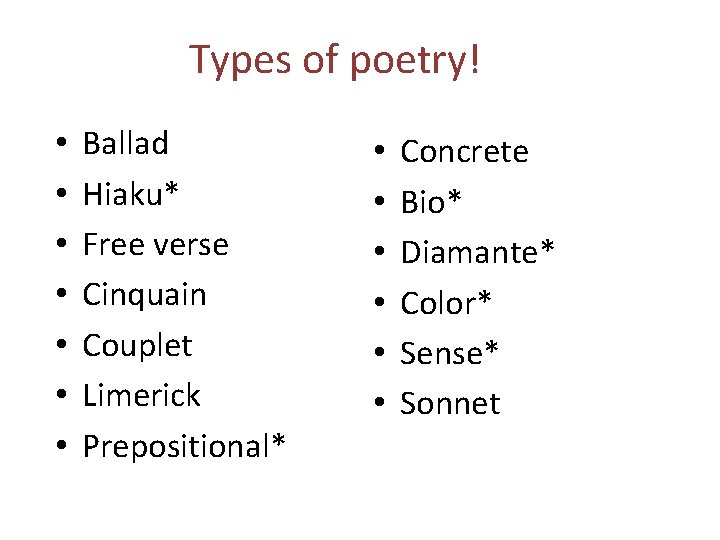
Types of poetry! • • Ballad Hiaku* Free verse Cinquain Couplet Limerick Prepositional* • • • Concrete Bio* Diamante* Color* Sense* Sonnet
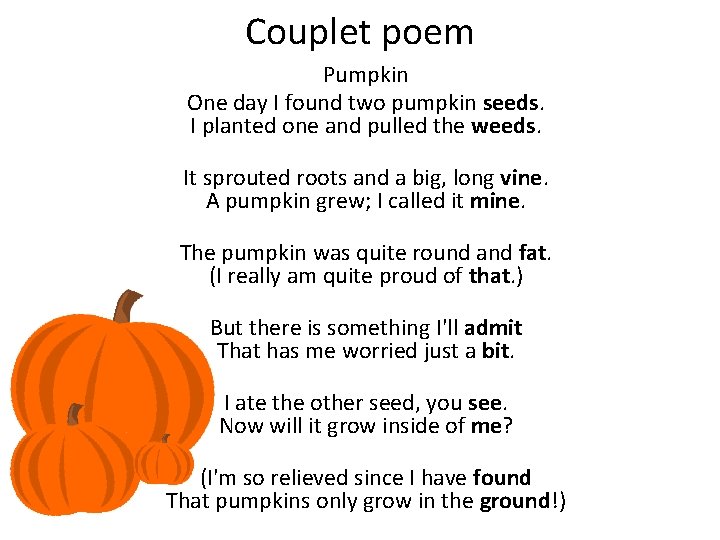
Couplet poem Pumpkin One day I found two pumpkin seeds. I planted one and pulled the weeds. It sprouted roots and a big, long vine. A pumpkin grew; I called it mine. The pumpkin was quite round and fat. (I really am quite proud of that. ) But there is something I'll admit That has me worried just a bit. I ate the other seed, you see. Now will it grow inside of me? (I'm so relieved since I have found That pumpkins only grow in the ground!)
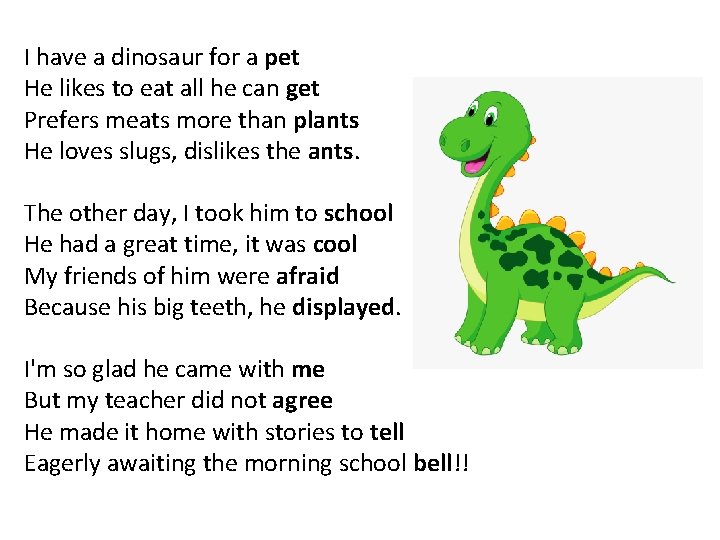
I have a dinosaur for a pet He likes to eat all he can get Prefers meats more than plants He loves slugs, dislikes the ants. The other day, I took him to school He had a great time, it was cool My friends of him were afraid Because his big teeth, he displayed. I'm so glad he came with me But my teacher did not agree He made it home with stories to tell Eagerly awaiting the morning school bell!!
Your turn! Write a couplet. Step 1: Pick a topic. Step 2: Brainstorm a list of rhyming words at the top of your journal paper. Step 3: Begin your couplet poem. As you write, be sure the ending words rhyme and each line has the same number of syllables. Step 4: Complete 4 stanzas. (8 lines total)
Diamanté Poetry • Forms the shape of a diamond • Has a specific order • Has 7 lines • Uses parts of speech • Contrasts two ideas
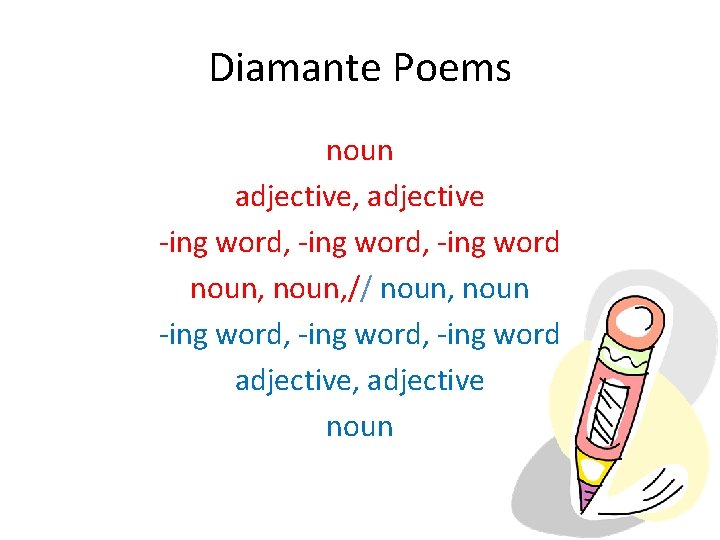
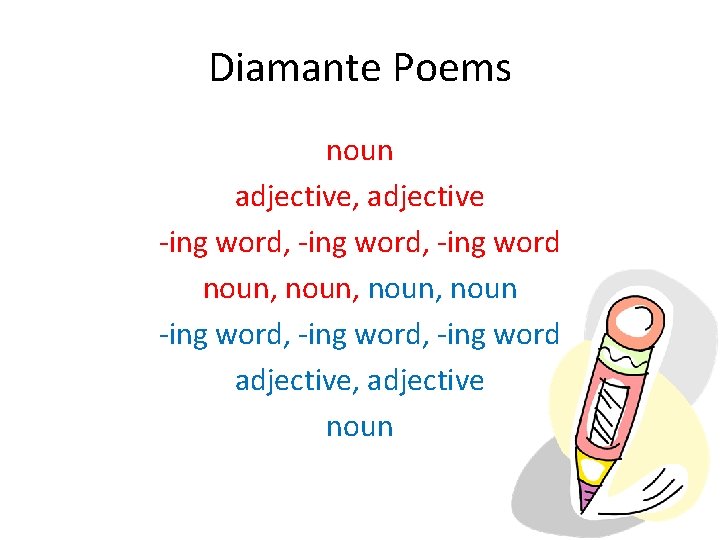
Diamante Poems noun adjective, adjective -ing word, -ing word noun, // noun, noun -ing word, -ing word adjective, adjective noun
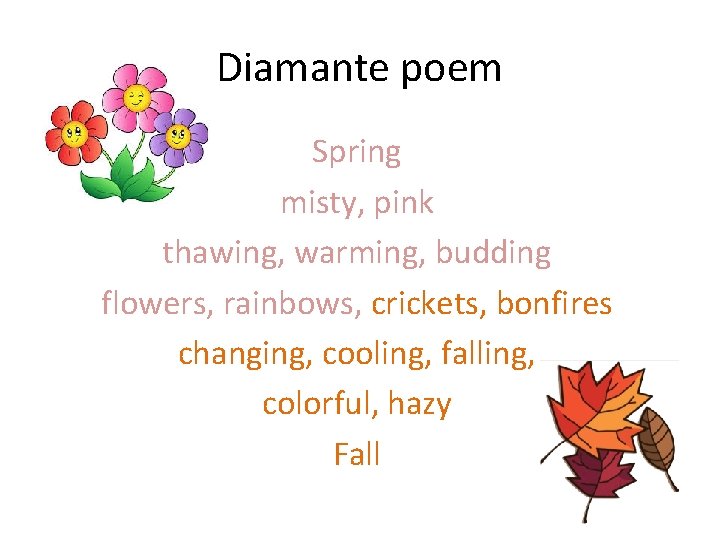
Diamante poem Spring misty, pink thawing, warming, budding flowers, rainbows, crickets, bonfires changing, cooling, falling, colorful, hazy Fall
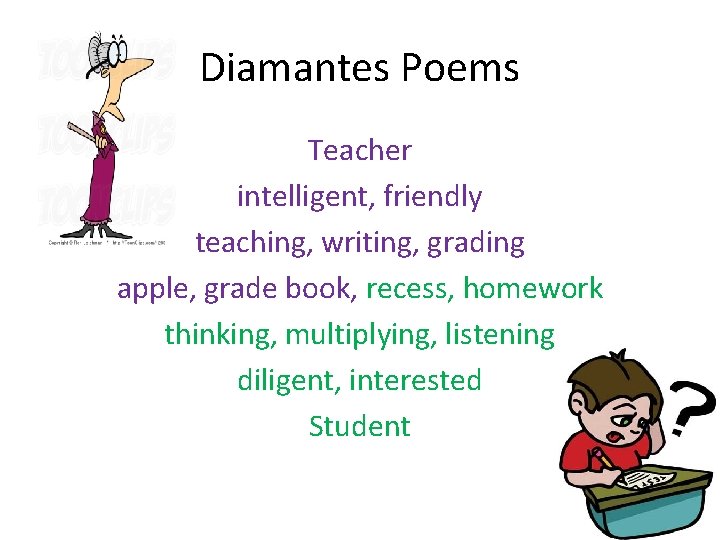
Diamantes Poems Teacher intelligent, friendly teaching, writing, grading apple, grade book, recess, homework thinking, multiplying, listening diligent, interested Student
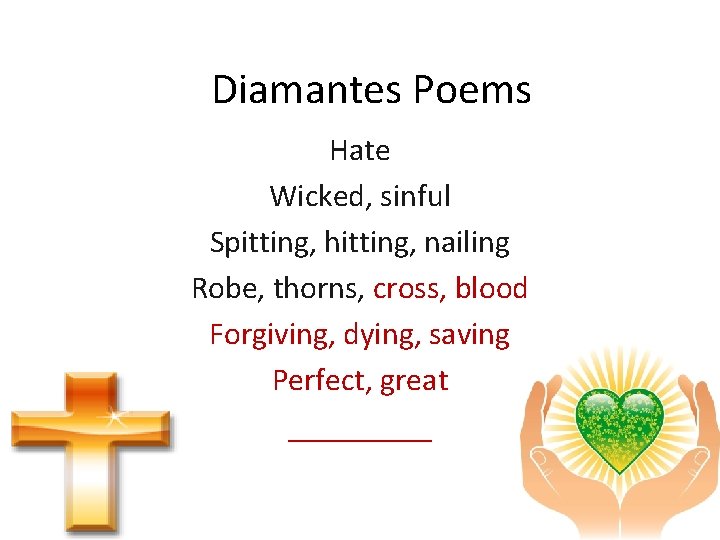
Diamantes Poems Hate Wicked, sinful Spitting, hitting, nailing Robe, thorns, cross, blood Forgiving, dying, saving Perfect, great _____
Diamante Poems Day Bright, sunny Laughing, playing, doing Up in the east, down in the west Talking, resting, sleeping Quiet, dark ______
Diamante Poems Ant busy, tiny crawling, working, carrying crumbs, dirt, mountaintops, talons rising, soaring, crying endangered, watchful ____
Diamante Poems noun adjective, adjective -ing word, -ing word noun, noun -ing word, -ing word adjective, adjective noun
Your turn! Write a Diamanté poem: • Think of two items to contrast: people, transportation, feelings, animals, etc. • Write one item on the first line and your contrasting item on the 7 th line. • Following the specific order (see previous slide), complete the poem. *Be sure you change from one item to the next in the center of the 4 th line.
Prepositional Poetry • Prepositional poetry takes the reader on a journey. • Visualize in your mind where something begins and how you arrive at the end. • Remember prepositions show location and direction. • Most/almost all phrases begin with a preposition. • Today, your poem must be 10 lines.
Christmas Under the roof, Of my house, In the living room, Beneath the Christmas tree, Under wrapping paper, Inside boxes, Are Christmas presents.
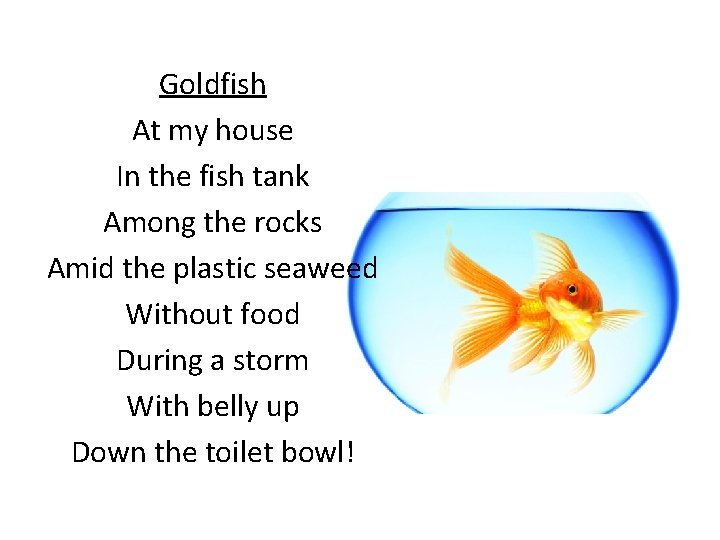
Goldfish At my house In the fish tank Among the rocks Amid the plastic seaweed Without food During a storm With belly up Down the toilet bowl!
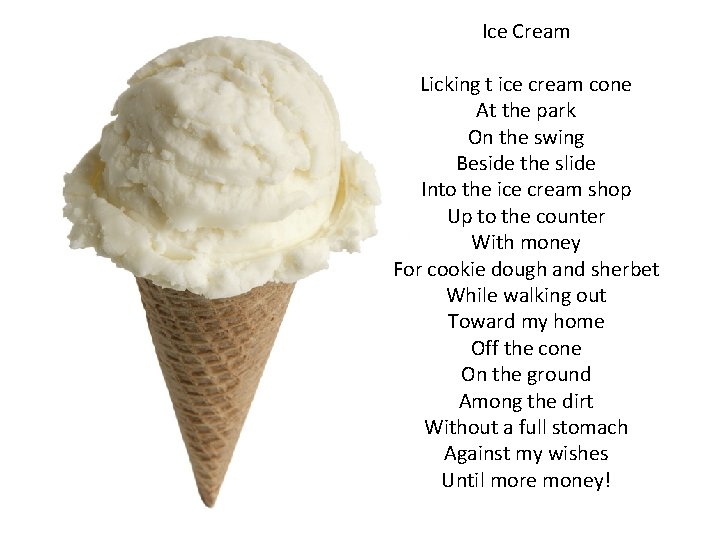
Ice Cream Licking t ice cream cone At the park On the swing Beside the slide Into the ice cream shop Up to the counter With money For cookie dough and sherbet While walking out Toward my home Off the cone On the ground Among the dirt Without a full stomach Against my wishes Until more money!
Shooting Hoops! On the Court around the opponent, down the court, to the top of the key, between the forwards, toward the basket, above my head, near a victory, in the hoop, SWISH!
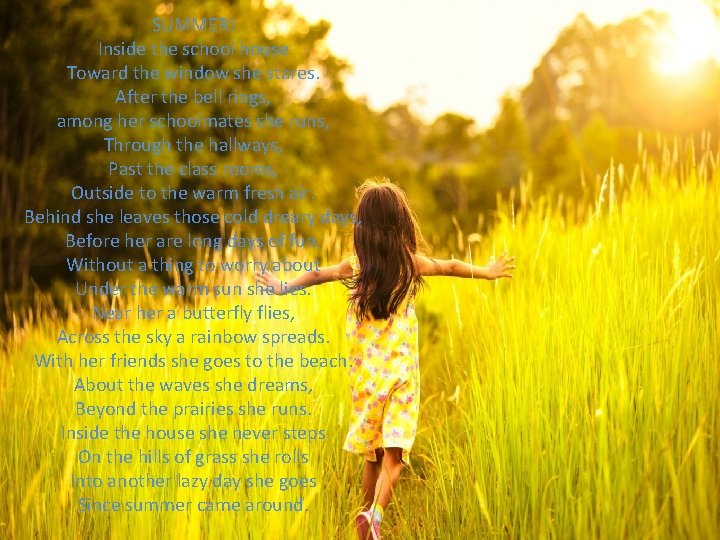
SUMMER! Inside the school house Toward the window she stares. After the bell rings, among her schoolmates she runs, Through the hallways, Past the class rooms, Outside to the warm fresh air. Behind she leaves those cold dreary days, Before her are long days of fun. Without a thing to worry about Under the warm sun she lies. Near her a butterfly flies, Across the sky a rainbow spreads. With her friends she goes to the beach. About the waves she dreams, Beyond the prairies she runs. Inside the house she never steps On the hills of grass she rolls Into another lazy day she goes Since summer came around.
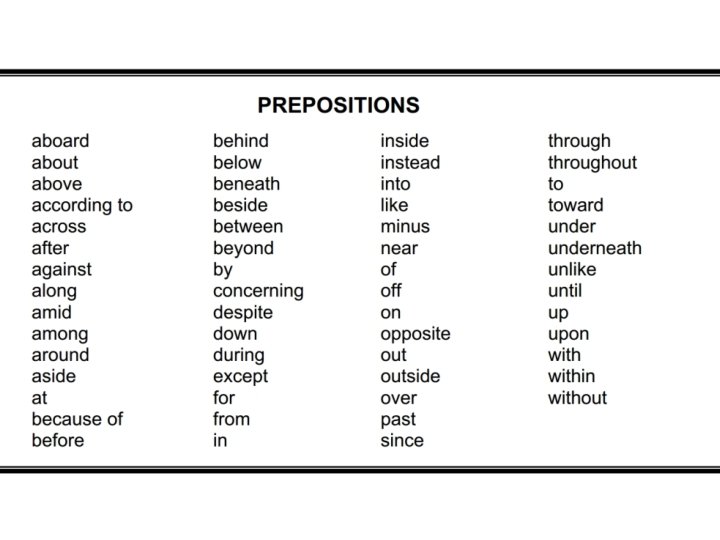
Your turn! Write a Prepositional poem: • Think of a topic: race car, hunting, walking a dog, eating lunch, etc. • Use the list of prepositions provided (see previous slide) • Visualize in your mind where something begins and how you arrive at the end. • Most/almost all phrases begin with a preposition. • Today, your poem must be 10 lines.
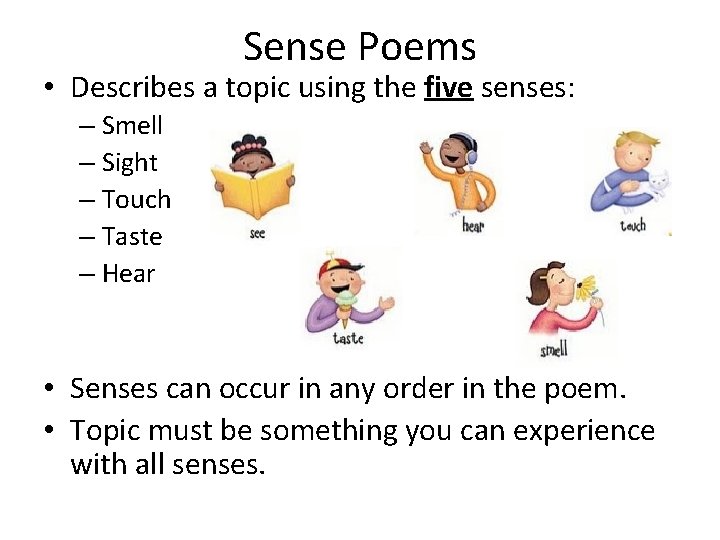
Sense Poems • Describes a topic using the five senses: – Smell – Sight – Touch – Taste – Hear • Senses can occur in any order in the poem. • Topic must be something you can experience with all senses.
Getting Up Sounds like an alarm beeping in my ear Looks like fuzzy pictures, out of focus Feels like getting off a roller coaster ride Smells like Mom’s coffee dripping in her cup Tastes like eggs and bacon in my mouth!
Christmas Looks like lights shining on my neighbor’s house Sounds like carols playing on our kitchen radio Tastes like cinnamon and sugar for baking Smells like gingerbread cookies in the oven Feels like a cozy wool blanket around my shoulders.
Baseball Games Sounds like the crack of a bat at home plate, Tastes like the scrumptious, juicy hot dog on my lips Feels like the warm sun on my skin Smells like stinky, dirty cleats in the locker room, Looks like VICTORY after a home run!!
Happiness Sounds like birds tweeting outside my window, Looks like my family sitting together at the dinner table, Feels like a nice Sunday afternoon nap, Smells like freshly baked cookies from the kitchen, Tastes like yummy chips and salsa on Thursday night!
Your turn! Write a Sense poem: • Think of a topic: swimming, winter, soccer, etc. • List all of your senses: smells like, tastes like, sounds like, feels like, looks like (the order does not matter) • Think of how your topic is experienced with your senses. • Add a prepositional phrase to each line. • • Ex. It feels like a warms fire blazing. (nope) Ex. It feels like a warms fire blazing in the fire place. (YES!)
Color Poems • Very similar to sense poems. • Uses all five senses to describe the color of something. • Give accurate words and explanations to describe the color. • Use figurative language!
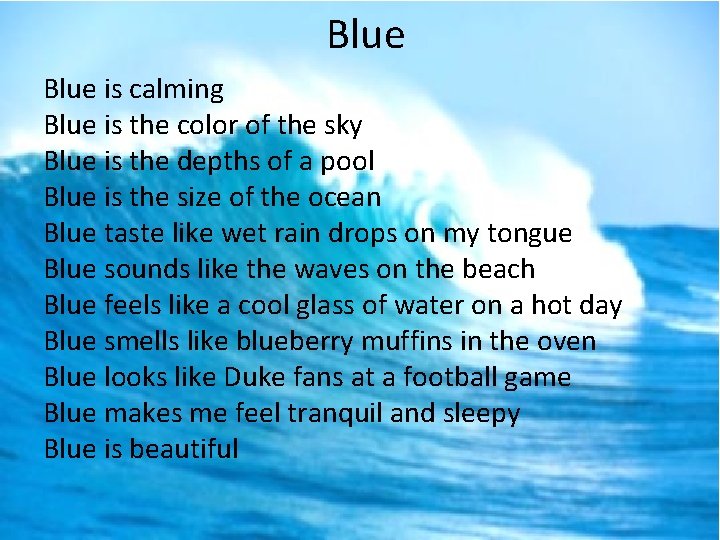
Blue is calming Blue is the color of the sky Blue is the depths of a pool Blue is the size of the ocean Blue taste like wet rain drops on my tongue Blue sounds like the waves on the beach Blue feels like a cool glass of water on a hot day Blue smells like blueberry muffins in the oven Blue looks like Duke fans at a football game Blue makes me feel tranquil and sleepy Blue is beautiful
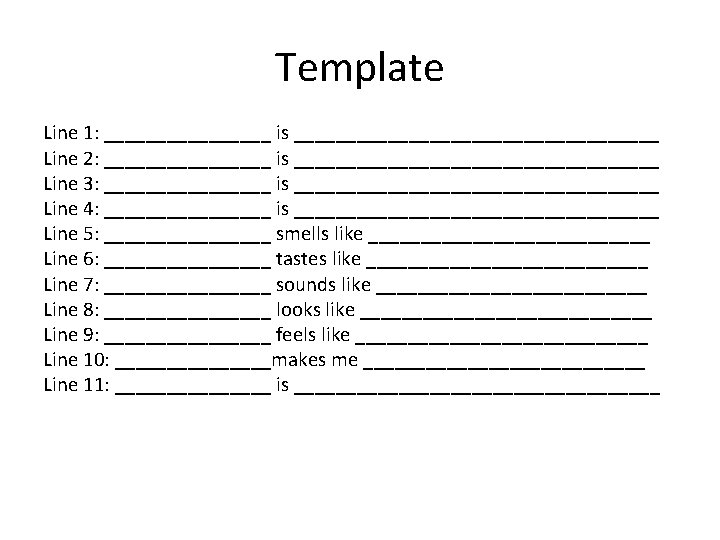
Your turn! Write a Color poem: • Pick a color: pink, red, yellow, black, etc. • Follow the template on the previous slide • Think of how your color is experienced with your senses. • Add a prepositional phrase to each line. • Ex. Red sounds like a fire engine. (Nope) • Ex. Red sounds like a fire engine racing down the street. (YES!)
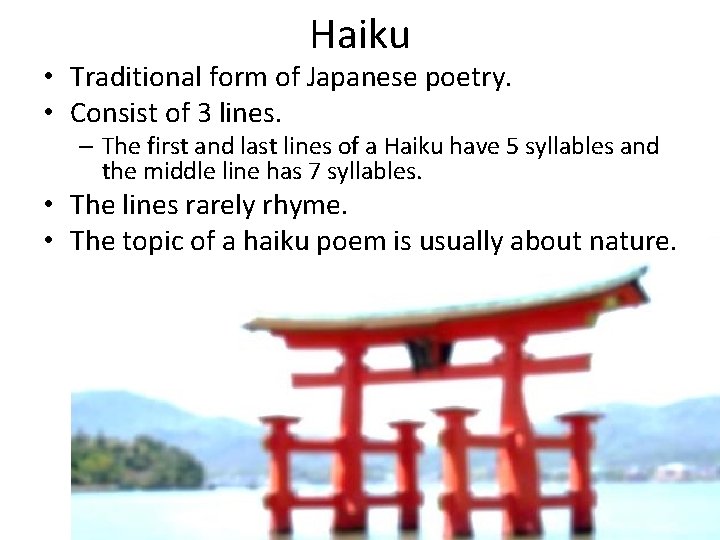
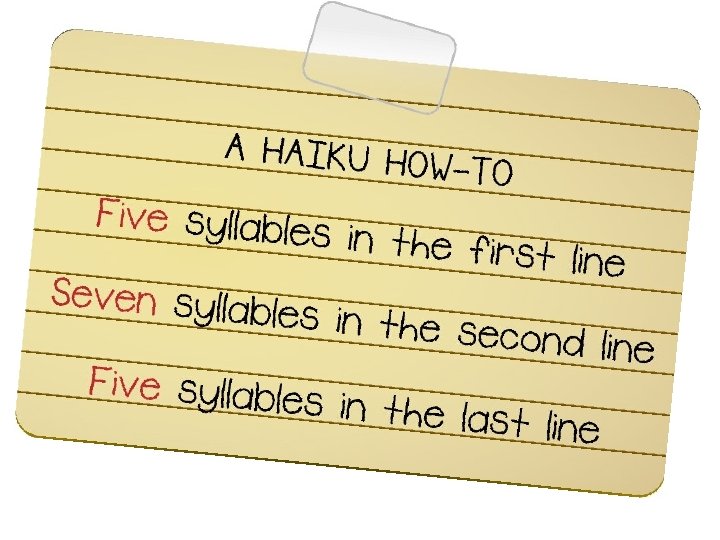
Haiku • Traditional form of Japanese poetry. • Consist of 3 lines. – The first and last lines of a Haiku have 5 syllables and the middle line has 7 syllables. • The lines rarely rhyme. • The topic of a haiku poem is usually about nature.
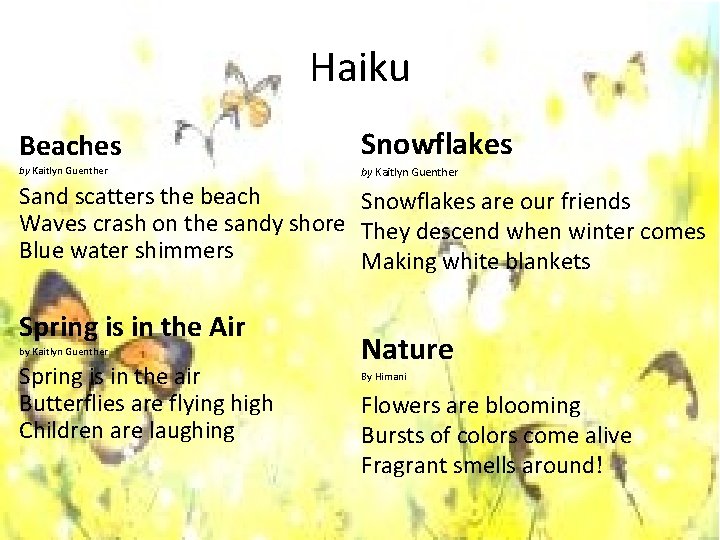
Haiku Beaches Snowflakes by Kaitlyn Guenther Sand scatters the beach Snowflakes are our friends Waves crash on the sandy shore They descend when winter comes Blue water shimmers Making white blankets Spring is in the Air by Kaitlyn Guenther Spring is in the air Butterflies are flying high Children are laughing Nature By Himani Flowers are blooming Bursts of colors come alive Fragrant smells around!
Your turn! Write a Haiku poem: • Pick a topic from nature: wind, season, beetle, butterfly, rainforest, etc. • Follow the template on the previous slide. -5 syllables, 7 syllables, 5 syllables • Don’t repeat the same words.
Bio Poems A bio poem is about yourself and your life. What are your dreams? What do you like? What are you scared of? What do you value? Etc… It’s all about you!
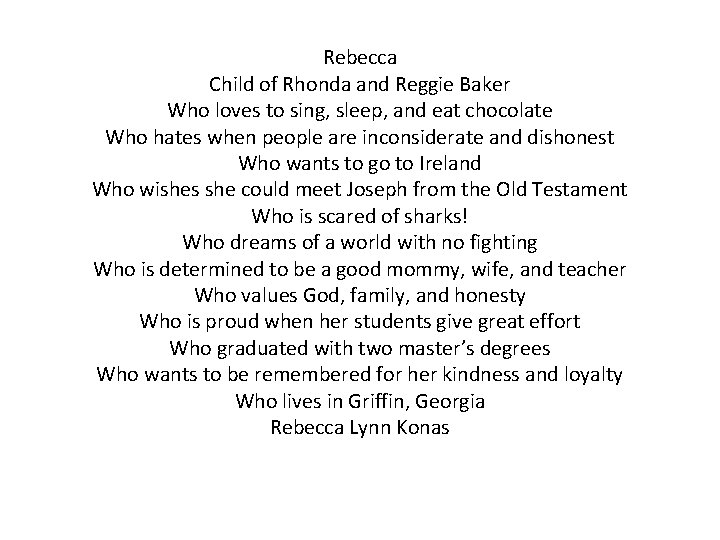
Rebecca Child of Rhonda and Reggie Baker Who loves to sing, sleep, and eat chocolate Who hates when people are inconsiderate and dishonest Who wants to go to Ireland Who wishes she could meet Joseph from the Old Testament Who is scared of sharks! Who dreams of a world with no fighting Who is determined to be a good mommy, wife, and teacher Who values God, family, and honesty Who is proud when her students give great effort Who graduated with two master’s degrees Who wants to be remembered for her kindness and loyalty Who lives in Griffin, Georgia Rebecca Lynn Konas
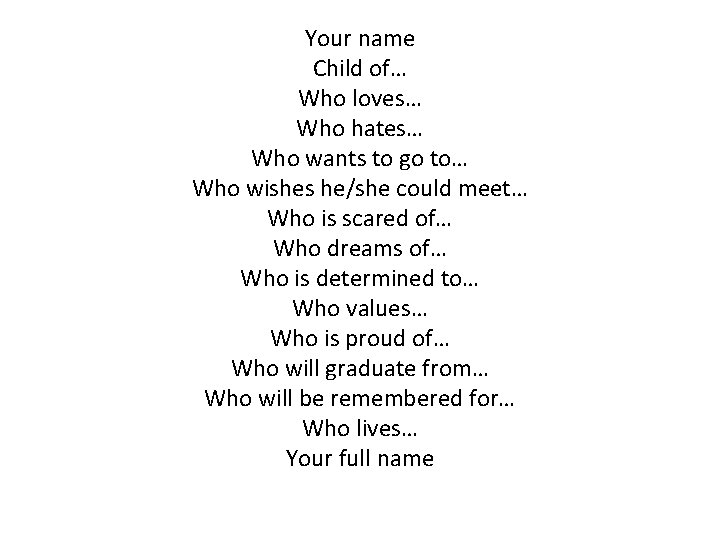
Your name Child of… Who loves… Who hates… Who wants to go to… Who wishes he/she could meet… Who is scared of… Who dreams of… Who is determined to… Who values… Who is proud of… Who will graduate from… Who will be remembered for… Who lives… Your full name
Write a Bio poem: • Follow the template on the previous slide. Easy as pie! Your turn!