
POETRY ANALYSIS LEARNING OBJECTIVES Explain who Banjo Patterson

POETRY ANALYSIS
LEARNING OBJECTIVES Explain who Banjo Patterson and Henry Lawson were.
THE ASSESSMENT Written Response 10% Ballads by Patterson and Lawson were published in newspapers and magazines. These ballads were recited after dinner around the kitchen table, in the parlour and around the campfire. With reference to two or more ballads discuss why you think these ballads became part of the popular culture of the day? (Hint: why were they entertaining? )
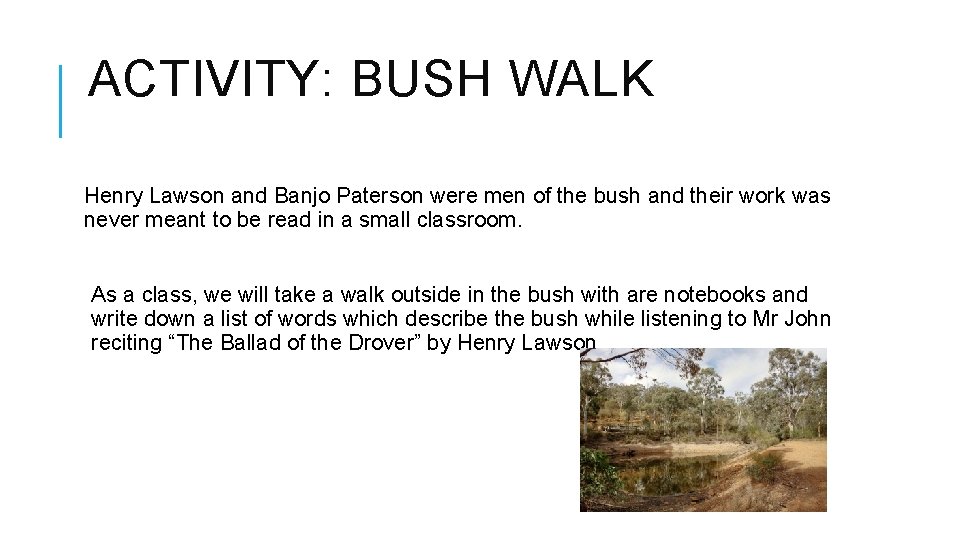
ACTIVITY: BUSH WALK Henry Lawson and Banjo Paterson were men of the bush and their work was never meant to be read in a small classroom. As a class, we will take a walk outside in the bush with are notebooks and write down a list of words which describe the bush while listening to Mr John reciting “The Ballad of the Drover” by Henry Lawson.
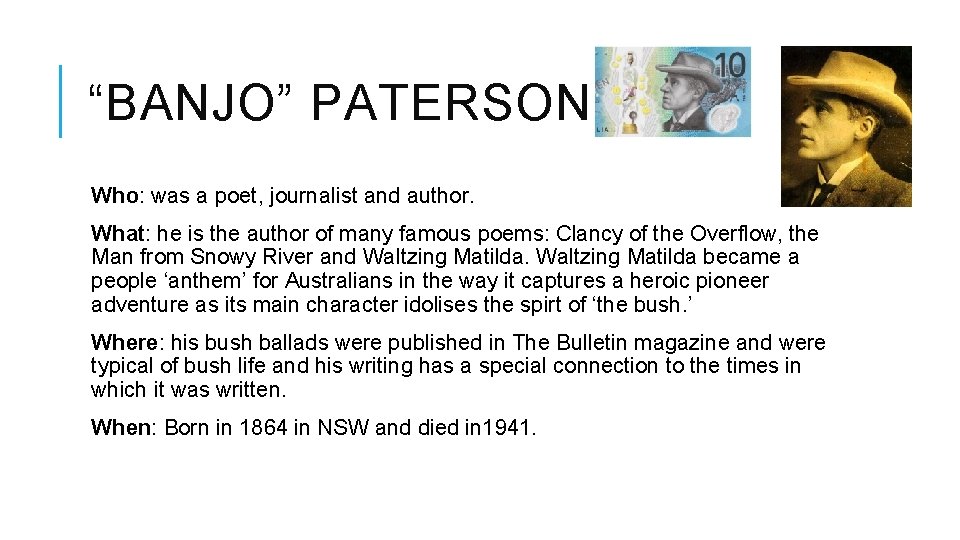
“BANJO” PATERSON Who: was a poet, journalist and author. What: he is the author of many famous poems: Clancy of the Overflow, the Man from Snowy River and Waltzing Matilda became a people ‘anthem’ for Australians in the way it captures a heroic pioneer adventure as its main character idolises the spirt of ‘the bush. ’ Where: his bush ballads were published in The Bulletin magazine and were typical of bush life and his writing has a special connection to the times in which it was written. When: Born in 1864 in NSW and died in 1941.
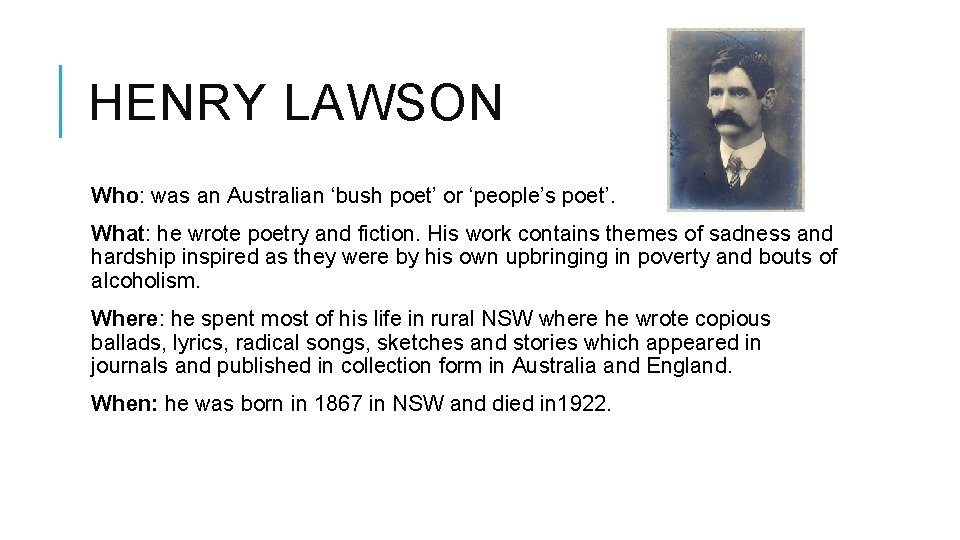
HENRY LAWSON Who: was an Australian ‘bush poet’ or ‘people’s poet’. What: he wrote poetry and fiction. His work contains themes of sadness and hardship inspired as they were by his own upbringing in poverty and bouts of alcoholism. Where: he spent most of his life in rural NSW where he wrote copious ballads, lyrics, radical songs, sketches and stories which appeared in journals and published in collection form in Australia and England. When: he was born in 1867 in NSW and died in 1922.
HENRY LAWSON “The Man from Ironbark” https: //www. youtube. com/watch? v=QNqa. Jbp 2 l-g
TIMELINE ACTIVITY I know this is not history class, however, it might be useful to map out a timeline of events that were happening in Australia in the 1800 s to early 1900 s to better understand the poetry we are about to study. Place these events and any other events in a timeline in your notebooks: 1854 – Eureka Stockade 1851 -1860 s – The Victorian Gold Rush 1868 – Last convicts from Britain delivered to Australia 1880 – Ned Kelly hanged 1880 – The Bulletin First Published 1890 – Banjo Paterson Published “The Man from Snowy River” 1894 – Jandamarra a Bunuba man from the Kimberley starts a Guerrilla War 1899 -1902 – The Boer War 1901 – Australian Federation 1914 -1918 – World War 1
LEARNING OBJECTIVE Write notes on the poetry acronym SMILE and apply it by analysing The Old Bark School poem.
THE SMILES METHOD S structure how is the poem organised? How many stanzas or verses are there? What is the rhyming scheme? Ie ABAB (each rhyming set is named by a consecutive letter) How do the ideas progress? What is the line length in syllables? Is there repetition of words and or phrases
THE SMILES METHOD M meaning look at the title – what does it suggest the poem means? Is there an overall theme? What is the main subject? Does it have a message?
THE SMILES METHOD I imagery what visual picture do you think of when reading it? Describe the imagery used eg: metaphor, simile, personification, symbolism.
The Old Bark School 21/02/2018 LO – Finish writing notes on the poetry acronym SMILE and apply it by analysing The Old Bark School poem.
THE SMILES METHOD L language what words are used – are they simple or complex? Serious or ironic? Is it lyrical and flowing? Colloquial/slang or proper English? Are there any interesting grammatical features or punctuation?
THE SMILES METHOD E effect what opinion is presented by the author/narrator? Is there a particular tone used? What do you feel when you read it, what is your response?
THE SMILES METHOD S sound what sounds are evident – onomatopoeia, alliteration, consonance or assonance
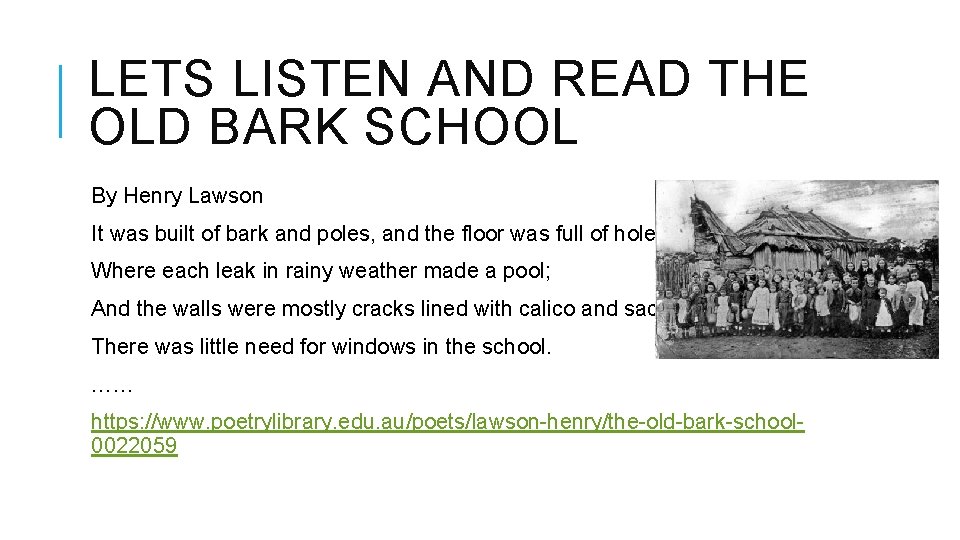
LETS LISTEN AND READ THE OLD BARK SCHOOL By Henry Lawson It was built of bark and poles, and the floor was full of holes Where each leak in rainy weather made a pool; And the walls were mostly cracks lined with calico and sacks — There was little need for windows in the school. …… https: //www. poetrylibrary. edu. au/poets/lawson-henry/the-old-bark-school 0022059
LETS APPLY THE SMILES METHOD S M I L E S
STRUCTURE The Old Bark School is ABCB with consecutive stanzas progressing in the alphabet in the format DEFE GHIH etc. It has eleven verses and progresses from depicting the bark school hut to the horse which transported the kids to school in the first three stanzas. Then follows the details of schooling including the master, including his attitude to ‘blackfellas’ the last three verses return to the bark school and the horses with a summary stanza that sums up the narrator’s view of ‘eddication’
MEANING The narrator tells the story of Jim Bullock’s ‘eddication’ through the eyes of another school mate. The message appears to contrast the intentioned aims of formal schooling with the life skills and education a man receives on the land.
IMAGERY The visual picture the reader gets is from simple adjectives such as ‘rugged gully-track’, ‘ancient dingy maps’ and phrases which matter of factly state the rough conditions ‘ the floor was full of holes’ ‘walls were mostly cracks’ ‘carried three or four’
LANGUAGE The language used is conversational and informal with dialogue interspersed without.
EFFECT The reader is left with a sense of nostalgia for a simple school and home life that revolves around family and the bush.
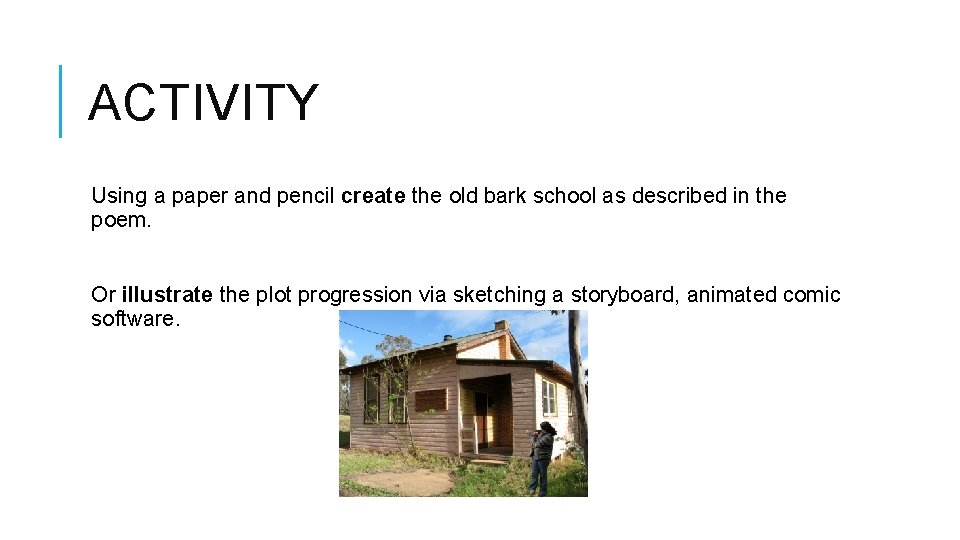
ACTIVITY Using a paper and pencil create the old bark school as described in the poem. Or illustrate the plot progression via sketching a storyboard, animated comic software.
‘A Bush Christening’ 21/02/2018 LO – Analyse ‘A Bush Christening’ using the SMILE acronym
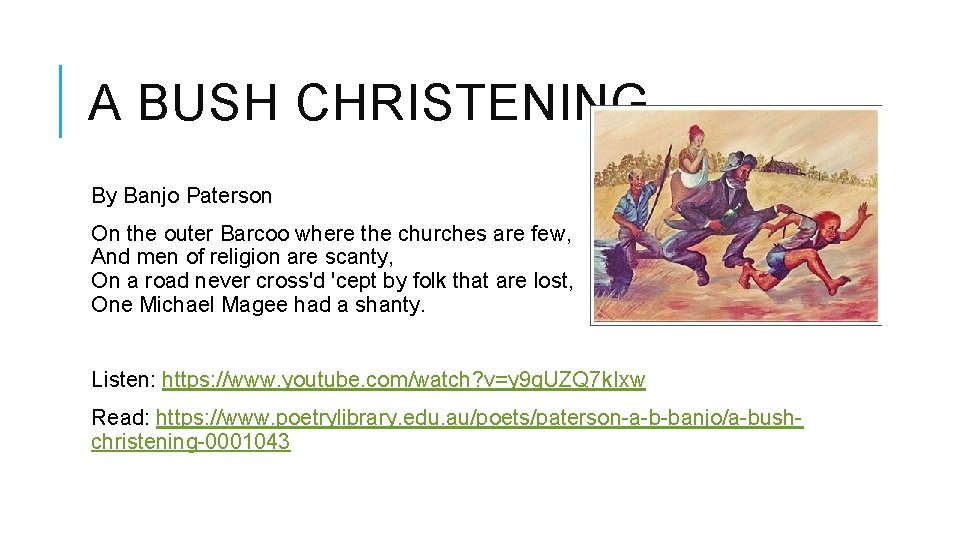
A BUSH CHRISTENING By Banjo Paterson On the outer Barcoo where the churches are few, And men of religion are scanty, On a road never cross'd 'cept by folk that are lost, One Michael Magee had a shanty. Listen: https: //www. youtube. com/watch? v=y 9 g. UZQ 7 k. Ixw Read: https: //www. poetrylibrary. edu. au/poets/paterson-a-b-banjo/a-bushchristening-0001043
STRUCTURE ‘ A bush christening’ is structured using ABCB rhyme scheme wherein the second and last line of each stanza rhymes. The accent is , indicated above the words by in twelve verses. The plot line. The first verse begins with the setting followed by two verses describing the wife’s concern over their son. The reverend arrives and the son overhears the plan to be christened – his thinking and words provide a humorous verse four five and six. The action occurs next as the boy hides in a log and the family and reverend try to capture him. The highlight when he is caught and baptised by a flask of whisky occurs in ten and eleven. The summary concludes with the impact this event had on an adult maginnis.
MEANING The poem is a straightforward story about bush hardships and isolation featuring a boy who is christened in amusing circumstances. The main subject is the lad ‘maginnis’ and the family members along with the reverend who conspire to ‘brand’ him as a Christian.
IMAGERY The visual picture is an outback bush setting early 1800 s in Australia. The rough conditions are presented through similes such as ‘like a young native dog’ and metaphor ‘howling cub’. Simple symbolism such as maginnis whisky to represent the iconic drunk priest and branding of colts to highlight the rite of passage that is ceremony in church tradition creates more visual features
LANGUAGE The tone is satirical the language is colloquial early Australian English such as ‘wid’ ‘brogue’ ‘collogue’. Phrases are used to highlight the eccentricities of the situation with the satirical ‘ n a road never cross d cept by folk that are lost’ (isolated) and ‘And his wife used to cry, "If the darlin' should die Saint Peter would not recognise him. "( religion). The plot twists contain events which progress quickly to a pivotal moment in the log wherein the lad is poked and escapes to be hit by a flask. The dialogue between the parents and reverend ‘ give the spalpeen a prog’ is entertaining satire directed at the function of church in the outback. The ineptitude of the reverend as he forgets the name of the lad creates an amusing anecdote that nevertheless stays with ‘maginnis’ all his life. The reader is left with a taste of outback life in colonial times in which hardship, stupidity and difficulties are presented with humor.
SOUND There were no sound effects in this poem.
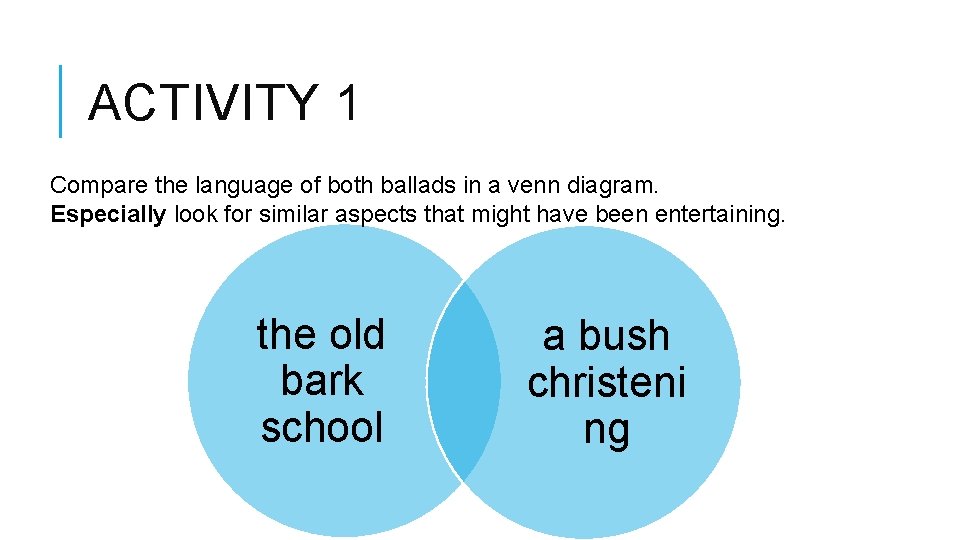
ACTIVITY 1 Compare the language of both ballads in a venn diagram. Especially look for similar aspects that might have been entertaining. the old bark school a bush christeni ng
Paragraphs and Punctuation 21/02/2018 LO – Learn how to write an awesome paragraph
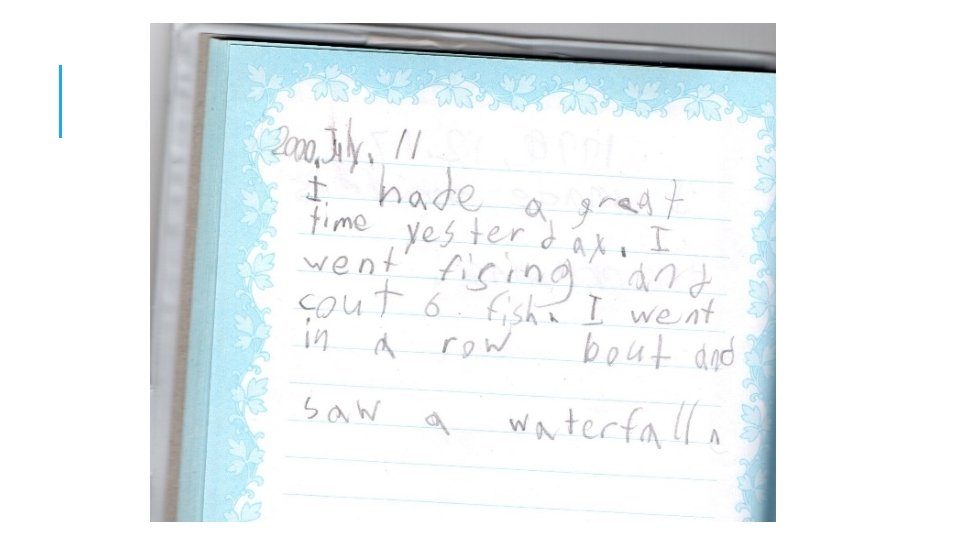
COMPLETE SENTENCES A complete sentence has a subject and a verb. EXAMPLE: John ran. Subject verb.
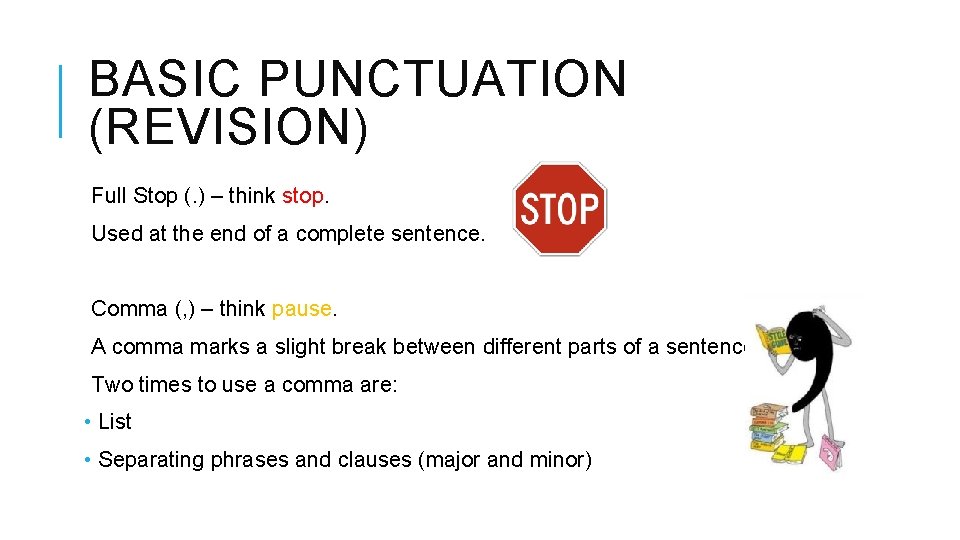
BASIC PUNCTUATION (REVISION) Full Stop (. ) – think stop. Used at the end of a complete sentence. Comma (, ) – think pause. A comma marks a slight break between different parts of a sentence. Two times to use a comma are: • List • Separating phrases and clauses (major and minor)
CAPITALIZATION RULES Rule 1. Capitalize the first word of a document and the first work after a full stop. Rule 2. Capitalize proper nouns—and adjectives derived from proper nouns. Examples include: • the Golden Gate Bridge • the Grand Canyon • a Russian song • a Shakespearean sonnet HINT: in short if in doubt don’t use them.
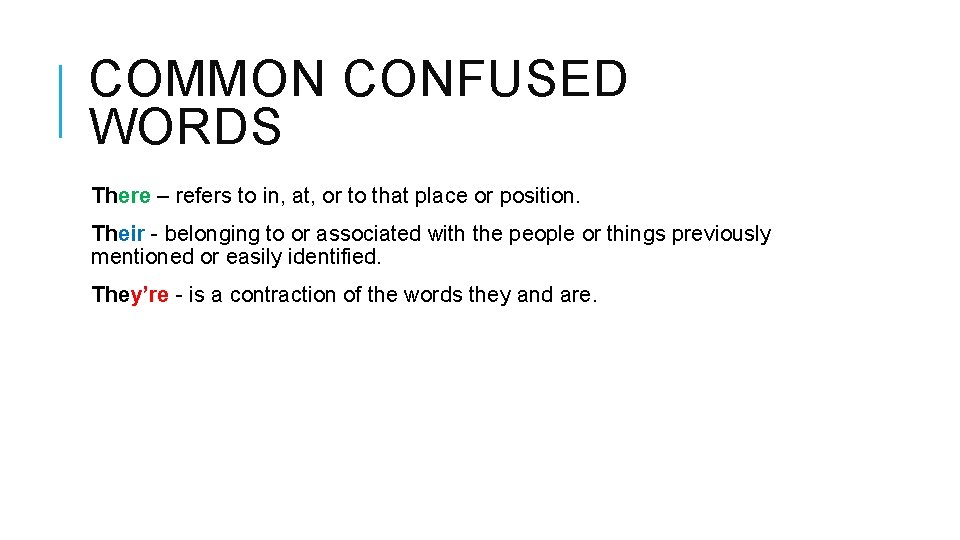
COMMON CONFUSED WORDS There – refers to in, at, or to that place or position. Their - belonging to or associated with the people or things previously mentioned or easily identified. They’re - is a contraction of the words they and are.
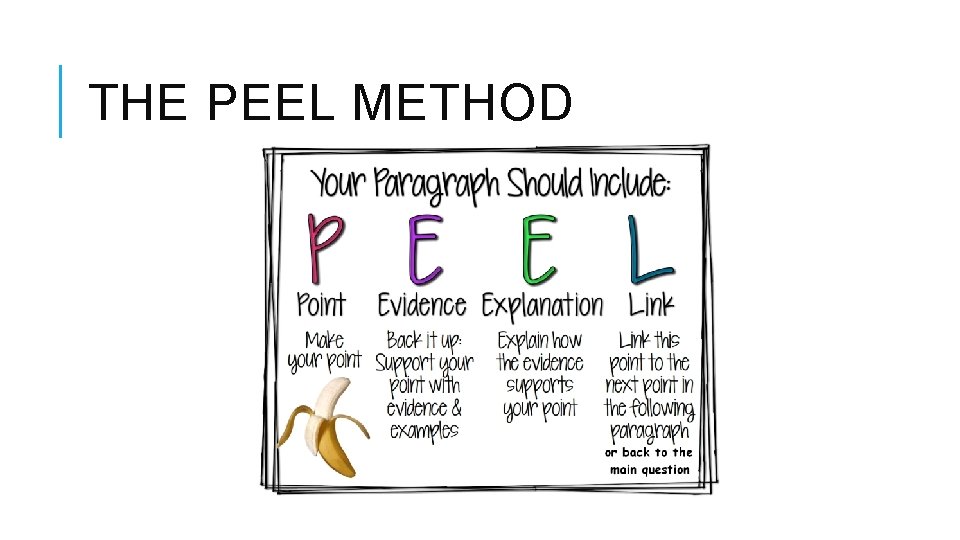
THE PEEL METHOD

LETS TRY IT OUT
- Slides: 40