
POETRY A medium for creative expression POINT OF


- Slides: 30
POETRY ~A medium for creative expression~
POINT OF VIEW IN POETRY POET SPEAKER • The poet is the author of the poem. • The speaker of the poem is the “narrator” of the poem.
POETRY FORM • FORM - the appearance of the words on the page • LINE - a group of words together on one line of the poem • STANZA - a group of lines arranged together A word is dead When it is said, Some say. I say it just Begins to live That day.
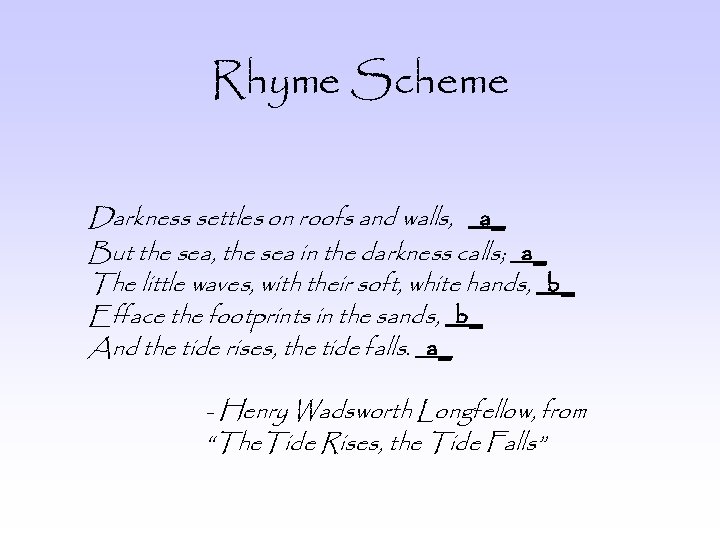
Rhyme Scheme • Rhymes at the end of lines of poetry • To indicate the rhyme scheme of a poem, use a separate letter of the alphabet for each rhyme
Rhyme Scheme Darkness settles on roofs and walls, a_ But the sea, the sea in the darkness calls; a_ The little waves, with their soft, white hands, b_ Efface the footprints in the sands, b_ And the tide rises, the tide falls. a_ - Henry Wadsworth Longfellow, from “The. Tide Rises, the Tide Falls”
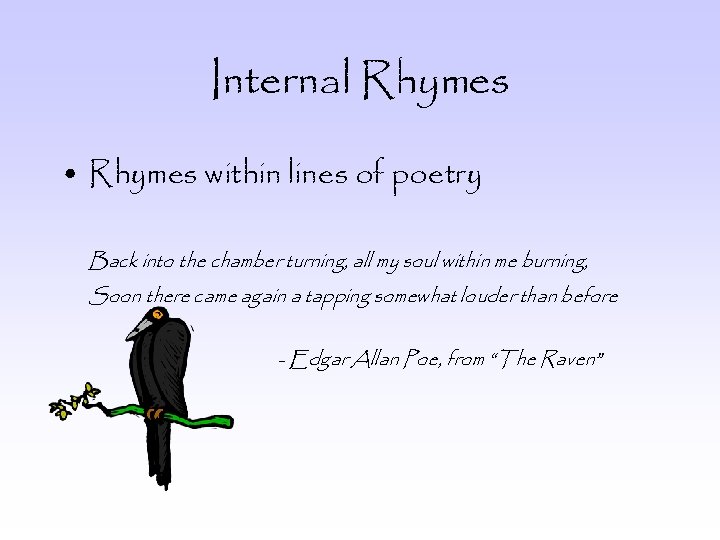
Internal Rhymes • Rhymes within lines of poetry Back into the chamber turning, all my soul within me burning, Soon there came again a tapping somewhat louder than before - Edgar Allan Poe, from “The Raven”
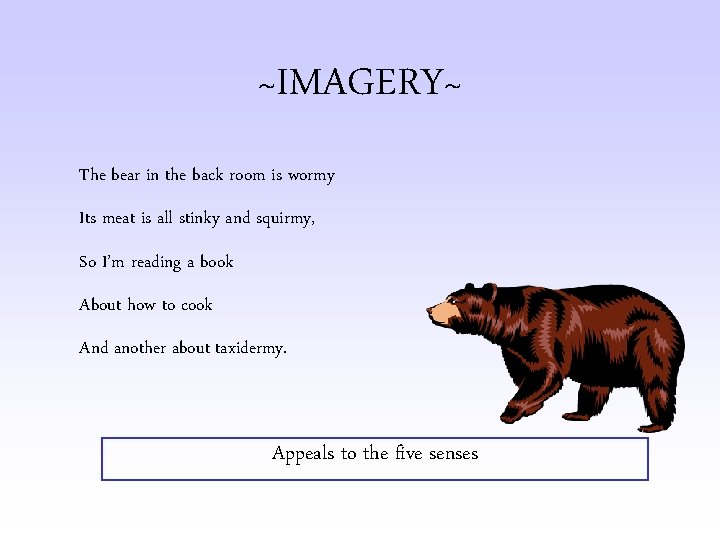
~IMAGERY~ The bear in the back room is wormy Its meat is all stinky and squirmy, So I’m reading a book About how to cook And another about taxidermy. Appeals to the five senses
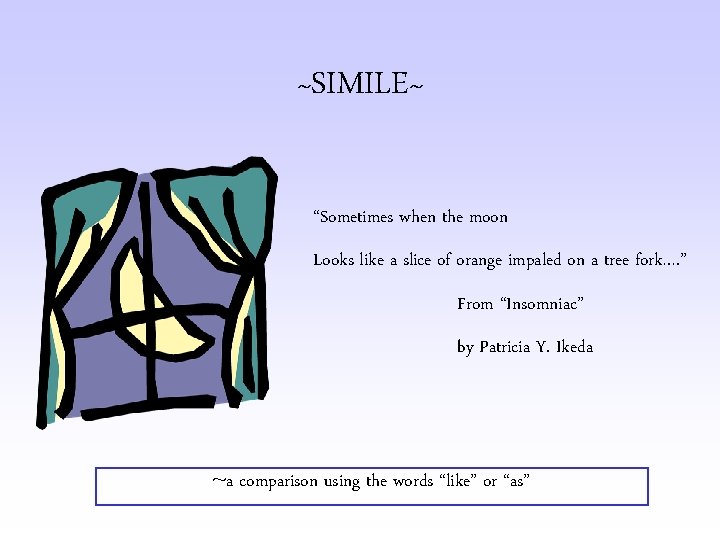
~SIMILE~ “Sometimes when the moon Looks like a slice of orange impaled on a tree fork…. ” From “Insomniac” by Patricia Y. Ikeda ~a comparison using the words “like” or “as”
“It seems to me You’ve lived your life Like a candle in the wind” Elton John
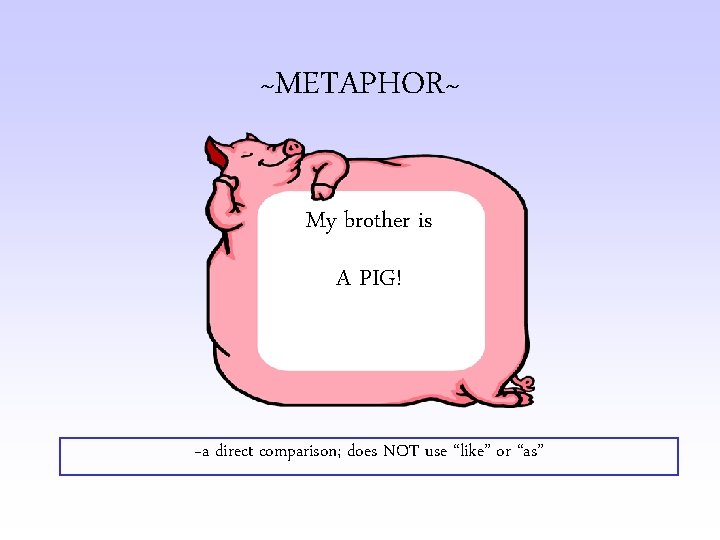
~METAPHOR~ My brother is A PIG! ~a direct comparison; does NOT use “like” or “as”
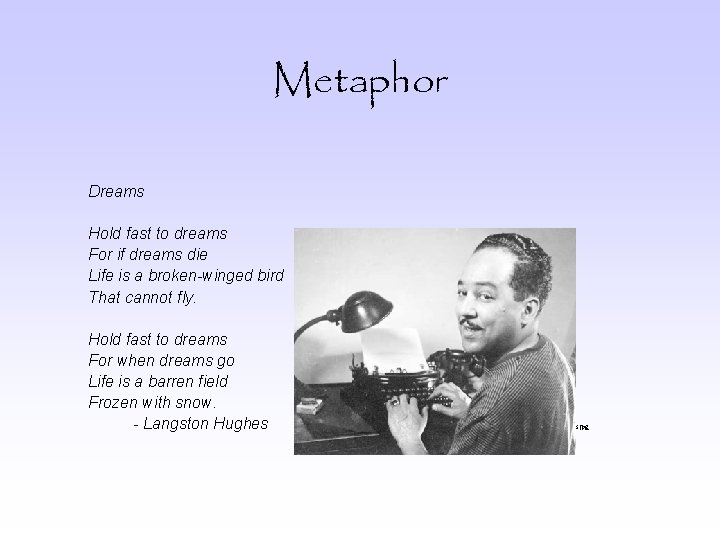
Metaphor Dreams Hold fast to dreams For if dreams die Life is a broken-winged bird That cannot fly. Hold fast to dreams For when dreams go Life is a barren field Frozen with snow. - Langston Hughes Image from http: //goinglocoinyokohama. files. wordpress. com/2009/06/hughes. jpg
~PERSONIFICATION~ “…And Spring herself, when she woke at dawn, Would scarcely know that we were gone” Sara Teasdale ~giving human qualities to inhuman things or objects
The fog comes on little cat feet It sits looking over harbor and city on silent haunches and then moves on. Carl Sandburg
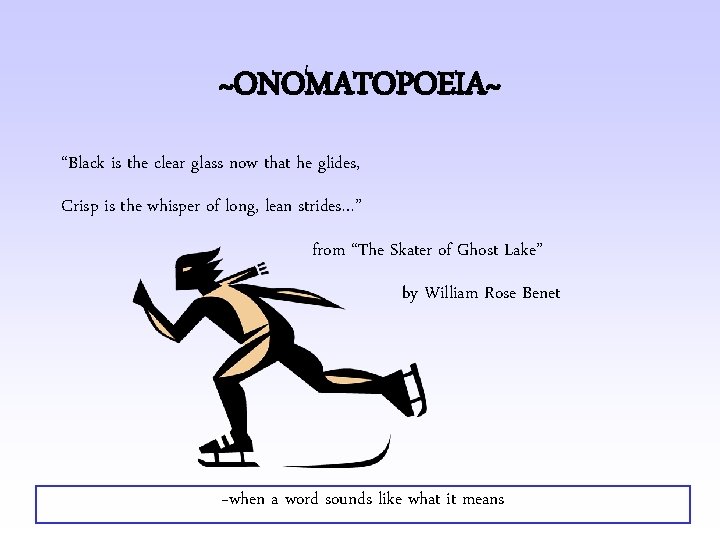
~ONOMATOPOEIA~ “Black is the clear glass now that he glides, Crisp is the whisper of long, lean strides…” from “The Skater of Ghost Lake” by William Rose Benet ~when a word sounds like what it means
Onomatopoeia • In “The Bells”, by Edgar Allan Poe, he creates a frenzied mood by choosing words that imitate the sounds of alarm bells 5 10 Oh, the bells, bells! What a tale their terror tells Of Despair! How they clang, and clash, and roar! What a horror they outpour On the bosom of the palpitating air! Yet the ear, it fully knows By the twanging And the clanging How the danger ebbs and flows.
ONOMATOPOEIA • Cafeteria Boom! Went the food trays. Clap! Goes the teacher. Rip! Went the plastic bag. Munch! Go the students. Slurp!!! Went the straws. Whisper Is what half the kids in the room are doing. Crunch! Go the candy bars. • By: Rachael
ALLITERATION • Consonant sounds repeated at the beginnings of words If Peter Piper picked a peck of pickled peppers, how many pickled peppers did Peter Piper pick?
ASSONANCE • Repeated VOWEL sounds in a line or lines of poetry. Lake Fate Base Fade
“Slow the low gradual moan came in the snowing. ” - John Masefield “Shall ever medicine thee to that sweet sleep. ” - William Shakespeare
HAIKU A Japanese poem written in three lines Five Syllables Seven Syllables Five Syllables An old silent pond. . . A frog jumps into the pond. Splash! Silence again.
Hyperbole • An over exaggeration
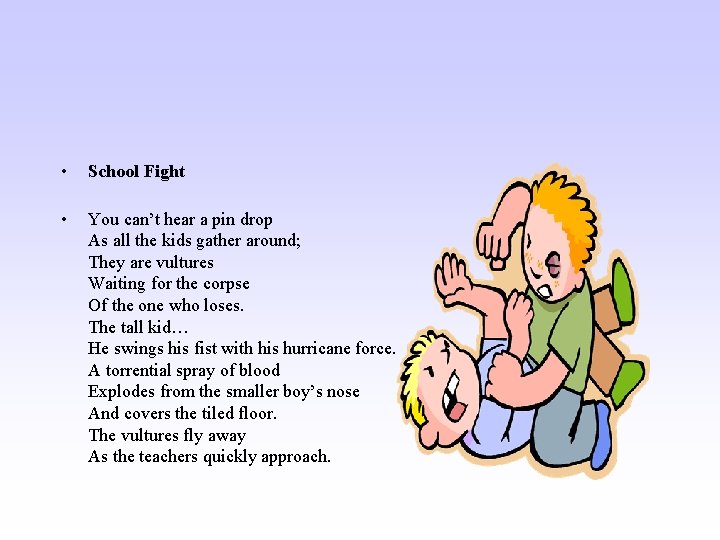
• School Fight • You can’t hear a pin drop As all the kids gather around; They are vultures Waiting for the corpse Of the one who loses. The tall kid… He swings his fist with his hurricane force. A torrential spray of blood Explodes from the smaller boy’s nose And covers the tiled floor. The vultures fly away As the teachers quickly approach.
Slant Rhyme • Rhymes involving sounds that are similar but not exactly the same milly befriended a stranded star whose rays five languid fingers were - E. E. Cummings, from “maggie and milly and molly and may”
Hope is the thing with feathers That perches in the soul, And sings the tune--without the words, And never stops at all,
Meter v. A regular pattern of stressed and unstressed syllables – Free verse does not have a regular pattern of stressed and unstressed syllables – Sounds like ordinary speech v When poets write in meter, they count out the number of stressed syllables (or strong beats) and unstressed syllables (weaker beats) in each line v They then repeat the pattern throughout v To avoid singsong effect, poets usually vary the basic pattern
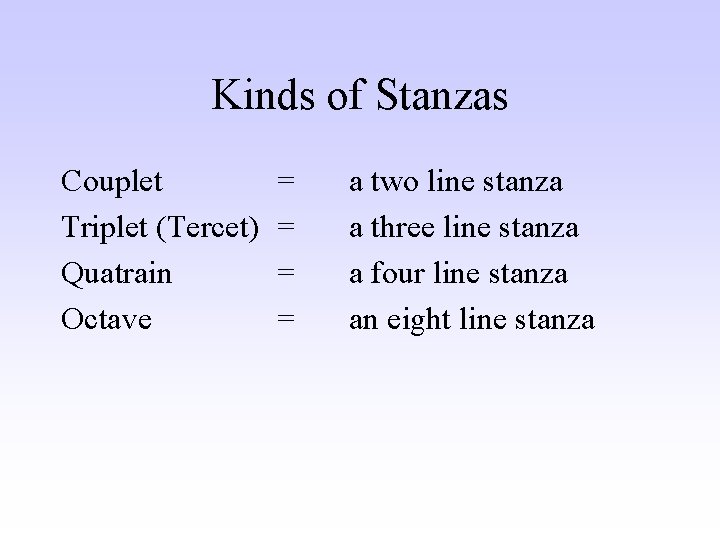
Kinds of Stanzas Couplet Triplet (Tercet) Quatrain Octave = = a two line stanza a three line stanza a four line stanza an eight line stanza
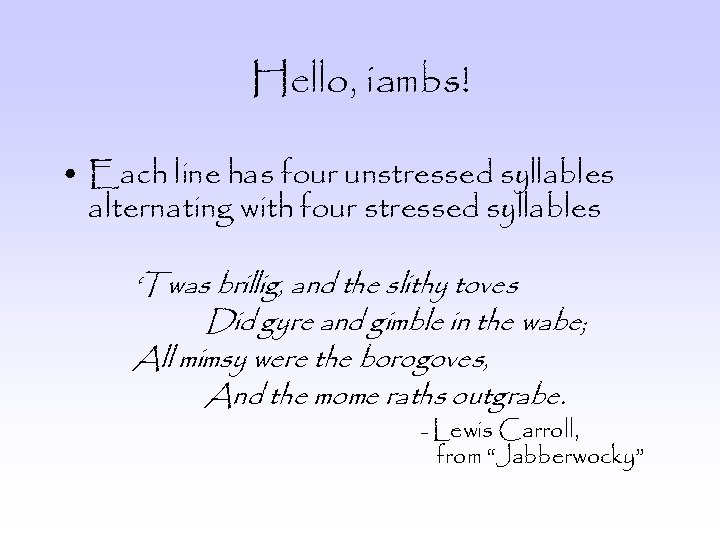
Hello, iambs! • Each line has four unstressed syllables alternating with four stressed syllables ‘Twas brillig, and the slithy toves Did gyre and gimble in the wabe; All mimsy were the borogoves, And the mome raths outgrabe. - Lewis Carroll, from “Jabberwocky”
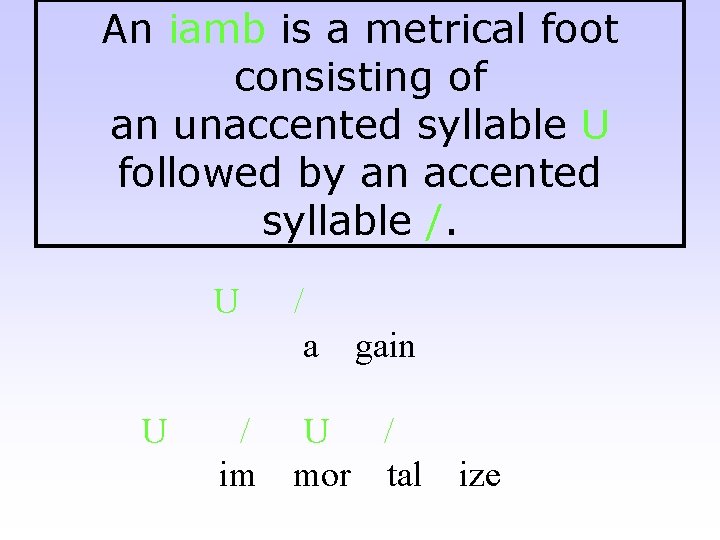
An iamb is a metrical foot consisting of an unaccented syllable U followed by an accented syllable /. U U / im / a gain U / mor tal ize
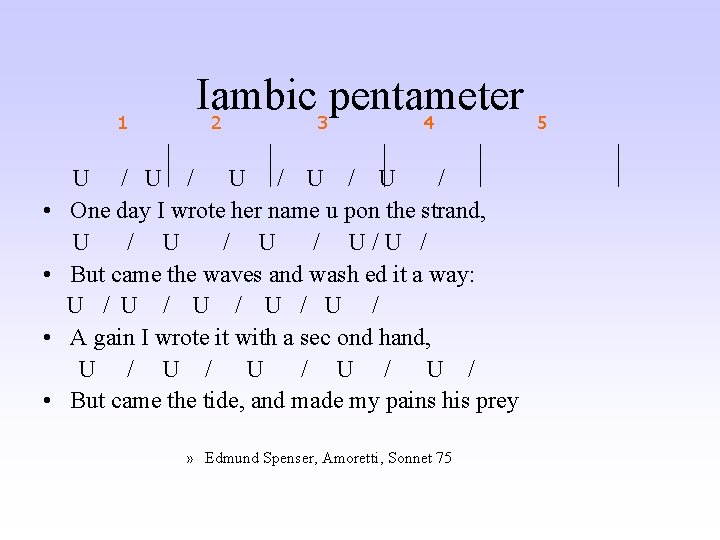
1 • • Iambic pentameter 2 3 4 5 U / U / U / One day I wrote her name u pon the strand, U / U / U/U / But came the waves and wash ed it a way: U / U / U / A gain I wrote it with a sec ond hand, U / U / U / But came the tide, and made my pains his prey » Edmund Spenser, Amoretti, Sonnet 75
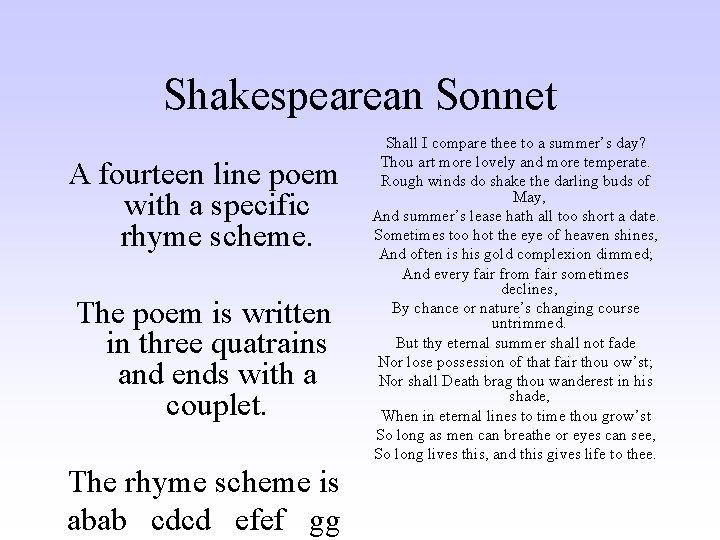
Shakespearean Sonnet A fourteen line poem with a specific rhyme scheme. The poem is written in three quatrains and ends with a couplet. The rhyme scheme is abab cdcd efef gg Shall I compare thee to a summer’s day? Thou art more lovely and more temperate. Rough winds do shake the darling buds of May, And summer’s lease hath all too short a date. Sometimes too hot the eye of heaven shines, And often is his gold complexion dimmed; And every fair from fair sometimes declines, By chance or nature’s changing course untrimmed. But thy eternal summer shall not fade Nor lose possession of that fair thou ow’st; Nor shall Death brag thou wanderest in his shade, When in eternal lines to time thou grow’st So long as men can breathe or eyes can see, So long lives this, and this gives life to thee.